
Japan LTPS LCD Module In Automotive Market Size and Share
Market Overview
| Study Period | 2021 - 2032 |
|---|---|
| Forecast Data Period | 2027 - 2032 |
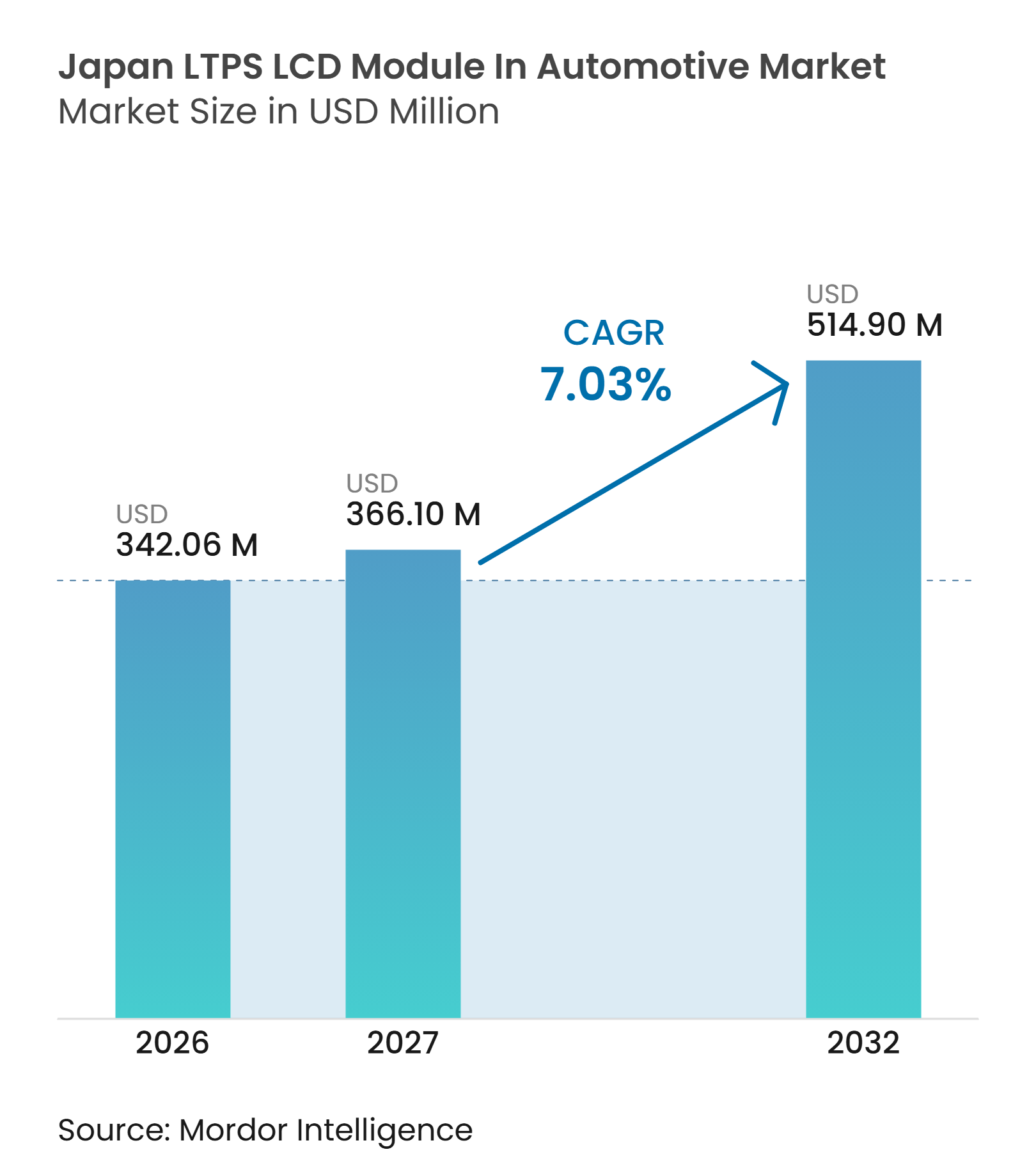
| Base Year Market Size (2026) | USD 342.06 Million |
| Market Size (2027) | USD 366.10 Million |
| Market Size (2032) | USD 514.90 Million |
| Growth Rate (2027 - 2032) | 7.03 % |
| Market Concentration | Medium |
Major Players *Disclaimer: Major Players sorted in no particular order Image © Mordor Intelligence. Reuse requires attribution under CC BY 4.0. | |
Japan LTPS LCD Module In Automotive Market Analysis by Mordor Intelligence
The Japan LTPS LCD module (LCM) in automotive market size is expected to increase from USD 342.06 million in 2026 to USD 514.90 million by 2032, expanding at a CAGR of 7.03% over 2027-2032. The market is being shaped by vehicle cockpits that use more screens and require higher resolution with controlled power use. Japanese automakers are linking display hardware more closely to connected vehicle functions and software updates, which favors panels that can support detailed graphics over a vehicle life cycle. Larger center displays and integrated panoramic layouts raise the value of display content installed in each vehicle. The Japan LTPS LCD module (LCM) in automotive market also faces a changing domestic supply base as Japan Display Inc. restructures its operations while Sharp expands its automotive display activities. These shifts may increase the importance of supplier qualification, production continuity, and long-term pricing in procurement decisions.
Key Report Takeaways
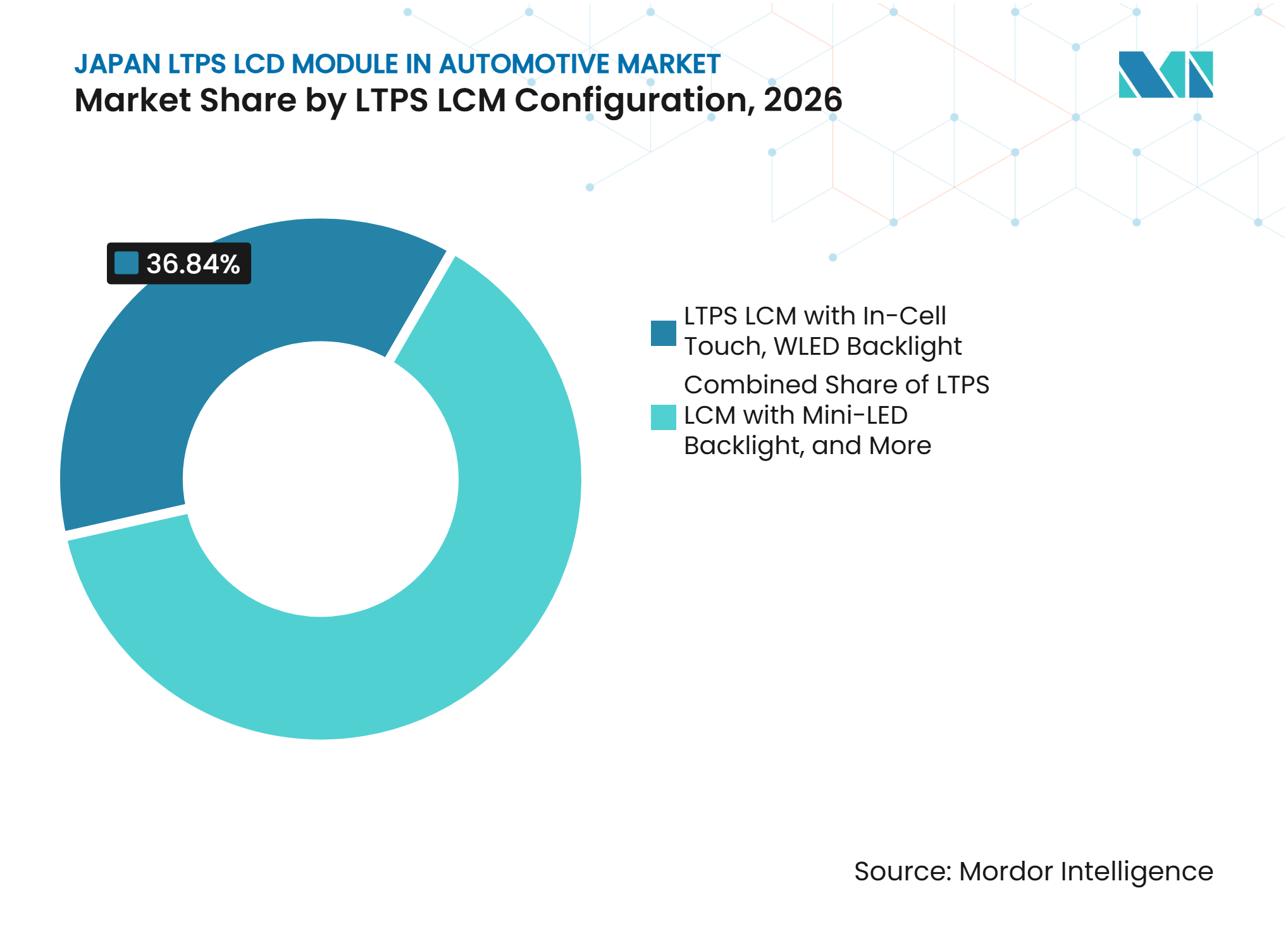
- By LTPS LCM configuration, LTPS LCM with in-cell touch and WLED backlight held 36.84% of the Japan LTPS LCD module (LCM) in automotive market share in 2026, while LTPS LCM with Mini-LED backlight and no touch is projected to expand at an 8.95% CAGR through 2032.
- By application, center stack and infotainment displays accounted for 40.58% of the Japan LTPS LCD module (LCM) in automotive market size in 2026, while pillar-to-pillar center console displays are projected to expand at an 8.86% CAGR through 2032.
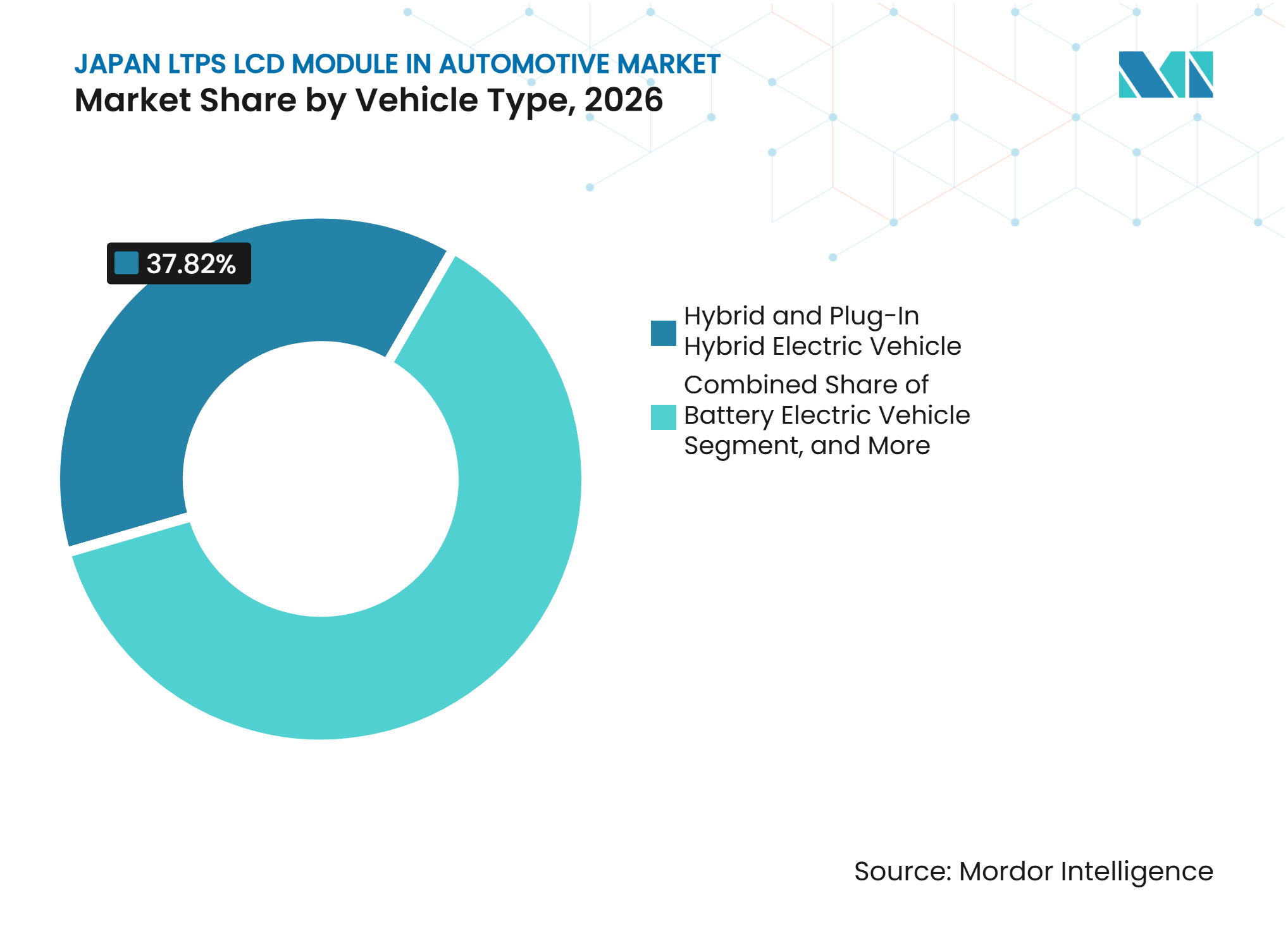
- By vehicle type, hybrid and plug-in hybrid electric vehicles held 37.82% share in 2026, while battery electric vehicles are projected to expand at an 8.75% CAGR through 2032.
- By bonding process, Film on Glass held 67.05% share in 2026, while Chip on Glass is projected to expand at an 8.92% CAGR through 2032.
Note: Market numbers in this report are based on Mordor Intelligence's proprietary estimation framework, which combines nine months of actuals with Q4 projections for base year 2026.
Market Trends and Insights
Drivers Impact Analysis of Japan LTPS LCD Module In Automotive Market*
| Driver | (~) % Impact on CAGR Forecast | Geographic Relevance | Impact Timeline |
|---|---|---|---|
| Digital Cockpit Adoption in Japanese Vehicles | +2.5% | National, with early volume gains in Chubu, Kanto, and Kansai automotive production clusters | Short term (≤ 2 years) |
| Larger and Higher-Resolution Display Adoption | +2.0% | National, strongest in premium and hybrid model lines produced across Aichi, Kanagawa, and Osaka prefectures | Short term (≤ 2 years) |
| Low-Power Display Demand in Electric Vehicles | +1.5% | National, correlated with EV production hubs in Aichi, Tochigi, and Kanagawa | Medium term (2-4 years) |
| In-Cell Touch Integration | +1.2% | National, with panel supply in Japan and Taiwan-based LTPS fabs serving Japanese OEM programs | Short term (≤ 2 years) |
| Connected and Software-Defined Vehicle Programs | +0.8% | National, anchored to Toyota City, Honda R&D in Saitama, and Nissan design facilities in Kanagawa | Medium term (2-4 years) |
| Localized Automotive Display Supply Chains | +0.6% | National, with procurement shifts benefiting Japanese and select Taiwanese display fabs | Long term (≥ 4 years) |
| Source: Mordor Intelligence | |||
Rising Adoption of Digital Cockpits in Japanese Vehicles
Japan's vehicle makers are moving from mechanical instruments and isolated infotainment screens toward cockpit layouts with multiple digital displays. Toyota selected Unity Technologies for the graphical user interface of its next-generation in-car human-machine interface in February 2025, showing the role of real-time graphical software in future vehicles.[1] Toyota also introduced Woven by Toyota's Arene platform in the all-new RAV4, where the platform supports the center display, voice agent, and Toyota Safety Sense functions.[2] These programs require a durable display base that can present detailed graphics while supporting software updates during the vehicle life cycle. Sharp has identified higher screen counts and larger display sizes as a focus of its display-device strategy, which aligns automotive module demand with cockpit complexity.[3] The Japan LTPS LCD module (LCM) in automotive market can therefore expand even when vehicle production changes slowly, because display content per vehicle is rising.
Migration Toward Larger, Higher-Resolution Displays
Larger displays require sufficient pixel density, brightness, and stable image performance across a broader surface. LTPS backplanes support higher-resolution applications than legacy amorphous-silicon LCD designs, which makes them relevant for center screens and integrated cockpit panels. Sharp presented a dual-view center information display with a 170 ppi resolution and personalized touch functions at Display Week 2026, compared with 74 ppi in its earlier display concept. This type of design allows driver and passenger functions to occupy the same display area without making the interface harder to read. LG Display began mass production of a 40-inch pillar-to-pillar display for Sony Honda Mobility's AFEELA in February 2025, providing a concrete example of the large-format direction in Japan-linked vehicle programs. The Japan LTPS LCD module (LCM) in automotive market benefits when larger panels raise module specification and value, even where the number of physical display frames declines.
Growing Demand for Low-Power Displays in Electric Vehicles
Electric vehicle programs place greater attention on electricity use across onboard systems, including cockpit displays. LTPS LCD can support high resolution and brightness while using less power than older amorphous-silicon LCD designs, which helps manufacturers balance display performance with energy management. Japan's Energy Saving Act provides a regulatory setting that encourages lower energy consumption across vehicle systems. Larger display surfaces in glass-roof interiors may require higher brightness, which increases the need to manage display power effectively. Battery electric vehicle cockpits also tend to use larger center screens and more digital functions than earlier vehicle designs. The Japan LTPS LCD module (LCM) in automotive market can benefit from these requirements, particularly where manufacturers select higher-brightness Mini-LED configurations.
Expansion of In-Cell Touch Integration
In-cell touch combines touch sensing and display functions in the panel structure, reducing the need for a separate digitizer layer. This approach can reduce module thickness, improve optical transmission, and support narrower bezels in wide or curved cockpit displays. A 2025 study in the SID Symposium Digest of Technical Papers described TP-MUX technology, which reduces the number of driver integrated circuits used in large automotive LTPS in-cell displays while retaining touch performance. Lower component counts can help reduce the cost barrier for in-cell touch in mid-sized and larger panels. JDI's consolidation at Ishikawa MULTI-FAB was designed to support a flexible production setup that includes automotive display programs. As touch functions become more integrated, the Japan LTPS LCD module (LCM) in automotive market has an opportunity to serve cockpit designs with fewer layers and more continuous screen surfaces.
Restraints Impact Analysis of Japan LTPS LCD Module In Automotive Market*
| Restraint | (~) % Impact on CAGR Forecast | Geographic Relevance | Impact Timeline |
|---|---|---|---|
| LTPS Manufacturing and Qualification Costs | -1.0% | National, affecting OEM design-in cycles that require Japan-based supplier qualification | Medium term (2-4 years) |
| Price Competition From Chinese Display Manufacturers | -0.8% | National, with procurement pressure strongest for mid-tier LTPS LCM specifications | Short term (≤ 2 years) |
| Domestic LTPS Capacity Constraints and Fab Restructuring | -0.6% | National, concentrated in Ishikawa, Kameyama, and Nara | Medium term (2-4 years) |
| Long Automotive Design-In and Qualification Cycles | -0.4% | National, embedded in Japan's Tier 1 and Tier 2 supplier qualification structure | Long term (≥ 4 years) |
| Source: Mordor Intelligence | |||
High LTPS Manufacturing and Qualification Costs
LTPS production requires laser crystallization equipment, close process control, and higher-grade glass than conventional amorphous-silicon TFT production. These requirements add to capital spending and operating costs before a module reaches vehicle production. Automotive suppliers must also complete extensive reliability testing for temperature, vibration, humidity, and long-term durability. IATF 16949 sets quality management expectations for the automotive supply chain, including process discipline and traceability. The cost burden can be harder to absorb when model volumes are limited or when a component must be qualified separately across multiple vehicle programs. These factors can slow supplier returns on a new program and constrain price flexibility in the Japan LTPS LCD module (LCM) in automotive market.
Price Competition From Chinese Display Manufacturers
Price competition remains a material constraint because China-based panel suppliers have substantial manufacturing scale and broad product portfolios. Tianma presented automotive technologies at CES 2025 and Display Week 2025, including LTPS and Mini-LED concepts suited to vehicle cockpit use. These suppliers can compete for Japanese vehicle programs where specifications are standardized and procurement decisions prioritize cost. Japanese suppliers retain advantages in local qualification experience, engineering relationships, and familiarity with OEM quality expectations. However, suppliers still need to maintain competitive pricing while investing in newer module functions and automotive validation. The Japan LTPS LCD module (LCM) in automotive market may therefore place a premium on products that offer clear system-level benefits rather than competing only on panel cost.
*Our forecasts treat driver/restraint impacts as directional, not additive. The impact forecasts reflect baseline growth, mix effects, and variable interactions.
Japan LTPS LCD Module In Automotive Market Segment Analysis
By LTPS LCM Configuration:
In-Cell Touch WLED Leads, Mini-LED Gains RapidlyLTPS LCM with in-cell touch and WLED backlight held 36.84% of the Japan LTPS LCD module (LCM) in automotive market share in 2026. This configuration has an established position in instrument cluster and center stack applications because it combines familiar WLED illumination with integrated touch control. Its maturity gives vehicle developers access to module designs with known reliability characteristics. Domestic production experience at JDI and Sharp can further reduce qualification uncertainty for Japanese OEM programs. The configuration is also suited to mainstream vehicles that need touchscreen interfaces without the added cost of higher-end backlighting.
LTPS LCM with Mini-LED backlight and no touch is projected to expand at an 8.95% CAGR through 2032. Mini-LED designs suit large displays where local dimming and stronger contrast are valued more highly than direct touch interaction. Tianma showed a 12.3-inch LTPS high-transmissivity InvisiVue Mini-LED display at CES 2025 and Display Week 2025, illustrating the type of panel development aimed at automotive interiors. Standard WLED configurations without touch are likely to remain relevant for secondary screens, including climate-control displays. In-cell touch Mini-LED modules serve premium front-of-dash applications where interaction and high contrast are both priorities.



By Application:
Infotainment Anchors Volume, Pillar-to-Pillar Redefines the CategoryCenter stack and infotainment displays accounted for 40.58% of the Japan LTPS LCD module (LCM) in automotive market size in 2026. Touchscreen infotainment has become common across mainstream and premium vehicle lines, creating a broad demand base for these modules. The application requires clear graphics, responsive touch behavior, and stable performance over long operating periods. Toyota's decision to use Arene in the all-new RAV4 connects the center display directly with a software platform that also supports voice functions and safety features. This increases the importance of consistent display performance during the vehicle life cycle.
Pillar-to-pillar center console displays are projected to expand at an 8.86% CAGR through 2032. LG Display's 40-inch AFEELA display demonstrates how a continuous wide panel can combine cockpit functions within one visual surface. Such systems can replace several separate display frames while increasing the value of the module installed in a vehicle. Rear-seat entertainment and passenger displays add demand from premium buyers seeking more connected cabin experiences. Larger modules also create a stronger need for thermal management, panel uniformity, and reliable backlighting.
By Vehicle Type:
Hybrid Foundations, BEV Trajectory AcceleratesHybrid and plug-in hybrid electric vehicles held 37.82% of the Japan LTPS LCD module (LCM) in automotive market size in 2026. Japan's established hybrid vehicle base gives suppliers a stable source of display demand linked to high-volume platforms. Display modules designed for hybrid vehicles may also be used in related battery-electric models, which can reduce redevelopment and qualification work. This continuity is useful for suppliers that need to recover engineering investment across more than one powertrain. Hybrid cockpit programs also use increasingly digital instruments and infotainment systems, supporting steady demand for LTPS modules.
Battery electric vehicles are projected to expand at an 8.75% CAGR through 2032. These vehicles often prioritize larger digital displays, higher brightness, and careful energy use across onboard electronics. Japan's Clean Energy Vehicle program provides support for the purchase of eligible electric vehicles, supporting a policy environment for wider electrification. Battery electric designs can require brighter panels in glass-roof cabins and more advanced interfaces for charging, range, and connected functions. Internal combustion passenger cars remain relevant during the transition period, while light commercial vehicles are an emerging use case for fleet-management displays.

By Bonding Process:
FOG Dominates, COG Gains on Thinness and ReliabilityFilm on Glass held 67.05% of the Japan LTPS LCD module (LCM) in automotive market share in 2026. The process has a long production history and is compatible with flexible circuit connections used in many automotive module layouts. It is well suited to established display programs and the equipment base of module assembly suppliers. The process can support curved and irregular display shapes that are now used in cockpit interiors. Its installed tooling base also makes rapid replacement less likely in existing vehicle programs.
Chip on Glass is projected to expand at an 8.92% CAGR through 2032. Direct placement of the driver integrated circuit on the glass can reduce signal path length and support thinner module construction. This can be useful where a cockpit includes multiple electronic systems in a restricted interior space. ISO 26262 provides a functional-safety framework that is relevant where displays are used to communicate driver-assistance alerts and other critical information. Research on automotive LTPS in-cell displays also shows continued work on integrated driver and touch architectures.
Geography Analysis
Japan's Chubu Region: Cockpit Display Demand Anchored in Toyota's Manufacturing Core
Chubu, centered on Aichi Prefecture and Toyota City, is a major demand cluster because it combines vehicle assembly with a dense network of automotive suppliers. Toyota has adopted Arene in the all-new RAV4, placing the center display and voice functions within a common software platform. Toyota's work with Unity on a next-generation vehicle interface also points to more complex graphics and user-interface requirements. These programs make Chubu an important location for display-module qualification decisions and for demand in the Japan LTPS LCD module (LCM) in automotive market.
Kanto Region: Display Technology Development and Premium Program Origination
Kanto includes major automotive technology, design, and program management activities in Tokyo, Kanagawa, and Tochigi. JDI established AutoTech Inc. as an automotive display subsidiary effective April 1, 2026, separating automotive research, development, manufacturing, and sales activities into a dedicated business. Nissan's Kanagawa operations and Honda's regional research activities also support premium and electrified vehicle development. Sony Honda Mobility's AFEELA program is an important regional reference point because it uses a 40-inch pillar-to-pillar display produced by LG Display. The region's links with JDI's Ishikawa production base show how engineering decisions and manufacturing operations can be located in different parts of Japan.
Regional Diversity: Kansai, Kyushu, and Emerging Demand Nodes
Kansai combines display production activity with vehicle assembly and supporting electronics operations. Sharp completed the consolidation of several display subsidiaries into Sharp Corporation effective October 1, 2026, including operations related to display devices and automotive technology. Sharp's display-device strategy also identifies automotive display programs as a focus for Kameyama No. 1 production activities. Kyushu hosts production facilities connected to Toyota, Nissan, and Daihatsu, with established transport links to Korean suppliers. This regional mix gives the Japan LTPS LCD module (LCM) in automotive market a dispersed supply and demand structure rather than dependence on a single cluster.
Competitive Landscape
Market Concentration
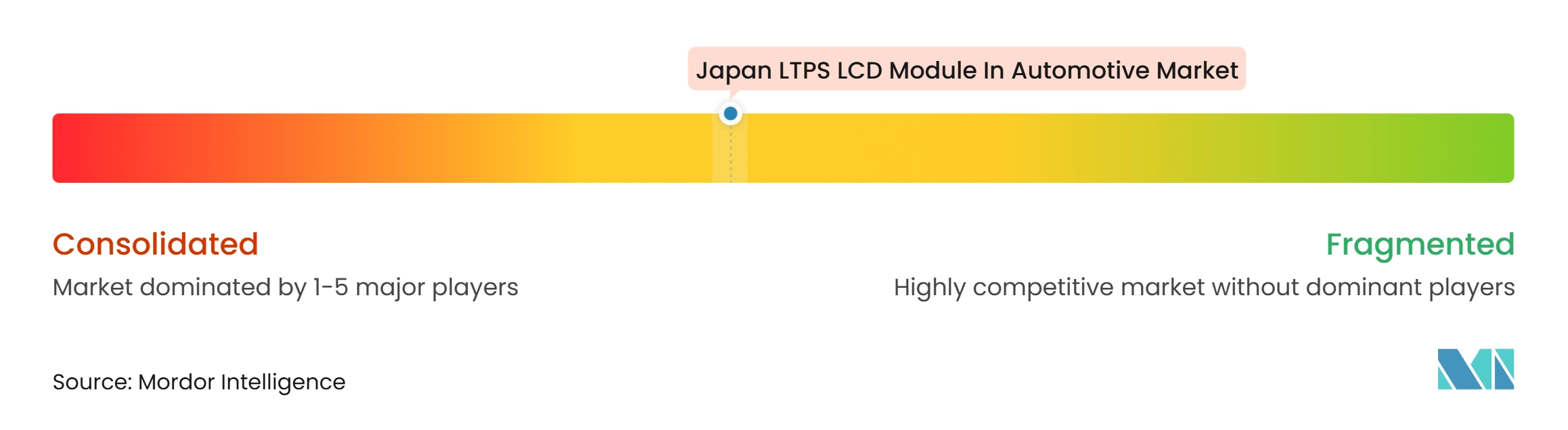
The Japan LTPS LCD module (LCM) in automotive market is moderately consolidated at the panel-manufacturing level and more fragmented at the module assembly and Tier 1 integration level. JDI, Sharp, LG Display, AUO, Innolux, and Tianma are relevant panel suppliers, while integrators configure modules for individual OEM programs. JDI has been restructuring its asset base by ending production at Mobara and consolidating production at Ishikawa MULTI-FAB. It also created AutoTech as a dedicated automotive display subsidiary, which may support more focused partnerships and capital decisions. Sharp's management plan identifies new automotive display production models and supply activity from Kameyama No. 1 beginning in the second half of fiscal year 2026.
Large-format Mini-LED LTPS modules for pillar-to-pillar and rear-seat screens are a key area of competition. LG Display's mass production of the 40-inch AFEELA display in 2025 provides a visible example of a high-specification program linked to Japan. Tianma is also positioning automotive LTPS and Mini-LED products through its 2025 CES and Display Week presentations. Product differentiation is increasingly based on touch integration, module thinness, contrast performance, and the ability to meet automotive validation requirements. JDI's technology programs include LTPS thin-film transistor capabilities and display development efforts that support its move toward higher-value applications.
Automakers are likely to assess suppliers through both module performance and supply continuity. Sharp's consolidation may simplify its customer interface and allow quicker coordination between display and automotive operations. Toyota's software-led cockpit work increases the importance of display hardware that can remain stable across updates and new interface features. The Japan LTPS LCD module (LCM) in automotive market is therefore defined by competition between local engineering capability, global technology offerings, and the ability to support long automotive development cycles.
Japan LTPS LCD Module In Automotive Industry Leaders
-
BOE Technology Group Co., Ltd.
-
Tianma Microelectronics Co., Ltd.
-
AUO Corporation
-
Japan Display Inc.
- *Disclaimer: Major Players sorted in no particular order
Japan LTPS LCD Module In Automotive Market Companies Covered in this Report
- Japan Display Inc.
- Sharp Corporation
- BOE Technology Group Co., Ltd.
- Tianma Microelectronics Co., Ltd.
- AUO Corporation
- LG Display Co., Ltd.
- Innolux Corporation
- TCL CSOT
- Samsung Display Co., Ltd.
- Truly International Holdings Limited
- Jiangsu Irico Display Technology Co., Ltd.
- Panasonic Holdings Corporation
- Sony Corporation
- Kyocera Corporation
- Hitachi, Ltd.
- Canon Inc.
- Nissha Co., Ltd.
- Mitsubishi Electric Corporation
- Seiko Epson Corporation
- Fujitsu Limited
Recent Industry Developments in Japan LTPS LCD Module In Automotive Market
- August 2026: Sharp Corporation consolidated its display device subsidiaries, merging Sharp Display Technology Corporation, Sharp Frontier Automotive Technology Corporation, and Sharp Yonago Corporation into Sharp Corporation, effective October 1, 2026, with the Hakusan Plant LCD panel business also absorbed via company split. The consolidation streamlines Sharp's automotive LTPS LCM supply chain into a unified entity, reducing administrative overhead and improving responsiveness to OEM procurement cycles.
- June 2026: Sharp Corporation disclosed its FY2026 automotive display target, confirming the sequential launch of new LTPS LCM production models from its Kameyama No. 1 plant from H2 FY2026 onward, including commencement of supply to a first European or North American OEM customer.
- April 2026: JDI's AutoTech Inc. became effective as a wholly owned autonomous subsidiary dedicated to automotive display research, development, manufacturing, and sales. AutoTech's independence allows independent external partnerships and capital-raising for LTPS automotive investments separate from JDI's parent balance sheet constraints.
Japan LTPS LCD Module In Automotive Market Report Scope
The Japan LTPS LCD Module (LCM) in Automotive Market encompasses the development, manufacturing, and supply of automotive-grade display modules using Low-Temperature Polycrystalline Silicon (LTPS) technology. These modules deliver high-resolution visuals, enhanced display performance, and power efficiency for advanced vehicle interfaces. Market growth is driven by increasing vehicle digitalization, adoption of sophisticated cockpit systems, and demand for high-quality automotive displays.
The Japan LTPS LCD Module (LCM) in Automotive Market Report is Segmented by LTPS LCM Configuration (Standard LTPS LCM (WLED Backlight, No Touch), LTPS LCM with In-Cell Touch (WLED Backlight), LTPS LCM with Mini-LED Backlight (No Touch), and LTPS LCM with Mini-LED Backlight and In-Cell Touch), Application (Center Stack/Infotainment, Instrument Cluster, Pillar-to-Pillar Center Console, and Rear Seat Entertainment and Passenger Screen), Vehicle Type (Battery Electric Vehicle (BEV), Hybrid / Plug-in Hybrid Electric Vehicle (HEV/PHEV), Internal Combustion Engine Passenger Car (ICE), and Light Commercial Vehicle (LCV)), and Bonding Process (Film on Glass (FOG), and Chip on Glass (COG)). The Market Forecasts are Provided in Terms of Value (USD).
Segmentation Overview
| Standard LTPS LCM, WLED Backlight, No Touch |
| LTPS LCM with In-Cell Touch, WLED Backlight |
| LTPS LCM with Mini-LED Backlight, No Touch |
| LTPS LCM with Mini-LED Backlight and In-Cell Touch |
| Center Stack and Infotainment |
| Instrument Cluster |
| Pillar-to-Pillar Center Console |
| Rear Seat Entertainment and Passenger Screen |
| Battery Electric Vehicle |
| Hybrid and Plug-In Hybrid Electric Vehicle |
| Internal Combustion Engine Passenger Car |
| Light Commercial Vehicle |
| Film on Glass |
| Chip on Glass |
| By LTPS LCM Configuration | Standard LTPS LCM, WLED Backlight, No Touch |
| LTPS LCM with In-Cell Touch, WLED Backlight | |
| LTPS LCM with Mini-LED Backlight, No Touch | |
| LTPS LCM with Mini-LED Backlight and In-Cell Touch | |
| By Application | Center Stack and Infotainment |
| Instrument Cluster | |
| Pillar-to-Pillar Center Console | |
| Rear Seat Entertainment and Passenger Screen | |
| By Vehicle Type | Battery Electric Vehicle |
| Hybrid and Plug-In Hybrid Electric Vehicle | |
| Internal Combustion Engine Passenger Car | |
| Light Commercial Vehicle | |
| By Bonding Process | Film on Glass |
| Chip on Glass |
Key Questions Answered in the Report
What is the size of the Japan LTPS LCD module (LCM) in automotive market?
The market is valued at USD 342.06 million in 2026 and is forecast to reach USD 514.90 million by 2032, at a 7.03% CAGR over 2027-2032.
Which LTPS LCM configuration leads Japan's automotive applications?
LTPS LCM with in-cell touch and WLED backlight leads with a 36.84% share in 2026.
Which automotive display application is expanding fastest in Japan?
Pillar-to-pillar center console displays are projected to expand at an 8.86% CAGR through 2032.
Which vehicle type creates the largest demand base for LTPS LCMs?
Hybrid and plug-in hybrid electric vehicles hold the largest vehicle-type share at 37.82% in 2026.
Why are LTPS LCD modules relevant to electric vehicle cockpits?
LTPS LCD supports high resolution and brightness while helping manufacturers manage power use in increasingly digital vehicle interiors.
Which bonding process is expanding fastest for automotive LTPS modules?
Chip on Glass is projected to expand at an 8.92% CAGR through 2032 because thin module designs and controlled signal paths are increasingly important.