
Japan Golf Cart Market Size and Share
Market Overview
| Study Period | 2019 - 2031 |
|---|---|
| Forecast Data Period | 2026 - 2031 |
| Base Year Market Size (2025) | USD 118.19 Million |
| Market Size (2026) | USD 123.01 Million |
| Market Size (2031) | USD 151.01 Million |
| Growth Rate (2026 - 2031) | 4.19 % |
| Market Concentration | Medium |
Major Players *Disclaimer: Major Players sorted in no particular order Image © Mordor Intelligence. Reuse requires attribution under CC BY 4.0. | |
Japan Golf Cart Market Analysis by Mordor Intelligence
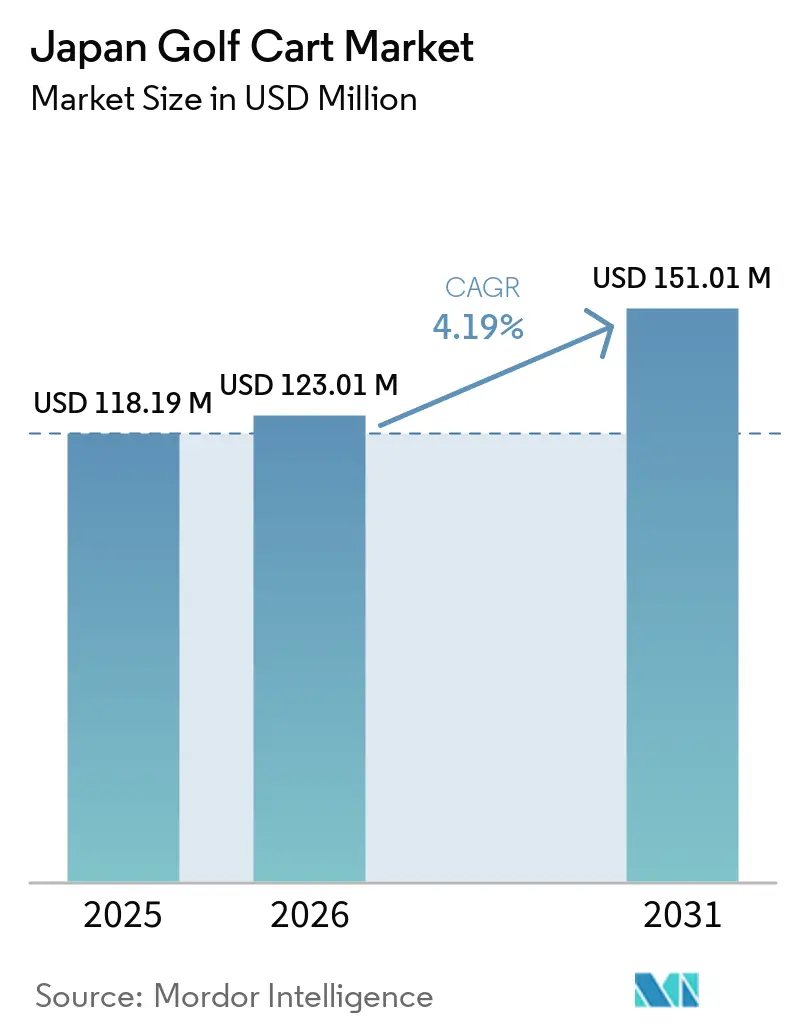
The Japan golf cart market size was valued at USD 118.19 million in 2025 and estimated to grow from USD 123.01 million in 2026 to reach USD 151.01 million by 2031, at a CAGR of 4.19% during the forecast period (2026-2031). Japan's golf cart market demand is increasingly tied to replacement decisions at established courses, rather than new course construction. The national course network recorded 2,154 courses as of February 2025 and 87.5 million visits in fiscal year 2024, which raised average activity at the remaining venues despite the continued reduction in course numbers [1]“2024 Fiscal Year Golf Course Users and Golf Course Count as of February 2025,” Japan Golf Course Management Association, golf-ngk.or.jp. This operating pattern supports investment in reliable carts, charging systems, and service contracts at courses with sustained daily use. Electric fleets, digital course systems, and resort transport needs are therefore shaping procurement priorities in the Japanese golf cart market. Suppliers that can support maintenance, navigation, and climate comfort are better positioned to serve operators updating fleets and facilities together.
Key Report Takeaways
- By propulsion type, electric golf carts held 75.13% of the Japanese golf cart market share in 2025, while solar-hybrid golf carts are forecast to grow at an 8.13% CAGR through 2031.
- By seating capacity, 2-seater carts held 47.22% Japanese golf cart market share in 2025, while 4-seater carts are forecast to grow at a 5.96% CAGR through 2031.
- By vehicle format, open-top carts held 79.04% of the Japanese golf cart market share in 2025, while enclosed and weatherproof carts are forecast to grow at a 6.24% CAGR through 2031.
- By application, golf courses held 59.11% market share in the Japanese golf cart market in 2025, while commercial services are forecast to grow at a 7.01% CAGR through 2031.
- By sales channel, offline dealers and distributors held 74.26% Japanese golf cart market share in 2025, while online and direct-to-consumer channels are forecast to grow at a 7.58% CAGR through 2031.
- By geography, Kanto accounted for 35.51% of the Japanese golf cart market share in 2025 and is set to grow at the fastest CAGR of 5.35% through 2031.
Note: Market size and forecast figures in this report are generated using Mordor Intelligence’s proprietary estimation framework, updated with the latest available data and insights as of January 2026.
Japan Golf Cart Market Trends and Insights
Drivers Impact Analysis*
| Driver | (~) % Impact on CAGR Forecast | Geographic Relevance | Impact Timeline |
|---|---|---|---|
| Electric Golf-Course Fleet | +1.5% | National, concentrated in Kanto, Kansai, and Chubu | Medium term (2-4 years) |
| Aging-Population Assisted Mobility | +0.8% | National, with early gains in urban Kanto and suburban Kansai | Long term (≥ 4 years) |
| Modernization and Smart-Course Investment | +0.7% | Kanto, Chubu, and Kansai, with early adoption clusters in Kyushu | Medium term (2-4 years) |
| Resort, Theme-Park, and Institutional Mobility | +0.6% | Kanto, Chubu, Kyushu, and Okinawa | Medium term (2-4 years) |
| Guidance for Caddie and Fairway Operations | +0.4% | Kanto, Kansai, and pilot clusters in Tohoku and Kyushu | Long term (≥ 4 years) |
| Heat-Resilient Cart Comfort | +0.3% | National, most acute in Western Japan and Kyushu | Short term (≤ 2 years) |
| Source: Mordor Intelligence | |||
Electrification of Golf-Course Fleet Replacement
Electric replacement decisions have become a central source of demand in the Japanese golf cart market. Operators with high course traffic can assess carts against fuel, maintenance, and battery replacement costs over a multi-year cycle. Yamaha Motor introduced the G30Es and G31EPs five-seater electric carts in Japan in June 2025. The models use in-house lithium iron phosphate batteries in 4 kWh and 6 kWh configurations. Yamaha stated that the new models reduced power consumption by 30% compared with earlier models [2]“Yamaha Motor Launches New Five-Seater Electric Golf Cars with New In-House Battery Technology,” Yamaha Motor Co., Ltd., news.yamaha-motor.co.jp. Lithium iron phosphate batteries also offer thermal stability that matters for fleets operating through hot Japanese summers. Course operators are placing greater weight on predictable fleet uptime and the cost of maintaining older gasoline vehicles. The Green Growth Strategy has provided a policy setting that favors lower-emission equipment and encourages companies to consider their operating emissions. The Japanese golf cart market can therefore benefit when a planned fleet renewal also supports broader facility modernization.
Aging-Population Demand for Assisted Short-Distance Mobility
Japan’s aging population supports demand for low-speed mobility in both golf and private-site settings. People aged 65 and older accounted for 29.3% of Japan’s population as of October 2024, and the 75-and-older group numbered 20.78 million [3]“Annual Report on the Ageing Society Summary FY2025,” Cabinet Office of Japan, cao.go.jp. The research also identified that a significant share of active golfers were aged 65 or older and that the average golfer age exceeded 58. This customer profile makes ease of movement and physical comfort relevant to cart use. Courses can use carts to help golfers continue playing over a full round. It also reinforces the value of accessible route design and clear vehicle controls. The Cabinet Office’s aging-society materials also identify transport access as an issue for older residents. In the Japanese golf cart market, this context can support interest in carts that are easy to board, operate, and maintain. It also creates a link between golf-course mobility and wider private-site transport needs.
Golf-Course Modernization and Smart-Course Investment
Cart systems are increasingly part of a wider effort to improve course operations. Operators are using digital tools for turf records, maintenance scheduling, player information, and round management. This makes the cart a useful platform for navigation and communication during a round. The user-supplied material described smart carts with wind information, elevation-based shot guidance, and geofenced safety boundaries. The renovation of Biwako Country Club’s Mikami Course is scheduled for completion in late 2026. The project includes smart-cart infrastructure as part of the redesigned layout. This type of work can influence equipment specifications before a course selects a new fleet. It favors vehicles that can integrate with navigation, safety, and fleet management systems. The Japanese golf cart market is therefore not defined only by the vehicle itself. Hardware suppliers may be in a weaker position when they cannot meet the digital requirements of a modern course. Operators are likely to value a system that reduces administrative work while preserving service quality.
Expansion of Resort, Theme-Park, and Institutional Mobility
Resorts, theme parks, campuses, and other private facilities are adding another demand base for the Japanese golf cart market. These locations use electric vehicles to move guests and staff across large grounds. Resort operators may need passenger comfort, enclosed cabins, and clear safety controls that differ from traditional fairway requirements. This broadens the product range that suppliers need to offer. It also gives manufacturers opportunities outside the course replacement cycle. Prince Hotels and Seibu Real Estate tested Mitsubishi Electric’s xAUTO autonomous-driving service at Prince Grand Resort Karuizawa in June 2026. The test covered transport within the resort and showed interest in private-site mobility services. Hourai Country Club also deployed 100 G-CART single-seater fairway carts in February 2026. These examples show that specialized vehicle formats can attract large orders when the use case is clear. Campus, airport, and industrial users remain subject to rules governing public road operation. However, private properties can still sustain a steady demand for equipment.
Restraints Impact Analysis*
| Restraint | (~) % Impact on CAGR Forecast | Geographic Relevance | Impact Timeline |
|---|---|---|---|
| Cost of Advanced Electric Fleets | -0.9% | National, most pronounced at smaller rural operators in Tohoku, Hokkaido, and Shikoku | Medium term (2-4 years) |
| Restricted Public-Road Operation | -0.5% | National | Long term (≥ 4 years) |
| Battery, Motor, and Controller Dependence | -0.4% | National, with exposure concentrated in coastal logistics hubs | Medium term (2-4 years) |
| Seasonal Utilization and Fleet-Occupancy | -0.3% | Northern Japan, including Hokkaido and Tohoku, and high-altitude Chubu | Short term (≤ 2 years) |
| Source: Mordor Intelligence | |||
High Upfront Cost of Advanced Electric Fleets
Advanced electric carts require a higher initial investment than gasoline models, particularly when equipped with lithium iron phosphate batteries, GPS systems, and onboard computing. Smaller operators may struggle to fund premium fleets before existing vehicles reach the end of their service life. Japan’s active golf course count declined for 15 consecutive years as of February 2025, and independent courses may have lower traffic than major club networks. Lower utilization can extend payback periods despite reduced operating costs and delay the shift from gasoline-powered units. Resort chains and multi-course groups can spread training, charging, servicing, and parts costs across larger fleets. At the same time, single-course operators face greater risk from unexpected battery replacement or maintenance expenses. Imported batteries, motors, and controllers also increase Japanese buyers' supply chain exposure. Seasonal closures in Hokkaido, Tohoku, and high-altitude Chubu further reduce annual utilization. These factors may slow adoption of premium carts at lower-volume facilities, despite the Japanese golf cart market's continued growth potential.
Restricted Public-Road Operating Envelope
Rules governing public road use limit the settings where golf carts can operate. Golf carts are primarily suited to private land and approved transport routes, which restricts wider use in local travel. This reduces opportunities in campus links, hospital grounds, and senior residential transport. The limitation is less restrictive at golf courses, resorts, and industrial sites with controlled vehicle access. It is more significant for suppliers seeking to expand into the general community mobility market. A wider operating framework would be needed before those applications could become a larger commercial category. Japan has a separate permit framework for Green Slow Mobility routes. The 2026 public-health study likewise examined a specific community transport service rather than unrestricted road use. This distinction matters when suppliers assess new use cases in the Japanese golf cart market. Existing rules favor purpose-built deployments on managed property. They also make local approvals and site planning important parts of any expansion strategy.
*Our forecasts treat driver/restraint impacts as directional, not additive. The impact forecasts reflect baseline growth, mix effects, and variable interactions.
Segment Analysis
By Propulsion Type: Electric Fleet Demand Leads Replacement Activity
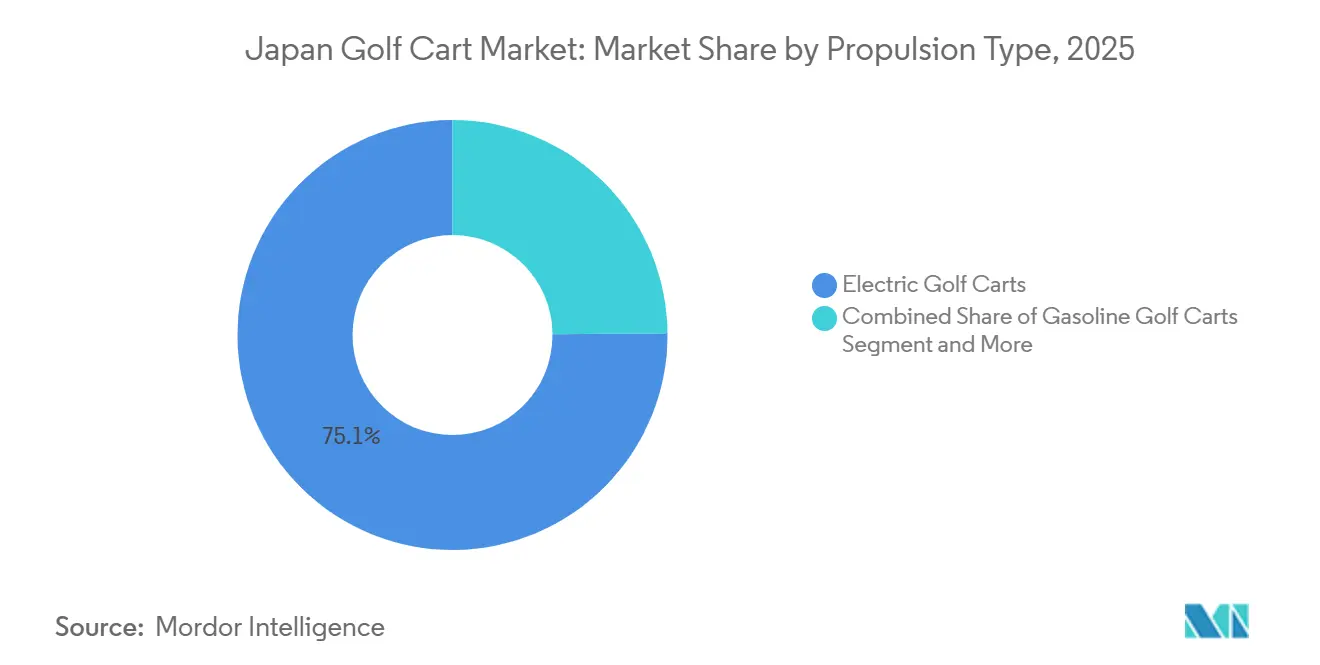
Electric golf carts accounted for 75.13% of the Japanese golf cart market in 2025. Their strong position reflects the long-standing use of guided electric carts at Japanese golf courses with caddie-supported operations. Golf course operators favor electric fleets because they efficiently support locations with sustained daily traffic. Gasoline carts remain in use, as operators continue to rely on established fueling and maintenance practices. Their replacement will likely depend on budget cycles and the availability of local technical support.
Solar-hybrid golf carts are forecast to grow at an 8.13% CAGR through 2031. They are still a smaller category, but they offer a way to supplement daily energy needs through rooftop photovoltaic panels. The Japanese golf cart market may see interest from eco-focused courses and resorts that already use solar carports or clubhouse generation. The Ministry of Economy, Trade, and Industry promotes distributed solar generation as part of its green-growth policy. Solar-hybrid carts can support a visibly lower-emission operating approach at these sites. Their growth will depend on purchase cost, local sunlight conditions, and the ability to maintain the added equipment. Conventional electric carts are likely to remain the larger procurement category during the forecast period.



By Seating Capacity: 2-Seater Carts Remain the Core Format
The 2-seater segment accounted for 47.22% of the Japanese golf cart market in 2025. It fits course operations where a cart may carry one or 2 golfers and equipment, rather than a full group. The format supports regular caddie service and enables relatively efficient vehicle movement on compact course layouts. It remains familiar to operators and staff, reducing training needs. The user-supplied research also described a preference for both caddie-inclusive larger carts and personal 2-seater formats. This creates room for several fleet configurations on the same course. Operators can select seating capacity based on course terrain, service model, and player flow.
The 4-seater segment is forecast to grow at a 5.96% CAGR through 2031. Resorts, campuses, and theme parks use these carts for passenger transport, giving the configuration a broader role than golf alone. The Japanese golf cart industry can benefit from this flexibility as private-site mobility needs expand. The 6-seater and 8-plus-seater categories serve smaller institutional applications such as resort transfers, airport operations, and industrial locations. These units may command a higher selling price because they must handle heavier passenger loads. Lithium-based systems are relevant where added capacity raises energy requirements. Their adoption will remain linked to safety expectations, maintenance capability, and each site’s route design.
By Vehicle Format: Open-Top Carts Retain Their Established Role
Open-top carts accounted for 79.04% of the Japanese golf cart market share in 2025. This configuration aligns with the operating practices of Japanese golf courses, where caddies manage equipment and vehicles that need to move efficiently between rounds. The open layout simplifies boarding, loading, and equipment access for staff and players. Busy facilities value these features because they help maintain a consistent flow across the course. Conventional courses in Japan continue to rely on this familiar format, while its large installed base supports demand for replacement parts and maintenance services. Open-top models are likely to remain the practical choice where weather protection is not a primary requirement.
Enclosed and weather-proof carts are forecast to expand at a 6.24% CAGR through 2031. The format is becoming more relevant during hot weather and at resorts that place greater weight on passenger comfort. Mikasa Seisakusho developed the OASIS 2 retrofit cooling system for existing Club Car and E-Z-GO 2-seater carts, with a commercial rollout planned for the 2027 season. The product indicates demand for cooling even before operators replace their entire fleet. Enclosed models can also suit hospitality sites where carts serve as guest transport. Their adoption may remain strongest at premium courses, resorts, and facilities serving older users. Open-top units will nevertheless retain a cost and operating advantage in many traditional course settings.
By Application: Golf Courses Continue to Generate Most Revenue
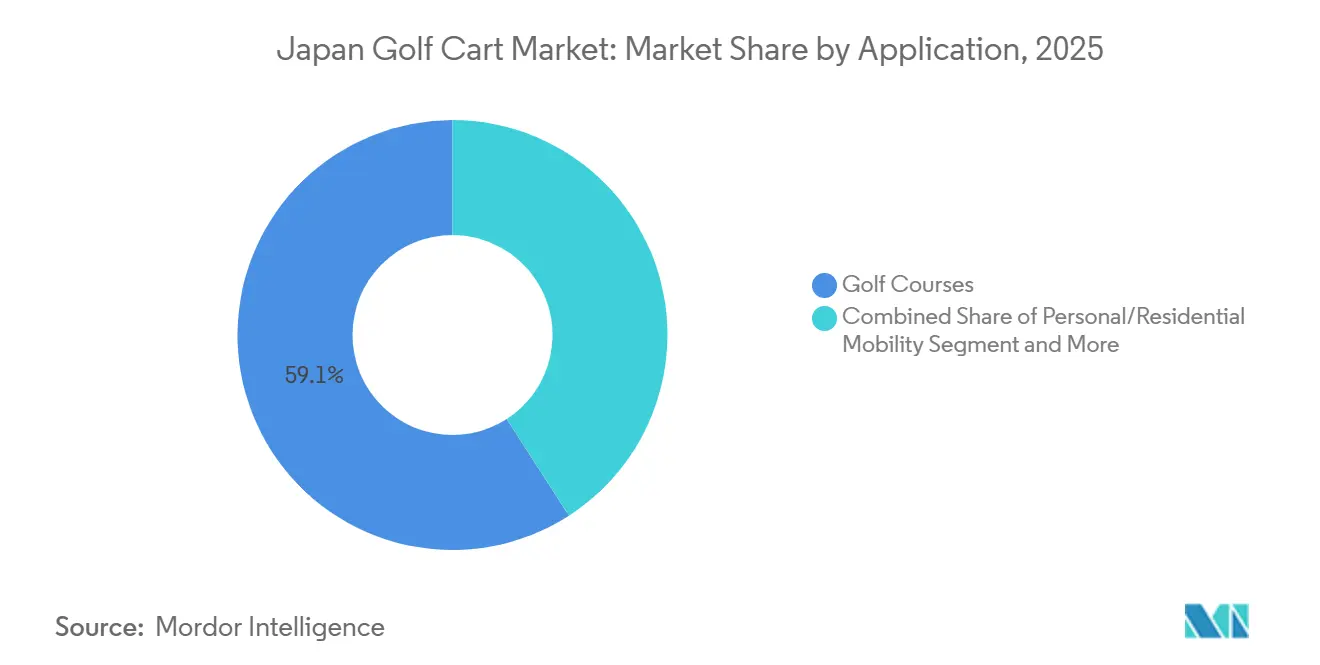
Golf courses accounted for 59.11% of the Japanese golf cart market share in 2025. Their demand is based on fleet replacement, high daily utilization, and the need to maintain a reliable service experience. Course closures have reduced the venue count, but activity at the remaining facilities has met equipment needs. Operators can use fleet upgrades to manage traffic and distinguish their service. This makes golf courses the stable core customer group within the Japanese golf cart market. Replacement demand should remain important even when the number of facilities does not rise.
Commercial services are forecast to grow at a 7.01% CAGR through 2031. Resorts, theme parks, and campuses use carts as guest or staff transport across large private properties. This use case places more emphasis on seating, weather protection, and site-specific safety functions. The Japanese golf cart industry can gain from purchases that are not tied to golf participation or seasonal course schedules. Industrial and airport utility users form a smaller demand pool within controlled sites. Their procurement process can take longer because buyers need to review service support and site operations. Suppliers with local dealers and after-sales capacity may have an advantage in these applications. Public road limits will continue to constrain use beyond enclosed properties.
By Sales Channel: Dealers Retain a Strong Service Role
Offline dealers and distributors held 74.26% of the Japanese golf cart market share in 2025. Large fleet buyers often need battery diagnostics, guidance-system calibration, repairs, spare parts, and preventive maintenance. A local dealer can provide these services alongside financing, trade-in arrangements, and seasonal support. These requirements help explain why dealer relationships remain valuable for major course and institutional contracts. The Japanese golf cart market depends on service continuity as much as initial vehicle delivery. This is especially true for fleets that rely on guided operation and digital features. Dealers can also help operators manage the transition from gasoline to electric vehicles.
Online and direct-to-consumer channels are forecast to grow at a CAGR of 7.58% through 2031. These channels enable smaller resorts, residential operators, and individual buyers to compare product configurations and pricing. In 2025, Daedong Mobility entered the Japanese market, combining dealer training across Kanto, Kansai, and Chubu with digital outreach to smaller customers. This strategy recognizes that online sales require reliable local after-sales support. Digital purchasing is unlikely to replace dealers for large fleet contracts. However, it may pressure dealer margins for single-unit purchases and accessories. In response, distributors may offer bundled service packages and enhanced maintenance programs.
Geography Analysis
Kanto is the largest regional part of the Japanese golf cart market, with a 35.51% share in 2025. The supplied research linked its position to its concentration of golf facilities, corporate memberships, and technology-focused operators. Kanto is projected to grow at a 5.35% CAGR through 2031. The region has demand for smart-course equipment, single-seater fairway formats, and carts used at resort-residential properties. These conditions support a wide range of vehicle and service requirements. Kanto’s position reflects its concentration of high-use commercial locations. Suppliers can use the region as a base for premium fleet and connected-cart offerings.
Kansai and Kinki form another important demand area, supported by private clubs and resort properties. Chubu has high-altitude courses in Nagano and Yamanashi, where seasonal conditions can reduce yearly cart use. Those conditions can also increase the need for weather protection and reliable battery performance after storage. Kyushu and Okinawa offer a year-round resort operating calendar that can support steady cart utilization. Resort and theme-park projects in the region can increase demand for private-site electric transport. These locations can require carts that address uneven terrain, passenger comfort, and daily service needs.
Tohoku is beginning to show more interest in specialized course technology. Noshiro Country Club in Akita reopened in July 2025 after reconstruction and introduced G-CART single-seater units and Hello Caddy autonomous-follow robots [4]“First Introduction in Tohoku G-CART and Hello Caddy,” Noshiro Country Club, noshirocountryclub.com . Hokkaido has a shorter operating season at many courses, which can discourage large premium-fleet investments. Chugoku and Shikoku remain smaller markets with uneven dealer coverage. Their cost-sensitive operators may present an opportunity for suppliers capable of providing practical service coverage and competitively priced models.
Competitive Landscape
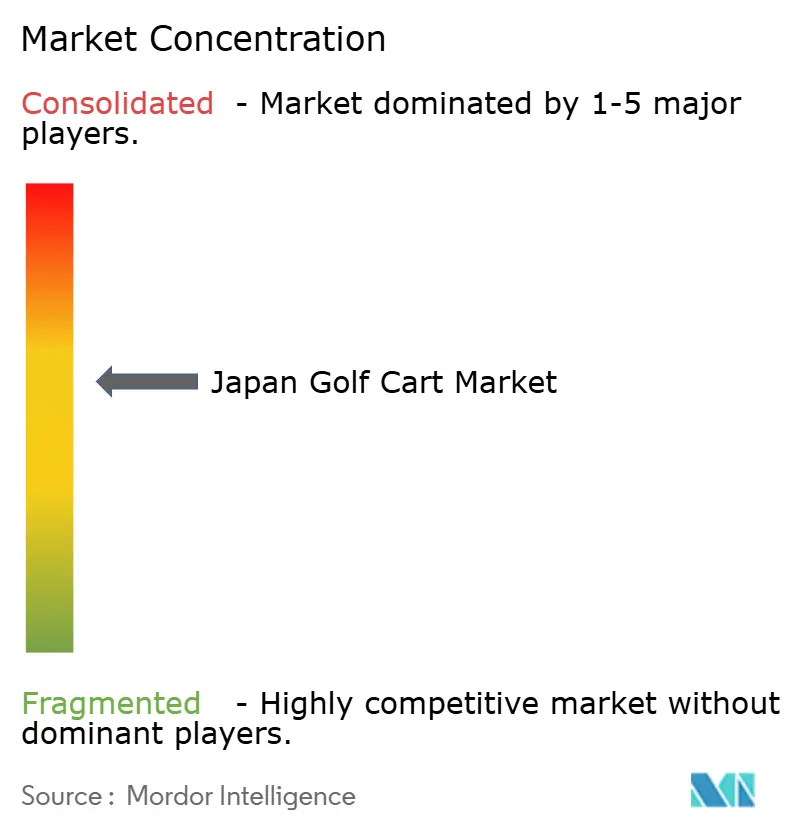
The Japanese golf cart market has a semi-consolidated premium tier, led by Yamaha Motor’s established domestic presence. Yamaha introduced its new five-seater electric models in 2025 with in-house battery technology. Club Car and E-Z-GO also compete in corporate and resort contracts through dealer relationships and established product ranges. Competition is not based only on vehicle price. Buyers also consider durability, service access, compliance needs, and battery support. The Japanese golf cart market, therefore, favors suppliers that can provide reliable long-term fleet support.
Daedong Mobility entered the Japanese market in August 2025 with carts compatible with guidance systems, integrated air conditioning, and slope-limiting speed control. These features address local requirements for guided courses, hot weather conditions, and varied terrain. As part of its Japan strategy, the company targets annual sales of 1,000 units by 2030.
Digital features are becoming increasingly important in bids from multi-site course operators. Fleet dashboards, GPS-based round monitoring, maintenance alerts, and safety controls can strengthen a supplier’s offering when customers modernize multiple properties. Consequently, product development now extends beyond drivetrain performance to connected operations. This enables established manufacturers to integrate carts, maintenance services, and digital support. It also allows specialized providers to compete through focused technology offerings. While emerging applications continue to create an open, competitive environment, large-fleet contracts still favor suppliers with a strong local presence and reliable service capabilities.
Japan Golf Cart Industry Leaders
Yamaha Motor Co., Ltd.
Club Car LLC
Textron Specialized Vehicles Inc.
Columbia Vehicle Group, Inc.
JH Global Services, Inc. (Star EV)
- *Disclaimer: Major Players sorted in no particular order

Recent Industry Developments
- May 2026: Ueno Zoo in Tokyo’s Taito Ward introduced a four-seat electric cart modeled after the shoebill, a bird known for its strikingly motionless posture. The modified golf cart features a front design resembling a shoebill, including its distinctive oversized beak.
- February 2026: Hourai Country Club in Tochigi Prefecture deployed 100 G-CART single-seater, fairway-riding electric carts. Each cart weighs 80 kg, operates on bentgrass fairways, and uses geofencing to control speeds in hazard zones. The carts reduce the duration of a typical round to three hours.


Japan Golf Cart Market Report Scope
The scope includes segmentation by propulsion type (electric golf carts, gasoline golf carts, and solar-hybrid golf carts), seating capacity (2-seater, 4-seater, 6-seater, and 8+ seater), vehicle format (open-top and enclosed/weatherproof), application (golf courses, personal/residential mobility, commercial services [resorts, theme parks, and campuses], and industrial and airport utility) and sales channel (offline [dealers and distributors] and online/direct-to-consumer). The analysis also covers regional-level segmentation, including Kanto, Kansai and Kinki, Chubu, Kyushu and Okinawa, Tohoku, Chugoku, Hokkaido, and Shikoku. Market size and growth forecasts are presented by value in USD and volume in Units.
| Electric Golf Carts |
| Gasoline Golf Carts |
| Solar-Hybrid Golf Carts |
| 2 Seater |
| 4 Seater |
| 6 Seater |
| 8+Seater |
| Open-Top |
| Enclosed / Weather-proof |
| Golf Courses |
| Personal / Residential Mobility |
| Commercial Services (Resorts, Theme-Parks, Campuses) |
| Industrial and Airport Utility |
| Offline (Dealers and Distributors) |
| Online / Direct-to-Consumer |
| Kanto |
| Kansai and Kinki |
| Chubu |
| Kyushu and Okinawa |
| Tohoku |
| Chugoku |
| Hokkaido |
| Shikoku |
| Electric Golf Carts | Golf Courses |
| Personal / Residential Mobility | |
| Commercial Services (Resorts, Theme-Parks, Campuses) | |
| Industrial and Airport Utility | |
| Gasoline Golf Carts | Golf Courses |
| Personal / Residential Mobility | |
| Commercial Services (Resorts, Theme-Parks, Campuses) | |
| Industrial and Airport Utility | |
| Solar-Hybrid Golf Carts | Golf Courses |
| Personal / Residential Mobility | |
| Commercial Services (Resorts, Theme-Parks, Campuses) | |
| Industrial and Airport Utility |
| By Propulsion Type | Electric Golf Carts | |
| Gasoline Golf Carts | ||
| Solar-Hybrid Golf Carts | ||
| By Seating Capacity | 2 Seater | |
| 4 Seater | ||
| 6 Seater | ||
| 8+Seater | ||
| By Vehicle Format | Open-Top | |
| Enclosed / Weather-proof | ||
| By Application | Golf Courses | |
| Personal / Residential Mobility | ||
| Commercial Services (Resorts, Theme-Parks, Campuses) | ||
| Industrial and Airport Utility | ||
| By Sales Channel | Offline (Dealers and Distributors) | |
| Online / Direct-to-Consumer | ||
| By Geography | Kanto | |
| Kansai and Kinki | ||
| Chubu | ||
| Kyushu and Okinawa | ||
| Tohoku | ||
| Chugoku | ||
| Hokkaido | ||
| Shikoku | ||
| By Propulsion Type by Application | Electric Golf Carts | Golf Courses |
| Personal / Residential Mobility | ||
| Commercial Services (Resorts, Theme-Parks, Campuses) | ||
| Industrial and Airport Utility | ||
| Gasoline Golf Carts | Golf Courses | |
| Personal / Residential Mobility | ||
| Commercial Services (Resorts, Theme-Parks, Campuses) | ||
| Industrial and Airport Utility | ||
| Solar-Hybrid Golf Carts | Golf Courses | |
| Personal / Residential Mobility | ||
| Commercial Services (Resorts, Theme-Parks, Campuses) | ||
| Industrial and Airport Utility | ||


Key Questions Answered in the Report
What is the forecast for Japan golf cart demand through 2031?
The Japanese golf cart market is projected to reach USD 151.01 million by 2031, registering a CAGR of 4.19% during the forecast period (2026-2031).
Which propulsion type leads golf cart sales in Japan?
Electric golf carts led with 75.13% revenue share in 2025, supported by fleet replacement and lower operating needs.
Why are Japanese golf courses replacing carts with electric models?
Operators are seeking lower power use, dependable fleet operation, and battery systems suited to frequent course use.
Which application is growing fastest for golf carts in Japan?
Commercial services, including resorts, theme parks, and campuses, are forecast to grow at a 7.01% CAGR through 2031.
Page last updated on:


 Your data is secure and never sold or shared.


