
Japan Fire Truck Market Size and Share
Market Overview
| Study Period | 2019 - 2032 |
|---|---|
| Forecast Data Period | 2027 - 2032 |
| Base Year Market Size (2026) | USD 434.51 Million |
| Market Size (2027) | USD 460.23 Million |
| Market Size (2032) | USD 613.57 Million |
| Growth Rate (2027 - 2032) | 5.92 % |
| Market Concentration | High |
Major Players *Disclaimer: Major Players sorted in no particular order Image © Mordor Intelligence. Reuse requires attribution under CC BY 4.0. | |
Japan Fire Truck Market Analysis by Mordor Intelligence
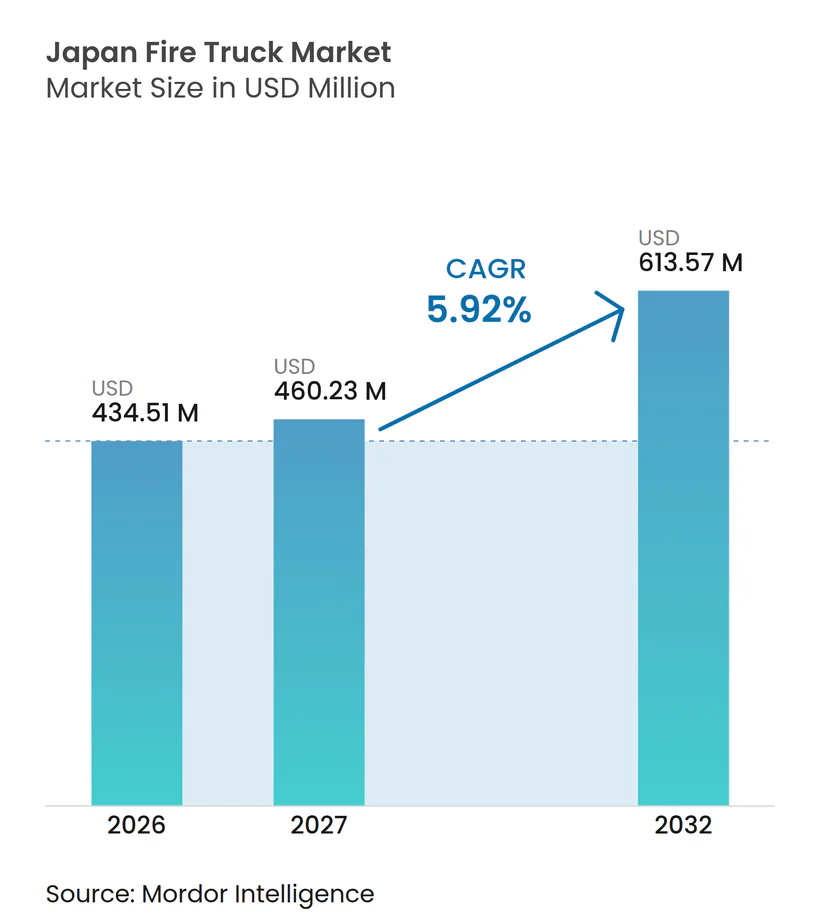
The Japan fire truck market size was valued at USD 434.51 million in 2026 and is expected to grow from USD 460.23 million in 2027 to USD 613.57 million by 2032, at a CAGR of 5.92% during 2027-2032. The Japan fire truck market is supported by a stable replacement base across 720 fire departments and 1,716 fire stations (as of April 1, 2024), as well as national fleet requirements that guide apparatus renewal. Public spending following the Noto Peninsula earthquake is shifting demand toward equipment capable of operating on damaged roads, carrying larger volumes of water, and supporting mutual aid. Electrification is moving first into urban and airport operations because these users have defined routes, fixed operating sites, and stronger access to charging investment. Domestic suppliers retain an advantage through qualified products, local service networks, and familiarity with public procurement, while overseas suppliers are building their positions in specialized airport and electric-vehicle applications [1].
Key Report Takeaways
- By vehicle type, pumper fire trucks and engines held a 49.22% share of the Japan fire truck market in 2026, while aircraft rescue and firefighting (ARFF) vehicles are forecast to grow at a 7.11% CAGR through 2032.
- By propulsion type, internal combustion engine vehicles held a 93.29% share in 2026, while battery electric vehicles are forecast to grow at an 11.39% CAGR through 2032.
- By vehicle capacity, vehicles below 5,000 liters held a 57.11% share in 2026, while vehicles above 20,000 liters are forecast to grow at a 7.32% CAGR through 2032.
- By end user, municipal fire departments held a 77.45% share in 2026, while airports are forecast to grow at a 7.19% CAGR through 2032.
Note: Market numbers in this report are based on Mordor Intelligence's proprietary estimation framework, which combines nine months of actuals with Q4 projections for base year 2026.
Market Trends and Insights
Drivers Impact Analysis of Japan Fire Truck Market*
| Driver | (~) % Impact on CAGR Forecast | Geographic Relevance | Impact Timeline |
|---|---|---|---|
| Aging Municipal Fleet Replacement | +1.3% | National, with heaviest renewal volumes in Tokyo, Osaka, Kanagawa, and Aichi | Medium term (2–4 years) |
| Disaster-Resilience Procurement After Earthquakes and Extreme Weather | +1.1% | Nationwide, with peak intensity in Tohoku, Noto Peninsula, and Chubu | Short term (≤ 2 years) |
| Airport and Defense Carbon-Neutrality Trials | +0.9% | Narita, Haneda, Kansai, Naha, and Self-Defense Forces bases | Medium term (2–4 years) |
| High-Density Urban Response Requirements | +0.8% | Tokyo, Osaka, Yokohama, and Nagoya | Long term (≥ 4 years) |
| Volcanic-Ash-Resilient Electric Pumping | +0.6% | Kanto and the Sakurajima corridor in Kyushu | Short term (≤ 2 years) |
| Smaller-Crew Operations Requiring Automation | +0.5% | National, with early uptake in rural and semi-urban departments | Long term (≥ 4 years) |
| Source: Mordor Intelligence | |||
Aging Municipal Fleet Replacement
Japan’s municipal apparatus fleet is positioned for continued demand for replacement as units reach the service-life threshold used in FDMA planning. The Japan fire truck market benefits from this predictable cycle because fire departments must preserve response capability even when local budgets are limited. Municipal tenders for rescue pump trucks and rescue vehicles continue on routine renewal schedules. Higher parts costs for older diesel vehicles and tighter emissions requirements reduce the appeal of extending the operating life of older apparatus. National Resilience Program funding gives earthquake-prone areas a clearer capital planning window through 2030. JIS vehicle dimension and mass requirements also favor suppliers that can meet local specifications without redesigning a platform.
Disaster-Resilience Procurement After Earthquakes and Extreme Weather
The 2024 Noto Peninsula earthquake changed the equipment priorities of many emergency response agencies. The FDMA’s FY2025 supplementary budget draft allocated JPY 13.08 billion (about USD 88 million) to measures such as large water-tank discharge trucks, long-distance seawater supply systems, and night-surveillance drones [2]. This budget was 30.4% higher than the prior supplementary appropriation. The Japan fire truck market is therefore seeing stronger interest in four-wheel-drive tankers and compact high-clearance units for areas where standard pumpers face poor road access. The FDMA’s FY2026 guidance for Emergency Fire Response Teams also supports wider mutual-aid preparation across prefectures. These requirements broaden demand beyond conventional urban pumpers and improve the case for specialized vehicles.
Airport and Defense Carbon-Neutrality Trials
Airport and defense procurement is becoming an important testing ground for lower-emission fire apparatus. Japan’s Ministry of Defense acquired an Oshkosh Striker Volterra 6×6 electric ARFF vehicle for the Japan Air Self-Defense Force, linking the purchase to national and defense emission-reduction targets. ICAO response-time and foam-delivery requirements establish a strict performance floor for airport firefighting fleets. Narita and Kansai have specialized ARFF fleets, which create a defined replacement opportunity for qualified suppliers. Airport decarbonization policy also supports the conversion of airport ground vehicles to EV or fuel-cell models. The Tokyo deployment of a Rosenbauer RT further demonstrates how electric pumpers can be adapted for municipal service and exposure to volcanic ash.
High-Density Urban Response Requirements
High-density cities require apparatus capable of reaching tall buildings and navigating constrained streets. Tokyo, Osaka, Kanagawa, and Aichi generate regular demand for aerial ladders, rescue units, and compact pumpers because their urban form combines dense housing, commercial buildings, and industrial sites. The Tokyo Fire Department has more than 18,000 employees and carries out more than 600,000 operations a year, which gives its fleet choices influence across surrounding departments [3]. Recurring municipal tenders for 40-meter-class aerial ladders show a continuing need for high-reach equipment in city centers. The Japan fire truck market also benefits from industrial fire brigade needs in the Keihin, Tokai, and Kinki coastal manufacturing areas. Standard requirements under the Fire Service Act and JIS maintain a common national baseline while allowing cities to specify additional operational features.
Restraints Impact Analysis of Japan Fire Truck Market*
| Restraint | (~) % Impact on CAGR Forecast | Geographic Relevance | Impact Timeline |
|---|---|---|---|
| Long Municipal Procurement Cycles and Budget Discipline | -1.2% | National, most acute in towns with populations below 50,000 | Short term (≤ 2 years) |
| Battery Range, Charging, and Payload Trade-Offs | -0.8% | National, with the strongest effect on tanker and aerial ladder applications | Medium term (2–4 years) |
| Japanese Acceptance Testing and Specification Localization | -0.6% | National, with type testing and acceptance checks for public-service apparatus | Short term (≤ 2 years) |
| Shrinking Regional Firefighting Workforces and Service-Capacity Gaps | -0.4% | Rural Hokkaido, Shikoku, and mountainous inland prefectures | Long term (≥ 4 years) |
| Source: Mordor Intelligence | |||
Long Municipal Procurement Cycles and Budget Discipline
Municipal purchasing follows multi-year capital plans, and smaller departments often face strict budget discipline. A single ladder truck or tanker can represent a significant portion of annual capital spending for a smaller department, making buyers cautious about non-standard equipment. The Japan fire truck market, therefore, has stable demand but can experience slow order conversion for newer technologies. Public tender requirements under the Local Autonomy Act can considerably extend decision timelines. Equipment certification, acceptance checks, and localized specifications add time and cost for suppliers without already-qualified products. These factors favor firms with local service capacity and established procurement relationships.
Battery Range, Charging, and Payload Trade-Offs
Battery-electric apparatus face trade-offs between vehicle weight, payload, range, and charging access. A CD-I pumper with a standard water tank weighs several tons when fully equipped, while large aerial and tanker vehicles can weigh considerably more. In heavier vehicle classes, battery mass can displace water, foam, or operational equipment. The Rosenbauer RT uses a dual-battery arrangement with a diesel backup engine, indicating that current electric pumpers do not operate fully on electric power under all conditions. High-speed fast charging is unavailable at many rural fire stations and requires infrastructure funding separate from vehicle purchases. Smaller workforces also limit some rural departments' ability to test, operate, and maintain new systems, reinforcing the advantage of established equipment designs.
*Our forecasts treat driver/restraint impacts as directional, not additive. The impact forecasts reflect baseline growth, mix effects, and variable interactions.
Japan Fire Truck Market Segment Analysis
By Vehicle Type:
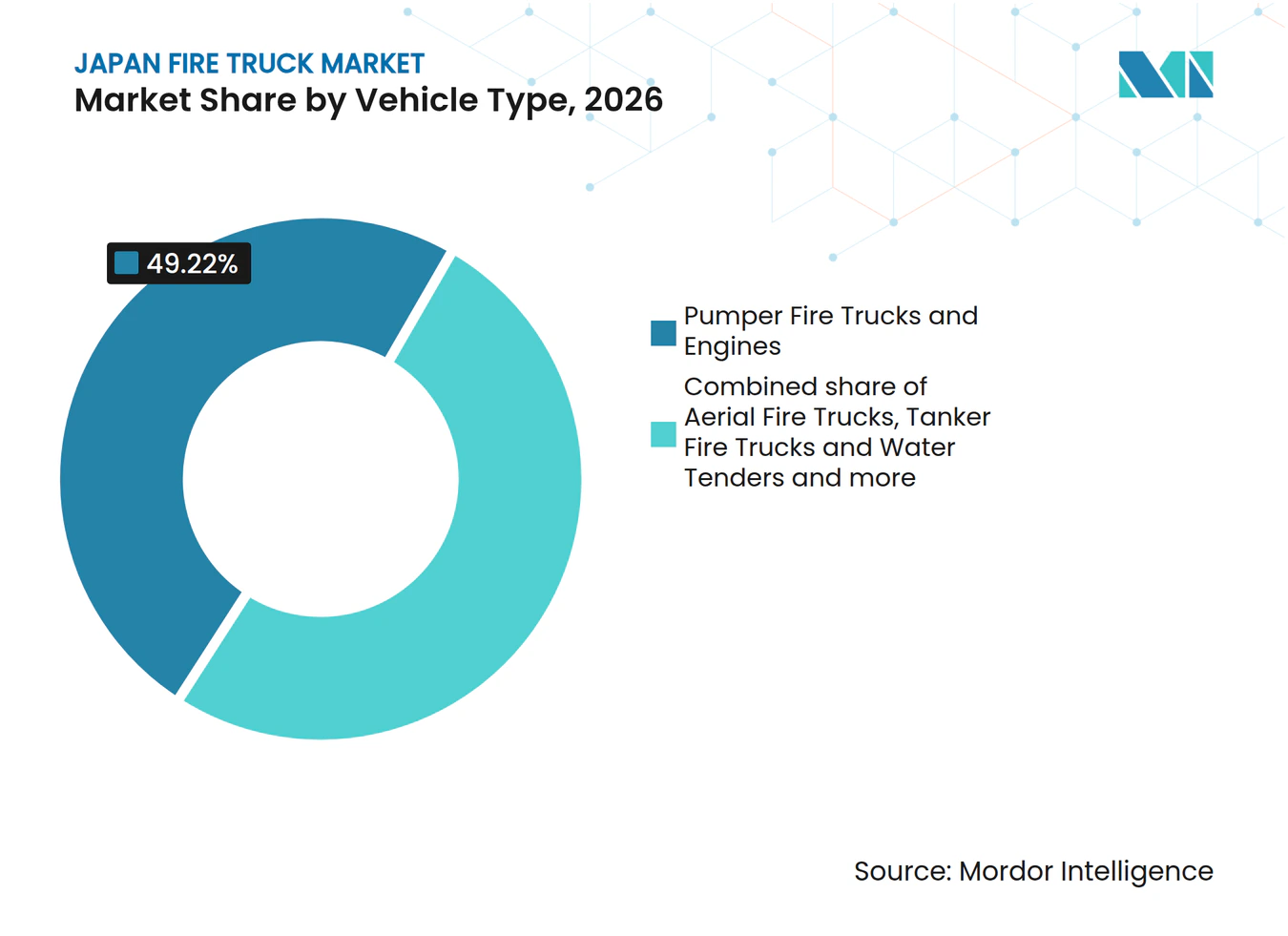
Pumpers Anchor Demand And ARFF Vehicles Set The PacePumper fire trucks and engines held 49.22% of the Japan fire truck market share in 2026, reflecting their role as the basic response platform across the country’s 720 fire departments and 1,716 fire stations (as of April 1, 2024). Pumpers are widely used because their specifications align with national apparatus guidelines and regular replacement cycles. Aerial fire trucks address high-rise exposure in dense urban areas, while tanker fire trucks and water tenders support rural and wildland response where hydrant coverage is limited. Rescue fire trucks, wildland fire trucks, special-purpose units, and HAZMAT vehicles serve defined operational needs. A recent supplementary budget reinforced demand for lightweight, high-clearance wildland apparatus following recent wildland-urban interface incidents.
Aircraft rescue and firefighting (ARFF) vehicles are forecast to grow at a 7.11% CAGR through 2032, the fastest rate among vehicle types in the Japan fire truck market. Certified airports require equipment that meets ICAO standards for agent delivery, response time, and operational readiness. Specialized rescue and firefighting vehicle fleets are maintained at major airports, while operators run regular training and replacement programs. The delivery of electric pumpers to urban fire departments reflects growing demand for electric firefighting equipment in city operations. The introduction of articulated aerial ladder trucks by manufacturers has further expanded the available high-reach product range.



By Propulsion Type:
ICE Dominates While Battery Electric Gains MomentumInternal combustion engine vehicles held a 93.29% share of Japan fire truck market revenue in 2026, supported by the broad installed base of diesel chassis from Isuzu, Hino, Mitsubishi Fuso, and UD Trucks. Municipal tenders still commonly list diesel as the default platform, while zero-emission options remain optional for many departments. Hybrid electric and battery electric vehicles accounted for the remaining share, and hydrogen and compressed natural gas options were still in the early stages of use in fire apparatus. The Japan fire truck market continues to rely on ICE platforms because they offer established service support and payload capacity. Airport decarbonization plans are nevertheless creating a policy reason for suppliers to develop EV and fuel-cell alternatives.
Battery electric vehicles are forecast to grow at an 11.39% CAGR through 2032, making it the fastest-growing propulsion category. This growth starts from a small base and is concentrated in large departments, airports, and defense applications where buyers can fund charging infrastructure. Morita's ePTO pump unit, displayed at INTERSCHUTZ, improved pump efficiency, reduced volume, and reduced weight compared with mechanical PTO designs. The JASDF purchase of an electric ARFF vehicle provides a defense-sector reference case for subsequent civilian airport purchases. Progress is expected to remain slower in heavy tankers and aerial vehicles because battery weight and charging requirements are more difficult to manage.
By Vehicle Capacity:
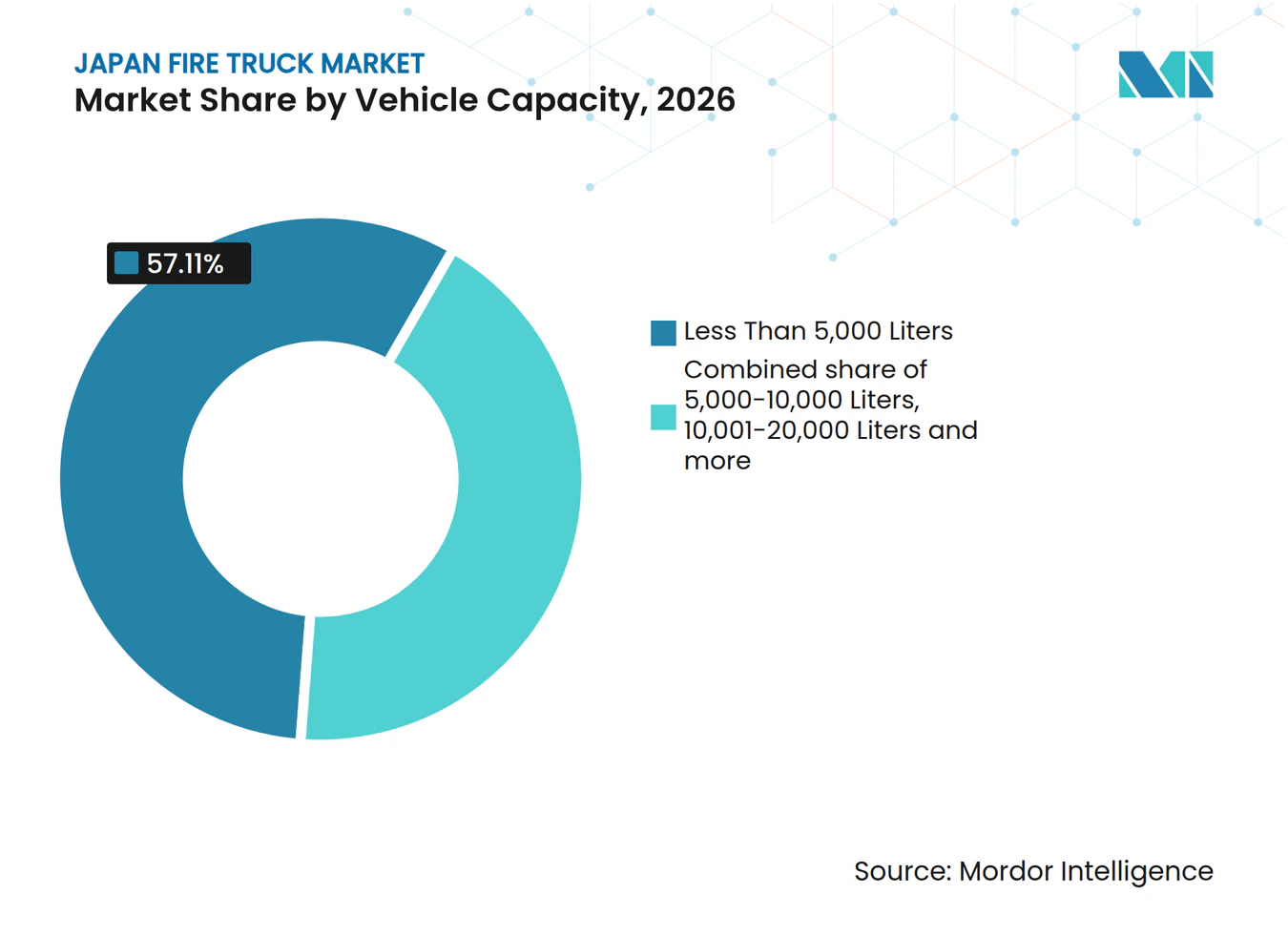
Compact Units Lead While Large-Capacity Fleets ExpandVehicles below 5,000 liters accounted for 57.11% of Japan fire truck market revenue in 2026 because lane width, turning radius, and dense development favor compact apparatus. CD-I pumpers and compact tankers in this class account for a large share of domestic body-builder output. Vehicles carrying moderate water volumes serve suburban and industrial areas that require greater water- or foam-delivery capacity. The larger-capacity class is used at petrochemical sites and airports that require sustained flow.
Vehicles above 20,000 liters are forecast to grow at a 7.32% CAGR through 2032, which gives this class the strongest growth rate by capacity. Large reserve capacity is relevant for disaster response, remote areas, and ARFF operations. The Japan fire truck market for these applications is supported by FDMA funding for large-capacity water-supply systems and seawater-utilization equipment. Narita operates ARFF equipment in a high-capacity class, and the wider airport network requires high-output firefighting capability. Demand in this category will be shaped by terrain, infrastructure gaps, and the need to maintain water supply during extended incidents.

By End User:
Municipal Departments Drive Volume While Airports Define DirectionMunicipal fire departments accounted for 77.45% of Japan fire truck market revenue in 2026 and remain the central purchasing group. Japan maintains a substantial career firefighter workforce across hundreds of departments, while emergency dispatches remain high. These operational demands support replacement programs across pumpers, rescue vehicles, ladders, and tankers. Industrial and commercial facilities generate additional demand through in-house brigades in the Tokai, Kinki, and Keihin manufacturing corridors. Forestry and wildland agencies received increased budget attention following recent fire events, with funding directed toward high-clearance response vehicles and related surveillance equipment.
Airports are forecast to grow at a 7.19% CAGR through 2032 and are the fastest-growing end-user segment. Japan has numerous public-use airports, and large hubs are required to maintain ARFF capability in line with aviation regulations. The Japan fire truck market benefits from recurring spending on specialized equipment, maintenance, training, and safety services at these facilities. Narita periodically conducts Aircraft Accident Fire and Rescue Comprehensive Training exercises to test fleet and agency coordination in runway fire scenarios. Military, ports, and expressway emergency services represent smaller channels for specialized units.
Geography Analysis
Tokyo, Osaka, Kanagawa, Hyogo, and Aichi account for a significant share of Japan fire truck market demand, driven by population density, high-rise building stock, and industrial activity that require specialized apparatus. The Tokyo Fire Department's large scale of operations supports frequent fleet evaluations, and its specifications influence procurement decisions among nearby services. Osaka sustains demand for pumpers and chemical trucks through its commercial base and the Kinki coastal petrochemical zone. Morita supported Expo 2025 Osaka with electric fire-pump trucks and an AI-assisted command-support system developed in coordination with the Osaka Municipal Fire Department. These demonstrations gave urban buyers operating experience with electric apparatus and digital support tools.
Disaster-exposed prefectures in Tohoku, Chubu, and the Noto Peninsula represent a distinct demand pattern for high-clearance, large-capacity, and multi-terrain equipment. The FDMA's supplementary budget response following the Noto earthquake funded equipment suited to severe access and water-supply conditions. Hokkaido requires wildland and large-capacity tanker equipment due to its wide, sparsely populated terrain. In these areas, the Japan fire truck market size is more closely linked to disaster exposure and hydrant availability than to population density.
Narita, Haneda, Kansai, and Naha form a high-value airport corridor for ARFF procurement. These hubs require specialized fleets and regular training to meet civil aviation obligations. Self-Defense Forces bases from Hokkaido to Okinawa represent another procurement channel for ARFF and HAZMAT equipment. The Japan Air Self-Defense Force's purchase of electric ARFFs illustrates the role of defense installations in early technology adoption. Rural and island municipalities represent a lower-volume but steady procurement pipeline, often supported by FDMA assistance and standardized products.
Competitive Landscape
Market Concentration

The Japan fire truck market is highly concentrated, with Morita Holdings accounting for about 60% of domestic fire truck output and international specialists participating selectively. Morita Holdings is the dominant domestic body builder, supported by a qualified product line and long-standing municipal relationships. The company reported consolidated net sales of JPY 116.6 billion for the fiscal year ended March 2026, up 4.3% year over year. ShinMaywa contributes specialized vehicle capability, while Hino, Isuzu, Mitsubishi Fuso, UD Trucks, and Toyota provide major chassis platforms.
Competition increasingly centers on electrification, automation, and qualification for Japan-specific requirements. Rosenbauer's RT deployment with the Tokyo Fire Department followed extensive adaptation work to meet local technical and service requirements. Morita's ePTO system improves efficiency and reduces system weight, supporting electric vehicle integration across more chassis types. Morita also worked with the Osaka Municipal Fire Department on AI-assisted command support during a major international event. EXEDY joined Morita's FDMA-supported firefighting drone research program, extending the company's work into coordinated aerial support systems.
Its EN-standard MLMA5-32 articulated ladder truck, shown at INTERSCHUTZ 2026, supports overseas expansion and high-reach product development. International suppliers face a high qualification burden, which limits rapid market entry but does not prevent participation in premium airport and urban niches. Competition in the Japan fire truck market is therefore driven by operational fit and qualification rather than price alone.
Japan Fire Truck Industry Leaders
-
MORITA HOLDINGS CORPORATION
-
ShinMaywa Industries, Ltd.
-
Rosenbauer International AG
-
Oshkosh Corporation
-
Isuzu Motors Limited
- *Disclaimer: Major Players sorted in no particular order
Japan Fire Truck Market Companies Covered in this Report
- MORITA HOLDINGS CORPORATION
- Teikoku Sen-i Co., Ltd.
- Rosenbauer International AG
- Oshkosh Corporation
- REV Group, Inc.
- IVECO Group N.V.
- ShinMaywa Industries, Ltd.
- Tadano Ltd.
- Isuzu Motors Limited
- Hino Motors, Ltd.
- Mitsubishi Fuso Truck and Bus Corporation
- Toyota Motor Corporation
- Nissan Motor Co., Ltd.
- UD Trucks Corporation
- Komatsu Ltd.
- KATAKURA INDUSTRIES Co., Ltd.
- Nihon Kikai Co., Ltd.
- Nagano Pump Co., Ltd.
- Kyokuto Kaihatsu Kogyo Co., Ltd.
- Bronto Skylift Oy Ab
- ANGLOCO LIMITED
- NAFFCO FZCO
Recent Industry Developments in Japan Fire Truck Market
- July 2026: EXEDY joined the Morita Holdings-led firefighting drone research project under the Fire and Disaster Management Agency’s FY2026 science and technology research program.
- July 2026: Rosenbauer reported that the Tokyo Fire Department commissioned its first fully electric firefighting vehicle, a Rosenbauer RT, in spring 2026.
- June 2026: Morita exhibited the MLMA5-32 EN-standard articulated ladder fire truck and an EV pump unit using its in-house ePTO system at INTERSCHUTZ 2026 in Hannover.
- April 2026: Morita Holdings reported consolidated net sales of JPY 116.6 billion for the fiscal year ended March 2026, up 4.3% year over year.
Japan Fire Truck Market Report Scope
The Japan Fire Truck Market Report is Segmented by Vehicle Type (Pumper Fire Trucks and Engines, Aerial Fire Trucks, Tanker Fire Trucks and Water Tenders, Rescue Fire Trucks, Aircraft Rescue and Firefighting Vehicles, Wildland Fire Trucks, Special-Purpose Fire Trucks, and HAZMAT and Multifunctional Fire Trucks), Propulsion Type (Internal Combustion Engine, Hybrid Electric, Battery Electric, and Other), Vehicle Capacity (Less Than 5,000 Liters, 5,000-10,000 Liters, 10,001-20,000 Liters, and More Than 20,000 Liters), and End User (Municipal Fire Departments, Industrial and Commercial Facilities, Airports, Military and Defense, Forestry and Wildland Agencies, and Other). Market Forecasts are Provided in Terms of Value (USD) and Volume (Units).
Segmentation Overview
| Pumper Fire Trucks and Engines |
| Aerial Fire Trucks |
| Tanker Fire Trucks and Water Tenders |
| Rescue Fire Trucks |
| Aircraft Rescue and Firefighting Vehicles |
| Wildland Fire Trucks |
| Special-Purpose Fire Trucks |
| HAZMAT and Multifunctional Fire Trucks |
| Internal Combustion Engine |
| Hybrid Electric |
| Battery Electric |
| Other |
| Less Than 5,000 Liters |
| 5,000-10,000 Liters |
| 10,001-20,000 Liters |
| More Than 20,000 Liters |
| Municipal Fire Departments |
| Industrial and Commercial Facilities |
| Airports |
| Military and Defense |
| Forestry and Wildland Agencies |
| Other |
| By Vehicle Type | Pumper Fire Trucks and Engines |
| Aerial Fire Trucks | |
| Tanker Fire Trucks and Water Tenders | |
| Rescue Fire Trucks | |
| Aircraft Rescue and Firefighting Vehicles | |
| Wildland Fire Trucks | |
| Special-Purpose Fire Trucks | |
| HAZMAT and Multifunctional Fire Trucks | |
| By Propulsion Type | Internal Combustion Engine |
| Hybrid Electric | |
| Battery Electric | |
| Other | |
| By Vehicle Capacity | Less Than 5,000 Liters |
| 5,000-10,000 Liters | |
| 10,001-20,000 Liters | |
| More Than 20,000 Liters | |
| By End User | Municipal Fire Departments |
| Industrial and Commercial Facilities | |
| Airports | |
| Military and Defense | |
| Forestry and Wildland Agencies | |
| Other |
Key Questions Answered in the Report
What is the forecast for Japan fire truck demand through 2032?
The Japan fire truck market is forecast to grow from USD 460.23 million in 2027 to USD 613.57 million in 2032 at a 5.92% CAGR.
Which vehicle type is forecast to grow fastest in Japan?
Aircraft rescue and firefighting (ARFF) vehicles are forecast to expand at a 7.11% CAGR through 2032, supported by airport compliance and fleet replacement needs.
How quickly are battery-electric fire trucks expanding?
Battery electric vehicles are forecast to grow at an 11.39% CAGR through 2032, starting from a small installed base.
What limits electric fire truck adoption in Japan?
Battery weight, charging availability, payload trade-offs, local testing, and lengthy municipal purchasing cycles limit wider use in heavy vehicle classes.
Which buyers purchase the most fire trucks in Japan?
Municipal fire departments held a 77.45% share in 2026, supported by nationwide fleet replacement and emergency-response requirements.