
Italy Rice Market Analysis by Mordor Intelligence
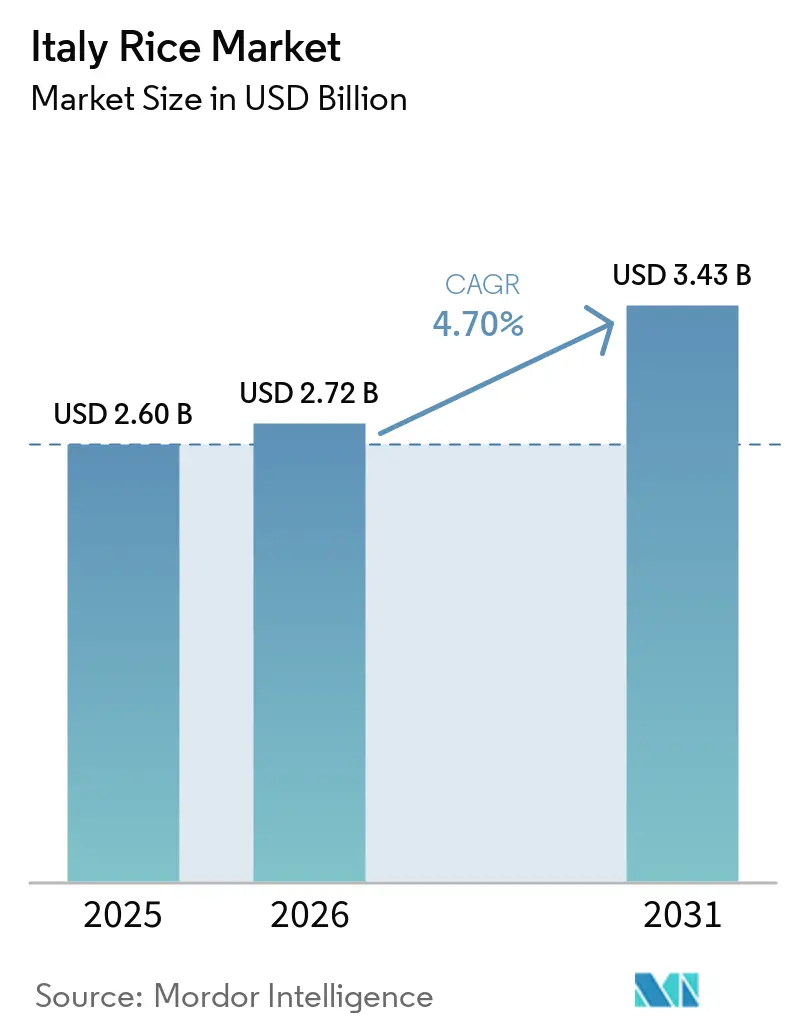
The Italy rice market size is projected to grow from USD 2.60 billion in 2025 to USD 2.72 billion in 2026, reaching USD 3.43 billion by 2031, with a CAGR of 4.7% during 2026-2031. This growth highlights the market's resilience despite challenges such as climate change and rising costs. Italy remains the leading producer of paddy rice in the European Union (EU), with its Arborio and Carnaroli varieties achieving good export prices. The Common Agricultural Policy, which includes coupled support for rice, aims to enhance grower profitability and encourage the adoption of eco-schemes such as alternate wetting and drying. The growing demand for ready-to-cook rice, the implementation of precision agriculture platforms with high yield-forecast accuracy, and the expansion of contract farming agreements are driving downstream opportunities and improving supply chain management. However, rising natural gas prices, salinity issues in the Po Valley, and import competition from Pakistan and India remain significant challenges to competitiveness.
Key Report Takeaways
- Italy produces about 50% of the European Union's rice, with cultivation concentrated in Piedmont and Lombardy's Po Valley regions, known for Arborio and Carnaroli varieties.
Note: Market size and forecast figures in this report are generated using Mordor Intelligence’s proprietary estimation framework, updated with the latest available data and insights as of January 2026.
Italy Rice Market Trends and Insights
Drivers Impact Analysis*
| Driver | (~) % Impact on CAGR Forecast | Geographic Relevance | Impact Timeline |
|---|---|---|---|
| Export premium for Arborio and Carnaroli varieties | +0.8% | Piedmont, Lombardy, Veneto export hubs in Germany, France, and United Kingdom | Medium term (2-4 years) |
| Shift to ready-to-cook rice in Italy retail market | +0.6% | National, strongest in North-West and Centro-Sardegna | Short term (≤2 years) |
| Government eco-schemes for low-water paddy systems | +0.7% | National, early adopters in Po Valley, Calabria, Sicily, and Sardinia | Long term (≥4 years) |
| Adoption of AI-based yield forecasting | +0.5% | Vercelli, Novara, Pavia pilots in Veneto and Emilia-Romagna | Medium term (2-4 years) |
| Expansion of contract farming by major millers | +0.4% | Piedmont, Lombardy emerging in Southern clusters | Medium term (2-4 years) |
| Growing demand for gluten-free carbohydrate sources | +0.5% | National, fastest in South-Sicily | Short term (≤2 years |
| Source: Mordor Intelligence | |||
Export Premium for Arborio and Carnaroli Varieties
Italy Arborio and Carnaroli rice varieties benefit from a strong geographic indication status and culinary preference in export markets, allowing them to command consistent price premiums over standard long-grain rice. According to Trade Map (ITC), Italy exported rice worth USD 926.8 million in 2025, highlighting robust international demand and reaffirming the country’s role as a significant rice exporter in European markets [1]Source: International Trade Centre (ITC), “Trade Map – Rice Exports from Italy (HS Code 1006), 2025,” trademap.org. Multiple quality certifications enhance product differentiation and help with fair pricing for growers and millers targeting high-value segments.
Shift to Ready-to-Cook Rice in Italy Retail Market
Convenience-driven consumption patterns are driving the growth of ready-to-cook rice formats, including microwaveable and pre-cooked meals, in Italy. Shifts in urban lifestyles, increasing demand for quick meal solutions, and a growing preference for portion-controlled packaging are shaping purchasing behavior across retail channels. Supermarkets and discount stores are allocating more shelf space to private-label and value-added rice products, prompting processors to innovate in packaging, flavors, and product formats. This trend is further supported by rising demand from foodservice and online delivery platforms, which prioritize consistent and easy-to-prepare rice options that align with modern consumption habits.
Government Eco-Schemes for Low-Water Paddy Systems
Government-supported sustainability policies are driving the adoption of water-efficient paddy systems in Italy. The European Commission reports that at least 25% of direct payments under the 2023–2027 Common Agricultural Policy (CAP) are dedicated to eco-schemes, promoting sustainable farming practices such as enhanced irrigation management [2]Source: European Commission, “Eco-schemes under the Common Agricultural Policy (CAP),” agriculture.ec.europa.eu. This financial support, guided by policy, encourages the implementation of techniques like alternate wetting and drying (AWD), which help reduce water usage while maintaining crop yields. Supported by research-based efficiency improvements, these measures are enabling a gradual transition toward climate-resilient and resource-efficient rice cultivation systems in Italy.
Adoption of AI-Based Yield Forecasting
The adoption of artificial intelligence and digital farming tools is reshaping rice cultivation practices in Italy by facilitating precise and data-driven decision-making. According to the OECD (2026), AI applications, including predictive analytics, remote sensing, and crop monitoring tools, are being increasingly utilized in European Union agriculture to enhance yield forecasting and optimize input usage. These technologies enable early detection of crop stress and improve resource efficiency. As their adoption grows, digital solutions are contributing to increased productivity, sustainability, and operational efficiency throughout Italy's rice value chain.
Restraints Impact Analysis*
| Restraint | (~) % Impact on CAGR Forecast | Geographic Relevance | Impact Timeline |
|---|---|---|---|
| Rising energy costs for parboiling and milling | -0.9% | Piedmont and Lombardy where milling is concentrated | Short term (≤2 years) |
| Soil salinity in the Po Valley from climate-driven sea intrusion | -0.7% | Coastal Po Valley, Polesine, and Veneto Delta | Medium term (2-4 years) |
| Competition from low-cost Asian imports in food service | -0.6% | National, acute in foodservice and discount retail | Medium term (2-4 years) |
| Fragmented farms limiting economies of scale | -0.5% | Nationwide, most severe in Northern clusters | Long term (≥4 years) |
| Source: Mordor Intelligence | |||
Rising Energy Costs for Parboiling and Milling
According to the Rome Business School (2025), electricity prices in Italy reached EUR 136.2 per MWh (USD 147.3 per MWh) during the first four months of 2025, the highest among major European economies [3]Source: Rome Business School, “Energy and Transition in Italy and Europe,” romebusinessschool.com. These elevated electricity costs significantly affect energy-intensive rice processing activities, including parboiling and milling. The increased power prices raise operational expenses for rice mills, particularly for small and medium-scale processors, thereby reducing cost efficiency and profitability. This ongoing pressure from high energy costs limits competitiveness and pricing flexibility, restraining the Italian rice market by increasing processing costs and hindering overall industry performance.
Soil Salinity in Po Valley from Climate-Driven Sea Intrusion
Climate variability and prolonged drought are increasing the risk of soil salinity in the Po Valley, Italy's main rice-growing region. Decreased river flow and reduced freshwater availability enable saline water from coastal areas to infiltrate inland, negatively impacting irrigation quality and soil health. This results in declining soil fertility and diminished land suitability for rice cultivation, especially in low-lying areas. Farmers are increasingly compelled to implement mitigation strategies, including enhanced water management, soil treatment, and crop adjustments, which contribute to higher production costs and increased operational complexity.
*Our forecasts treat driver/restraint impacts as directional, not additive. The impact forecasts reflect baseline growth, mix effects, and variable interactions.
Geography Analysis
Northern Italy continues to lead Italy's rice production, with key regions such as Piedmont, Lombardy, and Veneto forming the primary rice belt. This area benefits from fertile plains, advanced irrigation systems, and proximity to major milling and export hubs. In May 2024, Italy conducted its first field trial of gene-edited rice (RIS8imo) near Pavia, aimed at improving resistance to rice blast disease. This initiative reinforces Northern Italy's position as a center for innovation and high-quality rice production. The strong integration between growers and processors ensures efficient supply chains and supports premium varieties like Arborio and Carnaroli.
Southern Italy and the Islands are becoming significant growth areas for rice cultivation, driven by favorable climatic conditions and the adoption of water-efficient practices. Regions such as Calabria, Sicily, and Sardinia are expanding cultivation through micro-irrigation and alternate wetting techniques, enhancing resource efficiency. In 2024, European Union-backed sustainability initiatives and eco-schemes promoted the use of water-saving irrigation systems across southern regions, enabling cultivation on previously underutilized land. Producers in these areas are also focusing on organic farming and geographical certifications, while collaborations with millers are improving technical capabilities and market access.
Italy remains the largest rice producer in the European Union, with Northern Italy maintaining its dominance and Southern regions gradually increasing their contribution through improved practices and policy support. However, climate-related challenges, such as water scarcity and soil salinity, continue to impact productivity in parts of the north. Meanwhile, southern regions are adopting modern irrigation systems to enhance resilience. These regional dynamics, supported by innovation and sustainability initiatives, are shaping a dual-speed development pattern in Italy's rice production landscape.
Competitive Landscape
The Italy rice industry is well-structured, consisting of both large industrial millers and smaller regional producers operating across the value chain. Leading companies are focusing on branded products, export expansion, and value-added offerings to enhance their market position. Vertical integration strategies, including direct sourcing and investments in processing, are being employed to ensure consistent supply and quality. In October 2024, Euricom S.p.A. formed a joint venture with Fatima Rice Mills in Pakistan, gaining access to a significant basmati processing facility and bolstering its global sourcing and export capabilities.
Technological advancements and sustainability initiatives are becoming critical competitive factors for major players. Investments in digital tools, traceability systems, and sustainable practices are improving operational efficiency and aligning with evolving retailer demands. In August 2024, Euricom S.p.A. acquired Sonko sp. z o.o., a branded healthy snacks company in Eastern Europe, thereby expanding its portfolio into value-added and branded food segments. This move highlights the diversification strategies adopted by Italian rice companies.
Italy continues to be a leading rice producer within the European Union, reinforcing the strong position of domestic players in the regional market. This concentration benefits established millers and exporters while also drawing competition from lower-cost international suppliers. Competitive dynamics are shifting as companies pursue international expansion, acquisitions, and supply chain integration. These efforts aim to secure raw material access, strengthen global market presence, and enhance resilience against external competitive pressures.
Recent Industry Developments
- October 2024: Euricom S.p.A. formed a 50:50 joint venture with Fatima Rice Mills (Pvt.) Ltd. to establish a processing and export platform in Pakistan. This initiative aims to enhance its global sourcing network and ensure a long-term supply of premium rice.
- May 2024: Italy initiated its first field trial of gene-edited rice (RIS8imo variety) near Pavia. This variety, developed from Arborio rice, aims to enhance resistance to rice blast disease, representing a significant advancement in the adoption of biotechnology within the Italy rice market.


Italy Rice Market Report Scope
Rice is a grain of Oryza sativa and is a major staple food in many countries. It is known as paddy when threshed and is covered by a fibrous husk that comprises nearly 40% of the grain. The Italy rice market report is segmented by geography (North America, South America, Europe, Asia-Pacific, Middle East and Africa). The report includes production analysis (production volume, area harvested and yield), consumption analysis (value and volume), trade analysis (value and volume), import market analysis (import value and volume, key supplying markets), export market analysis (export value and volume, key destination markets), wholesale price trend analysis and forecast, regulatory framework, and logistics and infrastructure. The market forecasts are provided in terms of value (USD) and volume (metric tons).
Italy
| Production Analysis | Production Volume | |
| Area Harvested and Yield | ||
| Consumption Analysis (Value and Volume) | ||
| Trade Analysis (Value and Volume) | Import Market Analysis | Import Value and Volume |
| Key Supplying Markets | ||
| Export Market Analysis | Export Value and Volume | |
| Key Destinations Markets | ||
| Wholesale Price Trend Analysis and Forecast | ||
| Regulatory Framework | ||
| Logistics and Infrastructure | ||
| Seasonality Analysis | ||
| Italy | Production Analysis | Production Volume | |
| Area Harvested and Yield | |||
| Consumption Analysis (Value and Volume) | |||
| Trade Analysis (Value and Volume) | Import Market Analysis | Import Value and Volume | |
| Key Supplying Markets | |||
| Export Market Analysis | Export Value and Volume | ||
| Key Destinations Markets | |||
| Wholesale Price Trend Analysis and Forecast | |||
| Regulatory Framework | |||
| Logistics and Infrastructure | |||
| Seasonality Analysis | |||


Key Questions Answered in the Report
How large will the Italy rice market be by 2031?
The market is projected to reach USD 3.43 billion by 2031, expanding from USD 2.72 billion in 2026 at a 4.7% CAGR.
How precise are the satellite-based yield-forecasting models used in Northern Italy?
Multi-spectral machine-learning tools deployed in Vercelli reached 89% prediction accuracy, helping farmers fine-tune nitrogen applications.
Why do Arborio and Carnaroli command price premiums?
Protected origin certifications and superior culinary performance allow these varieties to average USD 1.19 per kilogram in export markets, nearly double United States long-grain prices.
How is technology improving farm efficiency?
AI-based satellite yield forecasting in Vercelli achieves 89% accuracy, enabling variable-rate input use that trims fertilizer costs by up to 15% while stabilizing yields.
Page last updated on:





