
Iraq Construction Market Size and Share
Market Overview
| Study Period | 2021 - 2032 |
|---|---|
| Forecast Data Period | 2027 - 2032 |
| Base Year Market Size (2026) | USD 37.17 Billion |
| Market Size (2027) | USD 39.11 Billion |
| Market Size (2032) | USD 50.47 Billion |
| Growth Rate (2027 - 2032) | 5.23 % |
| Market Concentration | Low |
Major Players *Disclaimer: Major Players sorted in no particular order Image © Mordor Intelligence. Reuse requires attribution under CC BY 4.0. | |
Iraq Construction Market Analysis by Mordor Intelligence
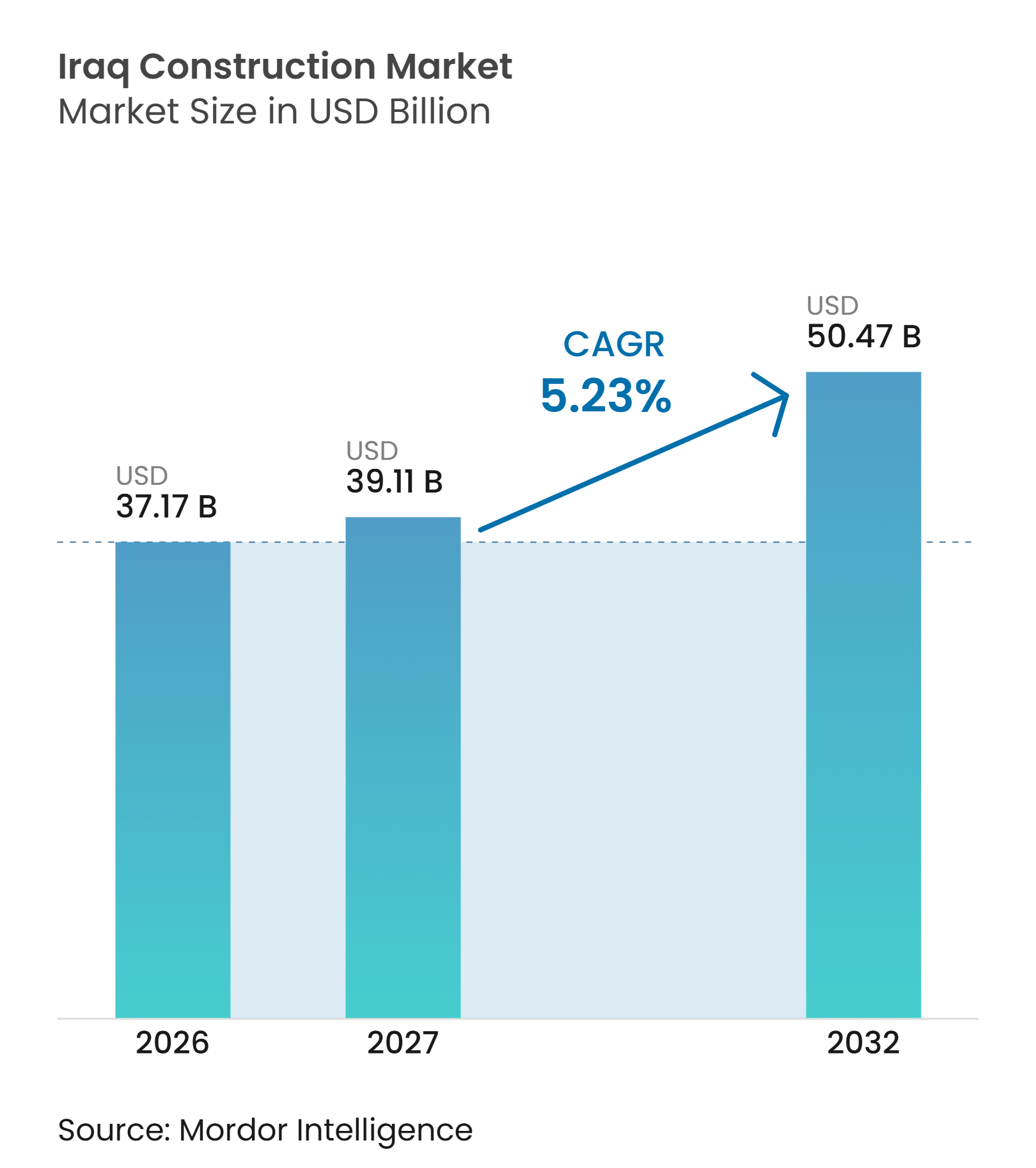
The Iraq Construction Market size was valued at USD 37.17 billion in 2026 and is estimated to grow from USD 39.11 billion in 2027 to reach USD 50.47 billion by 2032, at a CAGR of 5.23% during the forecast period (2027-2032).
The Iraq construction market is being supported by a large backlog in roads, power, water, and housing after many years of underinvestment, which keeps demand broad even when individual projects move at different speeds. Public spending still sets the pace, yet funding is becoming more balanced as multilateral lenders and bilateral partners add a more stable layer for transport and infrastructure delivery. Energy-linked projects are also broadening the work mix, as large oil and gas commitments create follow-on demand for civil works, utilities, access roads, and industrial support assets. Housing demand remains structurally strong because the country still faces a deficit of 2.3 million to 2.4 million units, which keeps residential delivery high on the national agenda. The main brake on the Iraqi construction market is not a lack of announced projects. Still, the gap between approvals and execution remains, as procurement changes, security concerns, and material logistics continue to affect timing and contractor pricing.
Key Report Takeaways
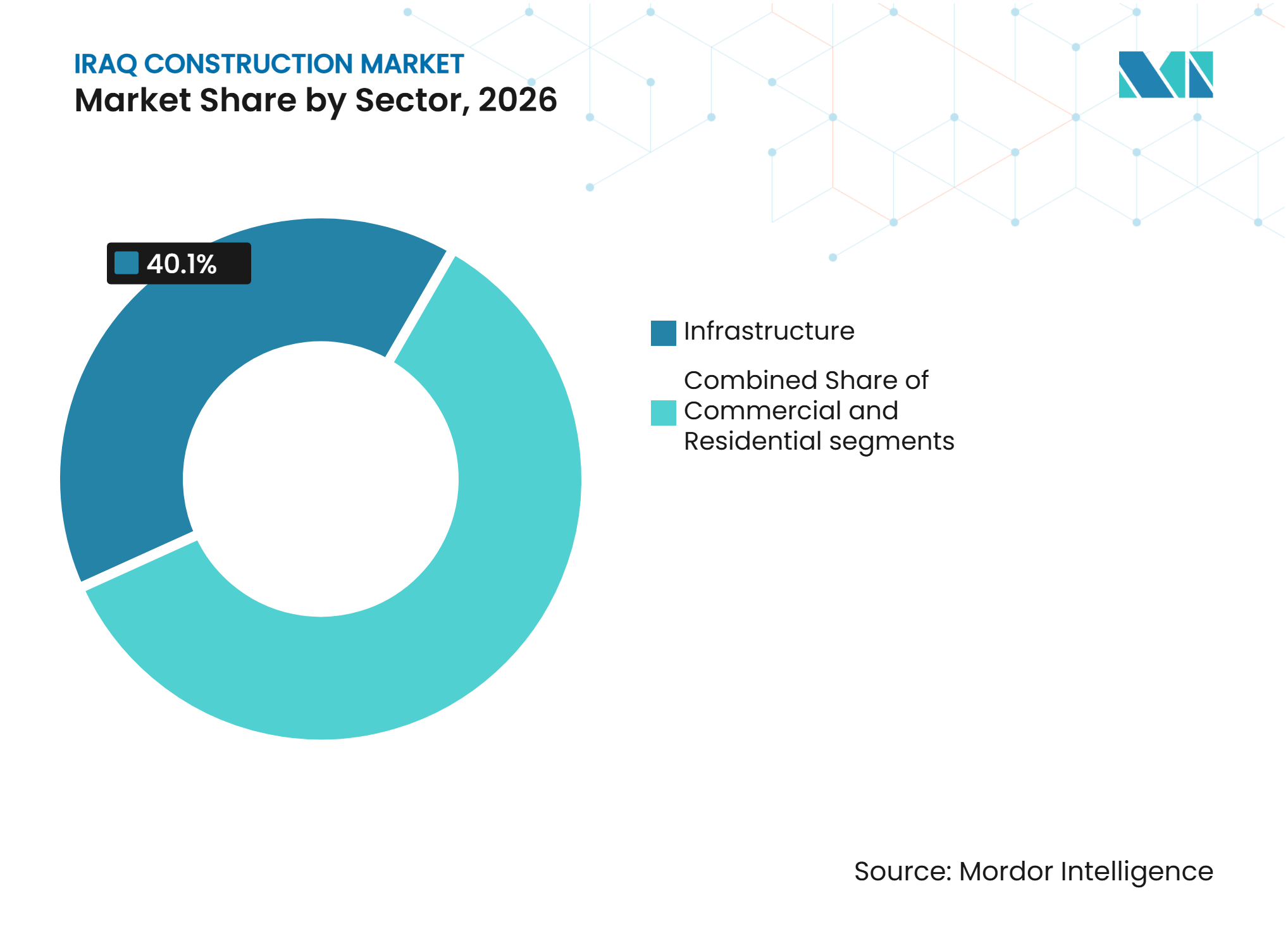
- By sector, infrastructure held 40.1% of the Iraq construction market share in 2026, while commercial is projected to grow at a 5.94% CAGR between 2027 and 2032.
- By construction type, new construction captured 69.7% of the Iraq construction market size in 2026, while renovation is projected to grow at a 5.67% CAGR between 2027 and 2032.
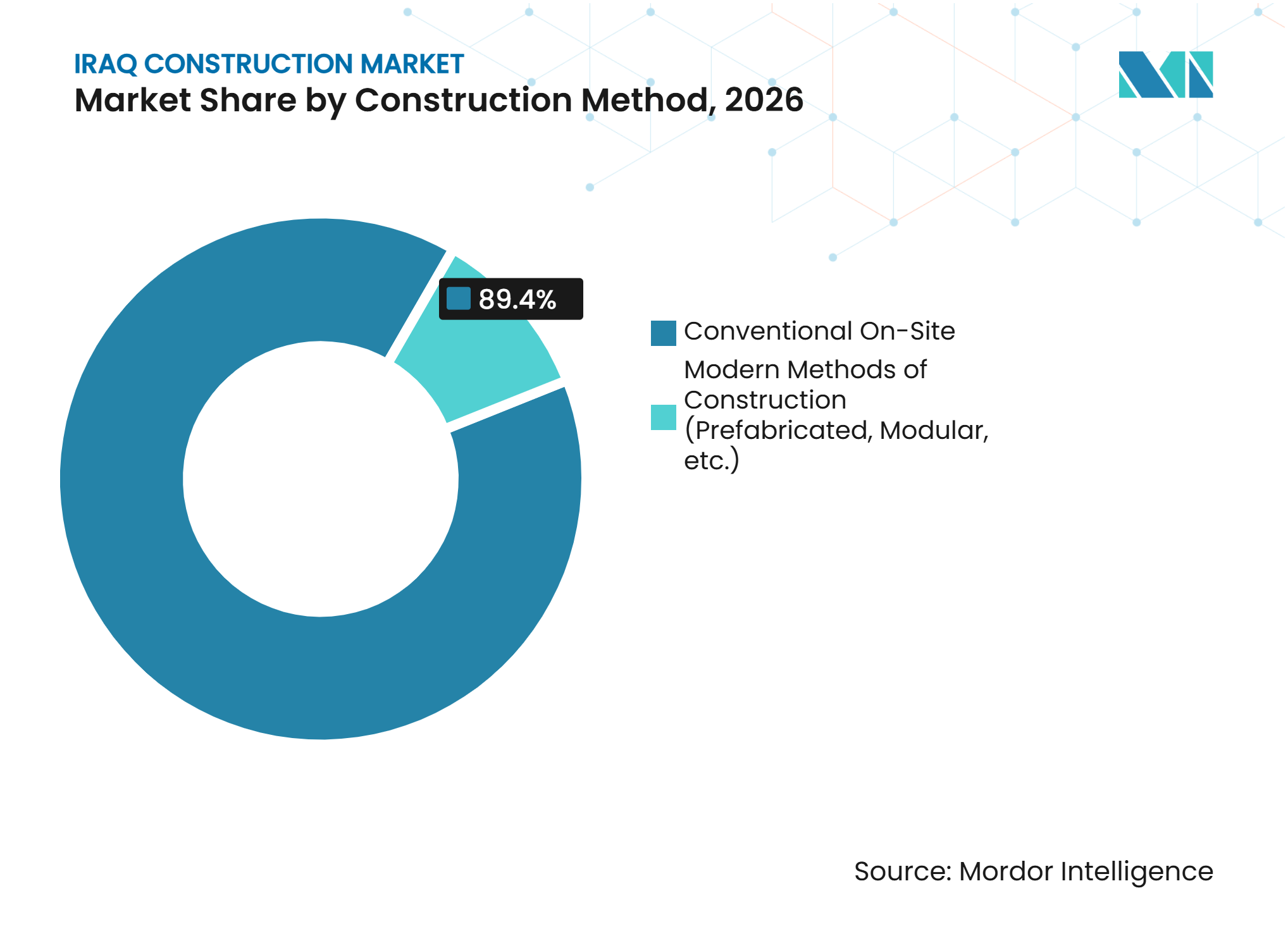
- By construction method, conventional on-site methods held 89.4% of the market in 2026, while modern methods of construction are projected to grow at a 5.85% CAGR between 2027 and 2032.
- By investment source, public investment held 76.2% of the market in 2026, while private investment is projected to grow at a 6.08% CAGR between 2027 and 2032.
- By geography, Baghdad held 32.5% of the Iraq construction market share in 2026, while Erbil is projected to grow at a 6.22% CAGR between 2027 and 2032.
Note: Market numbers in this report are based on Mordor Intelligence's proprietary estimation framework, which combines nine months of actuals with Q4 projections for base year 2026.
Market Trends and Insights
Drivers Impact Analysis of Iraq Construction Market*
| Drivers | (~) % Impact on CAGR Forecast | Geographic Relevance | Impact Timeline |
|---|---|---|---|
| Government Investment in Post-Conflict Reconstruction and Public Infrastructure | +1.5% | National, with primary gains in Baghdad, Basra, and Mosul | Long term (≥ 4 years) |
| Expansion of Oil and Gas Production Supporting Industrial and Energy Infrastructure | +1.2% | Basra, with spillover to Kirkuk and Wasit | Long term (≥ 4 years) |
| Rising Demand for Residential Housing and Urban Development | +0.9% | National, with highest intensity in Baghdad, Erbil, and Sulaymaniyah | Medium term (2-4 years) |
| Increasing Foreign Investment in Transport, Utilities, and Industrial Infrastructure | +0.7% | National, with early momentum in Baghdad, Basra, and Erbil | Medium term (2-4 years) |
| Development of Logistics Corridors and Regional Trade Connectivity Projects | +0.5% | Basra to the Turkish border corridor, including Al-Faw and connected hinterland | Long term (≥ 4 years) |
| Investment in Healthcare and Educational Infrastructure | +0.4% | National, with acute demand in Baghdad, Basra, and underserved southern governorates | Medium term (2-4 years) |
| Source: Mordor Intelligence | |||
Government Spending Reshapes Iraq's Project Pipeline
Government investment remains the main demand base for the Iraq construction market because public works still account for the largest share of contracts, the broadest project pipeline, and the largest funding commitments across transport, utilities, and social assets. The approval of USD 900 million in June 2026 for the Iraq Transport Economic Corridors project, covering priority road rehabilitation and new construction along national links that connect Baghdad with the Turkish border and westward routes, marked one of the most important infrastructure commitments in the current cycle. This followed the June 2025 support for railway modernization, which kept transport construction active across several asset classes instead of a single road-only cycle[1]. Long transport programs also include bridges, maintenance depots, logistics nodes, signaling systems, and utility interfaces, which extend the value chain for contractors beyond the first civil package. It also raises execution discipline because multilateral financing comes with procurement, environmental, and disbursement controls that ministries must follow. As a result, the Iraq construction market is not being driven solely by budget volume, but also by a gradual shift toward more structured funding and supervision.
Oil and Gas Capex Radiating into Construction Demand
Energy investment continues to shape the Iraq construction market, as upstream and midstream projects create dense work packages that extend well beyond oilfield equipment into civil, utility, transport, and accommodation assets. TotalEnergies' Gas Growth Integrated Project is a USD 10 billion multi-energy program, and its capital-intensive phase in 2025 and 2026 is supporting construction across seawater treatment, gas processing, and solar generation assets[2]. ENKA also broke ground in November 2025 on the central processing facility for the Associated Gas Upstream Project Phase 2 in Basra under a contract valued at around USD 3 billion, which shows the scale of package sizes now moving through the system[3]. Large energy schemes rarely stop at the main award, as each creates follow-on demand for foundations, camp infrastructure, internal roads, mechanical assembly areas, pipeline support structures, and grid links. This is why Basra remains central to the Iraq construction market, even when housing or commercial activity receives more public attention, since heavy industry continues to add multi-year projects that can sustain contractor utilization. The same pattern also supports local subcontractors because international engineering firms still rely on domestic partners for labor, site preparation, materials handling, and support works.
Housing Deficit Drives a Structurally Undersupplied Residential Market
The Iraq construction market is also supported by a large housing shortfall, which keeps residential delivery near the center of policy, financing, and land allocation decisions. The National Housing Policy 2025-2030 estimates the housing deficit at 2.3 to 2.4 million units, confirming that unmet demand is structural rather than temporary. That gap is being addressed through new residential city programs, including Ali al-Wardi, Jawahiri, and Ward City, where land transfers and project execution progressed during 2026. The scale matters because large urban schemes bring roads, water systems, schools, clinics, and retail areas, along with housing units, which multiply the effect on the wider Iraq construction market. Population pressure also supports absorption, as Baghdad is projected to exceed 11 million residents by 2040, keeping long-cycle demand in place even if supply accelerates from current levels. This makes residential work one of the more durable growth anchors, since demand is tied to demographics and urban formation rather than short-lived discretionary spending.
Foreign Capital Is Diversifying Construction Funding Beyond Oil Revenues
Foreign capital is becoming more important to the Iraq construction market because it adds projects that are not fully dependent on the annual state budget and also broadens demand across logistics, commercial real estate, tourism, and industry. More than USD 100 billion in investments were pledged between early 2023 and mid-2025, while the National Investment Commission handled more than 850 applications in 2025 and reported cumulative investments above USD 102 billion over three years. Sectoral targeting is also expanding in the Kurdistan Region, where licenses have been issued not only to energy but also to industry, tourism, and agriculture, creating a more varied project mix across the Iraq construction market. This shift matters because a more diverse funding base reduces the risk that a single budget bottleneck will pause the entire construction cycle. It also changes the profile of future demand, since foreign-backed retail, office, hospitality, and integrated community projects tend to require higher service levels, more formal delivery frameworks, and stronger contractor coordination. Over time, that can raise the quality threshold for project execution while also expanding the addressable opportunity set for firms that can work across both public and private mandates.
Restraints Impact Analysis of Iraq Construction Market*
| Restraints | (~) % Impact on CAGR Forecast | Geographic Relevance | Impact Timeline |
|---|---|---|---|
| Geopolitical Instability and Regional Security Challenges | -0.7% | National, with highest sensitivity in Basra and Baghdad | Short term (≤ 2 years) |
| Heavy Dependence on Oil Revenues | -0.6% | National, with the strongest exposure across federal budget-funded governorates | Medium term (2-4 years) |
| Weak Institutional Capacity and Lengthy Procurement Processes | -0.5% | National, with stronger effect in federal ministries than in the Kurdistan Region | Medium term (2-4 years) |
| Shortages of Skilled Labor and Construction Materials | -0.4% | National, with material pressure most acute in southern Iraq due to Hormuz-linked logistics | Medium term (2-4 years) |
| Source: Mordor Intelligence | |||
Geopolitical Risk Continues to Constrain Contractor Confidence
Geopolitical risk remains a clear restraint on the Iraq construction market because security events affect staffing, bid pricing, insurance costs, and supply movement before they show up in project completion data. During 2025 and 2026, regional conflict led several international engineering firms to reduce their site presence or evacuate staff, creating delays and a more cautious operating posture. The issue is broader than physical disruption, as contractors also add risk buffers to schedules and contract pricing when regional visibility weakens. Freight pressure through the Strait of Hormuz has added a cost layer, with steel coil transport costs in 2026 rising materially from pre-crisis levels, squeezing margins on fixed-price work. That mix of cost inflation and confidence risk does not stop the Iraq construction market from growing, but it does widen the gap between announced value and practical delivery. The result is a market where project opportunities remain large, yet execution premiums become an important part of contractor strategy.
Oil Revenue Dependence Leaves Construction Funding Exposed to Price Cycles
Heavy dependence on oil revenues creates uncertainty for public construction budgets and infrastructure project funding. Oil accounts for 90% of state income, which leaves capital spending exposed when export receipts weaken or prices fall. The oil price required to balance the budget rose to USD 84 per barrel in 2024 from USD 54 per barrel in 2020, increasing fiscal pressure on government programs. Crude export revenue is projected to fall from USD 99.2 billion in 2024 to USD 79.2 billion in 2026, while the fiscal deficit is projected to reach 9.2% of gross domestic product. Wages and pensions are projected to absorb 24.5% of gross domestic product in 2026, which can leave capital spending as the first major budget item to face reductions. This funding pattern can interrupt multi-year infrastructure contracts and make it harder for contractors to plan around reliable project cash flows.
*Our forecasts treat driver/restraint impacts as directional, not additive. The impact forecasts reflect baseline growth, mix effects, and variable interactions.
Iraq Construction Market Segment Analysis
By Sector:
Infrastructure Anchors Spending, Commercial AcceleratesInfrastructure held 40.1% of the Iraq construction market share in 2026, making it the largest sector. Ongoing requirements for roads, rail, airports, ports, power systems, water assets, and municipal networks support the segment. Transport investments such as the Development Road corridor, railway modernization, airport upgrades, and Al-Faw port construction create a long project pipeline for civil works. These programs also require related systems, including bridges, drainage, electrical connections, logistics facilities, and maintenance assets. Energy projects add further infrastructure needs through access roads, pipelines, water treatment systems, and grid connections. Infrastructure will remain the main foundation for the Iraq construction market because many core assets remain below the level required for population growth and private sector expansion.
Commercial construction is projected to grow at a 5.94% CAGR between 2027 and 2032, making it the fastest-growing sector. Demand is linked to organized retail, mixed-use urban developments, office space, hospitality assets, and services for a growing consumer economy. Iraq Mall opened in Baghdad in February 2026 with more than 550,000 m² of retail space and over 1,000 stores. The Talaat Moustafa Group development in Baghdad allocates 2.3 million m² of its masterplan to non-residential uses such as retail, offices, hospitality, and education. These projects indicate that commercial demand is becoming more visible outside traditional public works. Residential construction remains large by volume, but commercial growth shows that private developers are increasingly pursuing revenue-generating urban assets.



By Construction Type:
New Construction Dominates, Renovation Gaining GroundNew construction captured 69.7% of the Iraq construction market size in 2026. Iraq requires new housing communities, transport links, utilities, ports, energy facilities, and industrial sites because its existing stock cannot meet current demand. The new residential cities, Al-Faw Grand Port, the Development Road corridor, and large Basra energy projects are all major greenfield commitments. These programs need land preparation, new network connections, access roads, and supporting public services before the core asset can operate. Public investment plays a large role because these early enabling works require coordinated planning and long-term capital. Construction permits granted to the private sector totaled 25,934 in 2025, showing that smaller private activity can remain uneven even while government-backed greenfield development continues.
Renovation is projected to grow at a 5.67% CAGR between 2027 and 2032. The segment is supported by the need to upgrade airports, roads, public buildings, and infrastructure restored during earlier reconstruction cycles. The Baghdad International Airport upgrade, valued at USD 400-600 million, shows that rehabilitation projects are moving toward larger and more structured development programs. Road upgrades are also becoming more technical because new project frameworks call for stronger engineering standards and climate-resilient asset management. Renovation work can create demand for specialized contractors in systems replacement, building improvements, asset rehabilitation, and operational upgrades. New construction will remain much larger, yet the growing renovation base gives contractors a second source of work as older facilities require more than routine maintenance.
By Construction Method:
Conventional On-Site Methods Persist, Modern Methods of Construction Gaining Policy SupportConventional on-site methods held 89.4% of the market in 2026. These methods remain dominant because local contractors are familiar with site-based delivery, and the supply chain for cement, aggregate, and rebar is more established than off-site manufacturing logistics. Conventional construction also offers flexibility when project sites face uneven infrastructure conditions or changing service requirements. Labor-intensive delivery remains practical for many residential, municipal, and smaller civil projects. This approach will continue to represent the largest share of the Iraq construction market through the forecast period. However, the Ministry of Construction, Housing, and Public Municipalities has indicated that future housing programs will use more prefabricated systems and rapid construction approaches.
Modern methods of construction are projected to grow at a 5.85% CAGR between 2027 and 2032. The segment includes prefabricated elements, modular systems, and precast concrete solutions. These methods can help speed up housing delivery, reduce material waste, and improve quality control in repeatable projects. Adoption remains limited because Iraq has few experienced contractors, weak support structures, and high initial investment requirements for off-site production. Public procurement will likely be a key factor because housing contracts can create a reliable pipeline that justifies investment in modern construction capacity. Modern methods of construction will remain smaller than conventional methods. Still, they offer a clear growth opportunity for firms that build technical capability and local delivery capacity early.

By Investment Source:
Public Capital Leads, Private Sector Set to ScalePublic investment held 76.2% of the market in 2026, making it the largest funding source in the Iraq construction market. Oil revenues flow through the state budget, which keeps the government central to decisions on transport, energy, water, housing, and municipal investment. Public programs also fund enabling assets that private developers need before they commit to housing, commercial, and industrial schemes. Multilateral co-financing adds additional support for major public works and introduces stronger governance controls into project delivery. In Basra, state-led energy programs generate related demand for access roads, worker housing, water systems, and utilities. Public capital will remain the main source of construction value through 2032, even as private investment becomes more active.
Private investment is projected to grow at a 6.08% CAGR between 2027 and 2032. Iraq's national development plan targets IQD 84 trillion (USD 57 billion) in private capital formation. The National Investment Commission handled more than 850 applications during 2025, which indicates greater interest in formally licensed developments. Private capital is moving into retail, hospitality, logistics, integrated communities, and selected industrial projects. A young and increasingly urban population supports demand for consumer-facing real estate and private services. The Iraq construction industry will benefit if private developers can access land, permits, infrastructure connections, and clear financing structures without lengthy delays.
Geography Analysis
Baghdad
Baghdad held 32.5% of the Iraq construction market share in 2026, making it the largest geographic segment. The city combines central government projects, large public works, residential city development, flood management, road expansion, and growing commercial investment. The USD 18.8 billion Talaat Moustafa Group project and the transfer of Ali al-Wardi and Jawahiri residential cities to private investors show the scale of planned urban development. Baghdad is also attracting more organized retail and mixed-use development after the February 2026 opening of Iraq Mall. The concentration of government agencies, infrastructure needs, and private development sites gives the city the broadest current construction base. Its performance will remain important for the wider Iraq construction market because it connects public spending with the largest pool of urban demand.
Basra
Basra is the main industrial and energy construction hub in Iraq. The USD 10 billion Gas Growth Integrated Project is creating construction work across seawater treatment, gas processing, pipelines, and solar generation. The USD 2.4 billion Grand Basra Seawater Desalination Project adds a major utility investment to the governorate's pipeline. Basra also benefits from the Basra-Haditha pipeline program and other export-linked oil infrastructure work. Major projects create related demand for roads, labor accommodation, water systems, equipment yards, and local supply services. The geography is exposed to freight disruption and oil-market conditions, but its high concentration of industrial projects supports a steady workload for engineering and construction firms.
Erbil and Rest of Iraq
Erbil is projected to grow at a 6.22% CAGR between 2027 and 2032, making it the fastest-growing geography. The Kurdistan Region offers a comparatively stable investment setting and a more predictable environment for licensed private development. Its investment board issued 210 licenses worth USD 3 billion in 2025 and targeted 200 new licenses for 2026. Private housing and mixed-use activity in Erbil benefit from demand from buyers in Baghdad, Mosul, and Kirkuk seeking a more stable location. Sulaymaniyah and the rest of Iraq also have significant needs in transport and utility infrastructure, although project activation can be limited by local budget availability and institutional capacity. The regional pattern gives the Iraq construction market a diversified base, with Baghdad leading by current scale, Basra leading in industrial projects, and Erbil leading in forecast growth.
Competitive Landscape
Market Concentration
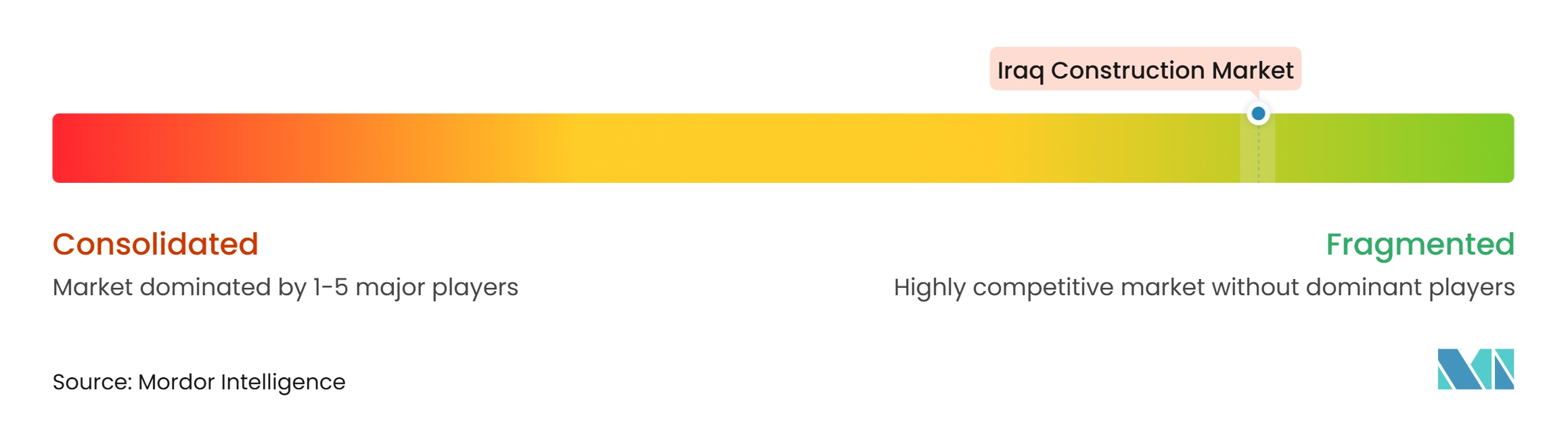
The Iraq construction market is fragmented in nature, with competitive activity spread across international engineering, procurement, and construction (EPC) contractors, regional companies, and local Iraqi firms. International contractors lead large energy, transport, and water packages that require deep technical resources and strong financing capacity. Local Iraqi and regional firms compete more actively in residential, municipal, civil, and support works, where local relationships, licensing, and subcontractor networks are important. ENKA, Hyundai Engineering and Construction, China Petroleum Pipeline Engineering, and Daewoo have secured major energy, water, pipeline, and port packages. Local contractors often participate as subcontractors, suppliers, site-service providers, and delivery partners on these projects. Egyptian construction and real estate companies have also increased their activity in Iraq, adding competition in civil works and property development.
Competitive positioning varies by project type and is increasingly based on delivery capability rather than price alone. Contractors that can manage public-private partnership structures, integrated project delivery, digital project management, and performance-based maintenance can be better positioned for complex projects. ENKA's engineering, procurement, supply, construction, and commissioning contract for the Associated Gas Upstream Project Phase 2 is an example of an integrated technical and delivery strategy. Hyundai Engineering and Construction's seawater treatment plant award is another example of a strategic move into energy-support infrastructure. China Petroleum Pipeline Engineering's USD 2.524 billion pipeline award highlights the continued role of Chinese engineering capacity in major southern Iraq projects. These contracts show that technical scope, execution record, and client confidence influence awards alongside cost.
The fragmented competitive landscape also leaves opportunities in modular housing, green building standards for commercial projects, and performance-based maintenance for roads and utilities. These fields remain less established than traditional civil works or large energy engineering packages. Local groups such as Mass Group Holding and Al-Burhan Group could benefit if housing procurement gives greater scope to domestic firms with modern methods of construction. International firms will likely retain an advantage in the largest EPC packages. Still, they will continue to rely on local partners for permits, labor supply, site logistics, materials handling, and community coordination. Overall, competition remains dispersed across project types, with different firms holding advantages in large industrial projects, public infrastructure, real estate development, and municipal delivery.
Iraq Construction Industry Leaders
-
Baghdad Engineering Company for Construction Investments and Trade
-
Builton Global
-
Bawabet Al Iraq Group
-
Mass Group Holding
-
Haris Al-Aqeelah Group
- *Disclaimer: Major Players sorted in no particular order
Iraq Construction Market Companies Covered in this Report
- Baghdad Engineering Company for Construction Investments and Trade
- Builton Global
- Bawabet Al Iraq Group
- Mass Group Holding
- Haris Al-Aqeelah Group
- Al-Burhan Group
- Shamara Holding
- Ibn-Yakteen
- JGC Corporation
- Daewoo Engineering and Construction Co. Ltd.
- Hyundai Engineering and Construction Co. Ltd.
- Bechtel Corporation
- China State Construction Engineering Corporation
- Samsung C and T Corporation
- Larsen and Toubro Limited
- Orascom Construction PLC
- CCC (Consolidated Contractors Company)
- Hill International, Inc.
- AECOM
- KBR, Inc.
Recent Industry Developments in Iraq Construction Market
- June 2026: Egypt's Talaat Moustafa Group received investment license No. 2026/515 from Iraq's National Investment Commission for an integrated urban development in southwest Baghdad, covering 12.8 million m² with projected sales of USD 18.8 billion and approximately 43,000 residential units. The project signals a new tier of foreign real estate capital committing to Iraq on long development cycles.
- June 2026: The World Bank's Board of Executive Directors approved USD 900 million in financing for the Iraq Transport Economic Corridors project, funding strategic road rehabilitation and new construction on Expressway 1 and Expressway 2 corridors. The project targets 7.9 million beneficiaries and marks the World Bank's second major infrastructure commitment in Iraq in 12 months.
- January 2026: PowerChina International and Iraq's Al-Ridha Group signed an engineering, procurement, and construction contract worth USD 2.4 billion with Basra province for the Grand Basra Seawater Desalination Project at Al-Faw, one of the largest water infrastructure contracts in Iraq's history.
Iraq Construction Market Report Scope
Segmentation Overview
| Residential | Apartments / Condominiums |
| Villas / Landed Houses | |
| Commercial | Office |
| Retail | |
| Industrial & Logistics | |
| Others | |
| Infrastructure | Transportation Infrastructure (Roadways, Railways, Airways, Others) |
| Energy & Utilities | |
| Others |
| New Construction |
| Renovation |
| Conventional On-Site |
| Modern Methods of Construction (Prefabricated, Modular, etc.) |
| Public |
| Private |
| Baghdad |
| Basra |
| Erbil |
| Sulaymaniyah |
| Rest of Iraq |
| By Sector | Residential | Apartments / Condominiums |
| Villas / Landed Houses | ||
| Commercial | Office | |
| Retail | ||
| Industrial & Logistics | ||
| Others | ||
| Infrastructure | Transportation Infrastructure (Roadways, Railways, Airways, Others) | |
| Energy & Utilities | ||
| Others | ||
| By Construction Type | New Construction | |
| Renovation | ||
| By Construction Method | Conventional On-Site | |
| Modern Methods of Construction (Prefabricated, Modular, etc.) | ||
| By Investment Source | Public | |
| Private | ||
| By Geography | Baghdad | |
| Basra | ||
| Erbil | ||
| Sulaymaniyah | ||
| Rest of Iraq | ||
Key Questions Answered in the Report
What is the size of Iraq construction activity in 2027?
The Iraq construction market is valued at USD 39.11 billion in 2027 and is projected to reach USD 50.47 billion by 2032 at a CAGR of 5.23%.
Which segment holds the largest share in Iraq?
Infrastructure is the largest segment, holding 40.1% of the Iraq construction market in 2026.
Which construction sector is growing fastest?
Commercial construction is the fastest-growing sector, with a projected CAGR of 5.94% between 2027 and 2032.
Why is public investment important in Iraq?
Public investment held 76.2% of the market in 2026 because the government remains the main funder of transport, water, energy, housing, and municipal projects.
Which location has the largest construction base in Iraq?
Baghdad held 32.5% of the market in 2026, supported by its concentration of government programs, infrastructure needs, and private urban development.
Which location is expected to grow fastest?
Erbil is projected to grow at a CAGR of 6.22% between 2027 and 2032, supported by private investment, comparative stability, and licensed development activity.