
IoT Network Slice Management Market Size and Share
Market Overview
| Study Period | 2021 - 2032 |
|---|---|
| Market Size (2027) | USD 0.59 Billion |
| Market Size (2032) | USD 1.73 Billion |
| Growth Rate (2027 - 2032) | 24.00 % |
| Fastest Growing Market | Middle East |
| Largest Market | North America |
| Market Concentration | Medium |
Major Players *Disclaimer: Major Players sorted in no particular order Image © Mordor Intelligence. Reuse requires attribution under CC BY 4.0. | |
IoT Network Slice Management Market Analysis by Mordor Intelligence
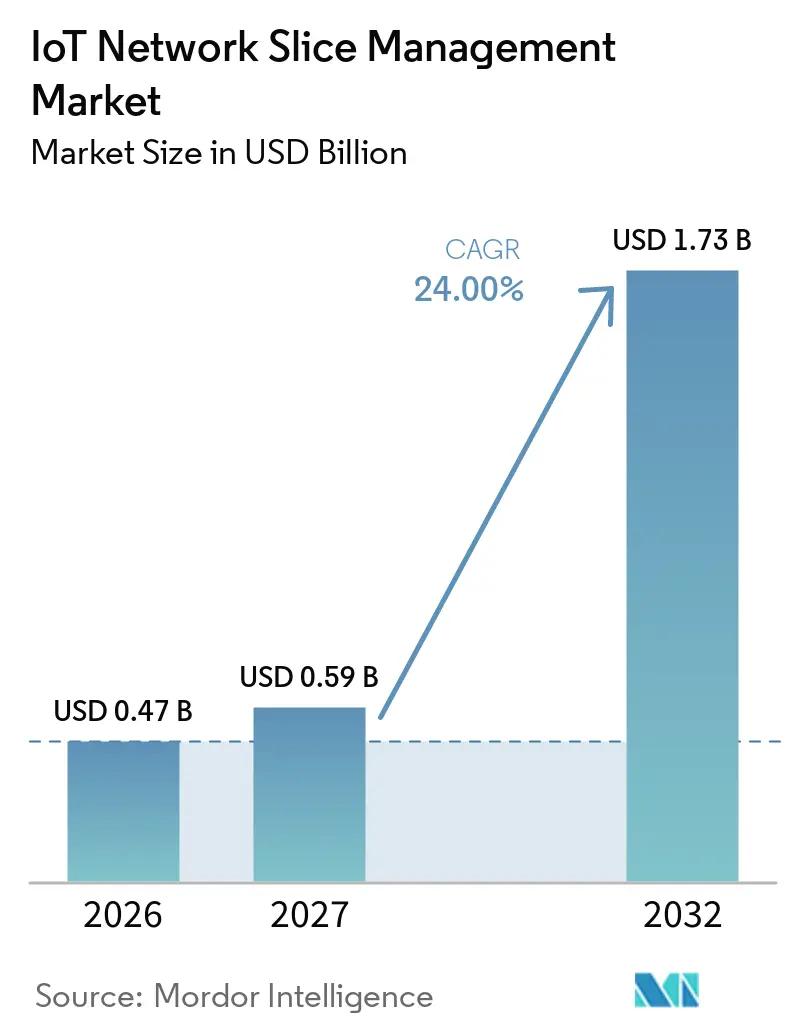
The IoT network slice management market size is projected to expand from USD 0.47 billion in 2026 and USD 0.59 billion in 2027 to USD 1.73 billion by 2032, registering a CAGR of 24.00% between 2027 to 2032. The IoT network slice management market is moving from best-effort cellular connectivity toward isolated network partitions with defined latency, reliability, and bandwidth commitments. Commercial 5G standalone cores are making native network slice management functions available, while non-standalone networks still limit deployment options in several regions. This change gives operators a route to package connectivity as a software-led service rather than a fixed infrastructure product, with service definitions that align more closely with specific enterprise applications and their operating conditions. Demand is strongest where industrial systems, vehicles, and public services require traffic control that conventional cellular networks cannot provide, especially where a delay or interruption has direct operational, safety, or service-delivery consequences. Vendors that simplify deployment across cloud, edge, and enterprise sites are better placed to convert technical trials into recurring service contracts.
Key Report Takeaways
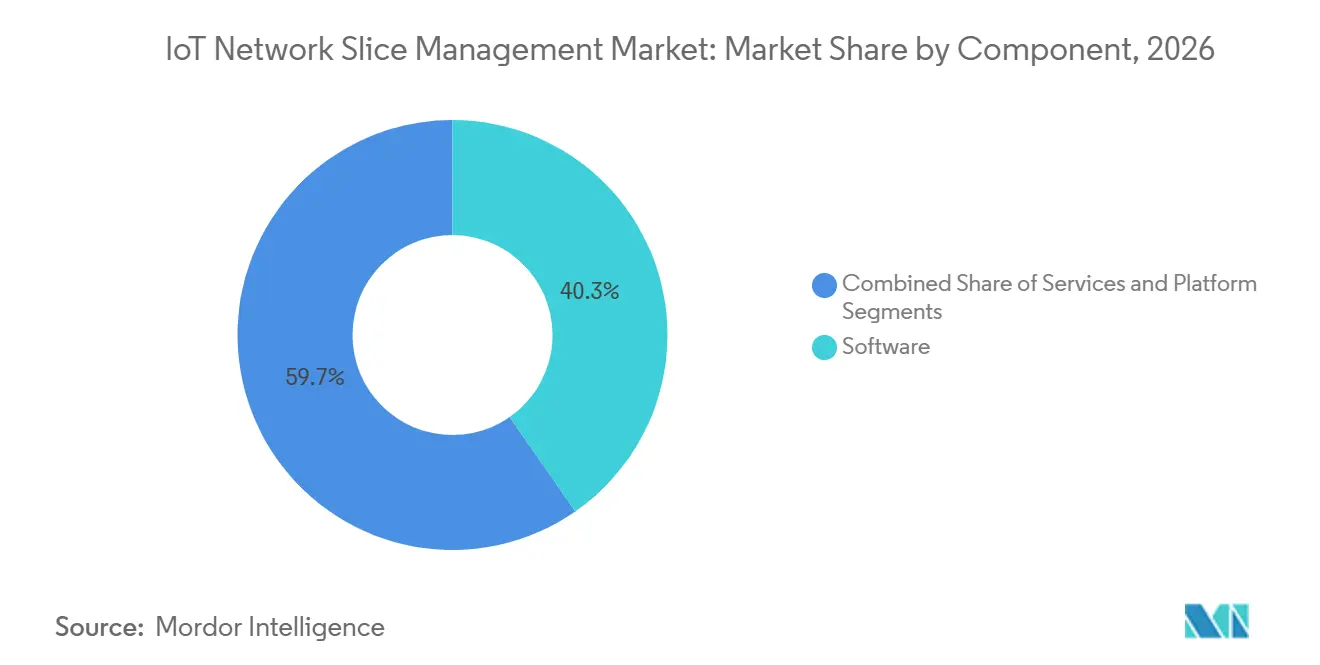
- By component, software held 40.32% of revenue in 2026, while services are expected to expand at a 25.13% CAGR through 2032 in the IoT network slice management market.
- By deployment mode, cloud accounted for 44.87% of revenue in 2026 and is expected to expand at a 26.74% CAGR through 2032.
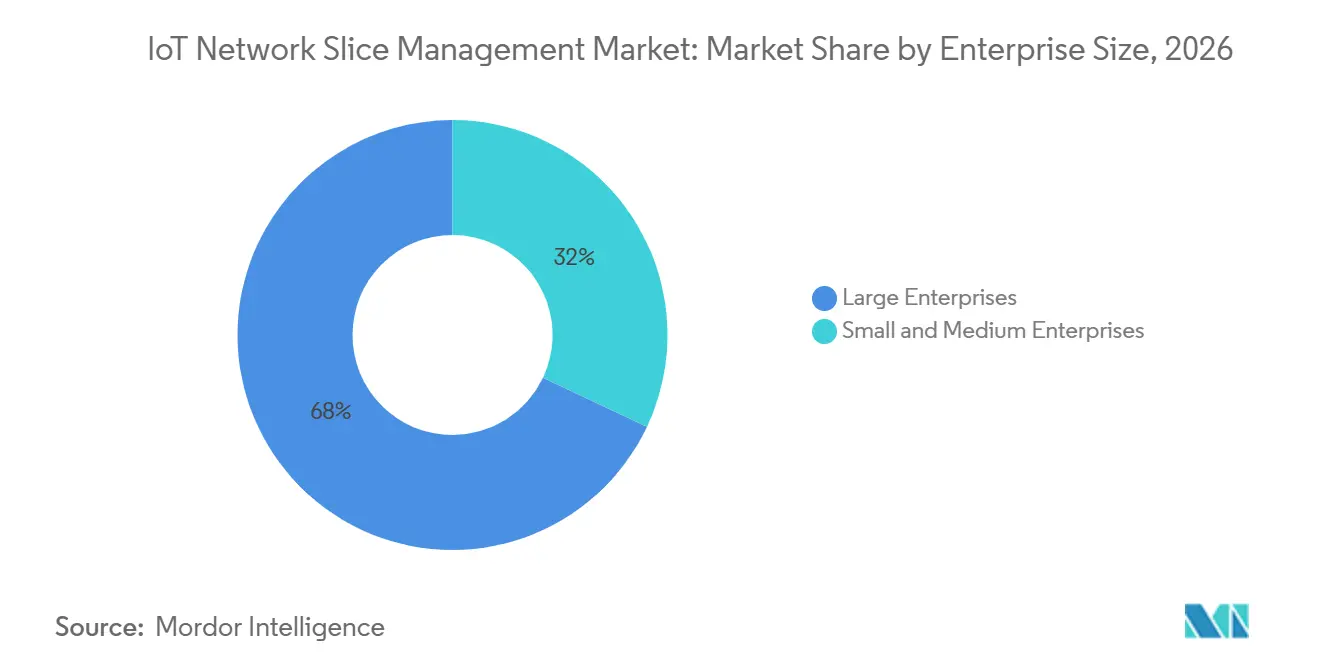
- By enterprise size, large enterprises held 67.98% of revenue in 2026, while small and medium enterprises are expected to expand at a 25.65% CAGR through 2032 in the IoT network slice management market.
- By application, enhanced mobile broadband held 25.66% of revenue in 2026, while ultra-reliable low-latency communications are expected to expand at a 26.48% CAGR through 2032.
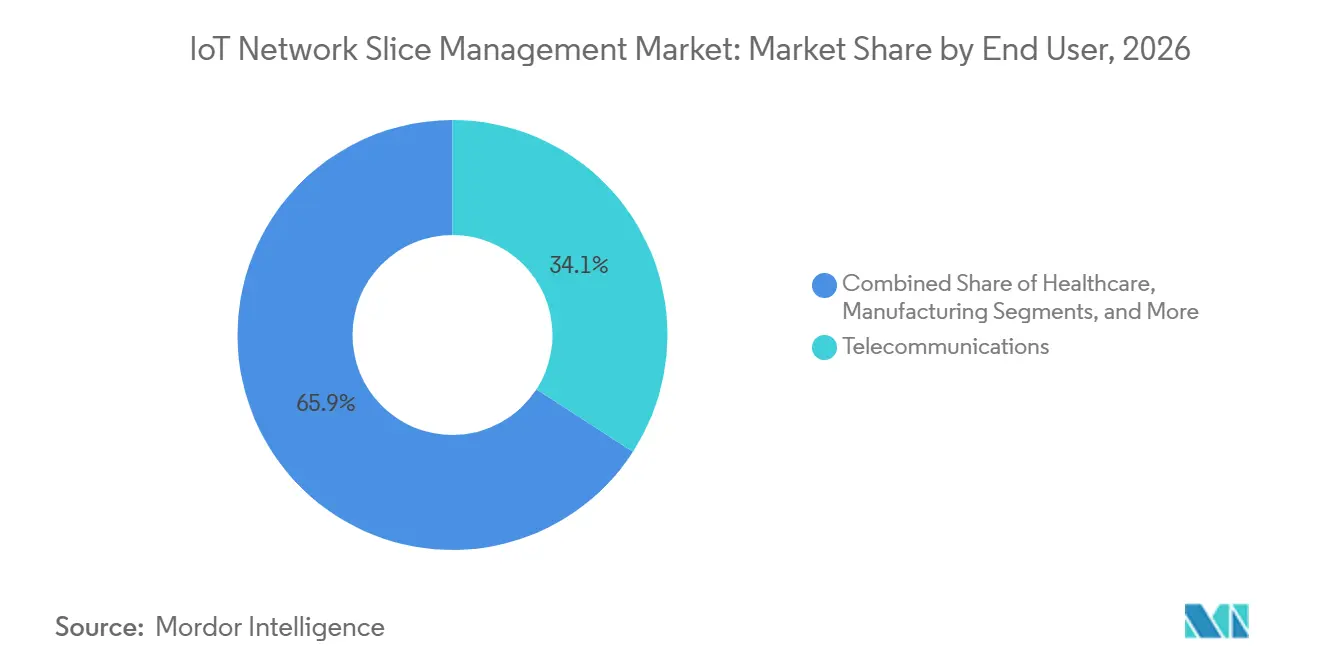
- By end user, telecommunications accounted for 34.14% of revenue in 2026, while automotive is expected to expand at a 25.88% CAGR through 2032 in the IoT network slice management market.
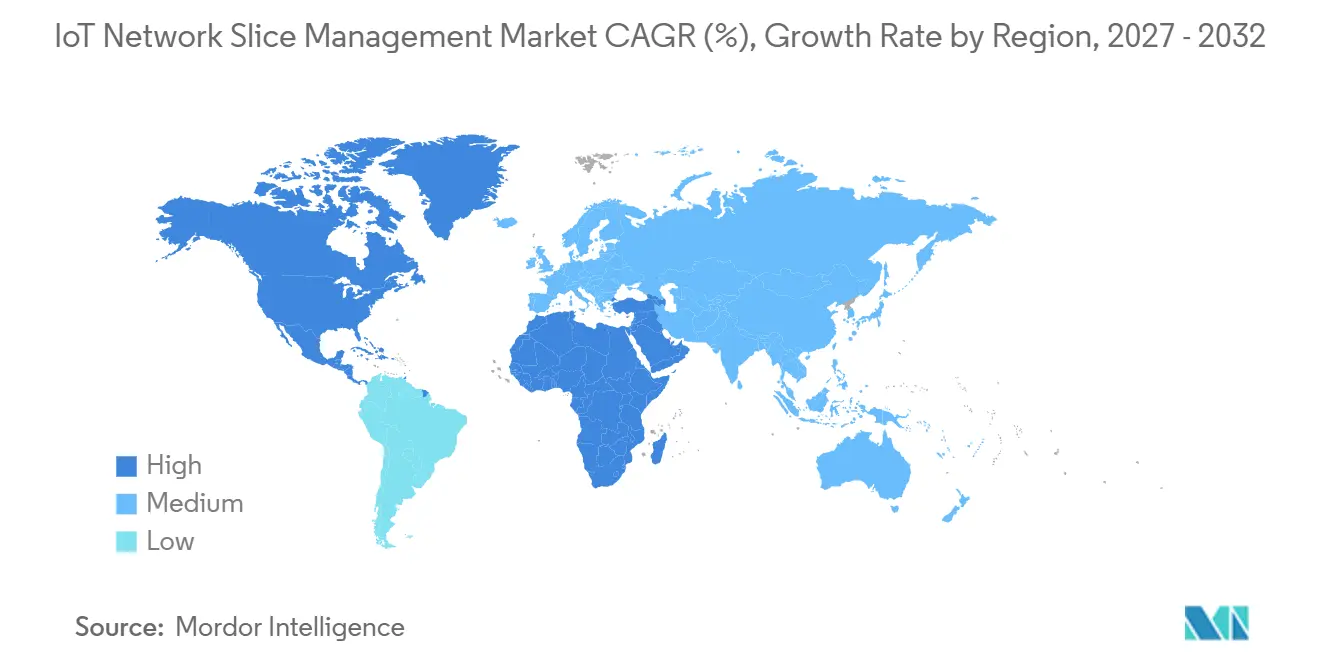
- By geography, North America held 29.99% of revenue in 2026, while the Middle East is expected to expand at a 26.21% CAGR through 2032 in the IoT network slice management market.
Note: Market numbers in this report are based on Mordor Intelligence's proprietary estimation framework, which combines nine months of actuals with Q4 projections for base year 2026.
Market Trends and Insights
Drivers Impact Analysis of IoT Network Slice Management Market*
| DRIVER | (~) % IMPACT ON CAGR FORECAST | GEOGRAPHIC RELEVANCE | IMPACT TIMELINE |
|---|---|---|---|
| 5G Standalone Rollouts Enabling Native Slice Control | +4.8% | Global | Short term (≤ 2 years) |
| Rising Industrial IoT Demand for Deterministic Connectivity | +4.3% | Asia-Pacific, North America, Europe | Medium term (2–4 years) |
| Enterprise Demand for SLA-Based Connectivity and Network-as-a-Service | +3.6% | North America and Europe, with early gains in Gulf markets | Medium term (2–4 years) |
| Growth of Edge Computing and Distributed User-Plane Functions | +2.7% | Global, led by Asia-Pacific and North America | Medium term (2–4 years) |
| Application-Aware Slice Selection for Connected Vehicles and Mobile IoT | +2.1% | North America and Europe, with adoption in South Korea and Japan | Medium term (2–4 years) |
| AI-Assisted Closed-Loop Slice Assurance and Resource Optimization | +1.8% | Global | Long term (≥ 4 years) |
| Source: Mordor Intelligence | |||
5G Standalone Rollouts Enable Native Slice Control
Commercial 5G standalone deployment enables slice control that non-standalone architectures cannot offer because it exposes cloud-native core functions and management interfaces. Telia launched Critical IoT Connectivity in Sweden in June 2026 as a commercial 5G standalone service for emergency services, energy, and industrial IoT uses that require slicing and low latency.[1] 3GPP Release 16 and later releases provide management interfaces that support orchestration across network domains and vendor systems. Nokia states that automation can reduce slice creation work from hundreds of hours to near-real-time execution in a network with 10,000 gNodeBs. The IoT network slice management market, therefore, favors operators that complete standalone core modernization and expose application programming interfaces for enterprise services. Operators that delay this migration risk having fewer differentiated service options as industrial buyers begin to request defined service commitments.
Rising Industrial IoT Demand for Deterministic Connectivity
Robotic control, automated guided vehicles, and real-time quality inspection need predictable connectivity that best-effort cellular service cannot guarantee. IEC PAS 63595:2025 links 5G time-sensitive networking and slicing to industrial safety and security frameworks, including IEC 61508 and IEC 62443. This framework is relevant to existing factories because a 5G ultra-reliable slice can act as a wireless bridge for time-sensitive networking without extensive civil works. China’s 2026-2028 IoT plan identifies 5G network slicing as enabling infrastructure and targets IoT terminal connections at a hundred-billion scale. The plan also sets a core IoT industry scale target above CNY 3.5 trillion (USD 482 billion).[2] These conditions support the IoT network slice management market as industrial automation spreads beyond greenfield projects.
Enterprise Demand for SLA-Based Connectivity and Network-as-a-Service
Enterprises are shifting from purchasing raw bandwidth toward service tiers with contractual commitments on latency, reliability, and traffic isolation. AT&T and Cisco activated a 5G standalone-native IoT platform in February 2026 that combines AT&T’s nationwide standalone core with Cisco IoT Control Center and Converged Core.[3] The platform supports programmable slicing for connected vehicles, smart cities, and digital healthcare at a national scale. Connectivity delivered through an application programming interface can move purchasing decisions toward operating budgets and reduce the need for enterprises to own specialized infrastructure. NTT launched its 5G Slicing service in March 2026 with always-on and event-based bandwidth reservation options for industrial, broadcasting, and infrastructure users. These launches make the IoT network slice management market more dependent on clear service definitions and reliable SLA monitoring.
Growth of Edge Computing and Distributed User-Plane Functions
Distributed user-plane functions at the network edge shift where slice rules are applied and increase the number of points that management systems must coordinate. Research presented at IEEE WCNC 2025 found that joint user-plane function and application placement improved user acceptance by up to 17% and reduced provisioning costs by 23.4% compared with the study’s baseline schemes.[4] A 2026 study found that the placement of 5G network functions needs ongoing reassessment as traffic patterns change, strengthening the case for automated management rather than static configuration. Every additional edge node expands the orchestration state that the network slice management function must reconcile. This creates demand for hierarchical management and automated user-plane selection in the IoT network slice management market. Edge-based deployments are particularly relevant when time-critical traffic cannot absorb the delay of routing through a distant core.
Restraints Impact Analysis of IoT Network Slice Management Market*
| RESTRAINT | (~) % IMPACT ON CAGR FORECAST | GEOGRAPHIC RELEVANCE | IMPACT TIMELINE |
|---|---|---|---|
| Multi-Domain and Multi-Vendor Orchestration Complexity | -2.9% | Global | Short term (≤ 2 years) |
| High Transformation Costs and Limited Skilled Workforce | -2.0% | South America, Africa, and Southeast Asia | Medium term (2–4 years) |
| Cross-Tenant Security and Slice-Isolation Risk | -1.5% | Global | Medium term (2–4 years) |
| Inconsistent Commercialization of Slice-Level SLAs and APIs | -1.2% | Global | Long term (≥ 4 years) |
| Source: Mordor Intelligence | |||
Multi-Domain and Multi-Vendor Orchestration Complexity
A slice spanning radio access, transport, and core networks from different suppliers requires coordination across many managed objects. Nokia reports that creating a single slice across a 10,000-node network can require hundreds of configuration commands and hundreds of hours of work without automation. IEEE research published in February 2026 describes multi-domain SLA decomposition as a federated orchestration problem that is still under active standardization. This complexity encourages enterprise buyers to select a full-stack supplier, even when specialized software may offer an attractive feature set. ETSI’s zero-touch management framework and 3GPP interfaces provide a path to interoperability, but they do not eliminate the practical burden of integration. The restraint limits opportunities for standalone tools in the IoT network slice management market until higher levels of automation become more common.
High Transformation Costs and Limited Skilled Workforce
Cloud-native 5G adoption requires investment in core upgrades, orchestration licenses, integration services, and operational changes. These costs affect smaller operators and enterprises more sharply in markets where 5G standalone coverage is still limited. Slice management also requires people who understand cloud-native network functions, 3GPP interfaces, and SLA engineering. This combination is less common in traditional telecommunications teams, which have historically focused on network infrastructure rather than software operations. South America, Africa, and parts of Southeast Asia face a longer path because standalone rollout schedules trail those in North America and Europe. Managed services can reduce the internal skills burden, but they can also extend the sales process and delay revenue conversion for the IoT network slice management market.
*Our forecasts treat driver/restraint impacts as directional, not additive. The impact forecasts reflect baseline growth, mix effects, and variable interactions.
IoT Network Slice Management Market Segment Analysis
By Component:
Software Holds the Largest Revenue Position, While Services AccelerateSoftware is projected to account for 40.32% of the IoT network slice management market in 2026, as orchestration engines, policy suites, and implementations of network slice management functions form the core of commercial slice delivery. Software platforms coordinate the creation, modification, assurance, and retirement of network slices across radio access, transport, core, and enterprise network domains. These domains must operate together to maintain service usability. Vendors that support 3GPP Release 17 and Release 18 management interfaces can better meet operator requirements for multivendor environments. Unified management consoles reduce the number of tools that operations teams use to address SLA issues while providing technical staff with clearer visibility into the relationship between service policies and customer-experienced performance. These consoles also enable operators to view policies, performance metrics, and alarms through a single operating interface.
Services are expected to expand at a CAGR of 25.13% through 2032, reflecting enterprises’ preference for contracts that transfer operational complexity to specialist providers. Many enterprises lack the internal teams required to design, operate, and assure slice policies across sites and public networks, particularly when these policies must integrate with existing operational technology, cloud applications, and security procedures. Managed service arrangements allow vendors to assume responsibility for integration, lifecycle operations, and agreed performance outcomes. In March 2026, Ericsson and Nokia are expected to announce cross-ecosystem rApp portability, enabling applications to operate across both companies’ orchestration marketplaces. Within the IoT network slice management industry, services provide suppliers with a means to support customers lacking internal network automation capabilities.

By Deployment Mode:
Cloud Combines Scale With the Highest Expansion RateCloud deployment is projected to account for 44.87% of revenue in 2026 and expand at a CAGR of 26.74% through 2032. Cloud-native network functions align naturally with centralized orchestration, policy control, and lifecycle management. This approach enables operators to apply common processes when introducing new service types or adjusting capacity across geographically dispersed customer locations. Hosted platforms can provision and modify slice settings more rapidly than traditional on-premises deployments when IoT workloads change. The model also reduces the initial infrastructure burden for operators by introducing network-as-a-service offerings, allowing them to build services on shared cloud resources rather than duplicating management infrastructure for each customer deployment. In addition, cloud deployment supports centralized visibility for enterprises managing connected assets across multiple sites.
On-premises deployment remains relevant for users in defense, critical infrastructure, and financial services who require local control-plane operations or strict data residency. Hybrid architectures serve industrial groups that require local user-plane control at specific plants while using centralized cloud orchestration elsewhere. These arrangements can preserve low-latency performance while maintaining centralized policy management. NTT’s 5G Slicing service demonstrates how cloud-managed bandwidth reservation can support industrial systems and venue operations. Therefore, the IoT network slice management market supports cloud, on-premises, and hybrid deployment models rather than a single deployment approach.
By Enterprise Size:
Large Enterprises Lead, While Smaller Firms Gain AccessLarge enterprises are projected to account for 67.98% of the IoT network slice management market revenue in 2026, as they possess the scale and governance capabilities required to manage complex slice integration. Their established relationships with operators also facilitate multiyear contract negotiations with defined service commitments, including reporting arrangements, escalation processes, and financial provisions that smaller buyers may find difficult to establish. Manufacturing automation and healthcare data transmission can justify investment when high traffic volumes require defined performance levels. Large organizations often use managed service agreements that assign SLA compliance responsibilities to suppliers. This structure reflects the ability of larger teams to define, monitor, and enforce detailed performance requirements.
Small and medium enterprises are expected to expand at a CAGR of 25.65% through 2032, as cloud-native platforms and prepackaged private 5G offerings reduce management complexity. Adoption is most visible in manufacturing and logistics, where automation requirements are high but internal technology resources are limited. Operators can bundle connectivity, management software, and support services into simpler offerings for these customers, reducing the need for internal teams to interpret network policy settings or coordinate multiple specialist suppliers. Data isolation requirements can also strengthen the case for a dedicated slice rather than a shared best-effort service. The IoT network slice management market can address a broader customer base if providers simplify implementation and pricing.
By Application:
Enhanced Mobile Broadband Leads, While URLLC Moves Into Production UseEnhanced mobile broadband is projected to account for 25.66% of the IoT network slice management market revenue in 2026, making it the largest application segment. High-throughput slices support video surveillance, remote asset monitoring, and broadband IoT backhaul applications, where predictable bandwidth represents the primary requirement. Operators introduced these slices early because their radio configurations are less complex than those required for ultra-reliable low-latency communications (URLLC). This sequencing enabled operators to gain practical experience in slice provisioning and assurance. It also created a customer base that can subsequently adopt more demanding service classes, providing suppliers with an established commercial path from bandwidth assurance to low-latency and mission-critical connectivity offerings.
URLLC is expected to expand at a CAGR of 26.48% through 2032 as factory automation and vehicle-to-everything deployments move beyond the trial stage. IEEE research indicates that industrial IoT applications may require sub-millisecond latency and five-nines reliability. Massive machine-type communications support dense sensor deployments in smart cities and precision agriculture, where numerous low-power devices may transmit small data packets while the network must maintain visibility and policy control. Industrial deployments increasingly align 5G quality-of-service identifiers with time-sensitive networking cycle times. The IoT network slice management industry will depend on operators’ ability to demonstrate that they can maintain these commitments in live networks.
By End User:
Telecommunications Leads Deployment, While Automotive Has the Fastest OutlookTelecommunications is projected to account for 34.14% of the IoT network slice management market revenue in 2026, as operators are the primary buyers of management platforms and providers of sliced connectivity. This dual role gives operators a cost-control incentive to invest internally and a revenue-generation incentive to sell services to other sectors. It directly links technology investment to their ability to develop differentiated enterprise connectivity offerings. Healthcare providers use low-latency slices for remote assistance and vital-sign telemetry. Manufacturers use isolated connectivity for production-line control, while utilities separate operational technology traffic from information technology traffic. Transportation and logistics operators are also beginning to use dedicated connectivity for port automation and intermodal freight tracking.
Automotive is expected to expand at a CAGR of 25.88% through 2032, as vehicle-to-everything services require consistent connectivity across changing coverage areas. 3GPP Release 20 is expected to specify architectural enhancements for vehicle-to-everything services. AI-assisted slice migration can help maintain service continuity as vehicles move across coverage zones. This use case increases the importance of application-aware policy decisions and consistent performance monitoring. These requirements create opportunities in the IoT network slice management market as operators and automotive suppliers collaborate across network boundaries.
Geography Analysis
The Americas IoT Network Slice Management Market
North America is projected to account for 29.99% of the IoT network slice management market in 2026, driven by mature 5G standalone deployments and enterprise network-as-a-service procurement. In February 2026, AT&T and Cisco are expected to commercially activate a standalone-native IoT platform for connected vehicles, smart cities, and healthcare applications. This rollout is expected to demonstrate how operators can integrate slice management with enterprise control platforms, enabling customers to order, monitor, and modify connectivity services through familiar operational interfaces. South America remains at an earlier stage of adoption, with Brazil serving larger mining, agriculture, and logistics organizations that can justify managed service contracts.
Europe and APAC IoT Network Slice Management Market
Europe is witnessing the adoption of IoT network slice management, particularly in Germany, the United Kingdom, and France, where Industry 4.0 initiatives and data sovereignty requirements support traffic isolation. The European Electronic Communications Code and the EU Cyber Resilience Act support more controlled connectivity in regulated environments. However, native slicing depends on a standalone architecture, which remains limited across Europe. As a result, some enterprises face a gap between their demand for service guarantees and the commercially available capabilities in their local markets. Telia is expected to launch commercial standalone slice services in Sweden in June 2026, indicating that these services are expanding across European markets. Asia-Pacific has a large base of industrial IoT devices, while China’s policy support positions domestic suppliers favorably.
MEA IoT Network Slice Management Market
The Middle East is expected to expand at a CAGR of 26.21% through 2032, the highest rate among regions in the IoT network slice management market. Saudi Arabia’s Vision 2030 initiatives and the UAE’s telecommunications deployments support this growth, as operators and public-sector programs incorporate private wireless networks, industrial digitalization, and advanced enterprise services into broader infrastructure investment plans. In December 2025, Nokia and du are expected to deploy an autonomous 5G Advanced slicing solution in the UAE. In February 2025, Nokia, Cisco, and ACES are expected to sign a memorandum of understanding in Saudi Arabia to develop private wireless networks. Africa remains in its early stages, but its agriculture, energy, and logistics industries present long-term opportunities as standalone coverage improves.
Competitive Landscape
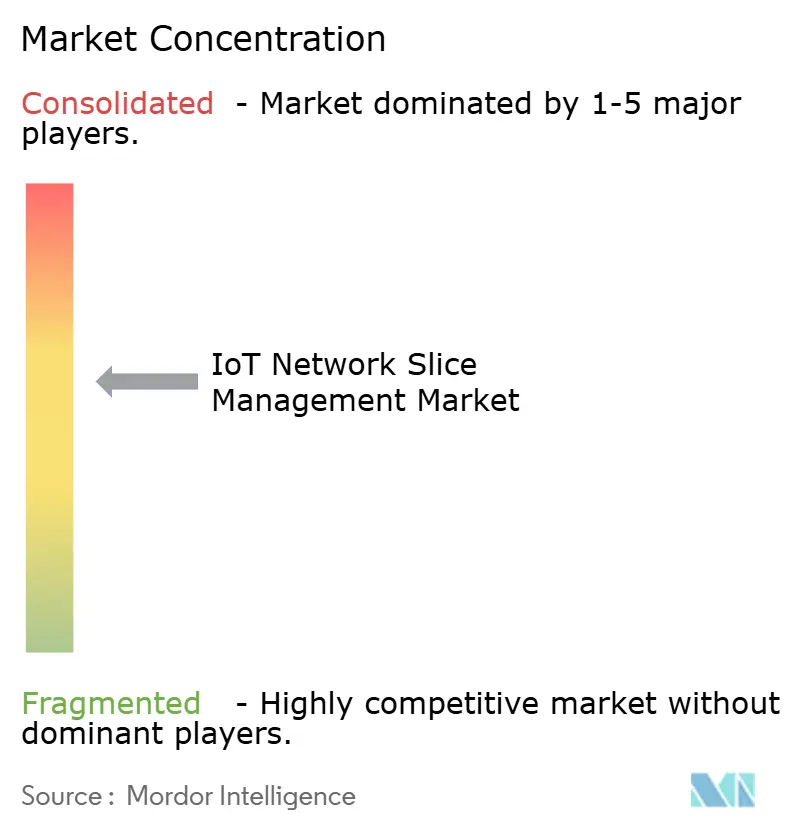
The IoT network slice management market is moderately concentrated at the platform and orchestration layer, where Ericsson, Nokia, Cisco, and Huawei offer broad 5G portfolios. Their integrated technology stacks reduce customer risk when selecting separate suppliers for radio, transport, core, and management. A single vendor can assume clearer responsibility for integration, assurance, and issue resolution across the service chain. In March 2026, Ericsson and Nokia are expected to announce the availability of rApps across both companies’ orchestration marketplaces. This initiative is expected to increase the practical value of automation applications in multivendor environments and raise the competitive threshold for smaller suppliers focused solely on orchestration.
Nokia’s planned December 2025 deployment with du is expected to combine AirScale base stations, MantaRay orchestration, and machine learning-driven rApps to adjust radio slice policies. The project highlights closed-loop automation and assurance as key differentiators, as operators need to adjust resources and policies in response to changing demand without relying on lengthy manual configuration processes. Cisco’s planned February 2026 collaboration with AT&T is expected to combine a nationwide standalone core with IoT Control Center and Converged Core. IBM and Microsoft are addressing analytics and intent translation through operator partnerships, reflecting the importance of data analytics and assurance capabilities around the core platform.
White-space opportunities remain in cloud-native tools for small and medium-sized enterprises, as well as in hybrid solutions that coordinate public and on-premises 5G slices. These opportunities are particularly relevant for customers who require simplified deployment while retaining local control over sensitive workloads. Aarna Networks, Mavenir, and Celona compete in these segments by offering open, cloud-native architectures. ETSI’s zero-touch management work provides a standards reference for multivendor interoperability claims. The IoT network slice management industry continues to offer opportunities for specialist providers; however, integrated vendors hold an advantage when customers prioritize accountability for service outcomes, clear commercial ownership, and predictable support throughout the network lifecycle.
IoT Network Slice Management Industry Leaders
-
Huawei Technologies Co., Ltd.
-
Nokia Corporation
-
Cisco Systems, Inc.
-
Samsung Electronics Co., Ltd.
-
ZTE Corporation
- *Disclaimer: Major Players sorted in no particular order
IoT Network Slice Management Market Companies Covered in this Report
- Telefonaktiebolaget LM Ericsson
- Huawei Technologies Co., Ltd.
- Nokia Corporation
- Cisco Systems, Inc.
- Samsung Electronics Co., Ltd.
- ZTE Corporation
- NEC Corporation
- Amdocs Limited
- Mavenir Systems, Inc.
- Hewlett Packard Enterprise Company
- Ciena Corporation
- Juniper Networks, Inc.
- Microsoft Corporation
- International Business Machines Corporation
- Verizon Communications Inc.
- AT&T Inc.
- T-Mobile US, Inc.
- NTT DOCOMO, INC.
- BT Group plc
- Orange S.A.
- Türk Telekomünikasyon A.Ş.
- Aarna Networks, Inc.
- Parallel Wireless, Inc.
- Celona, Inc.
- Keysight Technologies, Inc.
- NetScout Systems, Inc.
Recent Industry Developments in IoT Network Slice Management Market
- June 2026: Telia Sweden launched Critical IoT Connectivity, the first commercially available 5G standalone network slicing service in Sweden, targeting emergency services, energy, transport, industry, and healthcare with dedicated, SLA-backed bandwidth. The launch marks a Nordic commercialization milestone and signals operator confidence in the operational maturity of slice management for production IoT deployments.
- March 2026: NTT DOCOMO Business and NTT DOCOMO launched "5G Slicing" under the "docomo business Private 5G" platform, offering always-on bandwidth reservation for manufacturing and control systems and event-based reservation for stadiums and large venues. Japan's first large-scale B2B 5G standalone slice commercial service sets a NaaS pricing and service design reference that Asia-Pacific operators are actively benchmarking.
- March 2026: Ericsson and Nokia announced a cross-ecosystem collaboration, placing Ericsson in Nokia's SMO Marketplace and Nokia in Ericsson's rApp Ecosystem, enabling CSPs to deploy automation applications across both platforms with shared R1 interface standards. The collaboration specifically targets the multivendor SMO environment and advances the market toward Level 4 autonomous network operation.
- February 2026: AT&T and Cisco commercially activated a 5G standalone-native IoT platform that integrates AT&T's nationwide 5G standalone core with Cisco's Mobility Services Platform, IoT Control Center, and Converged Core, enabling programmable network slicing for connected vehicles, smart cities, and digital healthcare at a national scale. The deployment represents one of the first nationally scaled enterprise IoT slice management commercial activations in the United States.
Global IoT Network Slice Management Market Report Scope
The IoT Network Slice Management Market Report is Segmented by Component (Software, Services, and Platform), Deployment Mode (Cloud, On-Premises, and Hybrid), Enterprise Size (Large Enterprises and Small and Medium Enterprises), Application (Massive Machine-Type Communications, Ultra-Reliable Low-Latency Communications, Enhanced Mobile Broadband, Industrial Internet of Things, and Smart Cities), End User (Telecommunications, Healthcare, Manufacturing, Automotive, Energy and Utilities, and Transportation and Logistics), and Geography (North America, South America, Europe, Asia-Pacific, and the Middle East and Africa). The Market Forecasts are Provided in Value (USD).
Segmentation Overview
| Software |
| Services |
| Platform |
| Cloud |
| On-Premises |
| Hybrid |
| Large Enterprises |
| Small and Medium Enterprises |
| Massive Machine-Type Communications |
| Ultra-Reliable Low-Latency Communications |
| Enhanced Mobile Broadband |
| Industrial Internet of Things |
| Smart Cities |
| Telecommunications |
| Healthcare |
| Manufacturing |
| Automotive |
| Energy and Utilities |
| Transportation and Logistics |
| Other End Users |
| North America | United States |
| Canada | |
| Mexico | |
| South America | Brazil |
| Argentina | |
| Rest of South America | |
| Europe | United Kingdom |
| Germany | |
| France | |
| Italy | |
| Spain | |
| Rest of Europe | |
| Asia-Pacific | China |
| Japan | |
| India | |
| South Korea | |
| Rest of Asia-Pacific | |
| Middle East | Saudi Arabia |
| United Arab Emirates | |
| Rest of Middle East | |
| Africa | South Africa |
| Rest of Africa |
| By Component | Software | |
| Services | ||
| Platform | ||
| By Deployment Mode | Cloud | |
| On-Premises | ||
| Hybrid | ||
| By Enterprise Size | Large Enterprises | |
| Small and Medium Enterprises | ||
| By Application | Massive Machine-Type Communications | |
| Ultra-Reliable Low-Latency Communications | ||
| Enhanced Mobile Broadband | ||
| Industrial Internet of Things | ||
| Smart Cities | ||
| By End User | Telecommunications | |
| Healthcare | ||
| Manufacturing | ||
| Automotive | ||
| Energy and Utilities | ||
| Transportation and Logistics | ||
| Other End Users | ||
| By Geography | North America | United States |
| Canada | ||
| Mexico | ||
| South America | Brazil | |
| Argentina | ||
| Rest of South America | ||
| Europe | United Kingdom | |
| Germany | ||
| France | ||
| Italy | ||
| Spain | ||
| Rest of Europe | ||
| Asia-Pacific | China | |
| Japan | ||
| India | ||
| South Korea | ||
| Rest of Asia-Pacific | ||
| Middle East | Saudi Arabia | |
| United Arab Emirates | ||
| Rest of Middle East | ||
| Africa | South Africa | |
| Rest of Africa | ||
Key Questions Answered in the Report
What is the IoT network slice management market size?
The IoT network slice management market is projected to be USD 0.59 billion in 2027 and is forecast to reach USD 1.73 billion by 2032 at a 24.00% CAGR. The estimate reflects increasing use of standalone 5G core capabilities for managed enterprise connectivity.
What is driving demand for IoT network slice management?
Standalone 5G deployment, industrial automation, SLA-based services, and edge computing are increasing the demand for controlled connectivity. These factors help users separate critical traffic from less sensitive data flows.
Which component leads IoT network slice management revenue?
Software held the largest component share at 40.32% in 2026 because orchestration and policy tools are central to slice delivery. The segment includes functions for lifecycle control, service assurance, and policy coordination.
Which deployment model has the strongest outlook?
Cloud led with 44.87% of revenue in 2026 and is expected to expand at a 26.74% CAGR through 2032. Cloud delivery supports centralized management across sites and faster service configuration.
Which IoT network slice management application is expected to expand fastest?
Ultra-reliable low-latency communications are expected to grow at a 26.48% CAGR through 2032 as automation and vehicle connectivity enter production. The use case needs a defined latency and reliability for time-critical operations.
Which region has the strongest growth outlook?
The Middle East is expected to expand at a 26.21% CAGR through 2032, supported by telecommunications programs in Saudi Arabia and the UAE. Government-backed digital infrastructure investment supports private wireless and advanced service offers.