
Intravenous Stopcock Market Size and Share
Market Overview
| Study Period | 2020 - 2031 |
|---|---|
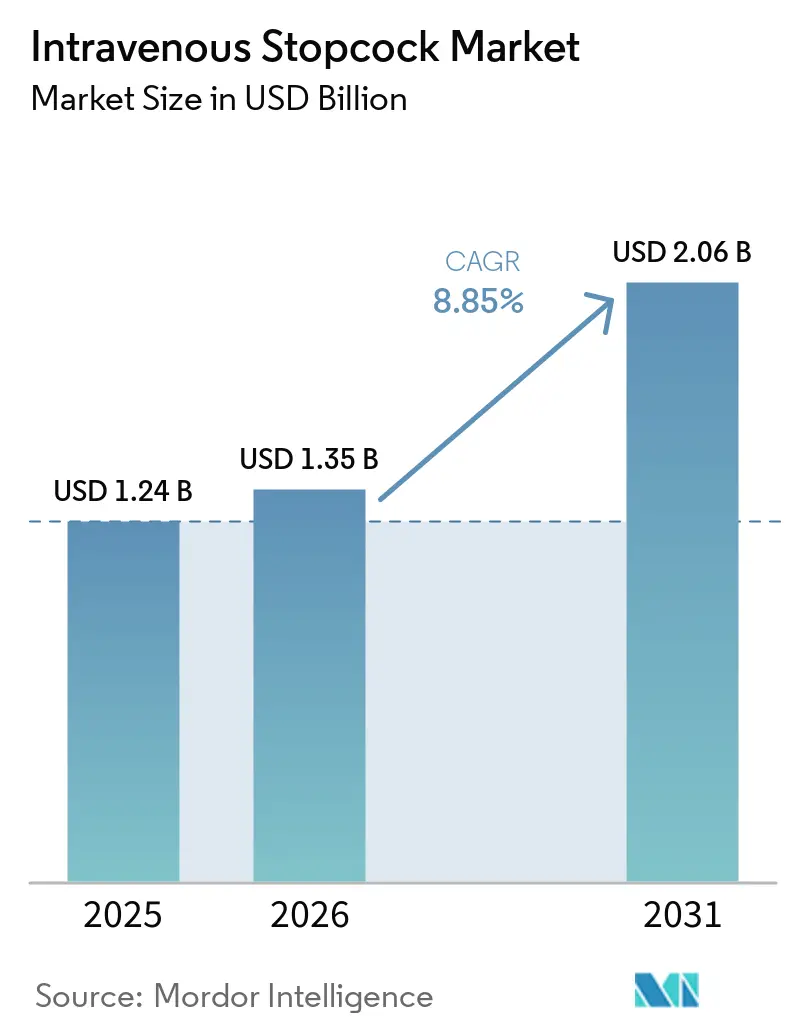
| Market Size (2026) | USD 1.35 Billion |
| Market Size (2031) | USD 2.06 Billion |
| Growth Rate (2026 - 2031) | 8.85 % |
| Fastest Growing Market | Asia-Pacific |
| Largest Market | North America |
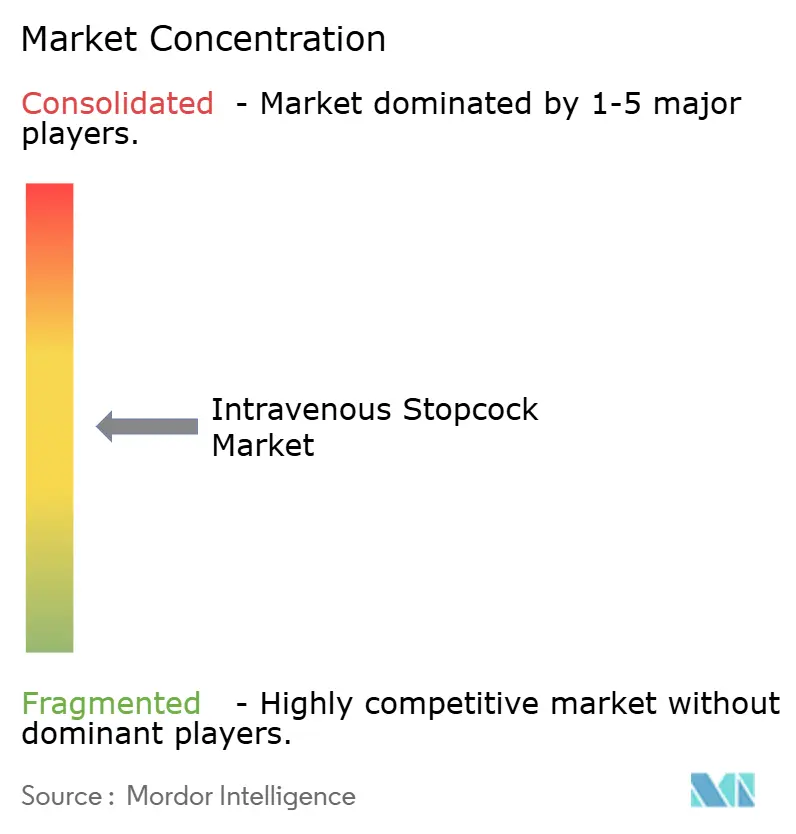
| Market Concentration | Medium |
Major Players *Disclaimer: Major Players sorted in no particular order Image © Mordor Intelligence. Reuse requires attribution under CC BY 4.0. | |
Intravenous Stopcock Market Analysis by Mordor Intelligence
The Intravenous Stopcock Market size was valued at USD 1.24 billion in 2025 and is estimated to grow from USD 1.35 billion in 2026 to reach USD 2.06 billion by 2031, at a CAGR of 8.85% during the forecast period (2026-2031).
Rising intravenous therapy volumes support demand as hospitals manage more chronic conditions through parenteral treatment across inpatient, outpatient, and procedure-based care, where clinicians must deliver fluids and medications through managed lines. Critical care capacity and interventional procedure activity also support the use of these components across complex care settings that depend on controlled access to several fluid paths, consistent product performance, and clear procedures for handling each connection. Infection prevention requirements are changing purchasing decisions because hospitals increasingly assess how line-access designs affect contamination risk, staff handling, and the consistency of established clinical procedures, especially when several teams may access the same line.
Key Report Takeaways
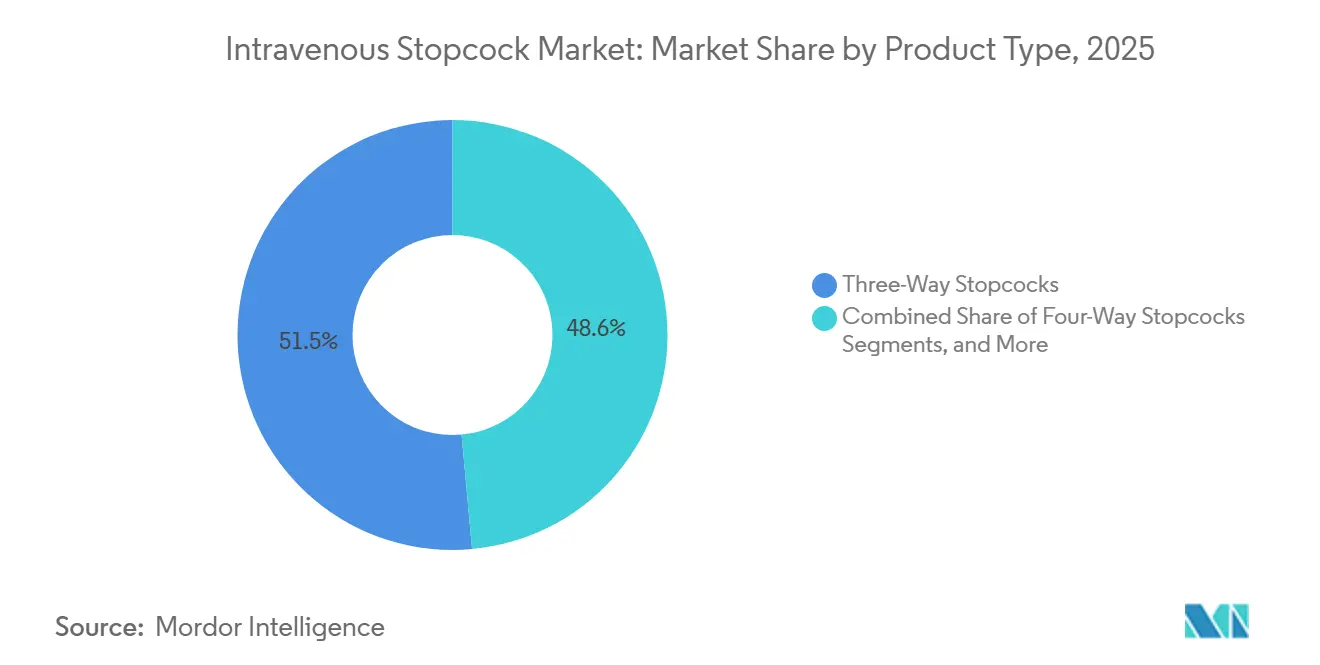
- By product type, three-way stopcocks held 51.45% of the intravenous stopcock market share in 2025, while the same segment is projected to grow at a 9.78% CAGR through 2031.
- By application, interventional cardiology and radiology accounted for 46.88% of the intravenous stopcock market size in 2025, while infusion therapy is projected to expand at a 9.44% CAGR through 2031.
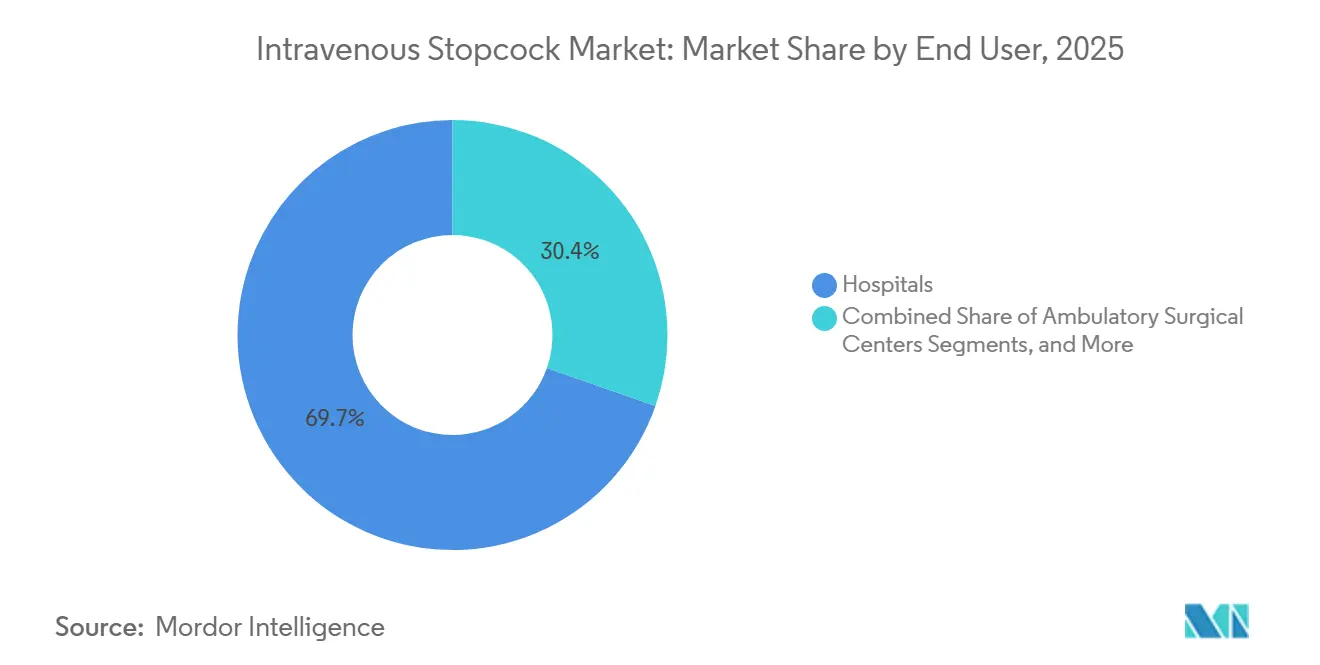
- By end user, hospitals held 69.65% of demand in 2025, while ambulatory surgical centers are projected to grow at a 10.25% CAGR through 2031.
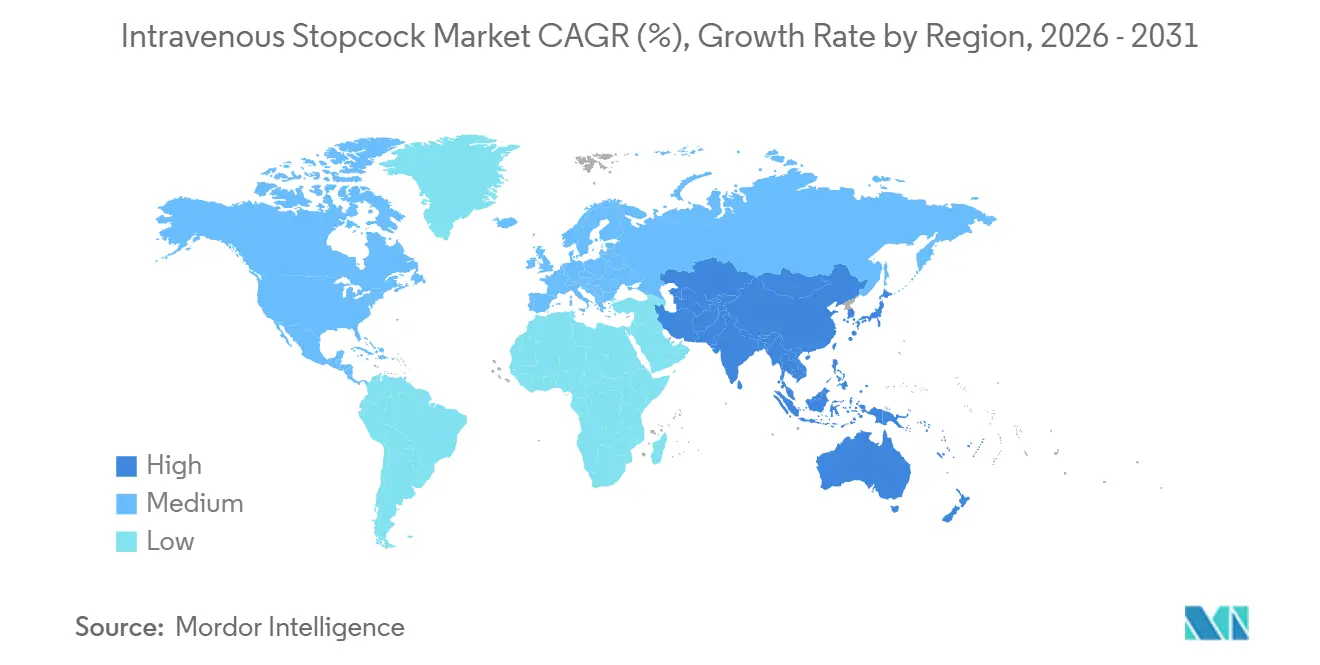
- By geography, North America held 39.34% of global demand in 2025, while Asia-Pacific is projected to expand at an 8.94% CAGR through 2031.
Note: Market size and forecast figures in this report are generated using Mordor Intelligence’s proprietary estimation framework, updated with the latest available data and insights as of January 2026.
Global Intravenous Stopcock Market Trends and Insights
Drivers Impact Analysis*
| DRIVER | (~) % IMPACT ON CAGR FORECAST | GEOGRAPHIC RELEVANCE | IMPACT TIMELINE |
|---|---|---|---|
| Rising intravenous therapy and infusion procedure volumes | +2.2% | Global | Short term (≤ 2 years) |
| Expansion of critical care and interventional procedures | +1.9% | North America, Europe, APAC | Medium term (2-4 years) |
| Adoption of closed and needle-free stopcock designs | +1.5% | North America, Europe | Medium term (2-4 years) |
| Demand for lipid-resistant and high-pressure fluid-path components | +1.0% | Global | Long term (≥ 4 years) |
| Standardized stopcock configuration in emerging-country hospitals | +0.8% | APAC, MEA, South America | Long term (≥ 4 years) |
| Increasing integration of stopcocks with smart infusion and monitoring systems | +0.6% | North America, Europe, APAC | Long term (≥ 4 years) |
| Source: Mordor Intelligence | |||
Rising Intravenous Therapy and Infusion Procedure Volumes
Infusion therapy remained a high-volume activity in acute care settings, as diabetes, renal disease, cancer, and infectious diseases often required parenteral treatment across repeated care episodes. Each intravenous line required one or more stopcocks to manage multiple medications, blood sampling, fluid administration, and treatment changes. Demand remained linked to hospital admissions, infusion-suite capacity, treatment complexity, and the intensity of care delivered per patient. Growth in ambulatory oncology and antimicrobial infusion programs also increased demand for reliable, standardized line-access solutions across hospital and outpatient settings.
Expansion of Critical Care and Interventional Procedures
Catheterization laboratories, hybrid operating rooms, and interventional radiology units used stopcocks and manifold assemblies extensively to manage multiple fluid pathways during procedures. These settings required access points for contrast delivery, pressure monitoring, flushing, and medication administration within tightly controlled procedural windows. Providers often purchased stopcocks as part of procedure kits or manifold assemblies, favoring manufacturers that offered compatible components, consistent specifications, and reliable supply. Expansion in cardiac catheterization capacity supported recurring demand for multiport access, validated pressure performance, and standardized procedure setups.
Adoption of Closed and Needle-Free Stopcock Designs
Open access points create contamination risks during medication injection and blood sampling, making appropriate handling essential for patient safety. The CDC recommends closed catheter access systems over open systems when they reduce catheter-related bloodstream infections and advises clinicians to cap unused stopcocks. The International Society for Infectious Diseases identifies hub and connector management as an evidence-based practice for preventing central line-associated bloodstream infections. A 2025 study reported a CLABSI rate of 1.32 per 1,000 central-line days in hospitals using solid-surface needle-free connectors, compared with 2.95 for devices with non-solid surfaces. These designs support infection-control compliance, simplify handling, and reduce line exposure during routine care.[1]Buetti N, et al., “Preventing Central Line-Associated Bloodstream Infections, A Position Paper of the International Society for Infectious Diseases, 2024 Update,” International Journal of Infectious Diseases, doi.org.
Demand for Lipid-Resistant and High-Pressure Fluid-Path Components
Parenteral nutrition, propofol sedation, and certain chemotherapy regimens require fluid pathways that remain compatible with demanding solutions throughout the intended use period. Standard polycarbonate may be unsuitable for prolonged exposure to lipid-based solutions, as chemical stress cracking can weaken seals and increase leakage risks over 24 to 96 hours. In March 2026, Elcam Medical introduced SafeT stopcocks made with Eastman Tritan copolyester and reported 96-hour resistance to 10 aggressive compounds, including Intralipid, Propofol, Cyclosporine, and Phenytoin Sodium, without leakage. Angiography also requires high-pressure configurations tested for contrast injection and rated above 4 bar, supporting demand for specialized products with validated material compatibility and pressure performance.
Restraints Impact Analysis*
| RESTRAINT | (~) % IMPACT ON CAGR FORECAST | GEOGRAPHIC RELEVANCE | IMPACT TIMELINE |
|---|---|---|---|
| Infection and bloodstream-contamination risk from open stopcock access | -1.0% | Global | Short term (≤ 2 years) |
| Medical-grade polymer cost and supply volatility | -0.7% | Global | Medium term (2-4 years) |
| Procedure-specific pressure, compatibility, and leakage failures | -0.5% | Global | Medium term (2-4 years) |
| Substitution by needle-free connectors and integrated closed systems | -0.4% | North America, Europe | Long term (≥ 4 years) |
| Source: Mordor Intelligence | |||
Infection and Bloodstream-Contamination Risk From Open Stopcock Access
Open-port stopcock designs remain a potential route for microorganisms to enter intravenous lines, particularly during repeated access in patient care. CDC guidance identifies stopcocks used for medication injection and blood sampling as potential entry portals and recommends capping them when not in use. The World Health Organization’s 2025 guidance supported multimodal prevention practices, including careful hub management and closed-system access for central venous catheters. Bloodstream infections can extend intensive care unit stays, increase antibiotic use, and expose hospitals to regulatory scrutiny.[2]World Health Organization, “Guidelines for the Prevention of Bloodstream Infections and Other Infections Associated With the Use of Intravascular Catheters, Part 2, Central Venous Catheters,” World Health Organization, who.int. This creates clinical and operational pressure to prevent avoidable line-related complications. The issue supports demand for closed-system designs while limiting the addressable volume for conventional open products.
Medical-Grade Polymer Cost and Supply Volatility
Medical-grade polymers remain essential inputs for high-volume intravenous stopcock production. Changes in material availability, transportation conditions, or pricing can affect supplier margins and hospital purchasing decisions. Manufacturers operating under multiyear hospital contracts may struggle to recover sudden increases in resin or transportation costs after pricing and supply terms are established. The impact is most significant for basic products, which have limited scope for price increases and face strong competition from contract manufacturers offering comparable configurations. Specialized polymer requirements increase sourcing complexity, as consistent material performance is critical for product safety, regulatory documentation, and customer confidence.
*Our forecasts treat driver/restraint impacts as directional, not additive. The impact forecasts reflect baseline growth, mix effects, and variable interactions.
Segment Analysis
By Product Type: Three-Way Stopcocks Lead Clinical Use
Three-way stopcocks captured 51.45% of global value in 2025 and are forecast to grow at a 9.78% CAGR through 2031. Their broad compatibility with intravenous administration sets, hemodynamic monitoring lines, and anesthesia delivery systems supports use across routine and high-acuity care settings. Three-direction flow control enables clinicians to infuse, sample, and monitor without disconnecting lines, supporting established workflows in intensive care units and catheterization laboratories. Clinical protocols, procedure kits, and hospital formularies commonly incorporate this format, strengthening its position in the intravenous stopcock market.
In March 2026, Elcam Medical introduced the E-Click 45° Detent Indication Stopcock, a three-way device that provides tactile confirmation at each flow position. The product reflects supplier efforts to improve workflow safety within established product configurations. Two-way stopcocks serve applications requiring simple on-off control, while four-way devices support cardiac surgery and anesthesia procedures involving simultaneous drug delivery. Preassembled stopcock manifolds are gaining relevance in catheterization laboratories by simplifying setup and reducing sterile connection assembly during procedures.



By Application: Interventional Cardiology and Radiology Anchor Demand
Interventional cardiology and radiology accounted for 46.88% of the application value in 2025. Catheterization laboratories, electrophysiology suites, and angiography rooms use individual stopcocks and manifold assemblies for contrast delivery, hemodynamic monitoring, and flush-line management. Procurement often aligns with catheter and guidewire suppliers that also provide related procedural components. This structure limits price-based competition and increases the value of compatible product portfolios.
Infusion therapy is forecast to grow at a 9.44% CAGR through 2031, driven by expanding ambulatory chemotherapy, antimicrobial programs, and parenteral nutrition. Blood sampling and transfusion, arterial pressure monitoring, and central venous access continue to provide stable inpatient demand. Anesthesia requires stopcocks for propofol infusion and multiagent delivery, where lipid resistance remains a key specification. Neonatal, pediatric, and oncology applications require low dead space, low priming volume, and fluid pathways that manage chemically demanding agents.
By End User: Hospitals Remain the Core Purchasing Base
Hospitals accounted for 69.65% of end-user value in 2025. High utilization across critical care, cardiology, surgery, and oncology departments drives demand, which hospitals often manage through formularies and group purchasing organization contracts in the United States. This structure favors suppliers that provide a consistent supply, broad product coverage, and documented clinical performance. Hospital value-analysis committees may formally review new products before adding them to existing purchasing arrangements.
Home health and hospice services fall within the other end-user group, where usage is generally simpler and focused on disposable three-way formats. Ambulatory surgical centers are forecast to grow at a 10.25% CAGR through 2031, making them the fastest-growing end-user group. As more complex procedures move to ambulatory settings, demand increases for reliable fluid management, controlled access, and procedure-specific kits. The intravenous stopcock industry benefits when clinical teams use compatible components across hospital and ambulatory settings with standardized workflows.
Geography Analysis
North America held 39.34% of global demand in 2025. Mature hospital infrastructure, high intravenous therapy utilization, and focus on CLABSI prevention supported its position. CDC guidance continued to prioritize practices that reduced contamination during intravascular catheter access. This focus supported demand for designs that simplified capping, disinfection, and closed access across hospitals and ambulatory care settings.
Europe remained important, supported by established hospital networks and structured procurement systems in Germany, the United Kingdom, and France. EU MDR 2017/745 influenced documentation, post-market surveillance, and traceability requirements for Class IIa devices, including intravenous stopcocks. The regulation increased compliance costs for smaller suppliers and encouraged partnerships for validation and regulatory support. Large suppliers leveraged broad portfolios, while smaller companies demonstrated product quality, traceability, and clinical suitability.
Asia-Pacific is forecast to grow at an 8.94% CAGR through 2031, driven by hospital expansion, broader insurance coverage, and chronic disease treatment. IHH Healthcare’s Fortis India had planned to nearly double capacity to 10,000 beds by 2030 and deployed INR 7 billion (USD 74.1 million) in 2026 to add 400 beds. Price-sensitive markets favored product availability, distribution support, and standardized configurations. Demand in the Middle East and Africa was linked to GCC hospital investments, while Brazil and Argentina shaped South American procurement through procedure volumes, currency conditions, import costs, and distribution capabilities.

Competitive Landscape
The global intravenous stopcock market was moderately consolidated, with BD, B. Braun, ICU Medical, Fresenius Kabi, and Terumo holding established hospital relationships and broad intravenous therapy and vascular access portfolios. Their integrated offerings, including stopcocks, administration sets, needle-free connectors, and infusion pumps, simplified procurement, training, and product support. Competition extended beyond individual product design to quality, supply continuity, clinical documentation, and service capabilities. Specialized suppliers remained competitive by addressing requirements for material compatibility, manifold design, and clinical workflow.
In April 2026, BD commercially launched the CentroVena One Insertion System, an all-in-one closed central venous catheter insertion device accepted into the FDA Safer Technologies Program. BD stated that the system combined the guidewire, needle, syringe, and catheter into a single design and reduced procedural steps by 30%. In June 2026, BD received a Vizient Innovative Technology contract for the same system. Elcam Medical supplied components through its modular closed-stopcock platform and Snap & Click manifold designs, highlighting the importance of closed-system design, workflow efficiency, and OEM supply.
Asian manufacturers, including Poly Medicure, Nipro, Jiangsu Shenli, and Shanghai Kindly, competed in the mid-price and value tiers across Asia-Pacific, the Middle East and Africa, and parts of South America. Their presence increased price competition, where procurement teams prioritized volume and availability. Oncology infusion, neonatal care, and high-pressure interventional procedures created differentiation opportunities through dead space, DEHP-free materials, chemical compatibility, and validated performance. Large global suppliers led complex procurement relationships, while regional manufacturers addressed local requirements for pricing, availability, and product configurations.
Intravenous Stopcock Industry Leaders
Becton, Dickinson and Company
B. Braun Melsungen AG
ICU Medical, Inc.
Terumo Corporation
Fresenius Kabi AG
- *Disclaimer: Major Players sorted in no particular order

Recent Industry Developments
- June 2026: BD received an Innovative Technology contract from Vizient for the BD CentroVena One Insertion System, supporting the expansion of integrated IV access solutions across U.S. health systems.
- April 2026: BD launched the CentroVena One Insertion System, an all-in-one central venous catheter insertion device that reduced procedural steps by 30% and procedure time by up to 50% in simulation studies.
- March 2026: Elcam Medical introduced the Snap & Click adhesive-free manifold and E-Click 45° Detent Indication Stopcock for IV therapy, angioplasty, anesthesia, and patient monitoring applications.


Global Intravenous Stopcock Market Report Scope
As per the scope of the report, an intravenous (IV) stopcock, also known as a multi-way stopcock, is a specialized medical valve connected to an intravenous line that controls, directs, regulates, or halts the flow of multiple fluids, medications, or blood products into a patient's vascular system.
The intravenous stopcock market is segmented by product type, application, end user, and geography. By product type, the market includes two-way stopcocks, three-way stopcocks, four-way stopcocks, and stopcock manifolds. By application, the market is segmented into infusion therapy, blood sampling and transfusion, arterial pressure monitoring, central venous access, peripheral intravenous access, interventional cardiology and radiology, anesthesiology, oncology and chemotherapy administration, neonatal and pediatric care, and pleural drainage and other fluid-management procedures. By end user, the market is segmented into hospitals, ambulatory surgical centers, specialty clinics, and others. By geography, the market is analyzed across North America, Europe, Asia-Pacific, the Middle East and Africa, and South America. The report also covers the estimated market sizes and trends for 17 countries across major regions globally. The report offers market sizes and forecasts in terms of value (USD) for the above segments.
| Two-Way Stopcocks |
| Three-Way Stopcocks |
| Four-Way Stopcocks |
| Stopcock Manifolds |
| Infusion Therapy |
| Blood Sampling and Transfusion |
| Arterial Pressure Monitoring |
| Central Venous Access |
| Peripheral Intravenous Access |
| Interventional Cardiology and Radiology |
| Anesthesiology |
| Oncology and Chemotherapy Administration |
| Neonatal and Pediatric Care |
| Pleural Drainage and Other Fluid-Management Procedures |
| Hospitals |
| Ambulatory Surgical Centers |
| Specialty Clinics |
| Others |
| North America | United States |
| Canada | |
| Mexico | |
| Europe | Germany |
| United Kingdom | |
| France | |
| Italy | |
| Spain | |
| Rest of Europe | |
| Asia-Pacific | China |
| India | |
| Japan | |
| Australia | |
| South Korea | |
| Rest of Asia-Pacific | |
| Middle East and Africa | GCC |
| South Africa | |
| Rest of Middle East and Africa | |
| South America | Brazil |
| Argentina | |
| Rest of South America |
| By Product Type | Two-Way Stopcocks | |
| Three-Way Stopcocks | ||
| Four-Way Stopcocks | ||
| Stopcock Manifolds | ||
| By Application | Infusion Therapy | |
| Blood Sampling and Transfusion | ||
| Arterial Pressure Monitoring | ||
| Central Venous Access | ||
| Peripheral Intravenous Access | ||
| Interventional Cardiology and Radiology | ||
| Anesthesiology | ||
| Oncology and Chemotherapy Administration | ||
| Neonatal and Pediatric Care | ||
| Pleural Drainage and Other Fluid-Management Procedures | ||
| By End User | Hospitals | |
| Ambulatory Surgical Centers | ||
| Specialty Clinics | ||
| Others | ||
| By Geography | North America | United States |
| Canada | ||
| Mexico | ||
| Europe | Germany | |
| United Kingdom | ||
| France | ||
| Italy | ||
| Spain | ||
| Rest of Europe | ||
| Asia-Pacific | China | |
| India | ||
| Japan | ||
| Australia | ||
| South Korea | ||
| Rest of Asia-Pacific | ||
| Middle East and Africa | GCC | |
| South Africa | ||
| Rest of Middle East and Africa | ||
| South America | Brazil | |
| Argentina | ||
| Rest of South America | ||


Key Questions Answered in the Report
What is the projected growth rate for intravenous stopcocks?
The intravenous stopcock market is forecast to grow at a CAGR of 8.85% from 2026 to 2031 and reach USD 2.06 billion.
Which product configuration leads to demand?
Three-way stopcocks held 51.45% of value in 2025 and are forecast to grow at a 9.78% CAGR through 2031. The format supports infusion, sampling, and monitoring without disconnecting an established line
Why are closed and needle-free designs important?
CDC and WHO guidance identifies catheter-access and hub management as important measures for limiting contamination risk. The intravenous stopcock market is responding with designs that support capping, protected access, and routine infection-control procedures.
Which clinical application uses the most stopcocks?
Interventional cardiology and radiology accounted for 46.88% of application value in 2025 because procedures require several access and monitoring points.
Which end user is growing fastest?
Ambulatory surgical centers are forecast to grow at a 10.25% CAGR through 2031 as more procedures move to outpatient settings. The intravenous stopcock market serves this setting with components that support standardized setup and controlled fluid access.
Which region is growing fastest?
Asia-Pacific is forecast to expand at an 8.94% CAGR through 2031, supported by hospital expansion and greater need for infusion and critical care capacity.
Page last updated on:





