
Intraosseous Devices Market Size and Share
Market Overview
| Study Period | 2021 - 2032 |
|---|---|
| Market Size (2027) | USD 583.99 Million |
| Market Size (2032) | USD 785.57 Million |
| Growth Rate (2027 - 2032) | 6.11 % |
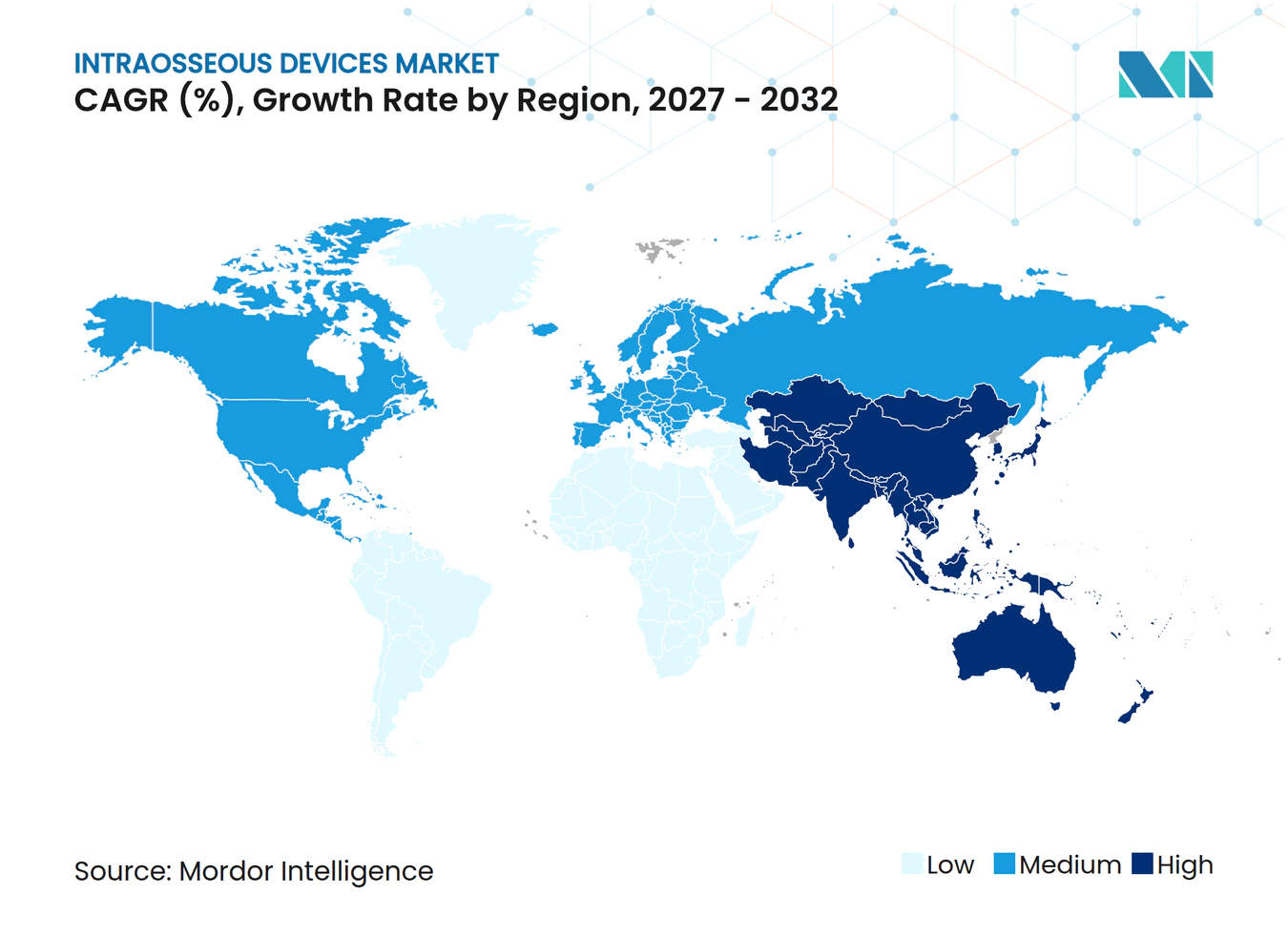
| Fastest Growing Market | Asia-Pacific |
| Largest Market | North America |
| Market Concentration | Medium |
Major Players *Disclaimer: Major Players sorted in no particular order Image © Mordor Intelligence. Reuse requires attribution under CC BY 4.0. | |
Intraosseous Devices Market Analysis by Mordor Intelligence
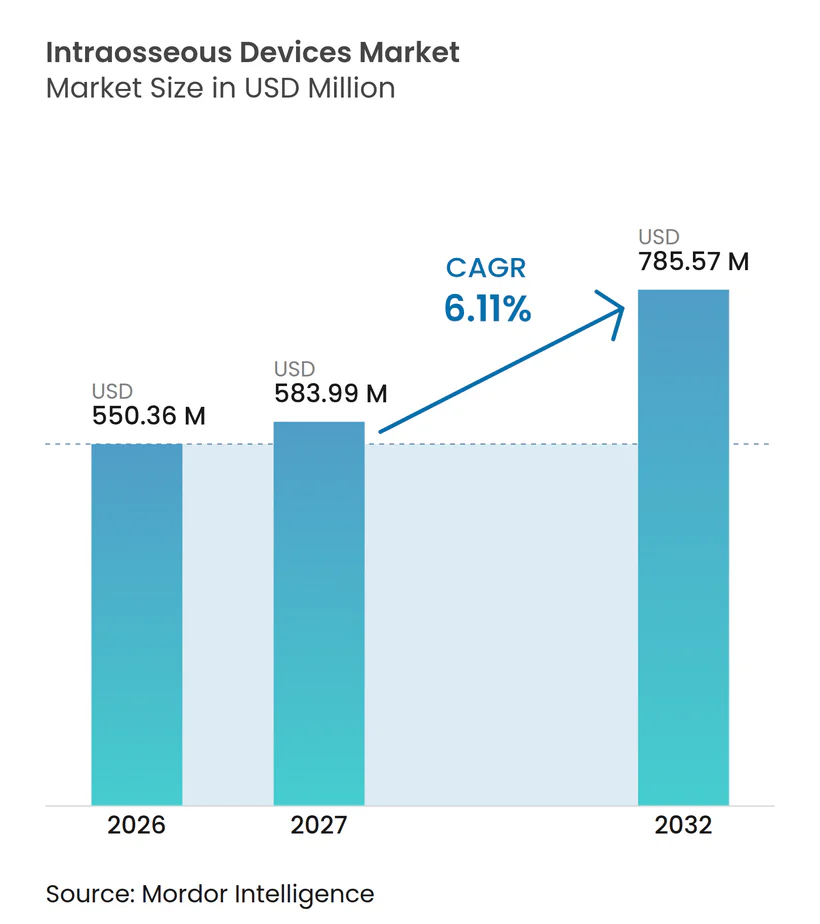
The Intraosseous Devices Market size was valued at USD 550.36 million in 2026 and is estimated to grow from USD 583.99 million in 2027 to reach USD 785.57 million by 2032, at a CAGR of 6.11% during the forecast period (2027-2032).
The Intraosseous Devices Market serves urgent care situations where peripheral intravenous access is difficult or unsuccessful, including cardiac arrest, trauma, sepsis, and hemorrhagic shock. Bone marrow access can provide a dependable route when venous collapse, pediatric anatomy, or triage conditions limit intravenous cannulation. A 2025 randomized trial review reported first-attempt vascular access success of 92.30% for intraosseous access and 62.30% for intravenous access in out-of-hospital cardiac arrest. The Intraosseous Devices Market is shaped by emergency medical service expansion, standardized clinical protocols, and demand for equipment that is ready for use under pressure. Suppliers are broadening their product portfolios through powered systems, automatic devices, manual sets, compatible consumables, and structured training support.
Key Report Takeaways
- By product type, powered drill-assisted devices held a 41.80% share in 2026, while automatic intraosseous devices recorded the highest projected CAGR at 7.60% through 2032.
- By route of administration, the proximal tibia accounted for a 45.20% share in 2026, while the proximal humerus recorded the highest projected CAGR at 6.90% through 2032.
- By patient type, adults held a 68.40% share in 2026, while geriatric patients recorded the highest projected CAGR at 6.80% through 2032.
- By end user, hospitals held a 71.50% share in 2026, while Emergency Medical Services recorded the highest projected CAGR at 7.40% through 2032.
- By geography, North America represented a 39.60% share in 2026, while Asia-Pacific is expected to expand at an 8.20% CAGR through 2032.
Note: Market numbers in this report are based on Mordor Intelligence's proprietary estimation framework, which combines nine months of actuals with Q4 projections for base year 2026.
Market Trends and Insights
Drivers Impact Analysis of Intraosseous Devices Market*
| Driver | (~) % Impact on CAGR Forecast | Geographic Relevance | Impact Timeline |
|---|---|---|---|
| Rising Cardiac Arrest, Trauma, Shock, and Sepsis Caseloads | +1.5% | Global, with concentrated impact in North America, Europe, and urban APAC | Short term (≤ 2 years) |
| Expansion of Prehospital Emergency Medical Services | +1.2% | APAC core, spill-over to MEA and South America | Medium term (2–4 years) |
| Emergency-Protocol Standardization and Guideline Endorsements | +1.0% | North America & EU; secondary adoption in South Korea, Japan | Short term (≤ 2 years) |
| Adoption of Powered and Automatic Intraosseous Systems | +1.1% | North America & EU; growing in China and GCC | Medium term (2–4 years) |
| Tactical, Disaster, and Mass-Casualty Medical Stockpiling | +0.6% | NATO-aligned nations, GCC, Israel | Long term (≥ 4 years) |
| Site-Specific Needle Selection and Workflow Integration | +0.5% | Global, highest in hospitals and Level I trauma centers | Medium term (2–4 years) |
| Source: Mordor Intelligence | |||
Rising Cardiac Arrest, Trauma, Shock, Sepsis, and Protocol Standardization
Emergency caseloads provide a stable source of demand for the Intraosseous Devices Market. Cardiac arrest, trauma, sepsis, and hemorrhagic shock require rapid vascular access when clinicians cannot establish a peripheral intravenous line. The American Heart Association placed intravenous access first in adult cardiac arrest, with intraosseous access recommended when 2 intravenous attempts fail. The European Resuscitation Council adopted comparable guidance in 2025, which supports consistent stocking and competency requirements across emergency settings. The Intraosseous Devices Market therefore benefits from a clear clinical role, even where the route is not the first option for adult cardiac arrest. Pediatric and trauma pathways retain broader support for intraosseous access, helping hospitals and emergency medical services maintain devices for varied clinical scenarios.[1]
Expansion of Prehospital Emergency Medical Services and Site-Specific Workflows
Prehospital emergency medical service expansion is extending the Intraosseous Devices Market beyond established hospital-centered demand. Ambulance networks need vascular access options that work in constrained and time-sensitive environments. Product selection differs by setting because powered platforms, spring-loaded systems, and manual sets have distinct requirements for portability, power availability, and user training. The proximal tibia remains familiar to many clinicians, while the proximal humerus is gaining attention for adult resuscitation and tactical care. The 2025 evidence review identified continued uncertainty in selecting between humeral and tibial access sites, which leaves protocol design and clinician familiarity important in purchasing decisions. These conditions favor suppliers that can support multiple insertion sites and provide clear workflow guidance for hospital and field use.
Adoption of Powered and Automatic Intraosseous Systems
Powered and automatic systems are changing the product mix within the Intraosseous Devices Market. A 2025 randomized trial review found that intraosseous access was established 15 seconds faster than intravenous access in the studied out-of-hospital cardiac arrest setting. Faster placement can be important when clinicians work in low-light, high-pressure, or resource-limited settings. BD introduced an intraosseous vascular access system in 2024 with a rechargeable driver, passive needle-tip safety, and 5 needle-length options. BD Teleflex introduced a sterile, single-use procedure tray for intraoperative use in 2024, expanding the relevance of its Arrow EZ-IO portfolio to sterile-field procedures. The Intraosseous Devices Market increasingly centers on readiness, needle safety, training, and the operating cost of the full device system rather than insertion mechanics alone.
Tactical, Disaster, and Mass-Casualty Medical Stockpiling
Tactical and disaster-response requirements add a distinct purchasing channel to the Intraosseous Devices Market. Military and mass-casualty settings require supplies that remain usable when peripheral access is difficult and conventional care infrastructure is disrupted. Manual and impact-driven devices retain a role in these environments because they do not depend on charged batteries. Their use does not imply inferior clinical performance in every setting. A 2025 network meta-analysis found no statistically significant safety or efficacy differences among 4 major intraosseous device types used in emergency department care. This evidence allows procurement teams to weigh portability, training, and cost alongside clinical performance. It also leaves room for manual formats within stockpiles and field kits, while powered platforms remain important in higher-resource care settings.
Restraints Impact Analysis of Intraosseous Devices Market*
| Restraint | (~) % Impact on CAGR Forecast | Geographic Relevance | Impact Timeline |
|---|---|---|---|
| Clinician and Paramedic Training Gaps | -0.8% | Global, most acute in APAC emerging markets, MEA, and South America | Medium term (2–4 years) |
| High Acquisition Cost of Powered and Disposable Systems | -0.7% | Price-sensitive markets: South America, MEA, South and Southeast Asia | Long term (≥ 4 years) |
| Reimbursement Ambiguity and Centralized-Tender Price Pressure | -0.5% | EU (especially Southern and Eastern Europe), Latin America | Medium term (2–4 years) |
| Complication Risk, Contraindications, and Evidence Heterogeneity | -0.4% | Global | Short term (≤ 2 years) |
| Source: Mordor Intelligence | |||
Clinician and Paramedic Training Gaps
Training gaps can limit use of intraosseous devices even when equipment is available. Correct placement requires anatomical landmarking, appropriate needle-length selection, and confirmation that the needle has passed the bone cortex. These skills require dedicated practice and do not automatically follow from intravenous insertion training. The Intraosseous Devices Market depends on training programs that prepare hospital staff, paramedics, and residents to act confidently in urgent cases. This requirement makes service, simulation, competency assessment, and education relevant parts of supplier relationships. It can also lead to uneven use between facilities with active simulation programs and those without comparable training support.
Powered-System Cost, Tender Pressure, and Clinical Constraints
The cost of powered equipment and disposable needle sets can constrain the Intraosseous Devices Market in price-sensitive settings. The 2026 IVOCA study reported a cost of EUR 109 per intraosseous needle, equal to USD 119.2, compared with EUR 0.60 per intravenous catheter, equal to USD 0.7. Centralized tenders can increase pressure on higher-priced systems where procurement decisions place strong weight on unit costs. Clinical contraindications and variation in the evidence base can also make users cautious about routine use in particular patient groups or sites. A 2025 review did not find statistically significant safety or efficacy differences across 4 major device types in emergency department use. Suppliers must therefore address cost, device selection, and clinician confidence at the same time, especially where reimbursement and public purchasing rules are restrictive.
*Our forecasts treat driver/restraint impacts as directional, not additive. The impact forecasts reflect baseline growth, mix effects, and variable interactions.
Intraosseous Devices Market Segment Analysis
By Product Type:
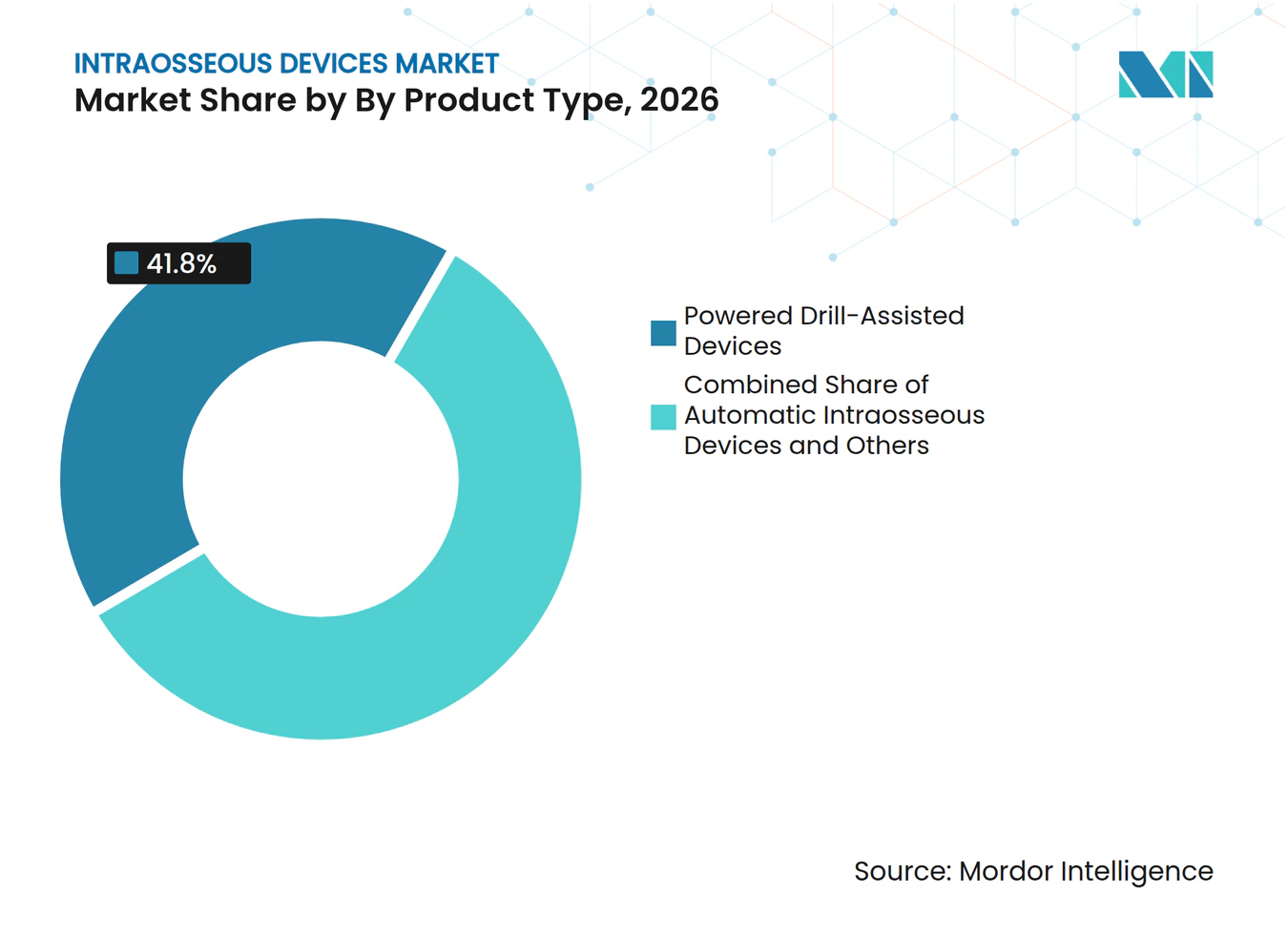
Powered Platforms Lead While Automatic Systems Grow FastestPowered drill-assisted devices held 41.80% of the Intraosseous Devices Market share for product type in 2026. Their position reflects their use in well-equipped emergency departments, trauma units, and other high-acuity settings. Hospitals often purchase a driver together with proprietary needles and related consumables. This arrangement can support recurring demand and make a change of platform more difficult. The Intraosseous Devices Market size for automatic devices is forecast to grow at a 7.60% CAGR through 2032. Automatic formats reduce dependence on manual force and can simplify use for first responders. Their development focuses on compact mechanisms and operations that reduce the number of steps during urgent care.
Manual devices, spring-loaded products, and impact-driven formats remain relevant in the field, military, and disaster settings. These formats can be appropriate where battery reliability is uncertain, or equipment must be stored for long periods. The product categories serve different operating needs rather than a single uniform use case. The 2025 network meta-analysis found no statistically significant safety or efficacy differences across 4 major intraosseous device types in emergency department care. That result supports competition based on cost, portability, workflow, and training requirements. Implantable intraosseous access remains a specialized development area. PAVmed completed a first-in-human PortIO study in 2024, which examined an implantable intraosseous infusion system for patients who need chronic vascular access.[2]



By Route of Administration:
Tibial Access Remains Established While Humeral Access AdvancesThe proximal tibia accounted for 45.20% of route-based procedures in 2026, representing the largest Intraosseous Devices Market share within this segmentation. Its established position reflects anatomical accessibility and extensive familiarity across adult and pediatric care. Training programs commonly cover the tibial route, which supports its use in emergency and prehospital settings. The proximal humerus is forecast to grow at a 6.90% CAGR through 2032. Interest in the humeral site reflects its potential role in adult resuscitation and prolonged field-care protocols. Site selection remains clinically important because patient anatomy and the nature of the emergency can affect access decisions. The Intraosseous Devices Market includes devices and needle lengths that must work across these differing sites.
Sternal access occupies a more specialized position in combat and prehospital care, particularly when injuries or barriers limit access to the extremities. Products such as FAST1 and FASTx address this specific route. The 2025 review of randomized trials identified the tibial-versus-humeral question as an active area of clinical uncertainty. The reported IVIO sub-analysis found a difference in favorable neurological outcome for humeral access, with an odds ratio of 0.58 and a 95% confidence interval of 0.35 to 0.98. Distal femur and calcaneus access remain useful in selected pediatric and bariatric cases. These alternatives help clinicians manage situations where commonly used sites are unavailable or unsuitable. Suppliers need to support clinical choice across sites without treating one route as appropriate for every patient.
By Patient Type:
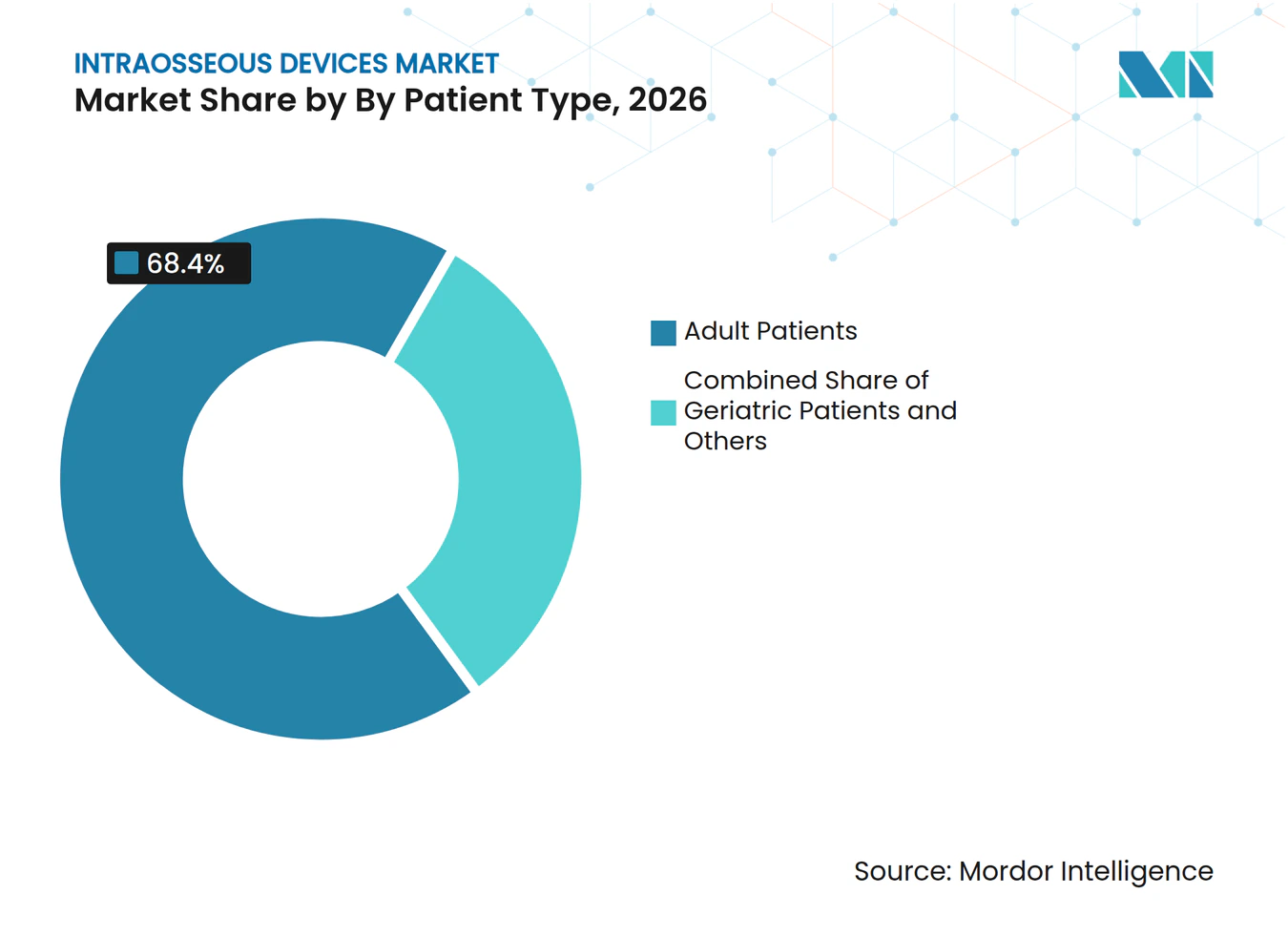
Adults Account for Most Demand While Geriatric Use GrowsAdults held 68.40% of the patient-type segment in 2026, the largest Intraosseous Devices Market share among patient groups. Adult demand is associated with the incidence of cardiac arrest, trauma, and sepsis in emergency care. Adult protocols also give hospitals and emergency medical services a consistent framework for maintaining access devices. The Intraosseous Devices Market size for geriatric patients is expected to grow at a 6.80% CAGR through 2032. Geriatric care can be more difficult when peripheral venous access is compromised. This patient group also requires careful attention to bone condition and suitable insertion technique. These factors can increase the importance of training and device design for older patients.
Pediatric patients have different anatomical needs and require equipment that supports safe depth control. Adult-calibrated needle sets may be unsuitable if clinicians do not adjust technique and device selection for smaller bones. The need for pediatric landmarking training remains relevant for hospitals and emergency responders. Neonatal access is the smallest and most specialized patient category in the source material. It has limited commercial device options, which leaves a gap in dedicated product availability. The other patient category includes people with morbid obesity who may need extended-length needles. Needle lengths of 45 mm and 55 mm help address increased soft-tissue depth in these cases. The Intraosseous Devices Market must therefore balance broad emergency use with patient-specific technical requirements.

By End User:
Hospitals Lead Demand While Emergency Medical Services ExpandHospitals accounted for 71.50% of end-user demand in 2026, giving them the leading Intraosseous Devices Market share in this segmentation. Emergency departments, trauma bays, and intensive care units are the principal hospital consumption settings. Hospitals also run many of the training programs that support correct device use. Teleflex launched a sterile, single-use Arrow EZ-IO procedure tray in 2024 for intraoperative use in sterile fields. The tray expands the potential use of intraosseous access beyond emergency departments into operating rooms and related procedural settings. Hospital purchasing is also shaped by group purchasing arrangements and recurring consumable needs. These factors make hospitals an anchor customer group for the Intraosseous Devices Market.
Emergency Medical Services is the fastest-growing end-user segment, with a projected 7.40% CAGR through 2032. The segment benefits from broader paramedic roles and the expansion of prehospital response networks. EMS teams need devices that can be carried, prepared quickly, and used in conditions that differ from hospital care. Military and defense organizations form a separate procurement channel because tactical medicine can require stored and field-ready equipment. Ambulatory surgical centers and specialty clinics are smaller end-user groups in the supplied material. Their potential use is linked to the broader adoption of perioperative intraosseous access. The end-user pattern supports demand for distinct product configurations, training models, and purchasing arrangements rather than a single standardized offering.
Geography Analysis
North America
North America held 39.60% of the Intraosseous Devices Market share in 2026. The region has established prehospital care systems and the broad use of powered intraosseous platforms in hospital emergency equipment. The United States is central to regional demand because emergency protocols and training practices support ready access to these devices. The American Heart Association guidance defines intraosseous access as an option after 2 unsuccessful intravenous attempts in adult cardiac arrest. Teleflex expanded its portfolio through a sterile procedure tray in 2024, while BD introduced a rechargeable intraosseous platform in the same year. Canada and Mexico are smaller contributors, with cost containment affecting the adoption of premium powered systems in public health settings.
Europe
Europe is the second-largest regional segment in the supplied material. Germany, the United Kingdom, and France support regional demand through advanced emergency care infrastructure. The European Resuscitation Council guidelines issued in 2025 recommend intraosseous access when adult cardiac-arrest intravenous attempts have failed. This guidance supports hospital purchasing requirements and structured training across the region. The Intraosseous Devices Market size in Europe is also affected by centralized tenders and reimbursement pressure in Southern and Eastern European systems. The IVOCA study illustrates the cost difference that can shape purchasing decisions for disposable intraosseous equipment. These conditions favor suppliers that can make a clear case for clinical value and total cost[3].
Asia-Pacific, MEA, and South America
Asia-Pacific is forecast to grow at an 8.20% CAGR through 2032, the highest rate among the geographic areas in the supplied material. Demand varies across the region because emergency care capacity, budgets, and procurement practices differ widely. Expansion of prehospital services supports demand for manual and spring-loaded formats in settings with constrained resources. Japan and South Korea have established emergency care networks that support steady device consumption. Korea’s 2025 adult advanced life-support guidelines align intraosseous use with the broader global approach to vascular access during resuscitation. The Middle East and Africa have concentrated demand in Gulf Cooperation Council states and South Africa, while South American demand remains more focused on manual devices because access costs can limit powered-platform adoption.
Competitive Landscape
Market Concentration
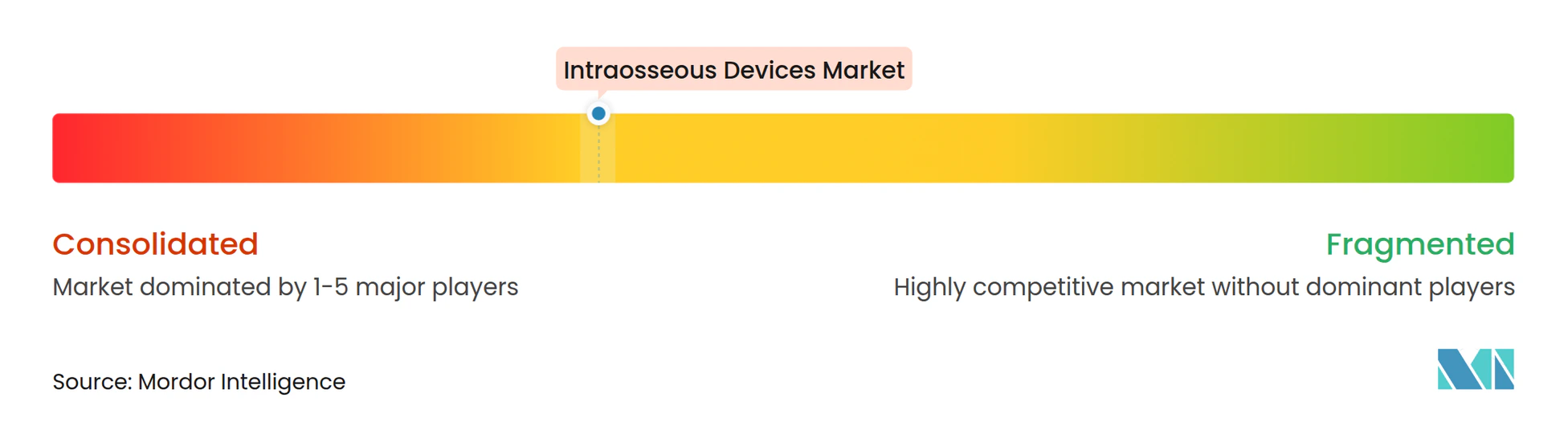
The Intraosseous Devices Market has a moderately concentrated structure among major suppliers. Teleflex and BD are prominent companies, while Pyng Medical, PerSys Medical, Cook Medical, and WaisMed serve specialized device categories or geographic needs. Teleflex’s Arrow EZ-IO platform combines drivers, needles of different lengths, training resources, and related procedure formats. The company expanded this portfolio in 2024 through the Arrow EZ-IO Intraosseous Access Procedure Tray for sterile-field use. This move addressed use in intraoperative settings that had not been the core focus of emergency-only device offerings. Product ecosystems, training, and consumable compatibility can make it difficult for customers to change platforms after adoption.
BD entered the competitive field with its intraosseous vascular access system in October 2024. The system included a rechargeable power driver, passive needle-tip safety, and 5 needle length options. BD These features address preparedness, sharps safety, and ownership-cost concerns. Competition in the Intraosseous Devices Market, therefore, extends beyond a basic needle design. It includes driver performance, readiness, ergonomics, clinical training, and the range of sites and patients a system can support. The 2025 review finding of no statistically significant safety or efficacy difference across 4 major device types also supports purchasing decisions that weigh these operational features.
Specialized development remains visible in implantable access, neonatal formats, insertion guidance, and infusion monitoring. PAVmed created the PMX incubator with Hatch Medical in 2024 to continue development and commercialization work for PortIO. The company’s first-in-human PortIO study was completed in 2024 and evaluated an implantable intraosseous infusion system. Entry barriers remain stronger for premium powered platforms because companies must support regulatory requirements, clinical evidence, training, and reliable consumable supply. Lower-cost needle-only products can compete in public tenders where price has greater weight. The Intraosseous Devices Market still contains specialized areas where no supplier has a clearly dominant position.
Intraosseous Devices Industry Leaders
-
Teleflex Incorporated
-
PerSys Medical
-
SAM Medical
-
Becton, Dickinson and Company
-
Cook Medical Inc.
- *Disclaimer: Major Players sorted in no particular order
Intraosseous Devices Market Companies Covered in this Report
- Aero Healthcare
- Allied Medical
- Argon Medical Devices
- Beckton Dickinson
- BIOPSYBELL SRL
- Cardinal Health
- Conmed
- Cook Group
- Haemonetics
- ICU Medical
- Implox Inc.
- Medax SRL Unipersonale
- PAVmed
- PerSys Medical
- SAM Medical
- Stryker
- Teleflex
- Vidacare Corporation
- WaisMed Ltd
Recent Industry Developments in Intraosseous Devices Market
- June 2026: Auxano Medical, an orthopedic implant company focused on advancing osseointegration and bone-implant interface technology, announced the launch of its redesigned website. The updated platform offers surgeons, distributors, and industry partners enhanced access to information on Auxano Medical’s proprietary surface morphology technology and its expanding portfolio of orthopedic implant systems, including the ARKEO Wedge Fixation System and the INTREPED Intraosseous Fusion Device.
- October 2024: BD Launched Next-Generation IO Vascular Access System. BD commercially launched the BD Intraosseous Vascular Access System in the United States, positioning it as the only IO device operable after extension-set attachment and the only system with integrated passive needle-tip safety. The rechargeable power driver offers up to 12 times the charge life of non-rechargeable competitive platforms, addressing a key procurement objection in high-volume emergency departments.
Global Intraosseous Devices Market Report Scope
As per the scope of the report, intraosseous devices are specialized medical devices designed to provide rapid vascular access through the bone marrow when conventional intravenous (IV) access is difficult, delayed, or impossible to establish. These devices enable the administration of fluids, blood products, medications, and emergency therapies directly into the medullary cavity and are widely used in trauma care, cardiac arrest management, emergency medicine, military medicine, critical care, and disaster response scenarios.
The intraosseous devices market is segmented by product type into manual intraosseous devices, spring-loaded & impact-driven devices, automatic intraosseous devices, powered drill-assisted devices, and others; by route of administration into proximal tibia, proximal humerus, sternum, and other anatomical sites; by patient type into adult patients, pediatric patients, neonatal patients, geriatric patients, and others; by end user into hospitals, emergency medical services (EMS), military & defense organizations, ambulatory surgical centers (ASCs), specialty clinics, and others; and by geography into North America, Europe, Asia-Pacific, Middle East and Africa, and South America. The market report also covers the estimated market sizes and trends for 17 countries across major regions globally. For each segment, the market size and forecast are provided in terms of value (USD).
Segmentation Overview
| Manual Intraosseous Devices |
| Spring-Loaded & Impact-Driven Devices |
| Automatic Intraosseous Devices |
| Powered Drill-Assisted Devices |
| Others |
| Proximal Tibia |
| Proximal Humerus |
| Sternum |
| Other Anatomical Sites |
| Other Anatomical Sites |
| Adult Patients |
| Pediatric Patients |
| Neonatal Patients |
| Geriatric Patients |
| Others |
| Hospitals |
| Emergency Medical Services (EMS) |
| Military & Defense Organizations |
| Ambulatory Surgical Centers (ASCs) |
| Specialty Clinics |
| Others |
| North America | United States | Canada |
| Mexico | ||
| Europe | Germany | United Kingdom |
| France | ||
| Italy | ||
| Spain | ||
| Rest of Europe | ||
| Asia-Pacific | China | Japan |
| India | ||
| Australia | ||
| South Korea | ||
| Rest of Asia-Pacific | ||
| Middle East and Africa | GCC | South Africa |
| Rest of Middle East and Africa | ||
| South America | Brazil | Argentina |
| Rest of South America | ||
| By Product Type | Manual Intraosseous Devices | ||
| Spring-Loaded & Impact-Driven Devices | |||
| Automatic Intraosseous Devices | |||
| Powered Drill-Assisted Devices | |||
| Others | |||
| By Route of Administration | Proximal Tibia | ||
| Proximal Humerus | |||
| Sternum | |||
| Other Anatomical Sites | |||
| Other Anatomical Sites | |||
| By Patient Type | Adult Patients | ||
| Pediatric Patients | |||
| Neonatal Patients | |||
| Geriatric Patients | |||
| Others | |||
| By End User | Hospitals | ||
| Emergency Medical Services (EMS) | |||
| Military & Defense Organizations | |||
| Ambulatory Surgical Centers (ASCs) | |||
| Specialty Clinics | |||
| Others | |||
| By Geography | North America | United States | Canada |
| Mexico | |||
| Europe | Germany | United Kingdom | |
| France | |||
| Italy | |||
| Spain | |||
| Rest of Europe | |||
| Asia-Pacific | China | Japan | |
| India | |||
| Australia | |||
| South Korea | |||
| Rest of Asia-Pacific | |||
| Middle East and Africa | GCC | South Africa | |
| Rest of Middle East and Africa | |||
| South America | Brazil | Argentina | |
| Rest of South America | |||
Key Questions Answered in the Report
What is driving demand for intraosseous devices?
Cardiac arrest, trauma, sepsis, and shock create demand when intravenous access is difficult. Standardized emergency protocols and prehospital care expansion also support use.
How large is the intraosseous devices sector?
The Intraosseous Devices Market is valued at USD 583.99 million in 2027 and is forecast to reach USD 785.57 million by 2032 at a 6.11% CAGR.
Which product type leads intraosseous vascular access?
Powered drill-assisted devices led product demand with a 41.80% share in 2026. Automatic devices are forecast to grow the fastest at a 7.60% CAGR through 2032.
Which insertion route is used most often for intraosseous access?
The proximal tibia led route-based use with a 45.20% share in 2026. The proximal humerus is forecast to grow at a 6.90% CAGR through 2032.
Which end user has the highest demand for intraosseous devices?
Hospitals held 71.50% of demand in 2026 because emergency departments, trauma bays, and intensive care units are primary use settings.
What limits wider adoption of powered intraosseous systems?
Device and disposable costs, training gaps, tender pressure, and clinical constraints can slow adoption. The IVOCA study reported EUR 109 per IO needle versus EUR 0.60 per IV catheter.