
Interceptor Missiles Market Size and Share
Market Overview
| Study Period | 2020 - 2032 |
|---|---|
| Market Size (2027) | USD 9.48 Billion |
| Market Size (2032) | USD 12.44 Billion |
| Growth Rate (2027 - 2032) | 5.59 % |
| Fastest Growing Market | Asia-Pacific |
| Largest Market | North America |
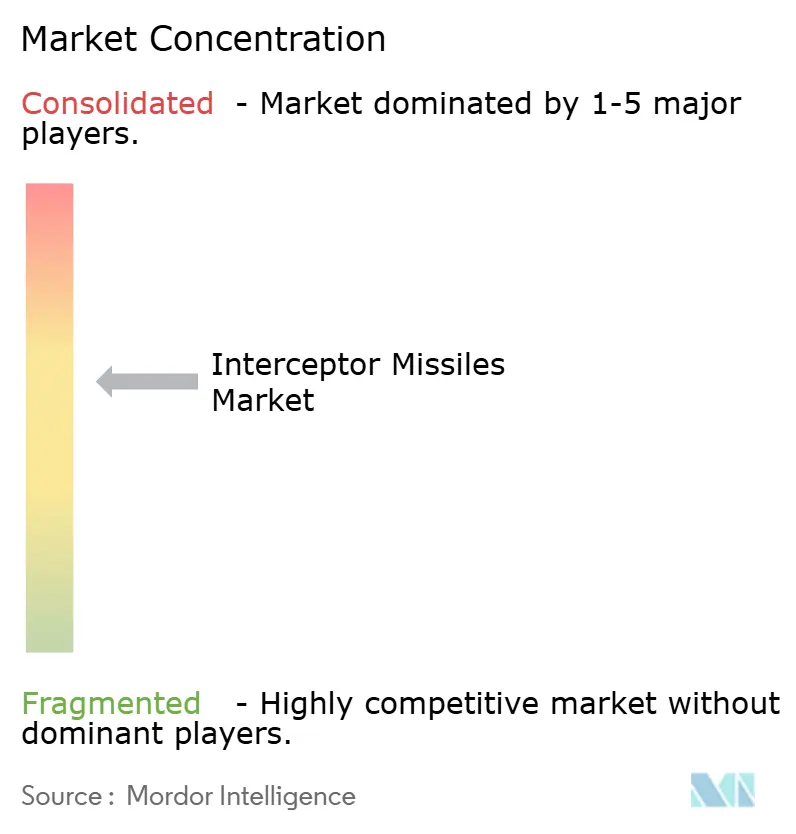
| Market Concentration | Medium |
Major Players *Disclaimer: Major Players sorted in no particular order Image © Mordor Intelligence. Reuse requires attribution under CC BY 4.0. | |
Interceptor Missiles Market Analysis by Mordor Intelligence
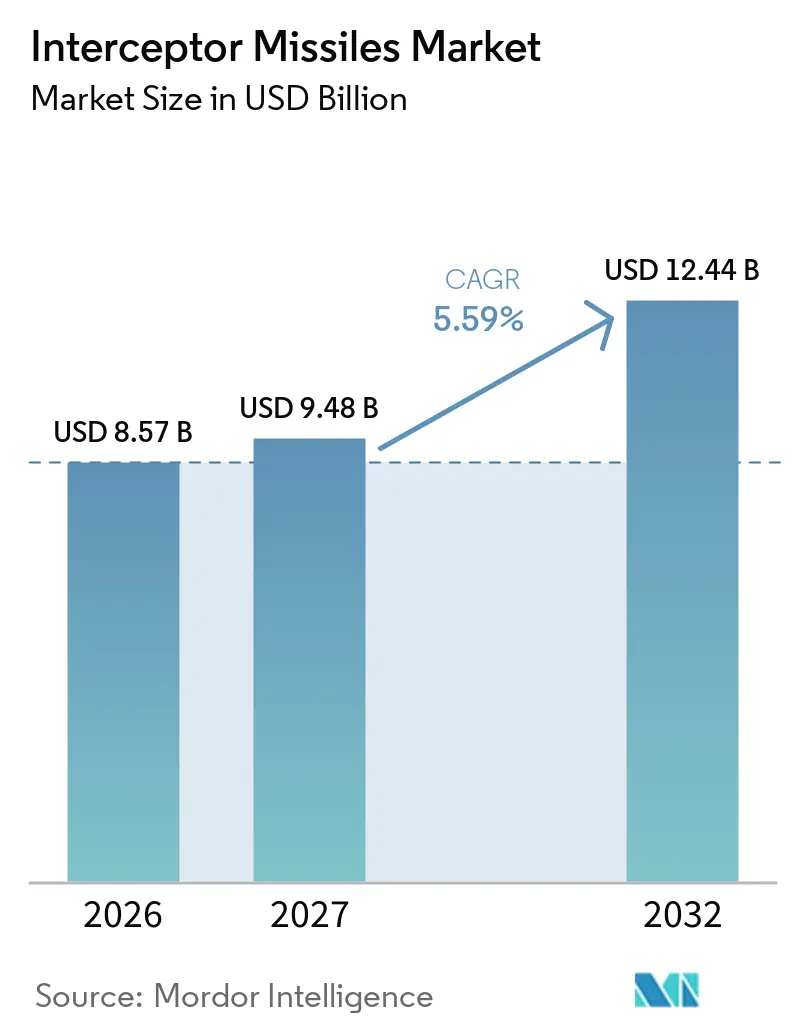
The interceptor missiles market size was valued at USD 8.57 billion in 2026 and is forecast to grow from USD 9.48 billion in 2027 to reach USD 12.44 billion by 2032, at a 5.59% CAGR during the forecast period (2027-2032). Record defense spending, replenishment needs after combat use, and the broader range of missile threats are driving procurement across land-, sea-, and space-based defense programs. NATO members agreed in June 2025 to target 5.0% of GDP for defense and security-related spending by 2035, which supports longer procurement planning for allied air and missile defense programs. The interceptor missiles market is also being shaped by high consumption rates in conflict, which are increasing the importance of production capacity, supply security, and multi-year contracts. Demand is moving toward layered systems that combine surface, naval, and space-enabled capabilities, while advanced threats are raising interest in more capable seekers and tracking networks. Cost per engagement, export restrictions, and shortages of specialized inputs may slow deliveries even where demand and budgets are strong.
Key Report Takeaways
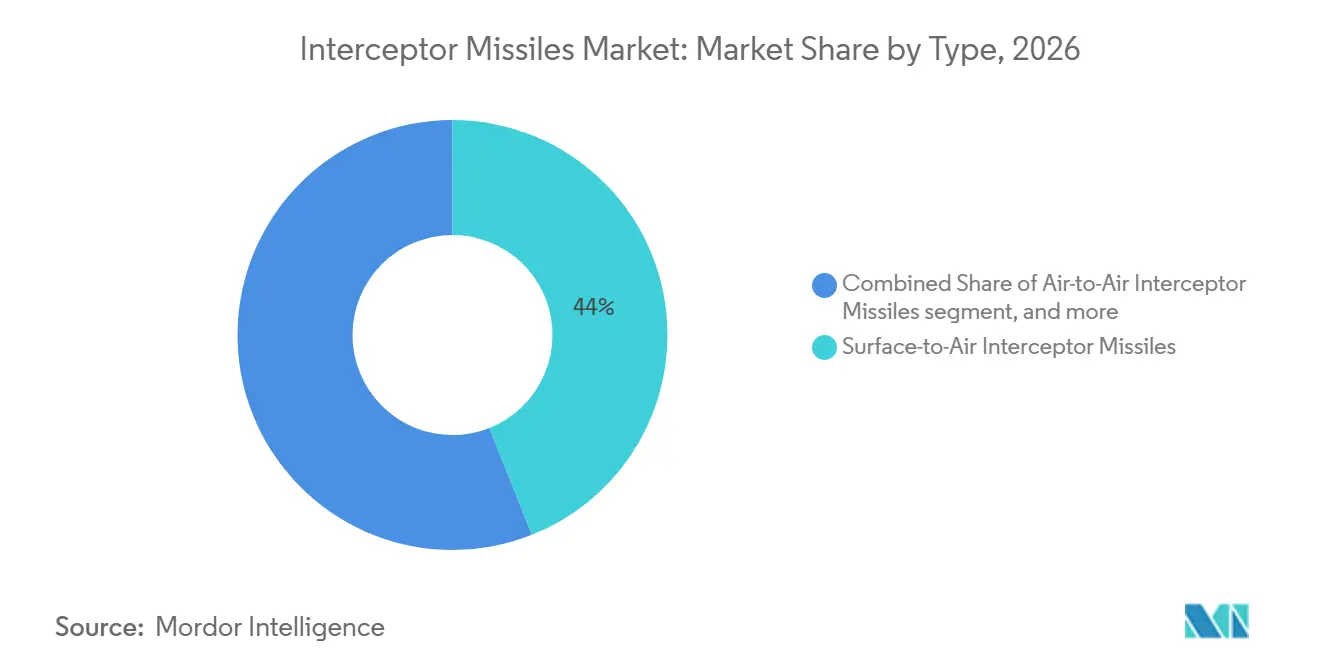
- By type, surface-to-air interceptor missiles held 43.98% of the interceptor missiles market share in 2026, while water-to-air and naval interceptor missiles are forecast to grow at a 7.11% CAGR through 2032.
- By range, medium-range interceptors accounted for 28.22% of the interceptor missiles market share in 2026, while extended-range interceptors are forecast to grow at a 7.54% CAGR through 2032.
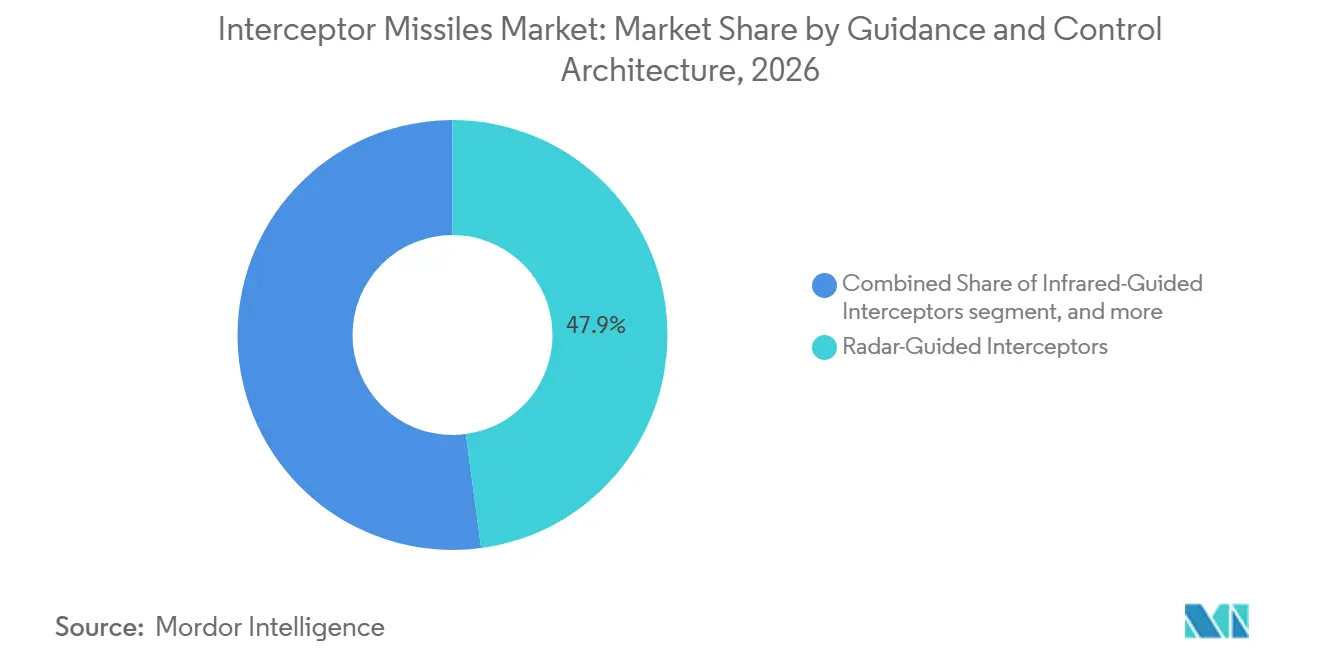
- By guidance and control architecture, radar-guided interceptors held a 47.87% share in 2026, while multi-sensor and hybrid-guided interceptors are forecast to grow at an 8.23% CAGR through 2032.
- By threat type, ballistic-missile interceptors held a 54.35% share in 2026, while hypersonic-threat interceptors are forecast to grow at a 9.44% CAGR through 2032.
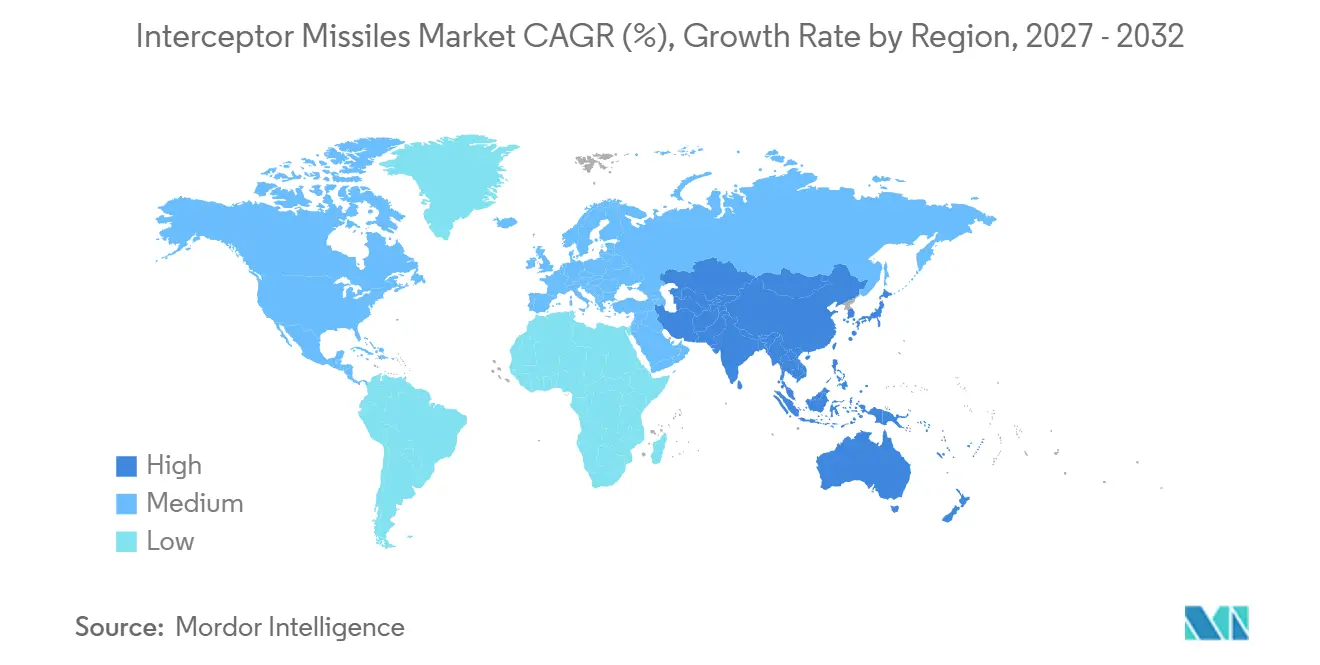
- By geography, North America held a 42.24% share in 2026, while Asia-Pacific is forecast to grow at a 7.75% CAGR through 2032.
Note: Market numbers in this report are based on Mordor Intelligence's proprietary estimation framework, which combines nine months of actuals with Q4 projections for base year 2026.
Global Interceptor Missiles Market Trends and Insights
Drivers Impact Analysis*
| Driver | (~) % Impact on CAGR Forecast | Geographic Relevance | Impact Timeline |
|---|---|---|---|
| Sustained defense-budget growth and replenishment demand | +1.8% | Global, concentrated in North America, Europe, and Asia-Pacific | Short term (≤ 2 years) |
| Proliferation of ballistic, cruise, hypersonic, and low-observable threats | +1.4% | Global, with high intensity in Asia-Pacific and the Middle East | Medium term (2-4 years) |
| Expansion of layered integrated air and missile defense | +1.2% | North America, Europe, and core Asia-Pacific countries | Medium term (2-4 years) |
| Indigenous defense manufacturing and allied coproduction | +0.7% | Asia-Pacific and the Middle East | Long term (≥ 4 years) |
| Combat validation and stockpile replenishment | +0.9% | The US, Israel, Europe, and Gulf states | Short term (≤ 2 years) |
| Space-enabled tracking and sensor-fusion investment | +0.5% | The US, Japan, Australia, and the UAE | Long term (≥ 4 years) |
| Source: Mordor Intelligence | |||
Sustained Defense-Budget Growth and Replenishment Demand
Record-level defense budgets are providing direct support for the interceptor missiles market. Global military expenditure reached USD 2,887 billion in 2025, while European spending reached USD 864 billion, up 14% from the prior year. NATO members agreed in June 2025 to a 5.0% of GDP defense and security spending target by 2035, including 3.5% for core defense needs. The US Army awarded Lockheed Martin Corporation a USD 9.8 billion multi-year PAC-3 MSE contract in September 2025, the largest Patriot order to date.[1] Simultaneous demand from several allied buyers is placing pressure on production schedules and favors contractors that can commit to higher, sustained output. This procurement pattern gives the interceptor missiles market a stronger base than one-off annual funding decisions do.
Proliferation of Ballistic, Cruise, Hypersonic, and Low-Observable Threats
The interceptor missiles market is responding to a threat set that now includes ballistic missiles, cruise missiles, hypersonic systems, and low-observable targets. The Missile Defense Agency included USD 247 million in mandatory FY2026 funding to accelerate the Glide Phase Interceptor toward delivery in FY2032. Hypersonic systems travel at Mach 5 or more and can follow maneuvering paths, which makes them difficult for systems built around earlier threat assumptions. Japan has identified low-flying, irregular-trajectory missile development by North Korea as a continuing regional concern. Buyers are therefore seeking several layers of defense rather than relying on a single interceptor type. That need supports procurement across different engagement ranges and guidance approaches in the interceptor missiles market.
Expansion of Layered Integrated Air and Missile Defense
Layered integrated air and missile defense is moving from a policy concept toward funded deployment programs. NATO updated its Integrated Air and Missile Defense Policy in February 2025 to address hypersonic glide vehicles and Class I unmanned aircraft systems, alongside established air and missile threats. The Guam Enhanced Integrated Air and Missile Defense network received deployment approval in October 2025, with an USD 8 billion program spanning 16 sites and using Aegis land-based systems, SM-3, and SM-6 interceptors.[2] The US Army also announced a 30% expansion of its air defense force structure in August 2025. These programs require several systems to operate together across surface, sea, and airborne layers. Their scale creates durable demand for medium- and long-range interceptors, sensors, and battle-management links across the interceptor missiles market.
Combat Validation and Stockpile Replenishment
Combat use has reinforced the need to replenish inventories and raise production capacity in the interceptor missiles market. During the June 2025 Israel-Iran conflict, US forces reportedly expended more than 150 THAAD interceptors and 80 SM-3 interceptors over 12 days. The Pentagon reprogrammed more than USD 700 million into FY2025 THAAD procurement during May and June 2025. Lockheed Martin then received a USD 35 billion, 7-year THAAD procurement award in June 2026 to accelerate production. RTX Corporation received a separate USD 6.3 billion, 5-year contract for SM-3 Block IB production and sustainment in October 2026. The contract actions place sustained manufacturing capacity at the center of readiness planning.
Restraints Impact Analysis*
| Restraint | (~) % Impact on CAGR Forecast | Geographic Relevance | Impact Timeline |
|---|---|---|---|
| High development and cost-per-intercept economics | -1.5% | Global, particularly lower-income NATO allies and Gulf states | Short term (≤ 2 years) |
| Export controls, configuration restrictions, and technology sovereignty | -0.9% | Middle East, Asia-Pacific non-allied states, and South Asia | Medium term (2-4 years) |
| Specialty-propellant, seeker, and GaN supply bottlenecks | -0.7% | North America and Europe, with effects on allied procurement schedules | Short term (≤ 2 years) |
| Software, cybersecurity, test-range, and system-integration risk | -0.5% | Global, with the greatest effect on advanced integrated architectures | Long term (≥ 4 years) |
| Source: Mordor Intelligence | |||
High Development and Cost-Per-Intercept Economics
High-end interceptors can cost more than the offensive missiles they are designed to defeat. The estimated unit cost of a THAAD interceptor is USD 15 million, and the FY2024 supplemental cost of an SM-3 IB interceptor is nearly USD 24 million. These costs can limit the number of systems that lower-budget customers can procure and sustain. The resulting cost challenge is especially significant for buyers who need large inventories to sustain operations. Procurement decisions in the interceptor missiles market therefore balance high-end capability against the need for affordable capacity. The Missile Technology Control Regime (MTCR) requirements also limit export configurations and flexibility for certain systems.
Specialty-Propellant, Seeker, and GaN Supply Bottlenecks
Supply constraints can delay deliveries even when customers have approved funding. China accounted for 98% of global primary gallium production, and its export controls on gallium and germanium have been in force since July 2023. GaN is important for radar applications used in systems such as LTAMDS, AN/SPY-6, and AN/TPY-2. Gallium requirements span more than 11,000 US defense parts and involve widespread exposure to Chinese suppliers within relevant supply chains. The availability of germanium presents a related concern because it is used in infrared seeker lenses. These supply conditions can limit the near-term conversion of contract awards into delivered inventory in the interceptor missiles market.
*Our forecasts treat driver/restraint impacts as directional, not additive. The impact forecasts reflect baseline growth, mix effects, and variable interactions.
Segment Analysis
By Type: Naval Interceptors Gain as Sea-Based IAMD Architectures Mature
Surface-to-air interceptor missiles accounted for 43.98% of the interceptor missiles market size in 2026. PAC-3 MSE, THAAD, and comparable national systems support this position across NATO members, India, South Korea, and Gulf Cooperation Council states. These systems provide fixed and mobile coverage for facilities, deployed forces, and populated areas. They also form a central layer within national air and missile defense networks. The segment benefits from established operating experience and a large installed base. Demand remains tied to both new deployments and the replenishment of existing inventories.
Water-to-air and naval interceptor missiles are forecast to grow at a 7.11% CAGR through 2032. The US Navy targets 63 Aegis ships with ballistic missile defense capability by the end of FY2026. Japan is advancing its Aegis System Equipped Vessel program, while South Korea is acquiring a shipboard ballistic missile interceptor capability for SM-3 integration. Sea-based platforms can operate in international waters and extend the engagement window beyond fixed shore positions. Air-to-air interceptor missiles retain a separate role in fighter programs, including South Korea’s short-range guided missile development program for the KF-21. Other interceptors, including directed-energy supplements and low-cost loitering systems, remain early-stage options for saturation-defense missions.

By Range: Extended-Range Interceptors Redefine the Area Defense Investment Case
Medium-range interceptors accounted for 28.22% of the interceptor missiles market in 2026. Programs such as MRSAM, Aster 30, and PAC-3 MSE support their role in national integrated air and missile defense networks. This range band combines established technology with the ability to protect important areas and assets. It serves a broad set of defense requirements across allied and domestic programs. Short-range interceptors are also receiving renewed attention after combat experience highlighted the need for dense terminal coverage. India completed 4 successful MRSAM Army flight tests in April 2025 across long-range, short-range, high-altitude, and low-altitude conditions.[3]
Long-range interceptors between 100 km and 1,000 km are benefiting from inventory rebuilding and larger procurement programs. The USD 35 billion THAAD award supports production expansion in this tier. Extended-range interceptors above 1,000 km are forecast to grow at a 7.54% CAGR through 2032. The US Space Force awarded agreements worth up to USD 3.2 billion to 12 companies in late 2025 and early 2026 for space-based interceptor development under the Golden Dome program. These awards create a new procurement path for the highest range category. The MTCR rules may affect which allied nations can participate in related coproduction.
By Guidance and Control Architecture: Hybrid Seekers Become the Dominant Technology Bet
Radar-guided interceptors held 47.87% of the interceptor missiles market share in 2026. Their lead reflects long-running investment in active radar homing across PAC-3 MSE, SM-3, and SM-6 programs. Radar-guided systems will continue to be purchased in high volume because they support several established missions. Infrared-guided interceptors remain relevant for terminal engagements against aircraft and slower cruise missiles. Their effectiveness can be limited against hypersonic glide vehicles because plasma effects can affect infrared seeker performance. Command-guided and GPS/inertial-guided systems retain roles where cost, infrastructure, or electronic warfare concerns shape the choice of system.
Multi-sensor and hybrid-guided interceptors are forecast to grow at an 8.23% CAGR through 2032. The demand reflects the need to address hypersonic, cruise missile, and maneuvering re-entry threats with more than one sensing method. Northrop Grumman is developing the Glide Phase Interceptor with Japan through a formal cooperative program. The design combines a multi-mode terminal seeker with direct thrust-vectoring attitude control. This architecture addresses a technically demanding interception requirement. The US export controls continue to affect which allied customers can acquire advanced guidance subsystems and which must pursue local development paths.
By Threat Type: Hypersonic-Threat Interceptors Transition from Laboratory to Fielded Requirement
Ballistic-missile interceptors held 54.35% of the interceptor missiles market share in 2026. The segment reflects decades of investment in theater ballistic missile defense and the operating record of systems such as THAAD, SM-3 Block IIA, Arrow 3, and MRSAM. Ballistic missile defense remains the anchor layer for many integrated architectures. Cruise-missile interceptors address a threat category that has increased in importance since 2022. The SM-6 provides both defensive interception and offensive strike capability. RTX received a USD 24.4 billion multi-year SM-6 contract in October 2026, which reinforces the program’s role in maritime defense.
Aircraft and aerial-threat interceptors continue to support traditional air defense roles and are increasingly connected to counter-unmanned aircraft requirements. Hypersonic-threat interceptors are forecast to grow at a 9.44% CAGR through 2032. The Missile Defense Agency’s FY2026 plan included USD 247 million in mandatory funding to accelerate the Glide Phase Interceptor. The Space Force’s space-based interceptor program targets an in-orbit demonstration by 2028. Near-term spending is focused on research, development, testing, and prototypes that could later move into procurement-scale programs.
Geography Analysis
North America accounted for 42.24% of the interceptor missiles market in 2026. The region combines the US’ position as the largest buyer, a leading developer of next-generation architectures, and a principal supplier to allies. Awards spanning THAAD, PAC-3 MSE, SM-6, SM-3 IB, and space-based interceptor programs exceeded USD 125 billion in potential value between April 2025 and October 2026. The US Space Force also awarded up to USD 3.2 billion for the space-based interceptor program. Canada is expanding its NORAD modernization commitments, while Mexico’s domestic interceptor demand remains limited during the forecast period. These conditions make North America the largest regional base for the interceptor missiles market.
Europe is translating post-2022 spending commitments into active procurement of air and missile defenses. European military expenditure reached USD 864 billion in 2025, up 14% year over year. Denmark selected MBDA France, Diehl Stiftung & Co. KG, and Kongsberg Gruppen ASA for air defense contracts valued at USD 919 million in June 2025. Norway selected Hanwha Aerospace for a USD 1.7 billion, long-range precision fires program in January 2026, with first deliveries expected in 2028 and 2029. NATO interoperability standards are becoming an increasingly important condition in regional procurement.
Asia-Pacific is forecast to grow at a 7.75% CAGR through 2032. Regional demand is linked to North Korean missile programs, Chinese military modernization, and the expansion of domestic manufacturing capabilities. Japan operates 8 Aegis-equipped destroyers with SM-3 interceptors and acquired SM-6 capability in February 2025, while also participating in the development of the Glide Phase Interceptor. South Korea is moving toward domestic production in higher-value interceptor categories and continuing work on the Cheongung-III program. India completed 4 MRSAM Army flight tests in April 2025 and is also pursuing a sea-based anti-ballistic missile interceptor. The interceptor missiles market in the Middle East and Africa has potential for growth driven by regional security conditions, although sovereign procurement in Africa remains limited.
Competitive Landscape
The interceptor missiles market is moderately concentrated at the program level. Lockheed Martin Corporation, RTX Corporation, Northrop Grumman Corporation, RAFAEL Advanced Defense Systems Ltd., and L3Harris Technologies, Inc. hold most program-of-record positions. These companies benefit from technical experience, established production lines, and access to long-running government programs. Competition is increasing below the prime-contractor level for propulsion, seekers, and GaN-enabled radar components. Contractors are also competing for new space-based and low-cost interceptor opportunities. Export controls under the International Traffic in Arms Regulations (ITAR) and missile technology rules can reinforce Western suppliers' position in advanced subsystems.
The US Space Force opened its space-based interceptor competition to companies such as Lockheed Martin Corporation, Northrop Grumman Corporation, RTX Corporation, Anduril, True Anomaly, and Turion Space. In April 2026, it awarded 20 agreements totaling up to USD 3.2 billion to 12 companies to support the integration of Golden Dome by 2028.[4] Lockheed Martin Corporation's June 2026 THAAD award includes more than USD 9 billion in facility investment through 2030, including a Munitions Production Center in Troy, Alabama. RTX Corporation has also expanded its LTAMDS radar integration and testing capacity in Andover, Massachusetts, in the US. These moves show that production capacity, sensor technology, and platform integration are major areas of competition.
Asian companies are becoming more important competitors in the interceptor missiles market. Hanwha Aerospace signed a USD 144 million contract in June 2025 to develop the L-SAM II interceptor with Divert and Attitude Control System technology and 10 adjustable thrusters. LIG Defense&Aerospace leads seeker and guidance integration forthe Cheongung-III, while South Korea's air-to-air missile program deepens domestic competition. Mitsubishi Heavy Industries and Japanese suppliers are involved in Glide Phase Interceptor cooperation with the US. The regional competitive change is less about one supplier replacing a Western prime and more about reducing reliance on US foreign military sales channels. This development expands production capability while reducing some export opportunities for established suppliers.
Interceptor Missiles Industry Leaders
-
Lockheed Martin Corporation
-
RTX Corporation
-
Northrop Grumman Corporation
-
L3Harris Technologies, Inc.
-
RAFAEL Advanced Defense Systems Ltd.
- *Disclaimer: Major Players sorted in no particular order
Recent Industry Developments
- October 2026: Raytheon (RTX Corporation) secured a five-year contract worth up to USD 24.4 billion to supply SM-6 interceptors to the US Navy, substantially scaling production of a dual-mission munition capable of ballistic missile interception and offensive strikes.
- June 2026: The US government awarded Lockheed Martin Corporation a seven-year undefinitized contract action for up to USD 35 billion to quadruple THAAD interceptor production. Lockheed committed more than USD 9 billion in facility investment through 2030, including a new Munitions Production Center in Troy, Alabama.
- April 2026: The US Space Force Space Systems Command awarded 20 OTA agreements worth up to USD 3.2 billion to 12 companies, including Lockheed Martin Corporation, Northrop Grumman Corporation, Raytheon (RTX Corporation), and Anduril, to develop space-based interceptors targeting integration with the Golden Dome architecture by 2028.
Global Interceptor Missiles Market Report Scope
The interceptor missiles market encompasses the research, design, development, manufacturing, integration, delivery, and lifecycle support of missile systems that detect, track, engage, and neutralize incoming aerial and missile threats. The study includes surface-to-air, air-to-air, and naval interceptor missiles, covering systems designed to counter ballistic missiles, cruise missiles, hypersonic threats, aircraft, and other airborne threats. It evaluates market performance across new interceptor system procurement, existing missile inventory replenishment, fleet modernization, and the expansion of integrated air and missile defense capabilities driven by evolving security threats and defense requirements.
The interceptor missiles market is segmented by type, range, guidance and control architecture, threat type, and geography. By type, the market is segmented into surface-to-air interceptor missiles, air-to-air interceptor missiles, water-to-air and naval interceptor missiles, and other interceptors. By range, the market is segmented into short-range (less than 50 km), medium-range (50 to less than 100 km), long-range (100 to less than 1,000 km), and extended-range (more than 1,000 km). By guidance and control architecture, the market is segmented into radar-guided interceptors, infrared-guided interceptors, command-guided interceptors, global positioning and inertial-guided interceptors, and multi-sensor and hybrid-guided interceptors. By threat type, the market is segmented into ballistic-missile interceptors, cruise-missile interceptors, hypersonic-threat interceptors, and aircraft and aerial-threat interceptors. The report also covers the market sizes and forecasts for the interceptor missiles market in major countries across different regions. For each segment, the market size is provided in terms of value (USD).
Source: https://www.mordorintelligence.com/industry-reports/aircraft-thrust-reverser-actuation-systems-market
| Surface-to-Air Interceptor Missiles |
| Air-to-Air Interceptor Missiles |
| Water-to-Air and Naval Interceptor Missiles |
| Other Interceptors |
| Short-Range (Less Than 50 km) |
| Medium-Range (50 to Less than 100 km) |
| Long-Range (100 to Less than 1,000 km) |
| Extended-Range (More Than 1,000 km) |
| Radar-Guided Interceptors |
| Infrared-Guided Interceptors |
| Command-Guided Interceptors |
| Global Positioning and Inertial-Guided Interceptors |
| Multi-Sensor and Hybrid-Guided Interceptors |
| Ballistic-Missile Interceptors |
| Cruise-Missile Interceptors |
| Hypersonic-Threat Interceptors |
| Aircraft and Aerial-Threat Interceptors |
| North America | United States | |
| Canada | ||
| Mexico | ||
| Europe | United Kingdom | |
| France | ||
| Germany | ||
| Italy | ||
| Spain | ||
| Russia | ||
| Rest of Europe | ||
| Asia-Pacific | China | |
| India | ||
| Japan | ||
| South Korea | ||
| Australia | ||
| Rest of Asia-Pacific | ||
| South America | Brazil | |
| Argentina | ||
| Rest of South America | ||
| Middle East and Africa | Middle East | Israel |
| Saudi Arabia | ||
| United Arab Emirates | ||
| Rest of Middle East | ||
| Africa | South Africa | |
| Egypt | ||
| Rest of Africa | ||
| By Type | Surface-to-Air Interceptor Missiles | ||
| Air-to-Air Interceptor Missiles | |||
| Water-to-Air and Naval Interceptor Missiles | |||
| Other Interceptors | |||
| By Range | Short-Range (Less Than 50 km) | ||
| Medium-Range (50 to Less than 100 km) | |||
| Long-Range (100 to Less than 1,000 km) | |||
| Extended-Range (More Than 1,000 km) | |||
| By Guidance and Control Architecture | Radar-Guided Interceptors | ||
| Infrared-Guided Interceptors | |||
| Command-Guided Interceptors | |||
| Global Positioning and Inertial-Guided Interceptors | |||
| Multi-Sensor and Hybrid-Guided Interceptors | |||
| By Threat Type | Ballistic-Missile Interceptors | ||
| Cruise-Missile Interceptors | |||
| Hypersonic-Threat Interceptors | |||
| Aircraft and Aerial-Threat Interceptors | |||
| By Geography | North America | United States | |
| Canada | |||
| Mexico | |||
| Europe | United Kingdom | ||
| France | |||
| Germany | |||
| Italy | |||
| Spain | |||
| Russia | |||
| Rest of Europe | |||
| Asia-Pacific | China | ||
| India | |||
| Japan | |||
| South Korea | |||
| Australia | |||
| Rest of Asia-Pacific | |||
| South America | Brazil | ||
| Argentina | |||
| Rest of South America | |||
| Middle East and Africa | Middle East | Israel | |
| Saudi Arabia | |||
| United Arab Emirates | |||
| Rest of Middle East | |||
| Africa | South Africa | ||
| Egypt | |||
| Rest of Africa | |||
Key Questions Answered in the Report
What is the projected value of the interceptor missiles market by 2032?
The interceptor missiles market is forecast to reach USD 12.44 billion by 2032, growing at a 5.59% CAGR from 2027 to 2032.
Which interceptor type is growing fastest?
Water-to-air and naval interceptor missiles are forecast to grow at a 7.11% CAGR through 2032, supported by expanding sea-based missile defense programs.
Which threat category has the highest growth forecast?
Hypersonic-threat interceptors have the highest forecast growth rate at a 9.44% CAGR through 2032.
Which region has the largest interceptor missile demand?
North America held 42.24% share in 2026, supported by US procurement programs and allied supply relationships
Which companies are most established in interceptor programs?
Lockheed Martin Corporation, RTX Corporation, Northrop Grumman Corporation, RAFAEL Advanced Defense Systems Ltd., and L3Harris Technologies, Inc. hold most program-of-record positions.