
Insurance Protection Product Market Size and Share
Market Overview
| Study Period | 2021 - 2032 |
|---|---|
| Market Size (2027) | USD 688.10 Billion |
| Market Size (2032) | USD 903.60 Billion |
| Growth Rate (2027 - 2032) | 5.60 % |
| Fastest Growing Market | South America |
| Largest Market | Asia-Pacific |
| Market Concentration | Low |
Major Players *Disclaimer: Major Players sorted in no particular order Image © Mordor Intelligence. Reuse requires attribution under CC BY 4.0. | |
Insurance Protection Product Market Analysis by Mordor Intelligence
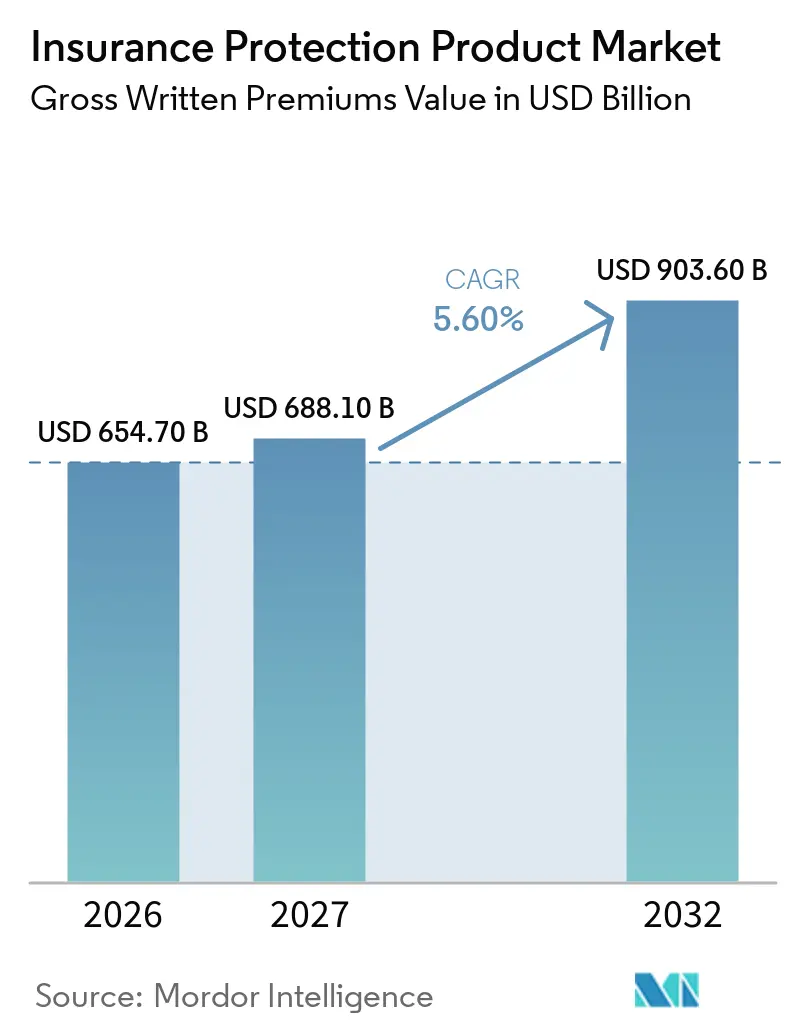
The Insurance Protection Product Market size in terms of gross written premiums value is projected to be USD 654.70 billion in 2026, USD 688.10 billion in 2027, and reach USD 903.60 billion by 2032, growing at a CAGR of 5.60% from 2027 to 2032.
The insurance protection product market is supported by persistent mortality, disability, and health coverage gaps in both developed and emerging economies. Noncommunicable diseases caused 74% of deaths globally, which keeps the need for health-linked and income-protection cover high. Swiss Re estimated the health protection gap across 12 Asian markets at USD 258 billion in premium-equivalent terms in 2024, 21% higher than in 2017. Digital distribution is expanding access to consumers who were difficult to serve through conventional sales models. Leading insurers are pairing quicker underwriting with bank, employer, and platform partnerships to improve acquisition efficiency and sustain retention.
Key Report Takeaways
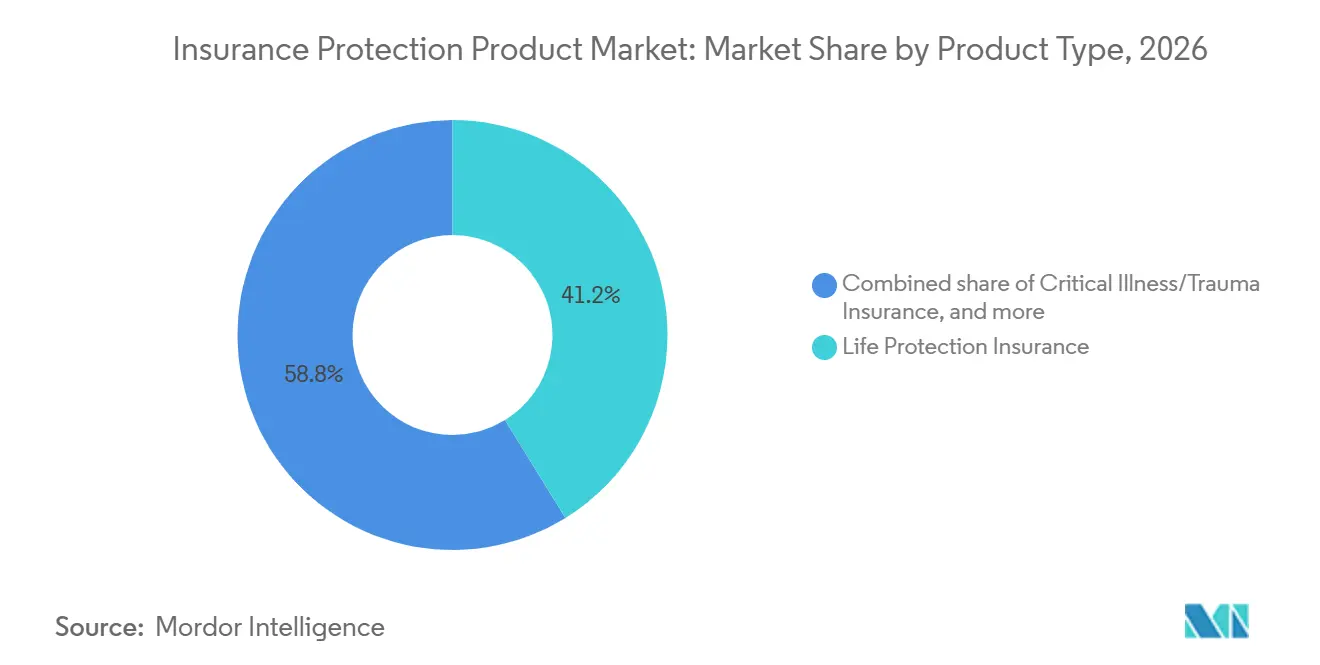
- By product type, life protection insurance captured 41.2% of the insurance protection product market share in 2026, while critical illness and trauma insurance is projected to grow at an 8.1% CAGR through 2032.
- By policy form, individual and retail policies captured 54.6% of the insurance protection product market share in 2026, while affinity, embedded, and creditor policies are projected to grow at a 7.7% CAGR through 2032.
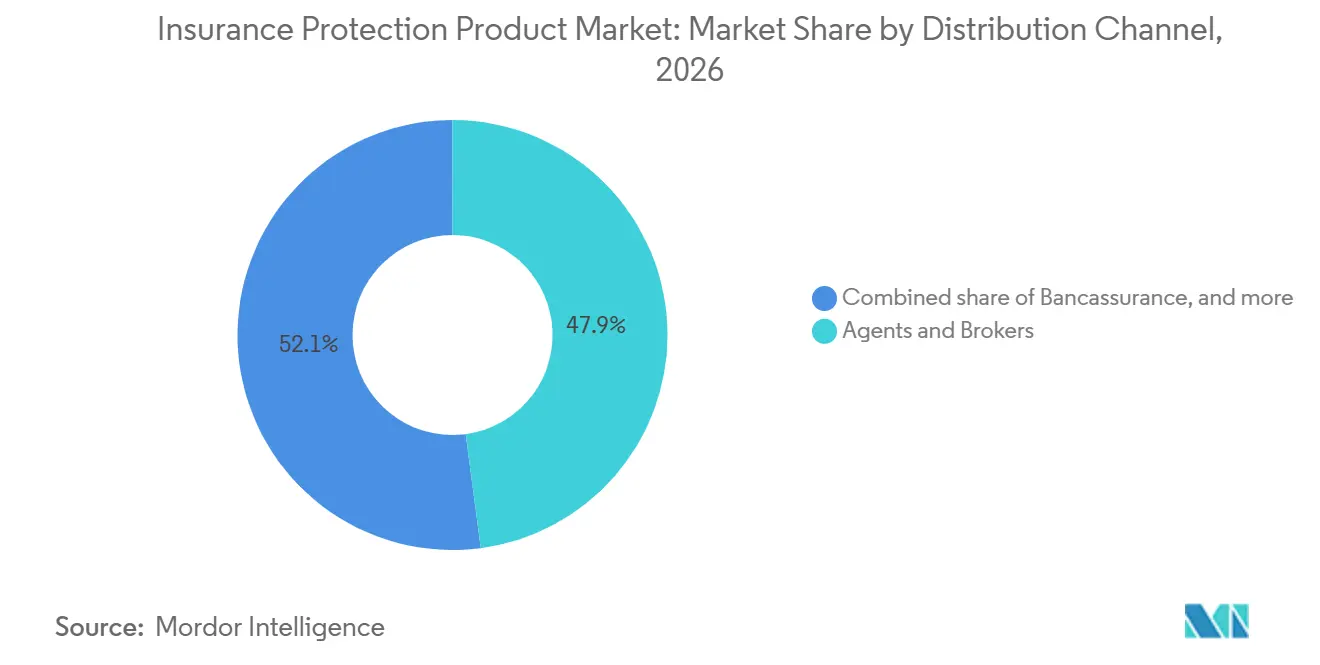
- By distribution channel, agents and brokers captured 47.9% of the insurance protection product market share in 2026, while embedded channels are projected to grow at a 9.2% CAGR through 2032.
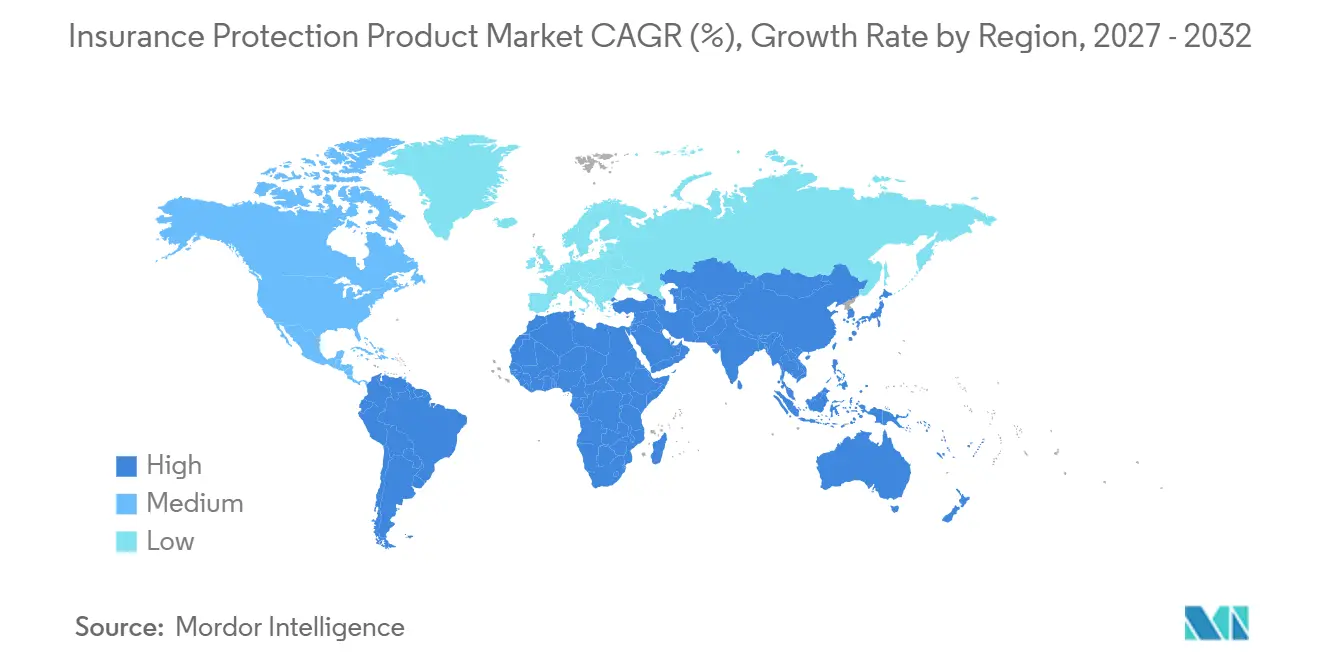
- By geography, Asia-Pacific captured 44.8% of the insurance protection product market share in 2026, while South America is projected to grow at an 8.5% CAGR through 2032.
Note: Market numbers in this report are based on Mordor Intelligence's proprietary estimation framework, which combines nine months of actuals with Q4 projections for base year 2026.
Market Trends and Insights
Drivers Impact Analysis of Insurance Protection Product Market*
| Driver | (~) % Impact on CAGR Forecast | Geographic Relevance | Impact Timeline |
|---|---|---|---|
| Growing Global Mortality and Income-Protection Gaps | +1.4% | Global | Long term (≥ 4 years) |
| Demand for Affordable Digital Protection | +1.1% | Asia-Pacific, Latin America, Middle East and Africa | Medium term (2-4 years) |
| Embedded Protection in Financial and Employment Ecosystems | +0.9% | Global, led by Asia-Pacific, North America, and Europe | Medium term (2-4 years) |
| Accelerated and Data-Driven Underwriting | +0.7% | North America, Europe, and advanced Asia-Pacific markets | Medium term (2-4 years) |
| Employer Demand for Group Life, Disability, and Income Protection | +0.6% | North America and Europe | Medium term (2-4 years) |
| Innovation for Underinsured Emerging-Market Consumers | +0.5% | Emerging Asia-Pacific, Africa, and Latin America | Long term (≥ 4 years) |
| Source: Mordor Intelligence | |||
Growing Global Mortality and Income-Protection Gaps
Insurance protection gaps continue to drive demand across the Insurance protection product market. South Africa’s life and disability insurance shortfall reached ZAR 50.4 trillion (USD 2.8 trillion) at the end of 2024 and was 7 times the national GDP[1]. The shortfall expanded at 12.5% annually from 2021, while the average South African family held only 40% of the disability cover it required. In the United Kingdom, 86% of mortgage holders had no income protection, and 85% of broader income-protection needs remained unmet in 2026. These conditions show that limited consumer understanding can constrain demand even where products are widely available. Insurers can respond through simpler benefit descriptions, modular protection designs, and financial education that centers on income replacement.
Rising Demand for Affordable, Digitally Distributed Protection Products
Digital delivery is lowering acquisition costs and helping insurers reach price-sensitive consumers in the insurance protection product market. Brazil’s Open Insurance framework enables customers to share data among insurers through application programming interfaces, which supports more tailored pricing and simpler enrollment. Life insurance premiums in Brazil rose 8.4% in the first half of 2025, and individual life business increased 13.2%. In the Asia-Pacific region, digital tools are improving agent productivity rather than replacing intermediaries, as agencies and bancassurance still account for more than 90% of protection sales. Ethos launched a native ChatGPT application in May 2026 to provide instant life insurance estimates to more than 900 million users[2]. The strongest channel models combine digital convenience with the guidance needed for complex protection decisions.
Expansion of Embedded Protection Across Financial and Employment Ecosystems
Embedded distribution is changing how insurers access customers and manage channel costs in the insurance protection product market. It places protection products within payment, lending, payroll, e-commerce, and employment journeys, where consumers are already making related financial decisions. This approach can make coverage easier to purchase and give carriers access to transaction information relevant to underwriting. It also shifts negotiating power toward platforms that control customer traffic and access to customer information. The model is particularly relevant for affinity and creditor products, where coverage can be linked to a loan, payment flow, or employee benefit. Carriers must select partners carefully because dependence on a limited number of platforms can weaken their position in future commercial negotiations.
Adoption of Accelerated and Data-Driven Underwriting
Faster underwriting is becoming an important operating tool in the insurance protection product market. Manulife’s MAUDE engine automatically approved 58% of eligible individual life applications by December 2025, 56% more than before launch[3]. The redesigned process reduced medical questions by 40% and made decisions in as little as 2 minutes. John Hancock’s Quick Quote reduced preliminary assessment time from 1 day to 15 minutes and has processed more than 20,000 cases since its late-2024 pilot. Aviva extended its underwriting summarization tool to individual critical illness applications in March 2026, reducing review time per case by 50%. Governance remains important because the International Association of Insurance Supervisors identifies bias, limited model explainability, and third-party vendor dependence as central risks.
Restraints Impact Analysis of Insurance Protection Product Market*
| Restraint | (~) % Impact on CAGR Forecast | Geographic Relevance | Impact Timeline |
|---|---|---|---|
| Affordability Constraints and Persistent Protection Underinsurance | -0.7% | Emerging Asia-Pacific, Middle East and Africa, and Latin America | Long term (≥ 4 years) |
| Regulatory and Privacy Constraints on Alternative-Data Underwriting | -0.5% | European Union, North America, and advanced Asia-Pacific markets | Long term (≥ 4 years) |
| Adverse Selection and Pricing Risk in Simplified Underwriting | -0.3% | Global | Medium term (2-4 years) |
| Rising Claims and Longevity Costs in Disability and Health-Linked Protection | -0.4% | North America, Europe, Japan, and Australia | Long term (≥ 4 years) |
| Source: Mordor Intelligence | |||
Affordability Constraints and Persistent Protection Underinsurance
Affordability limits participation in the insurance protection product market, particularly when rising premiums compete with essential household spending. New Zealand’s Financial Services Council reported in June 2026 that consumers were reducing or canceling income-protection cover as premiums increased. Only 10% of adults held income protection, compared with 59% who held motor vehicle insurance. The South African gap study also found that life cover adequacy was 49% for higher-income earners, while disability cover adequacy remained in the high 30% range. The pattern indicates that product relevance and complexity can deter purchase alongside price. Payroll deductions, employer-supported voluntary benefits, and staged coverage options can improve affordability without reducing protection to a single basic product.
Regulatory and Privacy Constraints on Alternative-Data Underwriting
Privacy requirements and insurance supervision can slow the adoption of alternative-data underwriting. The International Association of Insurance Supervisors identified bias, privacy breaches, non-explainability, and third-party dependencies as supervisory concerns for artificial intelligence use. In the European Union, General Data Protection Regulation requirements limit the use of wearable health data, telematics, and social media signals for protection underwriting. Refinements to Solvency II capital rules also affect pricing and capital allocation for life insurers. These obligations increase compliance costs and can delay launches across jurisdictions. Larger insurers may be better positioned to meet the requirements because they have established governance, legal, and model-control capabilities.
*Our forecasts treat driver/restraint impacts as directional, not additive. The impact forecasts reflect baseline growth, mix effects, and variable interactions.
Insurance Protection Product Market Segment Analysis
By Product Type:
Critical Illness Demand Expands Protection NeedsLife protection insurance accounted for 41.2% of the Insurance protection product market size in 2026, reflecting its role in mortgage lending, employer benefits, and public policy incentives. It remains the basic form of mortality cover for many households. Final expense and protection-oriented whole life policies serve older consumers in North America and Western Europe who value guaranteed death benefits. Disability and income protection insurance also serves a large employer-sponsored base. The United States group disability segment generated USD 19.9 billion in combined long-term, short-term, and paid family leave in-force premiums in 2024. Personal accident and credit life products support mobile-enabled micro-insurance and lending ecosystems in Asia-Pacific, Latin America, and Southeast Asia. Critical illness and trauma insurance is the fastest-growing product category at 8.1% CAGR through 2032. Rising noncommunicable disease prevalence and awareness of post-diagnosis income loss are increasing interest in lump-sum benefits. This demand addresses needs that mortality-only products do not fully cover.
Product development is also reducing the separation between protection and wellness. Aviva introduced a critical illness product in the United Kingdom in September 2025 that covers mental health conditions. The product responds to behavioral health as a contributor to long-term income loss. Sun Life Canada has bundled term and critical illness cover at a discount to improve the perceived value of protection. Bundled products can reduce the perception that separate policies are difficult to manage. The United Kingdom Financial Conduct Authority’s Consumer Duty requires insurers to show that product bundles provide fair value. This requirement makes benefit clarity and appropriate pricing central to product design. Insurers, therefore, need to distinguish genuine customer value from added complexity. The insurance protection product market can gain from broader coverage only when consumers understand the benefit structure.
By Policy Form:
Affinity and Embedded Models Expand AccessIndividual and retail policies held 54.6% of the Insurance protection product market share in 2026. Direct-to-consumer channels, independent adviser networks, and bancassurance platforms support this position. Individually underwritten products remain a major revenue source for insurers in many mature markets. Group and Employer-Sponsored forms provide another substantial layer of protection. In the United States, workplace life insurance's new premium reached USD 691 million in the third quarter of 2025. Affinity, embedded, and creditor forms are projected to grow at a 7.7% CAGR through 2032. Open banking and insurance frameworks can support these forms by allowing more efficient data sharing with consent. Platform partnerships can also make smaller policies economically viable at scale.
Employer budgets and employee demand are shaping policy-form design. Employers need to control costs while workers seek broader income, life, and health protection. Voluntary-benefit arrangements address this balance by linking optional benefits to a smaller employer-paid package. They allow workers to select coverage that better fits household needs and budgets. The model is well established in North America and the United Kingdom. It is also expanding in Australia and Singapore as employer-sponsored protection becomes more common. Gig-economy platforms are introducing income protection into freelance payroll flows in Asia-Pacific financial technology ecosystems. These models may add volume quickly, although regulatory classifications may not always keep pace. The insurance protection product market benefits when policy forms fit the practical way people earn, borrow, and pay.
By Distribution Channel:
Advice Remains Important as Embedded Sales RiseAgents and brokers held 47.9% of the insurance protection product market share in 2026. Their position reflects the advice requirements of complex life, disability, and income protection policies. Licensed intermediation remains important in many jurisdictions for long-form underwriting. Bancassurance was the second-largest channel by volume. In Poland, bancassurance gross written premiums reached PLN 1.8 billion (USD 450 million) in the first quarter of 2026, increasing 40.6% year over year. The change followed a 2025 slowdown after revised distribution requirements. Direct-to-consumer, employer, workplace, and affinity channels are also growing as digital onboarding becomes easier. Channel performance is increasingly shaped by technology integration rather than price alone.
Embedded distribution is projected to grow at 9.2% CAGR through 2032. Application programming interface-based administration can allow partners to quote, bind, and issue coverage within a customer journey. The approach reduces friction where a customer is already taking out credit, making a payment, or enrolling in benefits. Prudential Thailand and TTB launched a life protection product in March 2026 with artificial intelligence-supported portfolio management through bancassurance. This illustrates how insurers can combine managed bank relationships with more digital product experiences. However, a carrier that relies on only one or two platform partners may face reduced bargaining power over time. The insurance protection product market, therefore, requires a balanced distribution portfolio across advisers, banks, employers, direct channels, and platforms. That balance can protect customer access while avoiding excessive dependence on a single partner type.
Geography Analysis
APAC Insurance Protection Product Market
Asia-Pacific accounted for 44.8% of the global insurance protection product market size in 2026. China, Japan, India, and Southeast Asian countries provide the region’s largest premium base and its most significant long-term volume potential. China’s life insurance premiums grew 11.4% in 2025. India removed the goods and services tax on individual life and health policies in 2025 and approved 100% foreign direct investment in insurance. These changes can support partnerships between insurers and financial institutions, while the regional protection gap indicates that the insurance protection product market has further room to expand.
North America and Europe Insurance Protection Product Market
North America and Europe represent mature parts of the insurance protection product market with high premium density. The United Kingdom remains a notable opportunity because 85% of income-protection needs were unmet in 2026. In the United States, 74 million adults reported that they needed life insurance, and another 24 million needed more coverage. France, Germany, and the United Kingdom recorded return on equity of 11.6% in 2025, up from 9.1% in 2024. European Union capital rules continue to affect pricing and portfolio allocation.
South America and MEA Insurance Protection Product Market
South America is projected to record the highest geographic growth at 8.5% CAGR through 2032. Brazil’s insurance sector is projected to grow 5.7% in 2026, with life products expected to increase 4.3%. Argentina, Chile, and Colombia add growth through expanding middle-class populations. The Middle East and Africa are smaller in premium terms, but South Africa’s ZAR 50.4 trillion (USD 2.8 trillion) gap and new mandates in the United Arab Emirates and Saudi Arabia leave substantial room for protection adoption.
Competitive Landscape
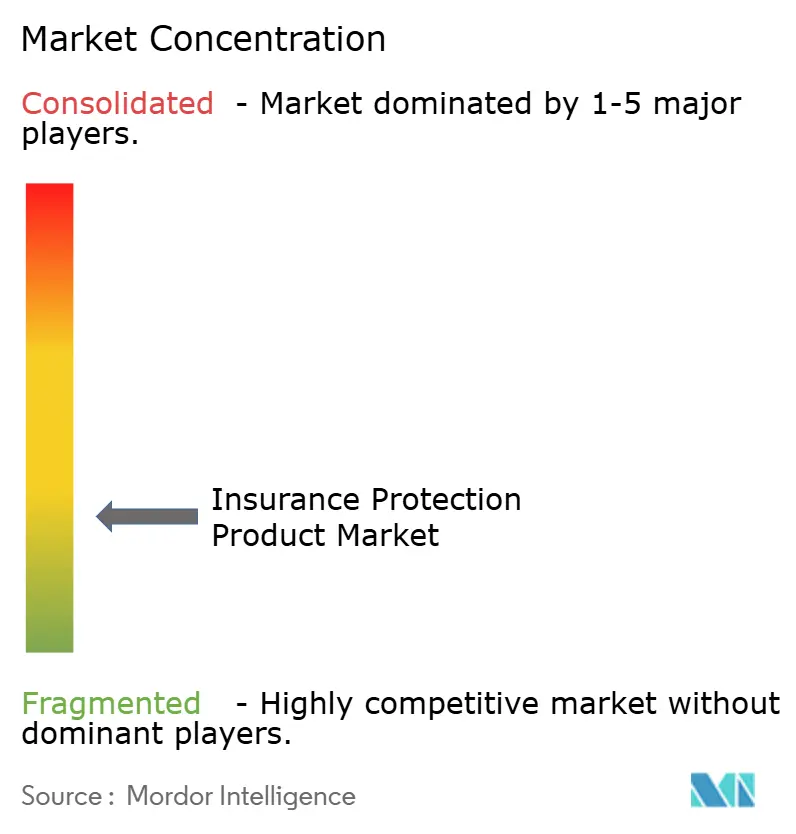
The insurance protection product market is fragmented across many national tiers. Competition is based on underwriting speed, product design, adviser relationships, bank partnerships, and digital distribution capability. Allianz SE announced an agreement valued at EUR 2 billion (USD 2.2 billion) to acquire HSBC Life Singapore and enter a 15-year bancassurance distribution partnership. Prudential Financial also announced the reinsurance of USD 7 billion of Japanese whole life reserves through Prismic Life.
Technology-focused entrants are competing from the underwriting layer rather than only through new product formats. Sixfold provides case-level underwriting recommendations for life, disability, and critical illness lines to insurers, including Guardian, New York Life, and ClearView. Ethos introduced its native ChatGPT application in May 2026 to provide instant life insurance estimates. Munich Re’s alitheia platform received United States patents in 2025 for natural-language-processing underwriting decisioning technology. These moves can improve conversion and shorten issuance times for technology-enabled carriers.
The Insurance protection product market remains open to challengers because protection needs differ by country, income level, and distribution model. Scale remains important where regulation, customer data, and reinsurance capacity are material barriers. Insurers with established brands can use advisers and bancassurance partners to retain customer trust for complex protection decisions. Newer firms can compete through simple digital journeys and faster decisions.
Insurance Protection Product Industry Leaders
-
Allianz SE
-
Ping An Insurance (Group) Company of China Ltd.
-
China Life Insurance Company Limited
-
AXA
-
MetLife, Inc.
- *Disclaimer: Major Players sorted in no particular order
Insurance Protection Product Market Companies Covered in this Report
- Allianz SE
- Ping An Insurance (Group) Company of China Ltd.
- China Life Insurance Company Limited
- AXA
- MetLife, Inc.
- Prudential Financial, Inc.
- AIA Group Limited
- Manulife Financial Corporation
- Zurich Insurance Group AG
- American International Group, Inc.
- Aviva plc
- Dai-ichi Life Holdings, Inc.
- Japan Post Insurance Co., Ltd.
- Sun Life Financial Inc.
- Cigna Group
- Aflac Incorporated
- Legal & General Group plc
- Unum Group
- China Pacific Insurance (Group) Co., Ltd.
- Nippon Life Insurance Company
Recent Industry Developments in Insurance Protection Product Market
- August 2026: Prudential Financial introduced Protection IUL, a new indexed universal life insurance policy from its Individual Life Insurance business that delivers a lifelong death benefit with flexibility to access cash value for health-related needs, responding to LIMRA's finding that 74 million United States adults need additional life coverage and 40% of consumers want policies tied to living benefits.
- July 2026: Prudential Singapore launched PRUApex Legacy Index II, an indexed universal life plan targeting affluent and high-net-worth customers seeking uncapped index-linked returns alongside life protection and legacy planning, expanding its IUL suite with additional global index options.
- May 2026: Ethos launched a native ChatGPT application delivering instant life insurance estimates to over 900 million users, becoming the first life insurance provider with a dedicated experience inside the world's most widely used AI assistant and eliminating medical exam requirements through proprietary accelerated underwriting.
- March 2026: Aviva extended its AI underwriting summarization tool to individual critical illness applications, the first such deployment in the protection market, reducing underwriter review time per case by 50%. The tool had originally launched for individual life applications in November 2025.
Global Insurance Protection Product Market Report Scope
Segmentation Overview
| Life Protection Insurance |
| Final Expense / Protection-Oriented Whole Life Insurance |
| Critical Illness / Trauma Insurance |
| Disability and Income Protection Insurance |
| Personal Accident Insurance |
| Credit Life |
| Individual / Retail |
| Group / Employer-Sponsored |
| Affinity / Embedded / Creditor |
| Agents and Brokers |
| Bancassurance |
| Direct-to-Consumer |
| Employer, Workplace, and Affinity Channels |
| Embedded |
| North America | United States |
| Canada | |
| Mexico | |
| South America | Brazil |
| Argentina | |
| Rest of South America | |
| Europe | United Kingdom |
| Germany | |
| France | |
| Italy | |
| Spain | |
| Rest of Europe | |
| Asia-Pacific | China |
| Japan | |
| India | |
| South Korea | |
| Australia | |
| Indonesia | |
| Thailand | |
| Malaysia | |
| Singapore | |
| Vietnam | |
| Rest of Asia-Pacific | |
| Middle East and Africa | Saudi Arabia |
| United Arab Emirates | |
| Turkey | |
| South Africa | |
| Egypt | |
| Rest of Middle East and Africa |
| By Product Type | Life Protection Insurance | |
| Final Expense / Protection-Oriented Whole Life Insurance | ||
| Critical Illness / Trauma Insurance | ||
| Disability and Income Protection Insurance | ||
| Personal Accident Insurance | ||
| Credit Life | ||
| By Policy Form | Individual / Retail | |
| Group / Employer-Sponsored | ||
| Affinity / Embedded / Creditor | ||
| By Distribution Channel | Agents and Brokers | |
| Bancassurance | ||
| Direct-to-Consumer | ||
| Employer, Workplace, and Affinity Channels | ||
| Embedded | ||
| By Geography | North America | United States |
| Canada | ||
| Mexico | ||
| South America | Brazil | |
| Argentina | ||
| Rest of South America | ||
| Europe | United Kingdom | |
| Germany | ||
| France | ||
| Italy | ||
| Spain | ||
| Rest of Europe | ||
| Asia-Pacific | China | |
| Japan | ||
| India | ||
| South Korea | ||
| Australia | ||
| Indonesia | ||
| Thailand | ||
| Malaysia | ||
| Singapore | ||
| Vietnam | ||
| Rest of Asia-Pacific | ||
| Middle East and Africa | Saudi Arabia | |
| United Arab Emirates | ||
| Turkey | ||
| South Africa | ||
| Egypt | ||
| Rest of Middle East and Africa | ||
Key Questions Answered in the Report
What is the projected value of the insurance protection product sector by 2032?
The Insurance protection product market is forecast to reach USD 903.6 billion by 2032, expanding at a 5.6% CAGR from 2026.
Which product category leads insurance protection sales?
Life Protection Insurance led with a 41.2% share in 2026, supported by its role in lending, employer benefits, and basic mortality cover.
Which insurance protection product is growing fastest?
Critical Illness and Trauma insurance is expected to expand at an 8.1% CAGR through 2032 as consumers seek lump-sum support for health-related income loss.
Which distribution channel has the largest share?
Agents and Brokers led distribution with a 47.9% share in 2026 because complex protection products often require advice and licensed intermediation.
Which region has the highest projected growth?
South America is forecast to grow at 8.5% CAGR through 2032, led by Brazil’s expanding financial inclusion and digital distribution.
How are insurers using artificial intelligence in protection products?
Insurers are using it to shorten underwriting decisions, reduce application questions, and support faster review, while addressing governance risks related to bias, privacy, and explainability.