
Inspection Services Market Size and Share
Market Overview
| Study Period | 2021 - 2032 |
|---|---|
| Market Size (2027) | USD 162.26 Billion |
| Market Size (2032) | USD 223.53 Billion |
| Growth Rate (2027 - 2032) | 6.62 % |
| Fastest Growing Market | Asia-Pacific |
| Largest Market | Asia-Pacific |
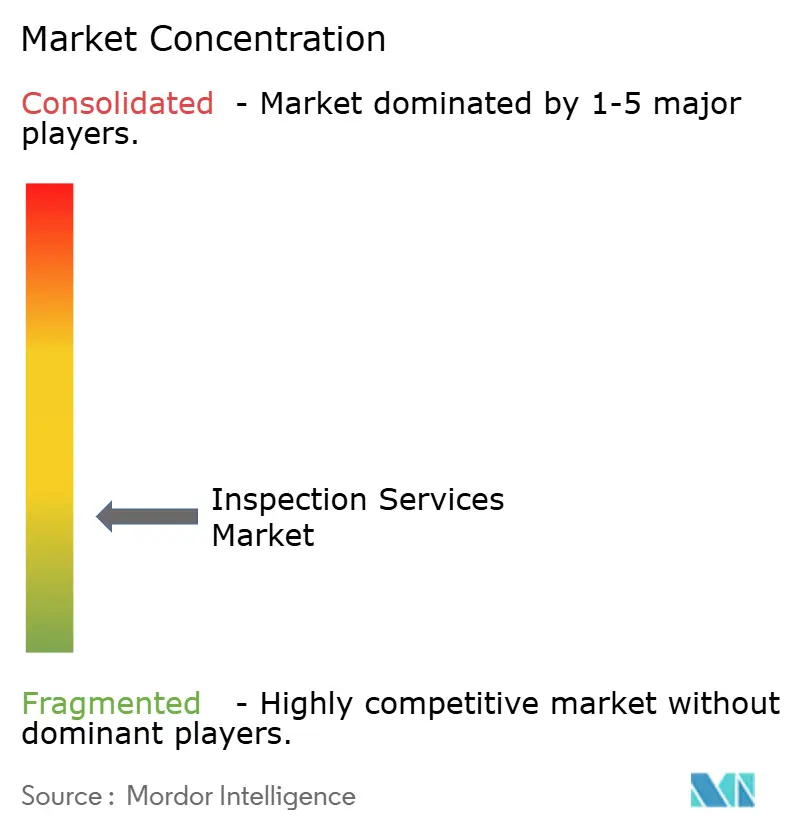
| Market Concentration | Low |
Major Players *Disclaimer: Major Players sorted in no particular order Image © Mordor Intelligence. Reuse requires attribution under CC BY 4.0. | |
Inspection Services Market Analysis by Mordor Intelligence
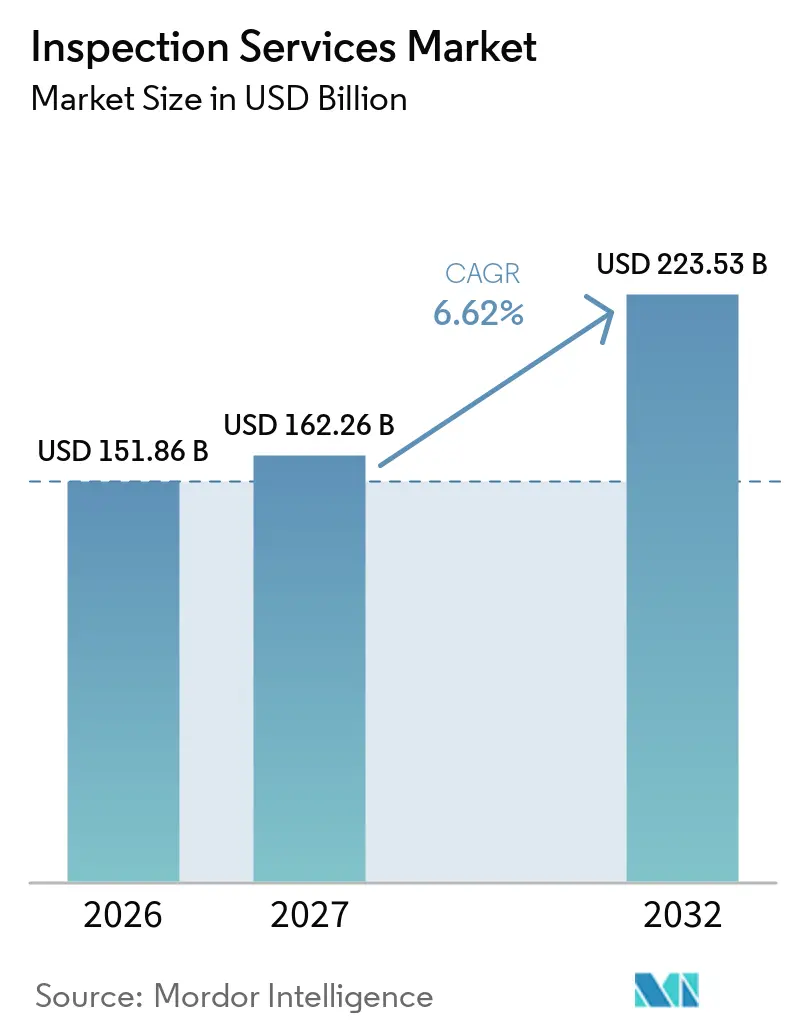
The Inspection Services Market size is expected to increase from USD 151.86 billion in 2026 to USD 162.26 billion in 2027 and reach USD 223.53 billion by 2032, growing at a CAGR of 6.62% over 2027-2032.
Mandatory safety obligations, aging assets, and a wider need for independent verification support the inspection services market. The ISO/IEC 17020:2026 transition requires accredited inspection bodies to update their systems, competence controls, and impartiality arrangements by March 2029, creating demand for procedural reviews, training, and documentation upgrades. Demand is also supported by supply-chain changes, as buyers need to qualify facilities, processes, and products when expanding sourcing into new locations. The growing complexity of industrial operations across infrastructure, energy, manufacturing, and transportation further increases the need for specialized inspections to identify defects, verify asset integrity, and reduce unplanned downtime. Aging equipment and infrastructure create opportunities for non-destructive testing, condition assessments, statutory inspections, and risk-based inspection programs that support preventive maintenance and operational reliability. Digitalization is also changing service delivery through remote inspections, drones, digital reporting platforms, and data-assisted defect detection, helping providers improve inspection coverage and streamline reporting.
Key Report Takeaways
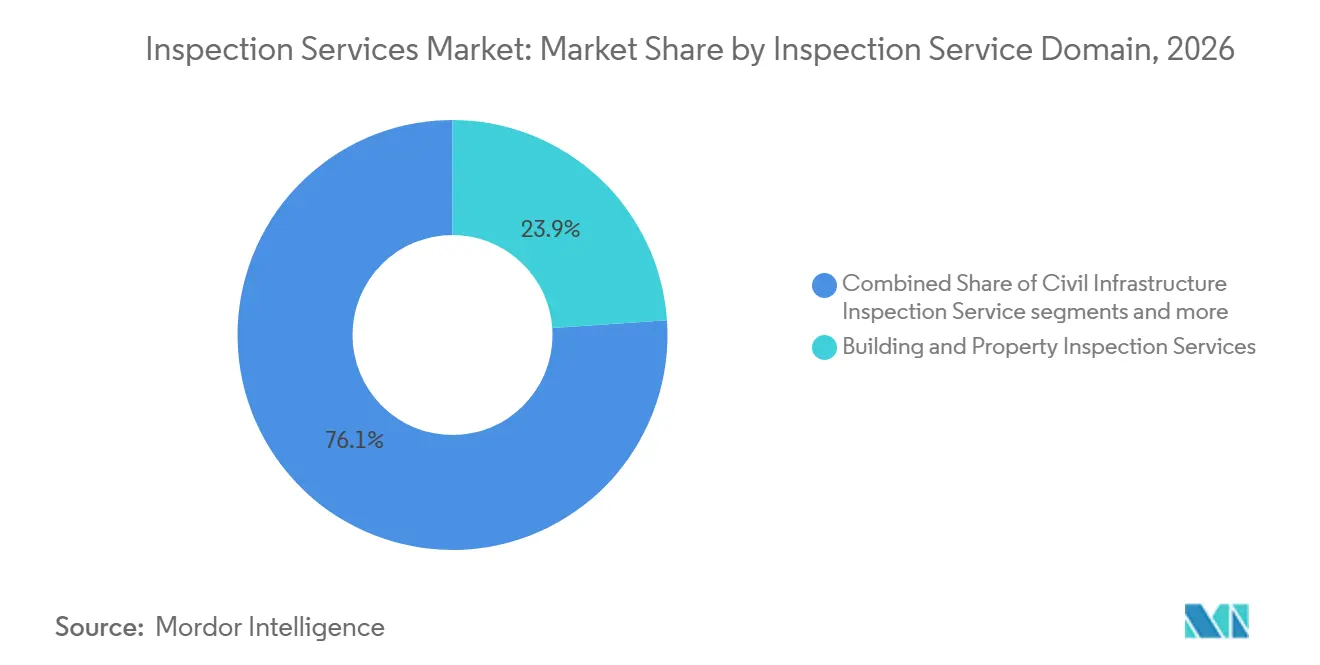
- By inspection service domain, building and property inspection services held 23.9% of the inspection services market share in 2026, while civil infrastructure inspection services are projected to grow at a 7.9% CAGR through 2032.
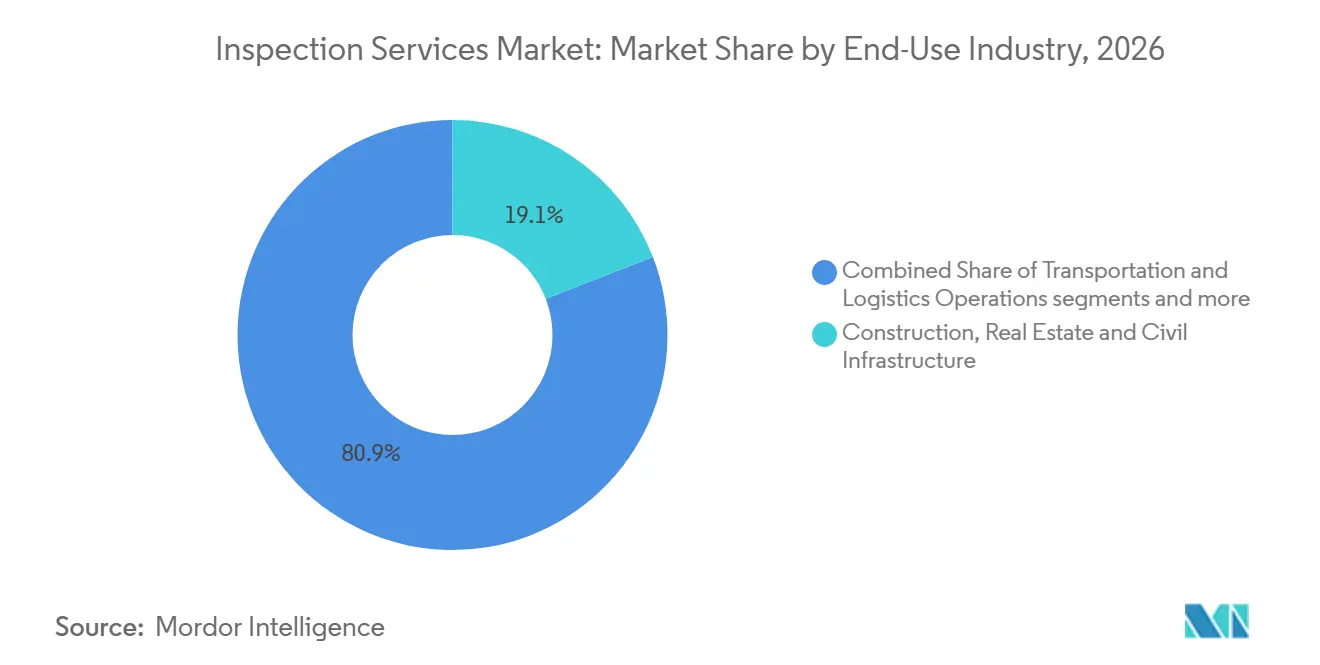
- By end-use industry, construction, real estate, and civil infrastructure accounted for 19.1% of the inspection services market size in 2026 and are forecast to advance at a 7.2% CAGR through 2032.
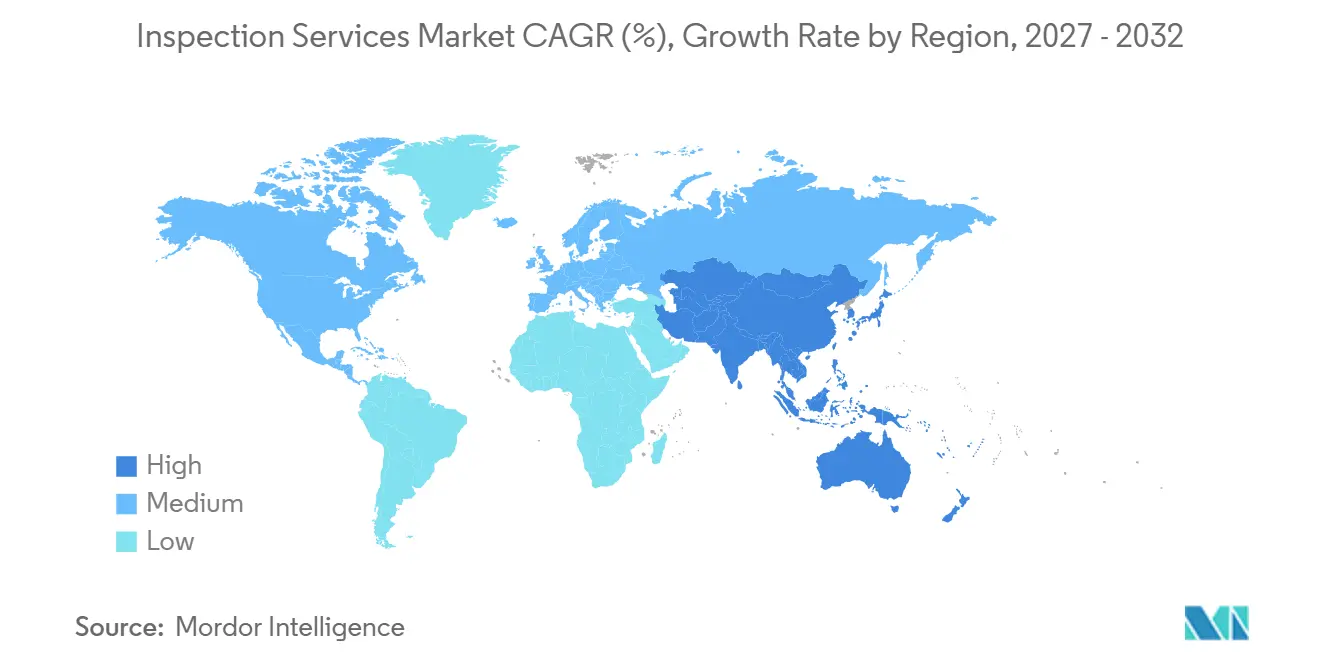
- By geography, Asia-Pacific held 37.1% of the inspection services market share in 2026 and is expected to expand at a 7.49% CAGR through 2032.
Note: Market numbers in this report are based on Mordor Intelligence's proprietary estimation framework, which combines nine months of actuals with Q4 projections for base year 2026.
Market Trends and Insights
Drivers Impact Analysis of Inspection Services Market*
| Driver | (~) % Impact on CAGR Forecast | Geographic Relevance | Impact Timeline |
|---|---|---|---|
| Stringent Safety, Quality and Regulatory Compliance Requirements | +1.8% | Global | Short term (≤ 2 years) |
| Aging Infrastructure and Industrial Assets Driving Periodic and Condition-Based Inspections | +1.5% | North America and Europe | Medium term (2-4 years) |
| Infrastructure Development, Construction Activity and Industrial Capital Investments | +1.2% | Asia-Pacific core, with spillover to the Middle East and Africa | Medium term (2-4 years) |
| Growing Outsourcing of Inspection Services and Demand for Independent Verification | +0.9% | Global | Short term (≤ 2 years) |
| Increasing Product Quality Requirements and Global Supply-Chain Complexity | +0.7% | Global, particularly Asia-Pacific, North America, and Europe, supply corridors | Short term (≤ 2 years) |
| Expansion of Renewable Energy, Electrification and Other Emerging Asset Classes | +0.5% | Europe, North America, and the Asia-Pacific | Long term (≥ 4 years) |
| Source: Mordor Intelligence | |||
Stringent Safety, Quality, and Regulatory Compliance Requirements
Safety, quality, and regulatory requirements are the largest source of recurring demand in the inspection services market. ISO/IEC 17020:2026 replaced the 2012 edition on March 27, 2026, and introduced changes to independence classification, impartiality governance, and complaints handling. UKAS states that accredited inspection bodies have a three-year transition period and must complete the change by March 2029. The new framework requires organizations to review procedures, train personnel, and maintain clearer evidence of competence. France expanded building-related obligations through Decree No. 2025-814, which requires structural diagnostic reports for collective residential buildings. Such rules make inspection spending less dependent on voluntary capital budgets because property owners and operators must demonstrate compliance.
Aging Infrastructure and Industrial Assets Driving Periodic and Condition-Based Inspections
Aging bridges, dams, levees, pipelines, and industrial plants increase the need for periodic and condition-based assessment. The American Society of Civil Engineers reported in 2025 that 6.8% of more than 623,000 United States bridges were in poor condition. The same assessment noted that nearly two-thirds of more than 24,000 levee miles in the national database had not received a formal risk assessment. More than 92,000 United States dams have an average age above 60 years, and 17,000 are classified as high-hazard-potential structures. Asset owners are therefore moving beyond fixed inspection intervals toward programs that use condition, risk, and operating data. This transition supports more frequent assessments and creates demand for specialists who can interpret asset condition and prioritize corrective work.
Infrastructure Development, Construction Activity, and Industrial Capital Investment
Construction and capital projects create inspection requirements from material verification through commissioning and handover. Intertek agreed in May 2025 to acquire TESIS in Brazil, a building products testing business, to expand its presence in the country's building and construction sector. The company linked the opportunity to expected activity in affordable housing and sanitation programs. In Germany, DB Services GmbH awarded a EUR 3.9 million (USD 4.6 million) framework contract for structural inspections and damage mapping across the country in 2025. France also used multi-year inspection frameworks for motorway structures, which reinforces the role of recurring procurement rather than one-time project work. In the inspection services market, these contract models improve revenue visibility for providers and help maintain inspection activity through changing construction cycles.
Growing Outsourcing of Inspection Services and Demand for Independent Verification
Companies increasingly use independent service providers when they add suppliers, enter new production locations, or need third-party evidence of product compliance. Outsourcing separates verification from manufacturing and purchasing functions, which can strengthen confidence among buyers, regulators, and insurers. This need becomes more important when firms establish supplier relationships in Southeast Asia, Eastern Europe, Mexico, or other new sourcing locations. Intertek launched SupplyTek in May 2025 as an end-to-end global market access and supply-chain compliance solution. The offering combines advisory, training, and assurance activities, which shows how inspection providers are extending their role across supply-chain compliance. In the inspection services market, independent verification also creates a repeatable service relationship after initial supplier qualification because facilities and processes require continuing checks.
Restraints Impact Analysis of Inspection Services Market*
| Restraint | Impact (%) | Geographic Scope | Timeframe |
|---|---|---|---|
| Shortage of Qualified and Accredited Inspection Professionals | -1.2% | Global | Medium term (2–4 years) |
| High Costs of Specialized Inspection Equipment and Technologies | -0.8% | Global, especially emerging markets | Medium term (2–4 years) |
| Pricing Pressure and Market Fragmentation Across Regional Providers | -0.5% | Asia-Pacific, Middle East and Africa, and South America | Short term (≤ 2 years) |
| Operational Constraints, Safety Risks and Restricted Asset Accessibility | -0.3% | Global | Short term (≤ 2 years) to Long term (≥ 4 years) |
| Source: Mordor Intelligence | |||
Shortage of Qualified and Accredited Inspection Professionals
The shortage of qualified personnel limits how quickly providers can add capacity in the inspection services market. The American Society for Nondestructive Testing identified a need for stronger skills, trust, and technology systems as the nondestructive evaluation workforce changes. Inspection work often requires documented industrial experience in addition to formal instruction and examination. This requirement extends the time needed to deploy technicians on critical assets. The ISO/IEC 17020:2026 transition adds training and competence-management work for organizations already facing staffing pressure. Different certification systems across regions can further limit the cross-border movement of experienced specialists. The constraint is most visible in advanced nondestructive testing, high-risk industrial assets, and inspection roles that require senior technical judgment.
High Costs of Specialized Inspection Equipment and Technologies
Advanced inspection methods can require phased-array ultrasonic testing, computed tomography, eddy current array systems, computer vision tools, and supporting calibration equipment. Within the inspection services market, smaller providers can find it difficult to finance these systems and maintain them at the required standard. ISO/IEC 17020:2026 places added importance on equipment competence, calibration records, and reliable documentation. NATA has also advised inspection bodies to prepare for changes in the revised standard. Public asset owners face similar pressures when budgets delay investment in monitoring equipment and digital inspection platforms. The cost burden is particularly important in emerging markets, where local firms may have fewer inspection volumes over which to spread equipment costs. Providers with broader networks can therefore gain an advantage by sharing technical assets and expertise across locations.
*Our forecasts treat driver/restraint impacts as directional, not additive. The impact forecasts reflect baseline growth, mix effects, and variable interactions.
Inspection Services Market Segment Analysis
By Inspection Service Domain:
Building and Property Services Lead, While Civil Infrastructure AcceleratesBuilding and Property Inspection Services held 23.9% of the inspection services market share in 2026. In the inspection services market, the segment serves residential, commercial, and institutional properties, where statutory obligations and property transactions both support inspection activity. Core work includes structural checks, mechanical, electrical, and plumbing assessments, fire-safety inspections, and pre-handover condition reports. These services respond to both scheduled compliance needs and time-sensitive events such as sales, leasing, renovation, and occupancy changes. Building owners also face wider expectations for documented condition and safety. France's 2025 structural diagnostic requirement for collective residential buildings illustrates how public policy can expand the scope of building assessment. This wide set of requirements gives the segment a stable demand base across different property types.
Civil Infrastructure Inspection Services is forecast to record a 7.9% CAGR through 2032. The inspection services market includes a segment that covers bridges, roads, tunnels, dams, rail assets, and related public structures that require recurring condition reviews. Aging assets and backlogs make detailed assessments more important, especially where owners need to prioritize repairs and maintain safe operation. The United States infrastructure condition data shows the scale of inspection needs across bridges, levees, and dams. Germany's 2025 nationwide structural-inspection framework also shows that public buyers are adopting multi-year procurement models. Industrial facilities, manufactured products, transportation assets, and commodities remain important adjacent domains. They extend demand across pressure equipment, pipelines, production processes, aircraft, vehicles, marine vessels, cargo, and trade flows.

By End-Use Industry:
Construction, Real Estate, and Civil Infrastructure Set the PaceConstruction, Real Estate, and Civil Infrastructure accounted for 19.1% of the market size in 2026. It is also the fastest-growing end-use category, with a forecast CAGR of 7.2% through 2032. Within the inspection services market, urban construction, infrastructure replacement, and building-quality obligations create activity at each stage of a project. Inspection providers verify materials, review artistry, assess structures, and support commissioning before assets enter service. Intertek's TESIS transaction shows that international providers see building products testing as a route into expanding construction demand in Brazil. The segment also benefits from public programs in housing, sanitation, transport, and other basic infrastructure. Its combination of regulatory requirements and investment activity makes it a major source of work for the inspection services market.
Oil and gas, petroleum refining, and petrochemicals remain significant users of inspection because asset integrity is central to safe operation. TÜV Rheinland expanded its SmartRBI service in December 2025 to help operators use risk-aligned inspection programs across oil and gas, petrochemicals, power generation, and manufacturing. Power generation, renewable energy, and utilities add new demand as wind, solar, battery storage, and transmission assets move into construction and maintenance cycles. DNV received a July 2025 contract to certify Norway's first bottom-fixed offshore wind farm, Sørlige Nordsjø II. Manufacturing, transportation, healthcare, pharmaceuticals, and life sciences also require continuing product, facility, fleet, and cold-chain verification. These end users widen the inspection services market beyond traditional industrial asset checks.
Geography Analysis
APAC Inspection Services Market
Asia-Pacific held 37.1% of the inspection services market share in 2026 and is forecast to grow at a 7.49% CAGR through 2032. China supports substantial inspection demand through its manufacturing base, ports, logistics networks, and domestic regulatory activity. India adds demand through investment in roads, metro rail, airports, renewable energy, and other infrastructure. Vietnam, Indonesia, Thailand, and Malaysia are also gaining production capacity as companies diversify supply chains. New facilities require qualification of equipment, processes, and suppliers before production can scale. TÜV Rheinland reported EUR 87.2 million (USD 102.6 million) of investments in 2025, including laboratory expansion in Taicang and Shenzhen, which indicates the priority placed on regional capacity. The inspection services market in the region combines large installed asset bases with new construction and manufacturing activity.
North America Inspection Services Market
North America remains an important part of the inspection services market because of its aging public infrastructure and large base of industrial assets. ASCE identified a USD 3.7 trillion 10-year United States infrastructure funding gap in its 2025 report card. This gap points to persistent needs for condition assessment, maintenance planning, and oversight across civil assets. SGS signed an agreement in July 2025 to acquire Applied Technical Services, which operates 85 United States facilities with 2,100 specialists. The transaction is intended to extend SGS's scale across testing, inspection, calibration, and forensics. North American demand also includes aerospace, manufacturing, power generation, and insurance-related verification. These applications support continuing demand for specialist staff and accredited inspection capability.
EMEA and South America Inspection Services Market
Mature procurement systems, regular reinspection cycles, and tightening obligations for buildings and civil structures characterize Europe. The EUR 3.9 million (USD 4.6 million) German structural-inspection framework demonstrates how operators formalize recurring asset checks through national contracts. The Middle East and Africa depend on oil and gas, power, and diversification-linked construction spending, while South America is supported by Brazil's building, sanitation, and commodity-related activity. DNV's August 2025 quality-assurance contract for the Net Zero Teesside Power and Northern Endurance Partnership projects shows how carbon capture infrastructure is opening new inspection mandates. These projects require providers to apply inspection and quality methods to newer asset classes. Across these regions, the inspection services market benefits from a mix of established compliance work and opportunities tied to energy and infrastructure development.
Competitive Landscape
The inspection services market exhibits a low level of market concentration. SGS, Bureau Veritas, Intertek, DEKRA, and the TÜV affiliates set many of the competitive standards for global coverage, accreditation, and technical breadth. Their scale allows them to serve multiple end-use sectors and to combine inspection with testing, certification, calibration, and assurance services. The largest groups are also using acquisitions to add expertise in specific geographies or asset categories. SGS signed an agreement to acquire Applied Technical Services for USD 460 million in July 2025. ATS operates 85 United States facilities and brings 2,100 specialists, supporting SGS's push for greater North American density. The transaction also supports cross-selling across manufacturing, aerospace, power generation, and forensics.
Bureau Veritas pursued several transactions in 2025 to build its presence in buildings, infrastructure, renewables, nuclear services, cybersecurity, and sustainability. Its October agreements to acquire Sólida and London Building Control added renewables engineering and United Kingdom building-control capability. The company also announced acquisitions in cybersecurity, nuclear, and transition services during July 2025. These actions show a focus on areas where customers need specialized technical assurance. In the inspection services market, technology is another competitive factor because clients increasingly expect access to inspection records, risk data, and clear audit trails. Larger firms can spread digital investment across a broader customer base, while local specialists can compete through sector expertise and proximity. This structure leaves room for both multinational providers and focused regional firms.
TÜV Rheinland's SmartRBI service uses data and engineering analysis to support risk-aligned inspection programs. TÜV NORD deployed a digital inspection tool for a 60-kilometer hydrogen pipeline project in Germany during April 2025. The tool brought geodata, material data, and project-party access into a shared process. DNV's work on offshore wind and carbon capture certification also shows the importance of credentials in emerging infrastructure. Competition will continue to depend on technical competence, accreditation, response time, geographic coverage, and the ability to offer reliable digital records.
Inspection Services Industry Leaders
-
SGS SA
-
Bureau Veritas SA
-
Intertek Group plc
-
DEKRA SE
-
TÜV SÜD AG
- *Disclaimer: Major Players sorted in no particular order
Inspection Services Market Companies Covered in this Report
- SGS SA
- Bureau Veritas SA
- Intertek Group plc
- DEKRA SE
- TÜV SÜD AG
- TÜV Rheinland AG
- TÜV NORD Group
- Applus+
- DNV
- RINA S.p.A.
- Lloyd's Register Group
- Kiwa Group
- SOCOTEC Group
- Apave Group
- OCA Global
- Acuren Corporation (Including NV5 Operations)
- MISTRAS Group, Inc.
- TEAM, Inc.
- Oceaneering International, Inc.
- ROSEN Group
- NDT Global
- QIMA
- Cotecna
- China Certification & Inspection Group (CCIC)
- Opus Inspection
Recent Industry Developments in Inspection Services Market
- March 2026: ISO/IEC 17020:2026 replaced the 2012 edition and introduced revised requirements for inspection-body independence classification, impartiality governance, competence management, and complaints handling. Accredited inspection bodies have a transition period through March 2029 to implement the new requirements
- October 2025: Bureau Veritas signed agreements to acquire Sólida (Spain) and London Building Control (UK). Sólida, a renewables Owner's Engineering firm with EUR 18 million in revenue and over 220 GW of renewable-energy project experience across 50-plus countries, strengthens Bureau Veritas's renewables inspection and advisory capabilities. London Building Control, with EUR 14 million in revenue and over 14,000 projects annually, adds a large pool of accredited Registered Building Inspectors in a regulated UK market. Both acquisitions advance the LEAP|28 strategy targeting Buildings & Infrastructure and energy-transition strongholds
Global Inspection Services Market Report Scope
The Inspection Services Market Report is Segmented by Inspection Service Domain (Building and Property Inspection Services, Civil Infrastructure Inspection Services, and More), by End-Use Industry (Construction, Real Estate and Civil Infrastructure, Mining and Quarrying, and More), and by Geography (North America, Europe, Middle East and Africa, and more). The Market Forecasts are Provided in Terms of Value (USD).
Segmentation Overview
| Building and Property Inspection Services | Residential, Commercial, and Institutional Building Inspections |
| Structural, Building Envelope, MEP, and Fire-Safety Inspections | |
| Property Condition, Construction, and Handover Inspections | |
| Civil Infrastructure Inspection Services | Roads, Bridges, Tunnels, and Rail Track Infrastructure |
| Dams, Civil Water Infrastructure, and Other Civil Engineering Structures | |
| Industrial Facilities and Fixed Asset Inspection Services | Industrial Plants and Installed Process Equipment |
| Pressure Vessels, Pipelines, and Storage Tanks | |
| Energy Generation and Utility Systems | |
| Other Stationary Industrial Equipment | |
| Manufactured Product and Production-Process Inspection Services | Raw Material and Component Inspection |
| In-Process Manufacturing Inspection | |
| Finished-Product and Production-Process Conformity Inspection | |
| Transportation Vehicle and Mobile Asset Inspection Services | Road Vehicles and Commercial Fleets |
| Rail Rolling Stock | |
| Aircraft and Aviation Assets | |
| Ships and Other Marine Vessels | |
| Other Mobile Transportation Assets | |
| Commodity, Cargo, and Trade Inspection Services | Bulk and Containerized Cargo Inspection |
| Traded Commodity Inspection | |
| Consignment Condition, Quantity, and Quality Verification | |
| Loading, Unloading, and Custody-Transfer Inspection | |
| Other Operational Site and Process Inspection Services | Physical Hygiene and Workplace Safety Inspection |
| Agricultural Site Inspection | |
| Other Operational Compliance Inspection |
| Oil and Gas, Including Petroleum Refining, and Petrochemicals |
| Power Generation, Renewable Energy, and Utilities |
| Manufacturing and Industrial Processing (Excluding Industries Separately Classified) |
| Construction, Real Estate, and Civil Infrastructure |
| Transportation and Logistics Operations |
| Mining and Quarrying |
| Agriculture, Food, and Beverage |
| Wholesale, Retail, and Commodity Trading |
| Healthcare, Pharmaceuticals, and Life Sciences |
| Households and Individual Consumers |
| Other Commercial Services and Public Institutions |
| North America | United States |
| Canada | |
| Mexico | |
| Europe | Germany |
| United Kingdom | |
| France | |
| Italy | |
| Spain | |
| Netherlands | |
| Poland | |
| Turkey | |
| Russia | |
| Rest of Europe | |
| Asia-Pacific | China |
| Japan | |
| India | |
| South Korea | |
| Taiwan | |
| Australia | |
| ASEAN (Indonesia, Thailand, Vietnam, Malaysia, Singapore, Philippines, Myanmar, Cambodia, Laos, Brunei, Timor-Leste) | |
| Rest of Asia-Pacific (Taiwan, Hong Kong, New Zealand, Bangladesh, Pakistan, Sri Lanka, etc.) | |
| Middle East and Africa | Saudi Arabia |
| United Arab Emirates | |
| Qatar | |
| South Africa | |
| Egypt | |
| Nigeria | |
| Rest of Middle East | |
| Rest of Africa | |
| South America | Brazil |
| Argentina | |
| Rest of South America (Chile, Colombia, Peru, etc.) |
| By Inspection Service Domain | Building and Property Inspection Services | Residential, Commercial, and Institutional Building Inspections |
| Structural, Building Envelope, MEP, and Fire-Safety Inspections | ||
| Property Condition, Construction, and Handover Inspections | ||
| Civil Infrastructure Inspection Services | Roads, Bridges, Tunnels, and Rail Track Infrastructure | |
| Dams, Civil Water Infrastructure, and Other Civil Engineering Structures | ||
| Industrial Facilities and Fixed Asset Inspection Services | Industrial Plants and Installed Process Equipment | |
| Pressure Vessels, Pipelines, and Storage Tanks | ||
| Energy Generation and Utility Systems | ||
| Other Stationary Industrial Equipment | ||
| Manufactured Product and Production-Process Inspection Services | Raw Material and Component Inspection | |
| In-Process Manufacturing Inspection | ||
| Finished-Product and Production-Process Conformity Inspection | ||
| Transportation Vehicle and Mobile Asset Inspection Services | Road Vehicles and Commercial Fleets | |
| Rail Rolling Stock | ||
| Aircraft and Aviation Assets | ||
| Ships and Other Marine Vessels | ||
| Other Mobile Transportation Assets | ||
| Commodity, Cargo, and Trade Inspection Services | Bulk and Containerized Cargo Inspection | |
| Traded Commodity Inspection | ||
| Consignment Condition, Quantity, and Quality Verification | ||
| Loading, Unloading, and Custody-Transfer Inspection | ||
| Other Operational Site and Process Inspection Services | Physical Hygiene and Workplace Safety Inspection | |
| Agricultural Site Inspection | ||
| Other Operational Compliance Inspection | ||
| By End-Use Industry | Oil and Gas, Including Petroleum Refining, and Petrochemicals | |
| Power Generation, Renewable Energy, and Utilities | ||
| Manufacturing and Industrial Processing (Excluding Industries Separately Classified) | ||
| Construction, Real Estate, and Civil Infrastructure | ||
| Transportation and Logistics Operations | ||
| Mining and Quarrying | ||
| Agriculture, Food, and Beverage | ||
| Wholesale, Retail, and Commodity Trading | ||
| Healthcare, Pharmaceuticals, and Life Sciences | ||
| Households and Individual Consumers | ||
| Other Commercial Services and Public Institutions | ||
| By Geography | North America | United States |
| Canada | ||
| Mexico | ||
| Europe | Germany | |
| United Kingdom | ||
| France | ||
| Italy | ||
| Spain | ||
| Netherlands | ||
| Poland | ||
| Turkey | ||
| Russia | ||
| Rest of Europe | ||
| Asia-Pacific | China | |
| Japan | ||
| India | ||
| South Korea | ||
| Taiwan | ||
| Australia | ||
| ASEAN (Indonesia, Thailand, Vietnam, Malaysia, Singapore, Philippines, Myanmar, Cambodia, Laos, Brunei, Timor-Leste) | ||
| Rest of Asia-Pacific (Taiwan, Hong Kong, New Zealand, Bangladesh, Pakistan, Sri Lanka, etc.) | ||
| Middle East and Africa | Saudi Arabia | |
| United Arab Emirates | ||
| Qatar | ||
| South Africa | ||
| Egypt | ||
| Nigeria | ||
| Rest of Middle East | ||
| Rest of Africa | ||
| South America | Brazil | |
| Argentina | ||
| Rest of South America (Chile, Colombia, Peru, etc.) | ||
Key Questions Answered in the Report
What is the projected value of inspection services by 2032?
The inspection services market is forecast to reach USD 223.53 billion by 2032, growing at a 6.62% CAGR from 2027.
Which inspection service domain has the largest share?
Building and Property Inspection Services lead with a 23.9% share in 2026.
Which end-use application is growing fastest?
Construction, Real Estate, and Civil Infrastructure is forecast to grow at a 7.2% CAGR through 2032.
Which region leads global demand for inspection services?
Asia-Pacific holds the largest share at 37.1% in 2026 and has the fastest forecast growth at a 7.6% CAGR through 2032.
Why are inspection providers investing in digital tools?
Digital tools help providers manage risk-aligned inspection programs, share records, and support audit-ready documentation.
What is limiting the availability of inspection services?
Shortages of qualified personnel and the cost of specialized equipment can limit capacity, especially for advanced inspection work.