
Inspection Equipment Market Size and Share
Market Overview
| Study Period | 2021 - 2032 |
|---|---|
| Market Size (2027) | USD 33.84 Billion |
| Market Size (2032) | USD 49.95 Billion |
| Growth Rate (2027 - 2032) | 8.10 % |
| Fastest Growing Market | Asia-Pacific |
| Largest Market | Asia-Pacific |
| Market Concentration | Medium |
Major Players *Disclaimer: Major Players sorted in no particular order Image © Mordor Intelligence. Reuse requires attribution under CC BY 4.0. | |
Inspection Equipment Market Analysis by Mordor Intelligence
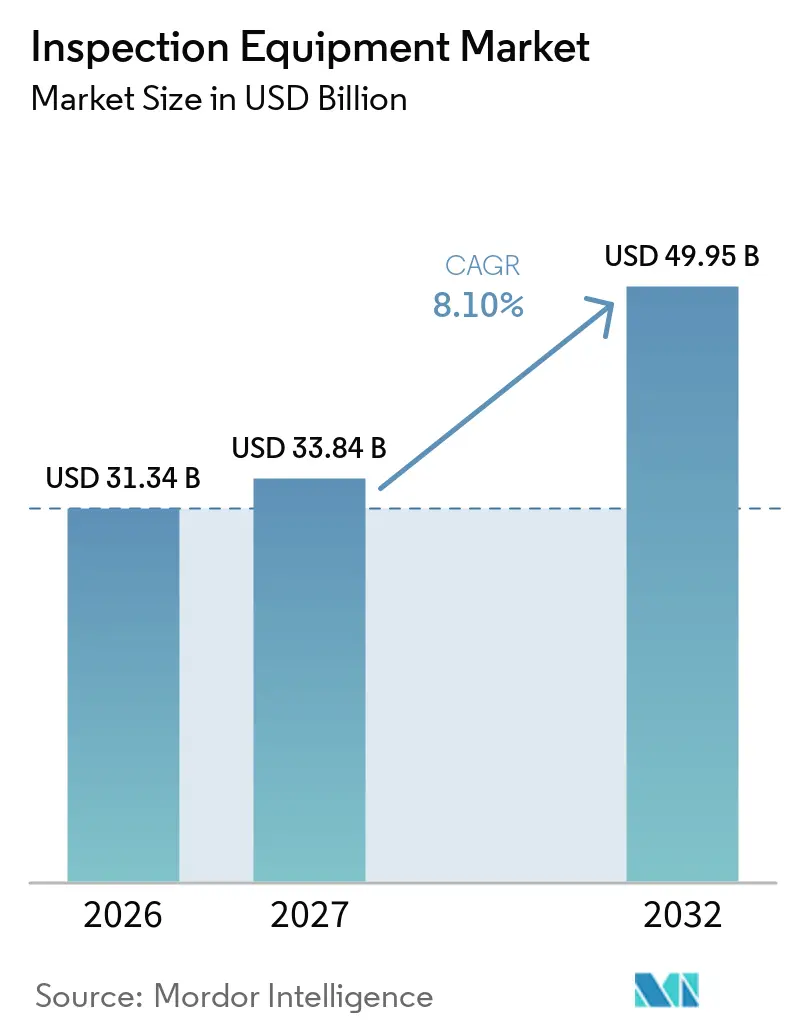
The Inspection Equipment Market size is projected to expand from USD 31.34 billion in 2026 and USD 33.84 billion in 2027 to USD 49.95 billion by 2032, registering a CAGR of 8.10% between 2027 and 2032.
The inspection equipment market is supported by tighter quality and safety requirements, rising automation, and investment in semiconductor manufacturing. Buyers are also replacing older systems used for industrial assets, transport networks, and civil infrastructure. Demand is moving toward systems that can record results digitally and fit into automated production lines. Software, service capability, and certified workflows are becoming more important in vendor selection. The growing complexity of manufactured products is further increasing the need for high-resolution inspection, automated defect detection, and real-time process monitoring. Semiconductor manufacturers require advanced optical and electron-beam inspection systems to identify microscopic defects and maintain production yields, while automotive and battery producers use automated inspection to verify component dimensions, weld quality, and structural integrity. In aerospace, energy, and heavy industries, non-destructive testing equipment helps assess material condition and identify internal defects without damaging critical components. The integration of machine vision, artificial intelligence, and data analytics is also enabling manufacturers to classify defects more consistently, reduce manual inspection workloads, and identify recurring quality issues. Digital inspection records support traceability, facilitate audits, and help production teams implement corrective actions across manufacturing facilities.
Key Report Takeaways
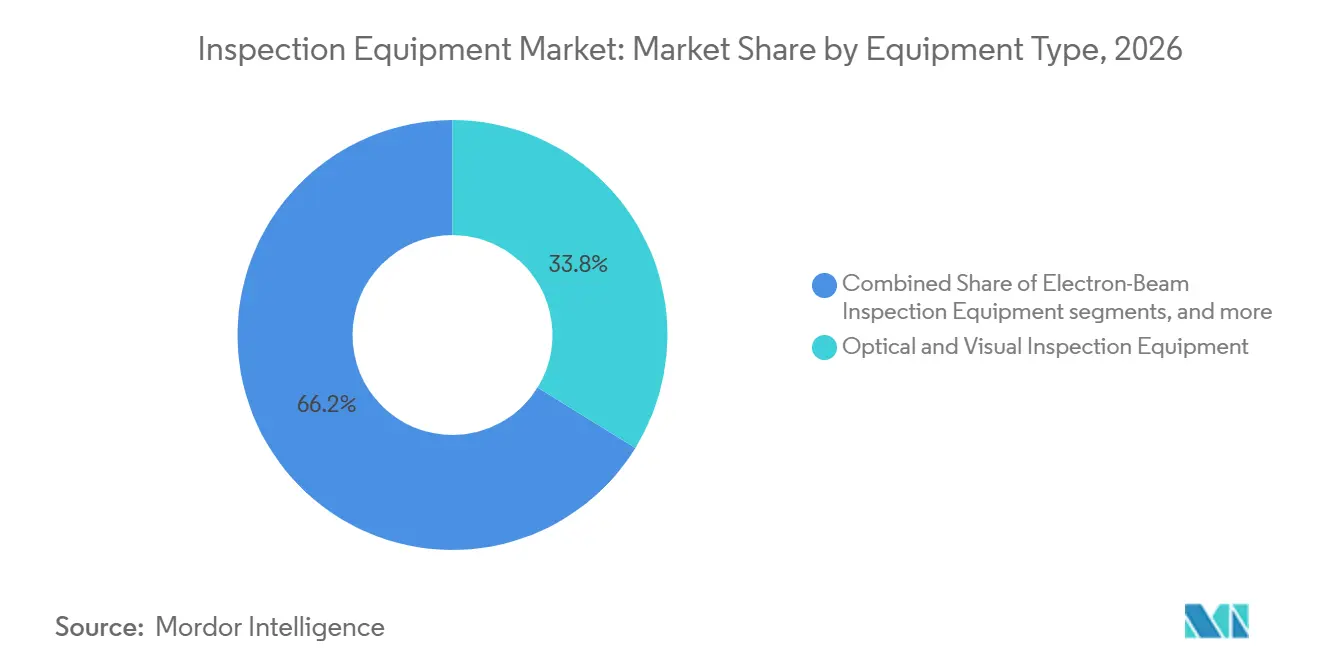
- By equipment type, optical and visual inspection equipment held 33.8% of the inspection equipment market size in 2026, while electron-beam inspection equipment is projected to expand the fastest at a 10.6% CAGR through 2032.
- By primary inspection application, manufactured product and production-process inspection accounted for 59.7% of the inspection equipment market share in 2026, and is projected to expand at an 8.3% CAGR through 2032.
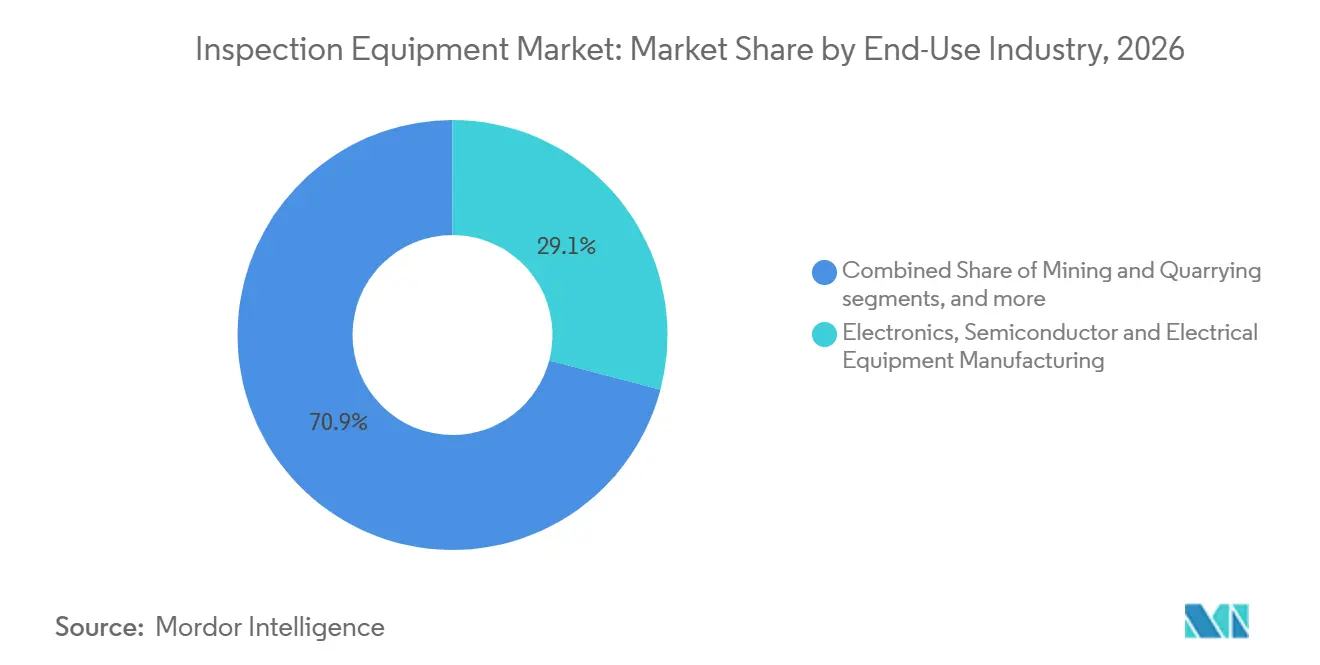
- By end-use industry, electronics, semiconductor, and electrical equipment manufacturing held 29.1% of revenue in 2026 and is also expected to remain the fastest-growing at a 9.3% CAGR through 2032.
- By geography, Asia-Pacific held 53.2% of revenue in 2026 and is also expected to remain the fastest-growing at a 9.2% CAGR through 2032.
Note: Market numbers in this report are based on Mordor Intelligence's proprietary estimation framework, which combines nine months of actuals with Q4 projections for base year 2026.
Global Inspection Equipment Market Trends and Insights
Drivers Impact Analysis*
| Driver | (~) % Impact on CAGR Forecast | Geographic Relevance | Impact Timeline |
|---|---|---|---|
| Stringent Quality, Safety, and Regulatory Compliance Requirements | +2.0% | Global, with concentrated enforcement in North America, Europe, and Japan | Short term (≤ 2 years) |
| Rising Industrial Automation and Manufacturing Quality Standards | +1.7% | Global, with highest intensity in Asia-Pacific manufacturing hubs and European automotive clusters | Medium term (2-4 years) |
| Expansion of Semiconductor, Electronics, and Advanced Manufacturing Industries | +1.5% | Asia-Pacific, with spillover to North America | Medium term (2-4 years) |
| Increasing Demand for Precision Inspection and Defect Detection | +1.1% | Global, with concentration in semiconductor, aerospace, and medical-device manufacturing | Long term (≥ 4 years) |
| Growth in Infrastructure, Energy, and Transportation Investments | +0.8% | North America, Europe, and Gulf Cooperation Council countries | Medium term (2-4 years) |
| Aging Infrastructure and Industrial Asset Inspection Requirements | +0.6% | North America, Europe, and mature industrial economies in Asia-Pacific | Long term (≥ 4 years) |
| Source: Mordor Intelligence | |||
Stringent Quality, Safety, and Regulatory Compliance Requirements
Updated rules are making inspection a recurring operating requirement rather than a discretionary purchase in many facilities. ISO 17635:2025 sets general rules for non-destructive testing of welds in metallic materials and influences the equipment and documented procedures used by manufacturers.[1] ASME Section XIII-2025 increases the value of traceable inspection records for pressure-retaining equipment in the United States. Pipeline integrity requirements also extend inspection activity beyond traditional energy assets into water and other public infrastructure. These conditions support replacement spending in the inspection equipment market because certified systems must remain current and auditable. Once a buyer has validated a platform and its documentation, changing suppliers can require further qualification work, which strengthens incumbent relationships.
Rising Industrial Automation and Manufacturing Quality Standards
Inspection is moving into production lines as manufacturers reduce manual checks at the end of a process. Automated systems must recognize defects that experienced operators previously identified during visual review. Cognex introduced OneVision in June 2025 as a cloud platform for building, training, and scaling AI-powered machine-vision applications across distributed sites. Hexagon launched its Autonomous Metrology Suite in 2025 to remove coding from coordinate measuring machine workflows. Rockwell Automation reported that AI-enabled robots and drones can improve inspection precision and reduce safety risks in industrial settings. This is shifting inspection equipment market demand from isolated capital projects toward upgrades that are aligned with software releases and line modernization.
Expansion of Semiconductor, Electronics, and Advanced Manufacturing Industries
The inspection equipment market is benefiting from more process-control steps at advanced semiconductor nodes. Leading foundries are expanding work on 2nm processes in 2025 and 2026, where defect detection needs increase relative to mature nodes. KLA reported USD 12.2 billion in fiscal 2025 revenue, up 24%, and USD 10.95 billion in semiconductor process-control revenue, up 25%.[2] Its annual filing identifies advanced packaging, high-bandwidth memory, and high-volume EUV manufacturing as separate sources of process-control demand. Electronics, semiconductors, and electrical equipment manufacturing is therefore a major source of demand for sensitive inspection tools and related metrology systems. This end-use area also drives growth in the inspection equipment market, which increases the role of specialist semiconductor suppliers in the overall equipment mix.
Increasing Demand for Precision Inspection and Defect Detection
A single undetected defect can result in recalls, repair costs, or safety liabilities that exceed the cost of inspection. This is strengthening the commercial case for precise measurement in aerospace, medical devices, automotive safety systems, and semiconductor fabrication. AMETEK completed its acquisition of FARO Technologies for USD 920 million in July 2025, adding laser trackers, handheld 3D scanners, and photogrammetry capabilities to its portfolio. Electron-beam systems support nanoscale defect and pattern-fidelity checks where optical methods face resolution limits. Renishaw introduced the XK20 alignment laser in September 2025 for machine-build and precision-stage measurement under current international ISO requirements. The inspection equipment market is consequently seeing greater interest in systems that combine precision measurement with standards-based documentation.
Restraints Impact Analysis*
| Restraint | (~) % Impact on CAGR Forecast | Geographic Relevance | Impact Timeline |
|---|---|---|---|
| High Capital Costs of Advanced Inspection Equipment | -1.5% | Global, with greatest pressure in small and mid-sized enterprise markets in South and Southeast Asia and Latin America | Short term (≤ 2 years) |
| Shortage of Skilled Inspection and Equipment Operation Personnel | -1.0% | Global, with severe pressure in North America, Northern Europe, and Japan | Long term (≥ 4 years) |
| Equipment Integration and Technology Compatibility Challenges | -0.8% | Global, with pronounced effects at brownfield facilities using legacy control systems | Medium term (2-4 years) |
| Calibration, Maintenance, and Lifecycle Ownership Costs | -0.5% | Global, including laboratories operating under ISO/IEC 17025 requirements | Medium term (2-4 years) |
| Source: Mordor Intelligence | |||
High Capital Costs of Advanced Inspection Equipment
Industrial CT systems, multi-sensor coordinate measuring machines, and electron-beam platforms can exceed the annual capital budgets of smaller manufacturers. The ASNT Foundation has stated that sustained investment in people, research, and education is necessary to support the non-destructive testing field. ISO/IEC 17025 requires testing and calibration laboratories to establish competence, traceability, and documented calibration processes.[3] These requirements add service, calibration, and record-management costs after installation. Integration can also be difficult where older control architectures were not built to exchange data with modern inspection systems. In response, leasing and inspection-as-a-service models can spread fixed costs across users, although this can shift spending from direct equipment purchases to service providers.
Shortage of Skilled Inspection and Equipment Operation Personnel
The inspection equipment market faces a limited supply of certified personnel for advanced testing methods and equipment operation. The ASNT Foundation reported in 2025 that workforce development is a priority for non-destructive testing as experienced workers approach retirement. ASNT also describes the need to strengthen skills, trust, and technology adoption across the digital NDE ecosystem. ISO 9712 qualification rules require documented education, training, experience, and certification for non-destructive testing personnel. Competition from expanding energy and infrastructure projects further raises demand for technically qualified workers. Automation reduces some reliance on scarce labor, but buyers still need capable staff to validate processes, maintain equipment, and oversee compliance.
*Our forecasts treat driver/restraint impacts as directional, not additive. The impact forecasts reflect baseline growth, mix effects, and variable interactions.
Segment Analysis
By Equipment Type: Optical Systems Lead While Electron-Beam Systems Grow Fastest
Optical and visual inspection equipment held 33.8% of the inspection equipment market share in 2026. The segment is supported by machine vision and automated optical inspection systems used in electronics assembly, automotive production, and semiconductor packaging. Its broad installed base reflects long-term improvements in cameras, illumination, software, and defect classification. Standardized camera interfaces have helped reduce installation risk for many users. Hexagon introduced the ATLASCAN Pro handheld 3D scanner in 2025 to make professional scanning more accessible to a wider group of users. The company also expanded its quality-station offer for manufacturers managing cost and skills constraints. Optical equipment remains the main entry point for buyers that need high throughput and repeatable visual checks. This position gives the inspection equipment market a large base of applications that can adopt additional software and automation features over time.
Electron-beam inspection equipment has the fastest projected expansion at a 10.6% CAGR through 2032. The inspection equipment market size for this segment rises as chipmakers move toward 3nm and 2nm nodes that require very high-resolution inspection. KLA stated in its fiscal 2025 annual report that EUV use in logic and DRAM high-volume manufacturing creates process-control requirements beyond traditional yield-learning applications. Dimensional and geometric tools, including coordinate measuring machines, laser scanners, and 3D measurement systems, remain important in automotive and aerospace production. Ultrasonic, acoustic, radiographic, CT, electromagnetic, and magnetic systems serve core non-destructive testing needs across infrastructure and industrial assets. Thermal and infrared systems are increasingly used in power-grid diagnostics and building-energy work. Other specialized equipment covers leak testing, pressure integrity, and automated checkweighing in food and pharmaceutical settings. These categories reduce dependence on a single inspection method and support demand across diverse manufacturing conditions.

By Primary Inspection Application: Manufactured Product and Production-Process Inspection Combines Scale and Growth
Manufactured product and production-process inspection accounted for 59.7% of revenue in 2026. It also leads primary applications with an 8.3% CAGR through 2032. The inspection equipment market share reflects the integration of quality verification into automated production cells. Instead of operating separate quality gates, manufacturers are embedding sensors and inspection routines directly into lines. This changes the buying process because automation integrators and production engineers gain more influence over equipment selection. ZEISS introduced the OMNIA GC 220-180 in July 2025 as a fully automated 2D X-ray inspection system for large aluminum automotive castings, including battery trays and structural components. The launch illustrates demand for at-line and inline checks on high-value assemblies. The inspection equipment industry is therefore increasingly tied to factory automation investments rather than stand-alone quality laboratory budgets.
Civil infrastructure inspection remains a significant application because bridges, pipelines, power assets, and transport systems require regular review. ASCE gave the United States a C grade in its 2025 infrastructure report card and estimated a USD 3.7 trillion gap between planned investment and needs for good repair. This supports multi-year requirements for structural testing and non-destructive inspection. Vehicles and mobile assets require condition monitoring and safety verification across their operating lives. Commodity, cargo, and trade inspection are shaped by security and trade-compliance needs. Operating standards for vessels, piping, and related equipment govern industrial facilities and fixed assets. These applications provide recurring demand even when manufacturing investment slows. Their different regulatory triggers also help the inspection equipment market remain diversified.
By End-Use Industry: Semiconductor and Electronics Manufacturing Set the Fastest Pace
Electronics, semiconductor, and electrical equipment manufacturing accounted for 29.1% of revenue in 2026. It is forecast to expand at a 9.3% CAGR through 2032, the highest rate among end-use industries. The inspection equipment market size for this end-use category benefits from demand for advanced logic chips, high-bandwidth memory, and AI-specific accelerators. Each process generation needs more inspection steps per wafer and tighter sensitivity requirements. KLA reported record fiscal 2025 revenue of USD 12.2 billion, while semiconductor process control grew 25%. These figures show that leading-edge semiconductor investment is translating into demand for inspection and metrology tools. Foundry capacity in Taiwan, South Korea, China, and the United States remains important to this demand. The inspection equipment industry is also influenced by advanced packaging and memory production, which require dedicated process controls.
Oil and gas, refining, and petrochemicals remain a major end use because pipelines, vessels, and plants need integrity monitoring and turnaround inspections. Power generation, renewable energy, and utilities add demand through wind-blade inspection, solar-panel verification, and grid testing. Automotive manufacturers use coordinate measuring machines and X-ray CT systems for dimensional control and battery-component checks. Aerospace and defense have high inspection intensity because safety-critical parts require documented non-destructive testing. Healthcare, pharmaceuticals, and life sciences use inspection to support controlled production and product quality. Construction, transportation and logistics, mining, agriculture, food and beverage, and public agencies extend the customer base. Their combined presence limits the effect of a downturn in any one vertical. This diversified demand base keeps the inspection equipment market from being defined only by the semiconductor cycle.
Geography Analysis
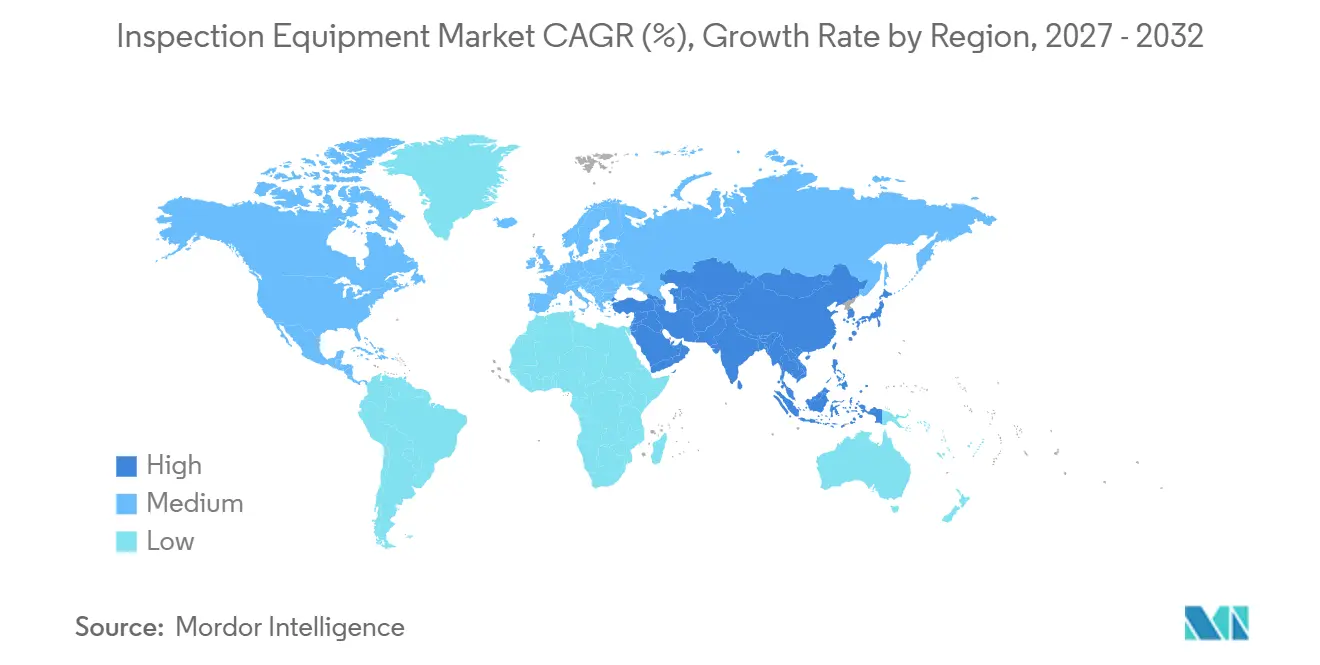
Asia-Pacific held 53.2% of the inspection equipment market share in 2026 and is forecast to expand at a 9.2% CAGR through 2032. China, Taiwan, South Korea, Japan, India, and ASEAN economies combine semiconductor fabrication, electronics assembly, and automotive-component production. China’s Yangtze River Delta and Taiwan’s advanced-logic foundry ecosystem support regular purchases of process-control equipment. South Korean memory production adds parallel demand for wafer and package inspection tools. Japan is supporting semiconductor capacity through initiatives that include Rapidus and TSMC Kumamoto. India is building first-wave process-control demand through semiconductor manufacturing incentives under the India Semiconductor Mission. The regional concentration of advanced and high-volume production gives Asia-Pacific a broad equipment customer base. This makes the inspection equipment market especially responsive to factory investment decisions in the region.
North America is the second-largest regional market. ASCE linked the IIJA and Inflation Reduction Act to USD 580 billion in new infrastructure investment in its 2025 report, supporting spending across water, transport, energy, and civil assets. Semiconductor projects in Arizona and Ohio add domestic demand for process-control systems. These projects place inspection closer to new fabrication capacity that has historically been concentrated in Asia. Europe ranks third, supported by industrial production in Germany, France, and Italy. ISO 17635:2025 and EN ISO 15708-4:2025 raise the importance of documented weld testing and industrial CT qualification. European pressure-equipment and CE-related compliance also support inspection in energy, chemicals, and process manufacturing. The inspection equipment market size in these mature regions depends on both new capital projects and replacement spending for established assets.
Middle East and Africa demand is concentrated in oil and gas, construction, and security inspection. OSI Systems received a USD 36 million contract for airport screening solutions in the Middle East during 2025. Saudi Arabia and the UAE are key locations because infrastructure programs and industrial localization support equipment adoption. South America remains the smallest regional area. Brazil, Argentina, and Chile provide baseline demand through agriculture, mining, and commodity exports. Energy and infrastructure spending is supporting gradual use of modern non-destructive testing and safety systems. Port and border screening also gains importance as trade-compliance needs expand. Together, these regions offer smaller but varied growth opportunities for the inspection equipment market.
Competitive Landscape
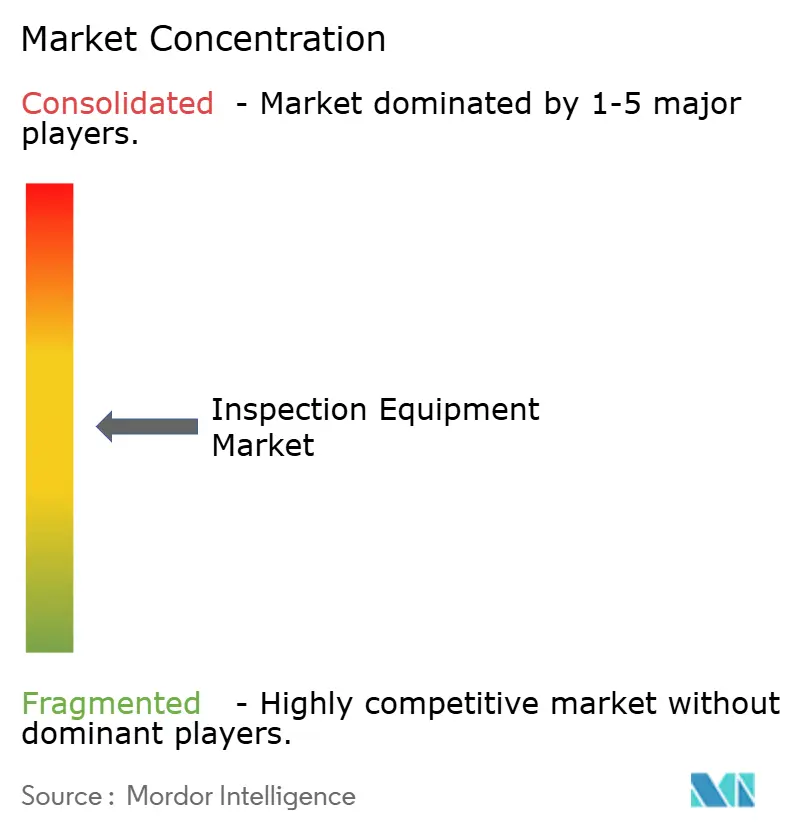
The inspection equipment market exhibits a medium level of market concentration. Hexagon, ZEISS, KEYENCE, KLA, Cognex, and Teledyne hold established positions across different equipment categories and regions. Competition is more intense among mid-sized suppliers, where acquisitions are changing portfolio boundaries. AMETEK completed the USD 920 million acquisition of FARO Technologies in July 2025. The transaction combines FARO’s laser trackers and handheld scanners with AMETEK’s wider metrology assets, including Creaform and Virtek. It gives AMETEK a more complete offer in portable and automated 3D measurement. Buyers continue to evaluate vendor capability across hardware, application knowledge, service coverage, and software compatibility. This keeps competition active even where large companies have entrenched customer relationships.
Software platforms are becoming an important point of differentiation in the inspection equipment market. Hexagon’s Nexus platform and Autonomous Metrology Suite position metrology systems within connected manufacturing workflows. Cognex’s OneVision platform offers another example by enabling machine-vision applications to be managed across sites. Such systems can increase switching costs when they hold inspection recipes, historical records, and workflow settings. In semiconductors, KLA, Lasertec, and Onto Innovation occupy specialist positions at advanced nodes. Their equipment is embedded in complex process flows and supported by proprietary recipes and long-term service arrangements. New competitors face substantial qualification requirements in this part of the market. The competitive structure is therefore more concentrated in leading-edge semiconductor inspection than in general industrial measurement.
Opportunities remain for systems that smaller manufacturers can operate and finance more easily. EV battery cells, offshore wind blades, and similar assets create use cases that require dedicated inspection approaches. Portable, drone-based, and robotic systems can reduce the disruption caused by scaffolding, access equipment, or road closures. Screening Eagle has supported the National Highways Structures Moonshot program, which uses non-destructive testing, AI, and robotics for infrastructure inspection. Suppliers can also compete by providing digital records that align with ISO/IEC 17025 and industrial CT qualification requirements. This can shorten a buyer’s validation work in compliance-sensitive uses. The inspection equipment market rewards suppliers that can combine reliable measurement with easier deployment, traceable records, and service support.
Inspection Equipment Industry Leaders
-
Hexagon AB
-
Carl Zeiss AG
-
KEYENCE Corporation
-
Cognex Corporation
-
Mitutoyo Corporation
- *Disclaimer: Major Players sorted in no particular order
Recent Industry Developments
- September 2025: OSI Systems was awarded a multi-year, five-year contract by United States Customs and Border Protection for its Non-Intrusive Inspection Common Integration Platform program, with a total estimated potential value of approximately USD 54 million. The CertScan platform will modernize screening of cargo and vehicles across CBP operations.
- September 2025: Renishaw launched the XK20 alignment laser system for machine build and precision stage measurement, its next-generation successor to the XK10. The system is designed in conformance with the latest international ISO standards and consolidates alignment measurements across machine tools and CMMs.
- July 2025: AMETEK, Inc. completed its acquisition of FARO Technologies for approximately USD 920 million, making FARO part of AMETEK's Ultra Precision Technologies Division alongside Creaform and Virtek. The combination creates one of the most comprehensive portable and automated 3D metrology portfolios available globally.
Global Inspection Equipment Market Report Scope
The Inspection Equipment Market Report is Segmented by Equipment Type (Optical and Visual Inspection Equipment, and More), by Primary Inspection Application (Building and Property Inspection, Civil Infrastructure Inspection, and More), by End-Use Industry (Automotive and Automotive Component Manufacturing, and More), and by Geography (North America, Europe, and More). The Market Forecasts are Provided in Terms of Value (USD).
| Optical and Visual Inspection Equipment | Machine Vision and Automated Optical Inspection Systems |
| Borescopes and Remote Visual Inspection Systems | |
| Other Optical and Surface Inspection Equipment | |
| Dimensional and Geometric Inspection Equipment | Coordinate Measuring Machines |
| Laser Scanning and 3D Measurement Systems | |
| Other Dimensional and Surface Profiling Inspection Systems | |
| Ultrasonic and Acoustic Inspection Equipment | Conventional Ultrasonic Inspection Systems |
| Phased-Array and Advanced Ultrasonic Inspection Systems | |
| Acoustic Emission and Acoustic Imaging Systems | |
| Radiographic and Computed Tomography Inspection Equipment | Conventional and Digital Radiography Systems |
| Industrial Computed Tomography Systems | |
| Cargo and Consignment X-Ray Inspection Systems | |
| Electromagnetic and Magnetic Inspection Equipment | Eddy-Current Inspection Systems |
| Magnetic Particle and Magnetic Flux Leakage Inspection Systems | |
| Ground-Penetrating Radar and Other Electromagnetic Inspection Systems | |
| Thermal and Infrared Inspection Equipment | Handheld Thermal Imaging Systems |
| Fixed and Integrated Thermal Inspection Systems | |
| Electron-Beam Inspection Equipment | Electron-Beam Defect Inspection and Review Systems |
| Other Charged-Particle Inspection Systems | |
| Other Specialized Inspection Equipment | Leak and Pressure-Integrity Inspection Systems |
| Automated Checkweighing and Other Physical Conformity Inspection Systems | |
| Other Dedicated Inspection Instruments and Systems |
| Building and Property Inspection |
| Civil Infrastructure Inspection |
| Industrial Facilities and Fixed Asset Inspection |
| Manufactured Product and Production-Process Inspection |
| Transportation Vehicle and Mobile Asset Inspection |
| Commodity, Cargo and Trade Inspection |
| Other Operational Site and Process Inspection |
| Oil and Gas, Including Refining and Petrochemicals |
| Power Generation, Renewable Energy and Utilities |
| Automotive and Automotive Component Manufacturing |
| Aerospace and Defense Manufacturing |
| Electronics, Semiconductor and Electrical Equipment Manufacturing |
| Other Manufacturing and Industrial Processing |
| Construction, Real Estate and Civil Infrastructure |
| Transportation and Logistics Operations |
| Mining and Quarrying |
| Agriculture, Food and Beverage |
| Healthcare, Pharmaceuticals and Life Sciences |
| Wholesale, Retail and Commodity Trading |
| Government, Regulatory and Border Inspection Agencies |
| Other End Users |
| North America | United States |
| Canada | |
| Mexico | |
| Europe | Germany |
| United Kingdom | |
| France | |
| Italy | |
| Spain | |
| Netherlands | |
| Poland | |
| Turkey | |
| Rest of Europe | |
| Asia-Pacific | China |
| Japan | |
| India | |
| South Korea | |
| Taiwan | |
| Australia | |
| ASEAN | |
| Rest of Asia-Pacific | |
| Middle East and Africa | Saudi Arabia |
| United Arab Emirates | |
| Qatar | |
| South Africa | |
| Egypt | |
| Nigeria | |
| Rest of Middle East | |
| Rest of Africa | |
| South America | Brazil |
| Argentina | |
| Chile | |
| Colombia | |
| Peru | |
| Rest of South America |
| By Equipment Type | Optical and Visual Inspection Equipment | Machine Vision and Automated Optical Inspection Systems |
| Borescopes and Remote Visual Inspection Systems | ||
| Other Optical and Surface Inspection Equipment | ||
| Dimensional and Geometric Inspection Equipment | Coordinate Measuring Machines | |
| Laser Scanning and 3D Measurement Systems | ||
| Other Dimensional and Surface Profiling Inspection Systems | ||
| Ultrasonic and Acoustic Inspection Equipment | Conventional Ultrasonic Inspection Systems | |
| Phased-Array and Advanced Ultrasonic Inspection Systems | ||
| Acoustic Emission and Acoustic Imaging Systems | ||
| Radiographic and Computed Tomography Inspection Equipment | Conventional and Digital Radiography Systems | |
| Industrial Computed Tomography Systems | ||
| Cargo and Consignment X-Ray Inspection Systems | ||
| Electromagnetic and Magnetic Inspection Equipment | Eddy-Current Inspection Systems | |
| Magnetic Particle and Magnetic Flux Leakage Inspection Systems | ||
| Ground-Penetrating Radar and Other Electromagnetic Inspection Systems | ||
| Thermal and Infrared Inspection Equipment | Handheld Thermal Imaging Systems | |
| Fixed and Integrated Thermal Inspection Systems | ||
| Electron-Beam Inspection Equipment | Electron-Beam Defect Inspection and Review Systems | |
| Other Charged-Particle Inspection Systems | ||
| Other Specialized Inspection Equipment | Leak and Pressure-Integrity Inspection Systems | |
| Automated Checkweighing and Other Physical Conformity Inspection Systems | ||
| Other Dedicated Inspection Instruments and Systems | ||
| By Primary Inspection Application | Building and Property Inspection | |
| Civil Infrastructure Inspection | ||
| Industrial Facilities and Fixed Asset Inspection | ||
| Manufactured Product and Production-Process Inspection | ||
| Transportation Vehicle and Mobile Asset Inspection | ||
| Commodity, Cargo and Trade Inspection | ||
| Other Operational Site and Process Inspection | ||
| By End-Use Industry | Oil and Gas, Including Refining and Petrochemicals | |
| Power Generation, Renewable Energy and Utilities | ||
| Automotive and Automotive Component Manufacturing | ||
| Aerospace and Defense Manufacturing | ||
| Electronics, Semiconductor and Electrical Equipment Manufacturing | ||
| Other Manufacturing and Industrial Processing | ||
| Construction, Real Estate and Civil Infrastructure | ||
| Transportation and Logistics Operations | ||
| Mining and Quarrying | ||
| Agriculture, Food and Beverage | ||
| Healthcare, Pharmaceuticals and Life Sciences | ||
| Wholesale, Retail and Commodity Trading | ||
| Government, Regulatory and Border Inspection Agencies | ||
| Other End Users | ||
| By Geography | North America | United States |
| Canada | ||
| Mexico | ||
| Europe | Germany | |
| United Kingdom | ||
| France | ||
| Italy | ||
| Spain | ||
| Netherlands | ||
| Poland | ||
| Turkey | ||
| Rest of Europe | ||
| Asia-Pacific | China | |
| Japan | ||
| India | ||
| South Korea | ||
| Taiwan | ||
| Australia | ||
| ASEAN | ||
| Rest of Asia-Pacific | ||
| Middle East and Africa | Saudi Arabia | |
| United Arab Emirates | ||
| Qatar | ||
| South Africa | ||
| Egypt | ||
| Nigeria | ||
| Rest of Middle East | ||
| Rest of Africa | ||
| South America | Brazil | |
| Argentina | ||
| Chile | ||
| Colombia | ||
| Peru | ||
| Rest of South America | ||
Key Questions Answered in the Report
What is the forecast growth rate for inspection equipment?
The inspection equipment market is projected to grow at an 8.10% CAGR from 2027 to 2032, reaching USD 49.95 billion by 2032.
Which equipment category has the largest revenue share?
Optical and visual inspection equipment leads with 33.8% of revenue in 2026, supported by machine vision and automated optical inspection use.
Why is electron-beam inspection growing quickly?
Electron-beam inspection equipment is forecast to expand at a 10.6% CAGR because advanced semiconductor nodes need nanoscale defect detection beyond optical resolution.
Which end-use sector is growing the fastest?
Electronics, semiconductor, and electrical equipment manufacturing is forecast to grow at a 9.3% CAGR through 2032.
Which region leads global demand?
Asia-Pacific holds 53.2% of revenue in 2026 and is forecast to expand at a 9.2% CAGR through 2032.
What are the main barriers to adopting advanced inspection systems?
High purchase and lifecycle costs, limited skilled personnel, and integration issues with legacy production systems constrain adoption.