
Industrial Vision System Integration Services Market Size and Share
Market Overview
| Study Period | 2020 - 2031 |
|---|---|
| Market Size (2026) | USD 2.31 Billion |
| Market Size (2031) | USD 3.88 Billion |
| Fastest Growing Market | Asia-Pacific |
| Largest Market | Asia-Pacific |
| Market Concentration | Low |
Major Players *Disclaimer: Major Players sorted in no particular order Image © Mordor Intelligence. Reuse requires attribution under CC BY 4.0. | |
Industrial Vision System Integration Services Market Analysis by Mordor Intelligence
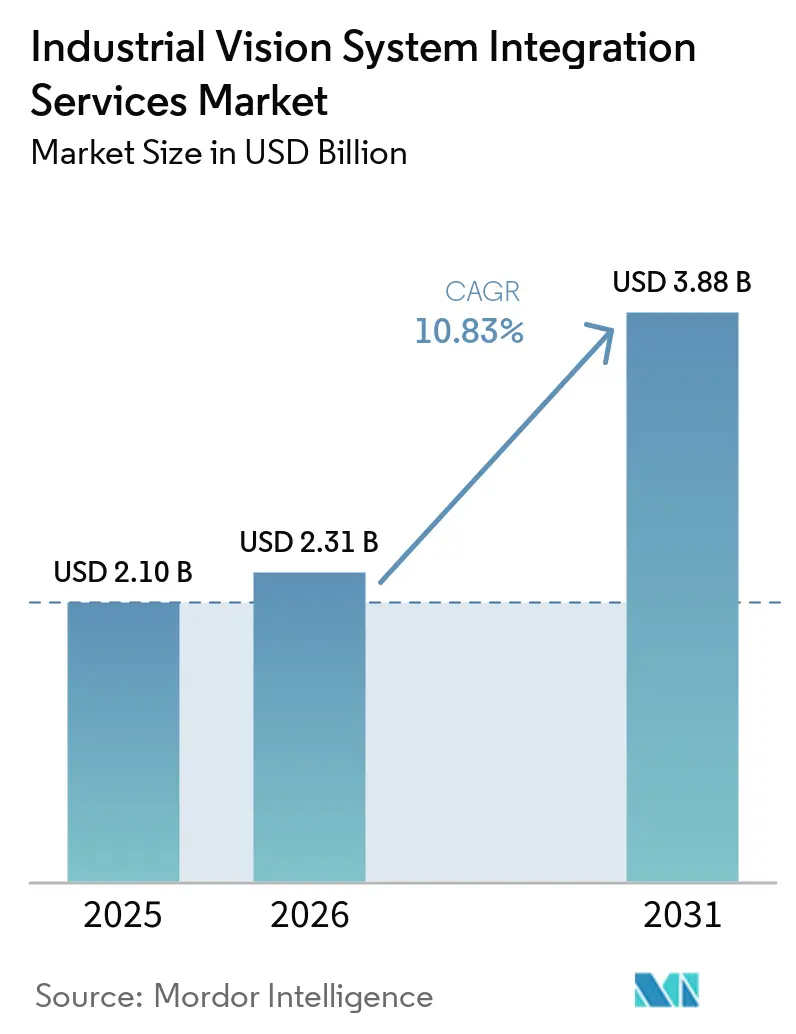
The industrial vision system integration services market size is expected to increase from USD 2.10 billion in 2025 to USD 2.32 billion in 2026 and reach USD 3.88 billion by 2031, expanding at a CAGR of 10.83% over 2026-2031.
The industrial vision system integration services market is moving from optional automation spending toward a core production requirement for facilities that need certified quality output, traceable records, and AI-supported process control. Manufacturers that delayed projects during capital-constrained years now face stronger competitive and compliance pressure to deploy connected inspection systems. Reshoring activity in North America and Western Europe, zero-defect requirements, and factory-floor AI processing support demand for specialist delivery services. The industrial vision system integration services market also creates opportunities for providers that can combine technical deployment with validation, cybersecurity documentation, and ongoing software support.
Key Report Takeaways
- By service type, system design and engineering held 25.45% of the industrial vision system integration services market share in 2025, while software, algorithm, and controls integration is projected to expand at a 12.34% CAGR through 2031.
- By project type, new system integration accounted for 64.78% of revenue in 2025, while retrofit and modernization is expected to expand at a 12.78% CAGR through 2031.
- By customer size, large enterprises held 69.71% of revenue in 2025, while SMEs are projected to expand at a 12.13% CAGR through 2031.
- By end-user industry, automotive and mobility captured 25.67% of revenue in 2025, while electronics and semiconductor is forecast to expand at a 13.43% CAGR through 2031.
- By geography, Asia-Pacific held 37.65% of revenue in 2025 and is expected to expand at an 11.93% CAGR through 2031.
Note: Market size and forecast figures in this report are generated using Mordor Intelligence’s proprietary estimation framework, updated with the latest available data and insights as of January 2026.
Global Industrial Vision System Integration Services Market Trends and Insights
Drivers Impact Analysis*
| Driver | (~) % Impact on CAGR Forecast | Geographic Relevance | Impact Timeline |
|---|---|---|---|
| Zero-Defect Manufacturing and Automated Quality Assurance | +2.5% | Global | Short term (≤ 2 years) |
| Vision-Guided Robotics and Flexible Automation | +2.2% | North America, Germany, Japan, Asia-Pacific | Medium term (2-4 years) |
| Artificial Intelligence and Deep-Learning Inspection | +2.0% | Global, led by China, the United States, and Germany | Short term (≤ 2 years) |
| Traceability Requirements Across Regulated Manufacturing | +1.5% | North America, Europe, and Asia-Pacific | Medium term (2-4 years) |
| Semiconductor, Battery, and Electronics Miniaturization | +1.1% | Asia-Pacific, with spillover to North America | Long term (≥ 4 years) |
| Shortage of In-House Machine Vision Engineering Talent | +0.8% | North America and Europe | Short term (≤ 2 years) |
| Source: Mordor Intelligence | |||
Zero-Defect Manufacturing and Automated Quality Assurance
Zero-defect production has become a contractual requirement for many Tier 1 automotive and aerospace suppliers. This requirement places automated visual inspection within the core design of closed-loop quality systems. A 2026 systematic review found that deep-learning machine vision can recognize objects under changing production conditions, including vibration, dust, and uneven lighting. Rule-based systems are less adaptable when those conditions change during high-speed operations. The industrial vision system integration services market benefits because manufacturers need expertise to connect inspection data with production controls and quality records. AIAG guidance on measurement system analysis also gives integrators a documentation role when automotive suppliers validate AI-supported quality systems. Inspection images can become a useful operating asset after the initial project is complete. When linked to manufacturing execution systems, image records can help teams identify repeated defect patterns before they become broader quality failures. That requirement changes the scope of work from a camera installation into a continuing data and process-control service. The industrial vision system integration services market, therefore, favors providers that can maintain models, manage image data, and support quality teams after commissioning. Zero-defect requirements also make project timing less dependent on general equipment spending cycles. Suppliers can postpone some factory investments, but they have less room to postpone controls that support contractual quality performance.
Vision-Guided Robotics and Flexible Automation
Vision-guided robotics is extending beyond high-volume automotive work into manufacturing settings with frequent product changes and lower production volumes. The Association for Advancing Automation reported 36,766 robot orders in North America during 2025, valued at USD 2.25 billion.[1]Association for Advancing Automation, “North American Robot Orders and Shipments 2025,” Association for Advancing Automation, a3automate.org. These environments require a system to locate components despite changing orientation, bin location, or surface variation. The industrial vision system integration services market gains from the additional work needed to connect cameras, robot controls, and production safety systems. 3D structured-light and depth-sensing equipment also require more careful design than fixed-coordinate robotic applications. A vision-to-robot interface often requires customized communication and motion logic for each production line. Integrators with libraries that support several robot brands can reduce repetitive engineering work and improve project delivery speed. KUKA describes AI-based vision tools for 2D and 3D image processing in robotic systems, showing the wider shift toward machine perception in automation. The industrial vision system integration services market has room for providers that can make these tools work safely in mixed production environments. European safety and AI rules also increase the value of suppliers that can prepare clear technical records for autonomous systems.
Artificial Intelligence and Deep-Learning Inspection
Factory-floor AI processing has reduced the delay that previously limited cloud-based inspection at high production speeds. A 2025 peer-reviewed study found that modern object-detection approaches can identify surface defects, dimensional errors, cracks, and fractures under changing conditions. The research also identified human-machine collaboration as an important operating model as manufacturers adopt Industry 5.0 practices. The industrial vision system integration services market is affected because these systems require careful decisions on hardware, models, data flows, and line controls. An effective installation must produce reliable results without disrupting production throughput. Synthetic image generation can help prepare a model before a physical line begins operation. Integrators can use CAD-based models and digital environments to build defect libraries before commissioning. Cognex made its OneVision collaborative AI development environment generally available in June 2026 after a beta phase that involved more than 100 enterprises. The industrial vision system integration services market has a clear opening for repeatable methods that reduce deployment time while retaining the ability to handle site-specific defects. Such methods can also make advanced inspection more accessible to smaller manufacturers with focused use cases.
Traceability Requirements Across Regulated Manufacturing
Traceability rules support demand across automotive, pharmaceutical, food, and medical-device production. These requirements create purchase decisions that are tied to regulatory deadlines rather than only to capital budgets. The U.S. Food and Drug Administration requires covered food traceability records to be available within 24 hours of a request, and the applicable compliance date is July 20, 2028. The industrial vision system integration services market supports the collection of structured records through optical character recognition, data matrix reading, and serialization checks. These functions can verify products while creating timestamped information for audits. IATF 16949 requirements for safety-relevant automotive components, FDA requirements for electronic records, and medical-device controls all raise the importance of verifiable records. Integrators must connect inspection results with manufacturing execution systems and partner data-exchange networks. That integration work is often beyond the remit of an internal production engineering team. The industrial vision system integration services market is therefore supported by recurring revalidation work when lines, algorithms, or regulatory expectations change. Pharmaceutical aggregation and medical-device documentation requirements add further reasons for manufacturers to maintain validated inspection workflows.
Restraints Impact Analysis*
| Restraint | (~) % Impact on CAGR Forecast | Geographic Relevance | Impact Timeline |
|---|---|---|---|
| High Integration Complexity Across Legacy Production Assets | -1.8% | Global, most acute in European and North American brownfield facilities | Long term (≥ 4 years) |
| Shortage of Qualified Vision and Automation Specialists | -1.2% | Global, particularly acute in North America and Europe | Medium term (2-4 years) |
| Cybersecurity and Data-Governance Risks in Connected Vision Systems | -0.8% | North America and Europe | Short term (≤ 2 years) |
| Hardware Commoditization and OEM-Bundled Vision Solutions | -0.5% | Global, especially Asia-Pacific and North America | Medium term (2-4 years) |
| Source: Mordor Intelligence | |||
High Integration Complexity Across Legacy Production Assets
Brownfield factories create different technical and commercial conditions from new production sites. Older programmable logic controllers, conveyor systems, and human-machine interfaces may not use the communication methods expected by current vision platforms. The industrial vision system integration services market must address interface work that may not be visible during early project scoping. Multi-vendor production lines can require separate driver stacks and safety checks for equipment from several manufacturers. These discoveries add labor hours during deployment and can reduce margins on fixed-price contracts. Detailed communication mapping before equipment procurement can help reduce later disruption. The work must identify controls, safety logic, available downtime, and data interfaces across the complete line. The industrial vision system integration services market can respond with structured brownfield assessments and managed upgrade services. Such services can provide regular software updates and algorithm retraining when product mixes change. The restraint remains material because retrofit installations often need to fit into brief planned shutdowns, leaving little flexibility when unexpected compatibility issues appear.
Shortage of Qualified Vision and Automation Specialists
A shortage of vision engineering talent has two effects on project demand and project capacity. Manufacturers without internal expertise often turn to external integrators for deployment and validation work. At the same time, integrators can struggle to staff large or multi-site projects. Machine vision engineering combines optics, electronics, software, and mechanical engineering skills, making specialist hiring difficult. The industrial vision system integration services market may face longer delivery times if the number of installations rises faster than the available workforce. Greatech Integration's 2026 vision-engineer postings called for 5-8 years of image-processing experience, indicating the experience level required for complex roles. Established firms are responding with internal training and university partnerships. Smaller providers are using lower-code configuration platforms for standard applications. That approach preserves experienced engineers for high-complexity work and limits the constraint on delivery capacity. It may also strengthen pricing for firms that can demonstrate certified deployment capability across multiple locations.
*Our forecasts treat driver/restraint impacts as directional, not additive. The impact forecasts reflect baseline growth, mix effects, and variable interactions.
Segment Analysis
By Service Type: Software Intelligence Changes Service Economics
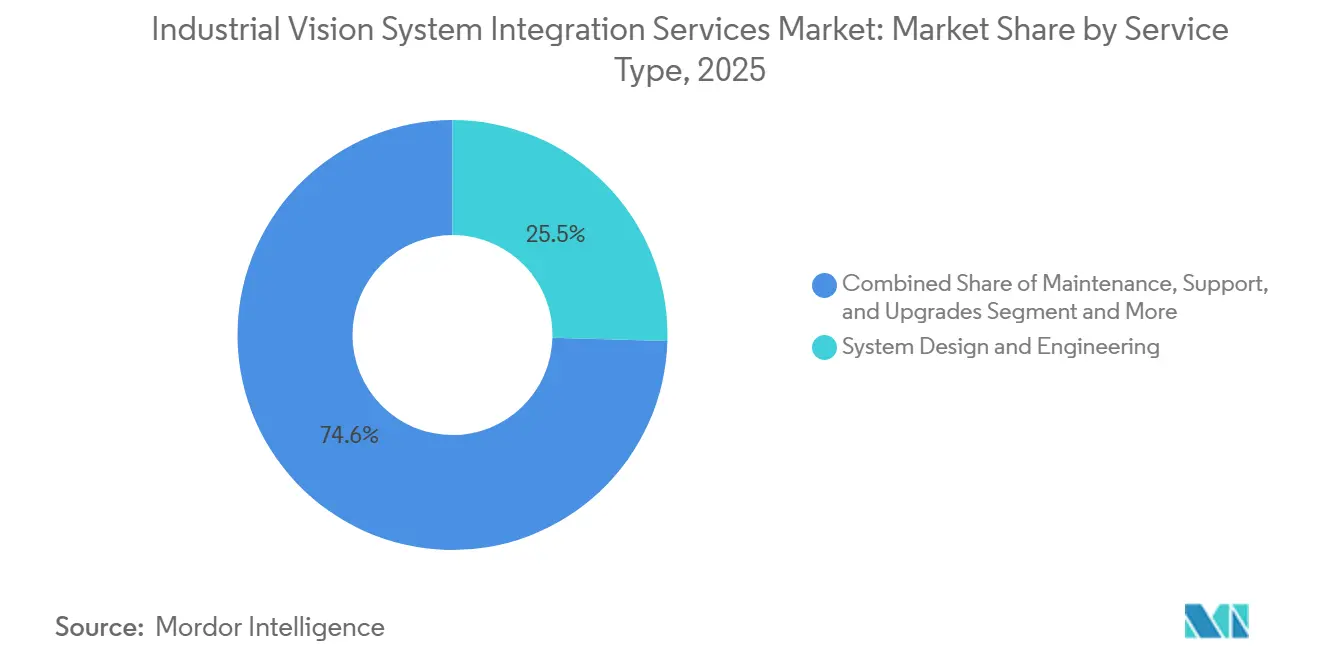
Software, algorithm, and controls integration is projected to expand at a 12.34% CAGR through 2031, making it the fastest-expanding service type. System design and engineering held 25.45% of the industrial vision system integration services market share in 2025. Design work remains essential because every installation needs a feasibility review, optics selection, lighting design, and communication plan. These decisions determine whether an inspection system can meet both accuracy and cycle-time requirements. Demand for software-related work is supported by the need to train models using a manufacturer’s own defect patterns.
Cognex’s OneVision environment shows how some parts of AI development are becoming more standardized. Standard tools can simplify routine configuration, but custom models still require significant technical work. System installation and commissioning services remain closely tied to new-factory schedules. Testing, validation, and calibration are important where regulated manufacturing requires repeatable evidence of performance. Maintenance, support, and upgrades are becoming recurring activities because models need retraining after products or production conditions change. Providers with ongoing software revenue may have a different commercial profile from those that rely largely on one-time hardware margins.



By Project Type: Retrofits Add Complexity to Established Lines
New system integration accounted for 64.78% of revenue in 2025, supported by factory construction in North America and Asia-Pacific. Retrofit and modernization is forecast to expand at a 12.78% CAGR through 2031. New sites can incorporate vision equipment and data connections during the initial line design. This reduces some integration barriers compared with modifying established equipment. The industrial vision system integration services market size for retrofit work is supported by legacy inspection equipment that is approaching the end of its useful life.
Retrofit projects must account for communication interfaces, safety approvals, and limited production downtime. These requirements mean that replacing an inspection system is rarely a simple equipment exchange. A modular approach can reduce installation disruption when the line architecture and interfaces have been identified in advance. The industrial vision system integration services market favors firms with a record of rapid commissioning on active production lines. Each completed brownfield project also creates operating knowledge that is difficult for new competitors to reproduce quickly. Providers that scope such work carefully can protect project margins and build longer-term upgrade relationships.
By Customer Size: SMEs Expand the Addressable Customer Base
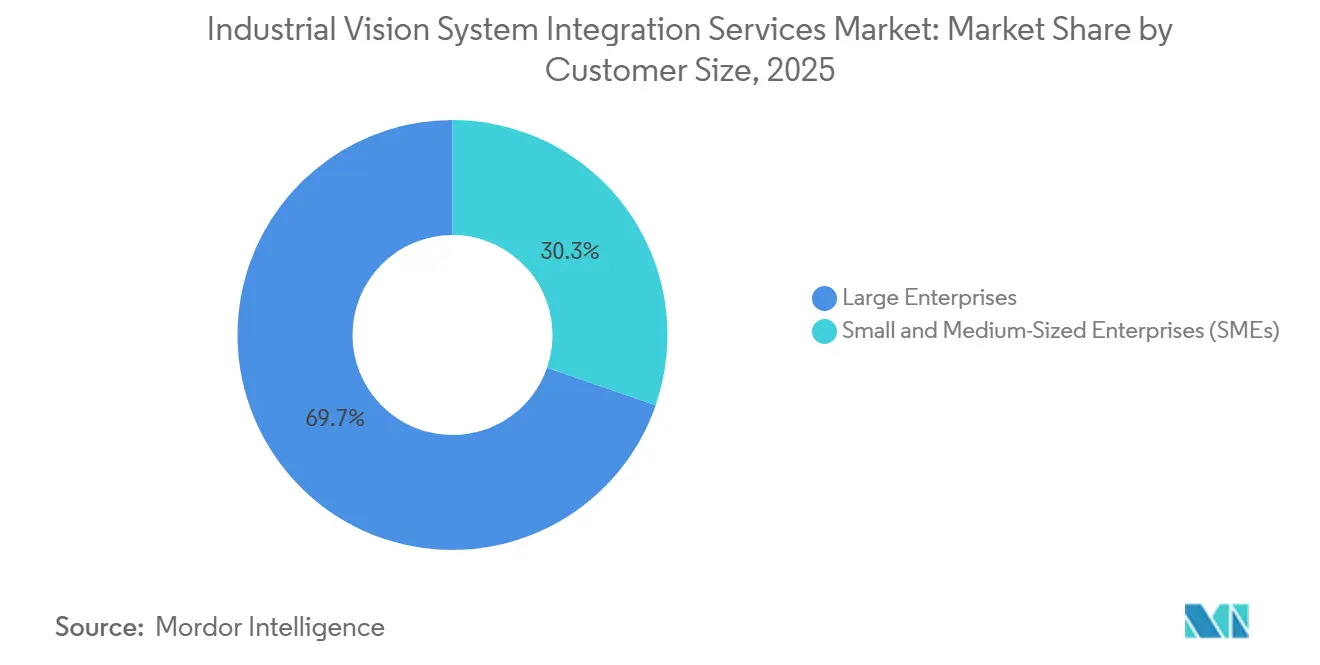
Large enterprises held 69.71% of revenue in 2025 because they can fund multi-year and multi-site integration programs. SMEs are projected to expand at a 12.13% CAGR through 2031. Large customers often need standard deployment templates across several facilities and countries. Their procurement processes also place weight on quality documentation and regulatory compliance. Their leading revenue position reflected an ability to commit to broad automation programs.
Smaller manufacturers are adopting targeted inspection systems as deep-learning tools become easier to configure. Their needs often suit fixed-scope service packages rather than highly customized engineering engagements. Predefined hardware configurations, pre-trained defect libraries, and monitoring subscriptions can improve access for this customer group. Qualitas Technologies offers the EagleEye platform with robot-controller support for Fanuc, KUKA, ABB, Yaskawa, and Universal Robots.[2]Qualitas Technologies Pvt. Ltd., “EagleEye Inspection System,” Qualitas Technologies Pvt. Ltd., qualitastech.com. The industrial vision system integration services market can reach more single-facility operators when integrators offer repeatable deployment models. This model can expand coverage without requiring engineering staffing to increase at the same rate as customer numbers.
By End-User Industry: Electronics and Semiconductor Set the Highest Inspection Requirements
Automotive and mobility held 25.67% of revenue in 2025, supported by electric vehicle powertrain changes and battery-module verification. Electronics and semiconductor is expected to expand at a 13.43% CAGR through 2031. Advanced packaging, wafer bonding, and high-bandwidth memory applications need precise inspection at production speed. These requirements can exceed the capabilities of general in-house teams. The industrial vision system integration services market size is supported by the increasing complexity of inspection requirements in semiconductor production.
Onto Innovation launched the Dragonfly G5 inspection and metrology platform in March 2026 for advanced semiconductor packaging applications.[3]Onto Innovation Inc., “Onto Innovation Launches Dragonfly G5 Inspection System,” Onto Innovation Inc., ontoinnovation.com. Its launch illustrates the changing equipment specifications that integration providers must understand when they design and maintain these installations. Automotive work remains a large base because IATF 16949 supports battery and powertrain verification requirements. Pharmaceutical and medical-device producers need validated inspection processes and auditable quality records. Food, beverage, packaging, and industrial manufacturing provide a wider base of mid-complexity projects. Logistics and warehousing add a separate opportunity through vision-guided mobile robots and barcode-reading systems.
Geography Analysis
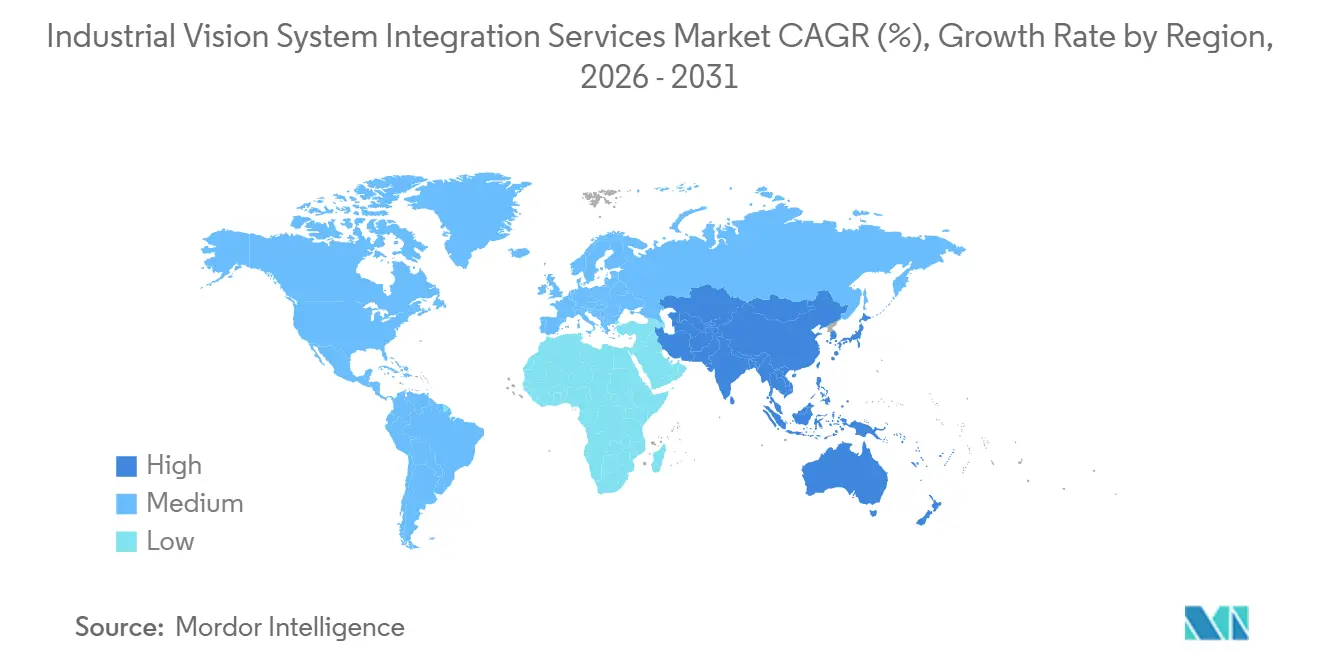
Asia-Pacific held 37.65% of revenue in 2025 and is expected to expand at an 11.93% CAGR through 2031. China supports demand through semiconductor fabrication, contract electronics assembly, and intelligent manufacturing programs. India is becoming a more important location for pharmaceutical and automotive supplier inspection projects that support export quality requirements. Malaysia’s Penang industrial zones support new-factory commissioning work for semiconductor and consumer electronics production. Japan and South Korea sustain demand for precision assembly and advanced packaging inspection.
North America held the second-largest position, supported by reshoring investment, food traceability requirements, and pharmaceutical serialization activity. The region’s 2025 robot orders provide a large base for vision commissioning, maintenance, and support work. STEMMER IMAGING completed the transition of Phase 1 Technology into STEMMER IMAGING USA in October 2025.[4]STEMMER IMAGING AG, “Phase 1 Transition to STEMMER IMAGING USA,” STEMMER IMAGING AG, stemmer-imaging.com. Europe is shaped by stricter AI, cybersecurity, and product-security requirements for connected factory systems. Germany remains a major source of projects across automotive, machinery, and precision manufacturing.
South America, the Middle East, and Africa represent smaller geographic segments with a longer expansion path. Brazil concentrates work in automotive manufacturing and food processing, where local providers have language and proximity advantages. Saudi Arabia and the United Arab Emirates support demand through industrial-zone development and automation-first factory designs. South Africa has activity in automotive assembly and food processing. Egypt and other North African countries offer earlier-stage opportunities connected to manufacturing diversification. The industrial vision system integration services market has a broad geographic base, but local engineering capacity will affect how rapidly these smaller regions develop through 2031.

Competitive Landscape
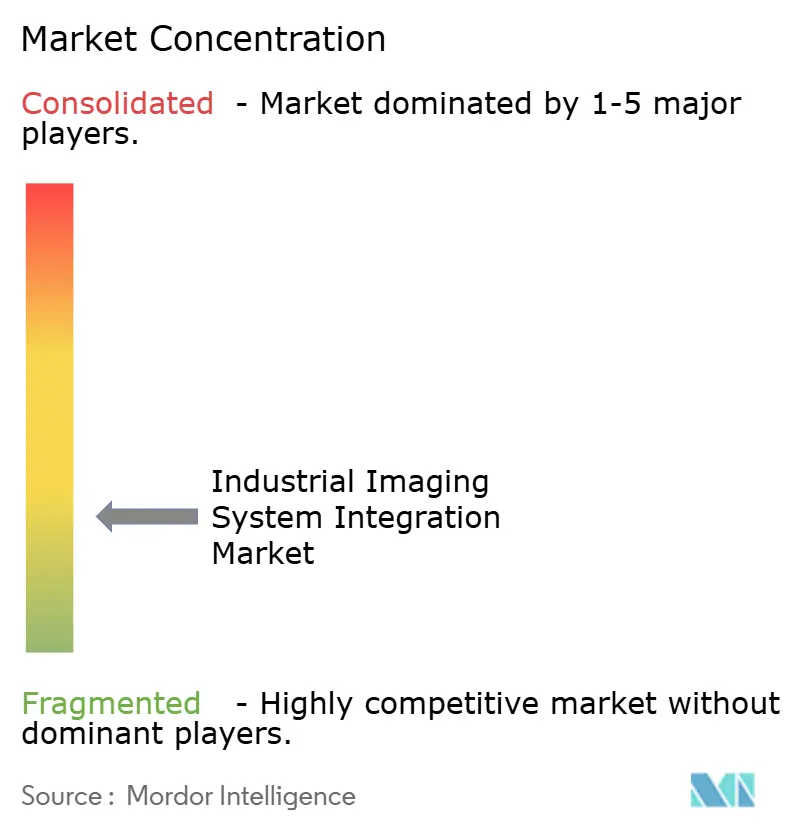
The industrial vision system integration services market is fragmented, and no single integrator holds a dominant global position. Hardware-aligned integrators benefit from certified relationships with camera, optics, and lighting suppliers. Software-first providers compete through model libraries that address specific defect types. Full-stack systems houses offer design, installation, validation, and maintenance across several sectors and locations. The industrial vision system integration services market is becoming more competitive as component distributors build engineering teams and software suppliers offer direct deployment services.
STEMMER IMAGING’s acquisition by MiddleGround Capital was completed in November 2024 at EUR 48.00 (USD 52.07) per share and represented a 52% premium. In June 2026, STEMMER IMAGING launched SIS-TA, a digital sales business for machine vision components. This move combines component access with the company’s established technical support and integration services. It also reflects a broader effort to serve both standard component purchases and more complex project requirements. Greatech Integration incorporated Greatech Integration Canada Limited in March 2026 to improve access to life sciences and semiconductor customers in North America.
Providers are also seeking recurring revenue through licensed software, monitoring, and model maintenance. Proprietary training data for defined defect categories can be difficult for competitors to reproduce without equivalent production-floor experience. MVTec certified Greatech Integration as an integration partner, formalizing its access to HALCON and MERLIC software for customer projects. Compliance documentation is becoming a more important qualification factor in European procurement. Firms with audit-ready processes may have an advantage in projects that require cybersecurity and quality evidence. The industrial vision system integration services market remains open to specialist providers, but success increasingly depends on technical depth, repeatable delivery, and support after commissioning.
Industrial Vision System Integration Services Industry Leaders
AIT Goehner GmbH
ATEsystem s.r.o.
EAM, Inc.
MSTVision GmbH
OCTUM GmbH
- *Disclaimer: Major Players sorted in no particular order

Recent Industry Developments
- June 2026: STEMMER IMAGING AG launched SIS-TA, Smart Industry Store Technology Access, a fully digital transactional sales subsidiary offering machine vision components, cameras, optics, lighting, and frame grabbers, through an online procurement platform. The subsidiary complements the company’s established consultative integration business and is planned to expand into cobots, autonomous mobile robots, motion control, and PLC systems over time.
- March 2026: Onto Innovation Inc. launched the Dragonfly G5 inspection and metrology platform, capable of detecting defects as small as 150 nm across advanced semiconductor packaging applications, including high-bandwidth memory. A leading HBM manufacturer selected the Dragonfly G5 for HBM4 ramp production, and shipments began in Q2 2026.
- October 2025: Phase 1 Technology Corp. completed its full transition into STEMMER IMAGING USA, Inc. The rebranding marked STEMMER IMAGING’s first entry into the North American machine vision distribution and integration market.


Global Industrial Vision System Integration Services Market Report Scope
The Industrial Vision System Integration Services encompasses the business ecosystem of engineering, designing, installing, and maintaining machine vision technology on factory floors. It focuses on the complete deployment lifecycle of automated machine vision and visual inspection ecosystems.
The Industrial Vision System Integration Services Market Report is Segmented by Service Type (System Design and Engineering, System Installation and Commissioning, Software, Algorithm, and Controls Integration, Testing, Validation, and Calibration, Maintenance, Support, and Upgrades, and More), Project Type (New System Integration and Retrofit and Modernization), Customer Size (Large Enterprises and Small and Medium-Sized Enterprises (SMEs)), End-user Industry (Automotive and Mobility, Electronics and Semiconductor, Food and Beverage, Pharmaceuticals and Medical Devices, Packaging, Industrial Manufacturing, Logistics and Warehousing, and Other End-User Industries), and Geography. The Market Forecasts are Provided in Terms of Value (USD).
| System Design and Engineering |
| System Installation and Commissioning |
| Software, Algorithm, and Controls Integration |
| Testing, Validation, and Calibration |
| Maintenance, Support, and Upgrades |
| New System Integration |
| Retrofit and Modernization |
| Large Enterprises |
| Small and Medium-Sized Enterprises (SMEs) |
| Automotive and Mobility |
| Electronics and Semiconductor |
| Food and Beverage |
| Pharmaceuticals and Medical Devices |
| Packaging |
| Industrial Manufacturing |
| Logistics and Warehousing |
| Other End-User Industries |
| North America | United States |
| Canada | |
| Mexico | |
| South America | Brazil |
| Argentina | |
| Rest of South America | |
| Europe | Germany |
| United Kingdom | |
| France | |
| Italy | |
| Spain | |
| Rest of Europe | |
| Asia-Pacific | China |
| Japan | |
| India | |
| South Korea | |
| ASEAN | |
| Rest of Asia-Pacific | |
| Middle East | Saudi Arabia |
| United Arab Emirates | |
| Rest of the Middle East | |
| Africa | South Africa |
| Rest of Africa |
| By Service Type | System Design and Engineering | |
| System Installation and Commissioning | ||
| Software, Algorithm, and Controls Integration | ||
| Testing, Validation, and Calibration | ||
| Maintenance, Support, and Upgrades | ||
| By Project Type | New System Integration | |
| Retrofit and Modernization | ||
| By Customer Size | Large Enterprises | |
| Small and Medium-Sized Enterprises (SMEs) | ||
| By End-User Industry | Automotive and Mobility | |
| Electronics and Semiconductor | ||
| Food and Beverage | ||
| Pharmaceuticals and Medical Devices | ||
| Packaging | ||
| Industrial Manufacturing | ||
| Logistics and Warehousing | ||
| Other End-User Industries | ||
| By Geography | North America | United States |
| Canada | ||
| Mexico | ||
| South America | Brazil | |
| Argentina | ||
| Rest of South America | ||
| Europe | Germany | |
| United Kingdom | ||
| France | ||
| Italy | ||
| Spain | ||
| Rest of Europe | ||
| Asia-Pacific | China | |
| Japan | ||
| India | ||
| South Korea | ||
| ASEAN | ||
| Rest of Asia-Pacific | ||
| Middle East | Saudi Arabia | |
| United Arab Emirates | ||
| Rest of the Middle East | ||
| Africa | South Africa | |
| Rest of Africa | ||


Key Questions Answered in the Report
What is the industrial vision system integration services market size?
The sector is expected to be USD 2.32 billion in 2026 and is forecast to reach USD 3.88 billion by 2031 at a 10.83% CAGR. Demand is linked to quality certification, traceability, and AI-enabled controls that can operate at production-line speed.
Which service type is expanding fastest?
Software, algorithm, and controls integration is projected to expand at a 12.34% CAGR through 2031. It benefits from demand for model training, line controls, data connections, and continuing updates after commissioning. It is especially relevant where a manufacturer must use its own production images to improve model performance.
Which project type has the highest projected CAGR?
Retrofit and modernization is expected to expand at a 12.78% CAGR through 2031 because many production sites are replacing older inspection equipment. These projects must resolve legacy communication interfaces, equipment safety requirements, and restricted installation windows during deployment.
Which end-user sector creates the fastest demand?
Electronics and semiconductor is forecast to expand at a 13.43% CAGR through 2031. Advanced packaging and high-bandwidth memory require precise inspection at high throughput, which often requires specialist integration support. Equipment, algorithms, and metrology requirements must be coordinated with the production process.
Which region leads industrial vision system integration services?
Asia-Pacific held 37.65% of revenue in 2025 and is forecast to expand at an 11.93% CAGR through 2031. Semiconductor, electronics, pharmaceutical, and automotive investment supports projects in China, India, Malaysia, Japan, and South Korea.
Why do manufacturers use external vision integration providers?
Providers connect cameras, algorithms, robots, production controls, and traceability records. They also support validation, documentation, model retraining, and system upgrades when product specifications or regulatory expectations change. This work helps factories obtain reliable results without interrupting required cycle times.
Page last updated on:





