
Industrial Technical Textile Market Size and Share
Market Overview
| Study Period | 2021 - 2032 |
|---|---|
| Market Size (2027) | USD 56.43 Billion |
| Market Size (2032) | USD 72.02 Billion |
| Growth Rate (2027 - 2032) | 5.00 % |
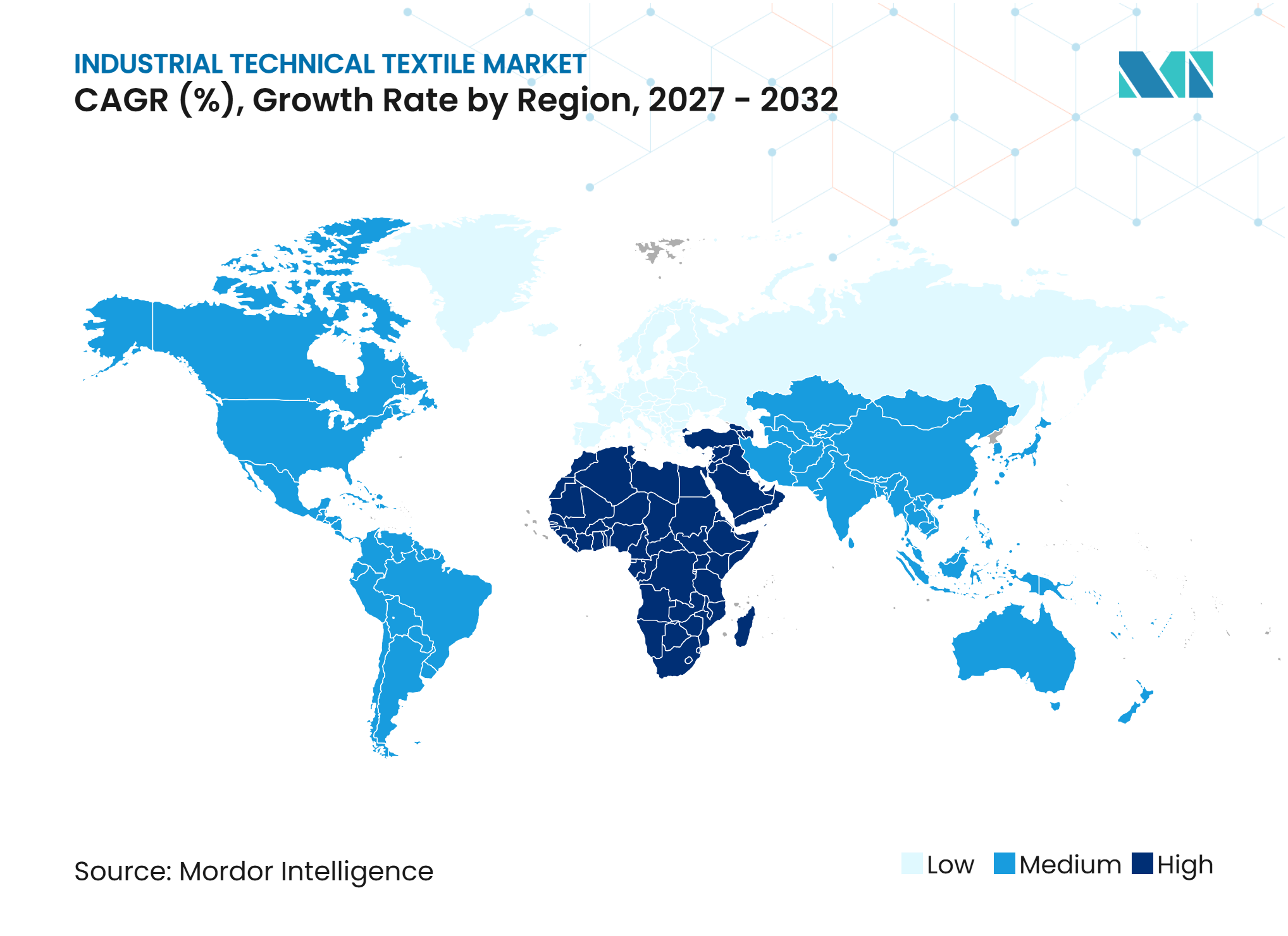
| Fastest Growing Market | Middle East and Africa |
| Largest Market | Asia-Pacific |
| Market Concentration | Medium |
Major Players *Disclaimer: Major Players sorted in no particular order Image © Mordor Intelligence. Reuse requires attribution under CC BY 4.0. | |
Industrial Technical Textile Market Analysis by Mordor Intelligence
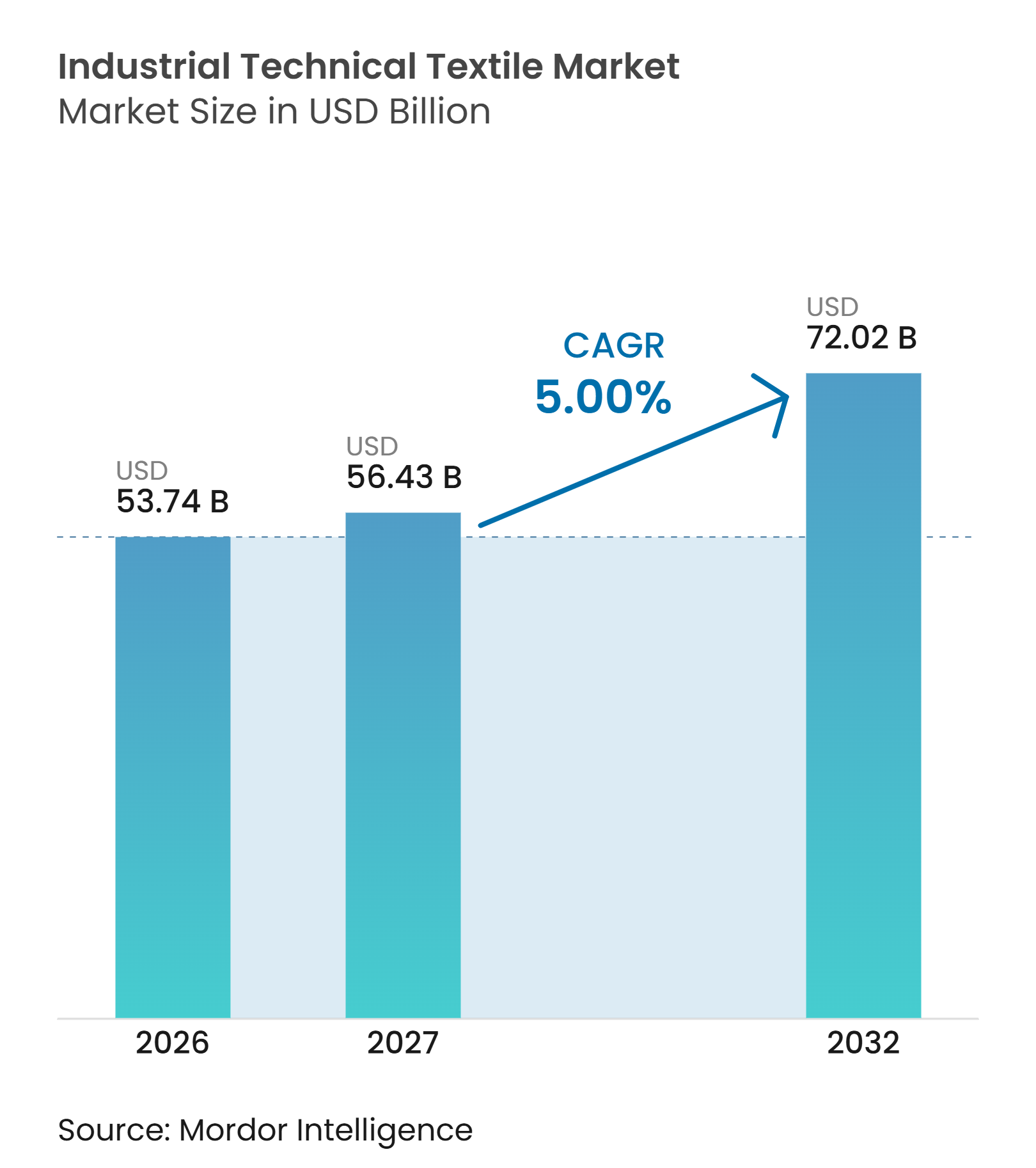
The Industrial Technical Textile Market size was valued at USD 53.74 billion in 2026 and is estimated to grow from USD 56.43 billion in 2027 to reach USD 72.02 billion by 2032, at a CAGR of 5% during the forecast period (2027-2032).
The industrial technical textile market is supported by recurring replacement demand across process industries, including chemicals, cement, mining, power generation, and manufacturing, where filtration media, conveyor belts, protective fabrics, and industrial fabrics require periodic replacement. Stricter environmental regulations and growing emphasis on emissions control are increasing the adoption of high-performance filtration materials, particularly in dust collection, liquid filtration, and industrial wastewater treatment. Higher-specification materials are gaining ground in composites, filtration, insulation, and electronics applications, driven by requirements for improved thermal resistance, chemical durability, mechanical strength, and operational efficiency. Suppliers are increasingly focusing on specialized applications where stringent product qualification requirements, consistent performance, and operating reliability take precedence over unit price. Growing industrialization, manufacturing capacity additions, and infrastructure investments across Asia-Pacific and the Middle East are widening the addressable market for specialized technical textile producers.
Key Report Takeaways
- By product type, industrial filtration and separation textiles held 25.5% of the industrial technical textile market share in 2026, while Industrial composite reinforcement textiles are forecast to grow at a 6.8% CAGR through 2032.
- By material type, polyester held 36.5% of the industrial technical textile market size in 2026, while other high-performance synthetic fibers are forecast to grow at a 6.3% CAGR through 2032.
- By end-use application, industrial machinery and material handling held 22.5% of demand in 2026, while electrical, electronics, and battery manufacturing is forecast to grow at a 7.2% CAGR through 2032.
-
By geography, Asia-Pacific accounted for 49% of demand in 2026, while the Middle East and Africa is forecast to grow at an 8.7% CAGR through 2032.
Note: Market numbers in this report are based on Mordor Intelligence's proprietary estimation framework, which combines nine months of actuals with Q4 projections for base year 2026.
Market Trends and Insights
Drivers Impact Analysis of Industrial Technical Textile Market*
| Driver | (~) % Impact on CAGR Forecast | Geographic Relevance | Impact Timeline |
|---|---|---|---|
| Automation and Industrial Material-Handling System Expansion | +1.3% | Global, with highest intensity in Asia-Pacific and Europe | Medium term (2-4 years) |
| Industrial Filtration Requirements and Process Efficiency Improvements | +1.1% | Global, strongest in North America, Europe, and China | Medium term (2-4 years) |
| High-Performance Textile Adoption in Composite Reinforcements | +0.9% | Asia-Pacific, North America, and Europe | Long term (≥ 4 years) |
| Electronics Manufacturing and Advanced Battery Material Requirements | +0.8% | Asia-Pacific, with spillover to North America and Europe | Medium term (2-4 years) |
| Industrial Equipment Modernization and Replacement Demand | +0.6% | Global, led by Asia-Pacific and North America | Short term (≤ 2 years) |
| Paper, Packaging, and Nonwoven Production Capacity Development | +0.4% | Asia-Pacific, with moderate relevance in North America and Europe | Long term (≥ 4 years) |
| Source: Mordor Intelligence | |||
Automation and Industrial Material-Handling System Expansion
Automation is raising the performance requirements for conveyor fabrics, paper machine clothing, and process belts. Autonomous mobile robots, vision-guided conveyors, and high-speed forming lines need components with stable dimensions and longer service intervals. A 2025 study of intralogistics automation in textile and clothing operations found that automated material flows reduced order-preparation inefficiencies and improved component traceability.[1] These operating changes increase the value placed on fabrics that can sustain higher speeds and shorter maintenance windows. The European Partnership for Textiles identifies robotic textile manipulation and automated factory handling as strategic development priorities.[2] The industrial technical textile market can therefore benefit when equipment operators move from scheduled fabric changes to condition-based replacement practices.
Industrial Filtration Requirements and Process Efficiency Improvements
Emissions controls and process-efficiency needs are driving upgrades to industrial filtration systems. The United States Environmental Protection Agency states that well-maintained fabric filters can achieve collection efficiencies above 99%, although performance can deteriorate with temperature extremes, acid-gas condensation, and ineffective cleaning.[3] This creates demand for membrane-laminated and chemically resistant filter media. The European Commission's 2025 draft reference document for the textiles sector places environmental performance and best available techniques at the center of industrial compliance. In Asia-Pacific, uneven enforcement allows high-specification and locally compliant media to coexist, creating price pressure in the middle of the market. Suppliers that can document characterization under ISO 11057 and air-permeability testing under ISO 9237 are better placed in specification-led purchasing cycles.
High-Performance Textile Adoption in Composite Reinforcements
Composite reinforcement textiles are gaining use in energy, transport, and advanced manufacturing where lower weight and structural performance are both needed. In August 2025, JBIC signed a co-financing agreement totaling USD 300 million, including up to USD 180 million from JBIC, to support Toray Industries' United States carbon fiber expansion for hydrogen fuel-cell vehicle gas tanks. The EIB also provided a EUR 25 million (USD 29.4 million) venture loan to Fairmat in 2025 for the industrialization of recycled composite materials. DITF programs backed by EUR 4.2 million (USD 4.9 million) in ERDF funding are developing industrial-scale approaches for recycled carbon and glass fiber applications. These investments support the industrial technical textile market by broadening the range of reinforcement materials available to manufacturers. Recycled reinforcement fabrics may displace lower-end conventional options in selected industrial applications as their technical performance improves.
Electronics Manufacturing and Advanced Battery Material Requirements
Precision glass cloth and specialty polymer textiles are important inputs in printed circuit boards, battery separators, and electronic packaging. Celanese reported that UHMW-PE is used in lithium-ion separator membranes, lead-acid battery separators, and high-performance filtration equipment. Glass cloth for printed circuit boards must meet precise weave and electrical-property requirements under IPC standards. Such requirements limit the number of qualified suppliers and create long procurement relationships. Nittobo manufactures glass fiber cloth and specialty materials used in electronics, illustrating the link between fiber-textile capability and electronic applications. New battery capacity in China, South Korea, and the United States is encouraging procurement teams to qualify additional separator and substrate suppliers.
Restraints Impact Analysis of Industrial Technical Textile Market*
| Restraint | (~) % Impact on CAGR Forecast | Geographic Relevance | Impact Timeline |
|---|---|---|---|
| Volatility in Synthetic Fiber, Polymer, and Specialty Material Prices | -1% | Global, most acute in Asia-Pacific and European manufacturing hubs | Short term (≤ 2 years) |
| High Manufacturing and Qualification Costs for Engineered Textile Products | -0.8% | Global, most restrictive in North America and Europe | Long term (≥ 4 years) |
| Performance Limitations under Extreme Industrial Operating Conditions | -0.6% | Middle East and Africa, Asia-Pacific mining belts, and North American heavy industry | Medium term (2-4 years) |
| Competition from Metallic, Ceramic, and Non-Textile Alternatives | -0.4% | Global, with highest exposure in mining and chemical processing | Long term (≥ 4 years) |
| Source: Mordor Intelligence | |||
Volatility in Synthetic Fiber, Polymer, and Specialty Material Prices
Petrochemical feedstock movements pass quickly into costs for polyester, polypropylene, polyamide, and other industrial textile inputs. The purified terephthalic acid, paraxylene, and polyester staple fiber prices declined during the first half of 2025, reducing processing spreads for upstream producers. That movement can temporarily reduce costs for downstream fabric manufacturers, but it also adds uncertainty to contracting and inventory decisions. Specialty fibers such as PTFE, PPS, and aramid have different cost patterns because their availability depends on specialty chemical supply and concentrated producer bases. Annual supply contracts can expose textile producers when feedstock prices reverse during a project. The industrial technical textile market remains vulnerable when long-cycle customer contracts do not permit timely price adjustments.
High Manufacturing and Qualification Costs for Engineered Textile Products
Multilayer forming fabrics, composite preforms, and high-temperature insulation assemblies require specialized weaving, nonwoven, or lamination equipment. They also require customer qualification processes that can run from 12 to 36 months. Albany International reported USD 48 million of research and development expenditure in 2025, up 4.2% from 2024, to advance proprietary weaving technologies and machine clothing. Incumbents can spread these costs across established customer bases, while new suppliers face higher costs per qualified product. This cost structure limits rapid entry into technically differentiated applications. It can also slow substitution when customers prefer a qualified incumbent to the operational risk of a new material.
*Our forecasts treat driver/restraint impacts as directional, not additive. The impact forecasts reflect baseline growth, mix effects, and variable interactions.
Industrial Technical Textile Market Segment Analysis
By Product Type:
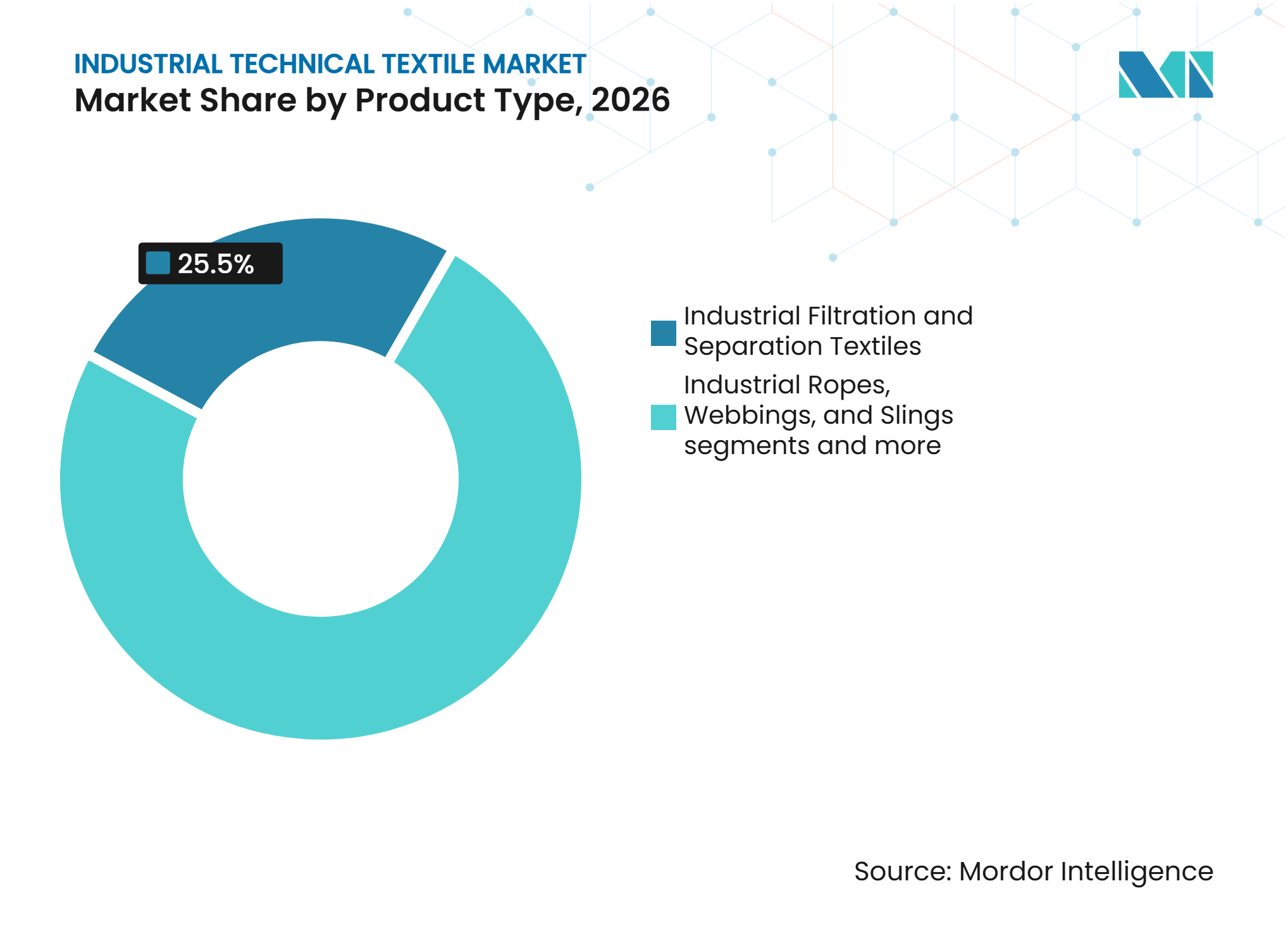
Filtration Textiles Anchor Demand, Composites AccelerateIndustrial filtration and separation textiles accounted for 25.5% of the industrial technical textile market size in 2026, while Industrial composite reinforcement textiles are forecast to grow at a 6.8% CAGR through 2032. Filtration demand spans dust-collection baghouses, liquid-filtration systems, and industrial screening. Regulatory controls on emissions and wastewater support recurring replacement demand for these materials. ISO 11057 characterization and ISO 9237 air-permeability requirements direct procurement toward suppliers that can provide validated performance. This creates a practical barrier to entry in the industrial technical textile market in applications where plant uptime and compliance are central. Composite reinforcements are advancing in wind energy, hydrogen infrastructure, and defense applications. SAERTEX Group and Chomarat expanded capacity for non-crimp and unidirectional carbon reinforcements in 2025, responding to demand from infusion-based composite manufacturers.
Paper-machine clothing and specialty process textiles form the next major group, supported by replacement needs in pulp and paper mills. Valmet's 2025 machinery investment in Finland reflects continuing demand for press-felt production capacity. Industrial belting, conveying, and flexible reinforcement textiles serve mining, food processing, and automated logistics. ISO 14890 and ISO 21183 provide relevant requirements for conveyor belt fabrics. Industrial ropes, webbings, and slings serve safety-critical lifting and lashing uses under EN 1492 and ISO 2307. Electrical and electronic textile components are also becoming more important as glass cloth is used in advanced circuit-board substrates and battery-related applications. These different applications make the Industrial technical textile industry dependent on a mix of regulatory compliance, replacement cycles, and specialized technical qualification.



By Material Type:
Polyester Dominates, High-Performance Fibers OutpacePolyester accounted for 36.5% of the industrial technical textile market in 2026 because it combines cost efficiency, chemical resistance, and processing versatility. It is used across conveyor fabrics, filtration media, and paper machine clothing. Its extensive global supply base also supports broad availability for manufacturers. Other high-performance synthetic fibers are forecast to grow at a 6.3% CAGR through 2032. This group includes aramid, PPS, PTFE, PEEK, and polyimide. Their growth reflects the need for performance in demanding thermal, chemical, and electrical conditions. PTFE membrane-laminated media are used in cement, steel, and pharmaceutical dust collection where fine-particle capture and chemical resistance are required. Demand for these specialty materials remains shaped by the higher cost of qualification and raw materials.
Glass fibers are expanding their role in industrial applications through infrastructure reinforcement and electronic circuit-board substrates. Carbon fibers are becoming more important in composite reinforcement, although higher cost restricts their use in mass-market applications. Investment in carbon fiber production for hydrogen applications supports the longer-term supply base. Polyamide remains important in belting and rope uses because of abrasion resistance. Polypropylene is widely used in liquid filtration and food-contact process fabrics. Material choice depends on the required balance of strength, chemical resistance, operating temperature, electrical properties, and cost. The Industrial technical textile industry increasingly favors performance-defined specifications over generic fiber selection. This keeps specialty fiber suppliers relevant even when commodity fiber pricing is volatile.
By End-Use Application:
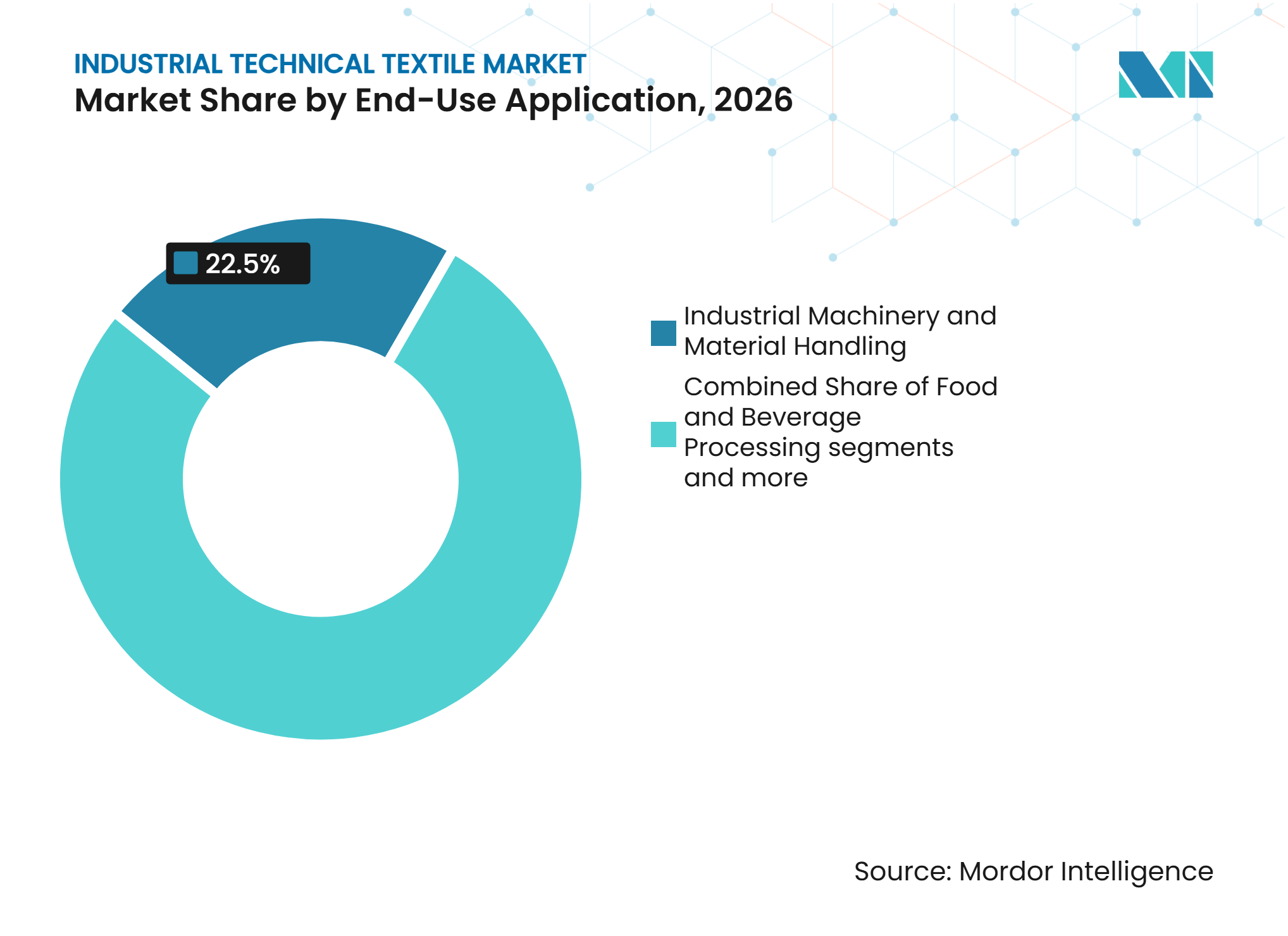
Machinery Leads, Electronics and Batteries SurgeIndustrial machinery and material handling accounted for 22.5% of end-use demand in 2026, while electrical, electronics, and battery manufacturing is projected to grow at a 7.2% CAGR through 2032. Machinery demand includes conveyor belt fabrics, drive-belt textiles, and process fabrics used in manufacturing, packaging, and logistics. Its replacement pattern is driven by wear and remains relatively stable when original-equipment sales weaken. Electronics and battery applications depend on precision glass cloth and separator substrates. Celanese identifies UHMW-PE as a primary material in lithium-ion separator membranes and lead-acid battery separators. Qualification, rather than price alone, determines supplier access in these applications. This supports premium positioning for producers that meet required electrical and dimensional specifications.
Pulp, paper, and nonwoven manufacturing remains a significant end-use vertical for the industrial technical textile market. Tissue capacity development in North America supports demand for paper machine clothing and related process fabrics. Valmet's 2025 tissue-machine supply contract for Irving Consumer Products illustrates this continuing investment cycle. Chemical and pharmaceutical manufacturing require filtration and process materials that can support controlled operating conditions. Food and beverage processing relies on fabrics used in filtration, conveying, and food-contact processes. Mining, metals, cement, and mineral processing create stable demand for durable belting and filtration products. Energy applications are adding demand for composite reinforcements and technical textile inputs in hydrogen-related systems. The Industrial technical textile industry therefore serves both mature replacement markets and newer specification-led applications.

Geography Analysis
Asia-Pacific: The Center of Industrial Textile Demand and Production
Asia-Pacific held 49% of the Industrial technical textile market size in 2026. China anchors the region through its large chemical-fiber production base and broad manufacturing capacity. ITMF shipment statistics reported that China absorbed more than 90% of global polyester-filament texturing spindle deliveries in 2025. India is strengthening its role through policy support for technical-textile investment. In October 2025, the Ministry of Textiles reduced the minimum investment threshold under the PLI Scheme for technical textiles from INR 300 crore (USD 33.4 million) to INR 150 crore (USD 16.7 million) for Part 1, effective from August 2025. The revision is intended to lower investment barriers and support capacity additions. South Korea and Taiwan contribute specialized glass cloth and electronic textile substrates, strengthening the region's position in higher-value electronic applications.
Europe: Precision Technology and Sustainability-Driven Specialization
Europe competes through high-specification paper machine clothing, composite reinforcement fabrics, industrial filtration media, and high-temperature textiles. Germany remains a major center for technical textile development and specialized production. Sandler invested more than EUR 30 million (USD 353.9 million) at its Schwarzenbach an der Saale facility in 2025, automated material flow, and added a manufacturing line. In July 2025, Sandler also acquired a 24.9% stake in Phoenix Non-Woven to strengthen access to wet-laid materials for battery, fuel-cell, and construction uses. ASGLAWO combined its composite and technical-textile capabilities in August 2025 to focus on health, mobility, construction, and protective-textile applications. In France, EIB financing for Fairmat supports carbon-fiber recycling capacity and circular composite materials. These initiatives favor regional suppliers with material-science capability, established compliance systems, and specialized customer relationships.
Other Regions: Replacement Demand and Resource-Linked Niches
Middle East and Africa is forecast to grow at an 8.7% CAGR through 2032, the fastest geographic rate in the Industrial technical textile market. The Middle East is developing composite capabilities connected to energy-infrastructure diversification. North America has a significant position through its pulp, paper, nonwoven, filtration, belting, and machine-clothing base. The Industrial technical textile market in North America benefits from a large installed industrial base that sustains replacement demand even when new equipment investment changes. Valmet's planned tissue production line for Georgia adds future demand for paper-machine clothing. South America offers demand in filtration and process textiles linked to mining and pulp operations. Argentina and Chile provide niche potential in conveyor and filtration materials tied to lithium and copper mining activity. Across these markets, the key opportunity lies in technical service, local qualification support, and products that can operate reliably in demanding industrial environments. The Industrial technical textile market can expand beyond established production centers when specialized suppliers match local process needs with validated products.
Competitive Landscape
Market Concentration
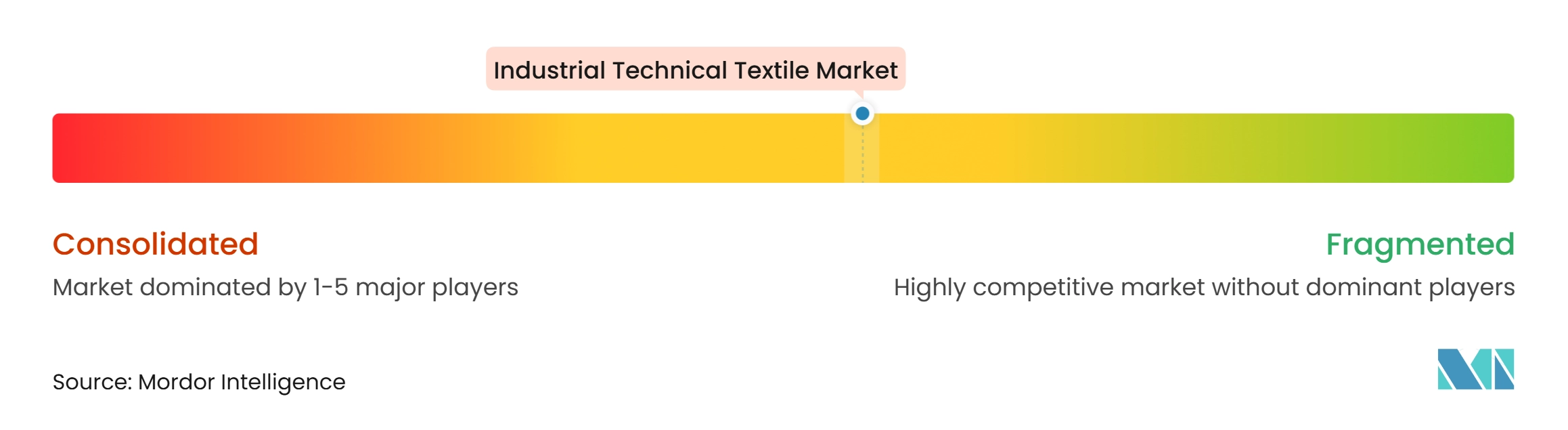
The industrial technical textile market exhibits a medium level of market concentration. Albany International, Valmet, Voith, Freudenberg, and W. L. Gore & Associates have established positions in paper machine clothing and process textiles through proprietary technologies and long-term customer relationships. Albany reported that it held approximately a 30% global share in paper machine clothing and invested USD 48 million in research and development during 2025. GKD Gebr. Kufferath specializes in precision mesh, SAERTEX in multiaxial composite reinforcements, and BWF Group in industrial filtration. This application focus helps suppliers defend technical differentiation and customer retention. Standards activity under ISO TC38 and relevant IEC committees also supports continued development of conductive, antistatic, and thermally stable textile designs.
Composite reinforcement and fiber recycling are attracting new competitors. Recycled-fiber suppliers are offering alternatives to virgin high-performance fibers in selected applications. Fairmat's EIB-backed expansion illustrates the growing institutional support for circular composite materials. Chomarat commissioned a EUR 2 million (USD 2.4 million) unidirectional carbon-fiber reinforcement line in 2025 for materials with improved infusion permeability and ply stability. This raises competitive pressure in infusion-based composite manufacturing. Digital monitoring and predictive replacement systems are another route to differentiation for suppliers of extended-service industrial fabrics. These offerings can increase the value of technical service and make switching more difficult for customers.
Certification and customer qualification remain important competitive safeguards. ISO 14890 requirements for conveyor belts and ISO 11057 requirements for filter-media characterization can favor suppliers with established testing and compliance records. In February 2025, Albany announced that it would consolidate engineered-fabric production in Italy by moving activity from Ballo to Merone. This move shows how established companies are aligning capacity with regional demand. In August 2025, JBIC-backed financing supported Toray's United States carbon-fiber expansion for hydrogen-storage applications. In July 2025, Sandler's investment in Phoenix Non Woven extended its position in wet-laid materials for batteries and fuel cells. Competitive outcomes will continue to depend on validated performance, reliable supply, and targeted investment in specialized applications.
Industrial Technical Textile Industry Leaders
-
Sefar AG
-
GKD - Gebr. Kufferath AG
-
Albany International Corp.
-
ANDRITZ AG
-
Valmet Oyj
- *Disclaimer: Major Players sorted in no particular order
Industrial Technical Textile Market Companies Covered in this Report
- Sefar AG
- GKD - Gebr. Kufferath AG
- Albany International Corp.
- ANDRITZ AG
- Valmet Oyj
- Voith GmbH & Co. KGaA
- AstenJohnson
- BWF Group
- W. L. Gore & Associates Inc.
- Ahlstrom
- Freudenberg Group
- Hollingsworth & Vose
- Donaldson Company Inc.
- Forbo Holding AG (Movement Systems)
- Habasit AG
- AMMEGA Group
- Continental AG (ContiTech)
- Michelin Group (Fenner)
- SAERTEX Group
- Chomarat Group
- Nitto Boseki Co. Ltd. (Nittobo)
- Teufelberger Holding AG
- Samson Rope Technologies Inc.
- Marlow Ropes Ltd.
- SpanSet Group
- Lift-All Company Inc.
- Newtex Industries Inc.
- Mid-Mountain Materials Inc.
Recent Industry Developments in Industrial Technical Textile Market
- February 2026: Nonwovenn invested in upgrading its impregnation line and introducing a second production line to double output capacity, strengthening its industrial filtration, activated-carbon, coalescer filtration, and acoustic textile capabilities.
- February 2026: The Ministry of Textiles approved 16 research projects under the National Technical Textiles Mission, covering high-performance fibers, smart textiles, protective materials, textile machinery, and advanced composites.
- October 2025: India's Ministry of Textiles revised the PLI Scheme for technical textiles, reducing minimum investment thresholds in Part-1 from INR 300 crore (USD 33.4 million) to INR 150 crore (USD 16.7 million) and in Part-2 from INR 100 crore (USD 11.1 million) to INR 50 crore (USD 5.6 million), effective August 2025, and cutting the incremental turnover qualifying criterion from 25% to 10% from FY 2025-26, to lower financial barriers and accelerate technical textile capacity additions in-country.
- October 2025: Freudenberg Performance Materials Apparel expanded its Chennai, India facility by 20,000 square feet with new cotton and polyester interlining lines, cutting lead times from 6-8 weeks for imports from China to 1-2 weeks and targeting the growing Indian technical textile intermediate market.
Global Industrial Technical Textile Market Report Scope
The Industrial Technical Textile Market Report is segmented by Product Type (Industrial Filtration and Separation Textiles, and more), by Material Type (Polyester, Polyamide, and more), by End-Use Application (Pulp, Paper, and Nonwoven Manufacturing, Chemical and Pharmaceutical Manufacturing, and more), and by Geography (North America, Europe, and more). The Market Forecasts are Provided in Terms of Value (USD).
Segmentation Overview
| Industrial Filtration and Separation Textiles | Industrial Gas and Dust Filtration Textiles |
| Industrial Liquid Filtration Textiles | |
| Industrial Screening and Sieving Fabrics | |
| Paper-Machine Clothing and Specialty Process Textiles | Paper-Machine Forming Fabrics |
| Paper-Machine Press Felts and Fabrics | |
| Paper-Machine Dryer Fabrics | |
| Paper-Machine Shoe Press Belt Textiles | |
| Nonwoven Production and Specialty Process Fabrics | |
| Textile Processing and Finishing Fabrics | |
| Industrial Belting, Conveying, and Flexible Reinforcement Textiles | Textile Conveyor Belt Fabrics and Reinforcements |
| Industrial Drive and Power Transmission Belt Textiles | |
| Industrial Hose and Flexible Duct Textile Reinforcements | |
| Pneumatic Conveying and Fluidization Fabrics | |
| Industrial Ropes, Webbings, and Slings | Industrial Fiber Ropes and Cordage |
| Industrial Textile Webbings | |
| Textile Lifting Slings | |
| Industrial Composite Reinforcement Textiles | Woven Industrial Reinforcement Fabrics |
| Multiaxial and Non-Crimp Reinforcement Fabrics | |
| Other Engineered Composite Textile Reinforcements | |
| Industrial Thermal, Insulation, and Sealing Textiles | High-Temperature Industrial Fabrics |
| Others (Thermal Insulation Textile, Expansion Joint and Flexible Barrier Fabrics, etc.) | |
| Electrical and Electronic Industrial Textile Components | |
| Industrial Surface Processing, Printing, and Cleaning Textiles |
| Polyester |
| Polyamide |
| Polypropylene |
| Polyethylene and High-Performance Polyolefins |
| Glass Fibers |
| Carbon Fibers |
| Other High-Performance Synthetic Fibers (Aramid, PPS, PTFE, PEEK, Polyimide Fibers, etc.) |
| Other Materials (Other Inorganic and Mineral Fibers, Natural and Regenerated Cellulosic Fibers) |
| Pulp, Paper, and Nonwoven Manufacturing |
| Chemical and Pharmaceutical Manufacturing |
| Food and Beverage Processing |
| Mining, Metals, Cement, and Mineral Processing |
| Industrial Machinery and Material Handling |
| Electrical, Electronics, and Battery Manufacturing |
| Energy, Power, and Utilities |
| Textile Manufacturing and Industrial Printing |
| Other Industrial End-Use Industries |
| North America | United States |
| Canada | |
| Mexico | |
| Europe | Germany |
| United Kingdom | |
| France | |
| Italy | |
| Spain | |
| Poland | |
| Switzerland | |
| Austria | |
| Finland | |
| Sweden | |
| Rest of Europe | |
| Asia-Pacific | China |
| Japan | |
| India | |
| South Korea | |
| Taiwan | |
| Australia | |
| Indonesia | |
| Vietnam | |
| Thailand | |
| Rest of Asia-Pacific | |
| Middle East and Africa | Saudi Arabia |
| United Arab Emirates | |
| South Africa | |
| Rest of Middle East and Africa | |
| South America | Brazil |
| Argentina | |
| Chile | |
| Rest of South America |
| By Product Type | Industrial Filtration and Separation Textiles | Industrial Gas and Dust Filtration Textiles |
| Industrial Liquid Filtration Textiles | ||
| Industrial Screening and Sieving Fabrics | ||
| Paper-Machine Clothing and Specialty Process Textiles | Paper-Machine Forming Fabrics | |
| Paper-Machine Press Felts and Fabrics | ||
| Paper-Machine Dryer Fabrics | ||
| Paper-Machine Shoe Press Belt Textiles | ||
| Nonwoven Production and Specialty Process Fabrics | ||
| Textile Processing and Finishing Fabrics | ||
| Industrial Belting, Conveying, and Flexible Reinforcement Textiles | Textile Conveyor Belt Fabrics and Reinforcements | |
| Industrial Drive and Power Transmission Belt Textiles | ||
| Industrial Hose and Flexible Duct Textile Reinforcements | ||
| Pneumatic Conveying and Fluidization Fabrics | ||
| Industrial Ropes, Webbings, and Slings | Industrial Fiber Ropes and Cordage | |
| Industrial Textile Webbings | ||
| Textile Lifting Slings | ||
| Industrial Composite Reinforcement Textiles | Woven Industrial Reinforcement Fabrics | |
| Multiaxial and Non-Crimp Reinforcement Fabrics | ||
| Other Engineered Composite Textile Reinforcements | ||
| Industrial Thermal, Insulation, and Sealing Textiles | High-Temperature Industrial Fabrics | |
| Others (Thermal Insulation Textile, Expansion Joint and Flexible Barrier Fabrics, etc.) | ||
| Electrical and Electronic Industrial Textile Components | ||
| Industrial Surface Processing, Printing, and Cleaning Textiles | ||
| By Material Type | Polyester | |
| Polyamide | ||
| Polypropylene | ||
| Polyethylene and High-Performance Polyolefins | ||
| Glass Fibers | ||
| Carbon Fibers | ||
| Other High-Performance Synthetic Fibers (Aramid, PPS, PTFE, PEEK, Polyimide Fibers, etc.) | ||
| Other Materials (Other Inorganic and Mineral Fibers, Natural and Regenerated Cellulosic Fibers) | ||
| By End-Use Application | Pulp, Paper, and Nonwoven Manufacturing | |
| Chemical and Pharmaceutical Manufacturing | ||
| Food and Beverage Processing | ||
| Mining, Metals, Cement, and Mineral Processing | ||
| Industrial Machinery and Material Handling | ||
| Electrical, Electronics, and Battery Manufacturing | ||
| Energy, Power, and Utilities | ||
| Textile Manufacturing and Industrial Printing | ||
| Other Industrial End-Use Industries | ||
| By Geography | North America | United States |
| Canada | ||
| Mexico | ||
| Europe | Germany | |
| United Kingdom | ||
| France | ||
| Italy | ||
| Spain | ||
| Poland | ||
| Switzerland | ||
| Austria | ||
| Finland | ||
| Sweden | ||
| Rest of Europe | ||
| Asia-Pacific | China | |
| Japan | ||
| India | ||
| South Korea | ||
| Taiwan | ||
| Australia | ||
| Indonesia | ||
| Vietnam | ||
| Thailand | ||
| Rest of Asia-Pacific | ||
| Middle East and Africa | Saudi Arabia | |
| United Arab Emirates | ||
| South Africa | ||
| Rest of Middle East and Africa | ||
| South America | Brazil | |
| Argentina | ||
| Chile | ||
| Rest of South America | ||
Key Questions Answered in the Report
What is the projected value of the Industrial technical textile market by 2032?
The industrial technical textile market is projected to reach USD 72.02 billion by 2032, from USD 53.74 billion in 2026, at a 5% CAGR from 2027 to 2032.
Which product category leads industrial technical textile demand?
Industrial filtration and separation Textiles led with 25.5% of value in 2026, supported by industrial emissions controls and recurring replacement needs.
Which material segment is growing fastest in industrial technical textiles?
Other high-performance synthetic fibers, including aramid, PPS, PTFE, PEEK, and polyimide, are forecast to grow at a 6.3% CAGR through 2032.
Why are electronics and battery applications important for technical textiles?
Electrical, electronics, and battery manufacturing is projected to grow at a 7.2% CAGR through 2032 because qualified glass cloth and separator substrates are needed in electronic and energy-storage applications.
Which region has the strongest position in industrial technical textiles?
Asia-Pacific held 49% of demand in 2026, while Middle East and Africa is forecast to grow fastest at an 8.7% CAGR through 2032.
What limits adoption of industrial technical textile products?
Feedstock price volatility, high qualification costs, extreme operating conditions, and competition from metallic or ceramic alternatives can limit adoption.