
Industrial Noise Control Market Size and Share
Market Overview
| Study Period | 2021 - 2031 |
|---|---|
| Market Size (2026) | USD 6.44 Billion |
| Market Size (2031) | USD 7.89 Billion |
| Growth Rate (2026 - 2031) | 4.13 % |
| Fastest Growing Market | Asia-Pacific |
| Largest Market | Asia-Pacific |
| Market Concentration | Low |
Major Players *Disclaimer: Major Players sorted in no particular order Image © Mordor Intelligence. Reuse requires attribution under CC BY 4.0. | |
Industrial Noise Control Market Analysis by Mordor Intelligence
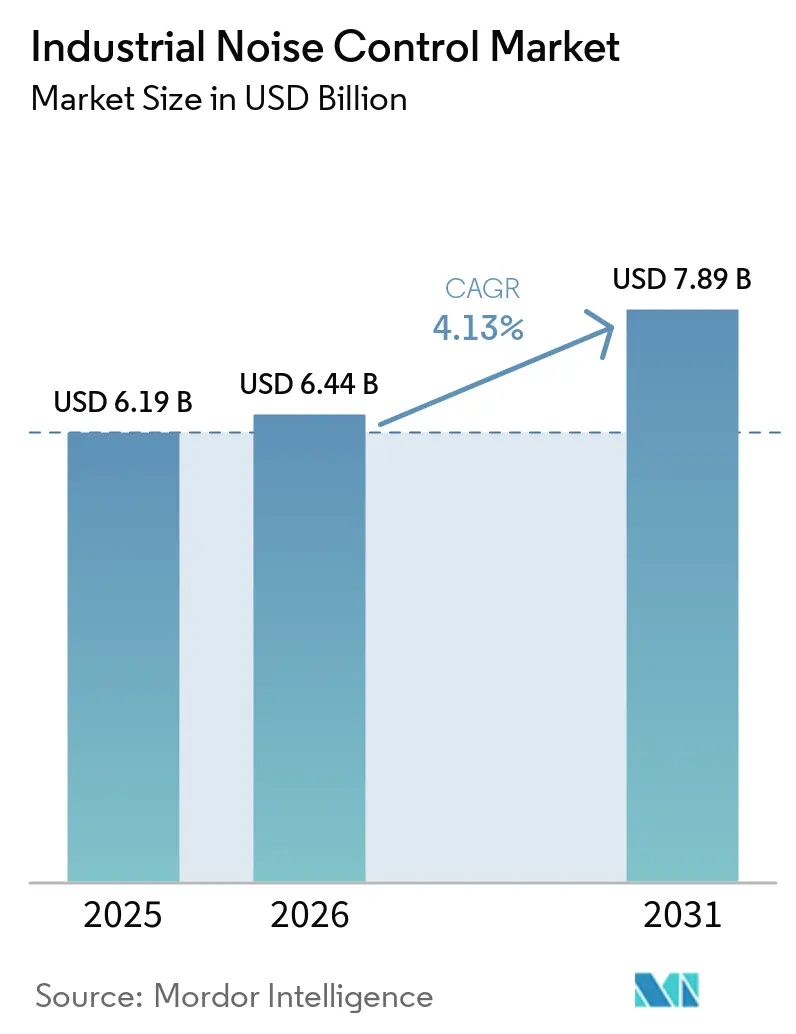
The industrial noise control market size was valued at USD 6.19 billion in 2025 and is estimated to grow from USD 6.44 billion in 2026 to reach USD 7.89 billion by 2031, at a CAGR of 4.13% during the forecast period (2026-2031). The industrial noise control market is supported by workplace rules that favor engineering controls when noise exposure reaches regulated limits. In the United States, the scope of occupational noise exposure requirements covered 285,510 establishments in 2025, with 3,935,792 workers above the 85 dBA action level. European policy also keeps attention on noise reduction because the European Environment Agency reported that progress toward the 2030 target remained limited. New factories and plant upgrades move acoustic requirements into design specifications, which can shorten the time between project approval and procurement. Consolidation among acoustic systems suppliers may strengthen access to large projects, while material costs and high initial system costs remain constraints for smaller operators.
Key Report Takeaways
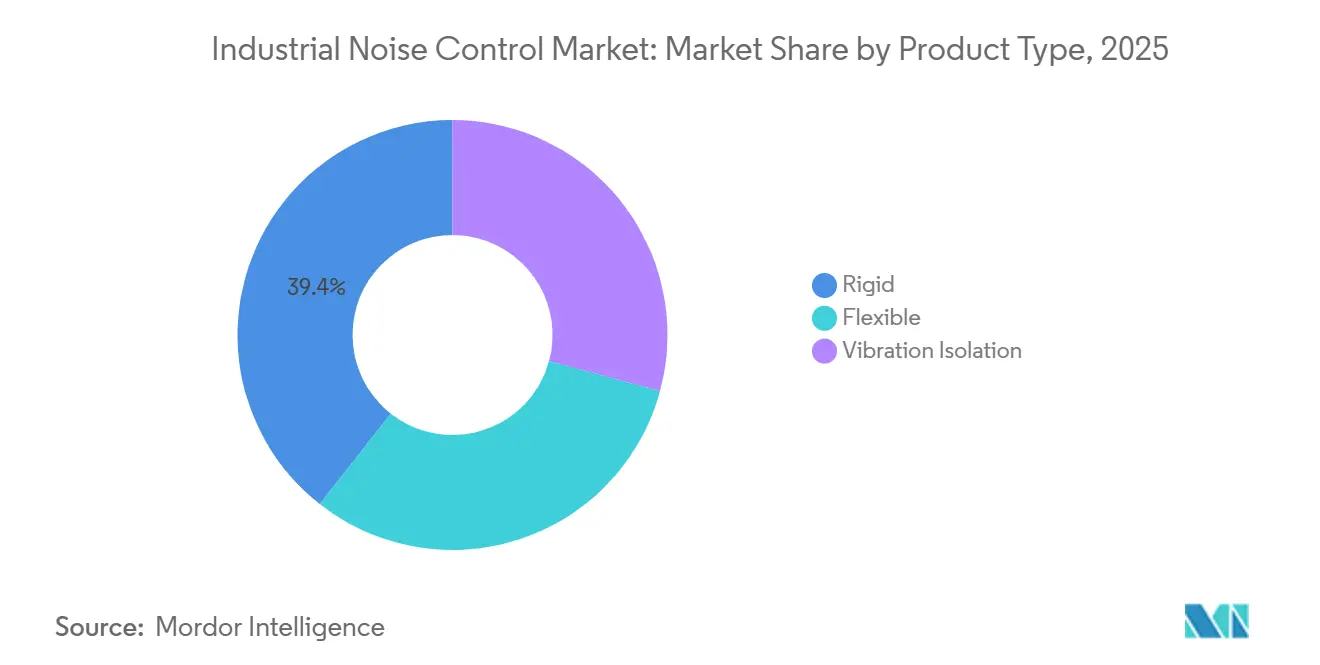
- By product type, rigid noise control products held 39.4% of the industrial noise control market share in 2025, while vibration isolation is forecast to grow at a 4.6% CAGR through 2031.
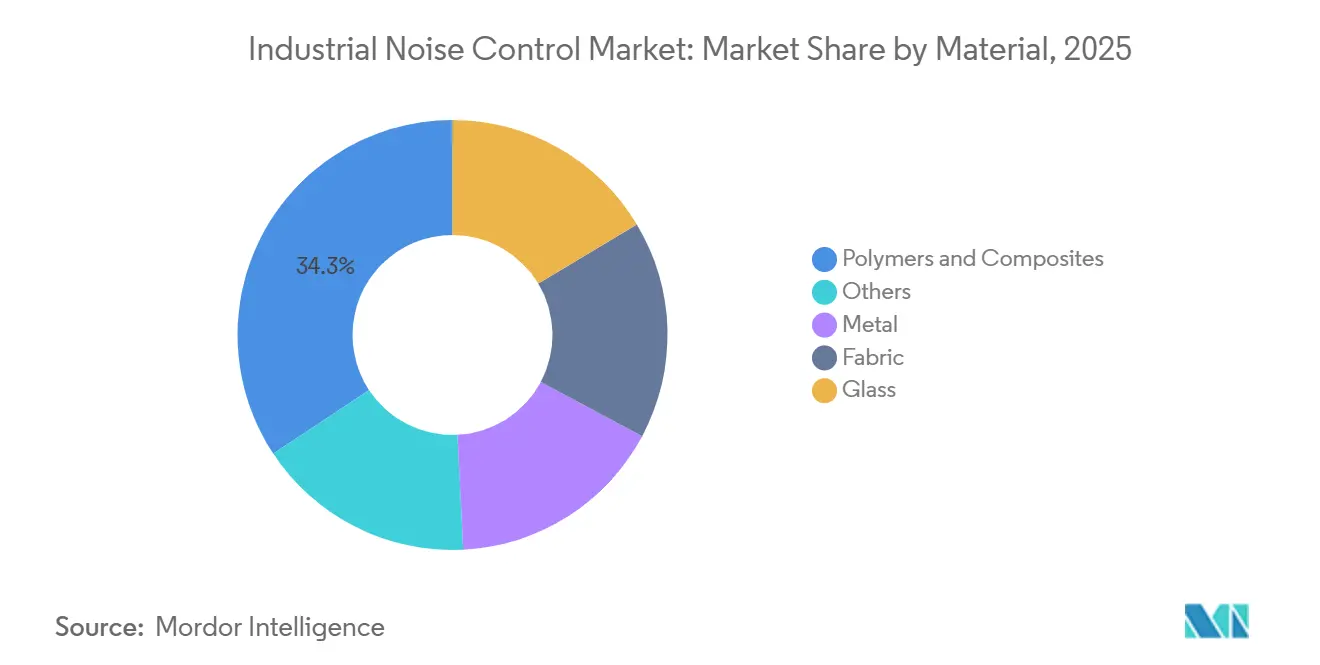
- By material, polymers and composites accounted for 34.3% of the industrial noise control market share in 2025 and are projected to expand at a 4.3% CAGR through 2031.
- By end-use industry, automotive held 31.1% of the industrial noise control market size in 2025, while metal processing and mining is forecast to grow at a 5.1% CAGR through 2031.
- By geography, Asia-Pacific held 38.5% of the industrial noise control market share in 2025 and is forecast to grow at a 5.3% CAGR through 2031.
Note: Market size and forecast figures in this report are generated using Mordor Intelligence’s proprietary estimation framework, updated with the latest available data and insights as of January 2026.
Global Industrial Noise Control Market Trends and Insights
Drivers Impact Analysis*
| Driver | (~) % Impact on CAGR Forecast | Geographic Relevance | Impact Timeline |
|---|---|---|---|
| Tightening Occupational and Environmental Noise Regulations | +0.70% | Global; most pronounced in North America and Europe | Medium term (2-4 years) |
| Industrial Facility Modernization and Capacity Expansion | +0.80% | North America, Europe | Short to medium term (≤ 4 years) |
| Manufacturing, Mining, Construction, and Utility Investment | +0.70% | Global; led by Asia-Pacific and Latin America | Long term (≥ 4 years) |
| Rising Adoption of Engineered Noise Control in New Industrial Projects | +0.50% | Asia-Pacific, South America | Medium term (2-4 years) |
| Nearshoring and Regionalization of Manufacturing Supply Chains | +0.50% | North America (US, Mexico); Europe (Poland, Eastern Europe) | Short term (≤ 2 years) |
| Electrification-Driven Demand for Broadband and Tonal Noise Management | +0.50% | Global; led by Asia-Pacific and Europe | Long term (≥ 4 years) |
| Source: Mordor Intelligence | |||
Tightening Occupational and Environmental Noise Regulations
Regulatory requirements provide a stable base of demand for the industrial noise control market. OSHA requires feasible engineering or administrative controls when employee exposure exceeds 90 dBA over an 8-hour period[1]U.S. Occupational Safety and Health Administration, “Occupational Noise Exposure Standard 29 CFR 1910.95,” Occupational Safety and Health Administration, osha.gov. The 2025 federal notice showed that 3,935,792 workers were above the 85 dBA action level, compared with 3,802,698 in the earlier review cycle. The European Environment Agency reported an annual economic cost of EUR 100 billion from noise exposure and noted that the region was not on track for its 2030 reduction target[2]European Environment Agency, “Environmental Noise in Europe 2025, Summary for Policymakers,” European Environment Agency, eea.europa.eu. The EU Publications Office published updated technical support for noise action plans in March 2026. These frameworks direct facilities toward enclosures, barriers, and isolation systems when personal protection alone is not sufficient.
Industrial Facility Modernization and Capacity Expansion
Plant modernization places acoustic requirements in project design instead of treating them as later upgrades. U.S. Steel announced in June 2026 that it plans to invest up to USD 2.5 billion in Mon Valley Works, including a hot strip mill at Edgar Thomson. The company expects construction to begin in 2026 and production to start in the second half of 2029. Tenaris announced a USD 90 million modernization program for its Koppel and Ambridge facilities in June 2026. Reheat furnaces, casting lines, and rolling equipment can produce noise levels that require supplementary acoustic engineering. This supports earlier engagement between suppliers and plant engineering teams in the industrial noise control market.
Manufacturing, Mining, Construction, and Utility Investment
Heavy-industry investment supports demand for enclosures, barriers, and vibration control systems. The top 20 mining companies are expected to undertake approximately USD 82.4 billion in capital expenditure in 2026, including USD 11 billion each from Rio Tinto and BHP. Mining and mineral processing equipment can generate occupational noise levels ranging from 100 dB to 115 dB. Crushing, grinding, and ventilation operations therefore require noise control measures as part of facility approval and operating compliance. Investment in automotive, semiconductor, appliance, utility, and construction industries also expands the number of sites requiring acoustic treatment. These project pipelines broaden the end-use base for the industrial noise control market.
Electrification-Driven Demand for Broadband and Tonal Noise Management
Electric motors and power electronics create tonal noise that differs from conventional engine noise. SAE research in 2025 identified motor whine, switching harmonics, and gear meshing as important acoustic targets in electric vehicle powertrains[3]SAE International, “A Review on Electric Vehicle NVH Challenges and Recent Trends,” SAE Technical Paper, saemobilus.sae.org. A 2026 SAE paper identified the 24th-order electromagnetic vibration in an 8-pole, 48-slot motor as a dominant excitation source[4]SAE International, “High-Fidelity NVH Analysis Model Development Process for EV Traction Motors Based on Experimental Correlation,” SAE Technical Paper, doi.org. Similar tonal profiles occur in variable-speed drives, compressors, and electric process motors. These applications require mounts and damping materials that address defined frequency bands. Vibration isolation is therefore the fastest-growing product area in the industrial noise control market, with a forecast CAGR of 4.6%.
Restraints Impact Analysis*
| Restraint | (~) % Impact on CAGR Forecast | Geographic Relevance | Impact Timeline |
|---|---|---|---|
| High Upfront Cost of Engineered Noise Control Systems | -0.50% | Emerging markets: Asia-Pacific, South America, MEA | Medium term (2-4 years) |
| Raw-Material Price Volatility and Supply Concentration | -0.40% | Global | Short term (≤ 2 years) |
| Industrial Downtime and Retrofit Integration Constraints | -0.30% | Global; particularly continuous-process industries | Medium term (2-4 years) |
| Pressure-Drop, Thermal, Fire, and Acoustic Performance Trade-Offs | -0.20% | Global | Long term (≥ 4 years) |
| Source: Mordor Intelligence | |||
High Upfront Cost of Engineered Noise Control Systems
Custom enclosures, barrier installations, and active systems require a larger initial investment than hearing protection programs. This difference is most significant for smaller manufacturers and facilities in emerging economies. Operators may defer an enclosure or barrier when local enforcement is intermittent. Payback periods for engineered systems can extend from 5 years to 10 years in some markets, making capital recovery a significant consideration. Capital reviews may then favor production equipment over noise control upgrades. This can limit penetration in the industrial noise control market even where long-term worker protection benefits are clear.
Raw-Material Price Volatility and Supply Concentration
Polymers and composites represented 34.3% of the 2025 demand by material type. They are used in flexible barriers, foam layers, and damping sheets, which expose suppliers to changes in petrochemical feedstock costs. Ethylene prices rose by EUR 450 per metric ton, and propylene prices rose by EUR 465 per metric ton following supply disruptions in early 2026. Higher resin costs are difficult to pass through under fixed-price bids. Steel prices can also affect the cost of rigid panels, frames, and modular enclosures. These input pressures can delay orders or reduce supplier margins across the industrial noise control market.
*Our forecasts treat driver/restraint impacts as directional, not additive. The impact forecasts reflect baseline growth, mix effects, and variable interactions.
Segment Analysis
By Product Type: Rigid Systems Lead While Vibration Isolation Grows Fastest
Rigid noise control products held 39.4% of the industrial noise control market size in 2025. These systems include machine enclosures, acoustic rooms, and structural barriers for compressors and power equipment. Permanent installations are widely used where operator noise levels regularly exceed occupational limits. Their value rests on long service life and predictable compliance performance. Rigid solutions can reduce the need for recurring responses when a facility has a stable source of high noise. Carbon fiber reinforced polymer structures with acoustic metamaterial features achieved a sound insulation bandwidth approaching 1,000 Hz in 2025 research. The study also reported performance above the classical mass-law insulation limit. Such work may support more capable rigid panel designs where weight and acoustic performance must be balanced.
Flexible products serve applications that need portability or regular access to equipment. They include curtains, quilted blankets, pipe wraps, and removable barriers. These products are used where permanent rigid structures are difficult to install. Vibration isolation is forecast to grow at a 4.6% CAGR through 2031. It addresses tonal vibration from electrified drivetrains and industrial motors. Standard engine mounts may not control the discrete excitation frequencies created by electric motors. Suppliers can therefore differentiate through frequency-specific damping and isolation performance. This product shift adds a specialized layer to the industrial noise control industry.



By Material: Polymers and Composites Combine Scale With Growth
Polymers and composites held 34.3% of the industrial noise control market size in 2025 and are forecast to grow at a 4.3% CAGR through 2031. The material class is used in rigid panels, flexible barriers, isolation pads, and foam absorption layers. This range allows a common material base to serve several product formats. Metal products remain important for heavy-duty enclosures, barrier frames, machine guards, mining facilities, power plants, and steelmaking. Their mechanical strength and fire resistance matter alongside acoustic performance. Fabric products support curtains, blankets, and noise-wrap systems. Glass is used in observation windows, control-room glazing, and specialized transparent barriers.
Research activity is expanding the material choices available to suppliers. A 2025 peer-reviewed study described waterborne interpenetrating polymer networks with tunable damping and acoustic properties. A 2026 Scientific Reports study reported a sound absorption average of 0.82 and a noise reduction coefficient of 0.85 for a natural-fiber micro-perforated panel and composite backing system. The reported results covered frequencies from 100 Hz to 2,500 Hz. These findings show a potential path for bio-composite materials in industrial acoustic specifications. Rising polymer costs also encourage interest in recycled-content and bio-based alternatives when they meet required performance levels. Materials innovation remains relevant to the industrial noise control market because it can change both acoustic performance and input exposure.
By End-Use Industry: Automotive Leads While Metal Processing and Mining Accelerate
Automotive held 31.1% of the industrial noise control market size in 2025. Vehicle production requires acoustic barrier materials, vibration mounts, and damping solutions. Electric vehicle programs add requirements linked to individual motor and inverter configurations. This can create design-specific sourcing relationships rather than standard liner purchases. Metal processing and mining is forecast to grow at a 5.1% CAGR through 2031. Mining equipment often produces sustained noise from crushing, grinding, and ventilation. Steel modernization projects also place acoustic engineering in the design scope for new hot-process equipment.
Power generation and utilities require systems for gas turbines, thermal power plants, and wind installations. These applications can create tonal and low-frequency noise that calls for designed isolation and muffler systems. Oil and gas facilities use acoustic enclosures for compressor stations and gas turbine packages. Pyrotek delivered an acoustic barrier solution for the USD 21 billion Plaquemines LNG project in May 2025. Food and beverage, pharmaceutical, chemical, paper, and pulp facilities support replacement demand because they operate continuous processes. Textile facilities also have high noise exposure from looms and air-jet equipment. Their engineered enclosure adoption remains below the level.
Geography Analysis
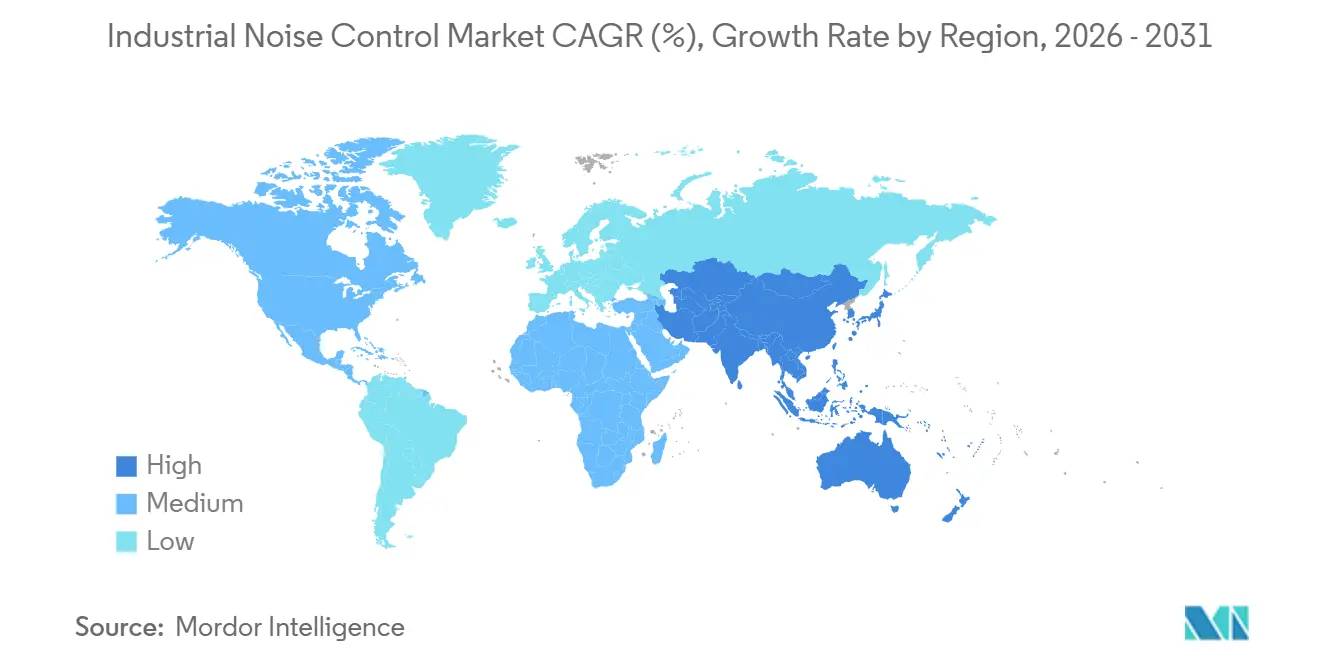
Asia-Pacific held 38.5% of the industrial noise control market share in 2025 and is forecast to grow at a 5.3% CAGR through 2031. The region’s position reflects manufacturing investment in China, India, and Southeast Asia. India recorded INR 3.6 trillion in manufacturing-linked capacity additions during FY2026. Semiconductor fabrication, automobile supply chains, and appliance production support demand for plant-level acoustic treatment. China’s 15th Five-Year Plan places manufacturing modernization and industrial robotics at the center of policy. Automated lines can generate structural vibration that requires isolation systems as well as conventional enclosures. Vietnam, Indonesia, and Thailand also attract electronics and automotive supply-chain investment.
In North America, demand is anchored in OSHA requirements and large modernization projects. The industrial noise control market benefits when compliance is included in greenfield construction and plant expansion. U.S. Steel’s Mon Valley Works program and Tenaris’s Pennsylvania modernization program illustrate this type of project activity. Nearshoring creates further demand because new facilities require acoustic controls from the beginning of operation. This can generate first-purchase demand instead of replacement demand. Suppliers that work with engineering, procurement, and construction teams can benefit from this shift.
In Europe, the demand base is shaped by the Environmental Noise Directive and five-year noise action plan cycles. Updated technical support published in March 2026 may reinforce compliance activity through the end of the decade. Poland, Germany, France, Italy, and the United Kingdom are the leading European countries. South America is supported by automotive and mining activity, especially in Brazil. The Middle East and Africa benefit from industrial diversification, industrial parks, and power infrastructure development. These projects create longer-term opportunities for the industrial noise control market.

Competitive Landscape
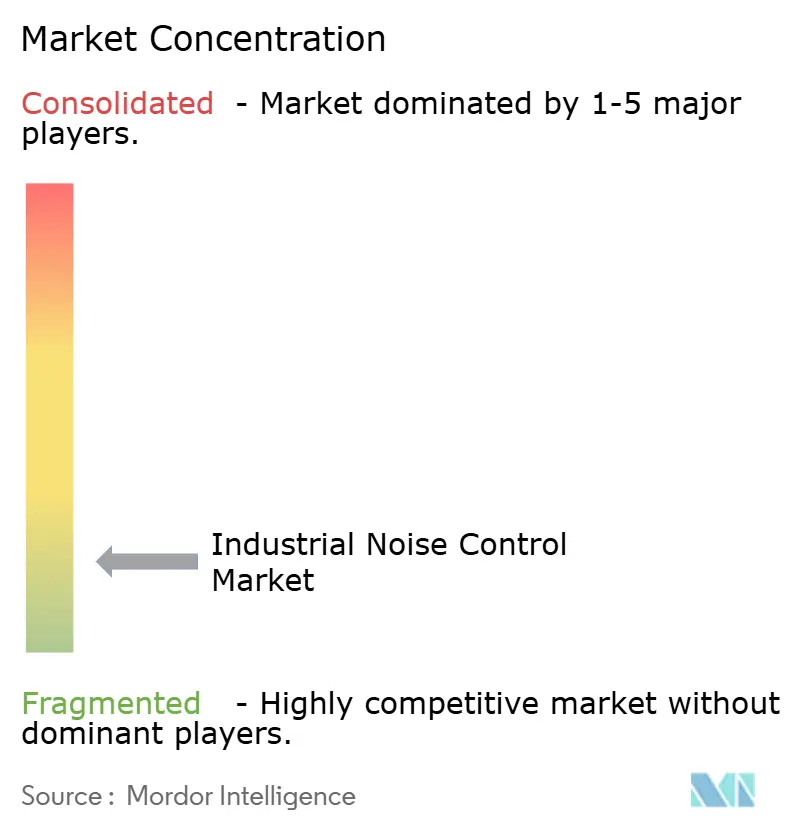
The industrial noise control market remains fragmented, with no supplier identified as holding a decisive global share. Competition includes full-service acoustic systems integrators and focused product specialists. Integrators design, supply, and commission complete installations for large industrial customers. Specialists compete through material expertise, product focus, local application knowledge, and regional distribution. The competitive setting is moving toward a two-tier structure as larger platforms acquire established businesses. Regional suppliers still retain meaningful positions where customer access and local support are important.
KPS Capital Partners completed its acquisition of Catalyst Acoustics Group in Q4 2024. The group brings together IAC Acoustics, Kinetics Noise Control, Sound Seal, Noise Barriers, and related brands. The combination expands the scale of a multi-brand acoustic platform. Gamut Capital Management announced its agreement to acquire Acousti Engineering Company in April 2026 and stated plans for further acquisitions. These transactions show that platform owners seek broader specification capability and geographic reach.
Larger suppliers are also extending their geographic and technical reach. Pyrotek acquired acoustic and thermal assets from MAAD Sp. z o.o. in Poland in February 2026, expanding its support network in Central and Eastern Europe. Pyrotek also entered a distribution and technology partnership with SIRN in Italy in June 2026, extending the reach of its Decidamp and Sorbermel products in the marine segment. The market is also seeing growing interest in recycled-content panels, bio-based composites, and smart acoustic monitoring. ISO 3740 measurement practices and ISO 9001 quality systems remain relevant filters for large specifications. The industrial noise control market therefore rewards suppliers that combine tested performance, engineering support, and access to regional project channels.
Industrial Noise Control Industry Leaders
Sound Seal Inc.
Sintesi PLC
Saint-Gobain
Pyrotek Inc.
Merford Holding B.V.
- *Disclaimer: Major Players sorted in no particular order

Recent Industry Developments
- June 2026: Tenaris announced a USD 90 million investment to modernize steelmaking and seamless pipe manufacturing operations at its Koppel and Ambridge, Pennsylvania facilities, with automation upgrades and new equipment installations scheduled for completion by end-2027. The project represents a direct acoustic and vibration control engineering demand event at specification stage.
- April 2026: Gamut Capital Management signed a definitive agreement to acquire Acousti Engineering Company, a specialty interiors contractor providing acoustic ceiling, drywall, and flooring solutions across the southeastern United States. Gamut stated plans to drive at least 3 additional acquisitions by mid-2027, targeting regional acoustic contractors with USD 25 million to USD 60 million in revenue.
- August 2025: Pyrotek’s Decidamp SP500 vibration damping product was deployed to reduce structural vibration in Belmond luxury rail carriages, demonstrating the cross-sector transferability of industrial vibration control materials into high-value transport refurbishment applications.
- May 2025: Pyrotek delivered an acoustic barrier solution for the USD 21 billion Plaquemines LNG project, illustrating direct alignment between major energy and utilities capital investment programs and engineered industrial noise control solutions procurement.


Global Industrial Noise Control Market Report Scope
Industrial noise control refers to the technologies, equipment, materials, and engineering practices used to measure, reduce, contain, or manage excessive noise generated by industrial machinery, equipment, and processes. It aims to protect workers from harmful noise exposure, ensure compliance with occupational and environmental noise regulations, and minimize noise disturbances to surrounding communities. Industrial noise control solutions are commonly applied in manufacturing plants, power generation facilities, oil and gas installations, chemical plants, construction sites, mining operations, and other industrial facilities.
The Industrial Noise Control Market is segmented by product type, material, end-use industry, and geography. By product type, the market is segmented into rigid, flexible, and vibration isolation. By material, the market is segmented into polymers and composites, metal, fabric, glass, and others. By end-use industry, the market is segmented into automotive, metal processing, mining, power generation, oil and gas, and others. The report also covers the market size and forecasts for the global industrial noise control market across 26 countries in key regions. For each segment, the market sizing and forecasts have been provided on the basis of value (USD).
| Rigid |
| Flexible |
| Vibration Isolation |
| Polymers and Composites |
| Metal |
| Fabric |
| Glass |
| Others |
| Automotive |
| Metal Processing and Mining |
| Power Generation and Utilities |
| Oil and Gas |
| Food and Beverage |
| Textile |
| Pharmaceutical and Healthcare Manufacturing |
| Chemical and Petrochemical |
| Paper and Pulp |
| Other Industries |
| North America | United States |
| Canada | |
| Mexico | |
| Europe | Germany |
| France | |
| Italy | |
| Spain | |
| United Kingdom | |
| Poland | |
| Russia | |
| Rest of Europe | |
| Asia-Pacific | China |
| India | |
| Japan | |
| South Korea | |
| Australia | |
| Indonesia | |
| Vietnam | |
| Thailand | |
| Rest of Asia-Pacific | |
| South America | Brazil |
| Argentina | |
| Chile | |
| Rest of South America | |
| Middle East and Africa | Saudi Arabia |
| United Arab Emirates | |
| Egypt | |
| South Africa | |
| Morocco | |
| Rest of Middle East and Africa |
| By Product Type | Rigid | |
| Flexible | ||
| Vibration Isolation | ||
| By Material | Polymers and Composites | |
| Metal | ||
| Fabric | ||
| Glass | ||
| Others | ||
| By End-Use Industry | Automotive | |
| Metal Processing and Mining | ||
| Power Generation and Utilities | ||
| Oil and Gas | ||
| Food and Beverage | ||
| Textile | ||
| Pharmaceutical and Healthcare Manufacturing | ||
| Chemical and Petrochemical | ||
| Paper and Pulp | ||
| Other Industries | ||
| By Geography | North America | United States |
| Canada | ||
| Mexico | ||
| Europe | Germany | |
| France | ||
| Italy | ||
| Spain | ||
| United Kingdom | ||
| Poland | ||
| Russia | ||
| Rest of Europe | ||
| Asia-Pacific | China | |
| India | ||
| Japan | ||
| South Korea | ||
| Australia | ||
| Indonesia | ||
| Vietnam | ||
| Thailand | ||
| Rest of Asia-Pacific | ||
| South America | Brazil | |
| Argentina | ||
| Chile | ||
| Rest of South America | ||
| Middle East and Africa | Saudi Arabia | |
| United Arab Emirates | ||
| Egypt | ||
| South Africa | ||
| Morocco | ||
| Rest of Middle East and Africa | ||


Key Questions Answered in the Report
What is driving demand for industrial noise control systems?
Regulatory requirements, plant modernization, new industrial construction, and electrification support demand for enclosures, barriers, and vibration isolation.
How large is the industrial noise control market in 2026?
The industrial noise control market size is estimated at USD 6.44 billion in 2026 and is forecast to reach USD 7.89 billion by 2031.
Which product type is growing fastest?
Vibration isolation is forecast to grow at a 4.6% CAGR through 2031 as electric motors and drives create tonal vibration challenges.
Which material category leads demand?
Polymers and composites held 34.3% share in 2025 and are projected to grow at a 4.3% CAGR through 2031.
Which end-use sector is expanding fastest?
Metal processing and mining is forecast to grow at a 5.1% CAGR through 2031, supported by equipment investment and high noise exposure.
Which region has the strongest growth outlook?
Asia-Pacific held 38.5% share in 2025 and is projected to grow at a 5.3% CAGR through 2031.
Page last updated on:





