
Industrial Insulator Market Size and Share
Market Overview
| Study Period | 2021 - 2031 |
|---|---|
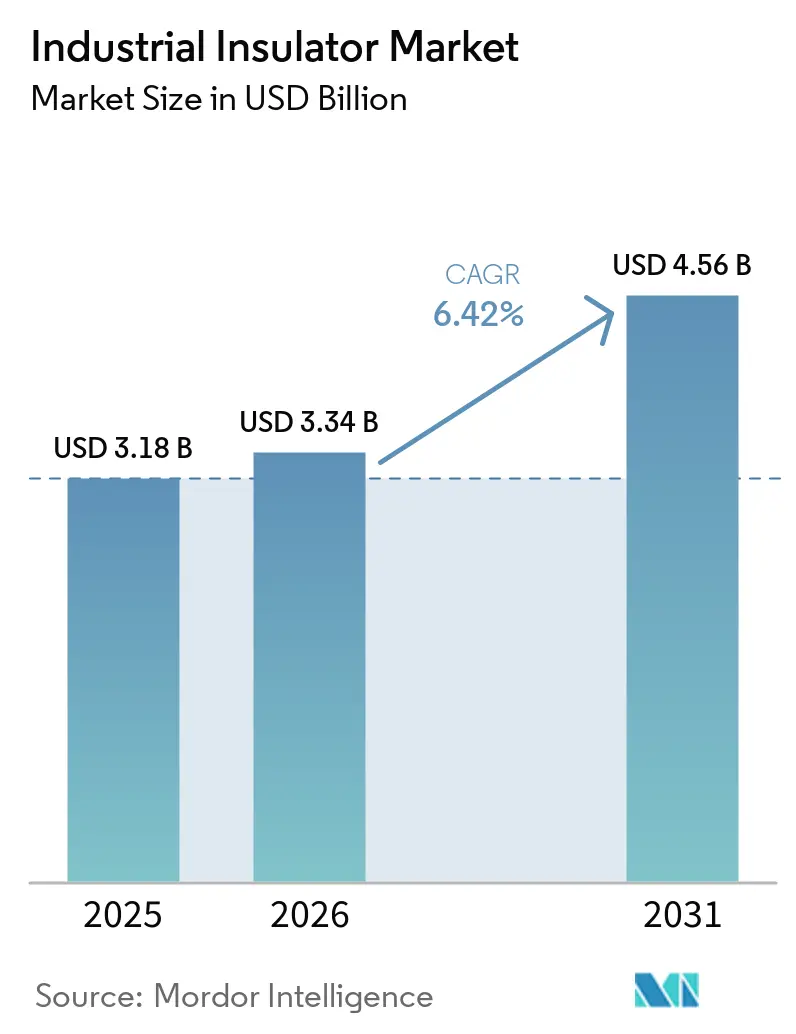
| Market Size (2026) | USD 3.34 Billion |
| Market Size (2031) | USD 4.56 Billion |
| Growth Rate (2026 - 2031) | 6.42 % |
| Fastest Growing Market | Asia-Pacific |
| Largest Market | Asia-Pacific |
| Market Concentration | Low |
Major Players *Disclaimer: Major Players sorted in no particular order Image © Mordor Intelligence. Reuse requires attribution under CC BY 4.0. | |
Industrial Insulator Market Analysis by Mordor Intelligence
The industrial insulator market size was valued at USD 3.18 billion in 2025 and is estimated to grow from USD 3.34 billion in 2026 to USD 4.56 billion by 2031, at a CAGR of 6.42% during the forecast period (2026-2031). Grid modernization is driving demand as utilities replace equipment when upgrading line voltage, expanding substations, or connecting new generation sources. Renewable power development is also increasing the need for equipment designed for long-distance direct-current transmission. Procurement is becoming more selective, with utilities placing greater weight on certification, service life, and operating performance in difficult environments. Suppliers with qualified composite designs and established utility relationships are better positioned to compete for long-duration projects. Digital inspection tools are shifting focus toward condition monitoring and lifecycle support rather than unit supply alone.
Key Report Takeaways
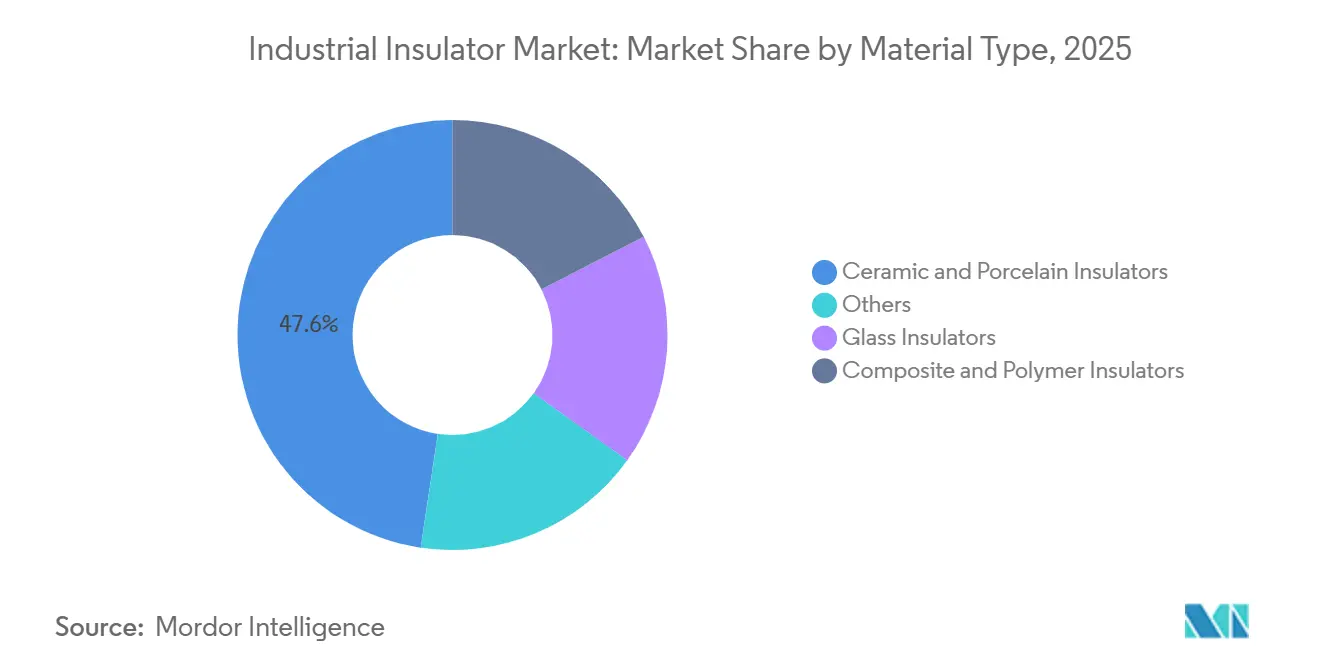
- By material type, ceramic and porcelain held 47.64% of the industrial insulator market in 2025, while composite and polymer insulators are forecast to grow at a CAGR of 6.85% through 2031.
- By voltage rating, medium voltage accounted for 40.43% of the industrial insulator market in 2025, while high voltage is forecast to grow at a 7.07% CAGR through 2031.
- By application, cables and transmission lines held 38.17% of the industrial insulator market in 2025 and are forecast to grow at a 7.24% CAGR through 2031.
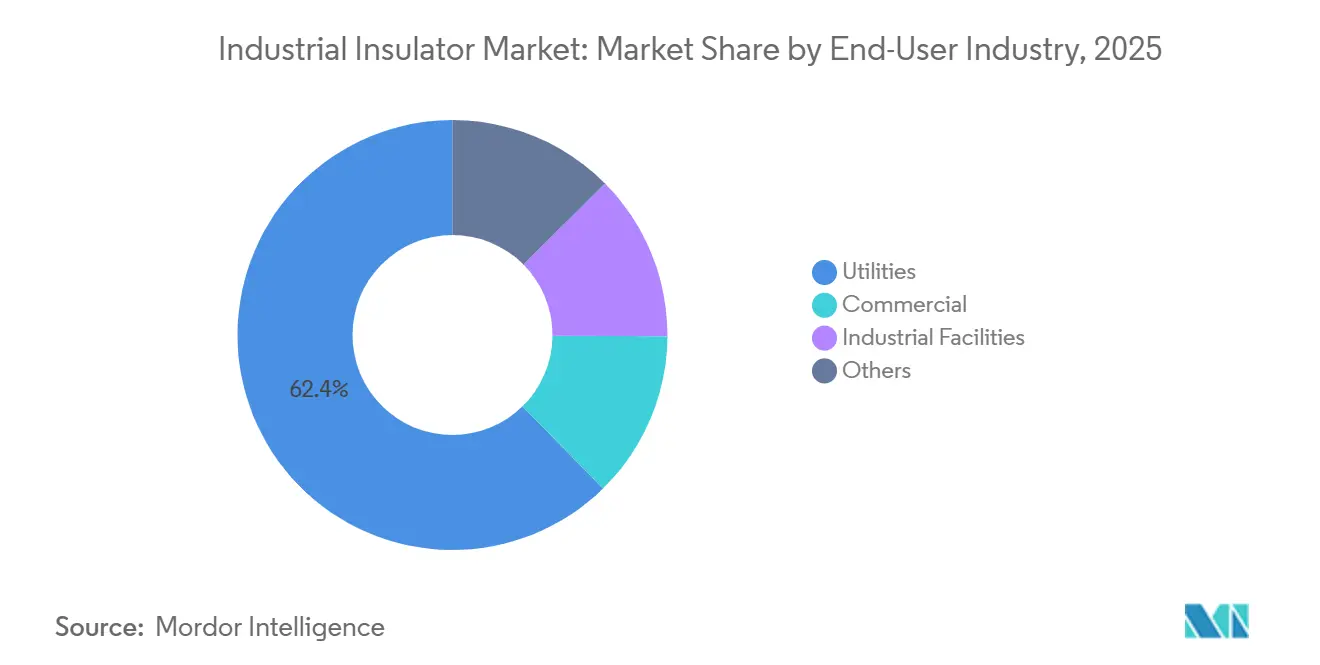
- By end-user industry, utilities accounted for 62.35% of demand in 2025 and are forecast to grow at a 7.43% CAGR through 2031.
- By geography, Asia-Pacific held 54.86% of the industrial insulator market in 2025 and is forecast to grow at a 6.96% CAGR through 2031.
Note: Market size and forecast figures in this report are generated using Mordor Intelligence’s proprietary estimation framework, updated with the latest available data and insights as of January 2026.
Global Industrial Insulator Market Trends and Insights
Drivers Impact Analysis*
| Drivers | (~) % Impact on CAGR Forecast | Geographic Relevance | Impact Timeline |
|---|---|---|---|
| Grid Modernization and Transmission and Distribution (T&D) Expansion | +2.1% | Global, with core demand in Asia-Pacific, North America, and Europe | Short term (≤ 2 years) |
| Renewable Energy and High-Voltage Direct Current (HVDC) Interconnection | +1.8% | Global, led by Asia-Pacific, Europe, and North America | Medium term (2-4 years) |
| Electrification of Railways and Transport Infrastructure | +0.9% | Asia-Pacific and Europe, with emerging growth in South Asia | Medium term (2-4 years) |
| Utility Replacement of Aging and Wildfire-Exposed Assets | +0.8% | North America, South Asia, and Australia | Short term (≤ 2 years) |
| Digital Condition Monitoring and Predictive Maintenance | +0.5% | Organization for Economic Co-operation and Development (OECD) markets, with early adoption in the Asia-Pacific | Medium term (2-4 years) |
| Source: Mordor Intelligence | |||
Grid Modernization and T&D Expansion
Grid modernization is driving demand for industrial insulators beyond simple additions of line kilometers, as higher-voltage systems require different physical and electrical specifications. Each voltage step-up requires a distinct insulator geometry, creepage distance, and pollution-resistance class that utilities cannot meet by repurposing existing stock. The resulting procurement covers replacement units for upgraded lines, expanded substations, and new interconnections that support broader transmission programs. In February 2026, Siemens Energy announced a USD 1 billion expansion of its US manufacturing footprint, including a USD 300 million high-voltage switchgear facility in Pearl, Mississippi[1]Siemens Energy, “Siemens Energy Is Investing USD 1 Billion and Creating Highly Skilled Jobs in the United States,” Siemens Energy, siemens-energy.com. The facility is expected to employ up to 300 people, reflecting the manufacturing response to utility equipment requirements. Insulators are typically replaced in full rather than repaired in the field, so network modernization creates a recurring need for qualified equipment.
Renewable Energy and HVDC Interconnection
High-Voltage Direct Current (HVDC) interconnections are changing technical requirements in the industrial insulator market, as direct-current electrical stress demands designs that go beyond those used on legacy AC overhead lines. Composite insulators with hydrophobicity-transfer properties can more effectively suppress contamination-related leakage under unidirectional DC electrical stress than ceramic and glass alternatives. Their performance is relevant in polluted and humid conditions, where surface contamination can affect system reliability and maintenance planning. IEC 61109:2025 applies certification requirements to AC and DC systems and includes DC-specific electric field control provisions. The updated standard changes which suppliers and designs are eligible for HVDC tenders from 2026 onward. Renewable projects support demand when they require new long-distance transmission links rather than relying solely on local grid additions.
Electrification of Railways and Transport Infrastructure
Railway electrification creates recurring demand in the industrial insulator market, driven by railway investment and maintenance cycles rather than utility capital programs alone. India's National Railway Vision targets the complete electrification of broad-gauge mainlines by 2031, supporting requirements for overhead contact systems and neutral-section equipment. Railway networks require specialized traction insulators that meet the operational requirements of electrified routes and high-speed systems. In Europe, the Connecting Europe Facility supports transport infrastructure modernization through 2034. Composite specifications are relevant in high-speed rail because lighter components reduce structural loading and tolerate vibration in overhead contact line systems. This source of demand is distinct from mainstream grid spending because procurement follows transport construction schedules and the upkeep of existing electrified lines.
Utility Replacement of Aging and Wildfire-Exposed Assets
Asset-hardening programs are supporting demand in the industrial insulator market in regions where utilities need to reduce wildfire exposure and address aging overhead equipment. PG&E's 2026-2028 Wildfire Mitigation Plan calls for hardening more than 700 miles of overhead power lines and converting 1,077 additional miles of distribution lines underground. The plan specifies polymer insulators for new overhead installations, making material selection part of its broader resilience approach. Montana-Dakota Utilities Co. also requires polymer materials for new installations and replaces porcelain units during scheduled maintenance. These policies reduce reliance on discretionary spot purchasing and provide qualified composite suppliers with a steadier source of demand. They also connect replacement decisions to safety and resilience planning rather than only to routine asset age.
Restraints Impact Analysis*
| Restraints | (~) % Impact on CAGR Forecast | Geographic Relevance | Impact Timeline |
|---|---|---|---|
| Volatility in Alumina, Epoxy, Silicone Rubber, and Glass Inputs | -1.3% | Global, with acute pressure in the Asia-Pacific and Europe | Short term (≤ 2 years) |
| Lengthy Utility Prequalification and Certification Cycles | -0.8% | North America, Europe, Japan, and Australia, with limited impact in emerging markets | Long term (≥ 4 years) |
| Counterfeit and Low-Grade Insulator Failure Risk | -0.5% | Southeast Asia, the Middle East and Africa, and South Asia, with spillover risk to Latin America | Medium term (2-4 years) |
| Source: Mordor Intelligence | |||
Volatility in Alumina, Epoxy, Silicone Rubber, and Glass Inputs
Input cost volatility can constrain the industrial insulator market by reducing manufacturer margins and affecting the timing of utility purchases. Alumina, epoxy, silicone rubber, and glass are material inputs across different product designs, exposing producers to changes in several supply chains. Price swings are difficult to absorb when supply contracts have fixed terms or when utilities defer orders until their procurement budgets become more predictable. Smaller regional producers face greater pressure due to fewer options for long-term supply agreements or investments connected to material processing. Larger manufacturers can manage some of their exposure through supply agreements and related investments, thereby strengthening their relative position. Material volatility can make the timing of demand less consistent, even when the underlying requirement for grid equipment remains in place.
Lengthy Utility Prequalification and Certification Cycles
Utility prequalification and certification cycles slow the pace at which new suppliers can enter the industrial insulator market. Composite products intended for 400 kV and higher-voltage lines face especially close scrutiny before utilities add a supplier to an approved vendor list. IEC 61109:2025 introduced provisions for core-housing interface evaluation and DC electric field control. Approved vendors may need to demonstrate that their composite designs meet revised requirements before bidding on High-Voltage Direct Current (HVDC) projects. National standards and utility qualification systems add further steps that affect procurement timing and access to tenders. These requirements can delay supplier entry and limit competitive choice in regions with strict approval procedures.
*Our forecasts treat driver/restraint impacts as directional, not additive. The impact forecasts reflect baseline growth, mix effects, and variable interactions.
Segment Analysis
By Material Type: Ceramic Incumbency Meets Composite Disruption
Ceramic and porcelain accounted for 47.64% of the industrial insulator market in 2025. This position reflects mature grid assets, where utilities often favor replacement with comparable equipment to align with existing line designs and maintenance practices. Porcelain units commonly remain in service for 30–40 years under rated conditions, and their dielectric strength remains important in locations with heavy industrial or agricultural contamination. South and Southeast Asian utilities continue to factor in seasonal pollution and monsoon humidity when setting creepage and tracking requirements. Glass insulators have a smaller installed base in Europe and Latin America, where their rain-assisted cleaning behavior and transparent sheds support field assessment on long overhead networks.
Composite and polymer insulators are forecast to grow at a 6.85% CAGR through 2031, the highest rate among material types. They can weigh 80-90% less than comparable ceramic units, reducing tower structural loading and simplifying live-line maintenance work. Their use is increasingly relevant in High Voltage Direct Current (HVDC) and Ultra High Voltage (UHV) transmission applications, where system requirements differ from legacy AC equipment. International Electrotechnical Commission (IEC) 61109:2025 strengthened the qualification framework by adding requirements, including core-housing adhesion evaluation and DC provisions. The other category covers specialty insulators used in high-temperature industrial processes and offshore applications, where demand follows the cycles of Liquefied Natural Gas (LNG) and chemical plant refurbishment.



By Voltage Rating: High Voltage Acceleration Reshapes Demand Mix
Medium voltage accounted for 40.43% of the industrial insulator market in 2025. Distribution-grid investment, smart-grid rollouts, and urban electrification support demand for this rating class across Africa, South Asia, and Southeast Asia. Medium-voltage equipment retains a broad installed base because these systems support new connections and upgrades to established distribution networks. Low-voltage insulators remain stable across many applications, but conventional overhead installations face increasing pressure from substitutes in densely built cities. Alternative cable management architectures are used more frequently in urban areas in Europe and North America, thereby limiting the growth potential for low-voltage overhead installations.
High-voltage insulators are forecast to grow at a 7.07% CAGR through 2031, supported by HVDC transmission projects. The industrial insulator market must meet project-specific requirements for creepage distance, surface resistance, and performance under DC electrical stress. IEC 61109:2025 provides a certification framework for composite suspension and tension insulators for AC and DC systems, and its updated provisions govern tender eligibility. Siemens Energy supplies composite insulators rated to 800 kV and mechanical loads up to 630 kN, supporting transmission plans above conventional high-voltage thresholds. Certification requirements can narrow the pool of eligible suppliers when utilities procure high-voltage equipment for HVDC corridors.
By Application: Cables and Transmission Lines Define the Growth Anchor
Cables and transmission lines held 38.17% of the industrial insulator market in 2025 and are forecast to grow at a 7.24% CAGR through 2031, making this the largest and fastest-growing application segment. National transmission programs can provide multi-year contracts to suppliers that have secured required approvals. These networks require equipment for long backbone corridors and cross-border interconnections, both of which involve large quantities of specialized components. Distribution lines represent another major application as electrification extends to rural and peri-urban areas in sub-Saharan Africa and South Asia.
Distribution applications generally have lower unit values than transmission projects, although installed quantity requirements remain extensive. Substations and switchgear require differentiated insulation systems, as the EU F-gas Regulation encourages sulfur hexafluoride (SF₆)-free equipment and related redesigns of insulation arrangements. GE Vernova's F35g gas-insulated switchgear uses g³ insulating medium and includes digital condition-monitoring capabilities. Transformers and bushings require compatible designs as utilities adopt alternative insulating media, including GE Vernova's POBR-g bushing for oil-to-g³ gas applications. The other category includes railway catenary, marine, and specialist process equipment, where project-specific specifications can lengthen qualification cycles.
By End-User Industry: Utilities Set the Floor, Industrials Add Breadth
Utilities accounted for 62.35% of end-user demand in 2025 and are forecast to expand at a 7.43% CAGR through 2031. Their demand reflects regulated capital spending on grid expansion, asset replacement, and renewable integration. Utility framework agreements increasingly use approved vendor lists, which favor manufacturers that have completed multistage qualification processes. IEC 61109:2025 adds relevant requirements for suppliers seeking HVDC opportunities and is important to their continued eligibility. Commercial users contribute via private grid connections for data centers, computing campuses, and large real estate developments that require dependable power.
Industrial facilities generate demand through expansion and refurbishment cycles rather than the regulated programs that guide utility procurement. Chemical sites, LNG terminals, mining operations, and heavy manufacturing plants use equipment designed for demanding electrical and environmental conditions. Their purchasing can be more variable because it is linked to individual plant investment and maintenance decisions. ISO and IEC safety requirements can raise specifications for insulators used in high-voltage process environments, reducing the role of non-certified products that compete mainly on price. The other end-user group includes upstream oil and gas, mining, and specialist transport applications, where custom requirements and longer lead times can result in higher unit values.
Geography Analysis
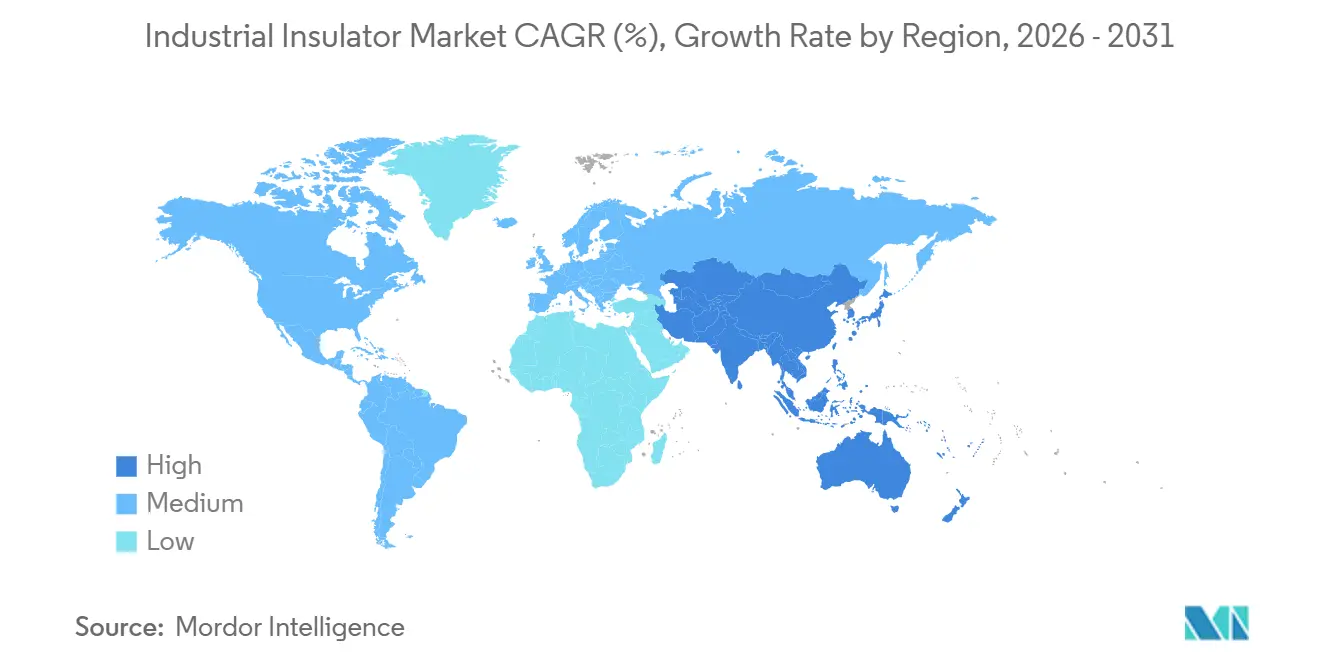
Asia-Pacific accounted for 54.86% of the industrial insulator market in 2025 and is forecast to grow at a 6.96% CAGR through 2031. China's Ultra-High Voltage Direct Current (UHVDC) backbone investment, India's transmission build-out, and ASEAN electricity access programs support demand across the region. National grid expansion and rising electricity needs are driving the procurement of transmission and distribution equipment. In April 2025, India's Directorate General of Trade Remedies imposed anti-dumping duties ranging from 15.30% to 27.60% on composite insulators from China[2]Directorate General of Trade Remedies, “Anti-Dumping Duty Notification on Composite Insulators from China,” Ministry of Commerce and Industry, dgtr.gov.in. This measure altered access to South Asian grid tenders and prompted suppliers to review regional supply arrangements. Japan's exposure to typhoons, coastal salt spray, and seismic risk also supports the use of composite insulators in new transmission assets.
North America and Europe are established industrial insulator markets, though different investment needs drive demand in each. In the United States, grid hardening and transmission expansion are increasing demand for equipment that supports utility reliability programs. Siemens Energy's 2026 U.S. investment includes a new high-voltage switchgear facility in Pearl, Mississippi, as part of a broader manufacturing expansion. PG&E is hardening overhead power lines and expanding underground conversion work, with polymer insulators specified for new overhead installations. In Europe, the F-gas Regulation is driving the shift toward SF₆-free switchgear and the redesign of related insulation systems.
South America, the Middle East, and Africa account for smaller shares of the industrial insulator market, but infrastructure conditions in each region support demand for equipment. Brazil and Argentina are pursuing grid development and renewable integration, while Brazil's long-distance hydroelectric corridors require equipment suited to tropical humidity and coastal pollution. Saudi Arabia's Vision 2030 program and the NEOM project require high-voltage substations and smart-grid assets that can withstand desert ultraviolet exposure and thermal cycling. Sub-Saharan Africa presents long-term potential as electricity access improves and infrastructure procurement pipelines develop. Cost sensitivity and qualification requirements will continue to influence how projects progress from planned investment to installed grid assets.

Competitive Landscape
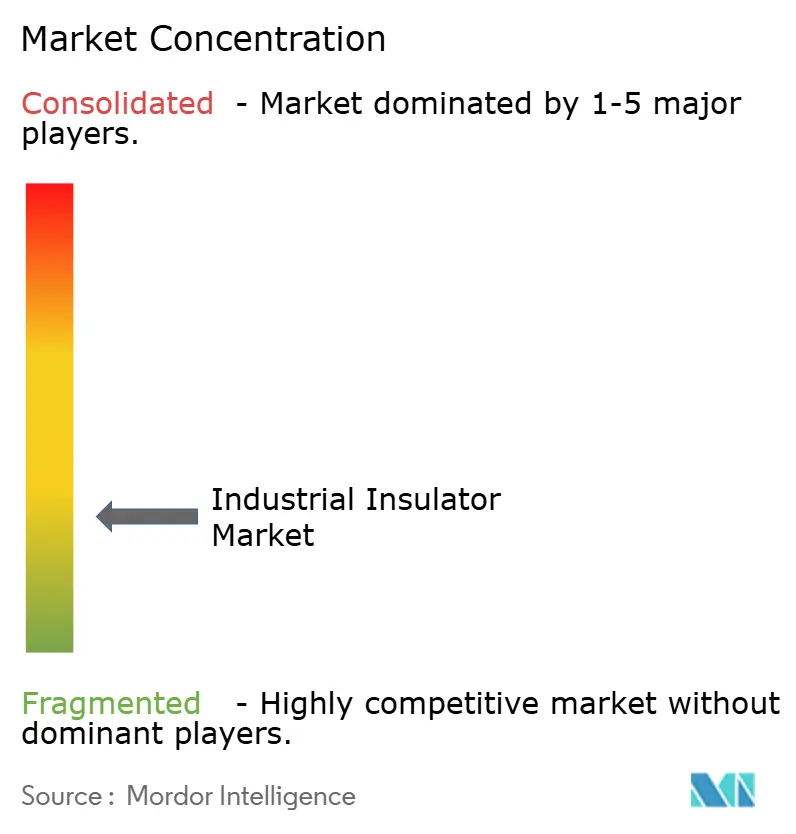
The industrial insulator market is fragmented. IEC qualification requirements, specialized aging-test infrastructure, and long utility approval procedures restrict participation in demanding projects. NGK stated in its FY2026 investor materials that investment in domestic and overseas power transmission networks remained strong. Data center and semiconductor construction can increase demand for new lines and substations, thereby increasing equipment procurement needs.
GE Vernova launched the F35g 170 kV SF₆-free gas-insulated switchgear at CIGRE Paris 2026. The product uses g³ insulating medium and includes digital condition-monitoring capabilities. The company also introduced the GL316c 420 kV, 63 kA CO₂-O₂ live-tank circuit breaker at the event. These products position composite insulation within broader grid technology offerings, supporting compliance as equipment specs evolve.
Siemens Energy supplies composite insulators rated to 800 kV and mechanical loads up to 630 kN for transmission projects, including the SuedLink HVDC corridor. Digital monitoring is also becoming more relevant as utilities require evidence of equipment condition before prioritizing inspection and replacement work. Scientific Reports published research in 2026 on lightweight defect detection for transmission lines under harsh weather conditions.
Industrial Insulator Industry Leaders
ABB
Siemens Energy
NGK Corporation
GE Vernova
Hubbell
- *Disclaimer: Major Players sorted in no particular order

Recent Industry Developments
- August 2026: GE Vernova introduced the GL316c 420 kV, 63 kA CO₂-O₂ Live Tank Circuit Breaker at CIGRE Paris 2026. The product incorporates composite industrial insulators to improve dielectric withstand under pollution conditions and was developed under the EU LIFE Program, co-funded by the LIFE SF₆-free HV Breaker project.
- June 2026: Siemens Energy was awarded the 2 GW North Sea Connector 2 offshore wind grid project from 50Hertz. The project scope includes SF₆-free gas-insulated switchgear with industrial insulators, to be manufactured at Siemens Energy's Berlin facility, with approximately 95% of the project scope to be delivered from Germany.


Global Industrial Insulator Market Report Scope
An industrial insulator is a material that does not readily conduct electrical current or heat. In these materials, electrons are tightly bound to their atoms, which prevents them from moving freely. Since electricity and heat rely on the free movement of electrons, insulators effectively block or resist electron transfer.
The industrial insulator market is segmented by material type, voltage rating, application, end-user industry, and geography. By material type, the market is segmented into ceramic and porcelain insulators, glass insulators, composite and polymer insulators, and others. By voltage rating, the market is segmented into low voltage, medium voltage, and high voltage. By application, the market is segmented into cables and transmission lines, distribution lines, substations and switchgear, transformers and bushings, and others. By end-user industry type, the market is segmented into utilities, commercial, industrial facilities, and others. The report also covers market size and forecasts for industrial insulators across 15 countries in major regions. The market sizes and forecasts are provided in terms of value (USD).
| Ceramic and Porcelain Insulators |
| Glass Insulators |
| Composite and Polymer Insulators |
| Others |
| Low Voltage |
| Medium Voltage |
| High Voltage |
| Cables and Transmission Lines |
| Distribution Lines |
| Substations and Switchgear |
| Transformers and Bushings |
| Others |
| Utilities |
| Commercial |
| Industrial Facilities |
| Others |
| Asia-Pacific | China |
| India | |
| Japan | |
| South Korea | |
| ASEAN Countries | |
| Rest of Asia-Pacific | |
| North America | United States |
| Canada | |
| Mexico | |
| Europe | Germany |
| United Kingdom | |
| France | |
| Italy | |
| NORDIC Countries | |
| Rest of Europe | |
| South America | Brazil |
| Argentina | |
| Rest of South America | |
| Middle East and Africa | Saudi Arabia |
| South Africa | |
| Rest of Middle East and Africa |
| By Material Type | Ceramic and Porcelain Insulators | |
| Glass Insulators | ||
| Composite and Polymer Insulators | ||
| Others | ||
| By Voltage Rating | Low Voltage | |
| Medium Voltage | ||
| High Voltage | ||
| By Application | Cables and Transmission Lines | |
| Distribution Lines | ||
| Substations and Switchgear | ||
| Transformers and Bushings | ||
| Others | ||
| By End-User Industry | Utilities | |
| Commercial | ||
| Industrial Facilities | ||
| Others | ||
| By Geography | Asia-Pacific | China |
| India | ||
| Japan | ||
| South Korea | ||
| ASEAN Countries | ||
| Rest of Asia-Pacific | ||
| North America | United States | |
| Canada | ||
| Mexico | ||
| Europe | Germany | |
| United Kingdom | ||
| France | ||
| Italy | ||
| NORDIC Countries | ||
| Rest of Europe | ||
| South America | Brazil | |
| Argentina | ||
| Rest of South America | ||
| Middle East and Africa | Saudi Arabia | |
| South Africa | ||
| Rest of Middle East and Africa | ||


Key Questions Answered in the Report
What is current market size of Industrial Insulator Market?
The industrial insulator market size was valued at USD 3.18 billion in 2025 and is estimated to grow from USD 3.34 billion in 2026 to USD 4.56 billion by 2031, at a CAGR of 6.42% during the forecast period (2026-2031).
Which material type leads the industrial insulator demand?
Ceramic and porcelain led demand with a 47.64% share in 2025, supported by installed grid assets and replacement needs.
Which voltage category is growing fastest through 2031?
High voltage insulators are forecast to grow at a 7.07% CAGR, supported by HVDC transmission projects.
Why are utilities important buyers of industrial insulators?
Utilities accounted for 62.35% of end-user demand in 2025 because grid expansion, replacement, and renewable integration require the procurement of insulators.
Page last updated on:





