
Industrial Imaging API Platforms Market Size and Share
Market Overview
| Study Period | 2020 - 2031 |
|---|---|
| Market Size (2026) | USD 537.03 Million |
| Market Size (2031) | USD 970.48 Million |
| Growth Rate (2026 - 2031) | 12.56 % |
| Fastest Growing Market | Asia-Pacific |
| Largest Market | Asia-Pacific |
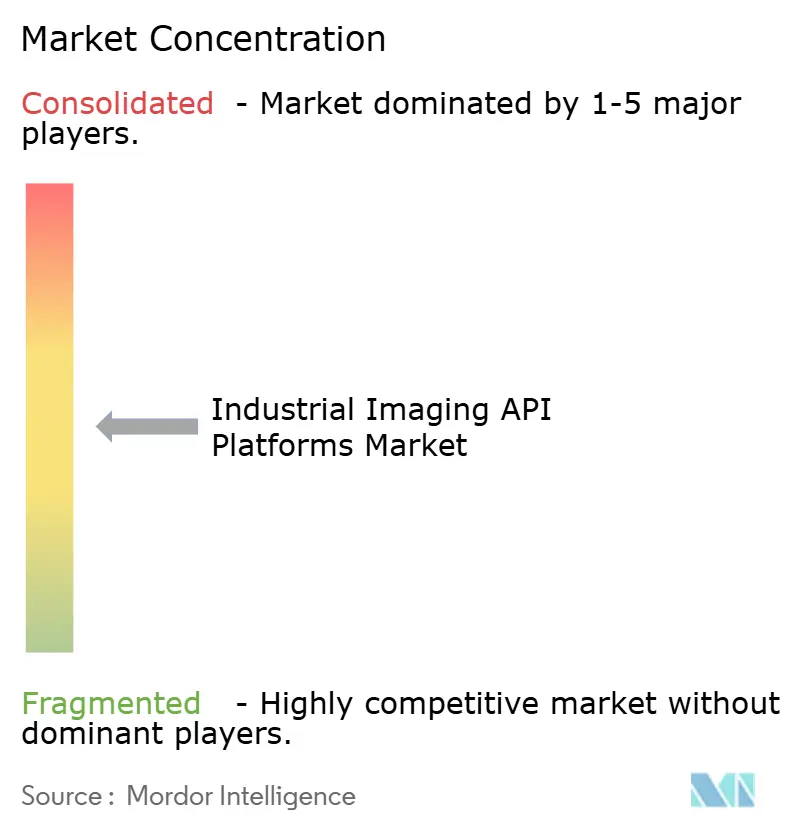
| Market Concentration | Medium |
Major Players *Disclaimer: Major Players sorted in no particular order Image © Mordor Intelligence. Reuse requires attribution under CC BY 4.0. | |
Industrial Imaging API Platforms Market Analysis by Mordor Intelligence
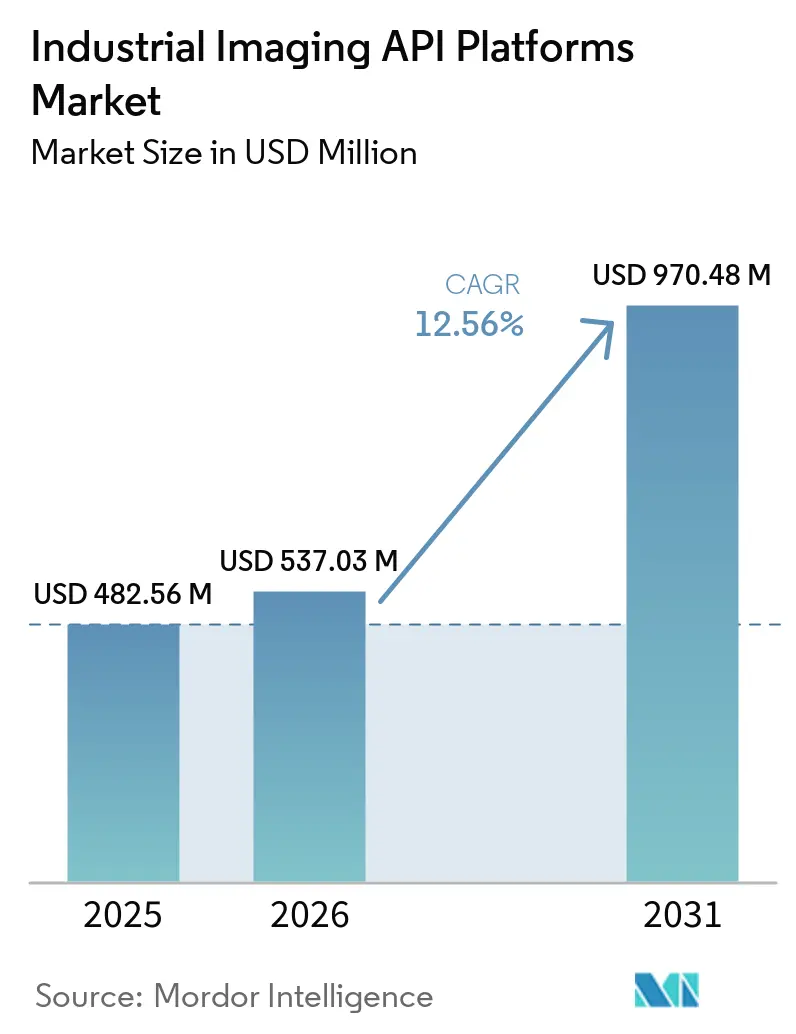
The industrial imaging API platforms market size is projected to expand from USD 482.18 million in 2025 and USD 537.03 million in 2026 to USD 970.48 million by 2031, registering a CAGR of 12.56% between 2026 to 2031. Factory automation investment is increasing demand for camera control, image acquisition, and computer vision software across production lines. The industrial imaging API platforms market is moving beyond pixel throughput as customers place greater value on AI model management, deployment across sites, and inspection accuracy. The move from sample-based checks to 100% inline inspection is raising the number of software instances required on each line. This favors platform subscriptions and centralized management models over isolated per-inspection deployments. Legacy integration and engineering shortages remain material limits on deployment speed, especially at established manufacturing sites.
Key Report Takeaways
- By API function, Computer Vision and AI Analytics APIs held 27.89% of 2025 revenue, while Image Management and Data APIs are projected to expand at a 13.78% CAGR through 2031.
- By deployment model, Edge and On-Premises held 62.34% of the industrial imaging API platforms market share in 2025, while Cloud-Based deployment is projected to expand at a 13.21% CAGR through 2031
- By imaging technology, 2D Area-Scan Imaging held 43.21% of 2025 revenue, while Multispectral and Hyperspectral Imaging is projected to expand at a 13.97% CAGR through 2031.
- By application, Quality Inspection and Defect Detection accounted for 31.44% of 2025 revenue, while Predictive Maintenance and Process Monitoring is projected to expand at a 13.87% CAGR through 2031.
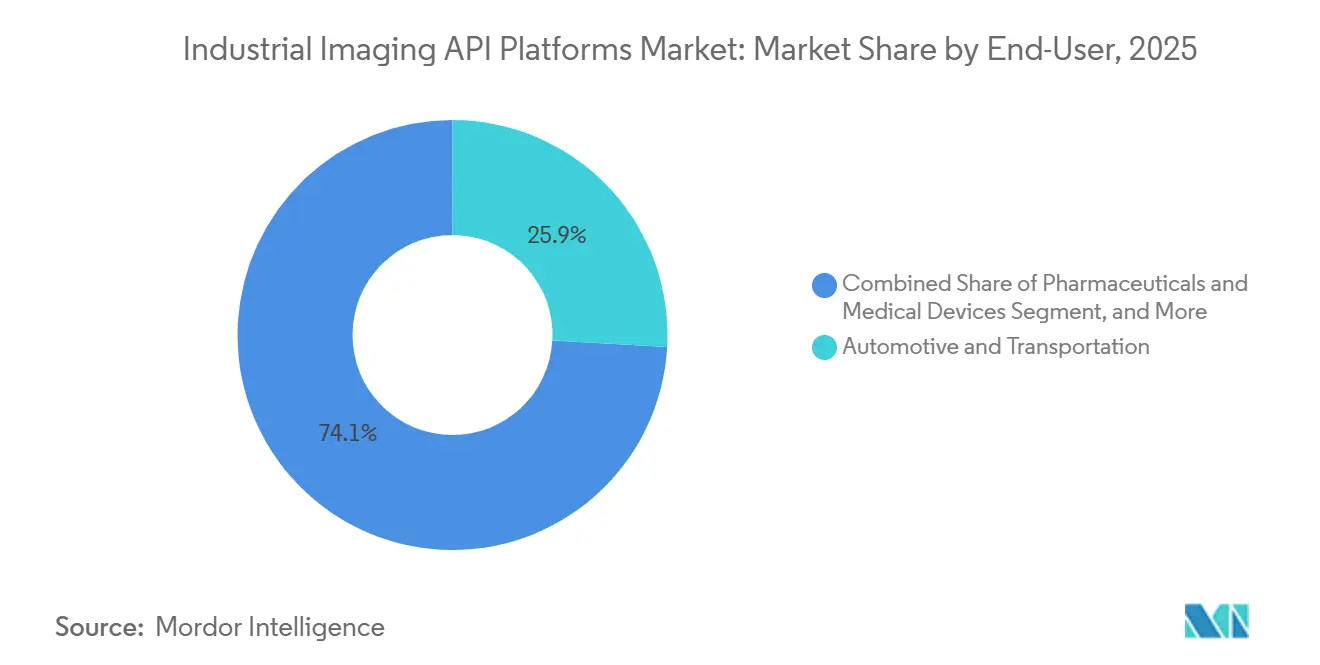
- By end-user, Automotive and Transportation held 25.89% of 2025 revenue, while Electronics and Semiconductors is projected to expand at a 13.78% CAGR through 2031.
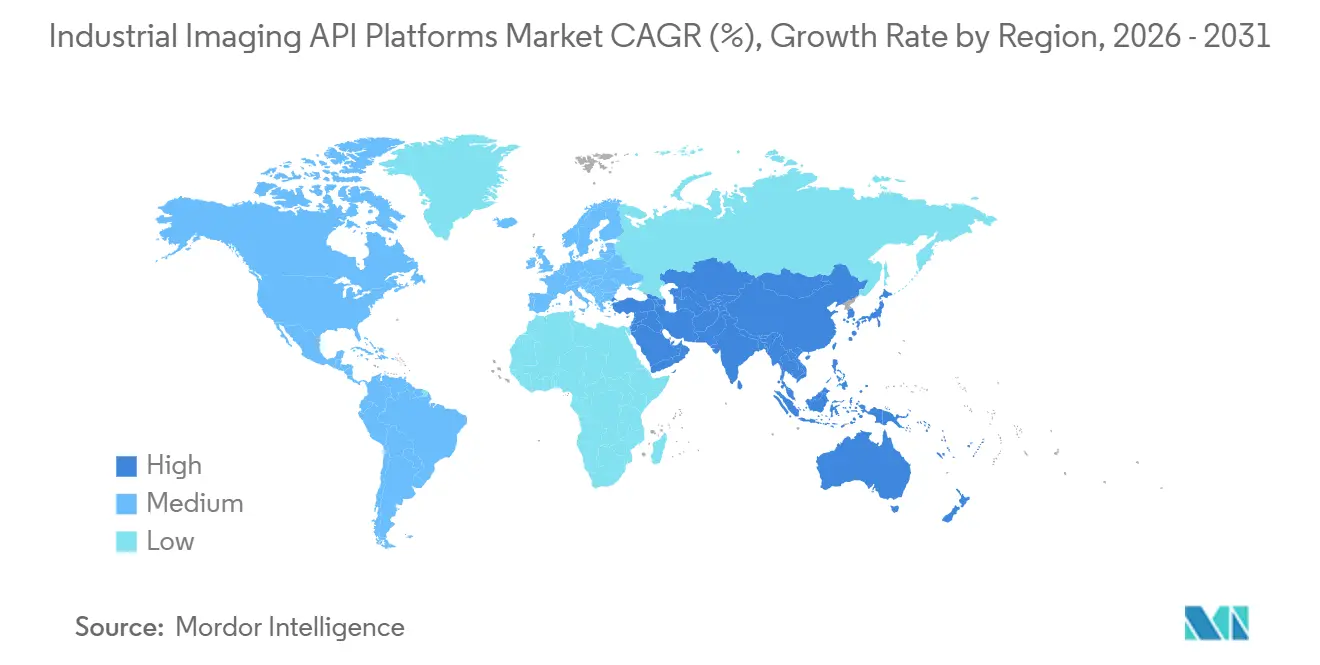
- By geography, Asia-Pacific held 35.89% of 2025 global revenue and is projected to expand at a 13.55% CAGR through 2031.
Note: Market size and forecast figures in this report are generated using Mordor Intelligence’s proprietary estimation framework, updated with the latest available data and insights as of January 2026.
Global Industrial Imaging API Platforms Market Trends and Insights
Drivers Impact Analysis*
| Driver | (~) % Impact on CAGR Forecast | Geographic Relevance | Impact Timeline |
|---|---|---|---|
| Factory Automation and Quality Inspection Adoption | +3.5% | Global, with the highest density in Asia-Pacific and North America | Long term (≥ 4 years) |
| AI-Enabled Defect Detection and Adaptive Inspection | +2.8% | Global, with strength in electronics and semiconductor manufacturing hubs | Medium term (2-4 years) |
| Edge Processing for Low-Latency Industrial Decisions | +2.2% | North America and Europe, plus Asia-Pacific electronics fabs | Medium term (2-4 years) |
| Robotics and Vision-Guided Automation Integration | +1.8% | Asia-Pacific core, with expansion into Europe and the Americas | Long term (≥ 4 years) |
| GenICam and GenTL Interoperability Demand | +1.0% | Global, concentrated in North America and the European Union | Medium term (2-4 years) |
| Camera-Agnostic APIs Reducing Application Rework | +0.8% | North America and Europe, including European Union OEM manufacturers | Short term (≤ 2 years) |
| Source: Mordor Intelligence | |||
Factory Automation and Quality Inspection Adoption Drive Baseline Demand
The industrial imaging API platforms market benefits directly from factory automation spending and broader use of automated quality inspection. The International Federation of Robotics reported 542,000 industrial robot installations in 2024, and the operational robot fleet reached 4.66 million units globally.[1] Robots used for inspection or pick-and-place work need camera control, image acquisition, and computer vision capabilities to perform their assigned tasks. The installed fleet creates replacement and expansion demand even when annual robot orders stabilize. The move toward 100% inline coverage increases the number of inspection points on a line and makes centralized software management more relevant. ISO 9001, IATF 16949, and pharmaceutical good manufacturing practice requirements make inspection systems more difficult to treat as optional productivity investments.
AI-Enabled Defect Detection and Adaptive Inspection Reshape Inspection Economics
The industrial imaging API platforms market is being shaped by AI functions that improve defect identification within production-line imaging workflows. A review found that machine-learning vision studies often reported defect-detection accuracy above 95%, with controlled settings reporting 98% to 100%.[2] MVTec released HALCON 26.05 in May 2026 with a deep-learning object-detection architecture that provides up to 5x faster inference. Cognex stated that its In-Sight 6900 controller supports few-sample classification using 10-20 training images, reducing the amount of training data needed for some applications. Lower training-data requirements can shorten deployment work for smaller manufacturers that lack large labeled image libraries. The IMDD-1M dataset introduced at CVPR 2026 contains 1,000,000 aligned image-text pairs across more than 60 material categories and over 400 defect types, supporting wider availability of pretrained industrial vision models.
Edge Processing APIs Enable Low-Latency Industrial Decisions
Edge processing supports machine-level decisions where cloud round trips can disrupt inspection timing. On-premises systems keep images within the plant network and can continue operating in bandwidth-constrained or air-gapped settings. Cognex launched the In-Sight 6900 Vision Controller in April 2026 with NVIDIA Jetson processing of up to 157 TOPS for embedded AI execution. Intel's Edge Insights System supports industrial video pipelines across GigE, RTSP, and USB camera interfaces and uses OpenVINO for inference acceleration.[3] Edge and On-Premises deployment held 62.34% of 2025 revenue, reflecting the importance of predictable performance at high-speed production sites. Keeping inspection workloads local can also reduce exposure created when production imagery travels beyond the facility network.
Vision-Guided Robotics Integration Extends the API Deployment Footprint
Robotics and imaging platforms are increasingly connected through standard interfaces rather than isolated proprietary stacks. The International Federation of Robotics stated that AI-enabled computer vision allows robots to recognize objects, read barcodes, sort items, and monitor production lines in real time. The federation also identified supervised learning uses in defect detection, predictive maintenance, quality inspection, and process optimization. Basler introduced a CoaXPress-over-Fiber TDI vision system in April 2026 with dual 100 Gbps bandwidth and frame-grabber-side preprocessing. Basler and Advantech also announced a GMSL-based vision and robotics computing platform for humanoid robots, autonomous mobile robots, and intelligent logistics applications. These developments extend imaging software requirements from fixed inspection stations to mobile and collaborative automation systems.
Restraints Impact Analysis*
| Restraint | (~) % Impact on CAGR Forecast | Geographic Relevance | Impact Timeline |
|---|---|---|---|
| Integration Complexity Across Legacy Automation Stacks | -2.4% | North America and Europe, especially mature brownfield manufacturing sites | Long term (≥ 4 years) |
| Shortage of Imaging and Industrial AI Engineering Skills | -1.8% | Global, with the greatest severity in North America and Europe | Medium term (2-4 years) |
| Deterministic-Latency Trade-Offs in Heterogeneous Edge Systems | -1.1% | Asia-Pacific electronics fabs and North America | Medium term (2-4 years) |
| Cybersecurity Exposure from Connected Imaging Endpoints | -0.8% | Global, with the highest regulatory exposure in the European Union | Short term (≤ 2 years) |
| Source: Mordor Intelligence | |||
Integration Complexity With Legacy Automation Stacks Constrains Deployment Velocity
Legacy PLC, SCADA, and machine-controller systems remain a major barrier to wider platform deployment. Mature plants in North America and Europe often use Modbus, PROFIBUS, and DeviceNet architectures that were not designed for high-bandwidth image metadata or asynchronous image events. Modern imaging interfaces can therefore require custom middleware, protocol translation, and lengthy validation work. These requirements can extend projects by 12-18 months and consume budgets close to the software platform cost. Multi-vendor production lines can introduce additional issues even when camera devices follow GenICam standards. Food and beverage, pharmaceutical, and older automotive facilities often schedule installation work during maintenance windows because production interruptions carry a high operating cost.
Engineering Skills Scarcity Limits Deployment Scale Across All Verticals
The industrial imaging API platforms market also faces a shortage of people with combined imaging, AI, embedded-software, and operational-technology experience. Cisco's 2026 State of Industrial AI Report identified skilled-worker shortage as the leading operational challenge for 42% of industrial organizations globally. The same report ranked it as the third barrier for 34% of organizations. CECIMO reported that mechanical and industrial engineering shortages increased 20% from 2023 to 2025 as advanced automation adoption raised demand for specialized skills. Successful deployments require knowledge of GenICam, GenTL, embedded programming, model lifecycle management, and plant-level integration. Pretrained model libraries and low-code configuration can reduce the burden, but the shortage is still likely to limit adoption among small and mid-sized manufacturers.
*Our forecasts treat driver/restraint impacts as directional, not additive. The impact forecasts reflect baseline growth, mix effects, and variable interactions.
Segment Analysis
By API Function: AI Analytics Leads as Data Management Spending Accelerates
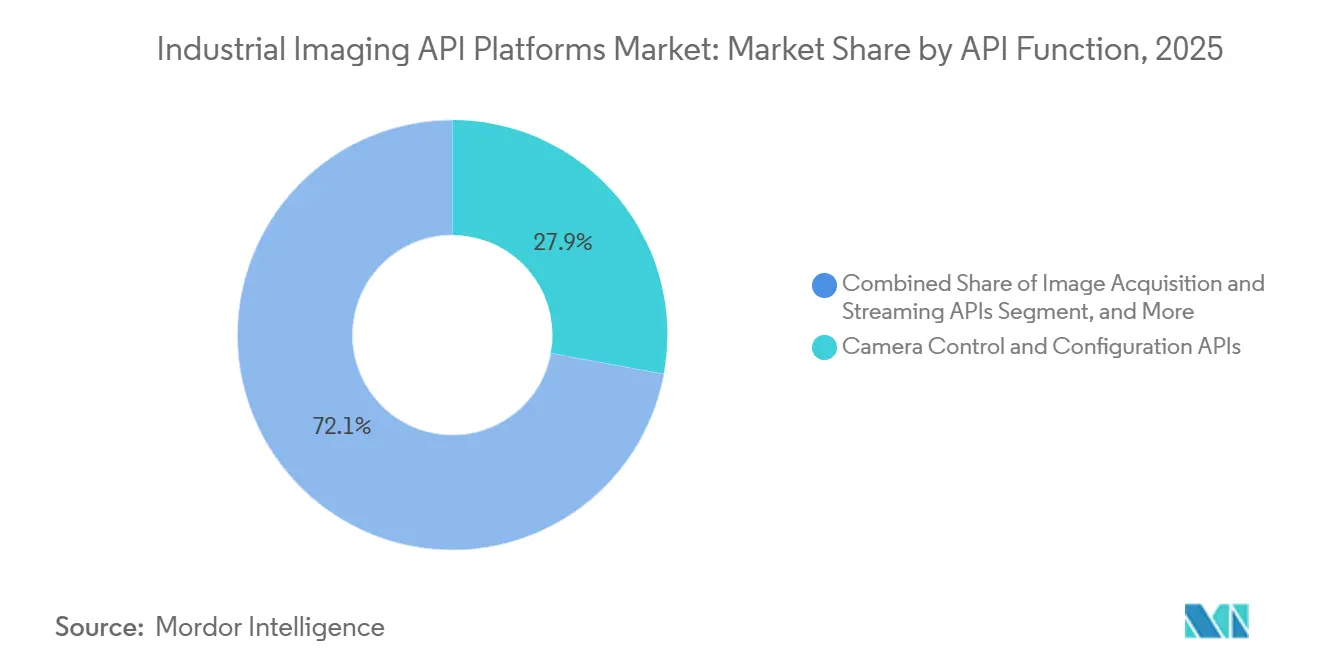
Computer Vision and AI Analytics APIs held 27.89% of the industrial imaging API platforms market share in 2025. The lead reflects a shift from transport functions toward software that interprets images and makes production decisions. Image acquisition and camera-control capabilities remain necessary for every inspection deployment. Their value is increasingly tied to AI functions for defect detection, measurement, and classification.
Image Management and Data APIs are projected to expand at a 13.78% CAGR through 2031. Manufacturers operating several sites need consistent management of images, model versions, and inspection records. EMVA released GenICam Package Version 2026.07 in July 2026, including GenApi 3.5.1, GenTL 1.6, SFNC 2.8, and GenDC 1.2. Cognex reported up to 50% lower scaling costs through centralized edge model management with OneVision. Camera-agnostic designs can reduce rework and support third-party analytics overlays.

By Deployment Model: Edge Dominates While Cloud Gains Structural Momentum
Edge and On-Premises deployment held 62.34% of the industrial imaging API platforms market share in 2025. High-speed lines need prompt responses because delayed rejection signals can affect downstream output. Local architectures also align with data sovereignty and operational-network segmentation. IEC 62443 and the EU Cyber Resilience Act reinforce the focus on security for industrial control environments.
Cloud-Based deployment is projected to expand at a 13.21% CAGR through 2031. It is most relevant for centralized training, cross-site rollout, data governance, and version control. Cognex's OneVision architecture combines central development with local execution on In-Sight devices. Hybrid environments offer local response times and common model management across many production lines.
By Imaging Technology: Area-Scan Cameras Lead but Spectral Imaging Outpaces Peers
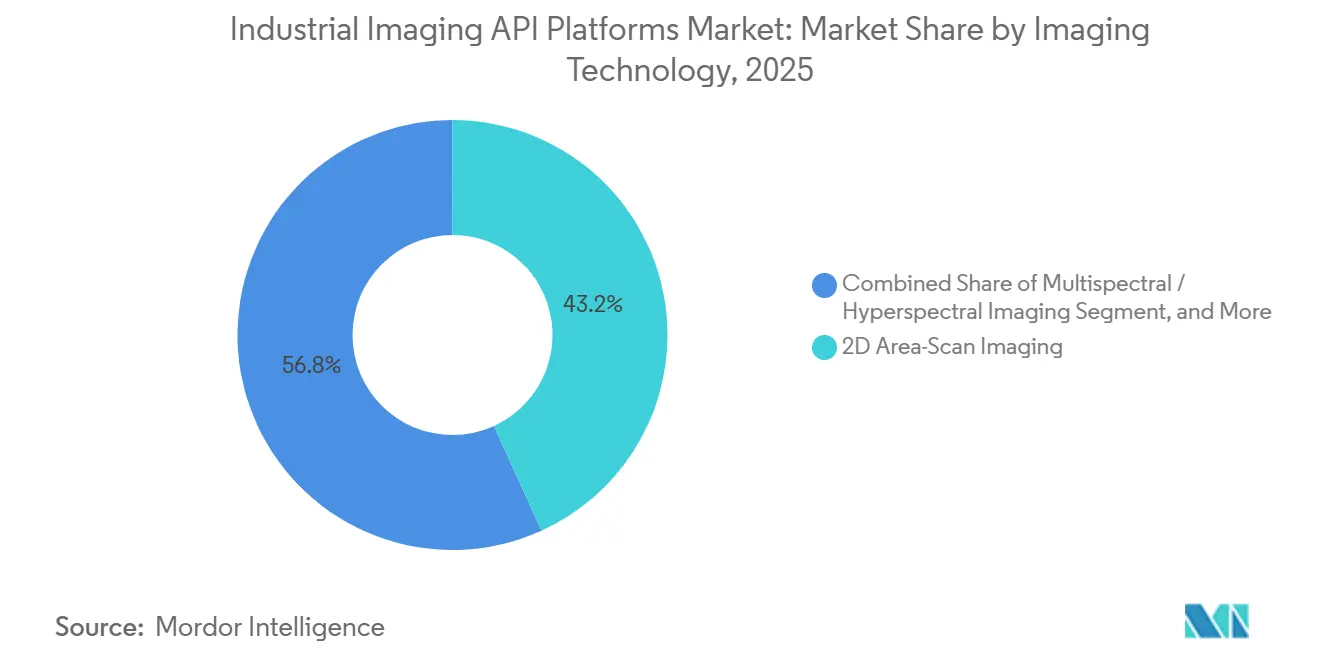
2D Area-Scan Imaging held 43.21% of the industrial imaging API platforms market share in 2025. It benefits from mature sensor supply, GenICam-compatible drivers, and CMOS camera cost efficiency. Area-scan systems serve general inspection in automotive, electronics, and consumer-goods production. Line-scan and 3D imaging support continuous web inspection, measurement, robot guidance, and bin-picking work.
Multispectral and Hyperspectral Imaging is projected to expand at a 13.97% CAGR through 2031. Spectral data supports food contamination detection, tablet-coating checks, and semiconductor wafer inspection where RGB imaging may not identify relevant differences. Research published in 2025 found that hyperspectral imaging with chemometric analysis is moving into inline process analytical technology. JAI's 45-megapixel SP-45000-CXP4 delivers 65 frames per second at 8K resolution. Thermal and infrared APIs support predictive maintenance and process monitoring.
By Application: Quality Inspection Anchors Demand as Predictive Use Cases Scale
Quality Inspection and Defect Detection accounted for 31.44% of the industrial imaging API platforms market size in 2025. The category has the broadest demand base because product conformance affects most manufacturing sectors. Quality, automotive, pharmaceutical, and food requirements make inline inspection less discretionary. These conditions support durable spending on inspection software.
Predictive Maintenance and Process Monitoring is projected to expand at a 13.87% CAGR through 2031. Sensors installed for pass-fail inspection can also generate data for equipment-health analysis. The software must manage immediate decisions and background data collection without reducing throughput. OMRON released the VHV5-SRV system in June 2026 for calibrated inline barcode verification at full production speed. Measurement, gauging, identification, and robot guidance remain linked to 3D imaging, traceability, and robotics adoption.
By End-User: Automotive and Transportation Leads While Semiconductor Demand Reorders Priorities
Automotive and Transportation held 25.89% of the industrial imaging API platforms market share in 2025. Dense automation, mandated quality systems, and multi-camera architectures create substantial software requirements at individual sites. Manufacturers use imaging for assembly checks, dimensional verification, direct-part-mark reading, and traceability. The sector remains a stable demand base, although higher-AI-intensity users are gaining investment.
Electronics and Semiconductors is projected to expand at a 13.78% CAGR through 2031. Advanced packaging, high-bandwidth memory, and AI chip fabrication require optical, spectral, and X-ray inspection at sub-micron levels. Teledyne announced an August 2026 agreement to acquire Varex Imaging for USD 1.1 billion. Pharmaceuticals, food and beverage, and logistics users apply these systems for auditable records, contamination detection, dimensioning, anomaly detection, and identification.
Geography Analysis
Asia-Pacific held 35.89% of the industrial imaging API platforms market share in 2025 and is projected to expand at a 13.55% CAGR through 2031. China supports demand through semiconductor capacity additions, advanced packaging, DRAM fabrication, and consumer-electronics production. Japan's precision manufacturing and robotics base supports automotive assembly, semiconductor inspection, and high-speed electronics. Mitsubishi Electric and Sony Semiconductor Solutions announced in July 2026 that their Advanced Vision Solutions Co., Ltd. joint venture is scheduled to begin operations in October 2026.
North America held the second-largest regional position in 2025. Its automotive, aerospace, semiconductor, pharmaceutical, and food-processing facilities face inspection requirements that support software deployment. The region also has a large installed base of collaborative robots and autonomous mobile robots. Europe remains important for automotive and machine-tool manufacturing in Germany, France, Italy, and the United Kingdom. VDMA stated that European machine vision expects 3% growth in 2026 after a three-year revenue contraction.
European component manufacturers reported 4% revenue expansion in 2025 even as system demand remained soft. The EU Cyber Resilience Act is affecting procurement requirements for connected industrial devices. TÜV Rheinland issued the first IEC 62443-4-2:2026 certification for an industrial vision controller in May 2026. South America is an emerging demand base led by Brazil's automotive and agricultural-machinery sectors and Argentina's agri-food processing. The Middle East and Africa has greenfield demand that can use cloud-hybrid architectures without legacy integration barriers.
Competitive Landscape
The industrial imaging API platforms market is moderately fragmented. Cognex, KEYENCE, SICK, Basler, and MVTec form a leading group alongside specialist software vendors, regional integrators, camera makers with bundled SDKs, and edge AI platform providers. Competition increasingly centers on model management, multi-site deployment, and GenICam compatibility. Hardware performance remains important for high-speed imaging and specialized modalities. Customers also assess how easily systems can be managed and updated after installation.
Cognex announced OneVision general availability in May 2026 and reported more than 100 global customer deployments since the June 2025 beta launch. The company reported lower scaling costs through centralized edge model management. MVTec released HALCON 26.05 in May 2026 with faster deep-learning object detection. It also released MERLIC 26.03 in March 2026 with package-based licensing, unlimited camera support, a TwinCAT ADS plug-in, and deep-learning code reading. These moves use software functions and licensing to deepen customer retention.
Smaller manufacturers need low-code configuration, prebuilt models, and simpler deployment workflows because many lack vision-engineering resources. Platforms that coordinate 2D, 3D, thermal, and spectral inspection through one environment could reduce separate middleware requirements. Cybersecurity-ready designs are increasingly relevant in regulated plants in Europe and North America. NVIDIA's Metropolis ecosystem supports camera-adjacent GPU computing and offers software-focused entrants a route to greenfield projects.
Industrial Imaging API Platforms Industry Leaders
-
Cognex Corporation
-
Teledyne Technologies Incorporated
-
Basler AG
-
OMRON Corporation
-
Keyence Corporation
- *Disclaimer: Major Players sorted in no particular order
Recent Industry Developments
- August 2026: Teledyne Technologies Incorporated announced a definitive agreement to acquire Varex Imaging Corporation for USD 1.1 billion in an all-cash transaction at USD 18.90 per share, a 52.3% premium. The agreement added X-ray tubes, photon-counting digital detectors, and imaging software to Teledyne's industrial and medical imaging portfolio. The transaction is expected to close in early 2027 pending regulatory approvals and shareholder vote.
- August 2026: SICK AG launched "AI for 3D" on its Nova machine vision platform on August 3, 2026, integrating deep-learning neural networks with high-precision 3D height data. The platform supported anomaly detection, surface inspection, and completeness verification for electronics, battery, automotive, and logistics applications. This was the company's first AI capability embedded directly into its 3D machine vision product line.
- July 2026: Mitsubishi Electric Corporation and Sony Semiconductor Solutions Corporation announced the formation of Advanced Vision Solutions Co., Ltd., a joint venture scheduled to begin operations in October 2026, to develop AI-based vision sensor solutions that execute inference directly on image sensors, targeting broad manufacturing automation for labor savings and unmanned operations.
- July 2026: Baumer Holding AG launched LX-series industrial cameras with RF mount support on July 1, 2026, extending Canon RF mount optics to industrial applications through the Open Optics Camera Interface, a GenICam standard extension for generic lens control. The cameras delivered up to 65-megapixel resolution at 18 frames per second in a 20% shorter form factor than EF mount predecessors.
Global Industrial Imaging API Platforms Market Report Scope
The industrial imaging API platforms market comprises the development, licensing, subscription, and implementation of software platforms, application programming interfaces (APIs), software development kits (SDKs), and related services that enable industrial applications to capture, process, analyze, manage, and exchange images and video from cameras, sensors, and machine-vision devices.
The Industrial Imaging API Platforms Report is Segmented by API Function (Camera Control and Configuration APIs, Image Acquisition and Streaming APIs, Image Processing and Enhancement APIs, Computer Vision and AI Analytics APIs, Image Management and Data APIs, and Other API Functions), Deployment Model (Edge/On-Premises, Cloud-Based, and Hybrid), Imaging Technology (2D Area-Scan Imaging, 2D Line-Scan Imaging, 3D Imaging, Thermal/Infrared Imaging, Multispectral/Hyperspectral Imaging, and Other Imaging Technologies), Application (Quality Inspection and Defect Detection, Identification/Barcode Reading and OCR, Measurement and Gauging, Positioning and Robot Guidance, Predictive Maintenance and Process Monitoring, and Other Applications), End-User (Automotive and Transportation, Electronics and Semiconductors, Pharmaceuticals and Medical Devices, Food and Beverage, Logistics and Warehousing, and Other End-Users), and Geography (North America, South America, Europe, Asia-Pacific, and Middle East and Africa). The Market Forecasts are Provided in Terms of Value (USD).
| Camera Control and Configuration APIs |
| Image Acquisition and Streaming APIs |
| Image Processing and Enhancement APIs |
| Computer Vision and AI Analytics APIs |
| Image Management and Data APIs |
| Other API Functions |
| Edge / On-Premises |
| Cloud-Based |
| Hybrid |
| 2D Area-Scan Imaging |
| 2D Line-Scan Imaging |
| 3D Imaging |
| Thermal / Infrared Imaging |
| Multispectral / Hyperspectral Imaging |
| Other Imaging Technologies |
| Quality Inspection and Defect Detection |
| Identification, Barcode Reading, and OCR |
| Measurement and Gauging |
| Positioning and Robot Guidance |
| Predictive Maintenance and Process Monitoring |
| Other Applications |
| Automotive and Transportation |
| Electronics and Semiconductors |
| Pharmaceuticals and Medical Devices |
| Food and Beverage |
| Logistics and Warehousing |
| Other End-Users |
| North America | United States | |
| Canada | ||
| Mexico | ||
| South America | Brazil | |
| Argentina | ||
| Rest of South America | ||
| Europe | Germany | |
| United Kingdom | ||
| France | ||
| Italy | ||
| Spain | ||
| Rest of Europe | ||
| Asia-Pacific | China | |
| Japan | ||
| India | ||
| South Korea | ||
| ASEAN | ||
| Rest of Asia-Pacific | ||
| Middle East and Africa | Middle East | Saudi Arabia |
| United Arab Emirates | ||
| Rest of the Middle East | ||
| Africa | South Africa | |
| Rest of Africa | ||
| By API Function | Camera Control and Configuration APIs | ||
| Image Acquisition and Streaming APIs | |||
| Image Processing and Enhancement APIs | |||
| Computer Vision and AI Analytics APIs | |||
| Image Management and Data APIs | |||
| Other API Functions | |||
| By Deployment Model | Edge / On-Premises | ||
| Cloud-Based | |||
| Hybrid | |||
| By Imaging Technology | 2D Area-Scan Imaging | ||
| 2D Line-Scan Imaging | |||
| 3D Imaging | |||
| Thermal / Infrared Imaging | |||
| Multispectral / Hyperspectral Imaging | |||
| Other Imaging Technologies | |||
| By Application | Quality Inspection and Defect Detection | ||
| Identification, Barcode Reading, and OCR | |||
| Measurement and Gauging | |||
| Positioning and Robot Guidance | |||
| Predictive Maintenance and Process Monitoring | |||
| Other Applications | |||
| By End-User | Automotive and Transportation | ||
| Electronics and Semiconductors | |||
| Pharmaceuticals and Medical Devices | |||
| Food and Beverage | |||
| Logistics and Warehousing | |||
| Other End-Users | |||
| By Geography | North America | United States | |
| Canada | |||
| Mexico | |||
| South America | Brazil | ||
| Argentina | |||
| Rest of South America | |||
| Europe | Germany | ||
| United Kingdom | |||
| France | |||
| Italy | |||
| Spain | |||
| Rest of Europe | |||
| Asia-Pacific | China | ||
| Japan | |||
| India | |||
| South Korea | |||
| ASEAN | |||
| Rest of Asia-Pacific | |||
| Middle East and Africa | Middle East | Saudi Arabia | |
| United Arab Emirates | |||
| Rest of the Middle East | |||
| Africa | South Africa | ||
| Rest of Africa | |||
Key Questions Answered in the Report
What is the industrial imaging API platforms market size?
The industrial imaging API platforms market size was USD 537.03 million in 2026 and is projected to reach USD 970.48 million by 2031 at a CAGR of 12.56%. This reflects broader use of inspection, automation, and AI software.
What is driving adoption of industrial imaging API platforms?
Factory automation, 100% inline inspection, AI-based defect detection, and vision-guided robotics are supporting adoption. Quality and traceability requirements also make many inspection deployments less discretionary.
Which deployment model leads industrial imaging API platforms?
Edge and On-Premises deployment led with 62.34% of 2025 revenue because high-speed manufacturing requires dependable local processing. Cloud functions are more relevant for model development and cross-site management.
Which imaging technology is expanding fastest?
Multispectral and Hyperspectral Imaging is projected to expand at a CAGR of 13.97% through 2031. The technology supports food, pharmaceutical, and semiconductor checks that need information beyond conventional RGB imaging.
Which end-user application has the largest revenue share?
Quality Inspection and Defect Detection accounted for 31.44% of 2025 revenue. Production-control, compliance, and traceability requirements support use across manufacturing environments.
Which region leads demand for industrial imaging software platforms?
Asia-Pacific held 35.89% of 2025 global revenue and is projected to expand at a CAGR of 13.55% through 2031. Semiconductor, electronics, robotics, and precision manufacturing support its regional position.