
Industrial Image Processing Software Market Size and Share
Market Overview
| Study Period | 2020 - 2031 |
|---|---|
| Market Size (2026) | USD 1.60 Billion |
| Market Size (2031) | USD 2.78 Billion |
| Growth Rate (2026 - 2031) | 11.68 % |
| Fastest Growing Market | Asia-Pacific |
| Largest Market | Asia-Pacific |
| Market Concentration | Medium |
Major Players *Disclaimer: Major Players sorted in no particular order Image © Mordor Intelligence. Reuse requires attribution under CC BY 4.0. | |
Industrial Image Processing Software Market Analysis by Mordor Intelligence
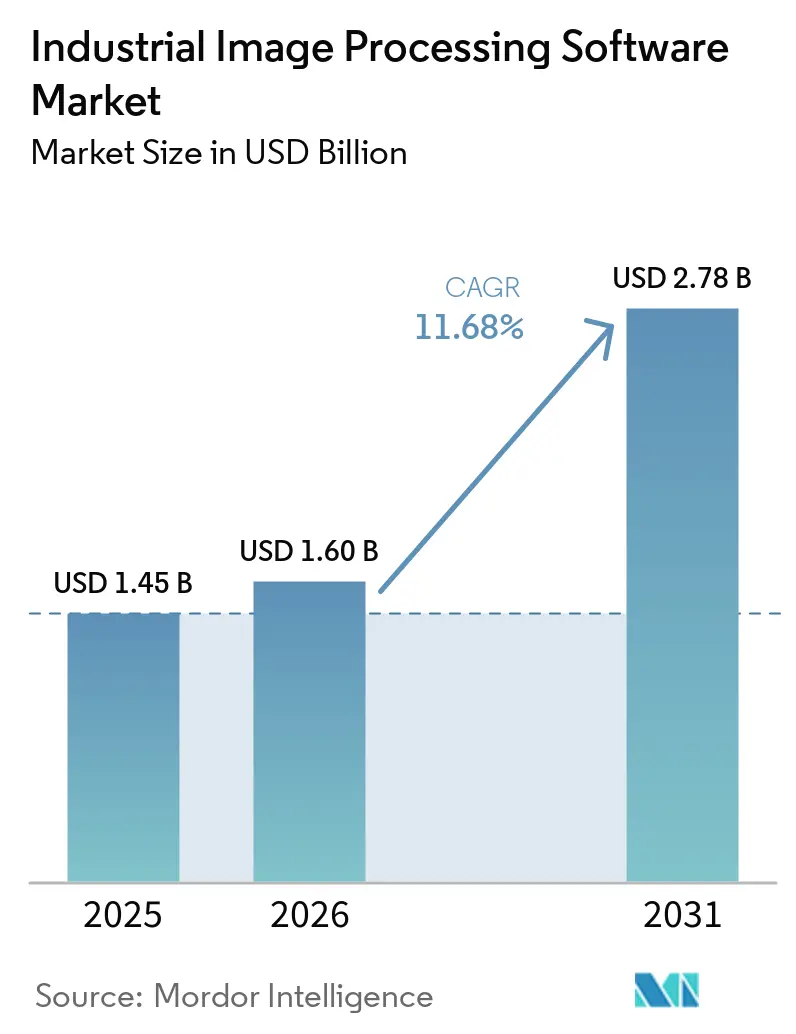
The industrial image processing software market size was USD 1.45 billion in 2025 and is estimated to grow from USD 1.60 billion in 2026 to reach USD 2.78 billion by 2031, at a CAGR of 11.68% during the forecast period (2026-2031). Manufacturers are moving from isolated, rule-based inspection stations toward software platforms that support AI model management across several facilities. This change reduces the time required to introduce new inspection applications and makes broader deployment more practical. Real-time inspection remains centered at the production site because high-speed lines need dependable response times. Competition increasingly depends on software capabilities, including model governance, edge deployment, and integration with factory systems. The industrial image processing software market also faces higher requirements for documented inspection records and controlled AI operations in regulated manufacturing settings.
Key Report Takeaways
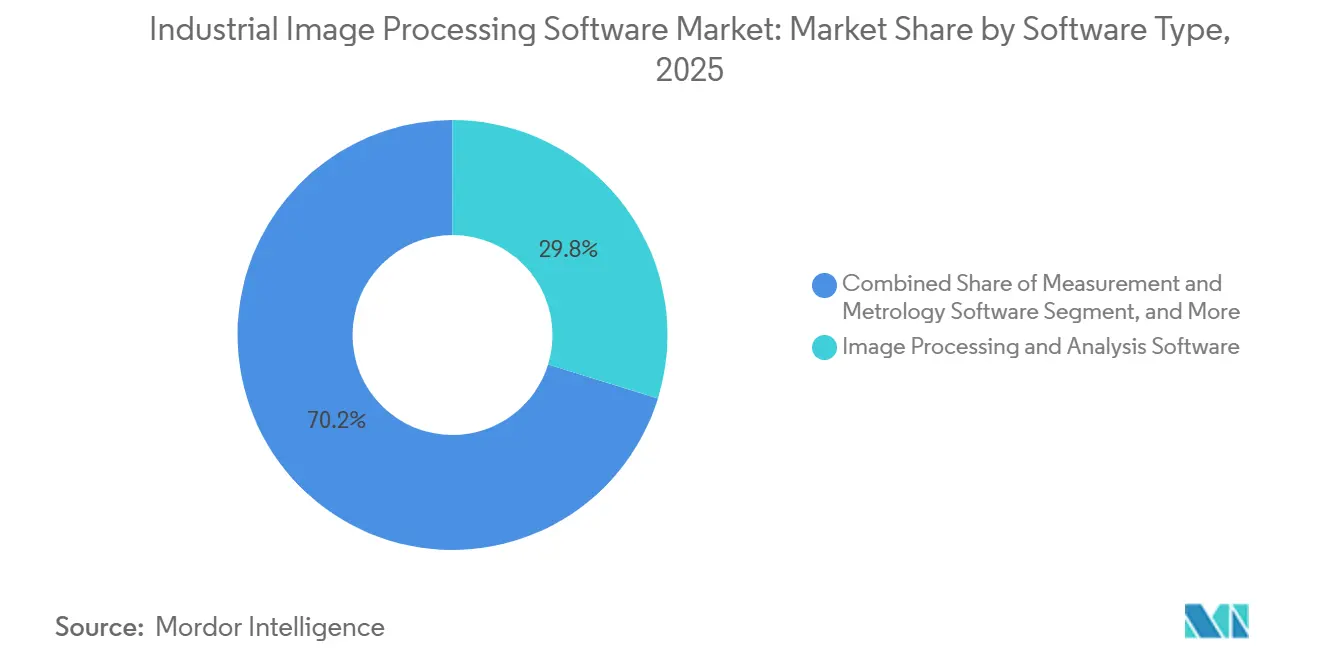
- By software type, image processing and analysis software held the 29.78% of the industrial image processing software market share in 2025, while AI and deep learning vision software is projected to expand at a 12.24% CAGR through 2031.
- By deployment model, on-premises and edge software held 73.23% of global revenue in 2025, while cloud-based software is projected to grow at a 12.37% CAGR through 2031.
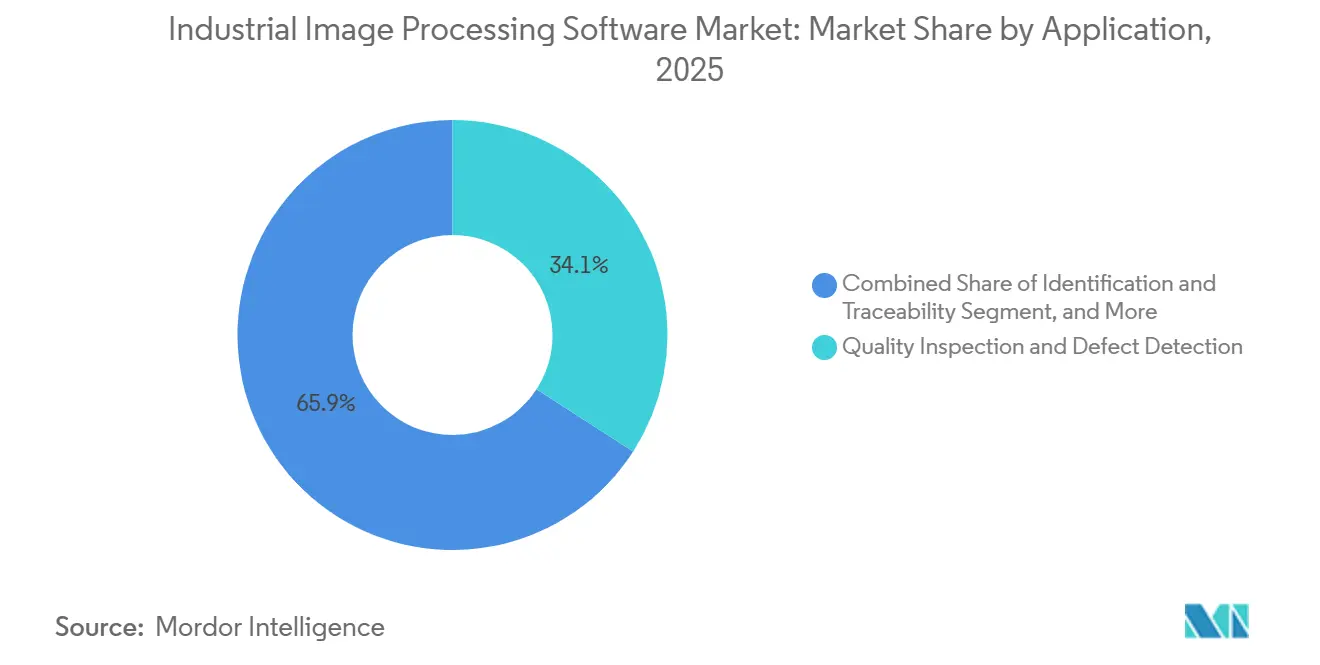
- By application, quality inspection and defect detection accounted for 34.11% of total revenue in 2025, while robot guidance and bin picking are projected to advance at a 12.42% CAGR through 2031.
- By end user, automotive and mobility held the 22.15% of total revenue in 2025, while EV and battery manufacturing is projected to expand at a 12.39% CAGR through 2031.
- By geography, Asia-Pacific held 36.56% of global revenue in 2025 and is projected to grow at a 12.83% CAGR through 2031.
Note: Market size and forecast figures in this report are generated using Mordor Intelligence’s proprietary estimation framework, updated with the latest available data and insights as of January 2026.
Global Industrial Image Processing Software Market Trends and Insights
Drivers Impact Analysis*
| Driver | (~) % Impact on CAGR Forecast | Geographic Relevance | Impact Timeline |
|---|---|---|---|
| Rising Demand for Automated Quality Inspection and Zero-Defect Manufacturing | +3.2% | Global | Short term (≤ 2 years) |
| Expansion of AI-Enabled Inspection and Adaptive Image Analysis | +2.8% | Global, with early gains in North America and Asia-Pacific | Medium term (2-4 years) |
| Growth of Vision-Guided Robotics and Smart Factory Deployments | +2.1% | Asia-Pacific core, spill-over to Europe and North America | Medium term (2-4 years) |
| Electronics, Semiconductor, and Battery Manufacturing Complexity | +1.6% | Asia-Pacific core, spill-over to North America and Europe | Medium term (2-4 years) |
| Persistent Industrial Labor Shortages and Pressure to Reduce Scrap | +1.1% | North America and Europe | Short term (≤ 2 years) |
| Reusable Edge AI Models for Brownfield Production Lines | +0.7% | Global | Long term (≥ 4 years) |
| Source: Mordor Intelligence | |||
Rising Demand for Automated Quality Inspection and Zero-Defect Manufacturing
Defects that pass through several production stages can create material losses because each stage adds value to the finished part. This makes early detection an important operating requirement for manufacturers. Industrial AI vision systems can inspect more than 10,000 parts per hour while maintaining sub-100-millisecond inference speeds, according to the supplied research. This operating requirement supports demand across the industrial image processing software market. Volkswagen Group used more than 1,200 AI applications across its manufacturing network in 2025, including quality-control computer vision applications. One facility reduced energy costs by 12% through these applications, demonstrating that inspection automation can support broader process improvements. Requirements under ISO 9001 and IATF 16949 also support demand for time-stamped and auditable inspection records on production lines. These requirements are material to the industrial image processing software market.
Expansion of AI-Enabled Inspection and Adaptive Image Analysis
The industrial image processing software market is shifting from fixed, rule-based programming toward example-based deep learning models. This approach helps address changing lighting conditions, surface variation, and complex geometry that can limit classical vision methods. In May 2026, Cognex stated that a customer built and demonstrated a sealing inspection application with OneVision in less than 1 day, compared with more than 1 year for a comparable classical vision project. MVTec released HALCON 26.05 in May 2026 with up to 5x faster deep-learning object-detection inference and support for visual prompting.[1]MVTec Software GmbH, “New Version of MVTec HALCON Available From May 20, 2026,” MVTec Software GmbH, mvtec.com Faster development can widen access to inspection uses that previously required extensive customization. Models that can be updated with current production images can also reduce the maintenance burden as products and processes change. This makes AI functionality increasingly important in the industrial image processing software market.
Growth of Vision-Guided Robotics and Smart Factory Deployments
Vision-guided robotics links image-processing software to automated picking, handling, and assembly operations. This capability is particularly relevant when production involves varied parts and fixed-fixture automation is difficult to use. South Korea launched the M.AX Manufacturing AI Transformation Alliance in September 2025 and allocated USD 491 million for 2026, with a target of 500 AI-equipped factories by 2030. The alliance had more than 1,300 participating organizations within 100 days of its launch, according to the supplied research. ABB and NVIDIA described robotic vision as an entry point to physical AI in precision manufacturing in a joint publication in March 2026. This link between software and robotics is expanding the industrial image processing software market. Training models centrally while running them locally is becoming more relevant for companies that need consistent practices across sites without relying on network connectivity at the line.
Electronics, Semiconductor, and Battery Manufacturing Complexity
Semiconductor, electronics, and battery production require inspection at many points because small defects can affect yield, safety, and traceability. Semiconductor fabrication requires submicron detection, making inspection software directly relevant to process control. Onto Innovation launched the Dragonfly G5 inspection system in March 2026 with submicron sensitivity down to 150 nanometers and more than 3x throughput improvement over its predecessor. Camtek acquired Visual Layer in April 2026 to expand visual AI capabilities for semiconductor inspection. Battery plants use inspection for electrode coating, laser weld quality, thermal interface coverage, and pouch seal integrity. IEC 62660 and UN 38.3 requirements support demand for inspection records connected to manufacturing execution systems. These manufacturing needs add to demand in the industrial image processing software market.
Restraints Impact Analysis*
| Restraint | (~) % Impact on CAGR Forecast | Geographic Relevance | Impact Timeline |
|---|---|---|---|
| High Integration, Calibration, and Total Cost of Ownership | -2.4% | Global | Short term (≤ 2 years) |
| Shortage of Machine Vision and Industrial AI Skills | -1.8% | North America and Europe | Medium term (2-4 years) |
| Legacy-System Interoperability and Data-Quality Constraints | -1.2% | Global | Long term (≥ 4 years) |
| Dataset Drift from Product Mix and Process Changes | -0.7% | Global | Long term (≥ 4 years) |
| Source: Mordor Intelligence | |||
High Integration, Calibration, and Total Cost of Ownership
The cost of an operational inspection system can exceed the combined cost of the original software license and hardware quotation. Manufacturers may need integration middleware, network upgrades for image streams, edge computing equipment, and calibration for difficult operating conditions. These requirements can create a greater obstacle for small and mid-sized manufacturers with limited capital budgets. The result can be a divided adoption pattern, with larger enterprises implementing advanced systems while smaller facilities use simpler tools. Standards such as OPC UA and IEC 62443 can reduce some protocol and cybersecurity barriers. Full interoperability remains difficult where a factory operates equipment from several suppliers and generations.
Shortage of Machine Vision and Industrial AI Skills
Vision deployment requires knowledge of production processes, image data, model training, and factory controls. This mix of skills is difficult to source and can slow both initial implementation and later model maintenance. Personnel must be able to configure deep learning workflows, monitor performance, and integrate inspection results into operational systems. Shortages are more acute in manufacturing centers that already face broad competition for technical workers. The constraint has increased interest in no-code and low-code tools that reduce the specialized knowledge required. Vendors that simplify setup and model management can address a key barrier within the industrial image processing software market. Better accessibility can also improve participation in the industrial image processing software market.
*Our forecasts treat driver/restraint impacts as directional, not additive. The impact forecasts reflect baseline growth, mix effects, and variable interactions.
Segment Analysis
By Software Type: AI Adoption Redefines the Core Software Stack
Image processing and analysis software held 29.78% of the industrial image processing software market share in 2025. It provides the core computational functions used across many industrial vision installations. These functions include feature extraction, edge detection, blob analysis, and morphological operations. Manufacturers use them for dimensional verification, surface grading, and presence confirmation. Automotive, electronics, and pharmaceutical production lines all rely on these established capabilities. General-purpose image processing software remains important because it provides stable, well-documented inspection logic. Image enhancement and preprocessing tools improve image quality before analysis. Measurement and metrology software serves applications that require repeatable dimensional checks. Real-time monitoring and anomaly detection libraries are also gaining use as plants shift from periodic sampling to continuous oversight.
AI and deep-learning vision software is projected to grow at a 12.24% CAGR through 2031. Example-based training can be more suitable than manually written rules for complex surfaces and variable geometry. Deep learning models can handle lighting variations and product differences that can disrupt classical approaches. MVTec released HALCON 26.05 in May 2026 with up to 5x faster deep-learning object-detection inference. The release also added multimodal large language model support with visual prompting. Hybrid implementations are expected to combine rule-based tools for familiar defects with AI tools for unusual failures. Model compression and edge-native inference can make this approach more practical on factory floors. These capabilities could reshape the software stack used in the industrial image processing software industry.



By Deployment Model: Edge Dominates, Cloud Accelerates
On-premises and edge software accounted for 73.23% of the industrial image processing software market size in 2025. Production lines require deterministic response times, particularly when running at high speeds. Cloud round-trip can introduce delays that are not acceptable for immediate inspection decisions. Data sovereignty and cybersecurity requirements also encourage facilities to keep production images within their own boundaries. IEC 62443 requirements reinforce the need for controlled industrial system architectures. Cognex launched the In-Sight 6900 Vision Controller in April 2026 with up to 157 TOPS of AI processing at the edge. The controller can run several high-resolution AI models in parallel without an external PC. These product designs show the continuing importance of local processing for real-time work.
Cloud-based software is projected to grow at a 12.37% CAGR through 2031. Its role is centered on centralized model development, version control, fleet management, and coordinated deployment across sites. It does not require real-time inference to move away from the factory floor. Cognex made OneVision generally available in May 2026 and reported multi-site scaling cost reductions of up to 50% for global manufacturing customers. The company also reported that users moved from single-line projects to global deployments in days rather than months. Schneider Electric used the platform across its inspection network and reported doubled yield with fewer false rejects in the supplied research. Hybrid deployments can allow companies to manage models centrally while retaining line-level reliability. This combination supports enterprise rollouts in the industrial image processing software market.
By Application: Quality Inspection at Scale Anchors Demand
Quality inspection and defect detection accounted for 34.11% of global revenue in 2025. The application is used in automotive, electronics, food and beverage, and pharmaceutical manufacturing. It covers surface defect detection, dimensional checks, assembly confirmation, and foreign-object identification. The cost of a missed defect can exceed the cost of an inspection system across its operating life. A 2025 peer-reviewed review described the growing use of deep-learning models for complex manufacturing inspection tasks. Measurement and metrology provide more precise dimensional information. Identification and traceability connect inspections with individual parts and production records. Assembly verification and process monitoring extend the use of software beyond rejecting defective output. Together, these applications support a broader role in process control.
Robot guidance and bin picking are projected to expand at a 12.42% CAGR through 2031. It is useful for high-mix manufacturing where fixed fixtures are not economical. KUKA introduced iiQKA.AI Vision in 2026 to combine 2D and 3D image processing with AI algorithms in its robot controller.[2]KUKA AG, “iiQKA.AI Vision: AI-Based 2D/3D Image Processing for Robots,” KUKA AG, kuka.com The software supports bin-picking and assembly tasks without requiring extensive vision expertise from users. CASIVIBOT began batch delivery in June 2026 for electric motor, semiconductor component, and new energy precision manufacturing applications. The system operates continuously and illustrates the movement from fixed camera stations to mobile inspection platforms. IATF 16949 traceability requirements also encourage robot-integrated vision systems that connect to manufacturing execution system data. This application is widening the operational scope of the industrial image processing software market.
By End User: Automotive Leads While EV and Battery Manufacturing Accelerates
Automotive and mobility held 22.15% of global industry revenue in 2025. Vehicle manufacturing has many inspection points across body panels, powertrain components, seats, electronics, and final assembly. IATF 16949 requirements support automated and auditable inspection practices among major suppliers. Software-defined vehicle platforms increase the need to verify connector placement, adhesive-bead geometry, and sensor calibration. These checks must often take place at assembly-line speed. Electronics and semiconductors represent another important end-user base due to their tight quality tolerances. Industrial machinery has its own demand for dimensional and assembly confirmation. Pharmaceuticals and medical devices require traceable, validated systems, whereas food and beverage operations rely on inspections for packaging and contamination checks. Aerospace and defense operations require high accuracy and documented quality controls.
EV and battery manufacturing is projected to grow at a 12.39% CAGR through 2031. Gigafactory operations require inspection for electrode coating, laser welds, thermal interfaces, and pouch seals. A missed defect can affect cell safety across many downstream units. SICK launched AI-powered 3D capabilities for its Nova machine vision platform in August 2026. The launch targeted battery assembly verification, surface inspection, and automotive classification. IEC 62660 and UN 38.3 requirements support the need for complete inspection records linked to manufacturing execution systems. Pharmaceutical and medical-device manufacturers also remain favorable users because FDA 21 CFR Part 11 requires controlled electronic records. These needs give the industrial image processing software market several compliance-sensitive areas of demand.
Geography Analysis
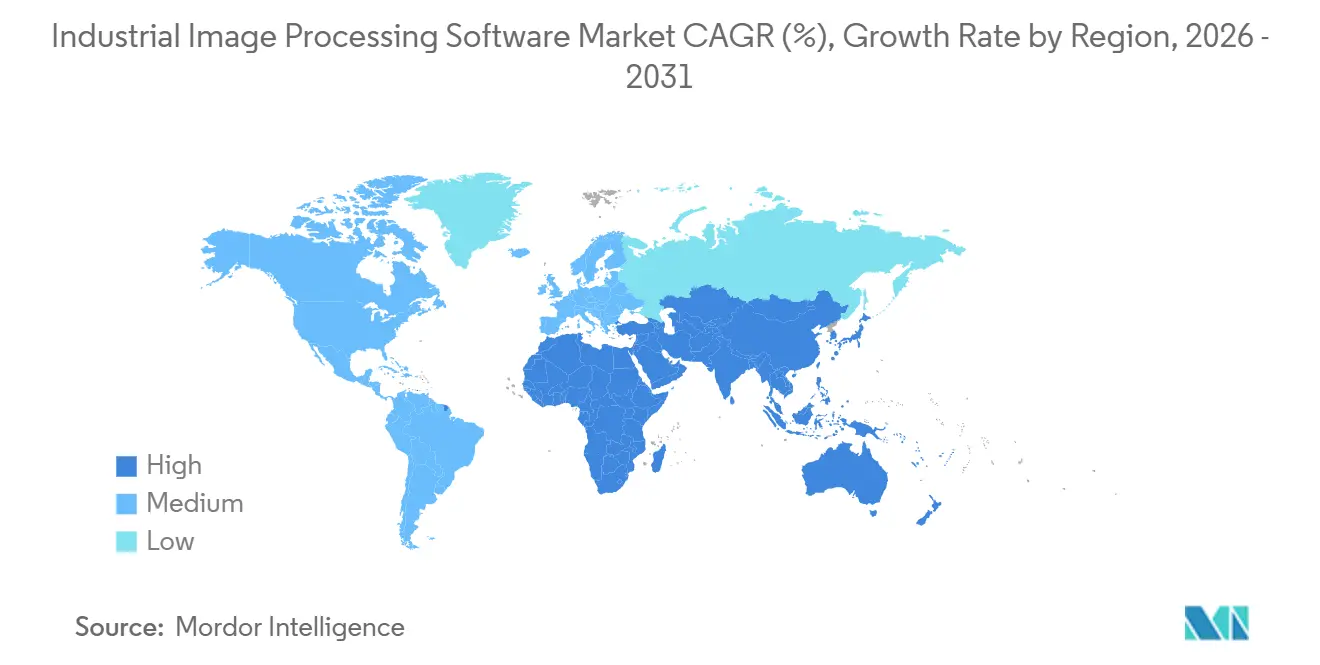
Asia-Pacific held 36.56% of the industrial image processing software market share in 2025 and is projected to grow at a 12.83% CAGR through 2031. China is the largest source of demand in the region because of its large manufacturing base. Asia received 74% of the 542,000 industrial robots installed globally in 2024, according to the International Federation of Robotics.[3]International Federation of Robotics, “Robot Sales Reach New Record,” International Federation of Robotics, ifr.org China accounted for the majority of these installations in the supplied research. This installed base supports demand for vision software, controls, and related services. South Korea launched the M.AX alliance in September 2025 and provided USD 491 million in government funding for 2026, with an objective of 500 AI-equipped factories by 2030. Japan uses AI scheduling and inspection tools to respond to skilled-labor shortages. India adds demand through expanding automotive and pharmaceutical production. China’s smart manufacturing standards and Japan’s productivity subsidies encourage more formal and traceable inspection deployments.
North America and Europe are technology-mature centers for the industrial image processing software market. They are characterized by high average contract values per facility and strong enterprise use of AI-native platforms. North American reshoring investment and skilled-labor constraints support automation procurement. Europe has a dense base of precision manufacturers in Germany, Italy, and France. DIN, ISO, and CE marking requirements provide structured conditions for inspection software procurement. Volkswagen Group used more than 1,200 AI applications across its production network in 2025, including computer vision for quality control. The EU AI Act introduces additional documentation and audit expectations for relevant high-risk uses beginning in 2026. This can favor vendors with formal model governance and audit-trail capabilities.
South America, the Middle East, and Africa represent smaller but expanding areas of demand. In South America, automotive supplier chains and food processing support gradual adoption in Brazil and Argentina. Multinational original equipment manufacturers can create demand when they require local suppliers to meet quality certification standards. Saudi Arabia and the UAE are developing greenfield smart-factory projects through industrial diversification programs. Larger deployments in the Middle East remain concentrated in petrochemicals and aerospace. African adoption is at an earlier stage, with South Africa, Egypt, and Nigeria showing activity in food, beverage, and packaging. Labeling verification and contamination inspection are common entry points for these users. Greater integration with multinational supply chains can encourage wider use of standardized vision platforms through 2031.

Competitive Landscape
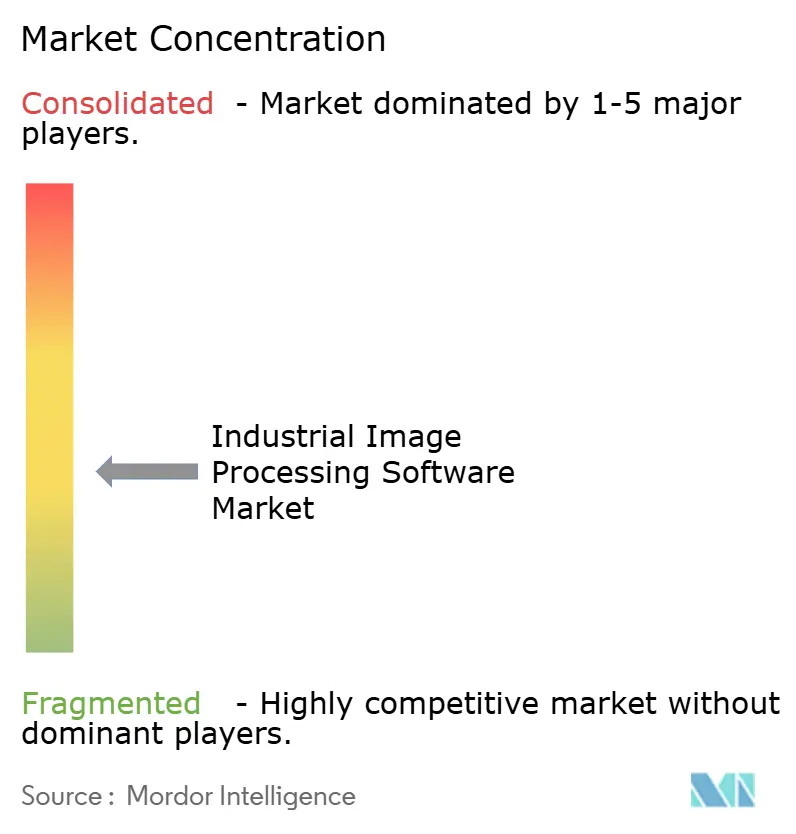
The industrial image processing software market is moderately fragmented. Cognex, KEYENCE, and Basler AG hold established positions in machine vision software. Siemens, ABB, Rockwell Automation, and Mitsubishi Electric compete through broader industrial automation platforms. Vendors are differentiating their products through AI tooling and cloud-to-edge operating models. These capabilities help customers govern models across geographically distributed production networks. Cognex made OneVision generally available in May 2026 and reported up to 50% lower multi-site scaling costs for global manufacturers. The platform also included enterprise customers such as 3M in the supplied research. Patent activity is increasing around transformer-based vision, few-shot learning, and on-device model compression. This shift places greater value on software intelligence rather than camera resolution alone.
AI-focused entrants are building inspection layers that can work with existing camera hardware. This approach separates software performance from a single proprietary hardware ecosystem. It is especially relevant in semiconductor and battery manufacturing, where users value accuracy and interoperability. Camtek acquired Visual Layer in April 2026 to bring large-scale visual AI capabilities into its inspection offering.[4]Camtek Ltd., “Camtek Announces Acquisition of Visual Layer to Deepen Its Visual AI Capabilities in Its Inspection and Metrology Offering,” Camtek, camtek.com This move reflects the interest of equipment companies in adding AI software capability through acquisition. MVTec released HALCON 26.05 in May 2026 with faster deep-learning inference and visual prompting support. Cognex also introduced the In-Sight 6900 Vision Controller in April 2026 with edge AI processing up to 157 TOPS. These moves show continued investment in both centralized management and local execution.
Compliance requirements may further influence competitive selection in safety-sensitive manufacturing uses. Vendors that support IEC 62443-aligned deployment approaches and traceable model governance can be better placed in regulated procurement processes. Smaller manufacturers may continue to seek modular and open approaches that reduce cost and implementation complexity. This creates room for hardware-agnostic subscription offerings alongside integrated automation platforms. Large suppliers can use installed relationships and end-to-end factory portfolios to support adoption. Specialist vendors can compete through focused software development and faster AI model deployment. The industrial image processing software industry therefore includes several distinct competitive approaches. This diversity keeps the industrial image processing software market moderately fragmented.
Industrial Image Processing Software Industry Leaders
Cognex Corporation
Basler AG
Keyence Corporation
Teledyne Technologies Incorporated
OMRON Corporation
- *Disclaimer: Major Players sorted in no particular order

Recent Industry Developments
- August 2026: SICK AG launched AI-powered 3D quality inspection capabilities through its Nova machine vision platform at Lanseria, combining deep-learning neural networks with precision 3D height-data analysis in a teach-by-example configuration requiring no additional hardware. The launch targets electronics, battery assembly, automotive classification, and tire inspection applications and marks SICK’s first intelligent AI capability for its high-precision 3D machine vision technology.
- May 2026: Cognex Corporation launched the In-Sight 3900 Vision System, powered by Qualcomm Dragonwing platforms, supporting up to 5,000 parts-per-minute inspection rates at 25 MP resolution and targeting demanding applications in automotive, electronics, and next-generation packaging without sacrificing throughput.
- May 2026: MVTec Software GmbH released HALCON 26.05, achieving up to 5x faster deep-learning inference for object detection, introducing multimodal large language model support with visual prompting, and expanding data augmentation operators for deep-learning pipeline customization.
- April 2026: Camtek Ltd. announced the acquisition of Visual Layer, a Tel Aviv-based AI company specializing in large-scale visual data analytics, to deepen AI software capabilities in semiconductor inspection across Advanced Interconnect Packaging, Memory, HBM, CMOS Image Sensors, and MEMS segments.


Global Industrial Image Processing Software Market Report Scope
The industrial image processing software market comprises solutions that analyze, interpret, and process visual data from industrial cameras and imaging systems. These solutions support applications such as quality inspection, defect detection, measurement, identification, and automation across industrial operations. Manufacturers use industrial image processing software to improve production accuracy, operational efficiency, and product quality.
The Industrial Image Processing Software Market Report is Segmented by Software Type (General-Purpose Image Processing Software, Image Enhancement and Preprocessing Software, Image Analysis and Feature Extraction Software, Measurement and Metrology Software, and Other Software Types), Deployment Model (On-Premises/Edge Software, Cloud-Based Software, and Hybrid Software), Application (Quality Inspection and Defect Detection, Measurement and Metrology, Identification and Traceability, Robotic Guidance, Assembly Verification, and Process Monitoring), End User (Automotive and Mobility, Electronics and Semiconductors, Industrial Machinery and Equipment, EV and Battery Manufacturing, Pharmaceuticals and Medical Devices, Food, Beverage and Packaging, Aerospace and Defense, and Other End Users), and Geography (North America, South America, Europe, Asia-Pacific, Middle East, and Africa). The Market Forecasts are Provided in Terms of Value (USD).
| General-Purpose Image Processing Software |
| Image Enhancement and Preprocessing Software |
| Image Analysis and Feature Extraction Software |
| Measurement and Metrology Software |
| Other Software Types |
| On-Premises / Edge Software |
| Cloud-Based Software |
| Hybrid Software |
| Quality Inspection and Defect Detection |
| Measurement and Metrology |
| Identification and Traceability |
| Robotic Guidance |
| Assembly Verification |
| Process Monitoring |
| Automotive and Mobility |
| Electronics and Semiconductors |
| Industrial Machinery and Equipment |
| EV and Battery Manufacturing |
| Pharmaceuticals and Medical Devices |
| Food, Beverage and Packaging |
| Aerospace and Defense |
| Other End Users |
| North America | United States |
| Canada | |
| Mexico | |
| South America | Brazil |
| Argentina | |
| Chile | |
| Rest of South America | |
| Europe | Germany |
| United Kingdom | |
| France | |
| Italy | |
| Spain | |
| Rest of Europe | |
| Asia-Pacific | China |
| Japan | |
| India | |
| South Korea | |
| Australia | |
| Rest of Asia-Pacific | |
| Middle East | United Arab Emirates |
| Saudi Arabia | |
| Qatar | |
| Rest of Middle East | |
| Africa | South Africa |
| Egypt | |
| Nigeria | |
| Rest of Africa |
| By Software Type | General-Purpose Image Processing Software | |
| Image Enhancement and Preprocessing Software | ||
| Image Analysis and Feature Extraction Software | ||
| Measurement and Metrology Software | ||
| Other Software Types | ||
| By Deployment Model | On-Premises / Edge Software | |
| Cloud-Based Software | ||
| Hybrid Software | ||
| By Application | Quality Inspection and Defect Detection | |
| Measurement and Metrology | ||
| Identification and Traceability | ||
| Robotic Guidance | ||
| Assembly Verification | ||
| Process Monitoring | ||
| By End User | Automotive and Mobility | |
| Electronics and Semiconductors | ||
| Industrial Machinery and Equipment | ||
| EV and Battery Manufacturing | ||
| Pharmaceuticals and Medical Devices | ||
| Food, Beverage and Packaging | ||
| Aerospace and Defense | ||
| Other End Users | ||
| By Geography | North America | United States |
| Canada | ||
| Mexico | ||
| South America | Brazil | |
| Argentina | ||
| Chile | ||
| Rest of South America | ||
| Europe | Germany | |
| United Kingdom | ||
| France | ||
| Italy | ||
| Spain | ||
| Rest of Europe | ||
| Asia-Pacific | China | |
| Japan | ||
| India | ||
| South Korea | ||
| Australia | ||
| Rest of Asia-Pacific | ||
| Middle East | United Arab Emirates | |
| Saudi Arabia | ||
| Qatar | ||
| Rest of Middle East | ||
| Africa | South Africa | |
| Egypt | ||
| Nigeria | ||
| Rest of Africa | ||


Key Questions Answered in the Report
What is the size of the industrial image processing software sector?
The industrial image processing software market size is estimated at USD 1.60 billion in 2026 and is projected to reach USD 2.78 billion by 2031, growing at a 11.68% CAGR.
What is driving demand for industrial image processing software?
Demand is supported by automated quality inspection, AI-enabled image analysis, vision-guided robotics, and complex semiconductor and battery production requirements.
Which software type is growing fastest?
AI and deep-learning vision software is projected to grow at a 12.24% CAGR through 2031 because it can address variable surfaces, lighting, and product geometry.
Why does edge deployment remain important for factory inspection?
Edge deployment supports dependable, low-latency inference and helps manufacturers retain production images within facility boundaries.
Which application is expected to grow fastest?
Robot guidance and bin picking is projected to grow at a 12.42% CAGR through 2031, supported by high-mix manufacturing and automated material handling.
Which region leads demand for industrial image processing software?
Asia-Pacific held 36.56% share in 2025 and is projected to grow at a 12.83% CAGR through 2031, supported by manufacturing activity in China, South Korea, Japan, and India.
Page last updated on:





