
Industrial Imaging Data Services Market Size and Share
Market Overview
| Study Period | 2020 - 2031 |
|---|---|
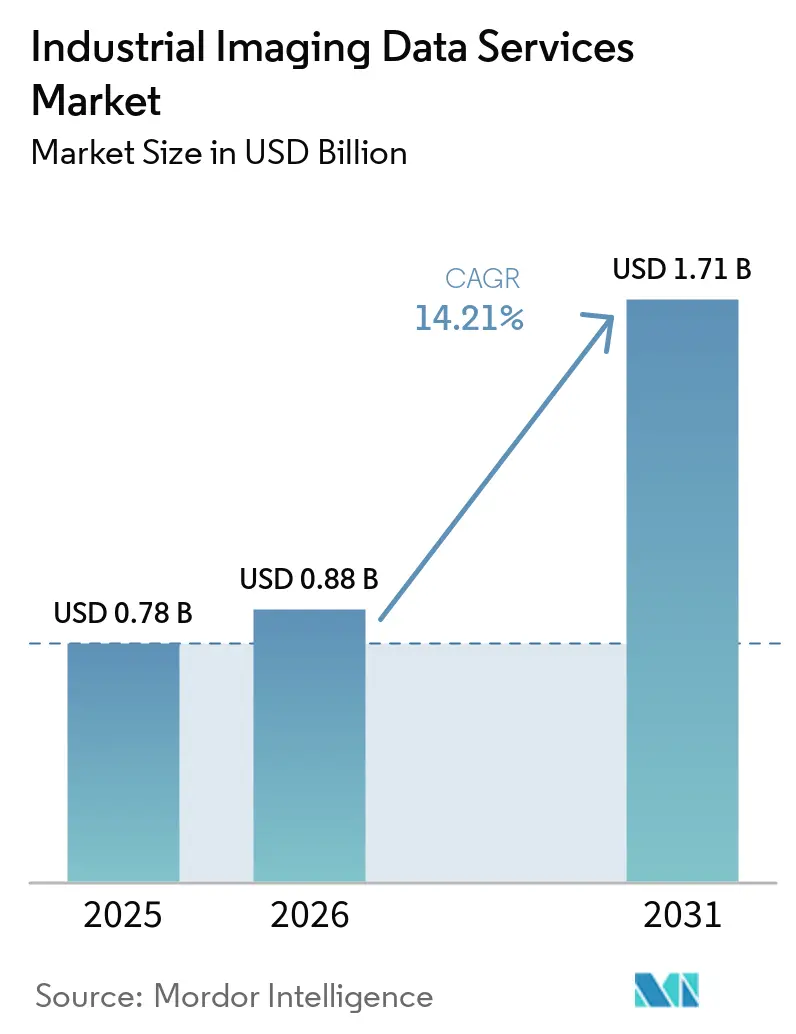
| Market Size (2026) | USD 0.88 Billion |
| Market Size (2031) | USD 1.71 Billion |
| Growth Rate (2026 - 2031) | 14.21 % |
| Fastest Growing Market | Asia-Pacific |
| Largest Market | North America |
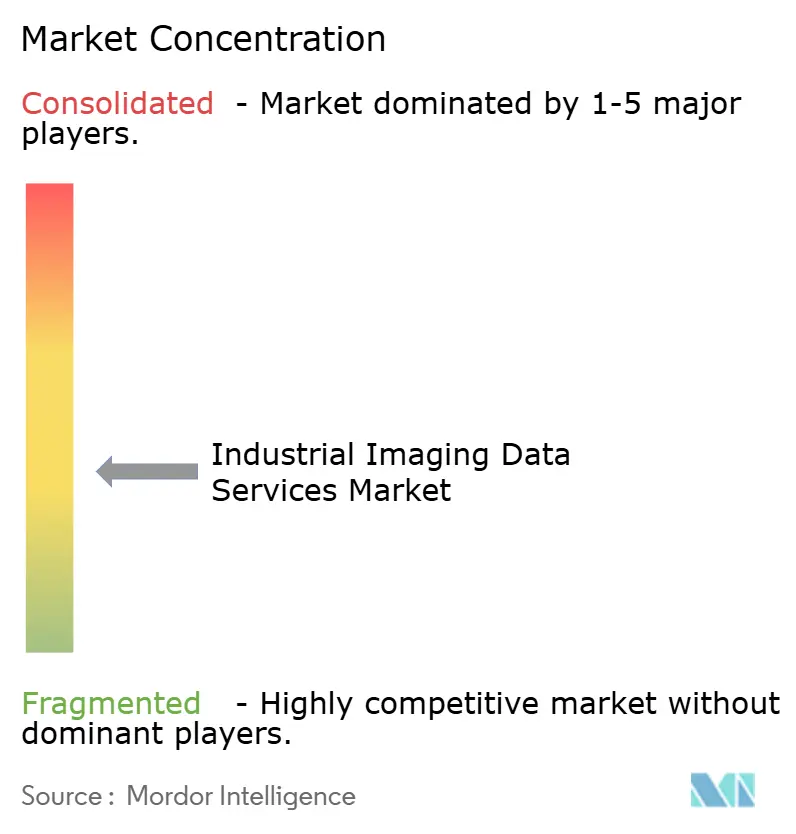
| Market Concentration | Medium |
Major Players *Disclaimer: Major Players sorted in no particular order Image © Mordor Intelligence. Reuse requires attribution under CC BY 4.0. | |
Industrial Imaging Data Services Market Analysis by Mordor Intelligence
The industrial imaging data services market size is projected to expand from USD 0.78 billion in 2025 to USD 0.88 billion in 2026, and to USD 1.71 billion by 2031, registering a CAGR of 14.21% from 2026 to 2031. The market covers collection, annotation, curation, augmentation, synthetic generation, and validation for industrial imaging data. Manufacturers are extending visual inspection programs across automotive, electronics, aerospace, and other production settings. This creates a continuing need to update training data when production lines, suppliers, products, or defect definitions change. Data governance is becoming more important as high-risk AI requirements take effect in key regions. Providers that combine industrial expertise with secure delivery models are better positioned to meet this demand.
Key Report Takeaways
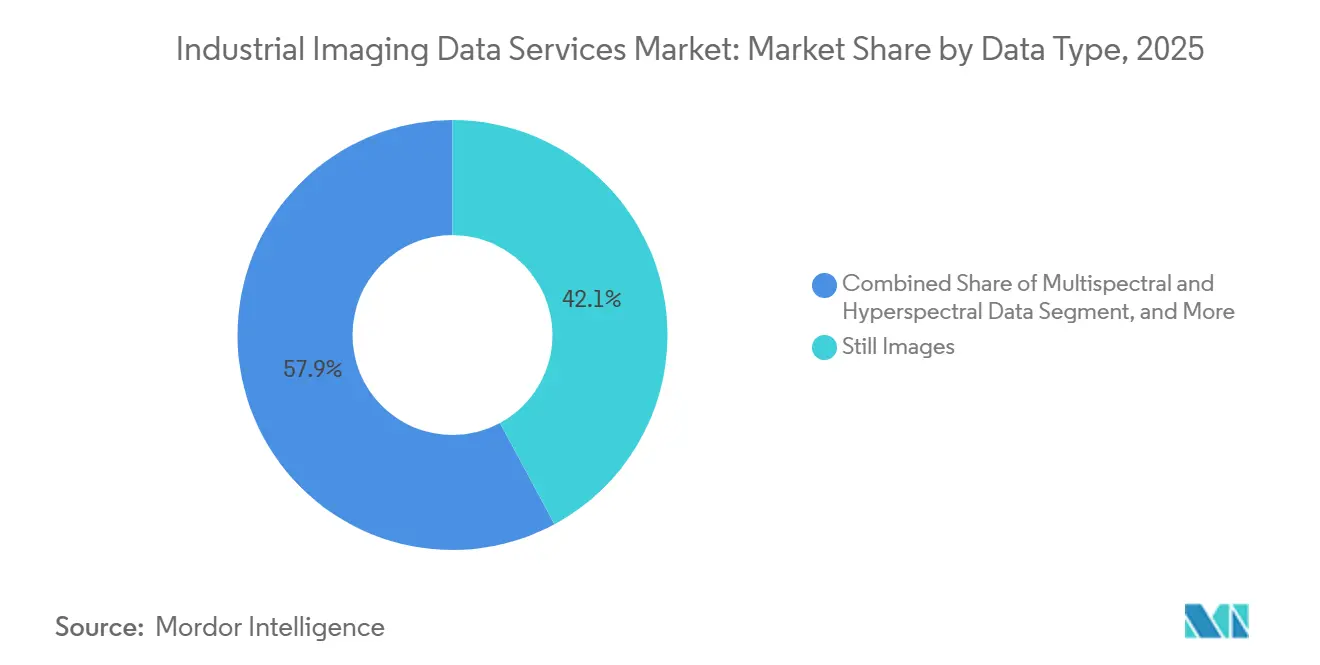
- By data type, still images held 42.13% of the industrial imaging data services market share in 2025, while multispectral and hyperspectral data are projected to expand at a 15.67% CAGR through 2031.
- By service type, data annotation and labeling services held 32.45% of the industrial imaging data services market share in 2025, while synthetic data generation services are projected to expand at a 15.98% CAGR through 2031.
- By delivery model, cloud-based services held 48.76% of the industrial imaging data services market share in 2025, while hybrid and edge-connected services are projected to expand at a 15.71% CAGR through 2031.
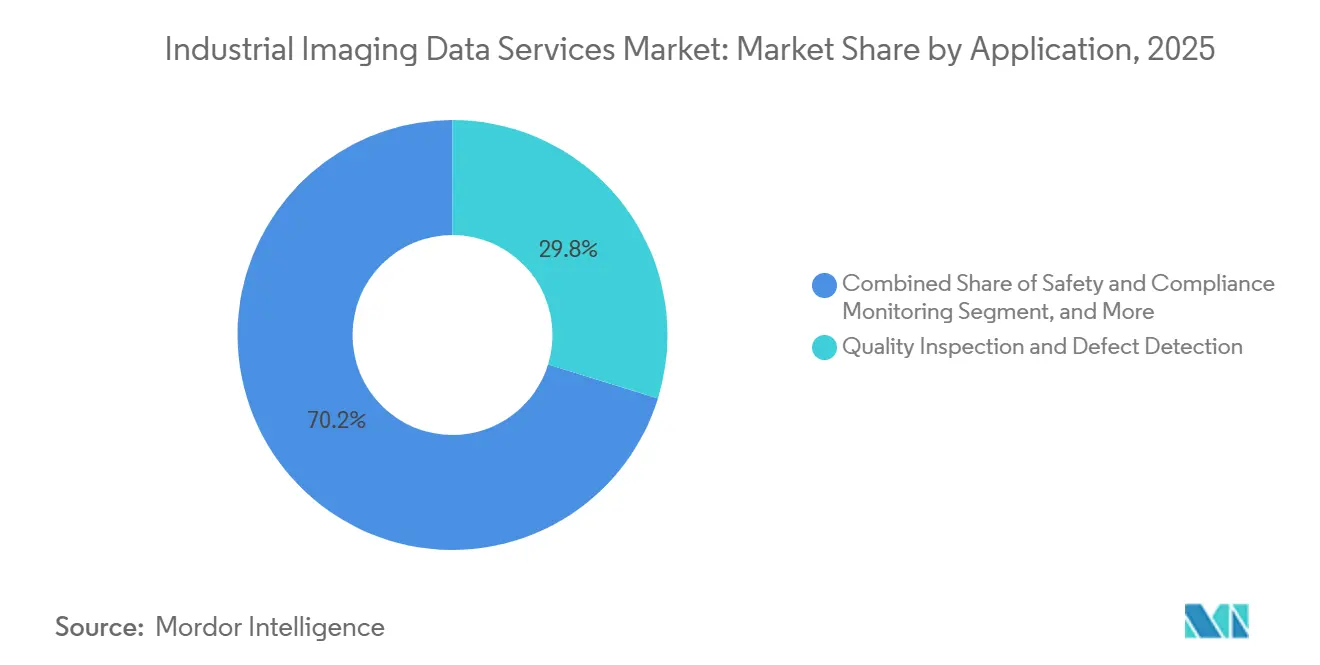
- By application, quality inspection and defect detection held 29.77% of the industrial imaging data services market share in 2025, while predictive maintenance and anomaly detection are projected to expand at a 15.11% CAGR through 2031.
- By industry vertical, automotive and mobility held 22.32% of the industrial imaging data services market share in 2025, while semiconductor and electronics is projected to expand at a 15.68% CAGR through 2031.
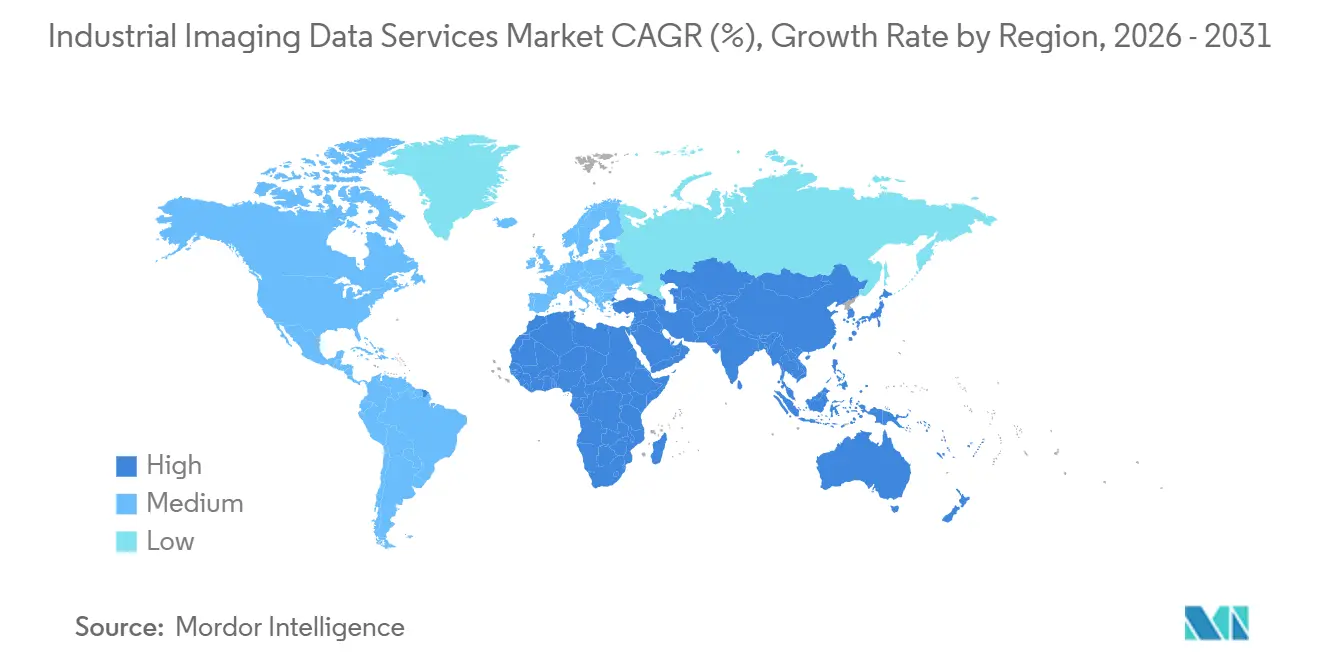
- By geography, North America held 34.38% of market value in 2025, while Asia-Pacific is projected to expand at a CAGR of 15.54% through 2031.
Note: Market size and forecast figures in this report are generated using Mordor Intelligence’s proprietary estimation framework, updated with the latest available data and insights as of January 2026.
Global Industrial Imaging Data Services Market Trends and Insights
Drivers Impact Analysis*
| Driver | (~) % Impact on CAGR Forecast | Geographic Relevance | Impact Timeline |
|---|---|---|---|
| Expansion of AI-Powered Quality Inspection | +3.2% | Global, with early gains in North America, Germany, Japan, and South Korea | Short term (≤ 2 years) |
| Rising Multisensor Data Complexity | +2.5% | Asia-Pacific core, with spillover to North America and Europe | Medium term (2-4 years) |
| Scarcity of Rare-Defect Data | +2.1% | Global, especially semiconductor and aerospace clusters | Short term (≤ 2 years) |
| Adoption of Physical AI and Vision-Guided Robotics | +1.9% | North America and Europe, with rapid Asia-Pacific adoption | Medium term (2-4 years) |
| Synthetic Data and Simulation | +1.5% | Global, especially automotive and semiconductor plants | Medium term (2-4 years) |
| Data Provenance and Traceability Requirements | +0.8% | Europe, the United Kingdom, the United States, and Asia-Pacific | Long term (≥ 4 years) |
| Source: Mordor Intelligence | |||
Expansion of AI-Powered Quality Inspection
Manufacturers accelerated the use of AI-enabled visual inspection during 2025. Rockwell Automation reported that 95% of surveyed manufacturing decision-makers had invested or planned to invest in machine learning or generative AI within 5 years.[1]Rockwell Automation, “State of Manufacturing Report 2025,” Rockwell Automation, rockwellautomation.com Quality control was the leading intended use case at 50%. Each deployment also creates repetitive labeling work when models encounter defects not represented in the original training data. A 2026 review found that many manufacturing vision systems remained in prototype or pilot use despite strong results in controlled environments. Cognex reported in May 2026 that OneVision had reached more than 100 customers since its 2025 beta release.
Rising Multisensor Data Complexity in Smart Factories
Industrial facilities are using RGB cameras, LiDAR, thermal imagers, hyperspectral sensors, and structured-light systems on the same production lines. These systems produce linked data that conventional image-labeling workflows do not always handle well. Spectral imaging can identify material and chemical differences that a standard RGB camera cannot detect. Push-broom systems increasingly support inline industrial inspection and material analysis. This raises the need for annotation teams that understand calibration, sensor noise, and differences in defect appearance across modalities.
Scarcity of Rare-Defect and Failure-Mode Data
High-performing production lines generate few genuine defect examples. This causes class imbalance in training sets and can reduce recall for rare but important failures. A semiconductor inspection study used 22,410 images, with crack defects accounting for less than 0.4% of the labels. Targeted augmentation is therefore important for model training in this setting. Aerospace and defense data can also be restricted by classification and export controls. Pharmaceutical imaging records may require additional traceability due to patient safety obligations.
Growing Adoption of Physical AI and Vision-Guided Robotics
Physical AI connects AI software with sensors and actuators used in operational environments. Vision-guided robots require defect labels as well as data on pose, orientation, and gripping conditions. This makes the required datasets more varied than standard still-image collections. Universal Robots and Scale AI introduced the UR AI Trainer in March 2026 to capture synchronized motion, force, and visual data. Research published in 2026 also showed how curated hybrid data can support recognition and correction across product variants. The industrial imaging data services market can benefit as these systems require specialized multimodal annotation.
Restraints Impact Analysis*
| Restraint | (~) % Impact on CAGR Forecast | Geographic Relevance | Impact Timeline |
|---|---|---|---|
| Industrial Data Sovereignty and Transfer Restrictions | -2.1% | Europe, China, India, and the United States | Short term (≤ 2 years) |
| Domain-Expert Shortage for Defect Taxonomies | -1.6% | Global, especially semiconductor and aerospace | Medium term (2-4 years) |
| High Validation Burden for Safety-Critical Models | -1.2% | North America, Europe, and Japan | Long term (≥ 4 years) |
| Synthetic-to-Real Domain-Transfer Risk | -0.9% | Global | Medium term (2-4 years) |
| Source: Mordor Intelligence | |||
Industrial Data Sovereignty and Cross-Border Transfer Restrictions
Cross-border rules limit the movement of proprietary production images. The EU Data Act applies accessibility requirements to connected products from September 12, 2026. The EU AI Act is fully applicable from August 2, 2026, and strengthens expectations for data governance in high-risk AI systems. Manufacturers may avoid offshore processing when images reveal process recipes, tooling conditions, or supplier-specific defect signatures. Secure local delivery can therefore become a procurement requirement. These conditions reduce the available labor pool but support demand for sovereign annotation services.
Domain-Expert Shortage for Ambiguous Defect Taxonomies
Complex failure analysis needs specialists rather than general data labelers. Defect interpretation can depend on material behavior, process history, and product geometry. IMDD-1M, presented at CVPR 2026, contains 1 million image-text pairs across more than 60 material categories and more than 400 defect types. Such broad coverage requires expert-verified labels. The shortage can delay model preparation and quality validation. It also gives service providers with engineering expertise a differentiated position.
*Our forecasts treat driver/restraint impacts as directional, not additive. The impact forecasts reflect baseline growth, mix effects, and variable interactions.
Segment Analysis
By Data Type: Still Images Remain the Largest Base While Spectral Data Advances
Still images held 42.13% of the industrial imaging data services market share in 2025. The result reflects long-standing investment in automated optical inspection across automotive, electronics, and consumer goods plants. Mature labeling tools support adoption by teams beginning machine-vision work. Video and image sequences also support process monitoring and robot perception. Their time-based data can capture changes in welding behavior and assembly sequence. Three-dimensional, depth, thermal, and spectral data address conditions that standard cameras cannot see.
Multispectral and hyperspectral data are projected to grow at a 15.67% CAGR through 2031. Lower sensor costs and industrial push-broom cameras support its adoption. Spectral information can help identify chemical composition and subsurface defects. An IEEE study reported subsurface defect detection in silicon carbide using a deep-learning-enhanced push-broom system in 2025.[2] IEEE ISCIT, “Deep Learning-Enhanced Push-Broom Hyperspectral Imaging System for Non-Destructive Subsurface Defect Detection,” doi.org These datasets require specialized annotation methods. This increases the value of providers capable of validating sensor-specific labels.



By Service Type: Annotation Leads While Synthetic Generation Grows Faster
Data annotation and labeling services held 32.45% of the industrial imaging data services market share in 2025. Manufacturers need updated labels after product redesigns, line changes, and new defect definitions. Collection, curation, augmentation, validation, and benchmarking remain important parts of the service mix. Curation helps organizations assess whether a dataset is fit for a particular model. Validation also supports governance where AI systems face higher assurance requirements. This makes annotation work more than a one-time data preparation step.
Synthetic data generation services are projected to expand at a 15.98% CAGR through 2031. These services address the limited availability of rare real-world defects. A review in the Journal of Manufacturing Systems described methods including generative adversarial networks, diffusion models, simulation, and variational autoencoders. A 2026 wafer inspection study achieved F1 scores above 0.96 on real images using synthetic training images. Synthetic data still requires careful validation before deployment. Providers that connect generation with benchmarking can address that need.
By Delivery Model, Cloud Services Lead and Hybrid Delivery Expands
Cloud-based services held 48.76% of the industrial imaging data services market share in 2025. Centralized systems help enterprises manage models, versions, and labeling workflows across sites. They can support common governance processes for distributed manufacturing operations. On-premises delivery remains important for defense and regulated pharmaceutical facilities. These customers may prohibit the external transmission of production images. The delivery choice, therefore, depends on security, compliance, and operating requirements.
Hybrid and edge-connected services are projected to expand at a 15.71% CAGR through 2031. High-speed inspection may require local inference without the delay of a cloud round trip. Cognex OneVision combines central model development with edge execution. This architecture supports local operation while retaining centralized workflow management. Hybrid delivery also requires edge-compatible model artifacts and organized training data. The industrial imaging data services market, therefore, gains work beyond standard annotation.
By Application, Quality Inspection Leads While Predictive Maintenance Develops
Quality inspection and defect detection held 29.77% of the industrial imaging data services market share in 2025. Surface and dimensional inspection are used across discrete manufacturing sectors. Measurement, robot guidance, identification, traceability, and process monitoring also require different data formats. Pharmaceutical and food traceability programs may need OCR labels that align with audit records. The wide use of inspection sustains demand across diverse factory environments. It also makes consistent labeling standards important for scale.
Predictive maintenance and anomaly detection are projected to expand at a 15.11% CAGR through 2031. This use case links image records with equipment condition and telemetry data. It shifts the value case toward better equipment uptime and asset use. Energy, aerospace, and industrial machinery are relevant settings because equipment downtime can be costly. Multimodal datasets are needed to link visual signs with operating conditions. Few general labeling providers have established this capability at scale.
By Industry Vertical, Automotive Leads While Semiconductor and Electronics Expands
Automotive and mobility held 22.32% of the industrial imaging data services market share in 2025. Vehicle production uses machine vision for panels, welds, and powertrain components. Model-year updates and supplier changes create new labeling needs. Battery electric vehicle components add further inspection requirements. Battery casing welds and hairpin stator windings are examples. Existing datasets cannot always be reused when the underlying process changes.
The semiconductor and electronics sector is projected to expand at a 15.68% CAGR through 2031. Smaller process nodes make line-edge roughness, voids, and electrostatic damage harder to detect. Interx developed Inspection.AI for semiconductor PCB and package-substrate manufacturing. Industrial machinery, aerospace and defense, energy, food and beverage, and pharmaceutical production remain relevant verticals. Regulated pharmaceutical and medical device applications require well-documented datasets. This supports demand for service providers with domain knowledge and controlled workflows.
Geography Analysis
North America held 34.38% of the industrial imaging data services market share in 2025. The United States has major automotive, semiconductor, and aerospace production bases with established AI inspection programs. Mature cloud infrastructure and technical talent support managed annotation workflows. Canada contributes through its automotive corridor and AI services base. Mexico adds demand through electronics and automotive manufacturing. Physical AI testing in the region can shape datasets used more broadly.
Europe was the second-largest region in 2025. Germany, France, the United Kingdom, Italy, and Spain are important demand centers. VDMA and VDI/VDE guidance support formal machine-vision acceptance practices in Germany.[3]VDMA, “Richtlinien VDI/VDE/VDMA 2632,” VDMA, wileyindustrynews.com The EU AI Act increases the importance of data lineage and traceability. South America, the Middle East, and Africa have smaller but growing opportunities. Brazil, Saudi Arabia, and South Africa reflect different industrial demand patterns.
Asia-Pacific is projected to grow at a 15.54% CAGR through 2031. China has scale in electronics assembly, while South Korea has dense semiconductor activity. Japan brings established precision manufacturing, and India has an expanding manufacturing base. China’s data-transfer requirements favor domestic or sovereign service models. South Korea’s AI Hub published manufacturing datasets in 2025 for SMT process defect prediction and welding detection. The region is becoming both an important demand center and a supply base for specialized annotation work.

Competitive Landscape
The industrial imaging data services market is moderately fragmented. Managed workforce providers, annotation platforms, and synthetic or physical AI specialists address different requirements. Appen, TELUS Digital, CloudFactory, Samasource, iMerit, Labelbox, SuperAnnotate, V7 Labs, Scale AI, DataForce, Defined.ai, Shaip, Quantigo AI, and LXT AI are among the named participants. Their positions differ by workforce model, platform capability, security posture, and domain expertise. No combined market-share data for the leading firms was supplied.
EXL completed its acquisition of iMerit in August 2026 for up to USD 310 million. The transaction adds specialist annotation capabilities to EXL’s enterprise data and AI practice.[4]ExlService Holdings, “EXL Completes Acquisition of iMerit, Accelerating Enterprise AI Leadership,” EXL Newsroom, exlservice.com Labelbox acquired Upcraft in February 2026 to expand its automated expert workflow capacity. Cognex made OneVision generally available in May 2026. These moves show efforts to combine data workflows, expert capacity, and industrial deployment. Onshore and sovereign annotation services are an important opportunity where cross-border movement is limited.
Physical AI data services need teleoperation capture, multimodal fusion, and annotation for Vision-Language-Action training. Industrial foundation-model adaptation also depends on calibration and benchmarking data for narrow defect types. Active learning and quality-assurance automation can reduce routine labeling work. Domain specialists remain important for ambiguous cases. Competition will continue to depend on the ability to supply reliable and auditable data.
Industrial Imaging Data Services Industry Leaders
Appen Limited
Alegion, Inc.
Cogito Tech LLC
iMerit Technology Services Private Limited
SuperAnnotate AI, Inc.
- *Disclaimer: Major Players sorted in no particular order

Recent Industry Developments
- August 2026: EXL completed the acquisition of iMerit for up to USD 310 million in upfront and contingent consideration.
- June 2026: Musashi AI unveiled the commercial configuration of its Gen 2 Cendiant inspection system at Automate 2026 in Chicago.
- May 2026: Cognex announced general availability of OneVision after reaching more than 100 customers since its June 2025 beta launch.
- February 2026: Labelbox acquired Upcraft to support workforce scaling within its Alignerr network.


Global Industrial Imaging Data Services Market Report Scope
The industrial imaging data services market comprises services that support the acquisition, storage, processing, management, analysis, and interpretation of image-based data generated across industrial environments. These services use technologies such as machine vision, thermal imaging, X-ray imaging, hyperspectral imaging, and 3D imaging to support applications including quality inspection, predictive maintenance, asset monitoring, process optimization, and operational safety.
The Industrial Imaging Data Services Market Report Is Segmented by Data Type (Still Images, Video and Image Sequences, 3D and Depth Imaging Data, Multispectral and Hyperspectral Data, and Thermal Imaging Data), Service Type (Data Collection Services, Data Annotation and Labeling Services, Data Curation and Quality Management Services, Data Augmentation Services, Synthetic Data Generation Services, and Dataset Validation and Benchmarking Services), Delivery Model (Cloud-Based Services, On-Premises Services, and Hybrid and Edge-Connected Services), Application (Quality Inspection and Defect Detection, Dimensional Measurement and Metrology, Robot Perception and Guidance, Identification and Traceability, Process Monitoring, Predictive Maintenance and Anomaly Detection, and Safety and Compliance Monitoring), Industry Vertical (Automotive and Mobility, Semiconductor and Electronics, Industrial Machinery and Equipment, Aerospace and Defense, Energy and Utilities, Food and Beverage Manufacturing, Pharmaceutical and Medical Device Manufacturing, and Other Industry Verticals), and Geography (North America, South America, Europe, Asia-Pacific, Middle East, and Africa). The Market Forecasts are Provided in Terms of Value (USD).
| Still Images |
| Video and Image Sequences |
| 3D / Depth Imaging Data |
| Multispectral and Hyperspectral Data |
| Thermal Imaging Data |
| Data Collection Services |
| Data Annotation and Labeling Services |
| Data Curation and Quality Management Services |
| Data Augmentation Services |
| Synthetic Data Generation Services |
| Dataset Validation and Benchmarking Services |
| Cloud-Based Services |
| On-Premises Services |
| Hybrid and Edge-Connected Services |
| Quality Inspection and Defect Detection |
| Dimensional Measurement and Metrology |
| Robot Perception and Guidance |
| Identification and Traceability |
| Process Monitoring |
| Predictive Maintenance and Anomaly Detection |
| Safety and Compliance Monitoring |
| Automotive and Mobility |
| Semiconductor and Electronics |
| Industrial Machinery and Equipment |
| Aerospace and Defense |
| Energy and Utilities |
| Food and Beverage Manufacturing |
| Pharmaceutical and Medical Device Manufacturing |
| Other Industry Verticals |
| North America | United States |
| Canada | |
| Mexico | |
| South America | Brazil |
| Argentina | |
| Chile | |
| Rest of South America | |
| Europe | Germany |
| United Kingdom | |
| France | |
| Italy | |
| Spain | |
| Rest of Europe | |
| Asia-Pacific | China |
| Japan | |
| India | |
| South Korea | |
| Rest of Asia-Pacific | |
| Middle East | United Arab Emirates |
| Saudi Arabia | |
| Qatar | |
| Rest of Middle East | |
| Africa | South Africa |
| Egypt | |
| Nigeria | |
| Rest of Africa |
| By Data Type | Still Images | |
| Video and Image Sequences | ||
| 3D / Depth Imaging Data | ||
| Multispectral and Hyperspectral Data | ||
| Thermal Imaging Data | ||
| By Service Type | Data Collection Services | |
| Data Annotation and Labeling Services | ||
| Data Curation and Quality Management Services | ||
| Data Augmentation Services | ||
| Synthetic Data Generation Services | ||
| Dataset Validation and Benchmarking Services | ||
| By Delivery Model | Cloud-Based Services | |
| On-Premises Services | ||
| Hybrid and Edge-Connected Services | ||
| By Application | Quality Inspection and Defect Detection | |
| Dimensional Measurement and Metrology | ||
| Robot Perception and Guidance | ||
| Identification and Traceability | ||
| Process Monitoring | ||
| Predictive Maintenance and Anomaly Detection | ||
| Safety and Compliance Monitoring | ||
| By Industry Vertical | Automotive and Mobility | |
| Semiconductor and Electronics | ||
| Industrial Machinery and Equipment | ||
| Aerospace and Defense | ||
| Energy and Utilities | ||
| Food and Beverage Manufacturing | ||
| Pharmaceutical and Medical Device Manufacturing | ||
| Other Industry Verticals | ||
| By Geography | North America | United States |
| Canada | ||
| Mexico | ||
| South America | Brazil | |
| Argentina | ||
| Chile | ||
| Rest of South America | ||
| Europe | Germany | |
| United Kingdom | ||
| France | ||
| Italy | ||
| Spain | ||
| Rest of Europe | ||
| Asia-Pacific | China | |
| Japan | ||
| India | ||
| South Korea | ||
| Rest of Asia-Pacific | ||
| Middle East | United Arab Emirates | |
| Saudi Arabia | ||
| Qatar | ||
| Rest of Middle East | ||
| Africa | South Africa | |
| Egypt | ||
| Nigeria | ||
| Rest of Africa | ||


Key Questions Answered in the Report
What is the industrial imaging data services market size?
The industrial imaging data services market size is USD 0.88 billion in 2026 and is projected to reach USD 1.71 billion by 2031.
What is driving demand for industrial imaging data services?
AI-powered inspection, complex sensor data, rare-defect data shortages, physical AI, and data governance requirements are key factors.
Which data type leads industrial imaging data services?
Still images led with 42.13% share in 2025, supported by established automated optical inspection systems.
Which service is growing fastest?
Synthetic data generation services are projected to grow at a 15.98% CAGR through 2031.
Which region is growing fastest?
Asia-Pacific is projected to grow at a 15.54% CAGR through 2031.
Why are hybrid and edge-connected services expanding?
They support low-latency local inference while allowing centralized workflow and model governance.
Page last updated on:





