
Industrial Emission Control System Market Size and Share
Market Overview
| Study Period | 2022 - 2032 |
|---|---|
| Market Size (2027) | USD 30.13 Billion |
| Market Size (2032) | USD 40.20 Billion |
| Growth Rate (2027 - 2032) | 5.94 % |
| Fastest Growing Market | Asia-Pacific |
| Largest Market | Asia-Pacific |
| Market Concentration | Medium |
Major Players *Disclaimer: Major Players sorted in no particular order Image © Mordor Intelligence. Reuse requires attribution under CC BY 4.0. | |
Industrial Emission Control System Market Analysis by Mordor Intelligence
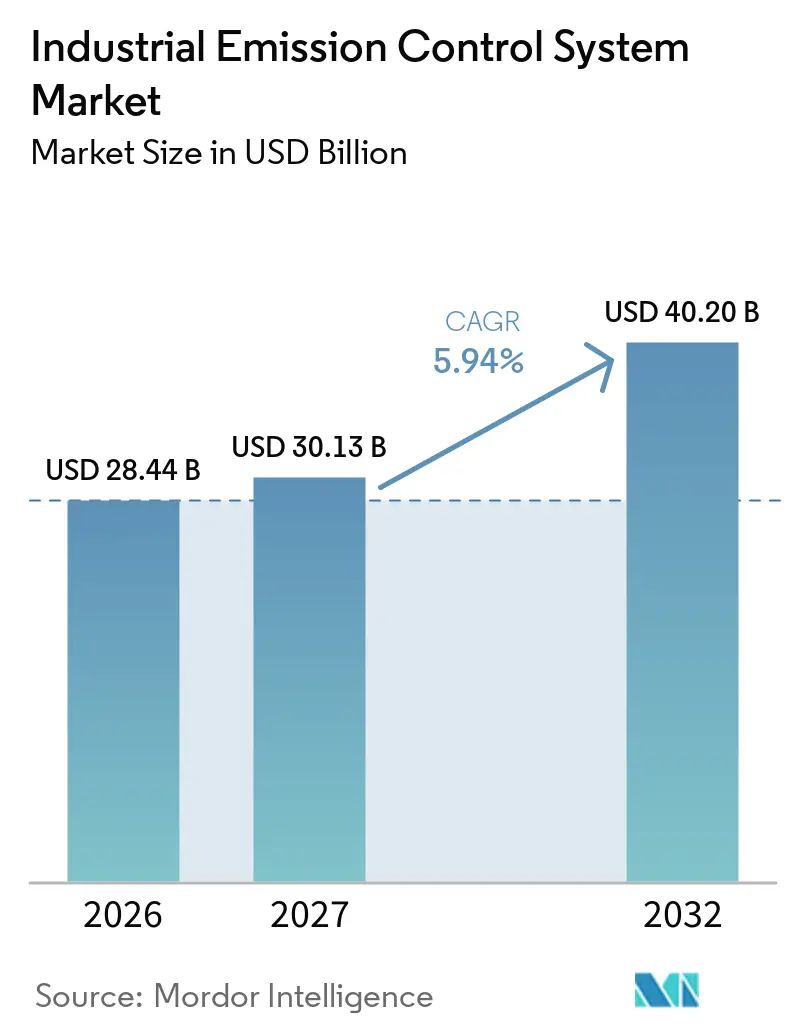
The Industrial Emission Control System Market size was valued at USD 28.44 billion in 2026 and is estimated to grow from USD 30.13 billion in 2027 to reach USD 40.20 billion by 2032, at a CAGR of 5.94% during the forecast period (2027-2032). The global industrial emission control system market is being shaped by compliance deadlines that affect utilities, cement plants, steel facilities, chemical sites, and other industrial operations at the same time. Operators increasingly need equipment that manages particulate matter, sulfur oxides, nitrogen oxides, and greenhouse gases within a single project. This is moving procurement toward integrated abatement systems rather than separate equipment additions. Regulatory changes in the European Union, India, China, and the United States are widening the number of facilities that must upgrade their controls. The global industrial emission control system market also benefits when suppliers combine engineering, equipment, monitoring, and maintenance services within one contract.
Key Report Takeaways
- By technology, flue gas desulfurization systems held 25.4% of the global industrial emission control system market share in 2026, while selective catalytic reduction is projected to grow at a 6.5% CAGR through 2032.
- By pollutant type, particulate matter controls held 29.3% of the global industrial emission control system market share in 2026, while greenhouse gas abatement is projected to grow at a 7.1% CAGR through 2032.
- By end-user industry, power generation held 32.7% of the global industrial emission control system market share in 2026, while waste-to-energy is projected to grow at a 7.4% CAGR through 2032.
- By geography, Asia-Pacific held 43.2% of the global industrial emission control system market share in 2026 and is projected to grow at a 7.2% CAGR through 2032.
Note: Market numbers in this report are based on Mordor Intelligence's proprietary estimation framework, which combines nine months of actuals with Q4 projections for base year 2026.
Market Trends and Insights
Drivers Impact Analysis of Industrial Emission Control System Market*
| Driver | (~) % Impact on CAGR Forecast | Geographic Relevance | Impact Timeline |
|---|---|---|---|
| Stricter Multi-Sector Emission Caps | +1.4% | Global | Short term (≤ 2 years) |
| Asia-Pacific Coal and Heavy-Industry Retrofit Cycle | +1.2% | APAC core, spillover to MEA | Medium term (2-4 years) |
| Industrial Decarbonization and Carbon-Capture Pretreatment | +0.9% | Global, led by Europe and North America | Long term (≥ 4 years) |
| Data-Center-Led Gas-Turbine Capacity Additions | +0.8% | North America, Europe, and APAC | Short term (≤ 2 years) |
| AI-Enabled Predictive Maintenance and Compliance Analytics | +0.5% | Global | Medium term (2-4 years) |
| Net-Zero Industrial Clusters and Modular Abatement Packages | +0.6% | Europe, East Asia, and Gulf States | Long term (≥ 4 years) |
| Source: Mordor Intelligence | |||
Stricter Multi-Sector Emission Caps
The global industrial emission control system market is gaining support as regulation extends beyond utilities into industries that historically faced less stringent permit conditions. The revised EU Industrial Emissions Directive entered into force in August 2024 and must be transposed by July 1, 2026. It extends best-available-technique permit obligations to metal ore mining and large battery manufacturing. The directive also requires penalties of at least 3% of annual turnover for serious violations.[1] India’s CAQM Statutory Direction No. 98 requires a particulate matter ceiling of 50 mg/Nm³ for 17 categories of highly polluting industries in Delhi-NCR from August 1, 2026.[2] These overlapping requirements encourage cement and steel operators to procure coordinated controls for dust, sulfur oxides, and nitrogen oxides instead of treating each pollutant through separate projects.
Asia-Pacific Coal and Heavy-Industry Retrofit Cycle
The Asia-Pacific retrofit cycle remains a major source of demand for the global industrial emission control system market. China extended its ultra-low-emission program to cement and coke in 2024, bringing 2 high-emitting industries into a broader compliance cycle. In 2026, technical guides T/CAEPI 117-2026 for cement and T/CAEPI 119-2026 for coal-fired industrial boilers translated this policy direction into equipment guidance. China also issued JB/T 15533-2026 in April 2026 for flue gas desulfurization, denitrification, and dust removal equipment used in rolling mill heating furnaces, with implementation scheduled for November 2026. India’s carbon credit trading framework covers 490 industrial plants across 8 sectors under greenhouse gas intensity rules notified in 2025 and January 2026. The need to demonstrate compliance is also increasing demand for digital monitoring alongside physical control systems.
Industrial Decarbonization and Carbon-Capture Pretreatment
Carbon capture projects create additional demand for upstream controls in the global industrial emission control system market. Carbon dioxide capture systems require feed gas that has been treated for particulate matter, sulfur oxides, and nitrogen oxides. This makes flue gas desulfurization, baghouse filtration, and high-selectivity SCR equipment part of the technical foundation for capture projects. The United Kingdom’s November 2025 update on industrial carbon capture business models confirmed revenue support for industrial capture projects and stated that CCUS could support up to 50,000 jobs and GBP 5 billion in annual economic value by 2050. GE Vernova and YTL PowerSeraya began a post-combustion capture feasibility study at Jurong Island in October 2025, with support from Singapore’s Energy Market Authority. Mitsubishi Heavy Industries commissioned a carbon dioxide recovery pilot at Kansai Electric’s Himeji No. 2 station in May 2025 with a capacity of 5 tonnes per day.
Data-Center-Led Gas-Turbine Capacity Additions
New on-site gas turbine installations at large data centers are creating a focused demand channel for the global industrial emission control system market. These turbines must meet local nitrogen oxide permit limits, which can be as low as 2 to 5 parts per million. Standard dry low-NOx combustion controls may not meet those limits, leaving SCR as a required add-on for certain installations. The US Environmental Protection Agency finalized stationary combustion turbine standards in January 2026 that require SCR for large, high-utilization units. GE Vernova reported a 74% year-over-year increase in gas turbine orders in 2025, with backlog equivalent to 40 gigawatts. This demand favors suppliers that can provide compact SCR systems, monitoring equipment, and ongoing maintenance for distributed generation facilities.
Restraints Impact Analysis of Industrial Emission Control System Market*
| Restraint | (~) % Impact on CAGR Forecast | Geographic Relevance | Impact Timelin |
|---|---|---|---|
| High Installed-System CAPEX and O&M Burden | -0.8% | Global | Short term (≤ 2 years) |
| Coal-Fleet Retirement in Mature Markets | -0.5% | North America and Europe | Medium term (2-4 years) |
| Long Outage-Installation and Certification Cycles | -0.4% | Global | Short term (≤ 2 years) |
| Reagent, Catalyst and Secondary-Waste Volatility | -0.3% | Global | Medium term (2-4 years) |
| Source: Mordor Intelligence | |||
High Installed-System CAPEX and O&M Burden
High capital requirements can delay projects in the global industrial emission control system market, especially when compliance deadlines move faster than plant financing decisions. Large flue gas desulfurization and SCR retrofits often require major shutdown planning, installation work, commissioning, and continuous emissions monitoring. Smaller industrial sites in developing economies may have limited access to long-term project financing or sustainability-linked credit. Operating costs also depend on inputs such as urea, ammonia, limestone, and catalyst materials. Changes in the cost or availability of these inputs make long-term maintenance pricing more difficult for both plant operators and suppliers. Long outage, installation, and certification cycles can further extend procurement decisions even when a plant has already identified a compliance need.
Coal-Fleet Retirement in Mature Markets
Coal retirements in North America and Western Europe reduce the recurring service base for legacy FGD, electrostatic precipitator, and SCR assets. This contraction is a restraint for the global industrial emission control system market because installed coal fleets historically supported long-term maintenance revenue. GE Vernova received an order from Enea Group in November 2025 for 2 H-Class combined-cycle blocks at Kozienice, Poland, with emissions projected to be up to 60% lower than the coal capacity displaced. Babcock & Wilcox partnered with Denham Capital in September 2025 to convert existing coal plants to gas-fired power for data centers in the United States and Europe. The transition creates openings in gas turbine servicing and carbon-capture pretreatment, but suppliers that remain tied to coal assets face lower long-term service demand. Reagent, catalyst, and secondary-waste management costs add further pressure when operators assess whether to extend or retire older equipment.
*Our forecasts treat driver/restraint impacts as directional, not additive. The impact forecasts reflect baseline growth, mix effects, and variable interactions.
Industrial Emission Control System Market Segment Analysis
By Technology:
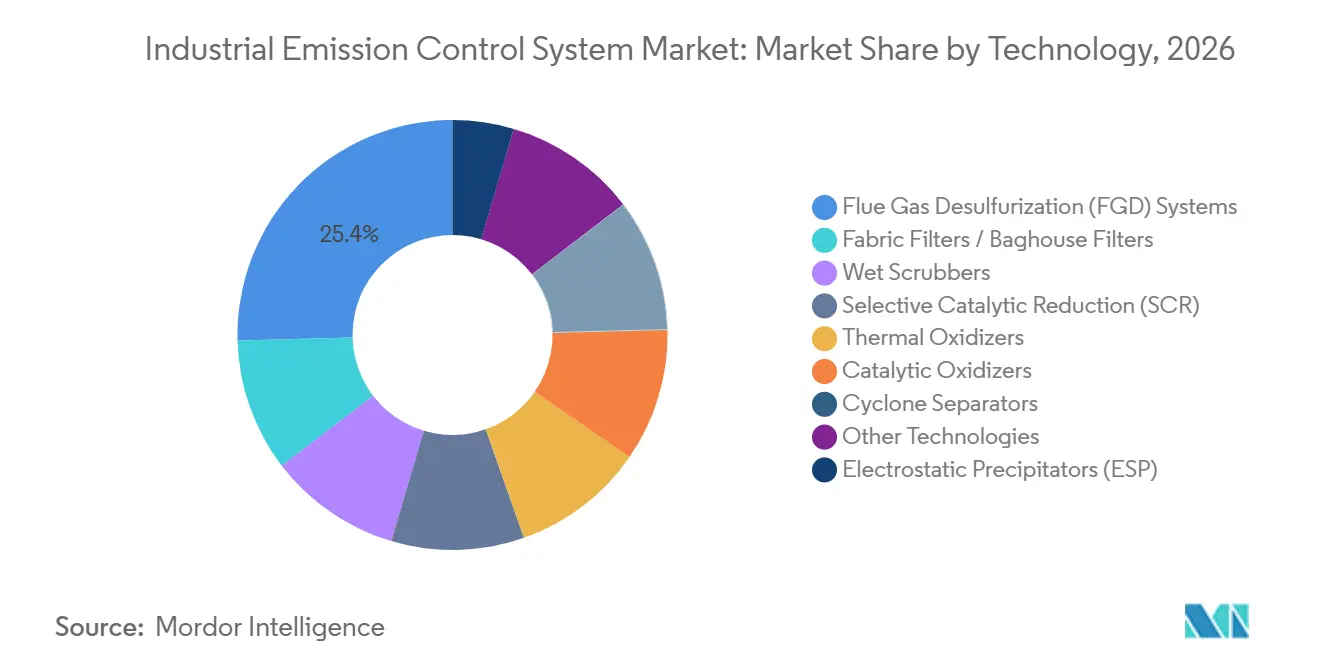
SCR Growth Supports Broader Multi-Pollutant SystemsFlue gas desulfurization systems held 25.4% of the global industrial emission control system market share in 2026. Their role remains closely linked to sulfur dioxide compliance in coal-fired power generation and cement production across China, India, and Southeast Asia. Wet limestone scrubbing is increasingly supplied with mist elimination and wastewater recovery components, which broadens the scope of individual projects. Electrostatic precipitators and fabric filters remain core particulate matter controls. They also serve as important pretreatment stages before FGD and SCR equipment. Wet scrubbers continue to address acid gases and particulate matter in waste-to-energy and chemical applications.
Selective catalytic reduction has the highest forecast growth rate among the listed technologies at 6.5% CAGR through 2032. The global industrial emission control system market size for SCR is supported by the January 2026 US turbine standards and China’s DL/T 3030-2026 guidance on SCR denitrification for flexible coal power operation. Thermal and catalytic oxidizers serve VOC-intensive automotive, pharmaceutical, and chemical operations. Dürr CTS launched a fully electrified Oxi.X regenerative thermal oxidizer line in May 2026 for flows up to 120,000 Nm³/h. Cyclone separators continue to protect downstream high-efficiency equipment. Technology providers are increasingly positioned to offer complete systems for particulate matter, sulfur oxides, and nitrogen oxides within one contract.

By Pollutant Type:
Greenhouse Gas Abatement Extends System ScopeParticulate matter controls held 29.3% of the global industrial emission control system market share in 2026. Particulate removal is a common first step for facilities seeking to comply with air quality requirements. It also protects downstream capture, scrubbing, and catalytic equipment from solids. Nitrogen oxide controls are supported by gas turbine permitting, furnace retrofits, cement upgrades, and power plant applications. Sulfur oxide control remains significant in regions that are still completing coal-fleet FGD upgrades. Carbon monoxide and other pollutants are commonly handled through catalytic oxidation installed with nitrogen oxide or VOC systems.
Greenhouse gas abatement is forecast to grow at 7.1% CAGR through 2032, the fastest rate among pollutant categories. The global industrial emission control system market size for greenhouse gas abatement is linked to carbon capture pretreatment and India’s framework for 490 plants across 8 sectors. VOC controls also benefit from tighter requirements and from demand in chemical, pharmaceutical, and manufacturing facilities. Mercury, heavy metals, and hazardous air pollutants remain technically important in waste-to-energy and pharmaceutical incineration. These applications require closely controlled filtration, sorbent injection, and monitoring arrangements. The mix of pollutant requirements increases the value of systems that combine several treatment stages.
By End-User Industry:
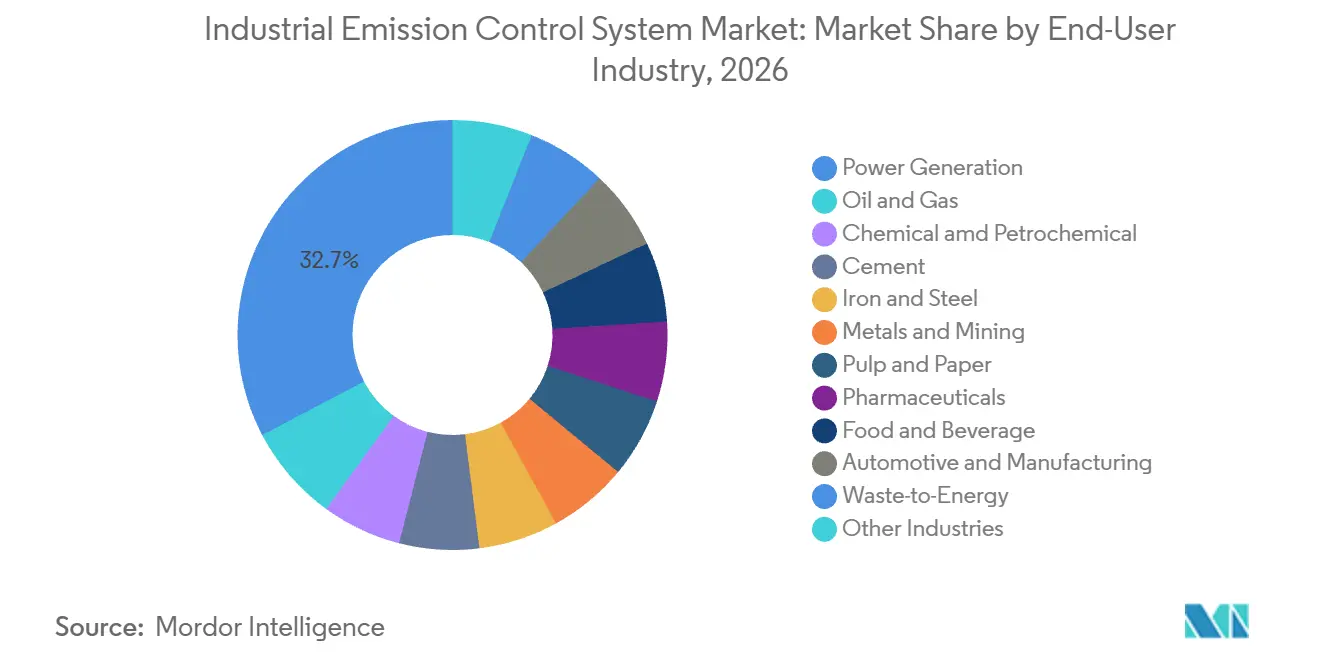
Waste-to-Energy Growth Broadens Demand Beyond PowerPower generation held 32.7% of the global industrial emission control system market share in 2026. The sector remains important because it includes coal fleet upgrades in Asia and gas turbine retrofits in North America and Europe. Its share may decline over time as coal retirements in mature economies outpace additions to gas-fired aftermarket demand. Oil and gas operations remain meaningful users of emission controls. Chemical and petrochemical facilities also require VOC, sulfur, particulate matter, and combustion-related controls. These sectors support continued demand for both project work and maintenance services.
Waste-to-energy is forecast to grow at 7.4% CAGR through 2032, the fastest rate among the listed end-user industries. The global industrial emission control system market is supported in this application by the need for integrated particulate matter, nitrogen oxide, acid gas, and trace pollutant controls. Cement, iron, and steel are also high-volume end users as industrial standards tighten and older equipment is replaced. China’s GB 4915-2013/XG1-2026 amendment tightens air pollutant limits for cement facilities in 2026. Metals and mining gain a new demand category through the revised EU Industrial Emissions Directive. Pharmaceutical, food and beverage, automotive, and general manufacturing sites remain smaller demand pools, but their requirements for VOC and odor control are becoming more compliance-led.
Geography Analysis
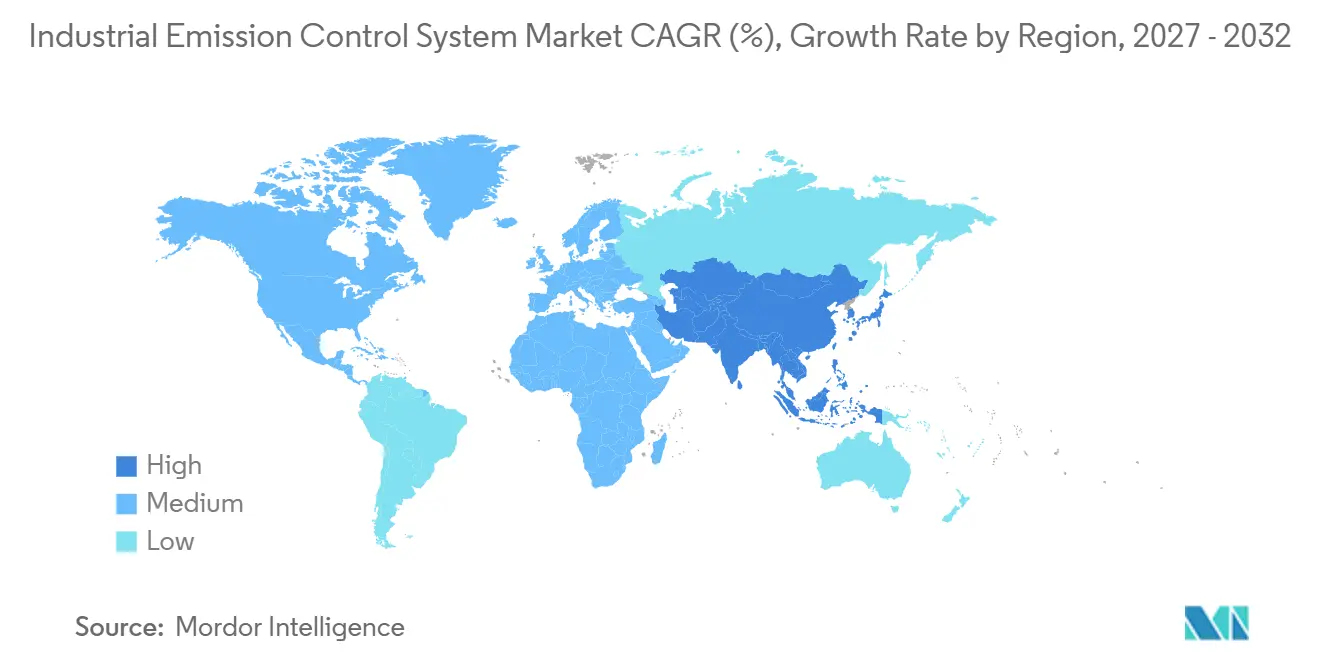
Asia-Pacific held 43.2% of the global industrial emission control system market share in 2026 and is forecast to grow at 7.2% CAGR through 2032. China’s ultra-low-emission expansion in cement and coke is supported by the 2026 technical guides for cement enterprises and coal-fired industrial boilers. India’s CAQM particulate matter requirement takes effect in Delhi-NCR in August 2026. India also has greenhouse gas intensity rules covering 490 plants across 8 sectors. Mitsubishi Heavy Industries’ Himeji pilot and Kawasaki Heavy Industries’ commercial-scale capture demonstration in Kobe show the role of carbon capture projects in Japan.
North America and Europe form another major demand area, although their drivers differ. In the United States, the global industrial emission control system market is supported by SCR requirements for large, high-utilization stationary turbines under the January 2026 EPA standards. This provides demand at large data center campuses and other regulated generation sites. Europe is shaped by the July 1, 2026 deadline for national transposition of the revised Industrial Emissions Directive. Germany has around 13,000 IED-regulated sites under its implementation process. The United Kingdom’s industrial carbon capture support adds a second source of demand for upstream pretreatment equipment.
South America and the Middle East and Africa are earlier in their regulatory development. Brazil is the most active South American country in the supplied material, with rules affecting oil refining, cement, and industrial combustion. Chile is advancing sulfur dioxide controls, while macroeconomic conditions in Argentina can limit capital commitments. Saudi Arabia and the United Arab Emirates support demand through industrial diversification and supply-chain decarbonization requirements from European customers. South Africa has a sizeable potential retrofit base in its coal fleet, although utility financial conditions have delayed work. Egypt and Morocco are earlier-stage opportunities as industrial infrastructure expands. GE Vernova’s April 2026 order to modernize plants in Egypt shows continued equipment activity in the region.
Competitive Landscape
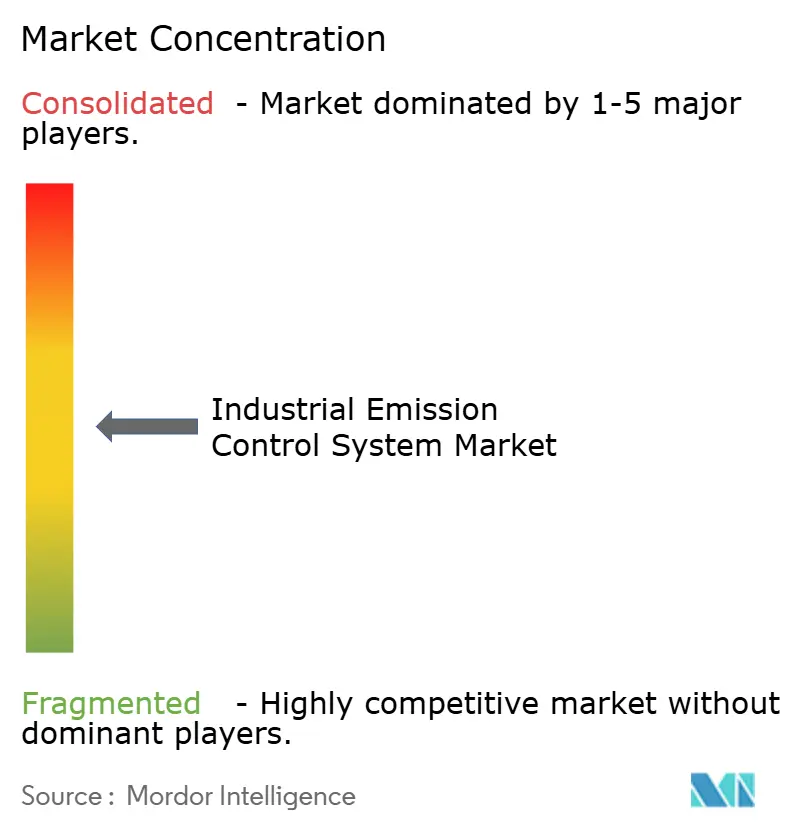
The global industrial emission control system market is moderately concentrated. Mitsubishi Heavy Industries, GE Vernova, Siemens Energy, and Honeywell compete through full engineering, procurement, and construction scope and broad aftermarket coverage. CECO Environmental, Babcock & Wilcox, Fuel Tech, Thermax, and Valmet maintain positions in particular technologies or service geographies. ANDRITZ, Donaldson, Ducon Technologies, Dürr AG, FLSmidth, GEA Group, Hamon & Cie, Johnson Matthey, AAF International, and Anguil Environmental Systems are also relevant equipment providers. ABB, Emerson Electric, Yokogawa, and Horiba contribute automation, measurement, and emissions management capabilities. This mix supports competition across equipment supply, integration, monitoring, and service.
Consolidation is changing the position of mid-sized suppliers in the global industrial emission control system market. CECO Environmental completed its combination with Thermon Group Holdings in June 2026, creating a broader environmental and thermal solutions platform and targeting USD 40 million in annual synergies. Donaldson signed an agreement in February 2026 to acquire Facet Filtration for USD 820 million. These moves broaden the product and service base of filtration and environmental equipment suppliers. Suppliers are also seeking to reduce dependence on one abatement technology or a single end-use sector. The competitive value of low-temperature SCR catalysts remains important because they could extend SCR use to lower-temperature industrial settings.
Technology differentiation increasingly includes electrification, continuous measurement, and predictive maintenance. Dürr CTS’s electrically heated Oxi.X line provides an alternative for facilities seeking exhaust purification without fossil fuel combustion in the oxidation unit. Operators are consolidating monitoring and control procurement to reduce integration complexity. This gives providers of compliance analytics and maintenance services a stronger role in supplier selection. Modular FGD and SCR packages may be relevant for smaller facilities in emerging economies that do not fit traditional large EPC projects. Pre-engineered systems can provide a separate route to demand alongside bespoke installations. The global industrial emission control system market therefore remains competitive across both project delivery and recurring services.
Industrial Emission Control System Industry Leaders
-
Mitsubishi Heavy Industries, Ltd.
-
GE Vernova Inc.
-
Babcock & Wilcox Enterprises, Inc.
-
Siemens Energy AG
-
Thermax Limited
- *Disclaimer: Major Players sorted in no particular order
Industrial Emission Control System Market Companies Covered in this Report
- AAF International
- ABB Ltd.
- ANDRITZ AG
- Anguil Environmental Systems, Inc.
- Babcock & Wilcox Enterprises, Inc.
- CECO Environmental Corp.
- Donaldson Company, Inc.
- Doosan Enerbility Co., Ltd.
- Ducon Technologies Inc.
- Durr AG
- Emerson Electric Co.
- FLSmidth & Co. A/S
- Fuel Tech, Inc.
- GE Vernova Inc.
- GEA Group AG
- Hamon & Cie (International) SA
- Honeywell International Inc.
- Horiba, Ltd.
- Johnson Matthey Plc
- Mitsubishi Heavy Industries, Ltd.
- Siemens Energy AG
- Thermax Limited
- Valmet Oyj
- Yokogawa Electric Corporation
Recent Industry Developments in Industrial Emission Control System Market
- June 2026: CECO Environmental completed its USD 2.2 billion combination with Thermon Group Holdings, establishing an integrated environmental and thermal solutions platform under CEO Todd Gleason with USD 40 million in targeted annual synergies.
- June 2026: GE Vernova secured an order for 2 9HA.02 gas turbines for Vietnam Electricity’s 1.6 GW Quang Trach II LNG power plant, targeting commercial operations by 2030 and adding emission-linked generation scope in Southeast Asia.
- May 2026: Dürr CTS became the first manufacturer to offer its entire Oxi.X RTO line in electrically heated versions handling flows up to 120,000 Nm³/h, eliminating fossil fuel combustion from industrial exhaust purification for chemical, pharmaceutical, and automotive customers.
Global Industrial Emission Control System Market Report Scope
An industrial emission control system comprises engineering equipment, hardware, and continuous monitoring tools that capture, treat, and neutralize harmful pollutants and greenhouse gases before factories, power plants, or refineries release exhaust gases or vapors into the atmosphere.
The global industrial emission control system market is segmented by technology, pollutant type, end-user industry, and geography. By technology, the market is segmented into electrostatic precipitators (ESP), fabric filters/baghouse filters, flue gas desulfurization (FGD) systems, wet scrubbers, selective catalytic reduction (SCR), thermal oxidizers, catalytic oxidizers, cyclone separators, and other technologies. By pollutant type, the market is segmented into particulate matter (PM), nitrogen oxides (NOx), sulfur oxides (SOx/SO₂), volatile organic compounds (VOCs), carbon monoxide (CO), mercury and heavy metals, hazardous air pollutants (HAPs), greenhouse gases (GHGs), and other pollutants. By end-user industry, the market is segmented into power generation, oil & gas, chemical & petrochemical, cement, iron & steel, metals & mining, pulp & paper, pharmaceuticals, food & beverage, automotive and manufacturing, waste-to-energy, and other industries. The report also covers the market size and forecasts for the global industrial emission control system market across 26 countries in the key regions. For each segment, market sizing and forecasts are provided in terms of value (USD).
Segmentation Overview
| Electrostatic Precipitators (ESP) |
| Fabric Filters / Baghouse Filters |
| Flue Gas Desulfurization (FGD) Systems |
| Wet Scrubbers |
| Selective Catalytic Reduction (SCR) |
| Thermal Oxidizers |
| Catalytic Oxidizers |
| Cyclone Separators |
| Other Technologies |
| Particulate Matter (PM) |
| Nitrogen Oxides (NOx) |
| Sulfur Oxides (SOx/SO2) |
| Volatile Organic Compounds (VOCs) |
| Carbon Monoxide (CO) |
| Mercury and Heavy Metals |
| Hazardous Air Pollutants (HAPs) |
| Greenhouse Gases (GHGs) |
| Other Pollutants |
| Power Generation |
| Oil & Gas |
| Chemical & Petrochemical |
| Cement |
| Iron & Steel |
| Metals & Mining |
| Pulp & Paper |
| Pharmaceuticals |
| Food & Beverage |
| Automotive and Manufacturing |
| Waste-to-Energy |
| Other Industries |
| North America | United States |
| Canada | |
| Mexico | |
| Europe | Germany |
| France | |
| Italy | |
| Spain | |
| United Kingdom | |
| Poland | |
| Russia | |
| Rest of Europe | |
| Asia-Pacific | China |
| India | |
| Japan | |
| South Korea | |
| Australia | |
| Indonesia | |
| Vietnam | |
| Thailand | |
| Rest of Asia-Pacific | |
| South America | Brazil |
| Argentina | |
| Chile | |
| Rest of South America | |
| Middle East and Africa | Saudi Arabia |
| United Arab Emirates | |
| Egypt | |
| South Africa | |
| Morocco | |
| Rest of Middle East and Africa |
| By Technology | Electrostatic Precipitators (ESP) | |
| Fabric Filters / Baghouse Filters | ||
| Flue Gas Desulfurization (FGD) Systems | ||
| Wet Scrubbers | ||
| Selective Catalytic Reduction (SCR) | ||
| Thermal Oxidizers | ||
| Catalytic Oxidizers | ||
| Cyclone Separators | ||
| Other Technologies | ||
| By Pollutant Type | Particulate Matter (PM) | |
| Nitrogen Oxides (NOx) | ||
| Sulfur Oxides (SOx/SO2) | ||
| Volatile Organic Compounds (VOCs) | ||
| Carbon Monoxide (CO) | ||
| Mercury and Heavy Metals | ||
| Hazardous Air Pollutants (HAPs) | ||
| Greenhouse Gases (GHGs) | ||
| Other Pollutants | ||
| By End-User Industry | Power Generation | |
| Oil & Gas | ||
| Chemical & Petrochemical | ||
| Cement | ||
| Iron & Steel | ||
| Metals & Mining | ||
| Pulp & Paper | ||
| Pharmaceuticals | ||
| Food & Beverage | ||
| Automotive and Manufacturing | ||
| Waste-to-Energy | ||
| Other Industries | ||
| By Geography | North America | United States |
| Canada | ||
| Mexico | ||
| Europe | Germany | |
| France | ||
| Italy | ||
| Spain | ||
| United Kingdom | ||
| Poland | ||
| Russia | ||
| Rest of Europe | ||
| Asia-Pacific | China | |
| India | ||
| Japan | ||
| South Korea | ||
| Australia | ||
| Indonesia | ||
| Vietnam | ||
| Thailand | ||
| Rest of Asia-Pacific | ||
| South America | Brazil | |
| Argentina | ||
| Chile | ||
| Rest of South America | ||
| Middle East and Africa | Saudi Arabia | |
| United Arab Emirates | ||
| Egypt | ||
| South Africa | ||
| Morocco | ||
| Rest of Middle East and Africa | ||
Key Questions Answered in the Report
What is the projected value of the global industrial emission control system market by 2032?
The Industrial Emission Control System Market size was valued at USD 28.44 billion in 2026 and is estimated to grow from USD 30.13 billion in 2027 to reach USD 40.20 billion by 2032, at a CAGR of 5.94% during the forecast period (2027-2032).
Which technology is growing fastest in industrial emission control systems?
Selective catalytic reduction is forecast to grow at a 6.5% CAGR through 2032, supported by stationary turbine and industrial retrofit requirements.
Which pollutant control category is growing fastest?
Greenhouse gas abatement is expected to grow at a 7.1% CAGR through 2032, supported by carbon capture pretreatment requirements.
Which end-user sector has the highest forecast growth?
Waste-to-energy is projected to grow at a 7.4% CAGR through 2032 as plants require integrated treatment for several pollutants.
Which region leads demand for industrial emission control systems?
Asia-Pacific held 43.2% share in 2026 and is expected to post the fastest regional growth at a 7.2% CAGR through 2032.
What factors are limiting adoption of emission control equipment?
High installation and operating costs, outage requirements, coal retirements, and volatility in reagent and catalyst costs can delay projects.