
Industrial Disconnect Switch Market Size and Share
Market Overview
| Study Period | 2022 - 2032 |
|---|---|
| Market Size (2027) | USD 5.72 Billion |
| Market Size (2032) | USD 7.72 Billion |
| Growth Rate (2027 - 2032) | 6.19 % |
| Fastest Growing Market | Asia-Pacific |
| Largest Market | Asia-Pacific |
| Market Concentration | Medium |
Major Players *Disclaimer: Major Players sorted in no particular order Image © Mordor Intelligence. Reuse requires attribution under CC BY 4.0. | |
Industrial Disconnect Switch Market Analysis by Mordor Intelligence
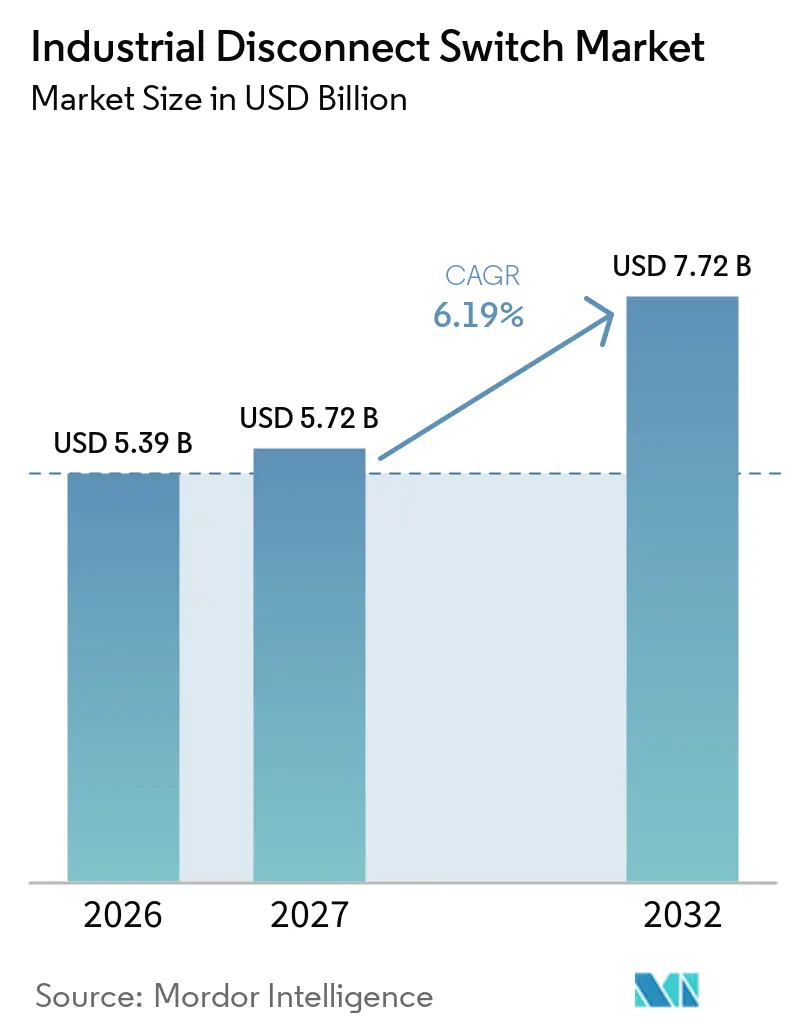
The Industrial Disconnect Switch Market size was valued at USD 5.39 billion in 2026 and is estimated to grow from USD 5.72 billion in 2027 to reach USD 7.72 billion by 2032, at a CAGR of 6.19% during the forecast period (2027-2032). The industrial disconnect switch market is supported by factory electrification, renewable generation, and data center construction. These activities require reliable isolation at multiple circuit boundaries. Renewable capacity reached 5,149 GW at the end of 2025 after 692 GW was added during the year, with solar and wind representing 96.8% of additions.[1] The industrial disconnect switch market also faces pressure from material costs and cross-border certification requirements. Suppliers are responding through certified product designs, broader voltage coverage, and products suited to remote operation.
Key Report Takeaways
- By type, non-fusible switches held 58.2% of revenue in 2026, while fusible switches are forecast to grow at a 6.3% CAGR through 2032.
- By mounting, DIN rail mounted switches held 36.5% of revenue in 2026 and are forecast to grow at a 6.4% CAGR through 2032.
- By voltage, low-voltage products held 72.4% of revenue in 2026, while medium-voltage products are forecast to grow at a 6.5% CAGR through 2032.
- By end user, manufacturing held 24.8% of revenue in 2026, while renewable energy is forecast to grow at an 8.1% CAGR through 2032.
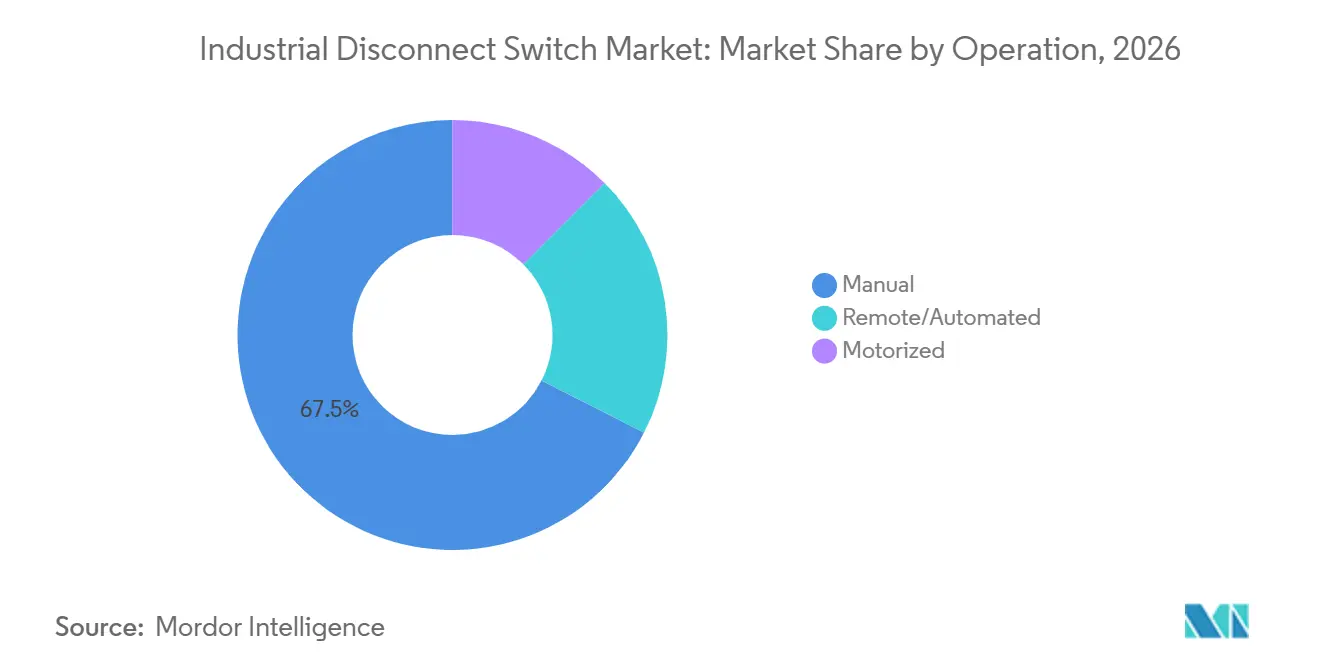
- By operation, manual switches held 67.5% of revenue in 2026, while remote and automated modes are forecast to grow at an 8.5% CAGR through 2032.
- By geography, Asia-Pacific held 39.9% of revenue in 2026, while forecast to grow at an 6.4% CAGR through 2032.
Note: Market numbers in this report are based on Mordor Intelligence's proprietary estimation framework, which combines nine months of actuals with Q4 projections for base year 2026.
Market Trends and Insights
Drivers Impact Analysis of Industrial Disconnect Switch Market*
| Driver | (~) % Impact on CAGR Forecast | Geographic Relevance | Impact Timeline |
|---|---|---|---|
| Industrial Electrification and Automation Expansion | +1.8% | Global | Medium term (2-4 years) |
| Grid Modernization and Renewable Energy Interconnection | +1.4% | Global, APAC core, spill-over to EU and MEA | Long term (≥ 4 years) |
| Stricter Electrical Isolation and Lockout Requirements | +0.7% | North America and EU | Medium term (2-4 years) |
| Compact Modular Panels for Space-Constrained Equipment | +0.5% | Global | Short term (≤ 2 years) |
| Certified Disconnect Demand in Distributed Energy and Storage | +0.6% | APAC core, spill-over to EU and North America | Long term (≥ 4 years) |
| Expansion of Data Centers and Critical Power Infrastructure | +0.8% | North America and APAC, with early gains in EU | Long term (≥ 4 years) |
| Source: Mordor Intelligence | |||
Industrial Electrification and Automation Expansion
Manufacturers are shortening electrification timelines as decarbonization policies, energy management needs, and reshoring programs shape capital spending. Each automated production cell needs several motor-drive circuits, and each circuit needs a dedicated isolation point. This relationship increases demand for the industrial disconnect switch market faster than broad industrial output in highly automated plants. Replacement demand is also rising where arc-flash assessments identify older manual equipment that does not meet current incident-energy boundaries. China issued NB/T 42044-2026, which sets intelligence and remote-control requirements for medium-voltage metal-enclosed switchgear. The standard supports replacement demand for higher-breaking-capacity products and products carrying both IEC and UL certification, allowing manufacturers with multi-regional operations to use approved vendor lists that meet common safety and operating requirements across their factory networks.
Grid Modernization and Renewable Energy Interconnection
Renewable deployment is creating a large source of demand for certified disconnect hardware in the industrial disconnect switch market. Solar strings, wind nacelle circuits, and battery rack each need isolation at several system points.[2] Global renewable capacity reached 5,149 GW at the end of 2025, and Asia provided 74.2% of the 692 GW added that year. Equipment needs are moving toward bidirectional DC-rated switching that can manage reverse power flows and frequent storage cycling. IEC 60947-3:2020/AMD1:2025 added Normative Annex G for DC disconnect switches and fuse-combination units used in battery supply and BESS (Battery Energy Storage System) up to 1,500 V DC.[3] Products without this compliance path can face limits in utility-scale storage tenders, since project developers and equipment buyers can require documented alignment with the relevant DC switching provisions before they accept equipment for battery installation.
Stricter Electrical Isolation and Lockout Requirements
Safety requirements are creating replacement demand for isolation hardware across industrial facilities. The 2024 edition of NFPA 70E introduced a separate audit requirement for lockout and tagout programs under Section 110.3(L)(3). That requirement has prompted reviews of installed equipment and attention to visible-break confirmation and padlocking provisions. Complex lockout and tagout situations can involve several energy sources, crews, or disconnecting means. These situations strengthen the need for clearly labeled and individually lockable isolation points within multi-panel installations. Multinational operators can apply one safety baseline across their sites, which extends this requirement beyond the strictest local jurisdictions and encourages the replacement of equipment that does not offer clear labeling, visible isolation, or practical lockout features.
Expansion of Data Centers and Critical Power Infrastructure
Data center construction creates demand for equipment with high availability and specified protection features. Facilities need visible isolation confirmation, remote trip capability, and rapid arc control under dense power conditions. The industrial disconnect switch market is gaining exposure to these projects because uptime requirements can favor certified equipment over the lowest-cost option. AI-oriented facilities are also considered 800 Volts DC (VDC) distribution and rack-adjacent DC isolation. This change creates demand for products that can operate beyond conventional low-voltage switching applications, especially where operators need isolation close to rack-level loads and must manage the operating characteristics of direct-current power systems.
Restraints Impact Analysis of Industrial Disconnect Switch Market*
| Restraint | (~) % Impact on CAGR Forecast | Geographic Relevance | Impact Timeline |
|---|---|---|---|
| High Installed Cost for Engineered and Medium-Voltage Systems | -0.4% | Global | Medium term (2-4 years) |
| Copper, Steel and Logistics Cost Volatility | -0.5% | Global | Short term (≤ 2 years) |
| Certification Fragmentation Across IEC, UL and Local Codes | -0.2% | Cross-border markets, particularly APAC and MEA | Medium term (2-4 years) |
| Competition from Integrated Circuit Protection and Switching Solutions | -0.3% | North America and EU | Long term (≥ 4 years) |
| Source: Mordor Intelligence | |||
High Installed Cost for Engineered and Medium-Voltage Systems
Engineered medium-voltage systems can defer or reduce orders from price-sensitive industrial buyers. Custom engineering, factory acceptance testing, and specialized logistics increase the delivery cost of these systems. Procurement teams can reduce medium-voltage unit counts or select lower-voltage architectures when project budgets are tight. Those choices can lower revenue relative to the technical demand for medium-voltage isolation. Regional suppliers in India and China offer localized engineering-to-order capability that can reduce some cost pressure. Their participation in regulated Western projects remains constrained where certifications and approvals are required, because project owners may prioritize long-established documentation, testing records, and supplier support for complex installations with demanding safety requirements.
Copper, Steel and Logistics Cost Volatility
Input cost inflation has affected the economics of manufacturing disconnect switches since 2024. Higher prices for copper and steel can raise product costs and narrow margins on orders with long delivery periods. Copper demand electric vehicle (EV) charging, renewable installations, and data center construction continues to compete for available supply. Manufacturers cannot always pass through higher input costs without affecting bid competitiveness. This situation has shortened bid-validity periods and increased attention to material sourcing. The industrial disconnect switch market therefore remains exposed to near-term cost changes even when underlying project demand remains strong, because material exposure affects product costs, quoted prices, and the ability of suppliers to protect margins during long delivery commitments.
*Our forecasts treat driver/restraint impacts as directional, not additive. The impact forecasts reflect baseline growth, mix effects, and variable interactions.
Industrial Disconnect Switch Market Segment Analysis
By Type:
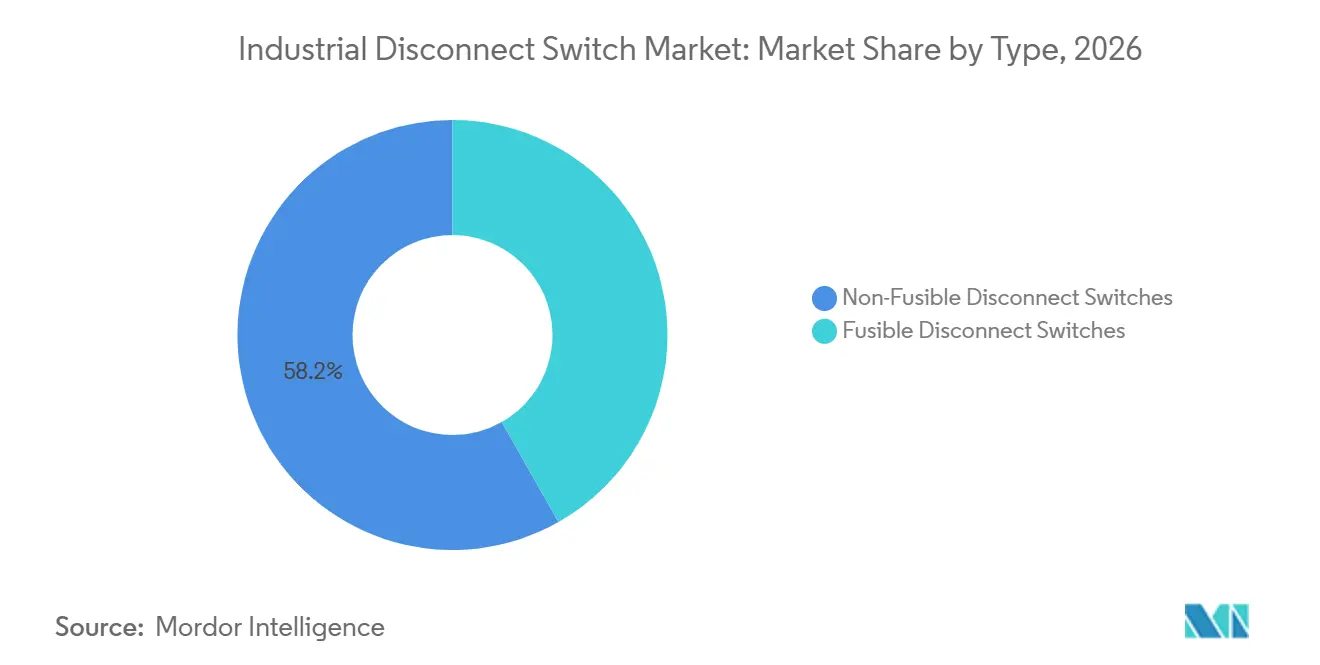
Non-Fusible Leads Volume While Fusible Gains in Safety-Critical ApplicationsNon-fusible switches accounted for 58.2% of industrial disconnect switch market share in 2026. They are widely used in manufacturing automation and utility sub-distribution where circuits already have upstream breaker protection. Their main role is to isolate circuits without combining the function with overcurrent protection. This arrangement can simplify a control panel and reduce dependence on one integrated component. Products are common in motor control centers used across process industries. Lower unit costs support their use in repetitive installations, including assembly lines and conveyor systems. Replacement logistics are also simpler because the design is familiar to installers and maintenance teams. These features support the scale of non-fusible products across established industrial facilities. Their established use also helps purchasing teams standardize spare parts and maintenance procedures across comparable equipment. They also explain why the segment remained the leading type in the industrial disconnect switch market, particularly where manufacturers use repeatable panel designs and reserve dedicated breakers for overcurrent protection, while relying on the switch for a clear and practical isolation function during maintenance.
Fusible switches are forecast to grow at a 6.3% CAGR through 2032. They combine switching and fault-current interruption in one enclosure, which can reduce the panel footprint. This design is useful where panel space is limited and a distinct fault record is valuable. Renewable installations, EV charging equipment, and oil and gas sites increasingly use these products. A fuse can provide a visible and auditable record of a fault event. That record can support insurance documentation and root-cause reviews after an interruption. Littelfuse and Mersen have developed DC-rated fusible engineering for battery storage and Photovoltaic (PV) string protection. These applications can create asymmetrical fault currents that require fast arc suppression. The industrial disconnect switch industry is therefore using fusible designs in applications where protection and isolation must work together. This combined function is particularly relevant when designers need a compact solution with documented fault response, as it brings switching and protective behavior into one physical location and can simplify the arrangement of equipment within constrained application layouts.

By Mounting:
DIN Rail Concentration Reflects Modular Panel MegatrendDIN rail mounted switches held 36.5% of revenue in 2026. They are also forecast to grow at a 6.4% CAGR through 2032. This combination shows that the leading mounting format is still gaining ground. Machine builders, HVAC integrators, and building automation OEMs use DIN rail architecture in compact enclosures. The format reduces panel depth and gives installers consistent wiring layouts. It also allows component replacement without redesigning the full cabinet. IEC 60947-3 recognizes DIN rail isolators as compliant switch-disconnectors.[4] This recognition supports adoption in European and Asian manufacturing facilities. Rail-based layouts are becoming more common in digital control cabinets. Their standardized form also helps equipment builders repeat panel designs across installations with similar operating requirements, reduce the variation in wiring work, and keep replacement components aligned with the mounting methods already used in compact cabinets.
Panel-mounted switches continue to serve control rooms and utility switchboards where higher current ratings justify the required installation space. Wall and box-mounted products are used outdoors and in harsh environments. Oil and gas wellhead applications can favor enclosure integrity over panel density. Base-mounted and flange mounted variants address specialized machinery that needs direct mechanical coupling. These formats remain relevant where physical robustness, environmental protection, or equipment geometry guides the specification. DIN rail adoption does not eliminate these needs within the industrial disconnect switch market. It changes the choice of applications that can use standardized compact panels. Panel builders are increasingly using rail-based layouts for Industry 4.0-compatible cabinets. This shift gradually reduces the share of non-rail formats in their traditional applications. Non-rail alternatives continue to serve applications where equipment size, exposure, or mounting geometry cannot be standardized, preserving their relevance in outdoor environments, large switchboards, and equipment designs that require direct mechanical connections instead of a common rail.
By Voltage:
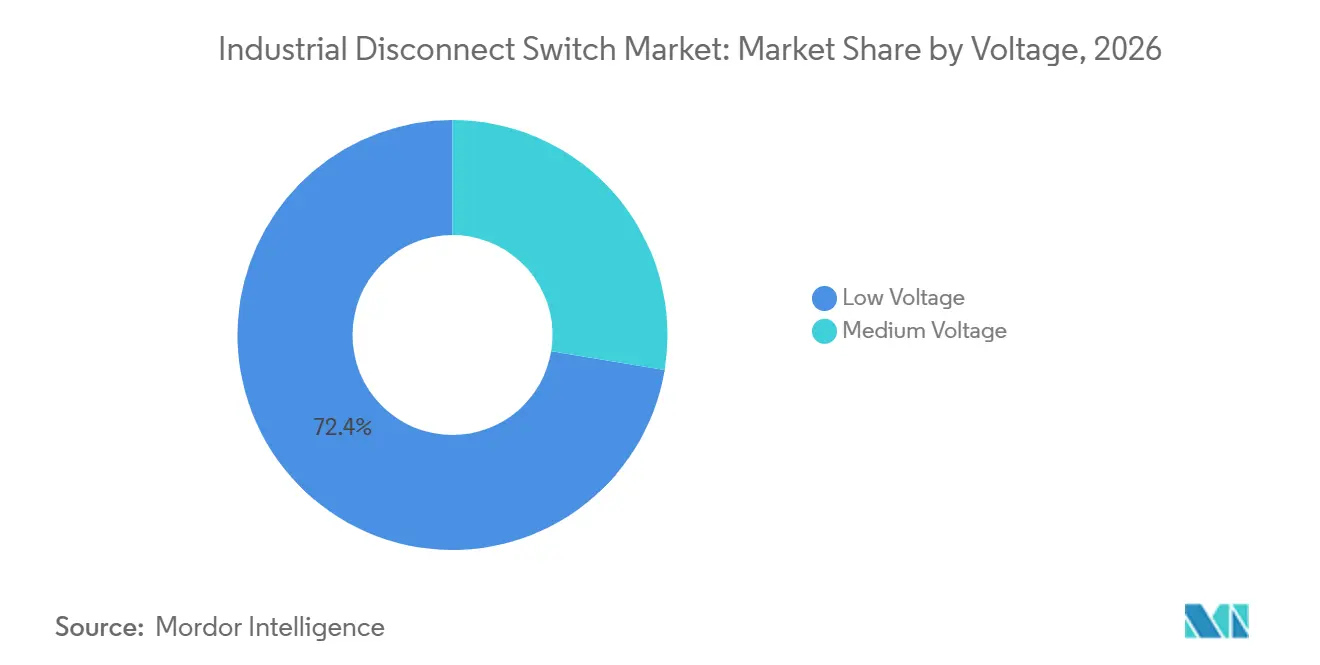
Low-Voltage Installed Base vs. Medium-Voltage Growth FrontierLow-voltage products accounted for 72.4% of revenue in 2026. The industrial disconnect switch market size for this category reflects the installed base of factory control panels, commercial switchboards, and residential distribution equipment at 690 V and below. These installations are replaced gradually when facilities are refurbished, expanded, or reassessed for safety. Low-voltage products also have a broader producer base than medium-voltage equipment. Distribution channels are deeper and delivery periods are usually shorter. Certification is generally less complex for this range. These conditions support volume pricing across a broad set of facilities. The segment remains central to the industrial disconnect switch market because every day electrical distribution depends on it. Its installed base provides stable replacement demand. This broad use means purchasing decisions often depend on practical availability, approval status, and compatibility with existing panels, rather than on a full redesign of the electrical system, which supports steady demand through maintenance, refurbishment, and facility expansion.
Medium-voltage products are forecast to grow at a 6.5% CAGR through 2032. Utility-scale renewable substations, data center step-down infrastructure, and large plant expansions commonly operate from 11 kV to 36 kV. These projects require isolation equipment with suitable voltage ratings and documented performance. IEC 60947-3:2020/AMD1:2025 increased specification attention for certified isolation in BESS applications. German OEMs are engineering medium-voltage switch-disconnector solutions in pre-assembled substation packages. This approach can reduce certification work for customers selling equipment across borders. Medium-voltage systems have higher project values than common low-voltage assemblies. Their growth is tied to new-build infrastructure rather than only replacement activity. The industrial disconnect switch market benefits as more power-intensive facilities are built. Suppliers can differentiate when they package suitable switching equipment with documented support for those project configurations, because large infrastructure buyers must match voltage ratings, certification requirements, control needs, and site-specific engineering practices before equipment can be approved.
By End User:
Manufacturing Anchors Revenue While Renewable Energy Rewrites the Growth MapManufacturing accounted for 24.8% of revenue in 2026. This position reflects the global base of motor control centers, machine tools, and process automation systems. These systems require several isolation points for operation, maintenance, and safety procedures. Manufacturing therefore provides recurring replacement and expansion demand for the industrial disconnect switch market. Oil and gas are a higher-value application because explosion-proof equipment can command premium pricing. Offshore and subsea operations in the Middle East and North Sea need durable engineered products. Mining and metals, chemical and petrochemical, and utilities add further demand. Long equipment life cycles in these sectors create a continuing aftermarket. Regular inspections also require functioning and compliant isolation hardware. These conditions keep replacement purchasing active even when new construction activity varies between industrial end-user groups, since operating facilities need equipment that remains suitable for safe isolation, scheduled maintenance, and continued compliance through long asset lifecycles.
Renewable energy is forecast to grow at an 8.1% CAGR through 2032. Solar and wind additions support this growth because each asset includes multiple protected circuits. Food and beverage and commercial infrastructure remain mid-tier contributors. Their demand is connected to Heating, Ventilation, and Air Conditioning (HVAC) electrification and upgrades to building systems. Automotive demand is changing as legacy internal-combustion assembly becomes a replacement category. EV battery-pack assembly needs higher-voltage DC isolation and can support higher product prices. Buyers across verticals increasingly seek application-specific products with pre-certified data sheets. This trend reduces room for undifferentiated products in the industrial disconnect switch market. It also rewards suppliers that can document performance for specific end uses. Renewable projects are the most rapidly expanding end-user opportunity described in the supplied research. Their project designs also place a premium on products that can be specified early and approved across several sites, which gives value to suppliers with suitable technical documentation and products designed for the DC, storage, and interconnection requirements of these assets.
By Operation:
Manual Base Sustains Volume as Remote/Automated Leads Strategic InvestmentManual switches accounted for 67.5% of revenue in 2026. Their installed base supports a large portion of industrial disconnect switch market size because many facilities continue to rely on on-site operators. Manual operation can be sufficient for routine isolation where remote capability does not improve safety or economics. Visible-break confirmation is another reason for continued use. It allows personnel to verify that a circuit is open without relying only on an electronic status signal. Site safety procedures require this direct confirmation as a redundant check. Manual products are familiar to maintenance personnel and can have lower acquisition costs. These factors sustain their volume across mature industrial locations. They remain the default solution for many conventional isolation tasks. This continued role makes manual products important where operational routines have not changed the value of direct physical access, visible confirmation, or an on-site response, and where the added cost of remote control does not provide a proportional operational benefit.
Remote and automated modes are forecast to grow at an 8.5% CAGR through 2032. Unmanned substations, renewable sites, and modular data center power units can make local access difficult. These settings favor products that can be controlled and monitored from a distance. IEC 60947-3:2020/AMD1:2025 specifies requirements for remotely operated switch-disconnectors. The requirements cover manual override, prevention of remote closing while locked open, and impulse-withstand values for separate circuits. Motorized products sit between manual and fully remote equipment. They can support scheduled switching through automatic controls while keeping manual override. These designs are used in industrial microgrids and building energy management applications. The industrial disconnect switch market is moving toward more digitally managed isolation where site conditions justify the added capability. Suppliers must balance these functions with dependable local control for maintenance and emergency conditions, because remote capability does not remove the need for a practical manual override, clear lockout procedures, and reliable operation when control power is unavailable.
Geography Analysis
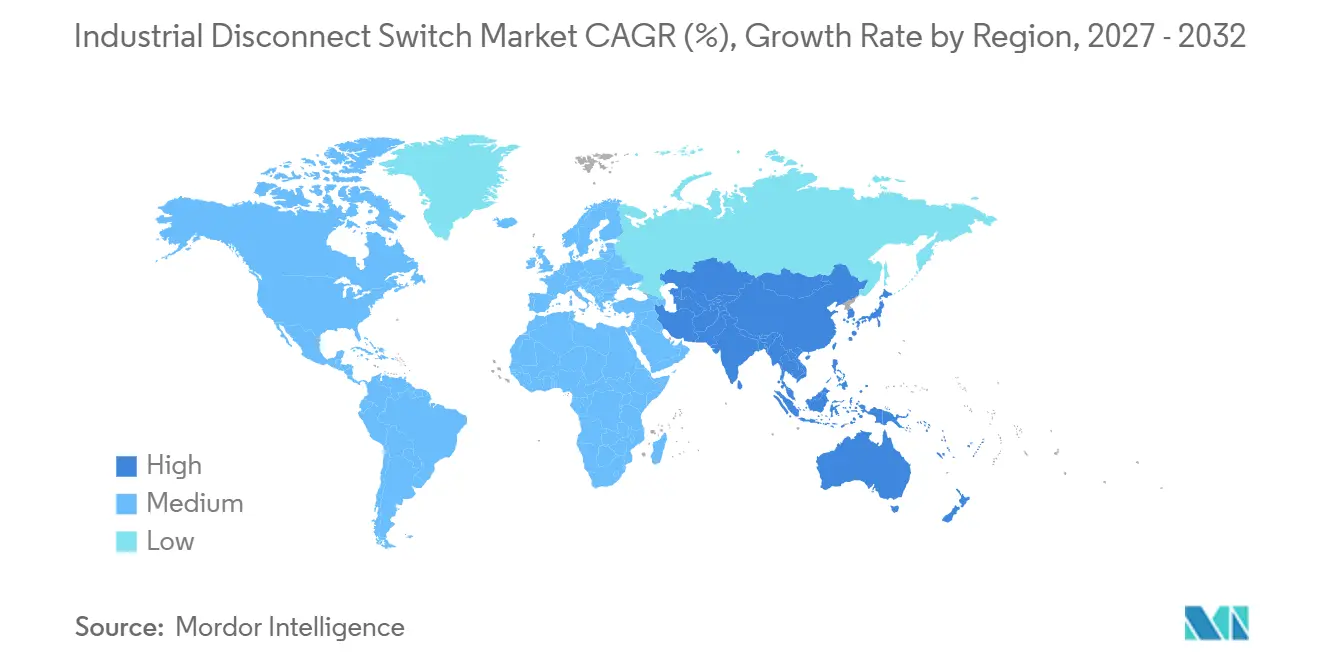
Asia-Pacific held 39.9% of industrial disconnect switch market share in 2026 and is forecast to grow at a 6.4% CAGR through 2032, which makes it both the largest regional revenue base and the fastest-growing regional opportunity. China’s State Grid and Southern Grid continued smart-grid investment and distributed photovoltaic integration during 2025 and 2026, creating demand for low-voltage and medium-voltage isolation equipment with reverse-power protection and remote switching capability. Traditional single-direction protection devices do not meet every need in these installations, while India’s expanding data center base adds another source of critical power infrastructure demand. Indonesia, Vietnam, and Thailand are also adding industrial zones and renewable capacity, and the gap between project activity and local certification capacity supports imports of pre-certified IEC equipment. This mix of utility investment, industrial construction, renewable development, and data center demand keeps Asia-Pacific central to the industrial disconnect switch market, while the combination of high-volume low-voltage installations and higher-value power infrastructure creates demand across several product ratings, mounting formats, and operation modes.
North America and Europe are supported by grid modernization, reshoring-led factory construction, and strict electrical safety practices. U.S. greenfield facilities are specifying current disconnect hardware at the design stage, while domestic content requirements support some of the construction activity. Germany benefits from Industry 4.0 practices that favor modular DIN rail layouts, and DIN Verband der Elektrotechnik, Elektronik und Informationstechnik (VDE) enforcement supports consistent replacement demand in established facilities. In March 2026, Schneider Electric launched MCSeT medium-voltage switchgear in the United Kingdom with native sensor integration across 12 kV, 17.5 kV, and 24 kV variants. The launch illustrates the grid-edge upgrade activity that can create incremental revenue in mature locations, where new facilities and upgrades to a large installed base both support the industrial disconnect switch market, and where engineering standards, safety rules, and customer expectations for monitoring can sustain demand for products with current specifications.
South America and the Middle East and Africa are smaller, but they remain important because their demand is tied to specific industrial and power projects. Brazil’s mining, oil and gas, and food processing sectors support a mid-market for certified equipment, while Chilean copper mining needs high-specification medium-voltage isolation. The Middle East recorded renewable capacity growth of 28.9% in 2026, led by Saudi Arabian solar development, which supports demand for certified disconnect switches at utility-scale PV interconnection substations. Africa recorded renewable capacity growth of 15.9% in 2026, with Ethiopia, South Africa, and Egypt increasing electrification investment. These investments are converting previously latent demand for isolation hardware into purchases, giving suppliers selective growth opportunities in the industrial disconnect switch market, particularly when they can provide products that meet relevant certification requirements and address the operating environments of utility, mining, oil and gas, and food-processing customers.
Competitive Landscape
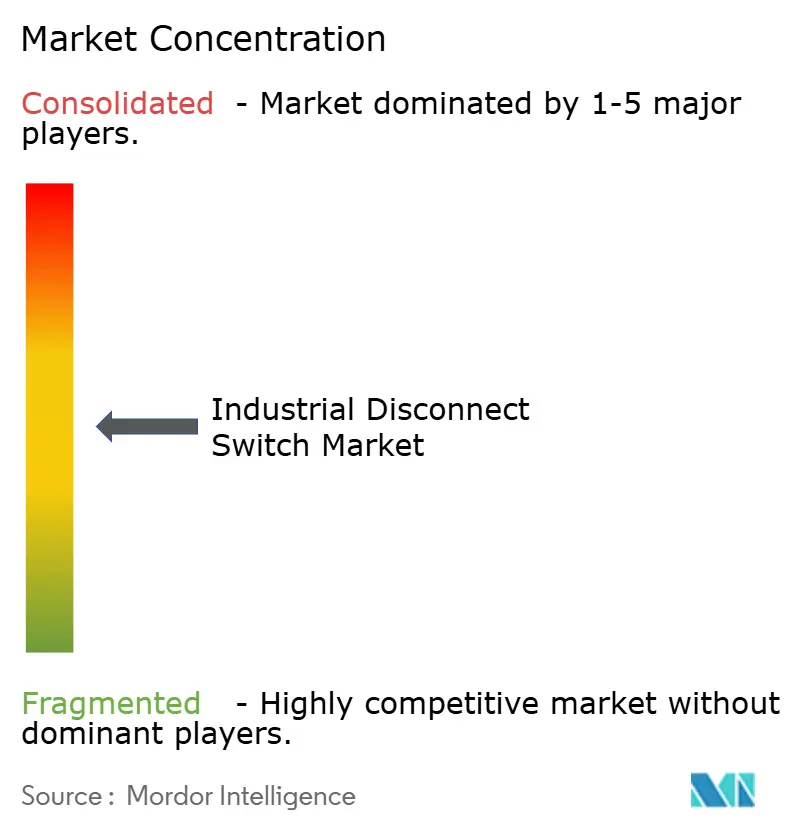
The industrial disconnect switch market is moderately consolidated among ABB, Siemens, Eaton, and Schneider Electric, which compete through certification, application engineering, and broad channel coverage. Havells, Salzer, LOVATO ELECTRIC, WEG, and Socomec compete effectively in volume applications through local production and distributor relationships, especially where customers prioritize availability and established supplier support. Certification investments create a meaningful competitive advantage because customers need documented suitability for specialized installations, including renewable, storage, industrial, and critical-power uses. Product launches for solar PV, BESS, mining, and marine applications show how suppliers use compliance documentation to enter newer application areas. This makes technical documentation, reliable application support, and product approval as important as price in many parts of the industrial disconnect switch market, because project teams must demonstrate that a selected device suits the system voltage, operating environment, safety procedures, and required method of isolation before installation.
Siemens is developing DC protection and switching equipment for data center and storage applications, including the SENTRON 3QD2 semiconductor circuit breaker and SIRIUS 3RF5 solid-state switching device for high-frequency DC switching. This approach reflects a move toward solid-state isolation in applications where conventional mechanical designs may not address every operating need. Eaton invested more than USD 422 million across 4 North American facilities during 2025 and 2026, seeking supply capacity before projected demand peaks in 2027 and 2028. In March 2026, Eaton announced a USD 30 million investment in a 370,000-square-foot medium-voltage switchgear facility in Bellevue, Nebraska, where air-insulated and gas-insulated production is expected to begin in early 2027. Capacity investments can improve supply-chain control and reduce the effect of extended project lead times for major suppliers in the industrial disconnect switch market, while also giving them more scope to support customers that need equipment for utility, industrial, data center, and other critical power projects.
Remote and automated products are forming another area of competition because they combine switching, metering, and predictive maintenance data within a single device. These offerings can challenge stand-alone mechanical disconnects in data centers and smart buildings where monitoring and remote access are valued. Schneider Electric expanded its medium-voltage range through MCSeT in the United Kingdom during March 2026. GE Vernova presented an updated SX Pantograph Disconnector portfolio in August 2026, rated up to 550 kV and 5,000 A, with sensors in live parts and insulators to monitor key operating parameters. The industrial disconnect switch market remains accessible to regional suppliers, but leading firms retain advantages in advanced certification, digital features, and manufacturing scale.
Industrial Disconnect Switch Industry Leaders
-
Eaton
-
Siemens AG
-
ABB Ltd.
-
Schneider Electric SE
-
GE Vernova
- *Disclaimer: Major Players sorted in no particular order
Industrial Disconnect Switch Market Companies Covered in this Report
- ABB Ltd
- B&J USA, Inc.
- c3controls, Inc.
- Eaton Corporation plc
- Emerson Electric Co.
- EMSPEC Inc.
- GE Vernova Inc.
- Giovenzana International B.V.
- Havells India Limited
- Honeywell International Inc.
- Hubbell Incorporated
- Legrand SA
- Littelfuse, Inc.
- LOVATO ELECTRIC S.p.A.
- Mersen SA
- Richards Manufacturing Company
- RITTAL GmbH & Co. KG
- Rockwell Automation, Inc.
- Salzer Electronics Limited
- Schneider Electric SE
- Siemens AG
- Socomec SAS
- WEG S.A.
- Wenzhou Shuguang Fuse Co., Ltd.
Recent Industry Developments in Industrial Disconnect Switch Market
- September 2026: Eaton announced a USD 242 million investment for a new 1-million-square-foot facility in North Little Rock, Arkansas. The facility is expected to create 1,200 jobs by 2028 and double Eaton’s domestic electrical enclosure manufacturing capacity, strengthening the company’s ability to serve electrical equipment customers from a larger U.S. production base.
- September 2026: Schneider Electric launched the ASCO 300 SERIES Multi-Voltage Transfer Switch. The field-configurable unit serves 208 V to 480 V applications at up to 600 A and replaces up to 10 voltage-specific models, reducing the need to maintain separate equipment for several voltage requirements.
- August 2026: GE Vernova unveiled the latest SX Pantograph Disconnector portfolio at CIGRE Paris 2026. The digital-native design extends the portfolio to 550 kV and 5,000 A and integrates sensors in live parts and insulators for real-time monitoring of key operating parameters, addressing modern substation automation needs.
- March 2026: Schneider Electric launched MCSeT medium-voltage switchgear in the United Kingdom. The product offers 12 kV, 17.5 kV, and 24 kV variants with native sensor integration, vacuum interrupter technology, and digital connectivity for industrial, commercial, and utility applications.
Global Industrial Disconnect Switch Market Report Scope
An industrial disconnect switch, also commonly referred to as a safety switch, load break switch, or isolator, is a mechanical switch used in industrial plants and commercial buildings. Its primary function is to ensure an electrical circuit is completely de-energized for maintenance, servicing, or emergency shutdown. Unlike a circuit breaker, which automatically interrupts power during an overload, a disconnect switch is a manually or automatically operated safety device that provides a visible, physical break in the power line.
The global industrial disconnect switch market is segmented by type into fusible and non-fusible options, and by mounting style including panel, DIN rail, wall/box, base, and flange configurations. Based on voltage, the market is divided into low and medium segments, while the primary end users span manufacturing, oil and gas, mining, food and beverage, chemical, utilities, automotive, renewables, commercial, and other sectors. Additionally, the industry is categorized by operation methods into manual, motorized, and remote or automatic systems. The report also covers the market size and forecasts for the global industrial disconnect switch market across 26 countries in key regions. For each segment, the market sizing and forecasts have been provided on the basis of value (USD).
Segmentation Overview
| Fusible Disconnect Switches |
| Non-Fusible Disconnect Switches |
| Panel Mounted |
| DIN Rail Mounted |
| Wall/Box Mounted |
| Base Mounted |
| Flange Mounted |
| Low Voltage |
| Medium Voltage |
| Manufacturing |
| Oil and Gas |
| Mining and Metals |
| Food and Beverage |
| Chemical and Petrochemical |
| Utilities |
| Automotive |
| Renewable Energy |
| Commercial and Infrastructure |
| Other Industries |
| Manual |
| Motorized |
| Remote/Automated |
| North America | United States |
| Canada | |
| Mexico | |
| Europe | Germany |
| France | |
| Italy | |
| Spain | |
| United Kingdom | |
| Poland | |
| Russia | |
| Rest of Europe | |
| Asia-Pacific | China |
| India | |
| Japan | |
| South Korea | |
| Australia | |
| Indonesia | |
| Vietnam | |
| Thailand | |
| Rest of Asia-Pacific | |
| South America | Brazil |
| Argentina | |
| Chile | |
| Rest of South America | |
| Middle East and Africa | Saudi Arabia |
| United Arab Emirates | |
| Egypt | |
| South Africa | |
| Morocco | |
| Rest of Middle East and Africa |
| By Type | Fusible Disconnect Switches | |
| Non-Fusible Disconnect Switches | ||
| By Mounting | Panel Mounted | |
| DIN Rail Mounted | ||
| Wall/Box Mounted | ||
| Base Mounted | ||
| Flange Mounted | ||
| By Voltage | Low Voltage | |
| Medium Voltage | ||
| By End User | Manufacturing | |
| Oil and Gas | ||
| Mining and Metals | ||
| Food and Beverage | ||
| Chemical and Petrochemical | ||
| Utilities | ||
| Automotive | ||
| Renewable Energy | ||
| Commercial and Infrastructure | ||
| Other Industries | ||
| By Operation | Manual | |
| Motorized | ||
| Remote/Automated | ||
| By Geography | North America | United States |
| Canada | ||
| Mexico | ||
| Europe | Germany | |
| France | ||
| Italy | ||
| Spain | ||
| United Kingdom | ||
| Poland | ||
| Russia | ||
| Rest of Europe | ||
| Asia-Pacific | China | |
| India | ||
| Japan | ||
| South Korea | ||
| Australia | ||
| Indonesia | ||
| Vietnam | ||
| Thailand | ||
| Rest of Asia-Pacific | ||
| South America | Brazil | |
| Argentina | ||
| Chile | ||
| Rest of South America | ||
| Middle East and Africa | Saudi Arabia | |
| United Arab Emirates | ||
| Egypt | ||
| South Africa | ||
| Morocco | ||
| Rest of Middle East and Africa | ||
Key Questions Answered in the Report
What is the forecast for the industrial disconnect switch market?
The sector is forecast to reach USD 7.72 billion by 2032, expanding at a 6.19% CAGR from 2027 to 2032. The forecast reflects demand from industrial electrification, renewable interconnection, and critical power infrastructure.
Which product type leads industrial disconnect switch sales?
Non-fusible switches led with 58.2% of revenue in 2026, supported by their use in circuits with upstream breaker protection. Their isolation function simplifies panel architecture in many industrial settings and supports applications where separate protective breakers are already installed upstream.
Which end user has the fastest expected growth?
Renewable energy is forecast to grow at an 8.1% CAGR through 2032 as solar, wind, and storage projects need certified isolation at several circuit boundaries and storage-related points. IEC requirements for DC storage applications reinforce the need for products with suitable documented compliance.
Why are remote disconnect switches gaining adoption?
Remote and automated products are forecast to grow at an 8.5% CAGR because they suit unmanned substations, renewable sites, and modular data centers where local access is impractical or control needs are more demanding. Manual override and lockout requirements remain important in these systems.
Which region leads demand for industrial disconnect switches?
Asia-Pacific led with 39.9% of revenue in 2026 and is forecast to grow at a 6.4% CAGR through 2032, supported by grid investment, industrial construction, and renewable interconnection needs. China, India, and Southeast Asia contribute to a wide range of utility and industrial project activity.
What factors constrain demand for disconnect switches?
Higher installed costs for medium-voltage systems, material cost volatility, fragmented certification, and integrated switching solutions can restrain demand. These issues can delay purchases, affect equipment selection, or favor alternative system architectures for some buyers.