
Indonesia Urban Logistics Market Size and Share
Market Overview
| Study Period | 2020 - 2031 |
|---|---|
| Forecast Data Period | 2026 - 2031 |
| Base Year Market Size (2025) | USD 29.69 Billion |
| Market Size (2026) | USD 33.24 Billion |
| Market Size (2031) | USD 56.99 Billion |
| Growth Rate (2026 - 2031) | 11.38 % |
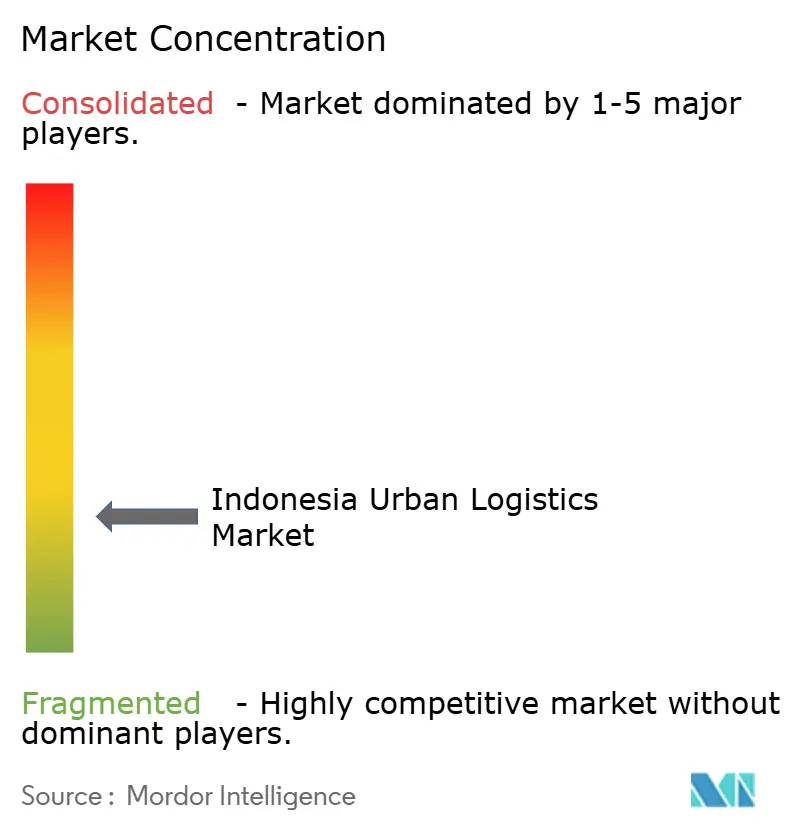
| Market Concentration | Low |
Major Players *Disclaimer: Major Players sorted in no particular order Image © Mordor Intelligence. Reuse requires attribution under CC BY 4.0. | |
Indonesia Urban Logistics Market Analysis by Mordor Intelligence
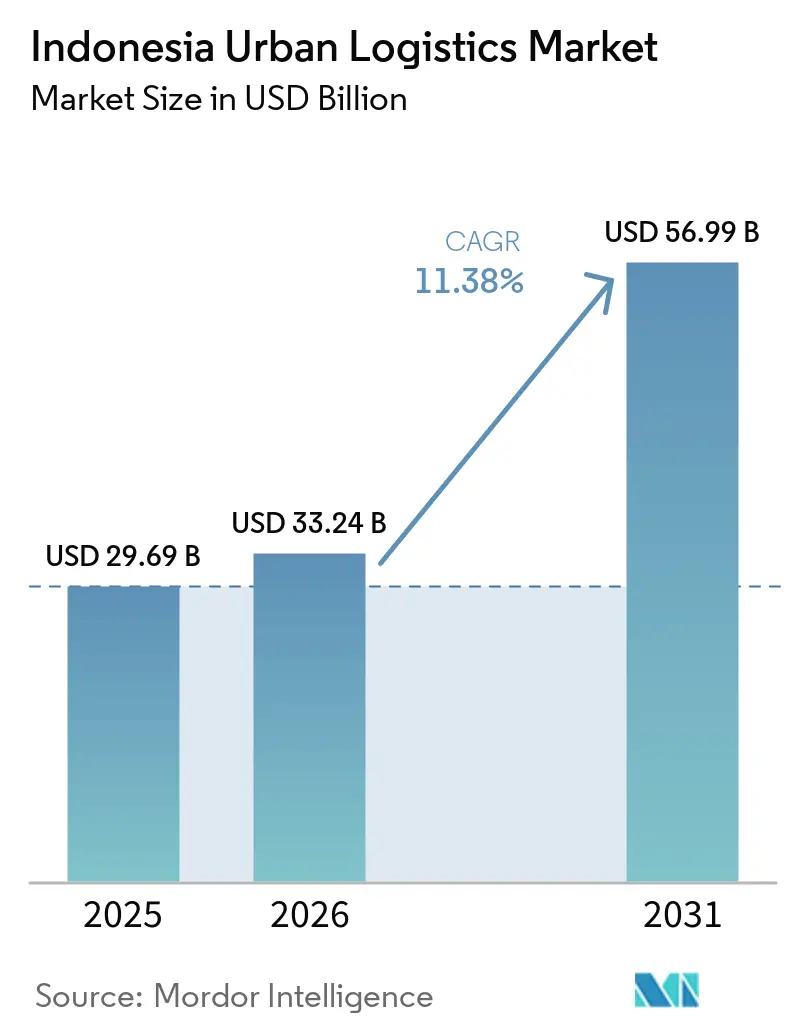
The Indonesia Urban Logistics Market size is expected to grow from USD 29.69 billion in 2025 to USD 33.24 billion in 2026 and is forecast to reach USD 56.99 billion by 2031 at 11.38% CAGR over 2026-2031.
Indonesia’s large digital commerce base continues to increase demand for parcel transport, fulfillment, and neighborhood delivery capacity. E-commerce growth is extending beyond central Jakarta, which increases the need for local sorting points and flexible pickup networks. Operators are balancing quick delivery in dense city corridors with wider next-day coverage in secondary cities. Investment is moving toward systems that connect inventory, order management, and delivery execution, because sellers need reliable service as well as wide geographic coverage. Congestion, inter-island costs, and limited electric vehicle support remain material operating constraints, although demand from digital sellers, platforms, and small businesses continues to support expansion.
Key Report Takeaways
- By service type, transportation services held 67.04% of the Indonesia urban logistics market share in 2025, while fulfillment services are forecast to grow at a 13.30% CAGR through 2031.
- By delivery speed, standard delivery accounted for 51.28% of the Indonesia urban logistics market size in 2025, while instant and same-day delivery are forecast to grow at a 12.47% CAGR through 2031.
- By customer type, B2C logistics held 73.40% of the Indonesia urban logistics market share in 2025, while C2C logistics are forecast to grow at a 14.25% CAGR through 2031.
- By end-use industry, e-commerce and retail accounted for 35.12% of the Indonesia urban logistics market size in 2025, while healthcare and pharmaceuticals are forecast to grow at a 14.02% CAGR through 2031.
- By city, Jakarta held 24.67% of the revenue in 2025, while Jakarta is forecast to grow at a 12.85% CAGR through 2031.
Note: Market size and forecast figures in this report are generated using Mordor Intelligence’s proprietary estimation framework, updated with the latest available data and insights as of January 2026.
Indonesia Urban Logistics Market Trends and Insights
Drivers Impact Analysis*
| Driver | (~) % Impact on CAGR Forecast | Geographic Relevance | Impact Timeline |
|---|---|---|---|
| E-Commerce and Social-Commerce Parcel Growth | +3.2% | National, concentrated in Java, expanding to Sumatra and Sulawesi | Short term (≤ 2 years) |
| Faster Delivery Expectations in Dense Urban Corridors | +2.4% | Jakarta, Surabaya, Bandung, Makassar | Short term (≤ 2 years) |
| Platform-Integrated Fulfillment and Delivery Networks | +2.0% | National, led by Greater Jakarta and Surabaya | Medium term (2-4 years) |
| Growth of MSME Digital Commerce and On-Demand Logistics | +1.6% | National, with early gains in Yogyakarta, Bandung, Surabaya, Makassar | Medium term (2-4 years) |
| Motorcycle Fleet Electrification Opportunity | +1.2% | Greater Jakarta and Bali, with expansion to Surabaya and Bandung | Medium term (2-4 years) |
| Micro-Fulfillment Expansion into Tier-2 Cities | +0.8% | Semarang, Medan, Makassar, Denpasar, Tasikmalaya | Long term (≥ 4 years) |
| Source: Mordor Intelligence | |||
E-Commerce and Social-Commerce Parcel Growth
Indonesia's e-commerce GMV reached USD 71 billion in 2025, growing 14% year on year, sustaining its position as Southeast Asia's largest digital consumer market by GMV. Video commerce was a major growth driver, with transaction volumes increasing 90% year on year to 2.6 billion in 2025, while active sellers and online shops grew 75% to 800,000. This expansion increased demand for high-frequency, small-batch parcel movements, including same-day and instant deliveries, alongside conventional standard-delivery services. This volume supports regular parcel flows between urban sellers, fulfillment sites, and households. The concentration gives carriers in Java denser routes and stronger asset utilization than networks serving outer islands. The Indonesia urban logistics market, therefore, has room to grow through both higher activity in established corridors and gradual extension to less-served urban locations.
Faster Delivery Expectations in Dense Urban Corridors
Urban buyers increasingly expect delivery windows that fit daily routines and favor dependable service. Quick commerce data showed that deliveries completed within 11 to 30 minutes represented 52.1% of volumes in 2025. Dark stores and demand forecasting systems have helped operators achieve 85% first-attempt delivery success in Jakarta and Surabaya. These service models need inventory close to demand clusters, which raises the importance of small urban fulfillment sites. A delivery network must also manage traffic uncertainty, driver availability, and the cost of maintaining local stock. Operators that improve route reliability can build a clearer service advantage than those that compete only on the shortest stated delivery time.
Platform-Integrated Fulfillment and Delivery Networks
Marketplace and social-commerce activity have tightened the link between online discovery, checkout, and physical delivery. TikTok Shop returned to Indonesia through a USD 1.5 billion partnership with Tokopedia and reached 3.2 million daily checkouts by March 2025. GoSend serves more than 300 enterprises across e-commerce, food and beverage, and healthcare through connected delivery services. These connections give sellers easier access to booking and give operators more predictable shipment volumes. Blibli’s 100,000 sqm Gudang Marunda smart logistics hub reduced FMCG fulfillment time by 70% and order cancellations by 35% after integration. The Indonesia urban logistics market is becoming more dependent on connected fulfillment models because platform-linked networks can coordinate inventory and delivery within one operating process.
Growth of MSME Digital Commerce and On-Demand Logistics
Indonesia has a large base of small sellers that require delivery services without formal volume commitments. Internet access exceeded 80% of the population in 2025, widening the potential reach of digital commerce beyond the largest cities.[1]Ministry of Communication and Information Technology, “Internet User Penetration Data 2025,” Republic of Indonesia, kominfo.go.id. On-demand booking suits businesses with uneven order volumes and residential pickup locations. J&T Express reported that international parcel volumes from Indonesian MSMEs rose from 16.9% of total MSME exports in 2024 to 19% in 2025. These shipments add handling and coordination needs that differ from conventional bulk freight. The Indonesia urban logistics market benefits as more sellers require pickup, labeling, sorting, and delivery support close to where they operate.
Restraints Impact Analysis*
| Restraint | (~) % Impact on CAGR Forecast | Geographic Relevance | Impact Timeline |
|---|---|---|---|
| Urban Congestion and Loading-Space Constraints | -1.4% | Jakarta, Surabaya, Bandung, Semarang | Short term (≤ 2 years) |
| Archipelagic Delivery Economics and Service Variability | -1.0% | National, concentrated in Eastern Indonesia, Maluku, Papua | Long term (≥ 4 years) |
| Insufficient Charging and Battery-Swapping Infrastructure | -0.8% | Outside Java and Bali, with national effects in tier-2 and tier-3 cities | Medium term (2-4 years) |
| Courier Financing and Income Pressure During Fleet Electrification | -0.6% | Greater Jakarta, Surabaya, Bandung | Medium term (2-4 years) |
| Source: Mordor Intelligence | |||
Urban Congestion and Loading-Space Constraints
Jakarta’s peak-hour average road speed fell to 11 km/h in 2025, limiting the number of stops that delivery fleets can complete during a shift.[2]Jakarta Smart City, “Jakarta Traffic Congestion Analysis 2025,” Jakarta Smart City, smartcity.jakarta.go.id. Congestion raises vehicle operating time and can require additional drivers or vehicles to maintain delivery commitments. The DKI Jakarta Provincial Government established a 5-hectare container truck parking facility at Terminal Tanah Merdeka with a capacity for at least 200 containers. It also waived parking fees in July and August 2026 to reduce truck queuing on Jalan Cakung-Cilincing. These steps may improve local flow, but operators still need route planning and loading access that can absorb daily traffic disruption. Higher delays favor businesses that have capital for dense facilities, routing tools, and operational buffers.
Archipelagic Delivery Economics and Service Variability
Indonesia’s network of more than 17,500 islands makes inter-island logistics more costly when cargo volumes are low, and return capacity is limited.[3]Gadjah Mada University Centre for Transportation and Logistics Studies, “National Logistics Costs Remain High, Government Urged to Improve Port Infrastructure and Maximize Ship Cargo,” Gadjah Mada University, ugm.ac.id. The same physical conditions create uneven service quality between Java and eastern regions. Presidential Regulation No. 27 of 2021 supports Sea Toll routes for frontier, remote, and border areas. A 2025 academic study found that the Java-Papua consumer price gap narrowed from 47% in 2019 to 31% in 2025, though the difference remained substantial. Operators serving outer islands need stronger shipping coordination and localized networks than those focused on high-density Java corridors.
*Our forecasts treat driver/restraint impacts as directional, not additive. The impact forecasts reflect baseline growth, mix effects, and variable interactions.
Segment Analysis
By Service Type: Transportation Revenues Lead, Fulfillment Draws Investment
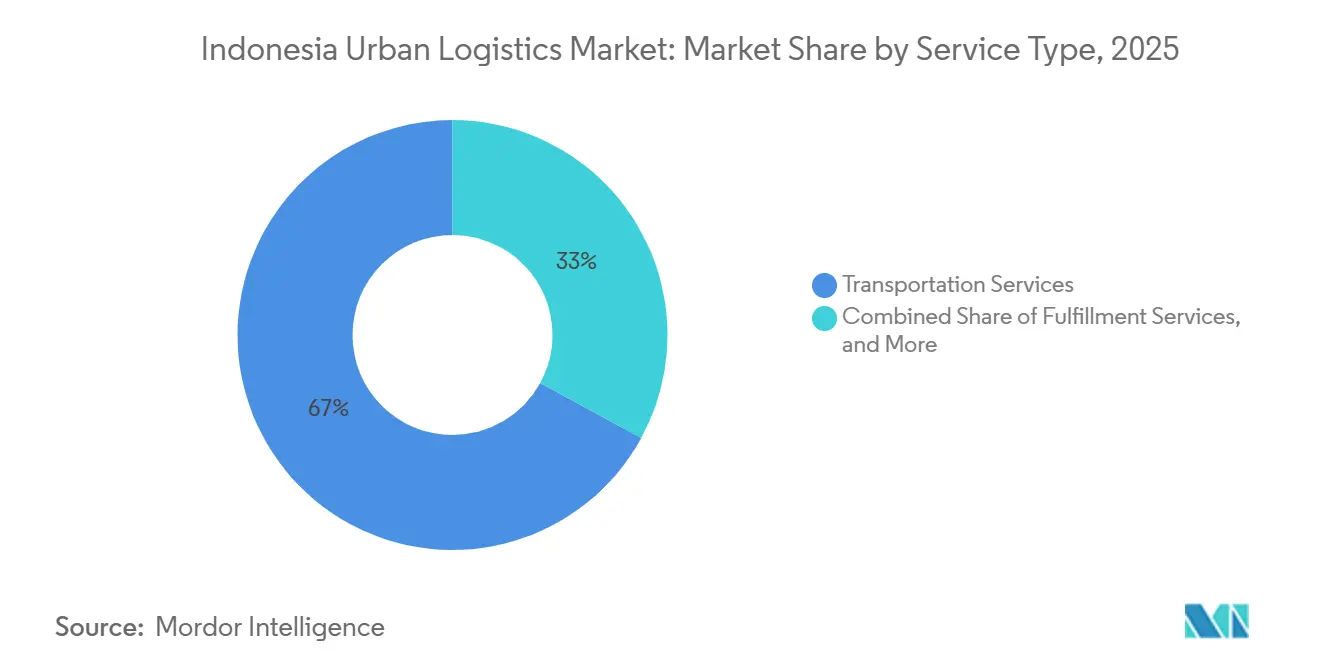
Transportation services held the largest position in the Indonesian urban logistics market, accounting for 67.04% of the market in 2025, as daily parcel movement creates a broad revenue base. E-commerce fulfillment, on-demand delivery, and intercity cargo all require regular transportation activity. Large parcel counts can sustain transport revenue even when individual shipments have limited value-added services. This service type also depends on consistent driver availability, sorting capacity, and route planning. Fulfillment services represent the fastest-growing category as sellers position inventory closer to urban buyers. The Indonesia urban logistics market size for fulfillment is supported by demand for same-day and next-day service from marketplaces and direct-to-consumer brands.
Fulfillment services represent the fastest-growing category, expanding at a CAGR of 13.30% through 2031 as sellers position inventory closer to urban buyers. Blibli’s Gudang Marunda hub reduced FMCG fulfillment time by 70% and cancellation rates by 35%, showing the operating value of integrated inventory and delivery management. Warehousing and urban storage are also expanding as operators add micro-fulfillment capacity in Greater Jakarta and secondary cities. Real estate constraints are encouraging multi-story warehouse formats in high-demand locations. Reverse logistics remains smaller, but fashion and electronics returns require more inspection, sorting, and customer coordination. Value-added logistics services include packaging, labeling, and quality checks. These capabilities can help fulfillment providers meet the documentation and handling requirements of healthcare and electronics customers.



By Delivery Speed: Standard Volumes Anchor Revenue, Premium Speed Reshapes Pricing
Standard delivery held the largest parcel-volume position in the Indonesia urban logistics market, accounting for 51.28% in 2025. It suits price-sensitive buyers and routes outside the limited areas where instant delivery is practical. Standard services support high shipment counts but earn less per item than faster tiers. Next-day delivery provides a middle option for consumers who want dependable service without the price of an instant option. Scheduled delivery also serves businesses and subscription models that value predictable timing. The Indonesia urban logistics market share of standard delivery is therefore supported by broad coverage and routine household demand.
Instant and same-day delivery is the fastest-growing delivery-speed category, expanding at a CAGR of 12.47% through 2031 as demand increases for faster urban fulfillment. Quick commerce networks can charge 3 to 5 times the standard tariff for immediate service. Jakarta, Surabaya, and Bandung have sufficient local fulfillment density to support sub-30-minute delivery commitments. These services require close inventory placement and accurate dispatch decisions. As hub density increases, the cost gap between same-day and next-day delivery can narrow. This could place pressure on operators that rely on a premium next-day proposition without comparable local fulfillment capacity.
By Customer Type: B2C Commands Volume, C2C Adds Pickup Complexity
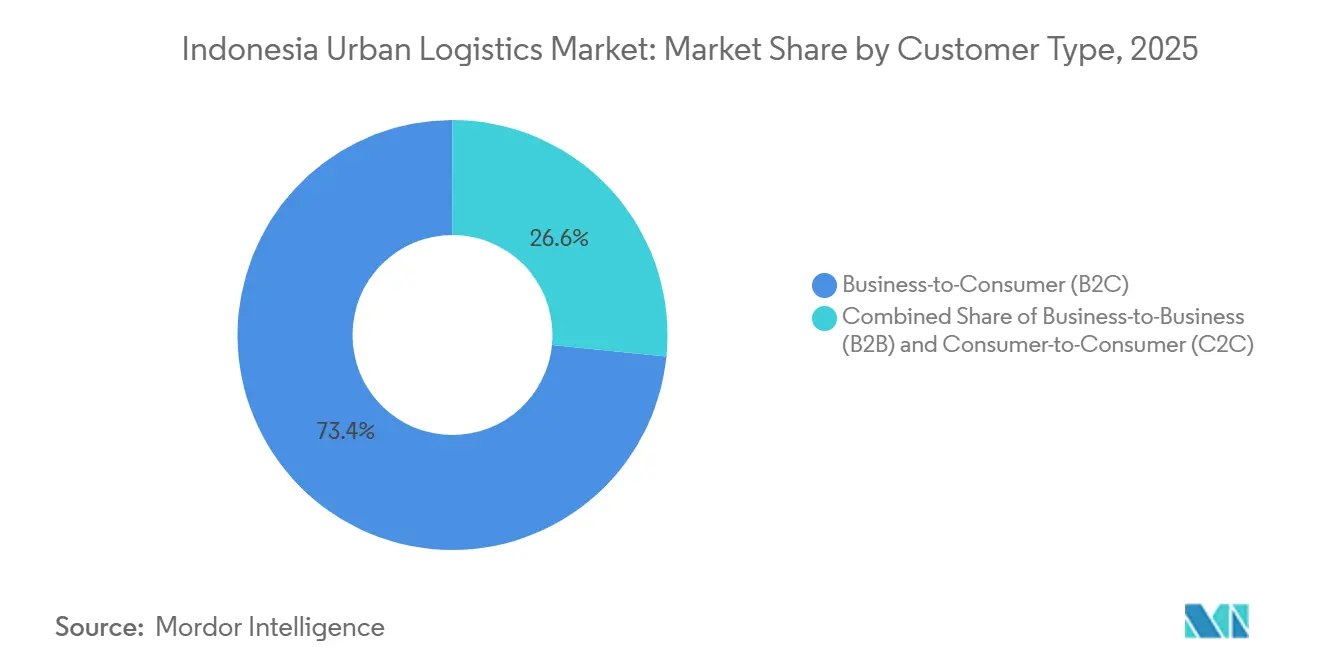
B2C held the largest revenue position in the Indonesian urban logistics market, accounting for 73.40% in 2025, supported by formal marketplaces and wider e-commerce use. Dense B2C delivery volumes in major cities allow carriers to plan routes and improve vehicle utilization. Sellers and platforms can provide regular order flows that support efficient last-mile operations. B2C shipments also benefit from established delivery addresses and standardized order processes. B2B movements contribute higher value per consignment, although many use dedicated fleets or bulk freight networks. The Indonesia urban logistics market size for B2C remains tied to the scale of household online purchases and platform fulfillment.
C2C is the fastest-growing customer type, expanding at a CAGR of 14.25% through 2031 as resale, live-stream selling, and social commerce spread. Individual sellers create distributed pickup points and variable collection windows. These shipments are usually lighter than branded B2C or B2B consignments. Carriers need app-based coordination to manage this activity without excessive failed collections. Digital procurement is also creating recurring B2B demand among small businesses. Providers with connected catalog, scheduling, and delivery functions can serve that demand more consistently.
By End-Use Industry: E-Commerce Anchors Volumes, Healthcare Expands Fastest
E-commerce and retail accounted for the largest end-use position in the Indonesian urban logistics market, with a 35.12% share in 2025. Marketplace sales, social commerce, and direct-to-consumer shipments create a large flow of urban parcels. Food and beverage is the second-largest category because dark kitchens, online grocery services, FMCG brands, and restaurants require frequent deliveries. These flows often need defined delivery windows because products may be perishable or time-sensitive. Consumer electronics, fashion, and automotive parts each have different packaging, security, return, and scheduling needs. The Indonesia urban logistics market share held by e-commerce and retail is supported by its breadth across consumer buying occasions.
Healthcare and pharmaceuticals are the fastest-growing end-use categories, expanding at a CAGR of 14.02% through 2031 as demand rises for specialized and reliable delivery services. Ministry of Health Regulation No. 20/2024 opened courier-based pharmaceutical delivery to certified operators.[4]Ministry of Health, “Regulation No. 20/2024 on the Distribution of Pharmaceutical Products via Courier Services,” Republic of Indonesia, kemkes.go.id. The requirements create a compliance barrier that favors established cold-chain networks and documented handling processes. Lion Parcel invested IDR 250 billion (USD 14.92 million) in temperature-controlled vehicles in 2025. J&T Express also added 82 refrigerated hubs during 2025. Industrial and manufacturing customers complete the end-use range through raw-material replenishment and custom-order fulfillment.
Geography Analysis
Jakarta held the largest and fastest-growing position in the Indonesian urban logistics market in 2025, accounting for 24.67% of the market and expanding at a CAGR of 12.85% through 2031, supported by its high parcel density, platform presence, and continued logistics investment. ESR and MCUDI entered a July 2026 agreement to develop 2 Grade A logistics and industrial facilities in Karawang and Cikarang with an expected combined asset value above USD 80 million. This investment reinforces the importance of the Greater Jakarta industrial corridor. Jakarta also faces acute port-related truck queues and constrained loading capacity. The city’s network will remain central, but its operating costs encourage some fulfillment activity to move outward.
Surabaya, Bandung, and Medan anchor the next tier of logistics development. Surabaya’s port connection and East Java industrial base support cross-island freight and regional distribution. Bandung benefits from proximity to Jakarta and shared transport links. Semarang’s lower warehouse rents and location on the northern Java corridor make it a practical relay location. Peregrine Cold Logistics entered Indonesia in August 2026 through a joint venture with Sinar Primera, which is expected to develop 35,000 sqm of temperature-controlled capacity in North and East Jakarta. This investment shows that urban logistics demand also includes specialized cold-chain capacity.
Makassar, Denpasar, and Yogyakarta represent emerging demand corridors with different operating patterns. Makassar serves as a gateway for Sulawesi and eastern freight flows. Sea Toll support helps improve connectivity for remote regions under Presidential Regulation No. 27 of 2021. Denpasar has seasonal demand linked to tourism, electronics, food and beverage, and hospitality supplies. Yogyakarta benefits from university and tourism activity, while smaller West Java cities add consumer demand. Internet penetration above 80% in 2025 supported growth in smaller cities, but investment-grade logistics infrastructure remained limited in many locations.
Competitive Landscape
The Indonesia urban logistics market is fragmented across express parcel providers, platform-linked networks, B2B on-demand operators, and cold-chain specialists. J&T Express, JNE Express, and SiCepat Ekspres are important players in the express segment. Platform-linked networks include GoSend, GrabExpress, and Shopee’s SAPX Express. These providers can internalize marketplace volumes and use connected booking systems to strengthen seller retention. J&T Express had more than 1,000 sorting machines across 500 drop centers and 2,700 Indonesian outlets as of June 2026. The scale of these assets supports broader parcel coverage and greater processing capacity.
State-sector consolidation also changed the competitive setting in 2026. Danantara Asset Management merged 7 state logistics enterprises into PT Multiterminal Indonesia on June 30, 2026. The combined entity brings port logistics, inter-island freight, and bonded-zone management into one public-sector operator. Its formation may affect contract logistics pricing for carriers that use state-controlled port and warehouse infrastructure. Nichirei Logistics Group acquired PT Mega Indo Logistik and PT Mega Internasional Sejahtera in April 2026. That move adds temperature-controlled logistics capability to the competitive field.
B2B on-demand operators such as Deliveree, Lalamove, and Borzo Indonesia focus on flexible freight matching for businesses that cannot make formal volume commitments. Compliance in pharmaceutical delivery offers opportunities for certified operators under Regulation No. 20/2024. Rural-to-urban links for tier-2 sellers and electric two-wheeler delivery networks are also developing areas of competition. ALVA, KALISTA, and Dash Electric deployed up to 500 ALVA N3 electric motorcycles in Jakarta in January 2026 for last-mile logistics activity. Operators with verified cold-chain, platform, and fleet capabilities can compete for more specialized contracts.
Indonesia Urban Logistics Industry Leaders
J&T Express
JNE Express
SiCepat Ekspres
TIKI
AnterAja
- *Disclaimer: Major Players sorted in no particular order

Recent Industry Developments
- September 2026: ESR and PT MC Urban Development Indonesia entered a joint development agreement for 2 Grade A logistics and industrial facilities in Karawang and Cikarang, Greater Jakarta, with a combined expected asset value exceeding USD 80 million. Construction is underway with completion targeted for Q3 2027, deepening institutional-grade logistics supply in Java’s established industrial corridors.
- August 2026: Peregrine Cold Logistics entered Indonesia through a joint venture with Sinar Primera to acquire an existing cold storage facility in Pluit, North Jakarta, and develop a greenfield site in Narogong, East Jakarta. The partnership is expected to deliver 35,000 sqm of temperature-controlled capacity across Greater Jakarta.
- June 2026: Danantara Asset Management formally merged 7 state-owned logistics enterprises, including Pos Logistics, Pelni Logistics, and PT Kawasan Berikat Nusantara, into PT Multiterminal Indonesia on June 30, 2026. The action targets redundancy elimination, lower pricing fragmentation, and integrated national port and maritime logistics operations.
- April 2026: Nichirei Logistics Group of Japan acquired PT Mega Indo Logistik and PT Mega Internasional Sejahtera as consolidated subsidiaries to expand temperature-controlled logistics operations in Indonesia.


Indonesia Urban Logistics Market Report Scope
| Transportation Services |
| Warehousing and Urban Storage Services |
| Fulfillment Services |
| Reverse Logistics Services |
| Value-Added Logistics (VAL) Services |
| Instant and Same-Day Delivery |
| Next-Day Delivery |
| Scheduled Delivery |
| Standard Delivery |
| Business-to-Business (B2B) |
| Business-to-Consumer (B2C) |
| Consumer-to-Consumer (C2C) |
| E-commerce and Retail |
| Food and Beverage |
| Healthcare and Pharmaceuticals |
| Consumer Electronics |
| Fashion and Apparel |
| Automotive Parts |
| Industrial and Manufacturing |
| Others |
| Jakarta |
| Bandung |
| Surabaya |
| Medan |
| Tasikmalaya |
| Yogyakarta |
| Semarang |
| Denpasar |
| Makassar |
| Rest of Cities |
| By Service Type | Transportation Services |
| Warehousing and Urban Storage Services | |
| Fulfillment Services | |
| Reverse Logistics Services | |
| Value-Added Logistics (VAL) Services | |
| By Delivery Speed | Instant and Same-Day Delivery |
| Next-Day Delivery | |
| Scheduled Delivery | |
| Standard Delivery | |
| By Customer Type | Business-to-Business (B2B) |
| Business-to-Consumer (B2C) | |
| Consumer-to-Consumer (C2C) | |
| By End-Use Industry | E-commerce and Retail |
| Food and Beverage | |
| Healthcare and Pharmaceuticals | |
| Consumer Electronics | |
| Fashion and Apparel | |
| Automotive Parts | |
| Industrial and Manufacturing | |
| Others | |
| By City | Jakarta |
| Bandung | |
| Surabaya | |
| Medan | |
| Tasikmalaya | |
| Yogyakarta | |
| Semarang | |
| Denpasar | |
| Makassar | |
| Rest of Cities |


Key Questions Answered in the Report
What is the expected value of Indonesia's urban logistics in 2031?
The sector is forecast to reach USD 56.99 billion by 2031, from USD 33.24 billion in 2026, at an 11.38% CAGR.
What is driving demand for urban delivery services in Indonesia?
E-commerce activity, social commerce, platform-linked fulfillment, and increasing digital participation among MSMEs are increasing parcel and pickup demand.
Which service type leads Indonesia's urban logistics revenue?
Transportation services lead revenue because e-commerce, on-demand delivery, and intercity cargo generate high daily parcel movement.
Which delivery option is expanding fastest in Indonesian cities?
Instant and same-day delivery is expanding fastest, supported by quick commerce networks and urban micro-fulfillment sites.
Why is healthcare logistics growing in Indonesia?
Regulation No. 20/2024 permits certified operators to deliver pharmaceutical products by courier, increasing demand for compliant cold-chain services.
Page last updated on:





