
Indonesia Third-Party Logistics (3PL) Market Size and Share
Market Overview
| Study Period | 2020 - 2031 |
|---|---|
| Forecast Data Period | 2026 - 2031 |
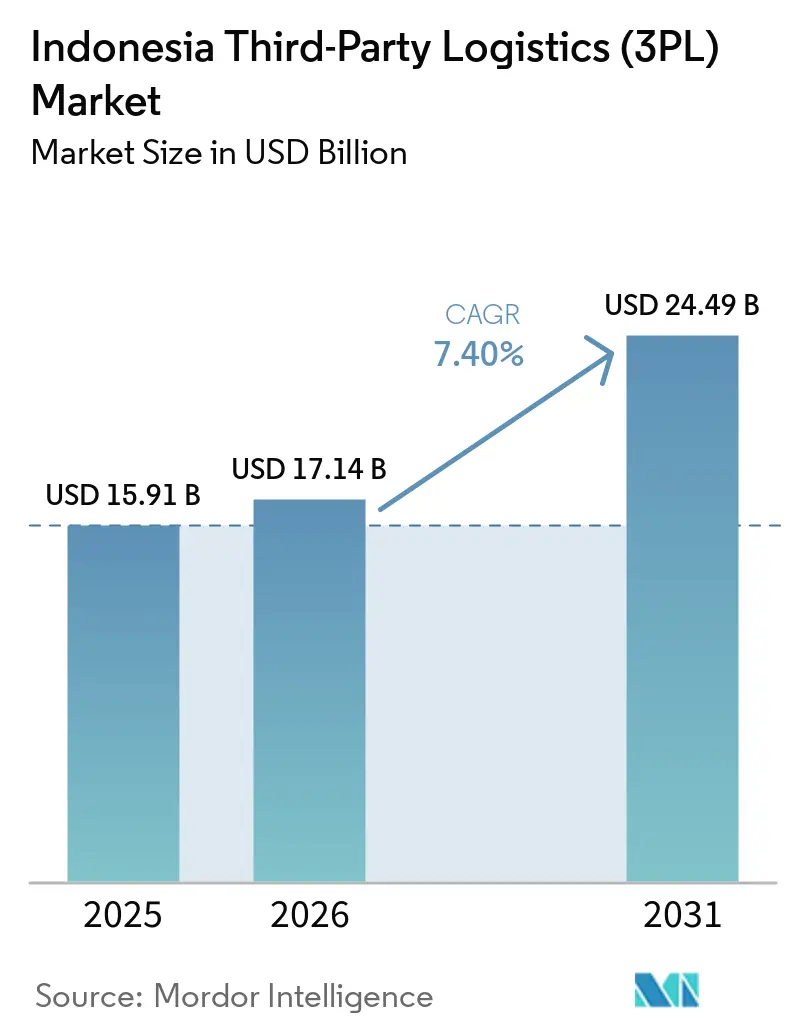
| Base Year Market Size (2025) | USD 15.91 Billion |
| Market Size (2026) | USD 17.14 Billion |
| Market Size (2031) | USD 24.49 Billion |
| Growth Rate (2026 - 2031) | 7.40 % |
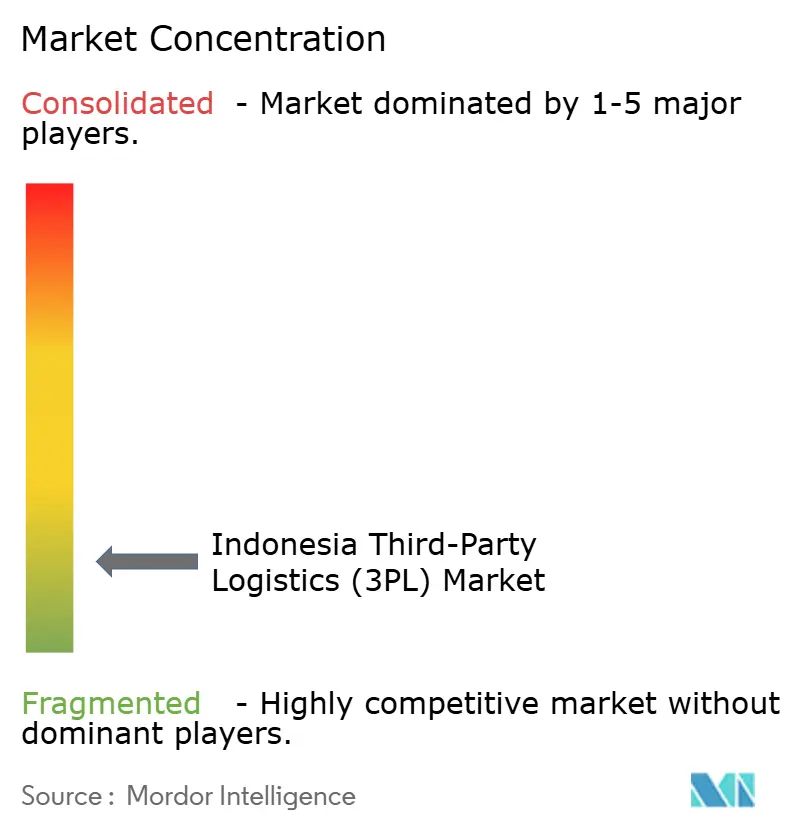
| Market Concentration | Low |
Major Players *Disclaimer: Major Players sorted in no particular order Image © Mordor Intelligence. Reuse requires attribution under CC BY 4.0. | |
Indonesia Third-Party Logistics (3PL) Market Analysis by Mordor Intelligence
The Indonesia third-party logistics (3PL) market size was valued at USD 15.91 billion in 2025, and is estimated to grow from USD 17.14 billion in 2026 to reach USD 24.49 billion by 2031, at a CAGR of 7.40% during the forecast period (2026-2031).
The Indonesia third-party logistics (3PL) market benefits from manufacturing investment, expanding healthcare distribution needs, and infrastructure projects that improve access between islands. Operators are moving beyond freight forwarding toward warehousing, distribution, returns processing, and compliance-led services because these activities can support longer client relationships. The country’s dispersed geography makes network reach and service reliability central to competition in the Indonesia third-party logistics (3PL) market. Investment in cold-chain capacity, digital tools, and multimodal networks could widen opportunities where formal logistics coverage remains limited.
Key Report Takeaways
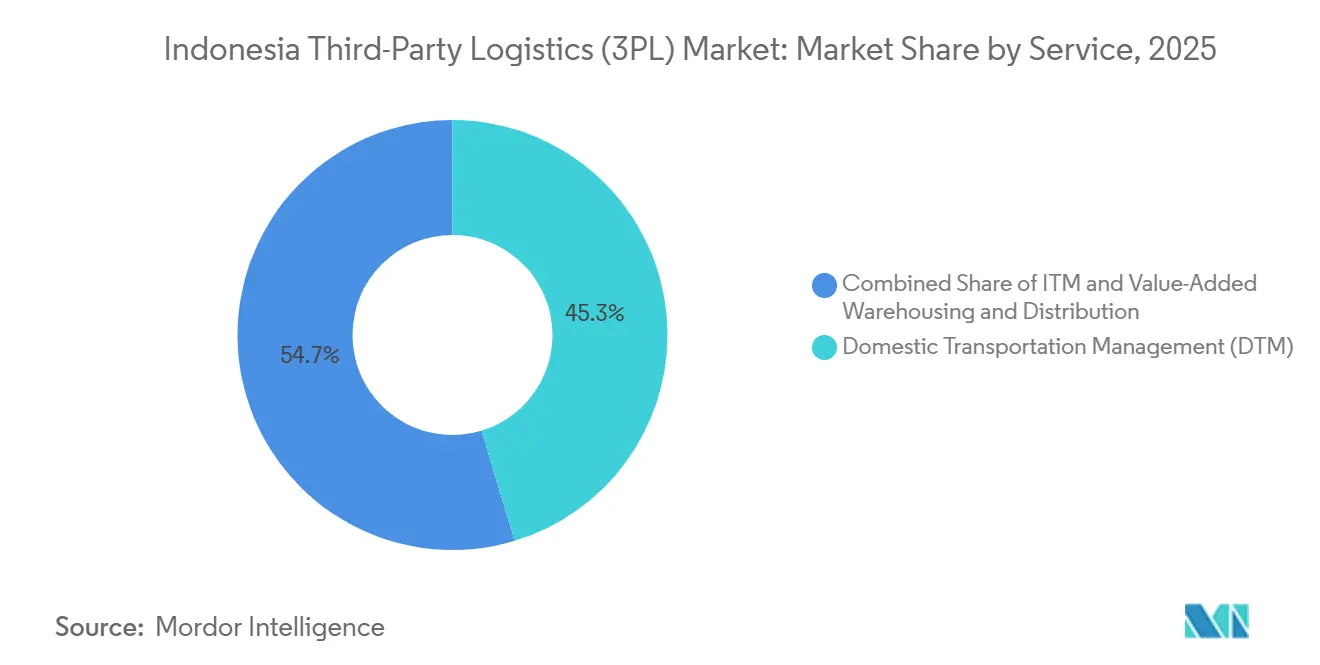
- By service, domestic transportation management held 45.32% of the Indonesia third-party logistics (3PL) market share in 2025, while value-added warehousing and distribution is forecast to register at a 10.54% CAGR through 2031.
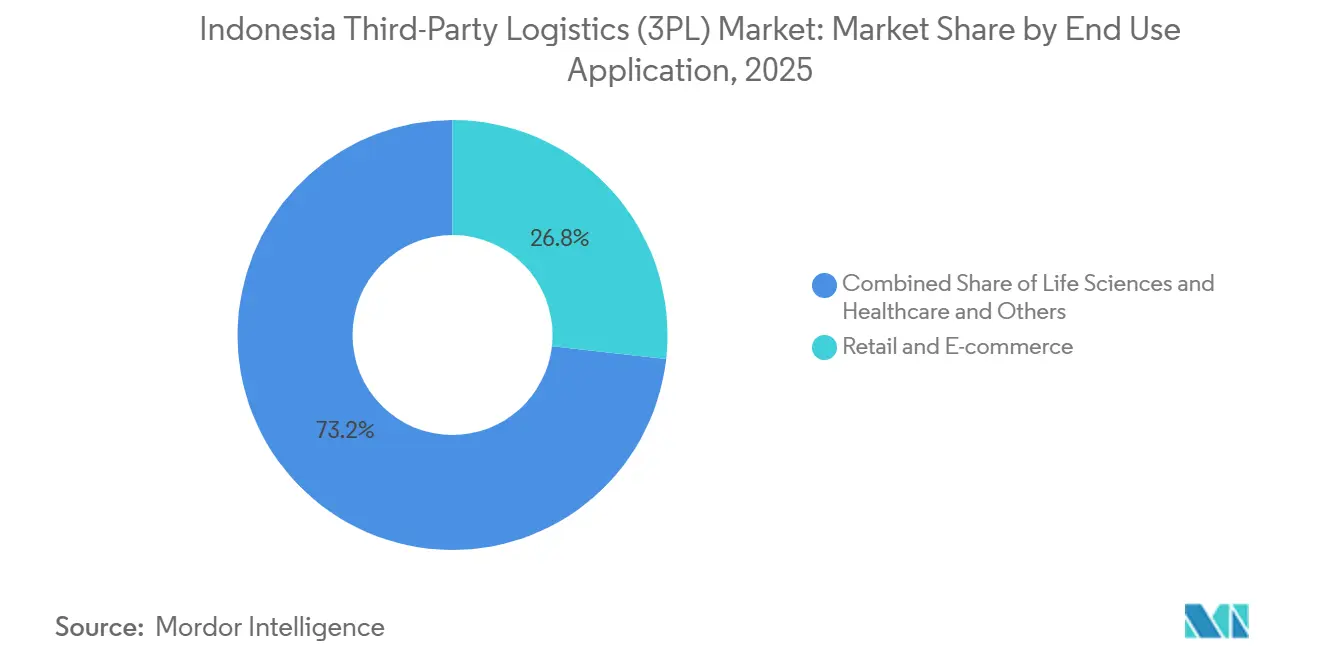
- By end-use application, retail and e-commerce held 26.78% of the Indonesia third-party logistics (3PL) market size in 2025, while life sciences and healthcare are forecast to register at an 8.43% CAGR through 2031.
- By logistics model, asset-light models held 52.85% of the Indonesia third-party logistics (3PL) market share in 2025, while hybrid models are forecast to register at a 9.72% CAGR through 2031.
- By geography, Java, including Jakarta and BOD, held 58.23% of the Indonesia third-party logistics (3PL) market share in 2025, while Sulawesi is forecast to register at an 11.23% CAGR through 2031.
Note: Market size and forecast figures in this report are generated using Mordor Intelligence’s proprietary estimation framework, updated with the latest available data and insights as of January 2026.
Indonesia Third-Party Logistics (3PL) Market Trends and Insights
Drivers Impact Analysis*
| Driver | (~) % Impact on CAGR Forecast | Geographic Relevance | Impact Timeline |
|---|---|---|---|
| E-Commerce Fulfillment and Omnichannel Outsourcing | +2.0% | Java, Sumatra, and tier-2 cities across the archipelago | Short term (≤ 2 years) |
| Manufacturing Expansion and Industrial Logistics Outsourcing | +1.5% | West Java, Batam, Banten, and East Kalimantan, including the IKN corridor | Medium term (2-4 years) |
| Infrastructure Investment and Inter-Island Network Connectivity | +1.2% | Sumatra, Sulawesi, Kalimantan, and the Jakarta, Semarang, Surabaya corridor | Medium term (2-4 years) |
| Contract Logistics Outsourcing and Integrated Service Demand | +0.9% | Java, Sumatra, and industrial special economic zones nationwide | Medium term (2-4 years) |
| Digitalization and Automation in 3PL Operations | +0.8% | Java, with spillover to major outer-island hubs | Long term (≥ 4 years) |
| Tier-2 City Expansion and Wider Service Coverage | +0.7% | Tier-2 cities in Sulawesi, Kalimantan, and Sumatra | Long term (≥ 4 years) |
| Source: Mordor Intelligence | |||
E-Commerce Fulfillment and Omnichannel Outsourcing Driving 3PL Demand
Platform delivery networks have expanded their own last-mile coverage, while upstream work has increasingly moved to specialist providers in the Indonesia third-party logistics (3PL) market. Shopee Express served 487 cities, and Lazada eLogistics operated 73 automated hubs that processed 850,000 packages daily in 2025. This arrangement concentrates delivery activity inside platforms but leaves inventory positioning, kitting, multichannel fulfillment, and returns handling open to third-party providers. Video commerce transactions reached 2.6 billion in 2025 after growing 90% year-over-year, which increased the volume of small, frequent orders. In September 2026, FAS expanded its portfolio to include a planned cold-chain offering alongside warehousing, delivery, and customer-care services. Brands can therefore seek broader support from one provider rather than coordinating multiple specialized vendors.
Manufacturing Expansion Increasing Industrial Logistics Outsourcing Requirements
At least 7 electric vehicle manufacturers committed to Indonesian production facilities since 2024, with Batam and West Java identified as manufacturing hubs. Their facilities require battery module storage, hazardous-material handling, aftermarket distribution, and just-in-time replenishment. Chinese and Hong Kong foreign direct investment rose 6.5% to USD 8.2 billion in the first half of 2025, while West Java industrial land rents rose 15% to 25% as manufacturers entered the country. The manufacturing base increases demand for bonded storage, customs support, and documented supply-chain controls. Indonesia’s downstream processing requirements for nickel and bauxite add further compliance needs for logistics partners. These needs favor providers that can combine physical handling with contract-based services across production and export flows.
Infrastructure Investment Improving Inter-Island 3PL Network Connectivity
The Trans-Sumatra Toll Road reached 982 km of operational coverage in August 2026[1]. The network connects industrial sites, ports, and agricultural centers across Sumatra’s export corridors. Indonesia also presented IDR 207.6 trillion (USD 11.8 billion) in 32 strategic infrastructure projects to Japanese investors in September 2026, covering toll roads, railways, and ports. These investments can reduce friction between production locations and gateway infrastructure. Each operational port node can make a wider service area commercially viable for the Indonesia third-party logistics (3PL) market. Better inter-island links also support a larger role for rail and sea services alongside road transport.
Digitalization and Automation Improving 3PL Operating Efficiency
PT Pos Indonesia deployed AI-powered robotic sorting systems at its Pulo Gadung warehouse in Jakarta in July 2026. The deployment shows that state-linked operators are investing in systems that private providers have also adopted. Research involving 350 Indonesian logistics managers found that AI implementation had the strongest standardized effect on operating efficiency among the tested digital tools[2]. Route optimization, predictive restocking, and fewer processing errors were the channels identified in that research. Larger multi-client operators can gain more from integrated systems than smaller providers with fragmented processes. This difference can make technology investment an important competitive factor in the Indonesia third-party logistics (3PL) market.
Restraints Impact Analysis*
| Restraint | (~) % Impact on CAGR Forecast | Geographic Relevance | Impact Timeline |
|---|---|---|---|
| Archipelagic Transshipment Costs and Complexity | -1.8% | Sulawesi, Papua, Maluku, Kalimantan, and nationwide inter-island freight flows | Long term (≥ 4 years) |
| Fragmented Trucking Capacity and Empty Returns | -0.9% | Java, Sumatra, and national cross-island corridors | Short term (≤ 2 years) |
| Zero-ODOL Compliance and Payload Economics | -0.7% | National, with stronger enforcement on Trans-Java and Trans-Sumatra toll roads | Medium term (2-4 years) |
| Power Reliability Constraints for Automated Cold Facilities | -0.4% | Sulawesi, Papua, Maluku, and parts of Kalimantan | Long term (≥ 4 years) |
| Source: Mordor Intelligence | |||
Archipelagic Transshipment Increasing Logistics Costs and Complexity
Indonesia’s 17,500-island geography requires much inter-island freight to move through sea transshipment. Similar inbound consumer-goods volumes do not match commodity exports from Sumatra, Kalimantan, and eastern Indonesia. The imbalance creates empty-container repositioning costs that affect freight rates across the archipelago. The Tol Laut program allocated IDR 623.4 billion (USD 35.28 million) across 756 voyages serving 104 ports in 2025. The program reduced the Java-to-Papua price gap from 47% in 2019 to 31% in 2025, although last-mile bottlenecks continued to limit the effect on retail prices. Smaller operators face a particular challenge because they lack enough network density to optimize loads in both directions.
Zero-ODOL Compliance Pressuring Payload Economics and Costs
The Zero ODOL policy targets full enforcement by 2027 after limited enforcement began in 2026. The policy requires freight vehicles to meet legal axle and dimension limits, reducing payloads unless tariffs rise[3]. More than 60% of freight vehicles were in the ODOL category in 2024, indicating that compliance will affect a broad part of the trucking sector. A 2026 simulation estimated a 4.6% increase in national logistics costs in the short term and a 6.7% increase in fleet investment requirements, equal to IDR 42.4 trillion (USD 2.53 billion). Law No. 22/2009 and related national logistics regulations establish penalties and fines for violations. Larger providers can renegotiate contracts or absorb some costs, while smaller providers face greater margin pressure.
*Our forecasts treat driver/restraint impacts as directional, not additive. The impact forecasts reflect baseline growth, mix effects, and variable interactions.
Segment Analysis
By Service: Value-Added Warehousing and Distribution Broadens the Service Mix
Domestic transportation management accounted for 45.32% of Indonesia third-party logistics (3PL) market share in 2025, reflecting its role in the country’s road-based freight system. Value-added warehousing and distribution is forecast to register a 10.54% CAGR through 2031, driven by demand for specialized logistics services. Road freight remained the main logistics backbone, with trucks handling around 90% of domestic cargo movements across major consumption and industrial corridors. Water and air transport remain important for connecting Kalimantan, Papua, and Sulawesi, while rail serves industrial corridors in Java and North Sumatra. International transportation management is also gaining importance as Batam develops as a customs gateway for electronics manufacturing and cross-border cargo.
Value-added warehousing and distribution is supported by kitting, labeling, cold-chain management, and reverse logistics. E-commerce, healthcare, and FMCG companies increasingly require standardized handling across multiple locations, creating opportunities for specialized 3PL providers. Halal certification and pharmaceutical Good Distribution Practice standards further raise compliance requirements. Logistics hubs in Greater Jakarta and Surabaya are also adopting warehouse-management systems and automated storage technologies to improve inventory and fulfillment efficiency.

By End-Use Application: Life Sciences and Healthcare Raise Specialized Demand
Retail and e-commerce held 26.78% of Indonesia third-party logistics (3PL) market size in 2025, while life sciences and healthcare are forecast to register an 8.43% CAGR through 2031. Retail and e-commerce demand was supported by high parcel volumes across Greater Jakarta, Bandung, and Surabaya, with Indonesia’s e-commerce gross merchandise value reaching USD 71 billion in 2025. Healthcare logistics is driven by growing demand for validated cold-chain operations, particularly for pharmaceuticals requiring temperature-controlled handling. Limited certified cold-chain capacity relative to healthcare distribution needs continues to create opportunities for specialized 3PL providers.
Consumer goods and FMCG, automotive, and manufacturing provide stable freight volumes for contract logistics providers. Automotive logistics is supported by Patimban Port’s expanding roll-on, roll-off capacity, strengthening its role in vehicle export logistics alongside Tanjung Priok. Food and Beverages distribution and Energy and Utilities logistics also require regular multi-island freight, project-cargo handling, and hazardous-material capabilities.
By Logistics Model: Hybrid Networks Balance Control and Reach
Asset-Light models held 52.85% of Indonesia third-party logistics (3PL) market share in 2025, while hybrid models are forecast to register a 9.72% CAGR through 2031. Asset-light providers can expand across Indonesia’s dispersed island network without owning assets in every location, supporting greater capital efficiency. Asset-Heavy operators remain relevant on dense routes around Greater Jakarta, Surabaya, and Medan, where frequent cargo volumes support high fleet utilization and predictable service levels.
Hybrid providers combine owned assets on core routes with subcontracted capacity and digital freight networks across tier-2 cities and outer islands. This model enables broader end-to-end coverage while limiting the cost of maintaining assets at every location. AI-enabled route planning and real-time tracking further support network coordination and fleet utilization. Providers with multi-temperature facilities can also serve FMCG and retail customers requiring ambient, frozen, and chiller distribution.
Geography Analysis
Java, including Jakarta and BOD, held 58.23% of Indonesia third-party logistics (3PL) market size in 2025. Tanjung Priok handled more than half of Indonesia’s transshipment cargo and supported the country’s largest concentration of manufacturing, retail, and fulfillment activity. The Trans-Java toll-road system links major industrial areas and consumption centers. Tanjung Emas reported 15% year-over-year throughput growth as Central Java’s textile and furniture exports expanded in 2026. DHL is investing in gateway capacity in Jakarta, Surabaya, Semarang, Batam, and Bali.
Sulawesi is forecast to register at an 11.23% CAGR through 2031, the fastest regional pace in the Indonesia third-party logistics (3PL) market. Nickel processing in Sulawesi and Halmahera, agricultural freight, and transport connections support the outlook. Pelindo Regional 4’s container throughput rose 2.04% year-over-year to 619,874 TEUs across Eastern Indonesia in the first quarter of 2025. PT Multi Terminal Indonesia opened a 3.1-hectare logistics yard at Bitung Port in September 2025. Sumatra benefits from the 982 km operational Trans-Sumatra Toll Road. Kalimantan’s demand is tied to Nusantara Capital City construction, mining, and rail-freight plans.
Bali and Nusa Tenggara depend on hospitality and tourism supply chains that require temperature-controlled distribution. Papua and Maluku remain the most constrained regions for commercial logistics development. Low return-cargo volumes, limited ports, and power reliability constraints continue to limit 3PL penetration. The Java-to-Papua price gap remained 31% in 2025 despite the Tol Laut program. A new ASDP ferry route connecting Balikpapan and Garongkong began operations in 2025, adding a link between Kalimantan and South Sulawesi.
Competitive Landscape
The Indonesia third-party logistics (3PL) market is highly fragmented, with global providers strongest in value-added services. Domestic specialists retain advantages in local networks, pricing, and customer relationships across diverse island routes. DHL Group had more than 4,000 employees and around 180 facilities nationwide as of June 2025. Kuehne+Nagel competes through an integrated oil-and-gas logistics portfolio that includes its Lamongan Shorebase hub. CEVA Logistics competes through integrated supply-chain services and compliance credentials.
Local and regional providers, including PT Samudera Indonesia, PT Puninar Logistics, PT Kamadjaja Logistics, and Waresix, compete through local experience and freight-corridor coverage. Samudera Indonesia completed its USD 16.2 million acquisition of Crest10 in July 2026. Nippon Express Holdings merged its 2 Indonesian subsidiaries effective March 2026 under its One Indonesia strategy. The combined entity brings ocean and air freight forwarding under one organization and is intended to improve customer coordination. CEVA Logistics Indonesia obtained BPJPH Halal Certification in June 2026, reinforcing the role of formal credentials in regulated distribution[4].
Pharmaceutical cold-chain logistics remains an opportunity because validated temperature-controlled capacity is limited. Sulawesi and Kalimantan also offer room for providers as commodity-related demand grows faster than formal 3PL coverage. Route optimization, digital freight networks, and real-time tracking can improve service consistency and competitive positioning. The Indonesia third-party logistics (3PL) market is most competitive in Java and tier-1 corridors, while outer-island competition is more dispersed.
Indonesia Third-Party Logistics (3PL) Industry Leaders
-
DHL Group
-
DSV A/S
-
PT Samudera Indonesia Tbk
-
Kiat Ananda Group
-
PT Kamadjaja Logistics
- *Disclaimer: Major Players sorted in no particular order
Recent Industry Developments
- July 2026: PT Samudera Indonesia Tbk completed the acquisition of Crest10 for USD 16.2 million (effective July 1, 2026), expanding its digital and maritime logistics capabilities and strengthening its competitive positioning within Indonesia's third-party logistics sector.
- April 2026: NYK Line (Yusen Logistics' parent group) conducted the inaugural port call of the car carrier "HYPERION LEADER" at Patimban International Car Terminal in West Java, validating the terminal's operational capability for automotive RoRo logistics and extending vehicle-export capacity beyond the congested Tanjung Priok gateway.
- March 2026: Nippon Express Holdings completed the merger of PT. NX Lemo Indonesia Logistik and PT. Nippon Express Indonesia (effective March 1, 2026), consolidating ocean and air freight forwarding under a single entity to deliver clearer customer interfaces, stronger account management, and improved operational efficiency under the "One Indonesia" unified strategy.
- April 2025: DHL Group reaffirmed its Indonesia growth strategy under Strategy 2030, announcing EUR 500 million (USD 540.3 million) in Asia-Pacific Life Sciences and Healthcare infrastructure investment by 2030 through the DHL Health Logistics brand, with Indonesia specifically identified as a focus market for EV, healthcare, and e-commerce logistics.
Indonesia Third-Party Logistics (3PL) Market Report Scope
| Domestic Transportation Management (DTM) | Roadways |
| Railways | |
| Airways | |
| Waterways | |
| International Transportation Management (ITM) | Roadways |
| Railways | |
| Airways | |
| Waterways | |
| Value-Added Warehousing and Distribution (VAWD) |
| Automotive |
| Energy and Utilities |
| Manufacturing |
| Life Sciences and Healthcare |
| Technology and Electronics |
| Retail and E-commerce |
| Consumer Goods and FMCG |
| Food and Beverages |
| Others |
| Asset-Light |
| Asset-Heavy |
| Hybrid |
| Java (Jakarta and BOD) |
| Sumatra |
| Kalimantan |
| Sulawesi |
| Bali and Nusa Tenggara |
| Papua Region and Maluku Islands |
| By Service | Domestic Transportation Management (DTM) | Roadways |
| Railways | ||
| Airways | ||
| Waterways | ||
| International Transportation Management (ITM) | Roadways | |
| Railways | ||
| Airways | ||
| Waterways | ||
| Value-Added Warehousing and Distribution (VAWD) | ||
| By End-Use Application | Automotive | |
| Energy and Utilities | ||
| Manufacturing | ||
| Life Sciences and Healthcare | ||
| Technology and Electronics | ||
| Retail and E-commerce | ||
| Consumer Goods and FMCG | ||
| Food and Beverages | ||
| Others | ||
| By Logistics Model | Asset-Light | |
| Asset-Heavy | ||
| Hybrid | ||
| By Region | Java (Jakarta and BOD) | |
| Sumatra | ||
| Kalimantan | ||
| Sulawesi | ||
| Bali and Nusa Tenggara | ||
| Papua Region and Maluku Islands | ||
Key Questions Answered in the Report
What is the forecast for Indonesia third-party logistics (3PL)?
The Indonesia third-party logistics (3PL) market is projected to reach USD 24.49 billion by 2031, growing at a 7.40% CAGR from 2026.
Which service is expanding fastest in Indonesia third-party logistics (3PL)?
Value-added warehousing and distribution is forecast to grow at a 10.54% CAGR through 2031, supported by fulfillment, cold-chain, and returns needs.
Which customer group creates the greatest demand for 3PL services in Indonesia?
Retail and e-commerce held 26.78% of revenue in 2025, supported by high parcel volumes and USD 71 billion in e-commerce gross merchandise value.
Why is healthcare logistics growing in Indonesia?
Life sciences and healthcare are forecast to grow at an 8.43% CAGR through 2031 because validated cold-chain logistics capacity remains limited.
Which Indonesian region is growing fastest for 3PL providers?
Sulawesi is forecast to grow at an 11.23% CAGR through 2031, supported by nickel processing, agricultural freight, and developing connections.
What challenge does the Zero ODOL policy create for logistics providers?
Full enforcement targeted for 2027 limits truck payloads, raises fleet investment needs, and increases pressure to revise freight tariffs and contracts.