
Indonesia Takaful Market Size and Share
Market Overview
| Study Period | 2021 - 2032 |
|---|---|
| Forecast Data Period | 2027 - 2032 |
| Base Year Market Size (2026) | USD 1.5 Billion |
| Market Size (2027) | USD 1.60 Billion |
| Market Size (2032) | USD 2.10 Billion |
| Growth Rate (2027 - 2032) | 5.60 % |
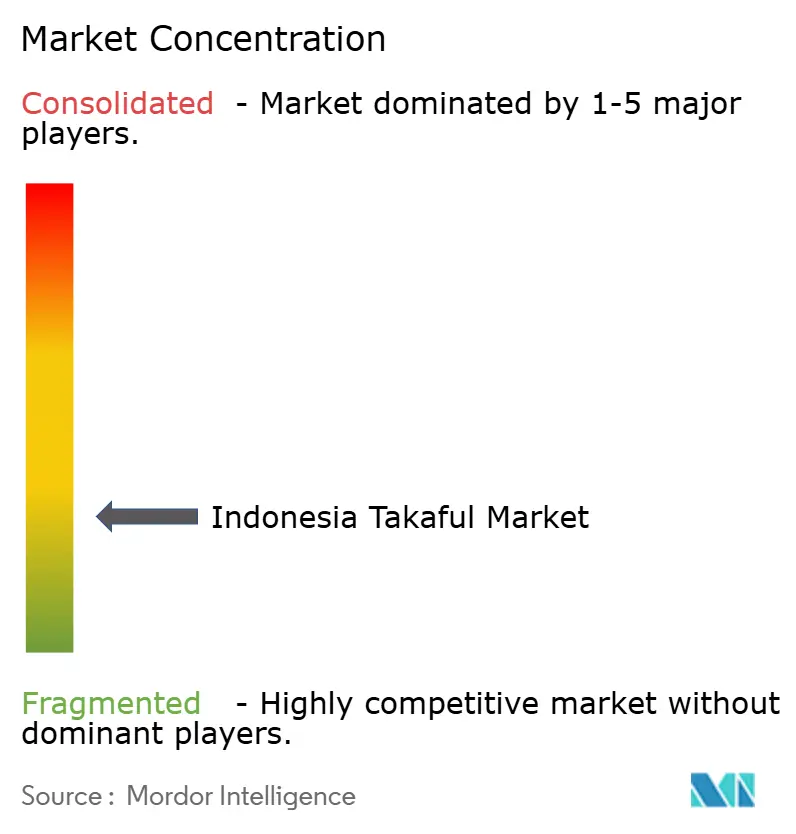
| Market Concentration | Low |
Major Players *Disclaimer: Major Players sorted in no particular order Image © Mordor Intelligence. Reuse requires attribution under CC BY 4.0. | |
Indonesia Takaful Market Analysis by Mordor Intelligence
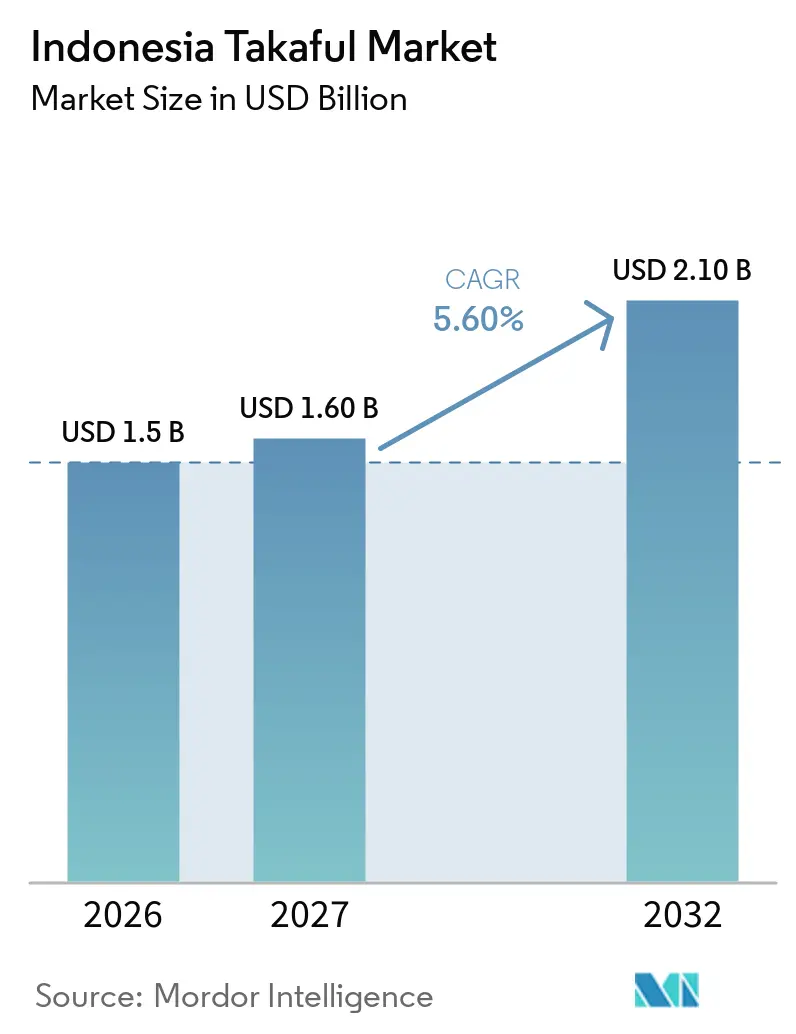
The Indonesia Takaful Market size is projected to be USD 1.5 billion in 2026, USD 1.60 billion in 2027, and reach USD 2.10 billion by 2032, growing at a CAGR of 5.60% from 2027 to 2032.
The Indonesia takaful market is being shaped by the required separation of sharia business units, broader Islamic finance activity, and wider digital distribution. Indonesia has more than 270 million people, and its predominantly Muslim population provides a large potential customer base. Sharia insurance penetration remains below 1%, which leaves substantial room for wider use before the sector reaches maturity. The mandatory spin-off deadline may pressure margins in the near term, but it also creates standalone operators with dedicated governance, underwriting, and actuarial capabilities. Competition is likely to increase as new entities build scale, while partnerships with banks, technology providers, and community groups can improve access to customers.
Key Report Takeaways
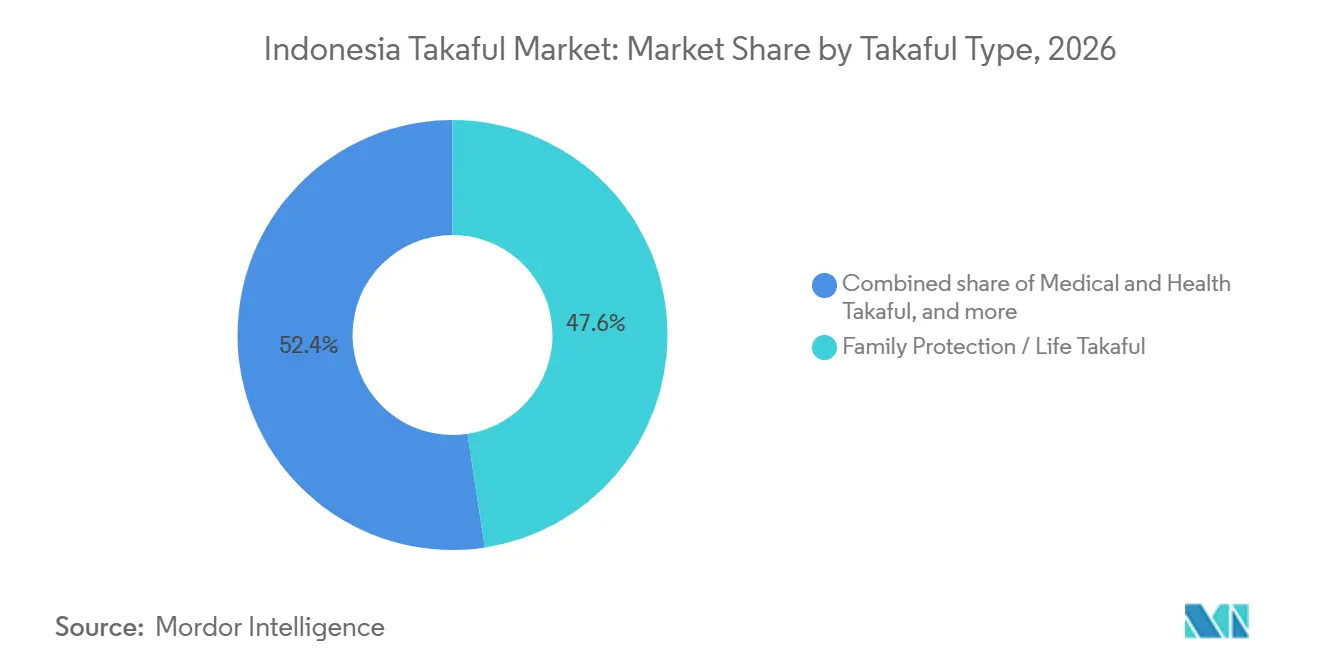
- By takaful type, family protection and life takaful captured 47.6% of the Indonesia takaful market share in 2026, while medical and health takaful is projected to grow at a 7.5% CAGR through 2032.
- By distribution channel, agents and brokers held 45.4% of the Indonesia takaful market share in 2026, while embedded, affinity, and other non-bank partnerships are forecast to grow at an 8.7% CAGR through 2032.
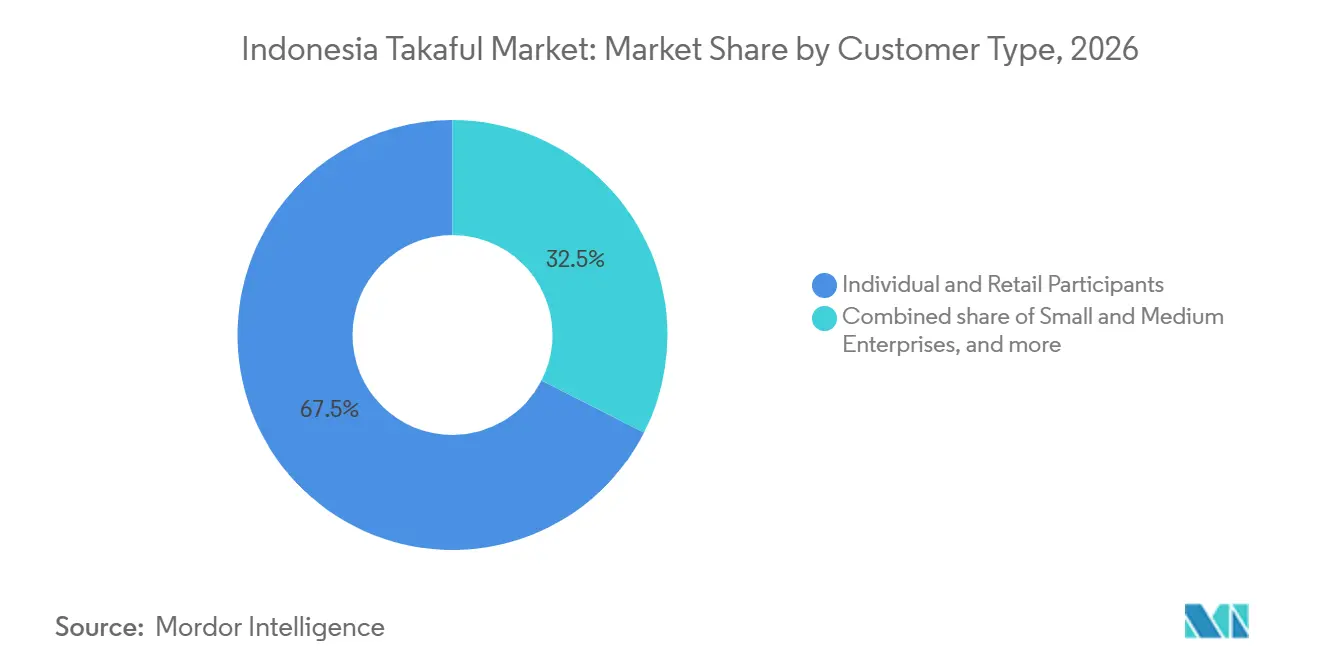
- By customer type, individual and retail participants captured 67.5% of the Indonesia takaful market share in 2026, while small and medium enterprises are projected to grow at an 8.1% CAGR through 2032.
Note: Market numbers in this report are based on Mordor Intelligence's proprietary estimation framework, which combines nine months of actuals with Q4 projections for base year 2026.
Indonesia Takaful Market Trends and Insights
Drivers Impact Analysis*
| Driver | (~) % Impact on CAGR Forecast | Geographic Relevance | Impact Timeline |
|---|---|---|---|
| Rising Sharia Financial Inclusion and Takaful Awareness | +0.9% | National, with higher adoption velocity in Java urban centers | Medium term (2-4 years) |
| Regulatory-Mandated Sharia Unit Spin-Offs and Market Formalization | +1.1% | National, concentrated through Jakarta's regulatory and financial infrastructure | Short term (≤ 2 years) |
| Digitalization of Takaful Distribution and Claims | +0.8% | National, with early gains in Greater Jakarta and secondary cities | Medium term (2-4 years) |
| Expansion of Affordable and Micro-Takaful Products | +0.6% | National, with stronger uptake in outer islands and rural Java | Long term (≥ 4 years) |
| Growth of Indonesia's Islamic Finance Ecosystem | +0.9% | National, with the Association of Southeast Asian Nations investment spillover | Medium term (2-4 years) |
| Sharia Social Finance and Product Innovation | +0.5% | National, concentrated in Islamic cooperative and community finance hubs | Long term (≥ 4 years) |
| Source: Mordor Intelligence | |||
Regulatory-Mandated Sharia Unit Spin-Offs and Market Formalization
OJK Regulation No. 11 of 2023 requires insurance and reinsurance companies with Sharia business units to complete their spin-offs by 31 December 2026, accelerating the transition toward standalone Sharia insurers and greater operational separation. By September 2026, 41 companies had submitted revised spin-off plans, with 23 planning to establish new entities and 18 opting to transfer their portfolios to existing Sharia insurers. As of September 2026, 21 companies had completed the process, comprising 11 new entities and 10 portfolio transfers, while 11 Sharia units remained in the process of establishing standalone entities[1]. The regulation provides eligible spin-off entities with an exemption from the minimum paid-in capital requirement applicable to newly established Sharia insurers, although other applicable capital and equity requirements remain relevant. Complementing these reforms, OJK inaugurated its Sharia Financial Development Committee on 8 July 2025 to strengthen governance and support the development of Indonesia’s broader Islamic financial services sector.
Rising Sharia Financial Inclusion and Takaful Awareness
Indonesia’s Sharia financial literacy index reached 43.07% in 2026, while Sharia financial inclusion stood at 13.24%, according to the National Survey of Financial Literacy and Inclusion conducted by OJK, Indonesia’s Deposit Insurance Corporation, and Statistics Indonesia[2]. The survey covered 75,000 respondents across 38 provinces and 514 regencies and cities. These figures indicate a substantial gap between understanding Sharia financial products and using them, highlighting the importance of improving product accessibility and consumer understanding. However, the indicators cover Sharia finance broadly and do not independently quantify Takaful awareness or demand.
Digitalization of Takaful Distribution and Claims
Digital distribution offers Indonesian takaful operators a potential route to serve smaller policies and geographically dispersed customers more efficiently. In May 2026, OJK reported 25 registered Financial Sector Technology Innovation (ITSK) providers, which had established 1,322 partnerships with financial institutions and technology or data providers by April 2026[3]. OJK also held an Insurance Digitalization Workshop on 25 May 2026 to discuss digital insurance marketing, consumer behaviour, and opportunities to reach underserved customer segments and geographic areas. OJK Regulation No. 8 of 2024 provides a regulatory framework for digital insurance products and distribution, including requirements for information-system registration, technology risk management, and compliance with Sharia principles. These developments create opportunities for Takaful operators to expand digital distribution, although lower operating costs and improved claims-processing efficiency should be treated as potential benefits rather than established market-wide outcomes.
Growth of Indonesia’s Islamic Finance Ecosystem
The Indonesia takaful market benefits from a broader Islamic finance system that supports customer demand and potential distribution channels. Total sharia financial assets reached IDR 3,131.02 trillion (USD 195.69 billion) in 2025, representing an 8.56% year-on-year increase[4]. The Insurance, Guarantee, and Pension Fund segment grew by 10.59% to IDR 74.27 trillion (USD 4.64 billion). Islamic banking financing increased by 9.58% to IDR 705.22 trillion (USD 44.08 billion) by December 2025, while deposits rose by 10.14%. Prudential’s bancassurance partnership with Bank Syariah Indonesia was announced in September 2024, providing access to BSI’s customer base of more than 20 million and its network of over 1,000 branches. Indonesia’s national zakat, infaq, sadaqah, and other religious social fund collections reached IDR 44.698 trillion (USD 2.79 billion) in 2025.
Restraints Impact Analysis*
| Restraint | (~) % Impact on CAGR Forecast | Geographic Relevance | Impact Timeline |
|---|---|---|---|
| Low Conversion of Sharia Financial Awareness into Insurance Adoption | -0.8% | National, more pronounced in rural and outer-island locations | Medium term (2-4 years) |
| Strong Competition from Conventional Insurance Providers | -0.7% | National, concentrated in large corporate, health, and motor segments | Short term (≤ 2 years) |
| High Cost and Complexity of Sharia Unit Spin-Offs | -0.5% | National, concentrated in below-scale Sharia unit operators | Short term (≤ 2 years) |
| Limited Specialized Sharia Insurance Talent | -0.4% | National, most acute outside Greater Jakarta | Long term (≥ 4 years) |
| Source: Mordor Intelligence | |||
Low Conversion of Sharia Financial Awareness into Insurance Adoption
Indonesia’s sharia financial literacy index reached 43.42% in 2025, while sharia financial inclusion stood at 13.41%, indicating a gap of 30.01 percentage points. These figures cover the broader Sharia financial sector. OJK and BPS identified rural residents and other demographic groups as having lower financial literacy or inclusion levels than the national average, highlighting barriers to expanding access to sharia financial products. IFG Progress also identifies low public literacy as a major obstacle to expanding sharia insurance penetration. This creates a need for targeted education, clearer product communication, and stronger distribution partnerships.
Strong Competition from Conventional Insurance Providers
Indonesia’s takaful operators face competitive and operational pressures from established conventional insurers, alongside rising capital and compliance requirements. OJK Regulation No. 23 of 2023 introduced phased minimum-equity requirements for insurance and reinsurance companies. As of December 2025, 114 of 144 insurance and reinsurance companies had met the minimum equity requirement applicable in 2026, indicating that some operators still needed to strengthen their capital positions. Separately, OJK Regulation No. 36 of 2025 strengthens health insurance governance, product design, risk management, utilization review, and consumer protection, increasing operational requirements for insurers offering health coverage, including sharia operators. These requirements can create additional implementation costs and capacity challenges, particularly for smaller providers.
*Our forecasts treat driver/restraint impacts as directional, not additive. The impact forecasts reflect baseline growth, mix effects, and variable interactions.
Segment Analysis
By Takaful Type: Life Takaful Provides the Largest Base While Health Coverage Expands Fastest
Family protection and life takaful held 47.6% of the Indonesia takaful market share in 2026. Medical and health takaful is forecast to advance at a 7.5% CAGR through 2032, the fastest rate among the product categories. BPJS Kesehatan covered 282.7 million participants and recorded IDR 191.3 trillion (USD 11.8 billion) in health expenditure in 2025. Its early 2026 claim ratio was 111.86%, which strengthens the case for supplemental private health protection. The government planned an IDR 20 trillion (USD 1.2 billion) injection to support BPJS Kesehatan in 2026.
Life Sharia insurance annualized premium equivalent was IDR 4.7 trillion (USD 290 million) in 2025 and grew 13%, with 24.5 million insured participants. Savings and investment-linked coverage is gaining interest as urban household incomes rise and customers seek protection with sharia-compliant savings features. General takaful gives the Indonesia takaful industry a wider product base across motor, property, fire, marine, aviation, engineering, construction, liability, travel, personal accident, and credit lines. Zurich General Takaful Indonesia reported gross contribution income above IDR 300 billion (USD 18.5 million) through May 2026, a 17% increase. Its experience shows that pilgrimage travel, small and medium enterprise property, and marine coverage can support growth when motor demand is weak.
By Distribution Channel: Agents Remain Important While Partnership Channels Grow Faster
Agents and brokers accounted for 45.4% of contributions in 2026, making them the leading distribution channel. Prudential Syariah had more than 67,000 licensed sharia marketers in the first quarter of 2026. Embedded, affinity, and other non-bank partnerships are expected to grow at an 8.7% CAGR through 2032. OJK registration of 30 insurance technology service companies and 1,350 institutional partnerships supports broader embedded distribution. Direct distribution remains smaller, but fully digital product launches and claims handling can improve its reach in the Indonesia takaful market.
Bancatakaful has the clearest partnership activity among the channels. Bancassurance represented 40.4% of total life insurance premiums by March 2026, showing the importance of financial institution partnerships for insurance distribution. Prudential Syariah partnered with Bank Syariah Indonesia, while Allianz Syariah expanded relationships with Maybank Indonesia and BTPN Syariah. Islamic cooperatives, Hajj pilgrim associations, and trade bodies can offer higher Sharia finance affinity than broad consumer campaigns. These channels may generate stronger conversions because they connect coverage with customer groups that already use Islamic financial services.
By Customer Type: Retail Customers Lead While Small and Medium Enterprises Offer Faster Expansion
Individual and retail participants held 67.5% share of the Indonesia takaful market in 2026. The Indonesia takaful market size for this group reflects a consumer-oriented product base that has developed since family takaful was introduced in Indonesia in 1994. Households earning IDR 5 million (USD 310) to IDR 10 million (USD 620) monthly were the largest ownership group in the Indonesia Finance Group study. A total of 81.80% of respondents preferred monthly payments, which supports the case for standard payment structures that align with salary cycles. Individual coverage continues to provide the main contribution base for providers with established agency and bancatakaful networks.
Small and medium enterprises are forecast to grow at an 8.1% CAGR through 2032. Indonesia has 64.2 million micro, small, and medium enterprises that often lack sharia-compliant protection for key persons, inventory, credit, and business continuity. Research involving businesses in Medan found positive views of sharia insurance but identified limited knowledge and affordability as the primary obstacles. Simplified packages can respond more effectively than complex product catalogs for this group. Large corporates, and government and institutional participants remain slower-growing, but their higher-value contracts can help newer standalone operators establish balance-sheet capacity.
Geography Analysis
Java generates most contributions in the Indonesia takaful market and is home to 57% of Indonesia’s population. Greater Jakarta serves as the commercial and regulatory center, while formal employment, bancatakaful relationships, and licensed agent networks are most developed on the island. As of December 2025, sharia life insurance assets were IDR 38.20 trillion (USD 2.36 billion), while general takaful assets were IDR 10.41 trillion (USD 643 million). The Association of Sharia Insurance of Indonesia reported total sharia insurance assets of IDR 50.903 trillion (USD 2.91 billion) in June 2026. These assets increased 7.09% year on year, with life takaful increasing 7.09% and general takaful increasing 9.06%.
Sumatra, Kalimantan, Sulawesi, and the eastern archipelago represent the largest geographic expansion opportunity in the Indonesia takaful market. The Green Zakat Framework highlights USD 2.53 billion in national zakat collection and USD 216 million in waqf funds, indicating substantial community finance activity outside Java. Of the 41 companies that submitted spin-off plans, 26 planned to establish new standalone entities. Some of these providers are expected to pursue differentiation in Sumatra and Sulawesi, where established Java-focused providers are less entrenched. Allianz Syariah’s January 2026 partnership with BTPN Syariah provides an example of using bank branches and field officers to reach lower-income communities in Sumatra and Java. SMS and USSD distribution can also support coverage in locations where smartphone use is lower, but mobile networks are available.
Indonesia has lower takaful penetration than Malaysia, despite leading Malaysia in the Knowledge sub-index of the LSEG Islamic Finance Development Indicator 2025. Malaysia’s takaful penetration is 15%, compared with below 1% in Indonesia. The gap reflects Malaysia’s longer history of dedicated regulation, deeper retakaful capacity, and more mature standalone operators. Indonesia’s 5.11% GDP growth in 2025 and income growth in Surabaya, Makassar, and Medan support broader protection spending. The Sharia Economy Vision 2029 and Visi Indonesia Emas 2045 provide a policy direction that extends beyond the forecast period. No separate reporting is provided for the United Kingdom, the United States, or the Asia-Pacific region because the Indonesia takaful market is defined as a single-country market.
Competitive Landscape
The Indonesia takaful market is fragmented, with competition distributed across established life operators, general takaful providers, and standalone Sharia insurers. PT Prudential Sharia Life Assurance held approximately 25% of the Sharia life insurance segment in the first quarter of 2026, although this share does not establish concentration across the broader takaful market. Prudential reported IDR 8 trillion (USD 494 million) in assets, up 19%, and contribution income of IDR 1.05 trillion (USD 65 million). PT Asuransi Allianz Life Syariah Indonesia and other operators compete across family protection, savings-linked products, and health coverage. The continued separation of Sharia business units into standalone entities is expanding the number of independent market participants and supporting a fragmented competitive structure.
Leading operators are strengthening distribution through agency networks, bancassurance partnerships, and product innovation. In April 2026, Allianz Syariah and Maybank Indonesia launched MyProtection Amanah, combining protection with investment-related and charitable features, including waqf and sedekah. In March 2026, Allianz Syariah introduced AlliSya CI Hasanah, a critical illness protection product. Prudential also continues to use strategic banking partnerships to broaden customer access. These initiatives illustrate how established insurers are competing through product differentiation and distribution rather than market share alone.
Growth opportunities remain in small and medium enterprise protection, supplemental health coverage, community-based products, and digitally distributed microinsurance. Embedded insurance and digital servicing can help operators reach customers beyond traditional agency networks, while waqf-linked products offer additional differentiation for Sharia-conscious consumers. OJK’s mandated spin-offs are also creating opportunities for new standalone insurers while requiring operators to strengthen governance, capital planning, and operational capabilities.
Indonesia Takaful Industry Leaders
-
PT Prudential Sharia Life Assurance
-
PT Asuransi Takaful Keluarga
-
PT Asuransi Allianz Life Syariah Indonesia
-
PT Asuransi Jiwa Manulife Indonesia Syariah
-
PT Asuransi Jiwa Syariah Al Amin
- *Disclaimer: Major Players sorted in no particular order
Recent Industry Developments
- September 2026: OJK reported that 41 insurers had submitted revised sharia unit spin-off plans: 23 planned to establish new companies and 18 planned portfolio transfers.
- September 2026: OJK granted PT AXA Sharia Life Insurance a business licence under Decree No. KEP-76/D.05/2026.
- August 2026: OJK granted PT Sompo Insurance Sharia a business licence for sharia general insurance under Decree No. KEP-64/D.05/2026.
- April 2026: Allianz Syariah and Maybank Indonesia launched MyProtection Amanah, a sharia life insurance product combining protection up to age 100, investment potential, and waqf and sedekah features.
Indonesia Takaful Market Report Scope
| Family Takaful | Family Protection / Life Takaful |
| Savings and Investment-Linked Takaful | |
| Medical and Health Takaful | |
| General Takaful | Motor Takaful |
| Property and Fire Takaful | |
| Marine and Aviation Takaful | |
| Engineering and Construction Takaful | |
| Liability Takaful | |
| Travel and Personal Accident Takaful | |
| Credit and Other General Takaful |
| Agents and Brokers |
| Bancatakaful |
| Direct Distribution |
| Embedded, Affinity and Other Non-Bank Partnerships |
| Individual and Retail Participants |
| Small and Medium Enterprises |
| Large Corporates |
| Government and Institutional Participants |
| By Takaful Type | Family Takaful | Family Protection / Life Takaful |
| Savings and Investment-Linked Takaful | ||
| Medical and Health Takaful | ||
| General Takaful | Motor Takaful | |
| Property and Fire Takaful | ||
| Marine and Aviation Takaful | ||
| Engineering and Construction Takaful | ||
| Liability Takaful | ||
| Travel and Personal Accident Takaful | ||
| Credit and Other General Takaful | ||
| By Distribution Channel | Agents and Brokers | |
| Bancatakaful | ||
| Direct Distribution | ||
| Embedded, Affinity and Other Non-Bank Partnerships | ||
| By Customer Type | Individual and Retail Participants | |
| Small and Medium Enterprises | ||
| Large Corporates | ||
| Government and Institutional Participants | ||
Key Questions Answered in the Report
What is the expected growth rate for takaful in Indonesia?
The Indonesia takaful market is projected to grow at a 5.6% CAGR from 2027 to 2032, reaching USD 2.1 billion by 2032.
Which takaful product category leads in Indonesia?
Family Protection and Life Takaful leads with 47.6% share in 2026. Medical and Health Takaful has the fastest projected growth at 7.5% CAGR, supported by the need for supplemental coverage alongside BPJS Kesehatan.
Why is health takaful expanding in Indonesia?
Pressure on BPJS Kesehatan, including a 111.86% claim ratio in early 2026, is increasing demand for supplemental private health protection. The health scheme covered 282.7 million participants and recorded health expenditure of IDR 191.3 trillion (USD 11.8 billion) in 2025.
Which sales channel is growing fastest for Indonesian takaful providers?
Embedded, Affinity, and Other Non-Bank Partnerships are forecast to expand at an 8.7% CAGR through 2032.
What customer group offers the strongest future opportunity?
Small and Medium Enterprises are expected to grow at an 8.1% CAGR through 2032, supported by unmet protection needs across 64.2 million businesses.
How will sharia unit spin-offs affect insurers in Indonesia?
The December 31, 2026 deadline will increase the number of standalone operators, raise near-term separation costs, and strengthen dedicated governance over time. By July 2026, 41 companies had submitted plans and 12 had completed their spin-offs.