
Indonesia Sukuk Market Size and Share
Market Overview
| Study Period | 2021 - 2032 |
|---|---|
| Forecast Data Period | 2027 - 2032 |
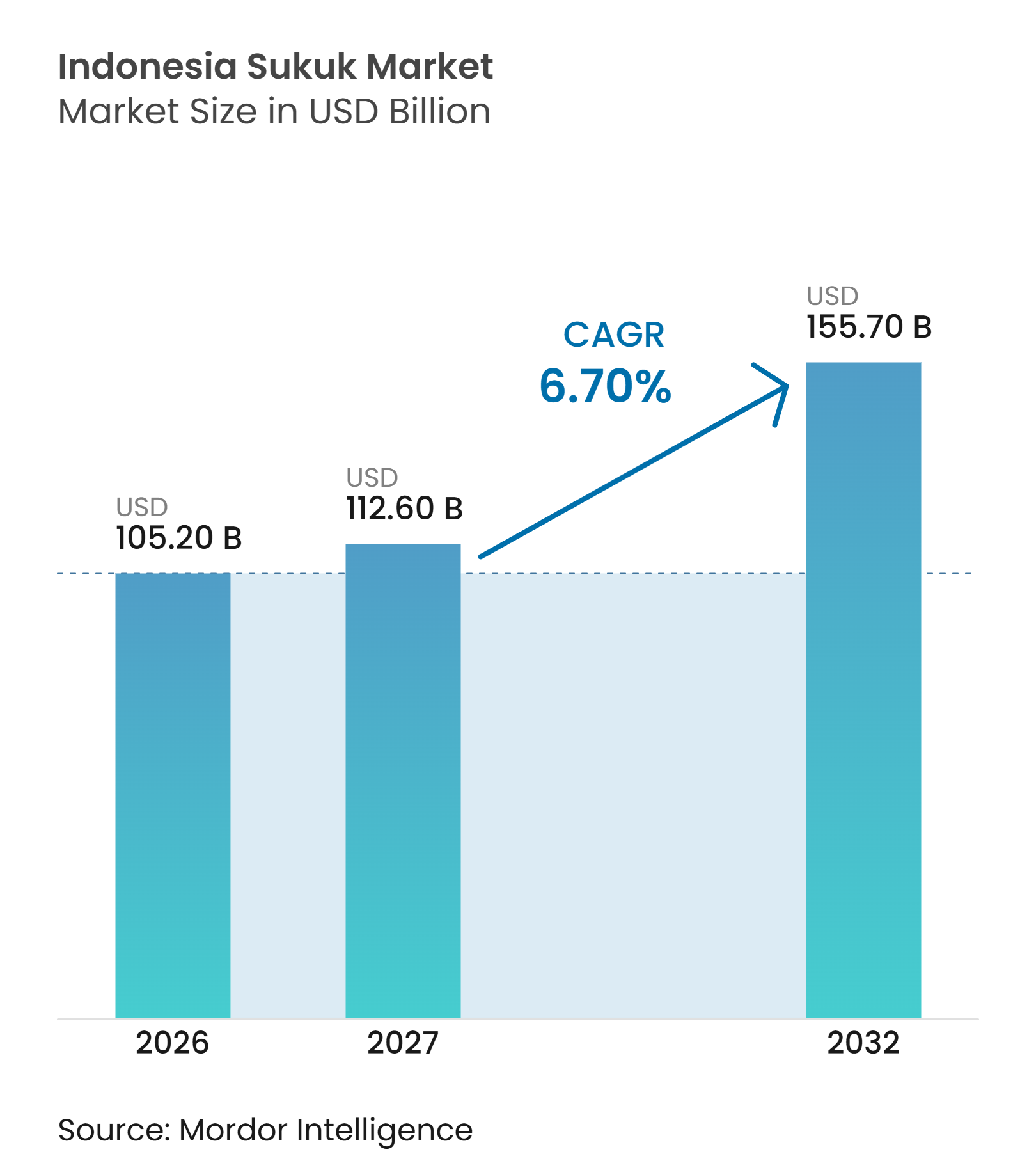
| Base Year Market Size (2026) | USD 105.20 Billion |
| Market Size (2027) | USD 112.60 Billion |
| Market Size (2032) | USD 155.70 Billion |
| Growth Rate (2027 - 2032) | 6.70 % |
| Market Concentration | High |
Major Players *Disclaimer: Major Players sorted in no particular order Image © Mordor Intelligence. Reuse requires attribution under CC BY 4.0. | |
Indonesia Sukuk Market Analysis by Mordor Intelligence
The Indonesia Sukuk Market size is projected to be USD 105.20 billion in 2026, USD 112.60 billion in 2027, and reach USD 155.70 billion by 2032, growing at a CAGR of 6.70% from 2027 to 2032.
The Indonesia sukuk market is supported by recurring sovereign financing needs, regular State Sharia Securities auctions, and continued use of project-based instruments for public infrastructure. Government securities outstanding reached IDR 8,966.79 trillion (USD 535.3 billion) on June 30, 2026, while the debt-to-GDP ratio stood at 41.26%, reinforcing the role of sukuk in national financing. International demand remains material, as the July 2025 USD 2.2 billion global sukuk drew a peak order book of USD 7 billion. The market also benefits from retail participation, sustainability rules, and broader digital distribution. OJK Regulation No. 18 of 2023, effective from February 2024, extended the framework for green, social, sustainability, waqf, and sustainability-linked sukuk.
Key Report Takeaways
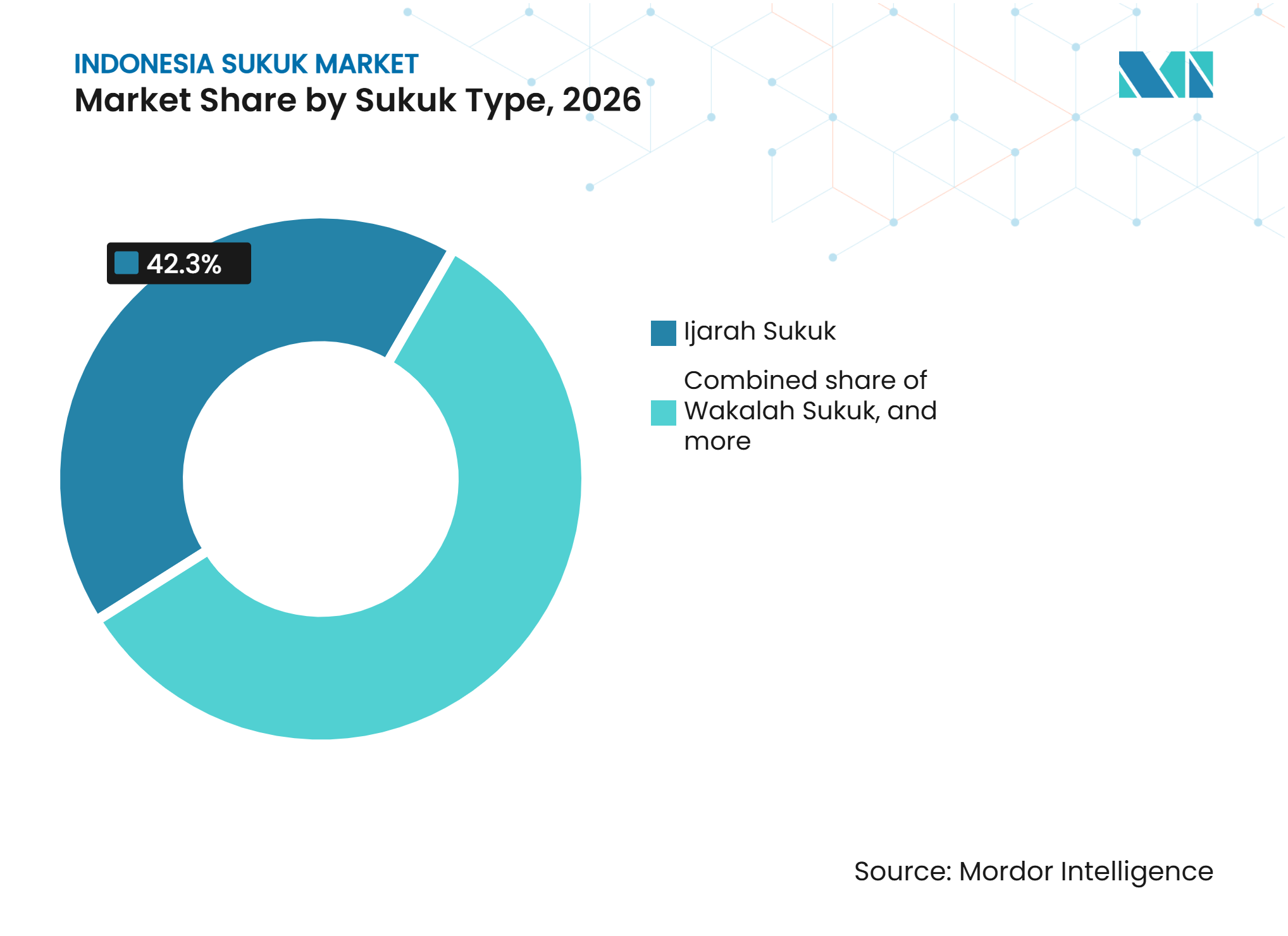
- By sukuk type, Ijarah captured 42.3% of the Indonesia Sukuk market share in 2026, while Wakalah is projected to grow at a 9.2% CAGR through 2032.
- By issuer type, Sovereign issuers held 85.4% of the Indonesia Sukuk market share in 2026, while Non-Financial Corporates recorded the highest projected CAGR at 9.5% through 2032.
- By market type, Domestic Sukuk accounted for 78.2% of the Indonesia Sukuk market share in 2026, while International Sukuk is forecast to expand at an 8.5% CAGR through 2032.
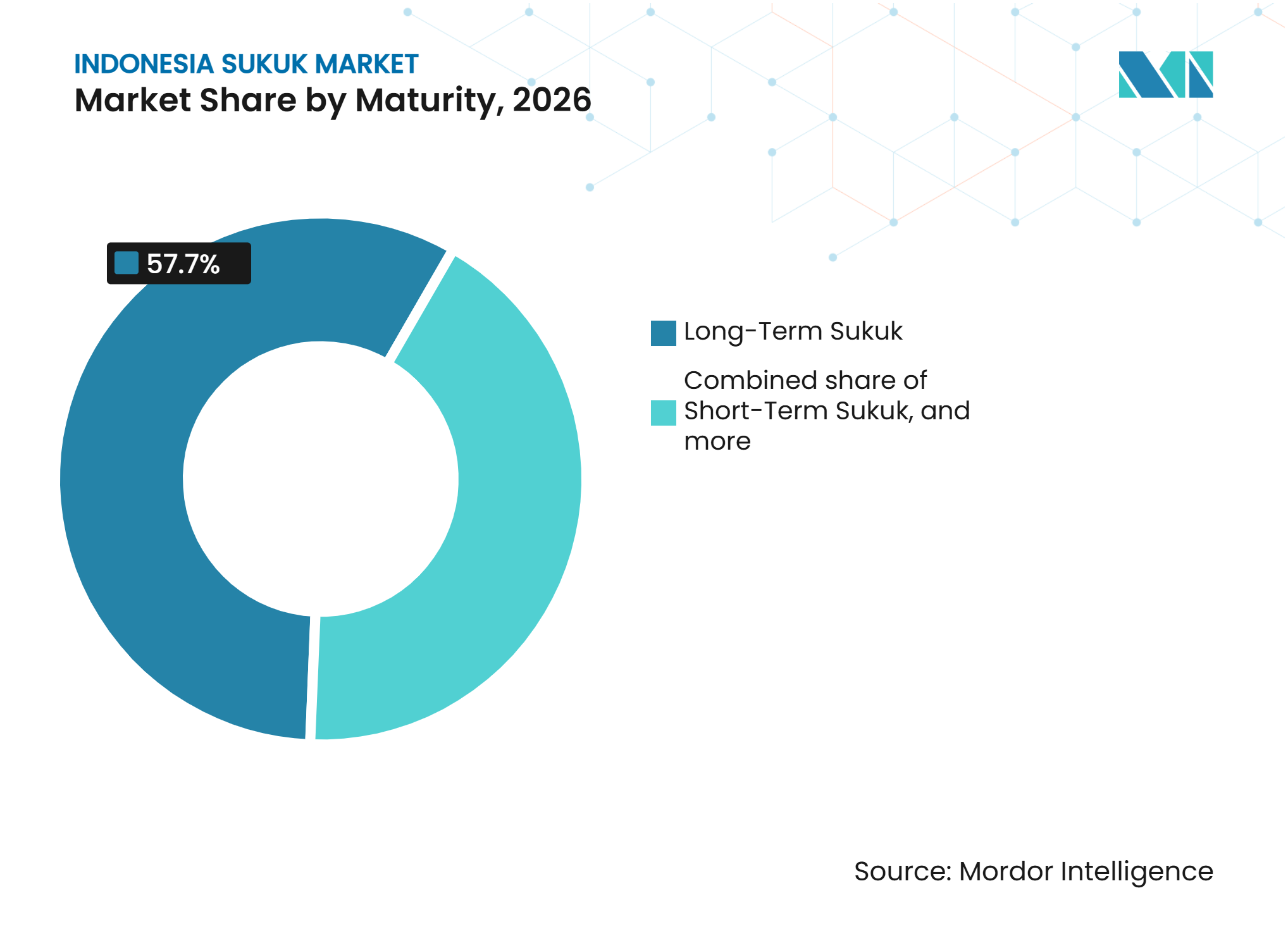
- By maturity, Long-Term Sukuk held 57.7% of the Indonesia Sukuk market share in 2026, while Medium-Term Sukuk is forecast to grow at a 7.8% CAGR through 2032.
- By label, Plain or Unlabelled Sukuk held 86.4% of the Indonesia Sukuk market share in 2026, while Sustainability-Linked and other Labelled Sukuk are projected to grow at a 13.5% CAGR through 2032.
Note: Market numbers in this report are based on Mordor Intelligence's proprietary estimation framework, which combines nine months of actuals with Q4 projections for base year 2026.
Market Trends and Insights
Drivers Impact Analysis of Indonesia Sukuk Market*
| Driver | (~) % Impact on CAGR Forecast | Geographic Relevance | Impact Timeline |
|---|---|---|---|
| Sovereign Financing and Refinancing Requirements | +1.8% | National | Short term (≤ 2 years) |
| Expansion of Domestic Retail Sukuk Participation | +1.2% | National, with early gains in Java and urban Sumatra | Medium term (2-4 years) |
| Growth in Sovereign Green Sukuk and Sustainable Financing | +1.0% | Global and domestic | Medium term (2-4 years) |
| Corporate and State-Owned Enterprise Sukuk Financing | +0.8% | National | Medium term (2-4 years) |
| Digital Distribution of Retail Sukuk Offerings | +0.6% | National, urban and semi-urban centers | Short term (≤ 2 years) |
| Infrastructure and Public Development Financing Needs | +0.7% | National, with concentration in Java and emerging gains in Kalimantan and Sulawesi | Long term (≥ 4 years) |
| Source: Mordor Intelligence | |||
Sovereign Financing and Refinancing Requirements
Indonesia’s fiscal financing needs and maturing government debt sustain recurring sovereign sukuk issuance. Government debt reached IDR 10,293.69 trillion (USD 614.5 billion) as of June 2026, equivalent to 41.26% of GDP[1]. The Ministry of Finance conducts regular SBSN auctions, typically targeting IDR 10 trillion (USD 597.0 million) to IDR 12 trillion (USD 716.4 million) per session, supported by a network of primary dealers. Project-Based Sukuk (PBS) and green sukuk broaden funding options for public infrastructure and environmental projects. Regular issuance and refinancing of maturing securities support market liquidity, establish pricing benchmarks, and strengthen investor participation in Indonesia’s sukuk market.
Expansion of Domestic Retail Sukuk Participation
Retail sukuk is widening household access to government securities across Indonesia. SR025 had a minimum subscription of IDR 1 million (USD 59.7) and was sold through 33 distribution partners in August and September 2026[2]. The offer included digital channels, which placed retail participation within reach of investors outside major financial centers. SR022 offered fixed coupons of 6.45% for 3 years and 6.55% for 5 years in May 2025. SR025 offered 6.80% for 3 years and 6.90% for 5 years, showing the government’s use of pricing to maintain retail demand. The e-SBN system gives salaried workers and students access to the same unit entry level as other retail buyers. This broader base can strengthen domestic absorption of the Indonesia Sukuk market over time.
Growth in Sovereign Green Sukuk and Sustainable Financing
Indonesia’s sustainable sukuk market is supported by recurring sovereign Green Sukuk issuance and an expanding regulatory framework for sustainable finance. The government issued a USD 1.1 billion, 10-year Green Sukuk Wakala in July 2025, marking its eighth consecutive year of global Green Sukuk issuance since 2018 and bringing cumulative issuance to USD 7.7 billion. OJK Regulation No. 18 of 2023 expanded the framework to cover green, social, sustainability, and sustainability-linked instruments, including sukuk-linked waqf. Corporate sustainable bonds and sukuk outstanding reached IDR 54.94 trillion (USD 3.28 billion) by December 2025[2]. The government also offered the domestic Green Sukuk series PBSG002 through its April 2026 auction program, while annual allocation and impact reporting support transparency and investor confidence.
Corporate and State-Owned Enterprise Sukuk Financing
State-owned enterprises and related institutions are expanding the range of corporate sukuk issuers. PT Bank Syariah Indonesia completed an IDR 5 trillion (USD 298.5 million) Sustainability Mudharabah Sukuk Phase II in June 2025. In October 2026, the bank launched a further IDR 2 trillion (USD 119.4 million) Phase III offering across tenors from 370 days to 3 years. PT Sarana Multigriya Finansial listed an IDR 808 billion (USD 48.2 million) Sukuk Musyarakah Phase II in March 2026 and an IDR 266.6 billion (USD 15.9 million) Social Sukuk Musyarakah for affordable housing[3]. PT Kereta Api Indonesia filed for an IDR 300 billion (USD 17.9 million) Sukuk Ijarah in October 2026 under an IDR 1.4 trillion (USD 83.6 million) shelf registration. These programs link Islamic capital raising with banking, housing, consumer finance, and transport needs. Corporate sukuk can gain further scale as issuers use registered programs to return to the market across different maturities.
Restraints Impact Analysis of Indonesia Sukuk Market*
| Restraint | (~) % Impact on CAGR Forecast | Geographic Relevance | Impact Timeline |
|---|---|---|---|
| Limited Secondary-Market Liquidity and Price Transparency | -0.8% | National | Short term (≤ 2 years) |
| Sukuk Structuring Complexity and Regulatory Compliance Costs | -0.5% | National | Medium term (2-4 years) |
| Eligible Green Project Availability and Impact-Reporting Requirements | -0.4% | National | Medium term (2-4 years) |
| Limited Depth of the Corporate Sukuk Investor Base | -0.4% | National | Long term (≥ 4 years) |
| Source: Mordor Intelligence | |||
Limited Secondary-Market Liquidity and Price Transparency
Secondary trading remains limited when compared with the outstanding stock of sukuk. SPPA Alternative Trading System transaction value rose 461.6% to IDR 1,382 trillion (USD 82.5 billion) in 2025. The rise signals stronger use of the platform, but the underlying market remains largely over-the-counter and buy-and-hold. The 2026 SBSN benchmark program included only PBS030, PBS040, PBS034, and PBS038, leaving gaps across the maturity curve. Domestic investors held more than 98% of Rupiah-denominated corporate sukuk, while foreign ownership stood at 1.18% in May 2025. This narrow buyer base limits price-setting diversity. Certain Sharia structures can also restrict resale at non-par values, which adds to trading constraints.
Sukuk Structuring Complexity and Regulatory Compliance Costs
Sukuk issuance requires a Sharia structure that fits the underlying transaction and relevant approvals. Indonesia recognizes structures including Ijarah, Wakalah, Musharakah, Mudharabah, Murabahah, Salam, Istisna, and hybrids. Each structure requires an applicable DSN-MUI fatwa, Sharia Supervisory Board review, and OJK documentation. These steps can increase time and cost for smaller and first-time issuers relative to conventional debt issuance. The effect is visible in the concentration of issuance among government-linked entities and larger state-owned enterprises. OJK announced efforts in 2026 to streamline bond and sukuk offering documentation processes. Greater coordination with DSN-MUI would be needed for deeper simplification at the contract level.
*Our forecasts treat driver/restraint impacts as directional, not additive. The impact forecasts reflect baseline growth, mix effects, and variable interactions.
Indonesia Sukuk Market Segment Analysis
By Sukuk Type:
Ijarah Anchors Supply While Wakalah Builds International ReachIjarah held a 42.3% share of the Indonesia Sukuk market in 2026, supported by sovereign Project-based Sukuk and established state-owned enterprise programs. PT PLN and PT Kereta Api Indonesia have used Ijarah structures across active and planned issuance programs. The Indonesia Sukuk market size for Ijarah reflects its use where assets and lease-based cash flows can support the transaction. Wakalah is projected to advance at a 9.2% CAGR through 2032. Indonesia has used the Wakalah contract for all international sovereign sukuk since 2018. The July 2025 USD 2.2 billion Global Sukuk Wakala used 5-year and 10-year tranches with 4.55% and 5.20% coupons.
Musharakah, Mudharabah, and other profit-sharing structures add flexibility for corporate financing. PT Sarana Multigriya Finansial used Sukuk Musyarakah tranches in 2025 and 2026 for housing and affordable housing financing. Its 5-year Social Sukuk Musyarakah carried an indicated yield of 7.70%. Salam and Istisna remain less developed despite their potential relevance to agricultural and manufacturing working capital. These structures could serve financing needs that are not as readily aligned with lease-based instruments. The Indonesia Sukuk industry therefore retains room to widen its structural range without changing the central role of Ijarah and Wakalah.


By Issuer Type:
Sovereign Issuers Lead While Corporate Funding BroadensSovereign issuers held 85.4% of the Indonesia Sukuk market in 2026. SBSN has legal standing alongside conventional government securities under the national legal framework. This share reflects the regular state auction calendar and the role of sukuk in budget financing. Non-Financial Corporates are projected to record a 9.5% CAGR through 2032. PT Adira Finance offered indicated coupons from 7.10% to 7.35% on its 2026 Phase IV Sukuk Mudharabah. PT Kereta Api Indonesia’s 2026 Sukuk Ijarah offered indicated coupons from 6.60% to 7.90% across 4 tenors.
Financial institutions provide significant supply through shelf-registered programs. PT Bank Syariah Indonesia has an aggregate IDR 10 trillion (USD 597 million) target under its Green Mudharabah Sukuk I shelf registration. Quasi-sovereign issuers such as PT Sarana Multigriya Finansial and PT PLN provide a link between state objectives and capital market funding. Multilateral and supranational issuance in Rupiah sukuk remains limited. That position may change as financial market deepening programs continue to support local currency capital markets. Private companies remain an underused issuer pool because their participation is affected by structuring costs and investor-base constraints. The Indonesia Sukuk market has scope for greater issuer diversity if these barriers are reduced.
By Market Type:
Domestic Issuance Has Scale While International Access DeepensDomestic Sukuk held a 78.2% share in 2026, based on regular domestic SBSN auctions and retail series. Biweekly auctions generally carried indicative targets of IDR 10 trillion to IDR 12 trillion (USD 597 million to USD 716.4 million). Retail SR and ST series use an authorized distribution network that expanded to 33 partners in 2026. International Sukuk is projected to grow at an 8.5% CAGR through 2032. The November 2025 USD 2 billion Global Sukuk generated a USD 5.8 billion peak order book and more than USD 3.9 billion in final orders.
International issuance uses Wakalah contracts and is priced against United States Treasury benchmarks. These instruments are listed on Singapore Exchange and NASDAQ Dubai. Sovereign issues have investment-grade ratings from Moody’s, S&P, and Fitch. The dual domestic and international funding approach gives the government options as Rupiah liquidity and global rate conditions change. Indonesia completed 7 international capital market transactions in 2025 across USD, EUR, JPY, AUD, and CNH denominations. This breadth distinguishes the country’s debt management program within the Indonesia Sukuk market.
By Maturity:
Long-Term Securities Support Infrastructure FinancingLong-Term Sukuk held a 57.7% share in 2026, supported by infrastructure-oriented PBS series. PBS038 matures in December 2049, and PBS034 matures in June 2039. These tenors offer duration for insurers and pension funds that match long-term obligations. Medium-Term Sukuk is forecast to grow at a 7.8% CAGR through 2032. Corporate issuers often use 2-year to 5-year maturities that suit consumer finance and mortgage origination cycles. Adira Finance, PT Sarana Multigriya Finansial, and PT Bank Syariah Indonesia have used such terms in recent offerings.
Short-Term Sukuk includes SPN-S treasury bills with 3-month to 12-month tenors. These instruments support Islamic bank liquidity management and central bank repo functions. Their inclusion in OJK’s Macroprudential Inclusive Financing Ratio framework adds a policy-related source of demand. Perpetual Sukuk remains at an early stage in Indonesia. Islamic banks may consider it for capital instruments with features comparable to Additional Tier 1 securities. OJK is also seeking term structures that can support longer-horizon infrastructure financing through SBSN and public-private partnership arrangements.

By Label:
Plain Sukuk Remains Larger While Labelled Instruments AcceleratePlain or Unlabelled Sukuk held an 86.4% share in 2026. Standard SBSN auction series and conventional corporate shelf registrations account for much of this scale. Sustainability-Linked and other Labelled Sukuk are projected to grow at a 13.5% CAGR through 2032. This is the fastest rate among the reported sub-segments. OJK Regulation No. 18 of 2023 provides a framework for green, social, sustainability, waqf, and sustainability-linked securities. The ongoing use of PBSG002 in domestic auctions supports the Indonesia Sukuk market share of labelled instruments over the forecast period.
Green Sukuk represented 48% of accumulated corporate labelled issuance in September 2025. Social instruments represented 28%, sustainability instruments represented 22%, and sustainability-linked instruments represented 2%. The Sustainable Government Securities Framework aligns with International Capital Market Association principles. This framework requires annual reporting on the allocation and impact of proceeds. Waqf Sukuk remains early in its development, but its inclusion in the OJK framework creates a route for endowment assets to support productive financing. The Indonesia Sukuk industry can use the sovereign reporting model as a reference point for new corporate labelled instruments.
Geography Analysis
Geographic Analysis
Indonesia’s domestic sukuk market is supported by regular sovereign issuance through Sharia Securities (Surat Berharga Syariah Negara or SBSN) auctions conducted by the Ministry of Finance. These auctions provide the government with a Sharia-compliant channel for financing its funding requirements. The Directorate General of Budget Financing and Risk Management (DJPPR) publishes official information on government sukuk issuance and trading. Domestic distribution also includes retail sukuk offerings, which provide individuals with access to government-backed Sharia-compliant investment instruments.
International sukuk issuance provides Indonesia with access to investors beyond its domestic market. On 20 November 2025, the government priced USD 2.0 billion in Global Sukuk, comprising USD 1.1 billion in five-year securities and USD 0.9 billion in 10-year securities. The transaction attracted peak order-book demand of USD 5.8 billion, with final orders exceeding USD 3.9 billion. The issuance used a Wakalah structure and was arranged through a government-established entity dedicated to issuing Sharia-compliant securities in international markets. The securities were scheduled for settlement on 1 December 2025 and listing on the Singapore Exchange and Nasdaq Dubai.
Indonesia’s secondary sukuk market is supported by established electronic trading infrastructure. The Indonesia Stock Exchange operates the Alternative Market Trading System (SPPA), which facilitates secondary-market trading in debt securities and sukuk among authorised users, including securities companies and banks. The platform supports three trading mechanisms: Central Limit Order Book, Request for Quotation, and Request for Order. Transactions conducted through SPPA are integrated with the Centralized Trading Platform for Securities Transaction Reporting (CTP-PLTE), supporting electronic transaction reporting. These systems provide an established framework for trading and reporting.
Competitive Landscape
Market Concentration
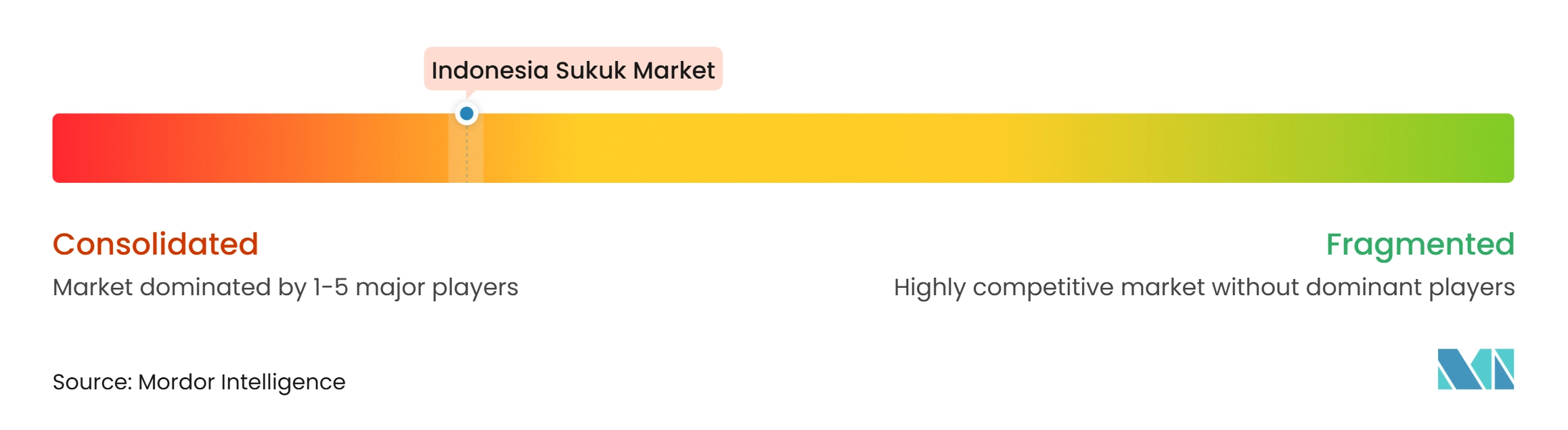
The Indonesia Sukuk market has a concentrated issuer structure because sovereign and sovereign-related issuers account for more than 85% of outstanding issuance. Competition is therefore concentrated in structuring, distribution, and secondary-market intermediation rather than among large numbers of principal issuers. PT BRI Danareksa Sekuritas reported that it was the most active securities firm on SPPA in 2025. PT Mandiri Sekuritas and PT Trimegah Sekuritas are SBSN primary dealers and retail distribution partners. International sovereign mandates have included joint bookrunners such as Dubai Islamic Bank, Goldman Sachs, JPMorgan, HSBC, Standard Chartered, and KFH Capital. Their role depends on balance-sheet capacity and established distribution with Sharia-compliant investors. Private non-state corporate issuance remains the main opening for new arrangers and issuers.
Digital distribution creates another area of competition. Bibit, Bareksa, Tanamduit, and DANA have integrated e-SBN purchase functions and compete for first-time retail investors through digital access and financial education. PT Trimegah Sekuritas partnered with DANA for retail government security purchases through the application. PT Bank Syariah Indonesia’s IDR 10 trillion (USD 597 million) shelf registration supports a continuous issuance approach within Islamic banking. OJK’s streamlined offering process can favor issuers that are able to prepare compliant documentation efficiently. The external review and reporting requirements under POJK 18 of 2023 may also distinguish sustainability-focused issuers. The Indonesia Sukuk market gives intermediaries room to differentiate through retail access, compliance capability, and distribution reach.
SBSN and public-private partnership structures may broaden collateral options beyond existing state-owned assets. This model could support financing for toll roads and power transmission where project structures meet regulatory and Sharia requirements. The principal competitive challenge remains secondary market liquidity and transparent pricing. A larger institutional investor pool would improve conditions for new corporate issuers and for intermediaries that support trading. The presence of sovereign benchmark series helps corporate issuers establish reference pricing across maturities. The Indonesia Sukuk market therefore remains concentrated at the issuer level while retaining active competition across the transaction and distribution chain.
Indonesia Sukuk Industry Leaders
-
PT Bank Aladin Syariah Tbk
-
PT Bank Jabar Banten Syariah
-
PT Bank Muamalat Indonesia Tbk
-
PT Bank Syariah Indonesia Tbk
-
PT Bussan Auto Finance
- *Disclaimer: Major Players sorted in no particular order
Indonesia Sukuk Market Companies Covered in this Report
- PT Bank Aladin Syariah Tbk
- PT Bank Jabar Banten Syariah
- PT Bank Muamalat Indonesia Tbk
- PT Bank Syariah Indonesia Tbk
- PT Bussan Auto Finance
- PT Adira Dinamika Multi Finance Tbk
- PT Dian Swastatika Sentosa Tbk
- PT Eagle High Plantations Tbk
- PT Ekamas Mora Republik Tbk (Moratelindo)
- PT Integra Indocabinet Tbk
- PT Medco Power Indonesia
- PT Pembangunan Perumahan (Persero) Tbk
- PT Perusahaan Listrik Negara (Persero)
- PT Pos Indonesia (Persero)
- PT Sarana Multi Infrastruktur (Persero)
- PT Sarana Multigriya Finansial (Persero)
- PT Samator Indo Gas Tbk
- PT TBS Energi Utama Tbk
- PT Waskita Karya (Persero) Tbk
- PT Wijaya Karya (Persero) Tbk
Recent Industry Developments in Indonesia Sukuk Market
- October 2026: PT Kereta Api Indonesia filed a prospectus for Sukuk Ijarah Berkelanjutan III Phase I 2026 of IDR 300 billion (USD 17.9 million) under a new IDR 1.4 trillion (USD 83.6 million) shelf registration, with coupon indications of 6.60%-7.90% across 4 tenor series.
- October 2026: PT Bank Syariah Indonesia launched its Shelf-Registered Green Mudharabah Sukuk I Phase III 2026 of IDR 2 trillion (USD 119.4 million), offering Series A of IDR 900 billion (USD 53.7 million), Series B of IDR 230 billion (USD 13.7 million), and Series C of IDR 870 billion (USD 51.9 million).
- August 2026: The Ministry of Finance opened subscriptions for Sukuk Ritel SR025, offering SR025T3 at 6.80% for 3 years and SR025T5 at 6.90% for 5 years through 33 authorized distribution partners.
- August 2026: DJPPR included the PBSG002 domestic Green Sukuk in the August 11 SBSN auction with an indicative target of IDR 10 trillion (USD 597 million), noting that the series can support the Macroprudential Inclusive Financing Ratio for conventional and Sharia banks.
Indonesia Sukuk Market Report Scope
Segmentation Overview
| Murabahah Sukuk |
| Ijarah Sukuk |
| Wakalah Sukuk |
| Musharakah Sukuk |
| Mudarabah Sukuk |
| Salam Sukuk |
| Istisna Sukuk |
| Hybrid / Composite Sukuk |
| Other Sukuk Types |
| Sovereign |
| Sovereign-Related / Quasi-Sovereign |
| Financial Institution |
| Non-Financial Corporate |
| Multilateral / Supranational |
| Domestic Sukuk |
| International Sukuk |
| Short-Term Sukuk |
| Medium-Term Sukuk |
| Long-Term Sukuk |
| Perpetual Sukuk |
| Plain / Unlabelled Sukuk |
| Green Sukuk |
| Sustainability / Sustainability-Linked / Social / Other labeled Sukuk |
| By Sukuk Type | Murabahah Sukuk |
| Ijarah Sukuk | |
| Wakalah Sukuk | |
| Musharakah Sukuk | |
| Mudarabah Sukuk | |
| Salam Sukuk | |
| Istisna Sukuk | |
| Hybrid / Composite Sukuk | |
| Other Sukuk Types | |
| By Issuer Type | Sovereign |
| Sovereign-Related / Quasi-Sovereign | |
| Financial Institution | |
| Non-Financial Corporate | |
| Multilateral / Supranational | |
| By Market Type | Domestic Sukuk |
| International Sukuk | |
| By Maturity | Short-Term Sukuk |
| Medium-Term Sukuk | |
| Long-Term Sukuk | |
| Perpetual Sukuk | |
| By Label | Plain / Unlabelled Sukuk |
| Green Sukuk | |
| Sustainability / Sustainability-Linked / Social / Other labeled Sukuk |
Key Questions Answered in the Report
What is driving growth in Indonesia’s sukuk sector?
Sovereign financing needs, retail participation, digital distribution, and sustainability-linked issuance support growth. The sector is forecast to grow at a 6.7% CAGR from 2027 to 2032.
Which sukuk structure holds the largest share in Indonesia?
Ijarah held 42.3% share in 2026, supported by its widespread use in Project Based Sukuk and state-owned enterprise programs.
Which issuer group dominates Indonesia’s sukuk issuance?
Sovereign issuers held 85.4% share in 2026 because SBSN is a regular component of government financing.
What is the fastest-growing sukuk category in Indonesia?
Sustainability-Linked and other Labelled Sukuk is projected to grow at a 13.5% CAGR through 2032, supported by the OJK sustainability framework
How are retail investors able to buy Indonesian sukuk?
Retail investors can purchase designated series through authorized banks, securities firms, fintech platforms, and the nationwide e-SBN system, starting from IDR 1 million (USD 59.7).
What is limiting corporate sukuk growth in Indonesia?
Limited secondary-market liquidity, a narrow long-term investor base, Sharia structuring requirements, and reporting obligations can increase issuance complexity.