
Indonesia Residential Construction Market Size and Share
Market Overview
| Study Period | 2021 - 2032 |
|---|---|
| Forecast Data Period | 2027 - 2032 |
| Base Year Market Size (2026) | USD 87.49 Billion |
| Market Size (2027) | USD 92.40 Billion |
| Market Size (2032) | USD 121.38 Billion |
| Growth Rate (2027 - 2032) | 5.61 % |
| Market Concentration | Medium |
Major Players *Disclaimer: Major Players sorted in no particular order Image © Mordor Intelligence. Reuse requires attribution under CC BY 4.0. | |
Indonesia Residential Construction Market Analysis by Mordor Intelligence
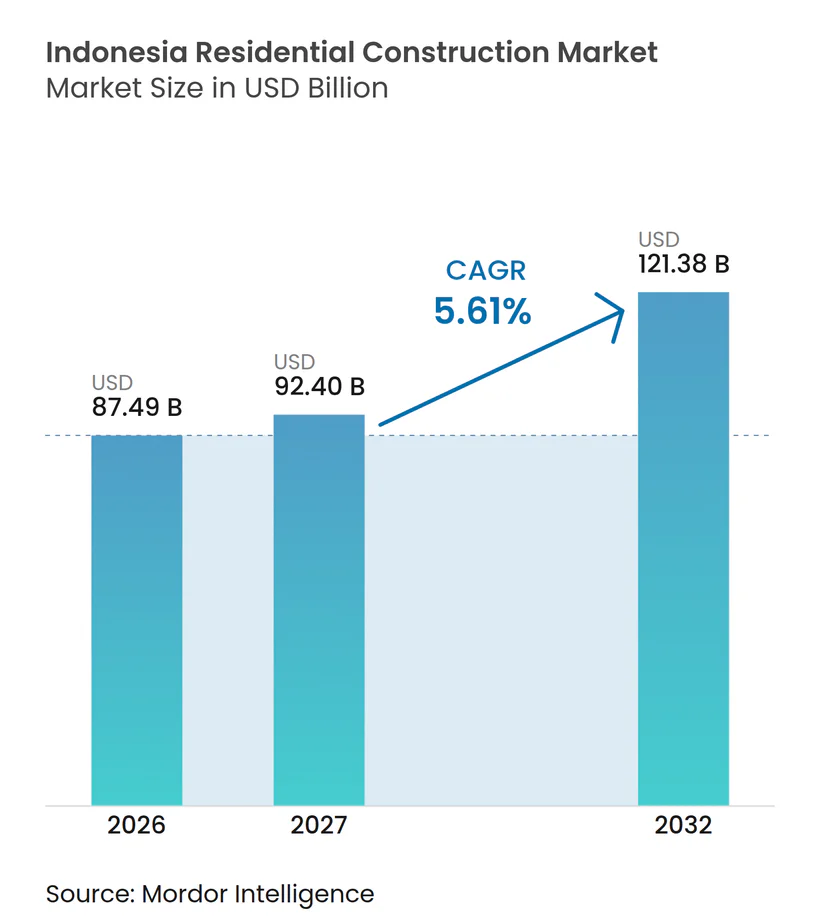
The Indonesia Residential Construction Market size is projected to expand from USD 87.49 billion in 2026 and USD 92.40 billion in 2027 to USD 121.38 billion by 2032, registering a CAGR of 5.61% between 2027 and 2032.
A national housing shortage of 9.8 million units continues to support demand for new homes, while the Three Million Homes Program provides a large public delivery framework. Subsidized mortgages and government tax support improve access to formal housing, especially for lower-income buyers. Developers are also directing investment toward transport-linked suburbs, secondary cities, and areas affected by industrial relocation. The Indonesia residential construction market must still manage weaker middle-income purchasing power, higher material costs, and lengthy land procedures.
Key Report Takeaways
- By type, villas and landed houses accounted for 66.1% of the Indonesia residential construction market share in 2026, while apartments and condominiums are projected to grow at the fastest CAGR of 6.11% through 2032, contributing to the Indonesia residential construction market size.
- By construction type, new construction held 68.2% of the Indonesia residential construction market share in 2026, while renovation recorded the highest projected CAGR at 6.34% through 2032.
- By construction method, conventional on-site construction held 88.8% of the Indonesia residential construction market share in 2026, while modern methods of construction recorded the highest projected CAGR at 6.51% through 2032.
- By investment source, private investment held 61.1% of the Indonesia residential construction market share in 2026 and recorded the highest projected CAGR at 6.21% through 2032.
- By geography, Java held 58.5% of the Indonesia residential construction market share in 2026, while Kalimantan recorded the highest projected CAGR at 6.77% through 2032.
Note: Market numbers in this report are based on Mordor Intelligence's proprietary estimation framework, which combines nine months of actuals with Q4 projections for base year 2026.
Market Trends and Insights
Drivers Impact Analysis of Indonesia Residential Construction Market*
| Drivers | (~) % Impact on CAGR Forecast | Geographic Relevance | Impact Timeline |
|---|---|---|---|
| Government-Backed Three Million Homes Program | +1.0% | National, with delivery concentrated in Java, Kalimantan, and Sumatra | Medium term (2-4 years) |
| Subsidized Mortgage Financing Through FLPP | +0.8% | National, with West Java, Central Java, and South Sulawesi as leading provinces | Short term (≤ 2 years) |
| Toll Roads and Mass Transit Development | +0.7% | Java, including Greater Jakarta and Trans-Java corridors, and Sumatra | Medium term (2-4 years) |
| Industrial Expansion and Workforce Migration | +0.6% | Java, Kalimantan, and North Sumatra | Medium term (2-4 years) |
| VAT Incentives on Eligible New Homes | +0.5% | National, with the strongest use in urban centers | Short term (≤ 2 years) |
| Urban Redevelopment and Housing Densification | +0.4% | Greater Jakarta, Surabaya, Bandung, and Makassar | Long term (≥ 4 years) |
| Source: Mordor Intelligence | |||
Government Housing Delivery and Subsidized Mortgage Financing
The Three Million Homes Program is the main public driver of the Indonesia residential construction market because it links housing delivery with infrastructure and employment priorities. The program targets 15 million homes during 2025-2029 across rural, coastal, and urban locations[1]. It has a projected investment value of USD 24 billion and is expected to create 380,000 jobs[2]. Local governments have been asked to waive land acquisition and building approval charges for low-income households, reducing the cost of qualifying projects[3]. The program gives private developers clearer demand signals where land and permit support are in place.
Subsidized Mortgage Financing Through FLPP
The Housing Financing Liquidity Facility, known as FLPP, lowers the financial barrier to homeownership through subsidized mortgages. FLPP financed 278,868 homes in 2025 through 40 partner banks and more than 8,000 developers across 401 regions and cities. The 2026 program targets 350,000 units, with fixed mortgage rates of 5%, tenors up to 20 years, and a 1% down payment. Nearly three-quarters of 2025 FLPP mortgages went to private-sector workers, which broadened access beyond public employees. This financing channel can expand formal homeownership in secondary cities and support the sales pipeline of participating developers.
Toll Roads and Mass Transit Development
Toll roads and mass transit improve the practical reach of residential locations by reducing travel time and opening peripheral land. Indonesia had 3,049 kilometers of operational toll roads across 76 corridors in April 2025. The Bogor-Serpong toll road concession covers 32 kilometers and can improve access to the Parung-Gunung Sindur area in Greater Jakarta. These links support larger landed townships where land remains comparatively available and can shift development toward new commuting areas. Their effect is strongest when housing projects are supported by schools, retail, utilities, and other local services.
Industrial Expansion and Workforce Migration
Industrial relocation is creating new residential demand outside established Greater Jakarta locations. Employers are moving activity from Bekasi and Karawang toward Central Java locations such as Batang and Kendal, where labor costs are lower and industrial land remains available. Industropolis Batang attracted USD 297 million of industrial investment in 2025 and expects to absorb 9,000 workers in the near term and 58,000 workers over 5 years. These workers create demand for first-time buyer homes and rentals near locations with limited formal housing stock. Developers that align unit prices and product formats with local incomes can benefit as these employment corridors develop.
Restraints Impact Analysis of Indonesia Residential Construction Market*
| Restraints | (~) % Impact on CAGR Forecast | Geographic Relevance | Impact Timeline |
|---|---|---|---|
| Weak Middle-Class Purchasing Power | -0.7% | National, most acute in Greater Jakarta and major urban centers | Medium term (2-4 years) |
| Rising Construction Material and Logistics Costs | -0.5% | National, with greater pressure on import-dependent outer-island projects | Short term (≤ 2 years) |
| Complex Land Ownership Documentation and Acquisition Procedures | -0.4% | National, most acute in urban brownfield sites and Kalimantan forest areas | Long term (≥ 4 years) |
| Limited Long-Term Development Financing for Smaller Developers | -0.3% | National, most acute in Sumatra, Sulawesi, and eastern Indonesia | Medium term (2-4 years) |
| Source: Mordor Intelligence | |||
Weak Middle-Class Purchasing Power
Middle-income affordability remains the main demand restraint because many households fall between subsidized housing eligibility and the income needed for conventional mortgage payments. Indonesia’s middle class fell from more than 57 million people in 2019 to 48 million in 2024, and its share of private consumption also declined. Homes priced from USD 30,000 to USD 123,000 face a particular challenge because they are too expensive for many subsidized buyers and may still be difficult to finance through commercial mortgages. A larger informal workforce can also weaken mortgage eligibility because income documentation is less consistent. This pressure is most apparent among developers serving the middle of the price range in major urban centers.
Rising Construction Material and Logistics Costs
Rising material and logistics costs can reduce margins and cause developers to delay new launches. Statistics Indonesia reported price increases for hollow bricks, clay bricks, gravel, and sand-and-stone materials during the second half of 2025. Imported steel, aluminum, specialized equipment, and transport can add further pressure, especially outside Java. Larger developers can consolidate procurement and spread higher costs across several projects, while smaller subsidized-housing providers have less flexibility to increase selling prices. These cost pressures can slow construction starts in locations where housing shortages are already significant.
*Our forecasts treat driver/restraint impacts as directional, not additive. The impact forecasts reflect baseline growth, mix effects, and variable interactions.
Indonesia Residential Construction Market Segment Analysis
By Type:
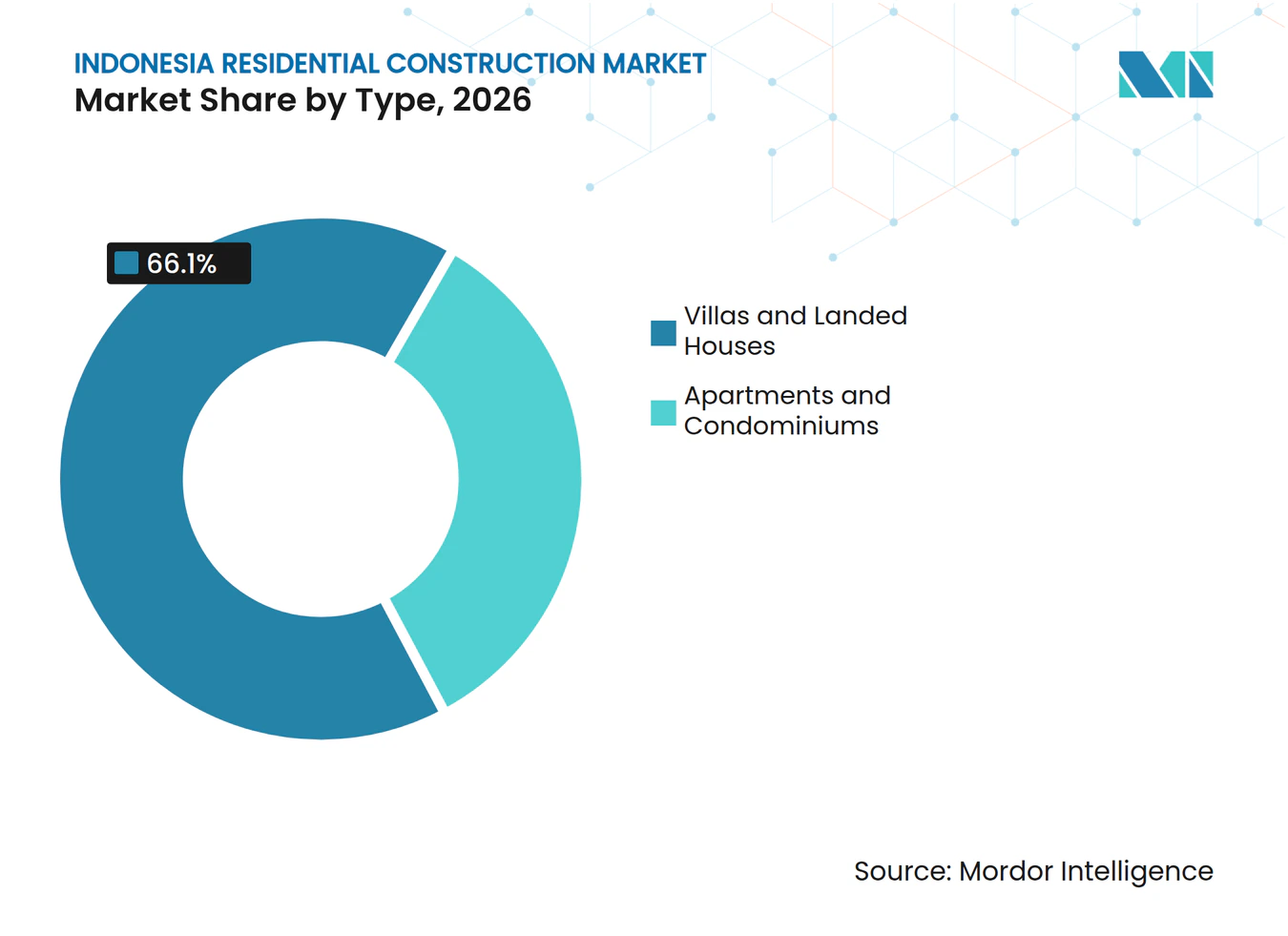
Villas and Landed Houses Retain the Largest Share While Apartments and Condominiums Grow FastestVillas and landed houses held 66.1% of the Indonesia residential construction market share in 2026, supported by buyer preferences for land ownership and the landed format used by many subsidized housing programs. This format remains practical in secondary cities and suburban districts where land is more available than in central Jakarta. It also fits projects that can be delivered in phases, allowing developers to match construction with presales. Public housing programs have reinforced this pattern because they usually support smaller landed units for low-income households. The segment benefits from road connections that make peripheral sites more accessible to employment centers. Township developers can add retail, schools, green space, and utilities, which makes land-based projects attractive to families planning long-term occupancy. The large position of landed supply means that changes in mortgage availability have an immediate effect on construction activity. Developers are still balancing lot size, unit specification, and affordability as building costs increase.
Apartments and condominiums are projected to grow at a CAGR of 6.11% through 2032, the fastest rate within the type segmentation. Urban land scarcity and transit-oriented development are supporting this growth, particularly around Jakarta Mass Rapid Transit corridors. The Indonesia residential construction market size for apartments and condominiums benefits from locations where daily commuting and access to amenities matter more than private land area. Verde Two in Jakarta became the country’s first high-rise residential complex to receive International Finance Corporation EDGE Zero Carbon certification. This example shows how energy and environmental performance can differentiate a premium vertical project. PT PP Properti’s Louvin Apartment in Jatinangor sold all its units, indicating that specialized student housing can perform well in a secondary-city market with a concentrated user base. Developers will need to select locations carefully because generalized apartment supply can face different demand conditions from purpose-built or transit-linked projects.



By Construction Type:
New Construction Leads While Renovation Gains MomentumNew construction held 68.2% of the Indonesia residential construction market share in 2026, reflecting the large housing deficit and the new-unit focus of national housing programs. Large townships across Java and Kalimantan also sustain this position. Developers continue to use new supply to serve first-time buyers, relocating workers, and families moving from informal or inadequate housing. New projects allow developers to incorporate infrastructure, drainage, utilities, and community facilities from the planning stage. This can be important in outer suburban and secondary-city locations where public services may need to grow with the housing stock. Large, planned projects can also use standardized designs and procurement to manage cost pressure. The Three Million Homes Program gives this segment public support, although delivery will depend on local land readiness and developer capacity. New construction will remain the main source of added housing stock during the forecast period.
Renovation is projected to grow at a CAGR of 6.34% through 2032 because many existing homes require rehabilitation rather than replacement. The Ministry of Housing and Settlement Areas allocated USD 529 million of its USD 671 million 2026 budget to the rehabilitation of substandard homes across 38,000 units. East Kalimantan alone has an estimated 300,000 substandard homes, while fewer than 26,000 have been addressed, showing the scale of unmet rehabilitation needs. Renovation work directs demand toward cement, ceramic tiles, paint, local installers, and small contractors. Grants under self-help housing programs can lower financing barriers because they do not require the same borrower assessment as a mortgage. The segment can therefore sustain local construction employment even when new project launches slow. It also reaches households that may not be able to move into newly built homes.
By Construction Method:
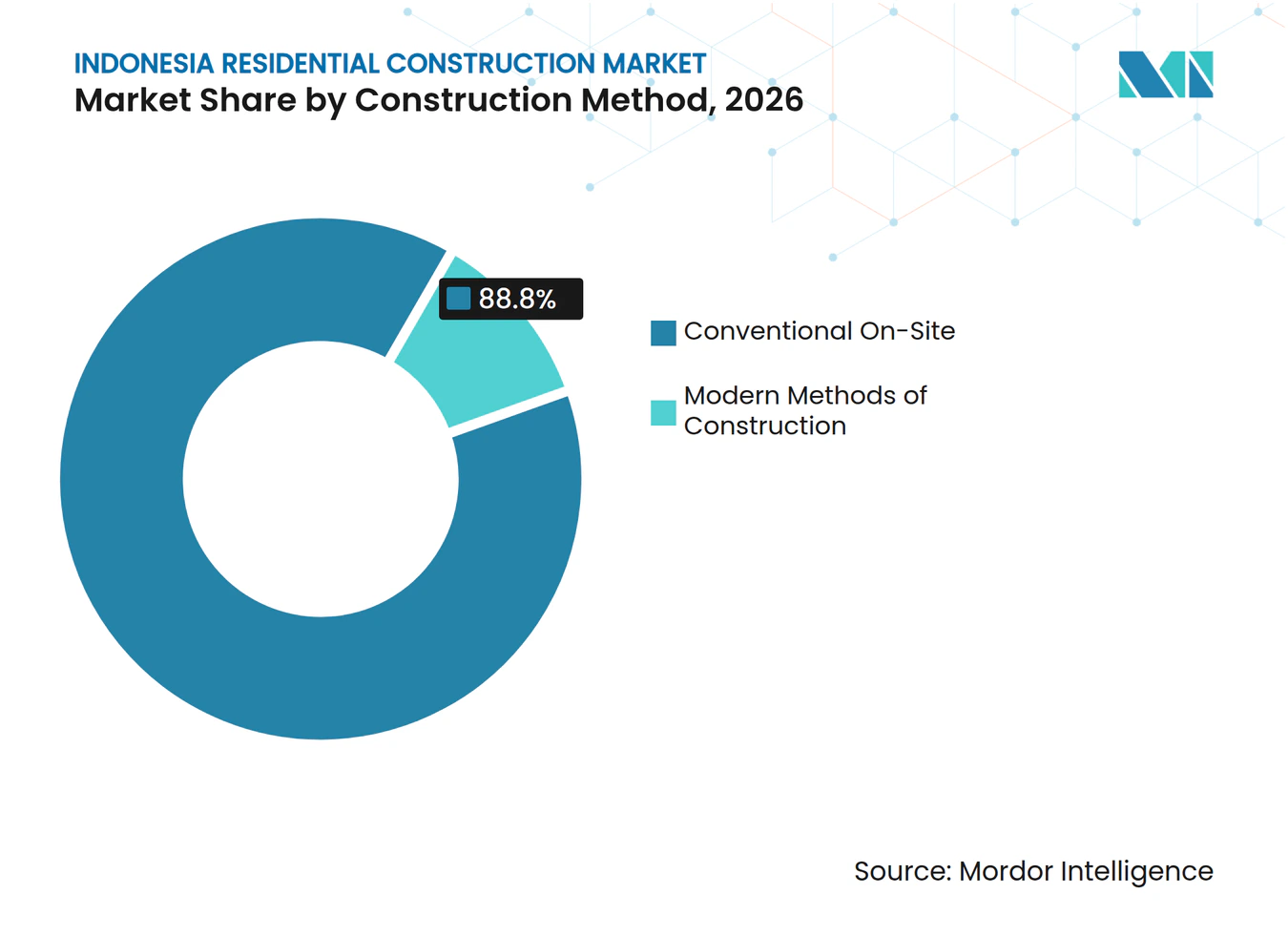
Conventional On-Site Construction Holds the Largest Share While Modern Methods of Construction Grow FastestConventional on-site construction held 88.8% of the Indonesia residential construction market share in 2026, reflecting the established role of site-based contractors and traditional labor practices. The method remains common because it is familiar to local builders and can use locally available materials. It is also flexible for small lots, incremental construction, and varied site conditions. Many regional developers have supplier and labor relationships built around conventional delivery. This method will remain necessary in places where factory-made components are difficult to transport or where projects are too small to support industrialized production. It allows design changes during construction, although this can also contribute to cost variation and delays. Conventional delivery is therefore likely to retain a substantial role even as alternative methods become more visible. Its share may gradually decline as large housing programs seek faster, more standardized completion.
Modern methods of construction are forecast to expand at a CAGR of 6.51% through 2032, the fastest rate across the construction-method segments. These methods include prefabrication, modular assembly, and precast concrete systems that can reduce work completed at the final site. PT Wijaya Karya Bangunan Gedung, PT Dex Solusi Transit, and Saint-Gobain Indonesia launched the Netro modular net-zero home in 2025, with 90% of components made off-site and construction time reduced by up to 60%. WIKA Beton also developed the WHOME modular precast system, which was validated for seismic design category D use across 21 provinces. The Indonesia residential construction market for modern methods of construction benefits when high-volume housing programs need repeatable designs and faster execution. The approach may be especially useful in Kalimantan and other outer islands, where wet-concrete work and long material supply routes can increase costs. Its wider adoption will depend on factory capacity, transport planning, procurement standards, and contractor skills.

- By Investment Source:
Private Investment Holds the Largest Share and Records the Fastest GrowthPrivate investment held 61.1% of the Indonesia residential construction market share in 2026 and remains the primary source of developer-led activity. This position reflects the large role of listed developers, private township companies, and more than 8,000 developers participating in the FLPP ecosystem. PT Bumi Serpong Damai recorded USD 678 million in residential presales in 2025, followed by PT Ciputra Development with USD 611 million and PT Lippo Karawaci with USD 354 million. These results demonstrate the scale of private demand capture among large listed companies. Private developers provide the land, project planning, construction coordination, and marketing that turn mortgage demand into completed homes. Their capacity to build across price points makes them essential to the wider housing pipeline. The segment’s scale also makes it sensitive to consumer confidence and the availability of development funding.
Private investment is also forecast to grow at a CAGR of 6.21% through 2032, the fastest rate within the investment-source segmentation. Government programs shape financing and affordability conditions, while private companies continue to supply most commercial projects. PT Bumi Serpong Damai allocated USD 185 million to USD 247 million in 2025 capital expenditure and realized USD 136 million in the first half for infrastructure, land acquisition, and investment property. Public investment is becoming more focused on social housing through Perum Perumnas, which can leave more mid-market opportunities for private developers. This division creates a market in which public policy supports access and private capital supplies a broad range of homes. Smaller private operators remain important because they reach local markets that large listed developers may not serve directly. Their ability to secure finance will influence whether private growth is widely shared or concentrated among larger groups.
Geography Analysis
Java held 58.5% of the Indonesia residential construction market share in 2026, making it the country’s largest residential construction geography. Its lead reflects major job centers, established developers, payroll-based mortgage borrowers, and a wide network of banks. West Java was the leading province for FLPP disbursement in 2025, with 29,856 units valued at USD 231 million. Greater Jakarta remains the largest urban demand center, but development is moving toward peripheral districts where roads support daily commuting. The Bogor-Serpong toll road can help open new opportunities in Parung and Gunung Sindur. Central Java is also gaining attention as manufacturers seek locations in Batang and Kendal. This gives developers more options than relying solely on high-cost land around Jakarta.
Sumatra has the second-largest geographic position, with activity centered on Medan, Palembang, and Batam. Its residential demand is tied to processing industries, logistics, port activity, and expanding transport links. The Trans-Sumatra road program can improve the access and feasibility of residential projects in secondary cities. The island’s development pattern differs from Java because city markets are more dispersed and private housing activity is less concentrated in a single metropolitan area. Local affordability and developer financing will determine how quickly transport improvements become residential projects. Smaller builders have a significant role in this geography, especially in locations served by FLPP. This makes loan availability and construction cost management particularly important.
Kalimantan’s 6.77% CAGR through 2032 gives it the fastest geographic growth profile in the Indonesia residential construction market. The combination of Ibu Kota Nusantara development, a shortage of formal homes, and rising policy attention supports its forecast. East Kalimantan has significant unmet needs, including a reported annual deficit of 38,000 units against annual delivery of 4,000 units. Sulawesi is more concentrated around Makassar, where port activity and urban renewal can support new demand. The other categories, including Papua, Maluku, Nusa Tenggara, and smaller islands, remain more reliant on rural housing programs and self-help grants. These locations can benefit from modular systems, but logistics, land access, and financing will continue to influence the pace of delivery.
Competitive Landscape
Market Concentration
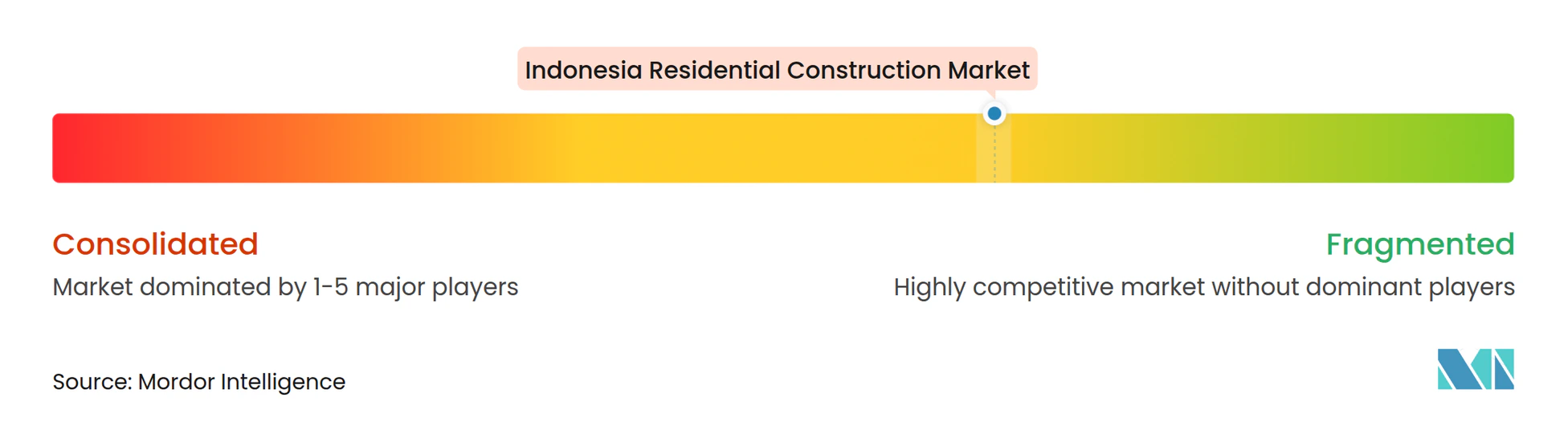
The Indonesia residential construction market comprises leading listed developers alongside a broad network of regional builders. PT Bumi Serpong Damai, PT Ciputra Development, and PT Lippo Karawaci ranked among the top listed companies by residential presales in 2025, with combined sales of USD 1.6 billion. More than 8,000 developers participate in the FLPP program, highlighting the continued importance of small and medium-sized businesses in supplying subsidized landed housing. Larger developers benefit from extensive land banks, stronger financing access, broader marketing networks, and procurement advantages. In contrast, smaller firms rely on local market knowledge, leaner operating structures, and access to locations that attract less interest from major developers. These differences shape competition across premium urban housing, large-scale townships, and subsidized regional developments.
Leading developers are extending their geographic reach and investing in integrated projects that combine residential, retail, and other uses. PT Pakuwon Jati Tbk recorded 14% net profit growth in 2025 and launched a new superblock project in Semarang, expanding beyond its established markets in Surabaya and Bekasi. Such developments create integrated communities that bring housing together with shopping, offices, and essential services. PT Agung Podomoro Land Tbk also expanded its partnership with Hankyu Hanshin Properties for Bukit Podomoro Jakarta, a project featuring 317 landed houses and 115 commercial shophouses. These collaborations can strengthen planning capabilities and financing relationships. Developers that combine large project scale with disciplined construction phasing are better equipped to respond to changing market conditions.
Product differentiation is gaining importance as homebuyers increasingly assess location, financing options, sustainability features, and community amenities. PT Ciputra Development introduced the Cremona cluster at CitraLand Puri Serang with International Finance Corporation EDGE certification, using green building credentials to set it apart in a market where price has often been the main competitive factor. Modern methods of construction may also help developers control costs and accelerate delivery, particularly in affordable housing. However, the USD 30,000–USD 62,000 housing segment remains challenging because buyers face affordability constraints while developers contend with elevated construction costs. Companies that integrate standardized designs, accessible financing, and cost-efficient construction methods may be better positioned to serve this market.
Indonesia Residential Construction Industry Leaders
-
PT Bumi Serpong Damai Tbk
-
PT Ciputra Development Tbk
-
PT Lippo Karawaci Tbk
-
PT Summarecon Agung Tbk
-
PT Lippo Cikarang Tbk
- *Disclaimer: Major Players sorted in no particular order
Indonesia Residential Construction Market Companies Covered in this Report
- PT Bumi Serpong Damai Tbk
- PT Ciputra Development Tbk
- PT Lippo Karawaci Tbk
- PT Summarecon Agung Tbk
- PT Lippo Cikarang Tbk
- PT Pakuwon Jati Tbk
- PT Agung Podomoro Land Tbk
- PT Alam Sutera Realty Tbk
- PT Intiland Development Tbk
- PT Metropolitan Land Tbk
- PT Jaya Real Property Tbk
- PT PP Properti Tbk
- Perum Perumnas
- PT Adhi Commuter Properti Tbk
- PT Wijaya Karya Realty
- PT Jababeka Tbk
- PT MNC Land Tbk
- PT Agung Sedayu Group
- PT Paramount Enterprise International
- PT Duta Anggada Realty Tbk
Recent Industry Developments in Indonesia Residential Construction Market
- July 2026: The Ministry of Housing and Settlements, PT Kereta Api Indonesia, and PT Astra International announced a collaboration to build 1,000 apartment units on idle state-owned land in Kiaracondong, Bandung, under the Three Million Homes Program model.
- July 2026: PT Agung Podomoro Land Tbk and Hankyu Hanshin Properties Corp. expanded their partnership through a partial share transfer in the developer of Bukit Podomoro Jakarta, a 9.6-hectare integrated project comprising 317 landed houses and 115 shophouses.
- May 2026: Swire Properties Ltd. and PT Jakarta Setiabudi Internasional Tbk welcomed the first residents at Savyavasa, a 402-unit premium apartment development in Dharmawangsa, South Jakarta. Tower 1 was fully sold, and 60% of the total saleable area had been transacted.
Indonesia Residential Construction Market Report Scope
Segmentation Overview
| Apartments and Condominiums |
| Villas and Landed Houses |
| New Construction |
| Renovation |
| Conventional On-Site |
| Modern Methods of Construction |
| Public |
| Private |
| Java |
| Sumatra |
| Kalimantan |
| Sulawesi |
| Others |
| By Type | Apartments and Condominiums |
| Villas and Landed Houses | |
| By Construction Type | New Construction |
| Renovation | |
| By Construction Method | Conventional On-Site |
| Modern Methods of Construction | |
| By Investment Source | Public |
| Private | |
| By Geography | Java |
| Sumatra | |
| Kalimantan | |
| Sulawesi | |
| Others |
Key Questions Answered in the Report
What is the forecast for Indonesia's residential construction through 2032?
The Indonesia residential construction market is forecast to reach USD 121.38 billion by 2032, expanding at a 5.61% CAGR from 2027.
Which property type is growing fastest in Indonesia?
Apartments and condominiums are projected to grow at a 6.11% CAGR through 2032, supported by land scarcity and transit-oriented development.
Why does landed housing remain important in Indonesia?
Villas and landed houses held 66.1% share in 2026 because buyer preferences and subsidized housing programs continue to favor landed units.
What is driving residential construction demand in Kalimantan?
Kalimantan is projected to grow at a 6.77% CAGR through 2032, supported by Ibu Kota Nusantara development and significant housing shortages.
How does FLPP affect residential housing demand?
FLPP financed 278,868 homes in 2025 and supports homebuyers through subsidized mortgage terms, widening formal access to housing.
Which construction method is expanding fastest?
Modern methods of construction are projected to grow at a 6.51% CAGR through 2032 as developers seek faster, more standardized housing delivery.