
Market Overview
| Study Period | 2020 - 2031 |
|---|---|
| Forecast Data Period | 2026 - 2031 |
| Base Year Market Size (2025) | 1.83 Million tons |
| Market Volume (2026) | 1.93 Million tons |
| Market Volume (2031) | 2.51 Million tons |
| Growth Rate (2026 - 2031) | 5.38 % |
| Market Concentration | High |
Major Players *Disclaimer: Major Players sorted in no particular order Image © Mordor Intelligence. Reuse requires attribution under CC BY 4.0. | |
Indonesia Polypropylene Market Analysis by Mordor Intelligence
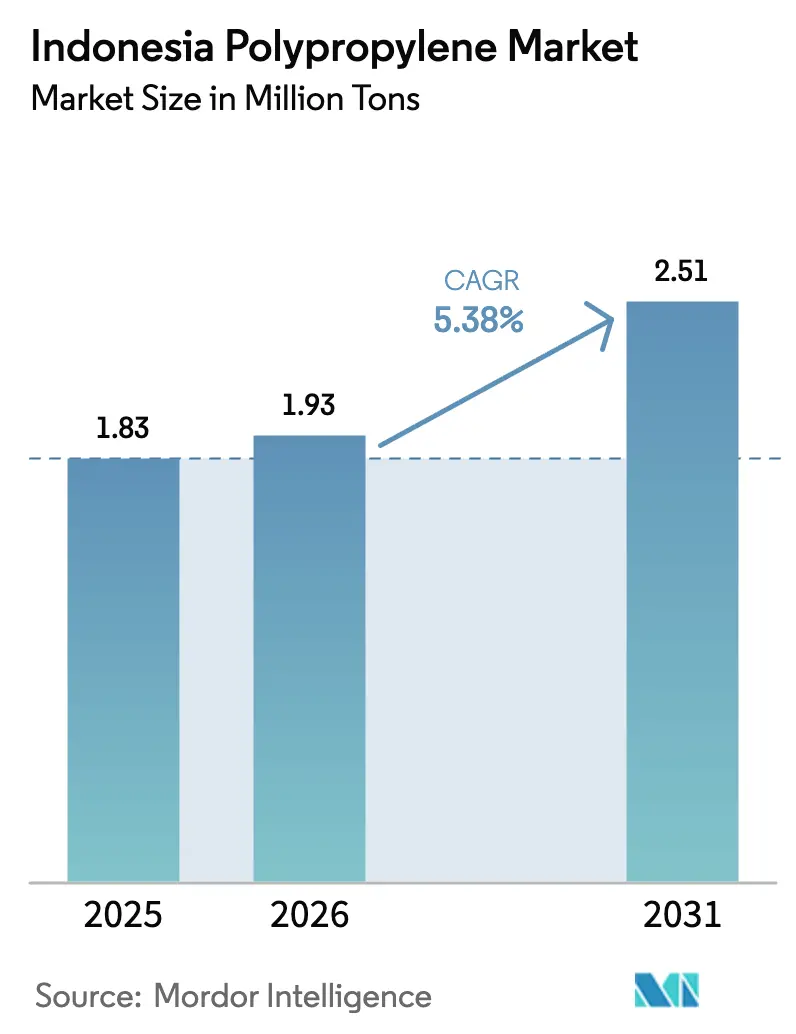
Indonesia Polypropylene Market size in 2026 is estimated at 1.93 million tons, growing from 2025 value of 1.83 million tons with 2031 projections showing 2.51 million tons, growing at 5.38% CAGR over 2026-2031. Population growth, widening middle-class purchasing power, new domestic capacity led by Lotte Chemical Indonesia’s 350 kiloton-per-year line, and rising sustainability mandates collectively sustain this trajectory. The Indonesia polypropylene market is transforming from a heavily import-dependent arena toward integrated local production as anti-dumping measures, refinery-to-polymer integration at Balikpapan, and extended-producer-responsibility rules steer resin buyers toward domestic supply. Flexible-packaging demand from snack, beverage, and personal-care brands is shifting rapidly toward recyclable mono-material films, while automotive lightweighting, under 40% TKDN local-content rules, is lifting demand for glass-fiber-reinforced grades. At the same time, e-commerce parcel volumes are accelerating the use of film and woven bags, and integrated producers such as Chandra Asri Petrochemical are leveraging feedstock control to compete on cost and reliability.
Key Report Takeaways
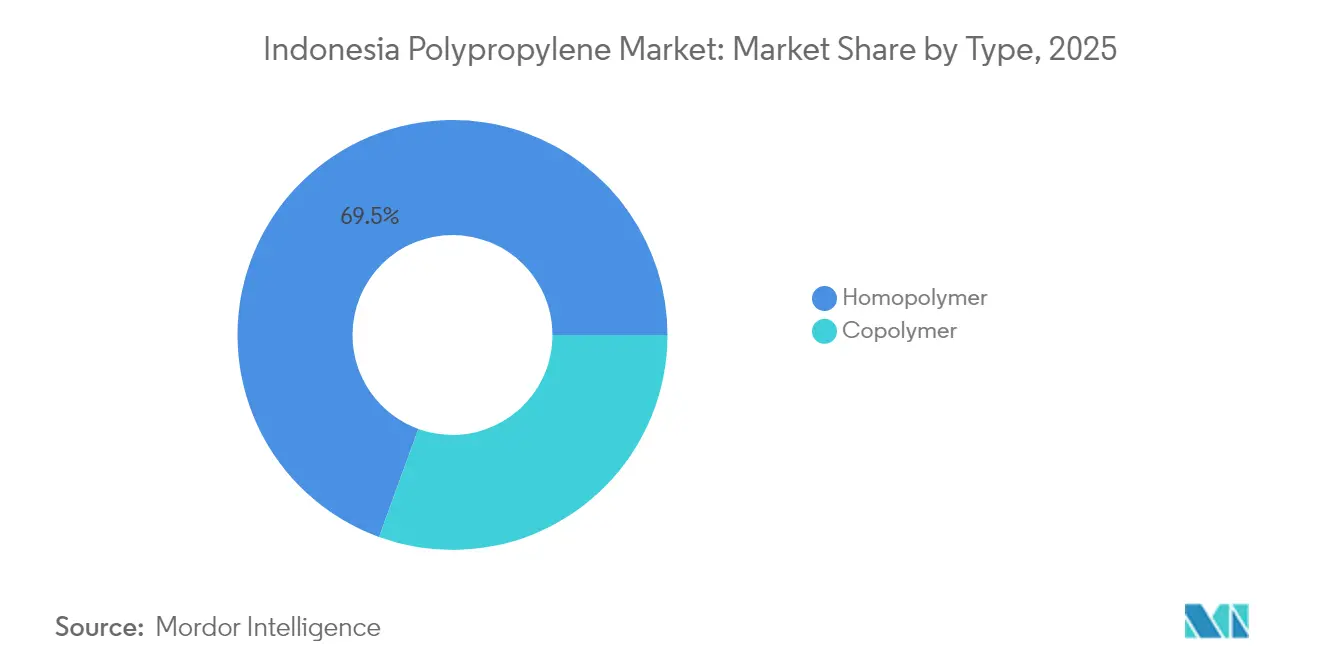
- By type, homopolymer captured 69.45% of the Indonesia polypropylene market share in 2025. The market share of homopolymer is expected to grow with a CAGR of 5.59% during the forecast period (2026-2031).
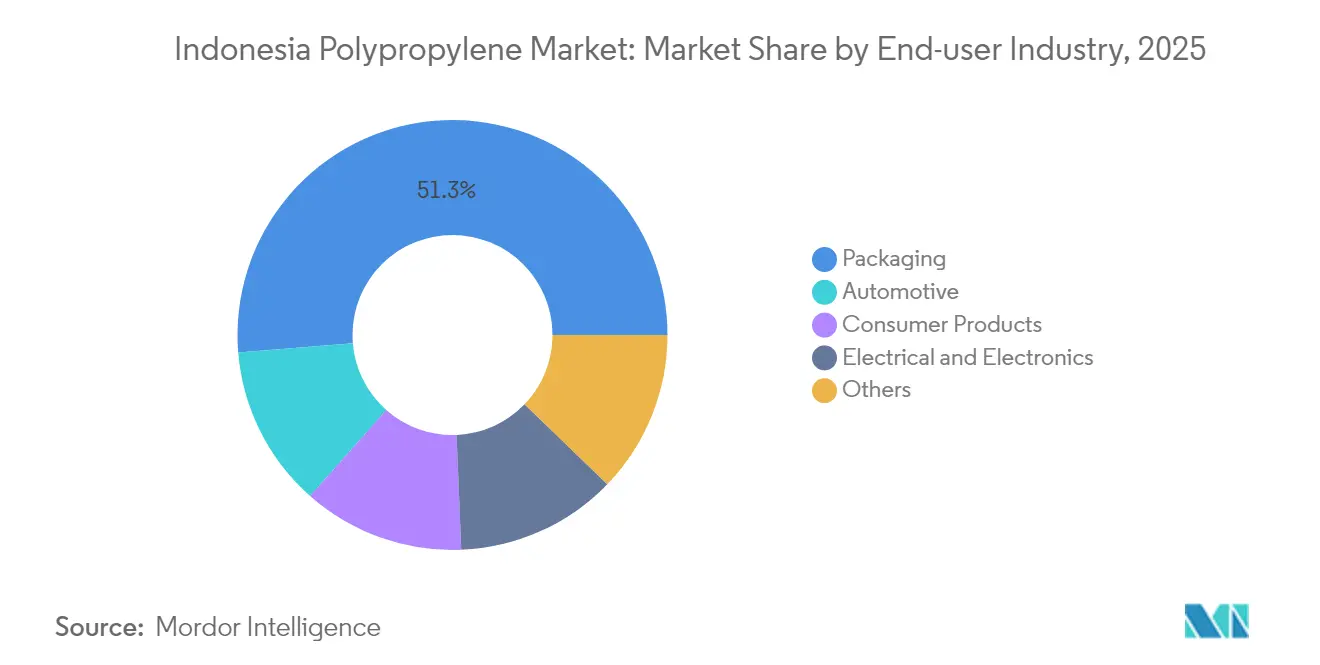
- By end-user industry, packaging accounted for 51.30% of the market in 2025. The market share of the automotive industry is expected to increase at a CAGR of 5.74% during the forecast period (2026-2031).
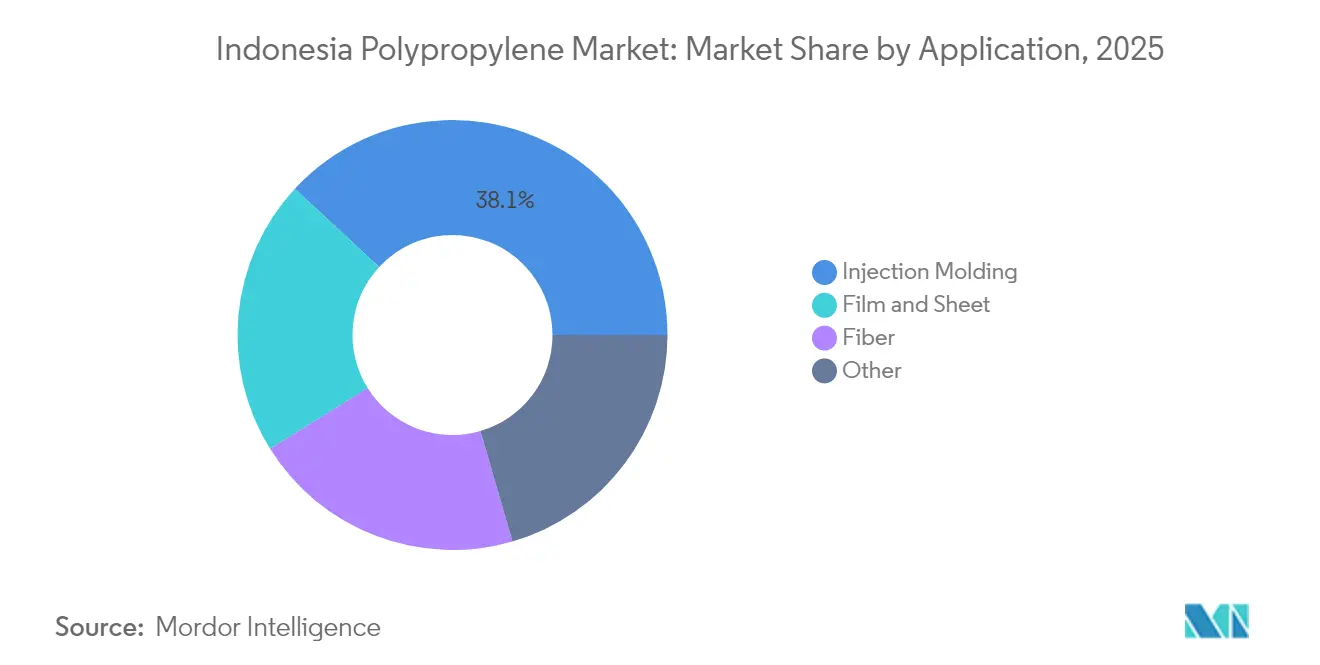
- By application, the market share of injection molding was 38.10% in 2025, and the share of film and sheet is expected to increase with a CAGR of 5.88% during the forecast period (2026-2031).
Note: Market size and forecast figures in this report are generated using Mordor Intelligence’s proprietary estimation framework, updated with the latest available data and insights as of 2026.
Market Trends and Insights
Drivers Impact Analysis of Indonesia Polypropylene Market*
| Driver | (~) % Impact on CAGR Forecast | Geographic Relevance | Impact Timeline |
|---|---|---|---|
| Surge in flexible-packaging demand from Indonesia's booming snack and FMCG sectors | +1.2% | National, concentrated in Java (Jakarta, Surabaya, Bandung) and Sumatra | Medium term (2-4 years) |
| Lightweighting push in domestic automotive OEM supply chains | +0.9% | National, with manufacturing clusters in Greater Jakarta, Karawang, and Bekasi | Long term (≥ 4 years) |
| Rapid build-out of e-commerce fulfillment networks needing durable tote and film solutions | +0.8% | National, early gains in Jakarta, Surabaya, Medan, and Makassar | Short term (≤ 2 years) |
| Local anti-dumping duties favoring domestic PP versus imports | +0.7% | National, affecting import flows from Korea, Vietnam, UAE, Malaysia, Singapore | Medium term (2-4 years) |
| Petrochemical integration at new Balikpapan refinery-to-PP complex | +1.1% | National, with supply-chain spillover to East Kalimantan and Sulawesi | Long term (≥ 4 years) |
| Source: Mordor Intelligence | |||
Surge in Flexible-Packaging Demand
Snack and FMCG producers are redesigning multilayer sachets into recyclable mono-material films to comply with Regulation 75/2019 that mandates 100% recyclable packaging by 2029. Twenty-one food and beverage companies filed official roadmaps in 2024, and converters such as Dai Nippon Printing Indonesia launched mono-material polypropylene formats that replace 40 kilotons of difficult-to-recycle instant-noodle wrap each year[1]. Middle-class demand for convenient single-serve packs accelerates volume, and polypropylene’s balance of sealability, stiffness, and clarity makes it the preferred candidate over multilayer laminates. The Indonesia polypropylene market benefits as brand owners shift volumes to domestically produced homopolymer and random-copolymer film grades. New capacity in Cilegon shortens lead times for converters and tempers raw-material price risk.
Lightweighting Push in Domestic Automotive OEM Supply Chains
Vehicle assemblers produced 551,082 units in H1 2025 under a policy that requires 40% local content on finished vehicles. Polypropylene compounds reinforced with 30%–40% glass fiber deliver up to 40% weight savings over steel for liftgates and front-end modules while meeting crash standards. The Indonesia polypropylene market gains from this substitution because the material is sourced locally, reducing imported assemblies. Electric-vehicle incentives raise the value of mass reduction, and capacity expansions at Chandra Asri and Polytama Propindo supply homopolymer feedstock for compounding. OEM validation cycles indicate steady demand visibility for at least four model years.
Rapid Build-Out of E-Commerce Fulfillment Networks
Tokopedia data show that 68% of fashion SMEs adopted polyethylene or polypropylene polymailers in 2024 to cut shipping weight and improve parcel protection[2]. Warehousing expansion in Jakarta, Surabaya, Medan, and Makassar requires millions of reusable totes, stretch-wrap, and woven sacks, all of which are polypropylene-intensive. The Indonesia polypropylene market therefore captures logistics-linked growth ahead of regional rivals. Superior tensile strength enables higher load factors compared to polyethylene, and domestic film extruders are scaling their co-extrusion lines to meet demand. Short delivery windows give a tactical edge to resin produced within the archipelago.
Local Anti-Dumping Duties Favoring Domestic PP Versus Imports
The Ministry of Trade imposed anti-dumping duties on imports of copolymers from South Korea, Vietnam, the UAE, Malaysia, and Singapore in 2024. Duties align with the October 2025 start-up of Lotte Chemical’s 350 kiloton line, redirecting procurement toward domestic sellers and narrowing historical reliance on imports that once met 65% of demand. International producers now face squeezed margins, while converters secure stable volumes without foreign-exchange risk. The Indonesia polypropylene market thus pivots to local feedstock, reinforcing recent investment cycles.
Restraints Impact Analysis of Indonesia Polypropylene Market*
| Restraint | (~) % Impact on CAGR Forecast | Geographic Relevance | Impact Timeline |
|---|---|---|---|
| Competition from PET and rPET in beverage and pouch formats | -0.6% | National, particularly Java and Bali where beverage consumption is highest | Medium term (2-4 years) |
| Volatile naphtha feedstock costs versus ethane-advantaged imports | -0.8% | National, affecting all naphtha-fed crackers and import economics | Short term (≤ 2 years) |
| Intensifying plastics-waste regulation in Jakarta and Bali provinces | -0.5% | Regional, with Jakarta and Bali enforcement leading national rollout | Long term (≥ 4 years) |
| Source: Mordor Intelligence | |||
Competition from PET and rPET in Beverage and Pouch Formats
Indonesia consumed 1 million tons of PET in 2024, and leading beverage brands committed to using 100% recycled PET bottles, reinforcing PET’s dominance in transparent applications. Higher collection rates and a 2.5 million-ton recycling infrastructure favor PET when producers must hit 50% recycled-content targets by 2029. For the Indonesia polypropylene market, this trend reduces penetration in premium beverage and high-barrier pouch categories. Converters are forced to differentiate based on rigidity and heat performance rather than clarity.
Volatile Naphtha Feedstock Costs Versus Ethane-Advantaged Imports
Asian naphtha traded USD 17 per barrel higher in April 2025 than a year earlier, widening the cost gap with ethane-rich producers in the Middle East and North America. Domestic crackers in Cilegon and Anyer rely on naphtha, so local resin pricing mirrors crude swings. Elevated feedstock costs tighten margins just as the Indonesia polypropylene market adds capacity. Although refinery integration at Balikpapan will cut propylene import bills, near-term volatility challenges profitability and may delay specialty-grade upgrades.
*Our forecasts treat driver/restraint impacts as directional, not additive. The impact forecasts reflect baseline growth, mix effects, and variable interactions.
Indonesia Polypropylene Market Segment Analysis
By Type:
Homopolymer Dominates on Cost-Performance BalanceHomopolymer captured 69.45% of the Indonesia polypropylene market share in 2025 and is forecast to grow at a 5.59% CAGR through 2031, reflecting its low cost and high stiffness in injection-molded automotive and rigid-packaging parts. The Indonesia polypropylene market size for homopolymer is predicted to reach 1.76 million tons by 2031, aided by Lotte Chemical’s new line that mainly targets general-purpose grades. Domestic converters gain security of supply and faster order cycles, aligning with TKDN local-content rules.
Copolymer serves caps, closures, and impact-modified films that require flexibility or clarity. Anti-dumping duties on copolymer imports have curtailed volume growth; however, the adoption of mono-material film under EPR rules is reviving interest. In the medium term, success depends on local producers upgrading reactors to random- and impact-copolymer capability.

By End-User Industry:
Automotive Outpaces Packaging GrowthPackaging retained 51.30% demand in 2025, powered by snacks, beverages, and household-care goods that favor polypropylene containers and films. The Indonesia polypropylene market size for packaging is expected to rise as mono-material films replace multilayer laminates.
Automotive demand, however, is projected to post the fastest 5.74% CAGR to 2031. The polypropylene content per vehicle increases as OEMs substitute metal with glass-fiber-reinforced compounds to meet efficiency targets. Domestic resin advances enhance supply transparency, providing Tier-1 molders with the confidence to localize parts that were previously assembled in Thailand or China.
By Application:
Film and Sheet Gains on E-Commerce LogisticsInjection molding contributed 38.10% in 2025. Film and sheet are set to overtake it by 2031 as polymailers, stretch-wrap, and mono-material food films proliferate across fulfillment and retail channels. The Indonesia polypropylene market size for film and sheet is projected to reach 522 kilotons in 2031.
Fiber applications in woven sacks, geotextiles, and non-woven fabrics show steady uptake alongside infrastructure expansion in Kalimantan and Sumatra. Government road-building and coastal-protection projects specify polypropylene geotextiles for durability and chemical resistance, supporting specialized fiber lines in Java.
Geography Analysis
Java remains the consumption epicenter, anchored by automotive assembly plants in Greater Jakarta and large FMCG processing zones in Surabaya and Bandung. Cilegon’s integrated complex supplies resin by pipeline, cutting transport costs that once burdened import-dependent processors. The Indonesia polypropylene market benefits from just-in-time deliveries that reduce converter working capital.
Sumatra and Kalimantan are next-wave growth fronts. Plantation agriculture and mining increase demand for woven sacks, geomembranes, and heavy-duty films. Pertamina’s USD 7.4 billion Balikpapan integration promises 225 kilotons of propylene, re-balancing supply away from Java and shortening lead times in eastern provinces.
Bali and Nusa Tenggara consume less resin but enact the toughest single-use-plastic bans, spurring rapid converter innovation. Compliance pressure creates an incubator for mono-material solutions that later scale nationwide. Overall, regional diversification mitigates logistics risk and encourages investment in satellite compounding and recycling hubs, deepening the Indonesia polypropylene market.
Regulatory Landscape
Indonesia’s polypropylene sector is overseen by the Ministry of Industry (Kemenperin), mainly through the Directorate General of Chemical, Pharmaceutical and Textile Industries (IKFT), alongside trade-policy actions administered by the Ministry of Trade. Regulatory focus centers on import management and downstreaming, including anti-dumping duties on PP copolymer imports from South Korea, Vietnam, the UAE, Malaysia, and Singapore (imposed in 2024), which have been used to curb import pressure and support domestic resin uptake.
On the industrial policy side, Kemenperin is reviewing proposals to elevate petrochemicals as a National Strategic Project (PSN), a pathway intended to streamline licensing and improve the investment environment for large integrated projects. The policy toolkit also includes energy-cost interventions such as the HGBT (Price of Specific Natural Gas) and AGIT (Allocation of Specific Industrial Gas) mechanisms, which affect resin economics and capacity utilization across Indonesia’s petrochemical corridor.
Value Chain Analysis
The polypropylene value chain in Indonesia begins with hydrocarbon feedstocks (notably naphtha and LPG), which are converted into propylene and then polymerized into PP at domestic production sites. Production is concentrated among a small number of local operators, including PT Chandra Asri Pacific Tbk (integrated naphtha cracking and polymers in Cilegon, Banten) and PT Polytama Propindo, with Lotte Chemical Indonesia adding a 350 ktpa PP line at Cilegon as part of a larger complex. Imported feedstock exposure and regional price cycles remain structural factors, keeping PP costs sensitive to global naphtha and LPG movements.
Downstream, PP is supplied to converters producing packaging films and sheets, injection-molded consumer and automotive parts, and fiber products such as woven sacks and nonwovens, with Java acting as the main conversion and consumption hub. Distribution typically runs through producer direct sales and polymer distributors into converter clusters, while logistics and inventory buffers take on more importance during tightness. In mid-2026, market signals highlighted tighter PP availability relative to PE, underscoring how plant operating rates and feedstock constraints can transmit quickly into local pricing and lead times.
Competitive Landscape
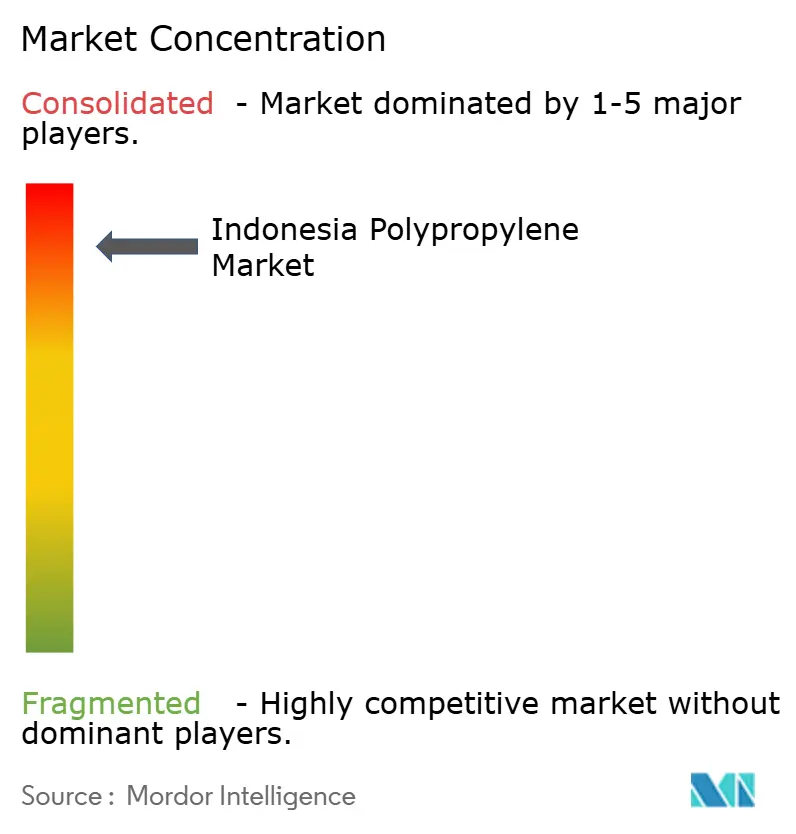
The Indonesia Polypropylene Market is highly concentrated. PT Chandra Asri Petrochemical, Lotte Chemical Indonesia, and Polytama Propindo collectively control the majority of domestic capacity, yet international firms maintain a strong foothold in specialty resins. Chandra Asri’s acquisition of Shell’s Singapore cracker secures upstream feedstock and positions the firm to capture value-chain margins. Lotte Chemical’s Cilegon complex pushes Indonesia toward 90% ethylene self-sufficiency, underpinning polypropylene cost competitiveness.
Indonesia Polypropylene Industry Leaders
-
Exxon Mobil Corporation
-
LG Chem
-
Chandra Asri Group
-
PT Polytama Propindo
-
LG Chem
- *Disclaimer: Major Players sorted in no particular order
Indonesia Polypropylene Market Companies Covered in this Report
- Argha Karya Prima Industry Tbk
- BASF
- Exxon Mobil Corporation
- INEOS
- LG Chem
- LOTTE Chemical CORPORATION
- LyondellBasell Industries Holdings BV
- Mitsubishi Chemical Corporation
- NAGA SEMUT
- PT Chandra Asri Petrochemical
- PT Langgeng Jaya Group
- PT Polytama Propindo
- PT Trias Sentosa Tbk
- SABIC
- Sumitomo Corporation
- TORAY INDUSTRIES, INC.
Market Opportunities and Future Outlook
A key whitespace for polypropylene in Indonesia is import substitution, alongside closing domestic polymer deficits within the broader plastics raw-material system. The Ministry of Industry has cited a national plastic raw-material supply deficit of 1.922 million tons (annual demand of 4.879 million tons versus domestic supply of 2.957 million tons), and it has been pushing to position petrochemicals as a National Strategic Project (PSN) to accelerate integrated capacity build-out and improve upstream input economics, including through gas-policy mechanisms such as HGBT and AGIT.
Opportunities are most concentrated where policy and conversion shifts are already visible: (i) mono-material packaging redesign aligned with Indonesia’s EPR-driven direction, which supports PP film structures and local resin sourcing; (ii) domestic-content (TKDN) programs that pull more polymer-intensive components into local automotive and appliance supply chains; and (iii) infrastructure-linked demand for PP fiber and geosynthetics as projects extend beyond Java into Sumatra and Kalimantan. Named projects and investment pipelines referenced by government and industry sources, including Chandra Asri Pacific 2, Lotte Chemical Indonesia, and the TPPI Olefin Complex in Tuban, offer concrete anchors for further downstream integration, compounding, and specialty-grade localization within Indonesia’s PP ecosystem.
Recent Industry Developments in Indonesia Polypropylene Market
- March 2026: Chandra Asri Group declared force majeure on polypropylene contracts following feedstock and supply-chain disruptions linked to security conditions affecting the Strait of Hormuz. The announcement highlighted Indonesia’s exposure to upstream logistics and feedstock volatility even as domestic polymer capacity expands, tightening spot availability and reinforcing the value of diversified supply options.
- January 2025: ExxonMobil signed an MoU with the Indonesian government to explore a potential integrated investment, including a petrochemical complex and large-scale carbon capture and storage (CCS), with figures cited up to USD 15 billion in public reporting. If advanced, this type of integrated platform adds long-horizon optionality for propylene and polymer value chains and strengthens the case for downstreaming-linked industrial zones.
- September 2024: PT Polytama Propindo held a groundbreaking for enabling infrastructure for its Balongan polypropylene program, including an EPCC jetty and a 3,000-ton propylene storage tank. The build-out supports feedstock handling and logistics resilience at the site, which is central to scaling domestic polypropylene availability and improving delivery reliability to converters.
Indonesia Polypropylene Market Report Scope and Research Methodology
Market Definition and Coverage
For this methodology, the market means polypropylene resin demand in Indonesia, counted in volume terms, and tied to how much PP is used by domestic converters across major end uses.
Scope exclusions: We exclude downstream converted plastic products, recycled PP, and internal transfer pricing effects that do not change physical resin demand.
Segments Covered in This Report
- By Type
- Homopolymer
- Copolymer
- By End-user Industry
- Packaging
- Automotive
- Consumer Products
- Electrical and Electronics
- Others
- By Application
- Injection Molding
- Fiber
- Film and Sheet
- Other
Data Sources, Market Sizing, and Validation
Desk Research
Desk research was used to set the hard boundaries of the Indonesia PP demand pool, and to anchor the model to measurable signals like production, trade, and industrial activity. We mainly used public statistics and official releases that can be checked independently, which helps keep assumptions traceable.
Typical inputs came from sources such as BPS manufacturing statistics, UN Comtrade and WITS trade tables for HS plastics lines, UNIDO industrial indicators, and customs and tariff publications, with supporting context from peer reviewed polymer and packaging journals and Indonesian industry association releases. Company annual reports and investor presentations were used to understand capacity changes and operating rate direction, and a paid subscription for company financials and an import export shipment-level database were used selectively to cross-check volume patterns. These desk sources are not exhaustive, and many other public documents and datasets were also consulted to collect data, validate it, and clarify open points.
Primary Interviews and Surveys
Primary work focused on validating how PP demand is split across packaging, automotive, and consumer goods, and on stress-testing the assumed application mix (film and sheet, injection molding, fiber, and others). We spoke with a mix of producers, distributors, converters, and industry experts so our pricing logic and utilization assumptions could be corrected when desk signals looked inconsistent across provinces and customer types.
Distribution of primary research fieldwork respondents
| Company type | Respondent position |
|---|---|
| Top tier: 32% | CXOs: 12% |
| Mid tier: 50% | Functional/Unit leaders: 30% |
| Smaller Players: 18% | Managers: 58% |
Market-Sizing & Forecasting
Sizing starts with a top-down build that reconstructs Indonesia PP demand from domestic production, net imports, and an allowance for stock changes, which are then reconciled with downstream consumption signals from key converting industries. After that, the totals are corroborated with selective bottom-up checks such as sampled converter capacity utilization, application-level volume splits, and a simple price times volume sense check so the end number stays realistic.
Key inputs used in the model include resin production capacity and operating rate direction, import and export volumes for PP in primary forms, application mix shifts between film, injection molding, and fiber, packaging and manufacturing output indicators, and an annual average PP price deck in local currency that is converted consistently to USD. Where bottom-up detail was missing for smaller converters, gaps were handled through conservative penetration assumptions by end use and then validated through distributor and converter interviews. Forecasting is based on scenario analysis, where near-term demand is linked to manufacturing activity and packaging intensity, and longer-term growth is adjusted for capacity additions, substitution dynamics, and expert views on purchasing behavior.
Data Validation & Update Cycle
Outputs were cross-checked against independent indicators like implied per-capita plastics use, trade direction consistency, and capacity utilization logic so that the result does not rely on one data stream. Large jumps were reviewed again, and when variances could not be explained, follow-up calls were triggered with respondents closest to the topic before final sign-off.
Before publication, the model and assumptions pass through multi-step internal review, including a separate check of arithmetic, units, and currency conversion timing. The report is refreshed annually, and interim updates are made when material events occur, such as a major capacity start-up, trade restriction change, or sharp feedstock-driven price reset. Right before delivery, we run a final scan to reflect the most recent public data and validated market signals.
Mordor Intelligence's Indonesia Polypropylene Market Sizing Compared With Other Published Estimates
Published market sizes for Indonesia polypropylene can look far apart because the underlying counting unit and the boundary line are not always the same, and then the price and conversion steps can further widen the gap. Differences also come from how each publisher treats trade flows, inventory swings, and the timing of updates when new capacity is announced.
By tracking domestic production, net import volumes, and a consistent annual average price deck, Mordor Intelligence keeps the Indonesia PP estimate tied to physical resin demand, while some sources lean more on revenue proxies that can bundle compounding, downstream plastics, or broader polymer groups. Another gap driver is the base year choice and refresh cadence, where older datasets may miss the near-term utilization impact of capacity ramp-ups or trade shifts, which then pushes the implied 2025 to 2026 starting point up or down.
Benchmark comparison
| Source | Market Size | Gaps in Research Methodology |
|---|---|---|
| Mordor Intelligence | USD 1.83 M (2025) | |
| Industry Blog A | USD 11.20 B (2024) | Uses revenue-style framing with a much wider scope, which likely mixes downstream plastics value or multiple polymer families, so it is not directly comparable to resin demand in tons. |
| Trade Desk B | USD 2.05 M (2026) | Leans heavily on trade-only balancing without a clear stock adjustment and without converter-side validation, which can overstate demand in years with inventory build or re-exports. |
The comparison shows that most of the spread is explained by scope and unit choices, followed by how prices and conversion timing are handled. When the model is anchored to production and net import reality and then checked with converter application patterns, the resulting market size becomes easier to reproduce and more stable for planning decisions.
Key Questions Answered in the Report
How large is the Indonesia polypropylene market today?
The Indonesia polypropylene market size reached 1.93 million tons in 2026 and is forecast at 2.51 million tons by 2031.
What is the expected CAGR for polypropylene demand in Indonesia?
Total demand is projected to grow at a 5.38% CAGR between 2026 and 2031.
How are anti-dumping duties affecting domestic supply?
Duties on copolymer imports from five countries redirect procurement toward local resin and strengthen domestic producers’ pricing power.
What role does automotive lightweighting play in polypropylene demand?
Automotive parts built with glass-fiber-reinforced polypropylene are growing at 5.74% CAGR as OEMs chase weight reduction and TKDN compliance.