
Indonesia Pharmaceutical Cold Chain Air Logistics Market Size and Share
Market Overview
| Study Period | 2020 - 2031 |
|---|---|
| Forecast Data Period | 2026 - 2031 |
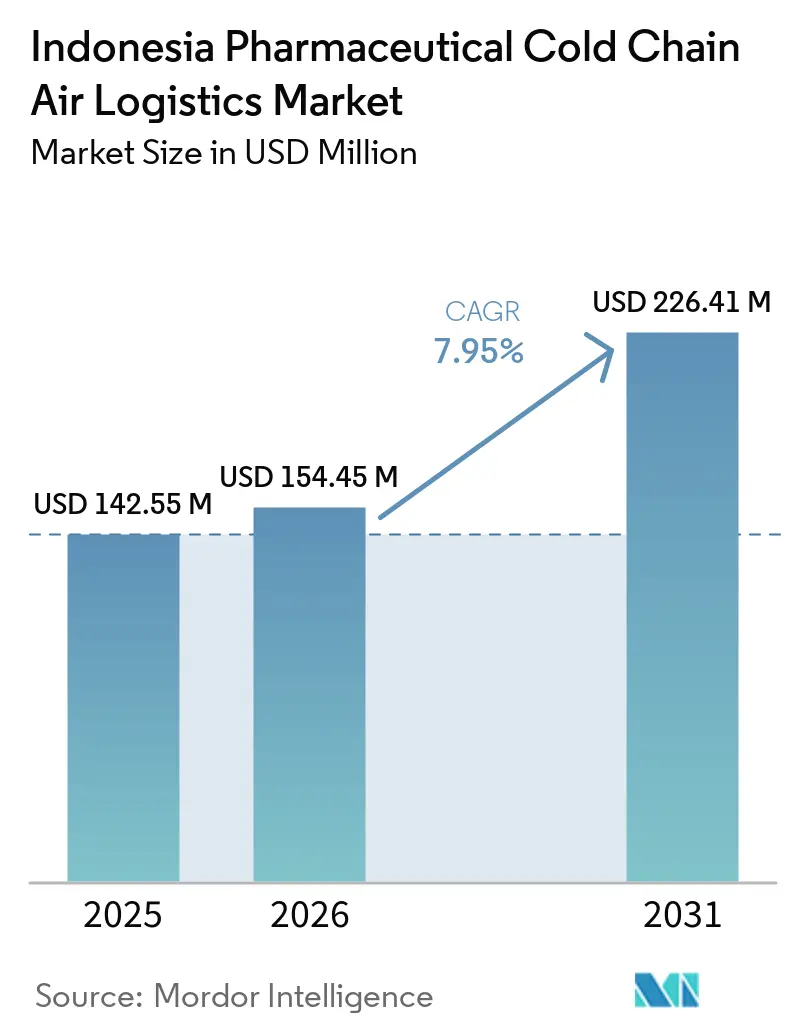
| Base Year Market Size (2025) | USD 142.55 Million |
| Market Size (2026) | USD 154.45 Million |
| Market Size (2031) | USD 226.41 Million |
| Growth Rate (2026 - 2031) | 7.95 % |
| Market Concentration | Medium |
Major Players *Disclaimer: Major Players sorted in no particular order Image © Mordor Intelligence. Reuse requires attribution under CC BY 4.0. | |
Indonesia Pharmaceutical Cold Chain Air Logistics Market Analysis by Mordor Intelligence
The Indonesia pharmaceutical cold chain air logistics market size was valued at USD 142.55 million in 2025 and is estimated to grow from 154.45 million in 2026 to reach 226.41 million by 2031, at a CAGR of 7.95% during the forecast period (2026-2031).
Indonesia’s geography makes air transport necessary for many temperature-sensitive medicines because distribution often crosses islands and cannot rely on a continuous road network. Investment in domestic biologics production can create several controlled transport movements between sourcing, production, testing, storage, and hospital delivery. CDOB 2025 raised the importance of monitoring, records, and validated handling across pharmaceutical distribution, which favored providers with established quality systems. Jakarta remains the central gateway, while growth in eastern corridors creates openings for operators that can provide reliable handling beyond the capital. The Indonesia pharmaceutical cold chain air logistics market also faces cost, capacity, and personnel constraints that can slow service expansion outside the main Java corridor.
Key Report Takeaways
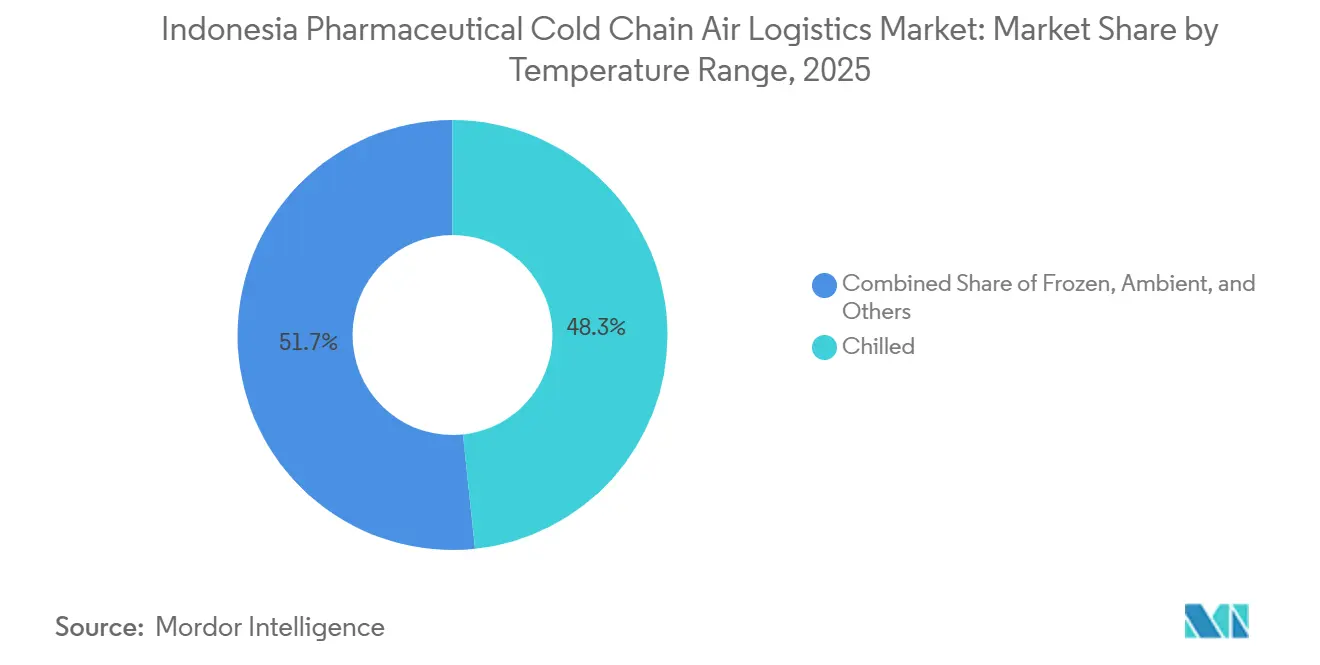
- By temperature range, chilled shipments held 48.34% of the Indonesia pharmaceutical cold chain air logistics market share in 2025, while deep-frozen and ultra-low shipments are projected to grow at an 11.93% CAGR through 2031.
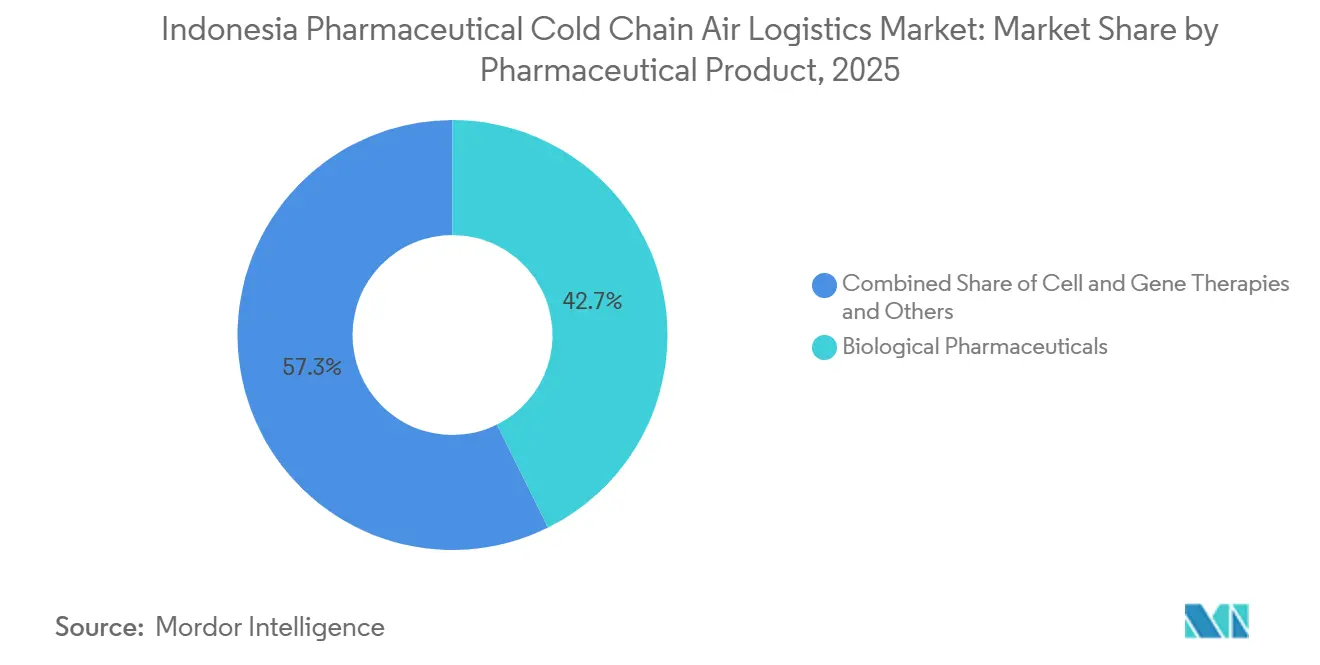
- By pharmaceutical product type, biological pharmaceuticals accounted for 42.67% of the Indonesia pharmaceutical cold chain air logistics market share in 2025, while cell and gene therapies are forecast to expand at a 14.07% CAGR through 2031.
- By shipment flow, domestic shipments held 68.37% of the Indonesia pharmaceutical cold chain air logistics market size in 2025, while international shipments are forecast to grow at an 8.84% CAGR through 2031.
- By city, Jakarta commanded 44.28% of the Indonesia pharmaceutical cold chain air logistics market size in 2025, while Makassar is projected to grow at a 9.31% CAGR through 2031.
Note: Market size and forecast figures in this report are generated using Mordor Intelligence’s proprietary estimation framework, updated with the latest available data and insights as of January 2026.
Indonesia Pharmaceutical Cold Chain Air Logistics Market Trends and Insights
Drivers Impact Analysis*
| Driver | (~) % Impact on CAGR Forecast | Geographic Relevance | Impact Timeline |
|---|---|---|---|
| Biologics, Vaccines, and Specialty Injectables Expansion | +2.0% | National, with intensity in Jakarta, Surabaya, and Makassar | Long term (≥ 4 years) |
| Expansion of Healthcare Access and Institutional Distribution | +1.5% | National, with early gains in Kalimantan, Sulawesi, and Papua | Medium term (2-4 years) |
| Increasing Outsourcing to GDP-Compliant Logistics Providers | +1.2% | National, concentrated in Java and Sulawesi corridors | Medium term (2-4 years) |
| Growth of Direct-to-Patient and E-Pharmacy Fulfillment | +0.8% | Urban centers, Jakarta, Surabaya, Bandung, and Semarang | Short term (≤ 2 years) |
| Inter-Island Air Bridges and Regional Micro-Hub Development | +1.0% | Eastern Indonesia, Makassar, Denpasar, and Medan | Long term (≥ 4 years) |
| CEIV-Oriented Airport Handling and Premium Shipment Integrity | +0.6% | Soekarno-Hatta, with spillover to Makassar and Denpasar | Short term (≤ 2 years) |
| Source: Mordor Intelligence | |||
Increasing Outsourcing to GDP-Compliant Logistics Providers
The Indonesia pharmaceutical cold chain air logistics market is supported by pharmaceutical manufacturers that increasingly use specialized third-party logistics providers. These requirements are harder for smaller providers to meet across a dispersed national network. Certified operators can therefore offer a more consistent service to manufacturers with complex temperature-control needs. In March 2026, NX Group integrated PT NX Lemo Indonesia Logistik and PT Nippon Express Indonesia under its One Indonesia approach to provide a single contact point across air and ocean freight operations. This type of integration can improve response times and strengthen the position of providers that combine local execution with broader international networks.
Growth of Direct-to-Patient and E-Pharmacy Fulfillment
The Indonesia pharmaceutical cold chain air logistics market is also shaped by the growth of deliveries to patients rather than only to hospitals and clinics. Insulin, fertility treatments, and selected oncology products need stable temperature conditions during delivery to remote locations. Orders in this channel are smaller and more frequent than institutional shipments, which changes packaging and dispatch requirements. Air freight can be necessary when a remote-island delivery would otherwise take several days by road or sea. B-LOG had more than 3,400 fleet units and 15 storage facilities, showing the scale being developed by domestic cold-chain providers[1]B-LOG, “Strengthening Cold Chain Services, B-LOG Ready to Support Indonesia’s National Logistics Needs at GIICOMVEC 2026,” B-LOG, b-log.co.id. The channel increases demand for service models that can manage frequent deliveries without weakening temperature documentation.
Inter-Island Air Bridges and Regional Micro-Hub Development
The Indonesia pharmaceutical cold chain air logistics market depends on dependable air links between Java and the outer islands. Direct cargo routes can reduce handoffs, which lowers the risk of temperature excursions during complex trips. Ahmad Yani International Airport announced a dedicated Semarang to Makassar cargo service in February 2025[2]Ahmad Yani International Airport, “Bandara Jenderal Ahmad Yani Semarang Layani Penerbangan Kargo Rute Semarang–Makassar,” Ahmad Yani International Airport, ahmadyani-airport.id. The capacity gap makes regional micro-hubs a practical opportunity, but operators need cold storage and reliable procedures rather than route capacity alone.
CEIV-Oriented Airport Handling and Premium Shipment Integrity
Airport handling quality has become an important consideration in the Indonesia pharmaceutical cold chain air logistics market. CEIV Pharma certification provides a recognized framework for managing high-value pharmaceutical cargo under controlled conditions. PT Gapura Angkasa obtained CEIV Pharma certification for cargo at Soekarno-Hatta International Airport in May 2026. The certification improves Jakarta’s capability to handle time-sensitive products that need close control during ground transfers. Secondary hubs still have less certified cold-room infrastructure, so they often require validated passive packaging during airport dwell time. This difference places a premium on providers that can protect shipments across both major gateways and smaller regional nodes.
Restraints Impact Analysis*
| Restraint | (~) % Impact on CAGR Forecast | Geographic Relevance | Impact Timeline |
|---|---|---|---|
| Archipelagic Infrastructure Gaps and High Logistics Costs | -1.5% | Eastern Indonesia, Papua, Maluku, NTT, NTB, and Kalimantan | Long term (≥ 4 years) |
| Regulatory, Customs, and Qualified-Personnel Complexity | -1.0% | National, most acute at Soekarno-Hatta and secondary international gateways | Medium term (2-4 years) |
| Repeated Inter-Island Handoffs and Temperature-Excursion Risk | -0.8% | All trans-island corridors, particularly in Eastern Indonesia | Long term (≥ 4 years) |
| Concentration of Certified Air-Cargo Cold Rooms at Jakarta Gateway | -0.7% | Secondary hubs, Makassar, Denpasar, Medan, and Semarang | Medium term (2-4 years) |
| Source: Mordor Intelligence | |||
Archipelagic Infrastructure Gaps and High Logistics Costs
The Indonesia pharmaceutical cold chain air logistics market must serve routes that may combine air, road, smaller aircraft, and boat transport. Each transfer adds handling, packaging, scheduling, and documentation requirements. Deep-frozen shipments need dry ice or active containers, which can make handling costs 4 to 6 times higher than ambient cargo rates. This cost burden is most difficult for lower-value temperature-sensitive products, including some generics and over-the-counter biologics. Providers serving eastern routes need enough volume and route density to spread these costs while maintaining validated handling.
Regulatory, Customs, and Qualified-Personnel Complexity
The Indonesia pharmaceutical cold chain air logistics market is constrained by regulatory procedures and a limited supply of qualified cold-chain personnel. Import approvals and customs classification can delay the release of temperature-sensitive products at international gateways. Delays are especially challenging for biologics with limited stability time outside controlled conditions. CDOB 2025 also increased the need for qualified staff and documented responsibilities at pharmaceutical distribution points. The concentration of certified airport cold rooms in Jakarta makes these issues more visible when cargo moves through secondary hubs. Providers that invest in staff training, documentation, and cold-room capability can reduce these operational pressures, although progress will take time across the national network.
*Our forecasts treat driver/restraint impacts as directional, not additive. The impact forecasts reflect baseline growth, mix effects, and variable interactions.
Segment Analysis
By Temperature Range: Chilled Volumes Anchor as Ultra-Low Heats Up
Chilled shipments at 0 to 5 °C held 48.34% of the Indonesia pharmaceutical cold chain air logistics market share in 2025. This position reflects the large role of vaccines, insulin, and biological products that require refrigerated handling rather than frozen storage. The chilled category supports routine distribution to hospitals, clinics, and other healthcare facilities. It also aligns with the broad need for refrigerated capacity across the country’s immunization and biologics supply chains. Frozen shipments at -18 °C to 0 °C form an important secondary category for plasma protein products and selected oncology biologics. Ambient shipments support branded medicines and over-the-counter products that can move within 15 to 25 °C conditions.
Deep-frozen and ultra-low shipments below -20 °C are forecast to grow at an 11.93 % CAGR through 2031. The category serves advanced biologics, as well as cell and gene therapies that require cryogenic handling. These medicines require specialized packaging, close temperature control, and clearly managed handoffs. FedEx stated in 2025 that its Asia-Pacific healthcare capabilities included va-Q-tainer solutions that can reach -60 °C. The Indonesia pharmaceutical cold chain air logistics market size for this category will depend on the availability of suitable airport handling and trained personnel. CEIV Pharma practices remain relevant across all temperature ranges because handling discipline is necessary in each controlled corridor.



By Pharmaceutical Product Type: Biologics Lead as Cell Therapies Emerge
Biological pharmaceuticals accounted for 42.67% of the 2025 Indonesia pharmaceutical cold chain air logistics market size by product type. This group includes biologics, biosimilars, vaccines, and blood-derived medicinal products. Their temperature sensitivity and high value per kilogram support the need for controlled air freight. Vaccines and blood-derived products account for major biologic volumes in the country. Biosimilars also add to refrigerated movement as they are used within hospital treatment programs. Small-molecule pharmaceuticals remain a substantial category, although their temperature requirements differ across branded, generic, and over-the-counter products.
Cell and gene therapies are projected to expand at a 14.07 % CAGR from 2026 to 2031. These therapies are beginning from a near-zero base as hospitals develop pilot programs for CAR-T and gene-editing treatments. Their transport can require conditions from -150 °C to -196 °C using liquid-nitrogen vessels. Air freight is essential for inter-island delivery within the limited stability windows of these products. DHL Group expanded its dedicated airfreight cold-chain network in February 2026 to support end-to-end visibility for cell and gene therapy shipments. The Indonesia pharmaceutical cold chain logistics industry is therefore becoming more dependent on cryogenic expertise as demand shifts toward biologics and advanced therapies.
By Shipment Flow: Domestic Routes Dominate, International Corridors Expand
Domestic shipments held 68.37% share of the Indonesia pharmaceutical cold chain air logistics market share in 2025. Inter-island air transport is central to national coverage for products that cannot tolerate long road or sea journeys. In a country with many islands, domestic air freight provides a function that land transport provides in contiguous markets. The route network connects pharmaceutical production and import gateways with provincial hospitals and regional distribution points. Domestic flows often require several stages of handling when a final destination is outside the main Java corridor. That makes consistent procedures at each transfer point a basic service requirement.
International shipments are forecast to grow at an 8.84% CAGR through 2031. Growth is linked to imports of biologics and specialty injectables that are not yet widely produced in Indonesia. International movements also support the country’s increasing participation in clinical trial supply chains. Many shipments enter through consolidation hubs in Singapore, Kuala Lumpur, or Hong Kong before reaching Jakarta. This adds handling events before arrival and makes coordination between carriers, forwarders, and ground handlers important. The Indonesia pharmaceutical cold chain air logistics market can benefit from stronger international corridors when these parties maintain traceability from origin to delivery.
Geography Analysis
Jakarta is the largest internal hub in the Indonesian pharmaceutical cold chain logistics market, with a 44.28% city share in 2025. Soekarno-Hatta International Airport concentrates on pharmaceutical import clearance, controlled storage, and air-cargo handling. PT Gapura Angkasa received CEIV Pharma certification at the airport in May 2026. This provided a recognized quality framework for high-value and time-sensitive cargo during ground handling[3]PT Gapura Angkasa, “Gapura Angkasa Obtains CEIV Pharma Certification for Cargo,” PT Gapura Angkasa, gapura.id. Jakarta’s certified infrastructure attracts international shipments of biologics and specialty medicines. Its dominance also creates a dependency because alternative hubs have less established controlled infrastructure.
Java’s secondary cities form a dense distribution corridor for the Indonesia pharmaceutical cold chain air logistics market. Surabaya is the most significant secondary hub because Juanda Airport relays cargo toward East Kalimantan, West Papua, and Maluku. Bandung and Yogyakarta serve regional healthcare networks and support distribution within Java. The region has the highest concentration of pharmaceutical distributors, making consistent monitoring and documentation particularly important. Its connections to the national import gateway make Java the primary operational base for most providers.
Makassar provides the strongest geographic growth opportunity with 9.31% CAGR through 2026-2031 in the Indonesia pharmaceutical cold chain air logistics market. The same research identified a need for expansion toward a 28,000 m² terminal standard. Medan is the key access point for northern Sumatra, while Denpasar supports Bali’s hospitals and medical tourism demand. Secondary airports generally lack certified pharmaceutical cold rooms, so operators often use validated passive packaging during airport dwell time. This leaves a clear need for more controlled regional handling as traffic shifts beyond Jakarta.
Competitive Landscape
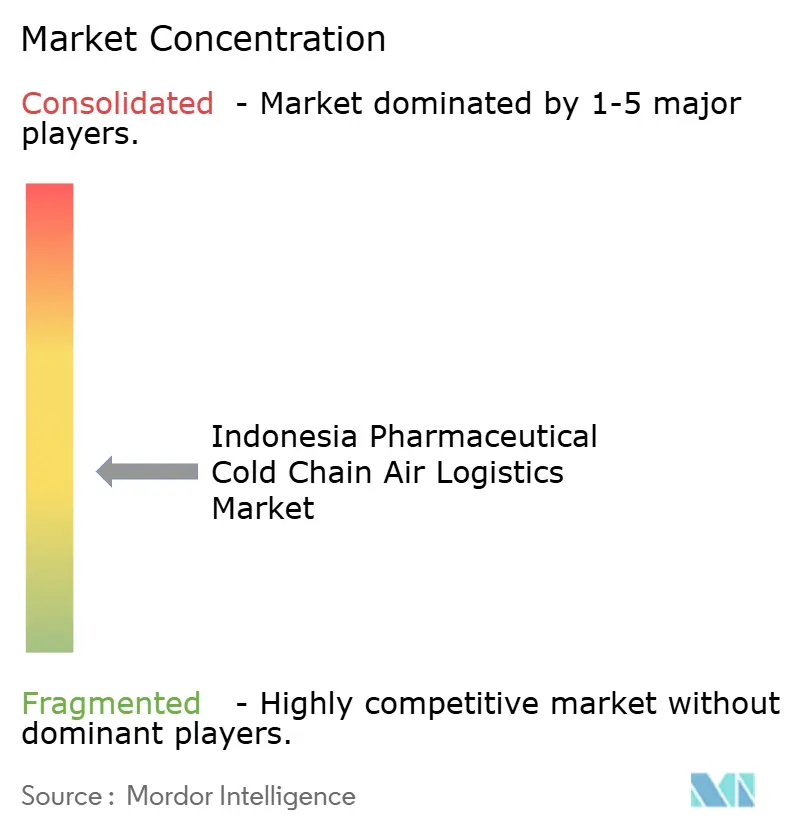
The Indonesia pharmaceutical cold chain air logistics market is moderately fragmented among premium international service providers and local handling. DHL Group, Kuehne+Nagel, DSV, FedEx, UPS, and CEVA Logistics compete through established networks, controlled facilities, and visibility tools. Their services are designed for customers who need consistent handling across international and domestic movements. DHL Group announced in February 2026 that it was expanding its airfreight cold-chain network to advance global health logistics. DHL also committed EUR 500 million (USD 581 million) for Asia-Pacific healthcare infrastructure by 2030. These investments support the company’s ability to serve complex pharmaceutical flows entering Indonesia.
Domestic operators provide the ground layer needed for the Indonesia pharmaceutical cold chain air logistics market to function across national airports. PT Garuda Indonesia, PT Gapura Angkasa, PT Jasa Angkasa Semesta, and PT Angkasa Pura Kargo are relevant to airport handling and inter-island freight. Gapura’s CEIV Pharma certification is an example of a domestic operator improving its capability for sensitive cargo. NX Group’s March 2026 integration of 2 Indonesian subsidiaries is another strategic move aimed at unifying air and ocean freight services under one customer interface[4]Nippon Express Holdings, “NX Group Integrates Business Companies in Indonesia,” Nippon Express Holdings, nipponexpress.com. Operators that combine local airport execution with international coordination can reduce service gaps on complex routes. The Indonesia pharmaceutical cold chain logistics industry will continue to need domestic handling expertise even as global providers expand their networks.
Technology and compliance distinguish providers where network coverage is otherwise similar. Real-time sensor data can support temperature records and help teams respond when handling conditions change. Quality-risk documentation can also make it easier to manage customer audits and distribution requirements. Secondary cities, including Makassar, Medan, and Denpasar, remain the main opportunity for companies establishing controlled micro-hubs. These locations need stronger airport cold-room capacity as well as trained teams and validated procedures. The Indonesia pharmaceutical cold chain air logistics market is therefore likely to reward service breadth, network resilience, and deep-freeze capability rather than basic freight capacity alone.
Indonesia Pharmaceutical Cold Chain Air Logistics Industry Leaders
DHL Group
Kuehne+Nagel International AG
DSV A/S
PT Jasa Angkasa Semesta Tbk
PT Garuda Indonesia (Persero) Tbk / Garuda Indonesia Cargo
- *Disclaimer: Major Players sorted in no particular order

Recent Industry Developments
- July 2026: CEVA Logistics and GSK extended their distribution center management agreement at the Robakowo facility in Poland for an additional 5 years, reinforcing CEVA’s strategic pharmaceutical contract logistics profile and its global commitment to GDP-compliant,
- March 2026: NX Group, Nippon Express Holdings, completed the integration of PT NX Lemo Indonesia Logistik and PT Nippon Express Indonesia into a single unified entity, consolidating air and ocean freight forwarding under one customer-facing structure to improve pharmaceutical logistics response and eliminate internal duplication. The move operationalized the One Indonesia cross-company sales team launched in 2025, creating a more direct account interface for pharmaceutical clients across Indonesia.
- December 2025: DHL Group committed EUR 500 million (USD 580 million) for Asia-Pacific Life Sciences and Healthcare infrastructure by 2030, including GDP-certified Pharma Hubs and expanded cold-chain capacity, with Indonesia positioned as a beneficiary of the regional network upgrade.
- March 2025: DHL Group acquired CRYOPDP, a specialist courier focused on clinical trial logistics, biopharma supply chains, and cell and gene therapy transport, expanding its cryogenic pharmaceutical logistics capability as part of the EUR 2 billion (USD 2.32 billion) Health Logistics investment strategy.


Indonesia Pharmaceutical Cold Chain Air Logistics Market Report Scope
| Chilled (0–5 °C) |
| Frozen (-18–0 °C) |
| Ambient |
| Deep-Frozen / Ultra-Low (Below -20 °C) |
| Small-Molecule Pharmaceuticals | Branded Pharmaceuticals |
| Over-the-Counter (OTC) Pharmaceuticals | |
| Generic Pharmaceuticals | |
| Biological Pharmaceuticals (Biologics, Biosimilars, Vaccines, and Blood-Derived Medicinal Products) | |
| Specialty Pharmaceuticals | |
| Cell and Gene Therapies | |
| Veterinary Pharmaceuticals | |
| Other Pharmaceutical Products |
| Domestic Shipments |
| International Shipments |
| Jakarta |
| Bandung |
| Surabaya |
| Medan |
| Tasikmalaya |
| Yogyakarta |
| Semarang |
| Denpasar |
| Makassar |
| Rest of Cities |
| By Temperature Range | Chilled (0–5 °C) | |
| Frozen (-18–0 °C) | ||
| Ambient | ||
| Deep-Frozen / Ultra-Low (Below -20 °C) | ||
| By Pharmaceutical Product Type | Small-Molecule Pharmaceuticals | Branded Pharmaceuticals |
| Over-the-Counter (OTC) Pharmaceuticals | ||
| Generic Pharmaceuticals | ||
| Biological Pharmaceuticals (Biologics, Biosimilars, Vaccines, and Blood-Derived Medicinal Products) | ||
| Specialty Pharmaceuticals | ||
| Cell and Gene Therapies | ||
| Veterinary Pharmaceuticals | ||
| Other Pharmaceutical Products | ||
| By Shipment Flow | Domestic Shipments | |
| International Shipments | ||
| By City | Jakarta | |
| Bandung | ||
| Surabaya | ||
| Medan | ||
| Tasikmalaya | ||
| Yogyakarta | ||
| Semarang | ||
| Denpasar | ||
| Makassar | ||
| Rest of Cities | ||


Key Questions Answered in the Report
What is the 2026 value of Indonesia pharmaceutical cold chain logistics?
The sector is estimated at USD 154.45 million in 2026 and is forecast to reach USD 226.41 million by 2031, at an 7.95% CAGR. The forecast reflects demand for validated transport of refrigerated, frozen, and cryogenic pharmaceutical products across Indonesia’s dispersed islands: capacity, quality systems, airport handling, and specialized packaging requirements.
Which temperature range leads pharmaceutical cold-chain air logistics in Indonesia?
Chilled shipments held 48.34% share in 2025 because vaccines, insulin, and many biologics require refrigerated handling. This range supports routine movement to hospitals, clinics, regional distribution points, and other healthcare facilities that need stable 0 to 5°C conditions.
Which pharmaceutical products will grow fastest in Indonesian-controlled logistics?
Cell and gene therapies are forecast to expand at a 14.07 % CAGR through 2031, driven by their need for cryogenic transport. These treatments can require temperatures from -150 °C to -196 °C, specialized liquid-nitrogen vessels, and carefully planned air-cargo handoffs.
Why is Jakarta important for temperature-sensitive pharmaceutical transport?
Jakarta held 44.28% city share in 2025 and concentrates import clearance, controlled handling, and recognized airport infrastructure. Soekarno-Hatta International Airport also provides the country’s strongest concentration of pharmaceutical import activity, international forwarders, and CEIV Pharma-certified ground handling.
Why is Makassar becoming more important for pharmaceutical air freight?
Makassar is forecast to grow at a 9.31% CAGR through 2031 because it links eastern Indonesian locations to wider air-cargo networks. New links improve access to South Sulawesi and underserved provinces, although airport capacity and controlled handling infrastructure need further development.
What constrains the expansion of pharmaceutical cold-chain services in Indonesia?
High inter-island costs, repeated handoffs, limited regional cold rooms, regulatory procedures, and qualified-staff shortages remain key constraints. These issues are most acute outside Jakarta, where providers may depend on passive packaging and more complex transfer arrangements to protect temperature-sensitive cargo.
Page last updated on:





