
Indonesia Office Real Estate Market Size and Share
Market Overview
| Study Period | 2021 - 2032 |
|---|---|
| Forecast Data Period | 2027 - 2032 |
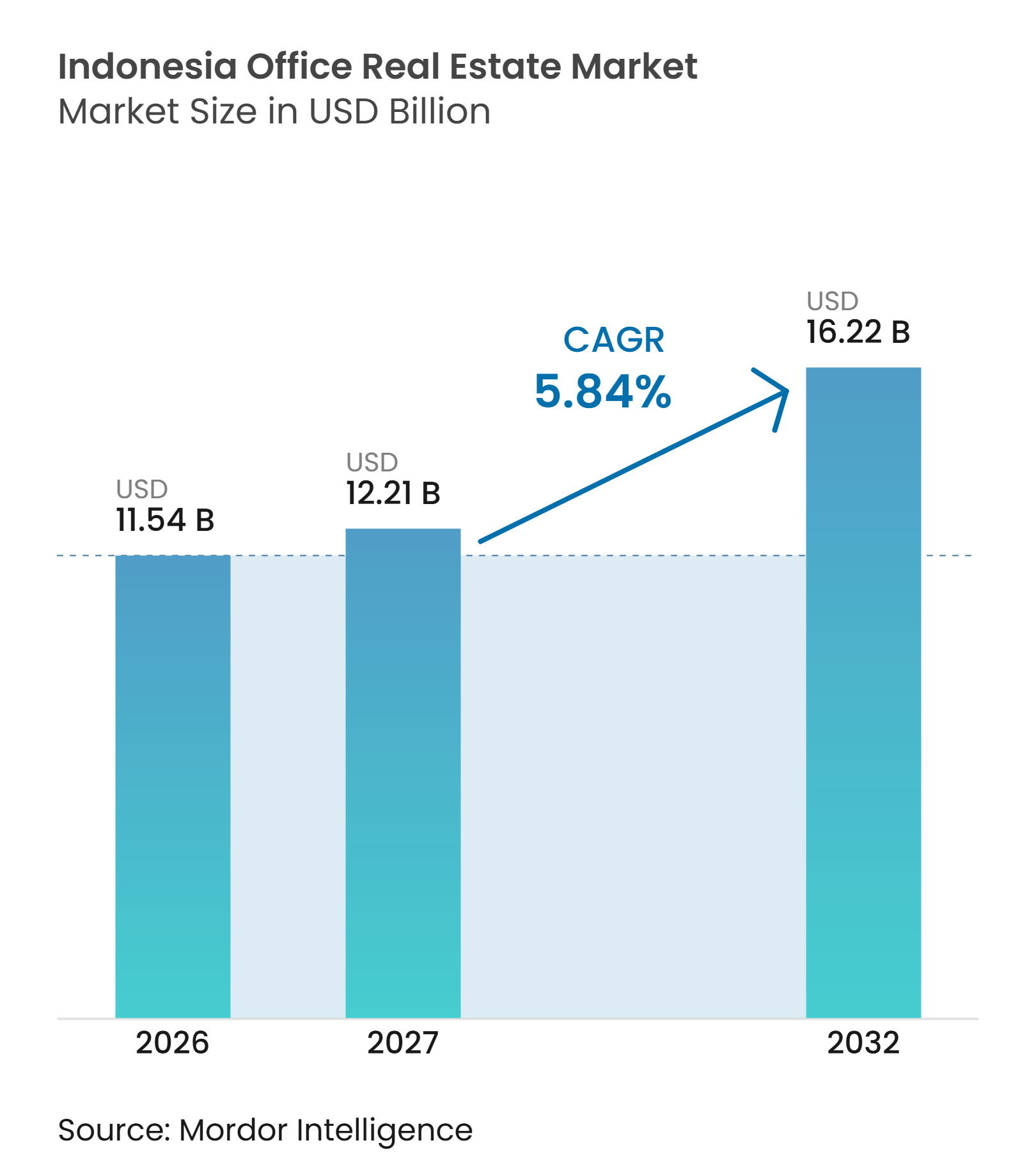
| Base Year Market Size (2026) | USD 11.54 Billion |
| Market Size (2027) | USD 12.21 Billion |
| Market Size (2032) | USD 16.22 Billion |
| Growth Rate (2027 - 2032) | 5.84 % |
| Market Concentration | Medium |
Major Players *Disclaimer: Major Players sorted in no particular order Image © Mordor Intelligence. Reuse requires attribution under CC BY 4.0. | |
Indonesia Office Real Estate Market Analysis by Mordor Intelligence
The Indonesia office real estate market was valued at USD 11.54 billion in 2026 and is projected to reach USD 12.21 billion in 2027 and USD 16.22 billion by 2032, registering a CAGR of 5.84% during the 2027–2032 forecast period.
Limited Grade A completions in Jakarta’s central business district are expected to tighten the availability of modern premium space before 2028, which favors landlords with occupied, well-located buildings. Indonesia’s economy grew by 5.1% year over year in the second quarter of 2025, supporting occupier confidence among technology, financial services, and energy companies. Government-backed development around Nusantara Capital City, known as IKN, and urban transit projects are widening demand beyond Jakarta toward mixed-use and transit-linked business districts. The Indonesia office real estate market is separating into modern, connected buildings that attract corporate upgrades and older stock that faces a longer vacancy cycle. This distinction creates opportunities in certified Grade A assets and emerging commercial corridors, while landlords of dated properties need to improve building quality or compete more heavily on price.
Key Report Takeaways
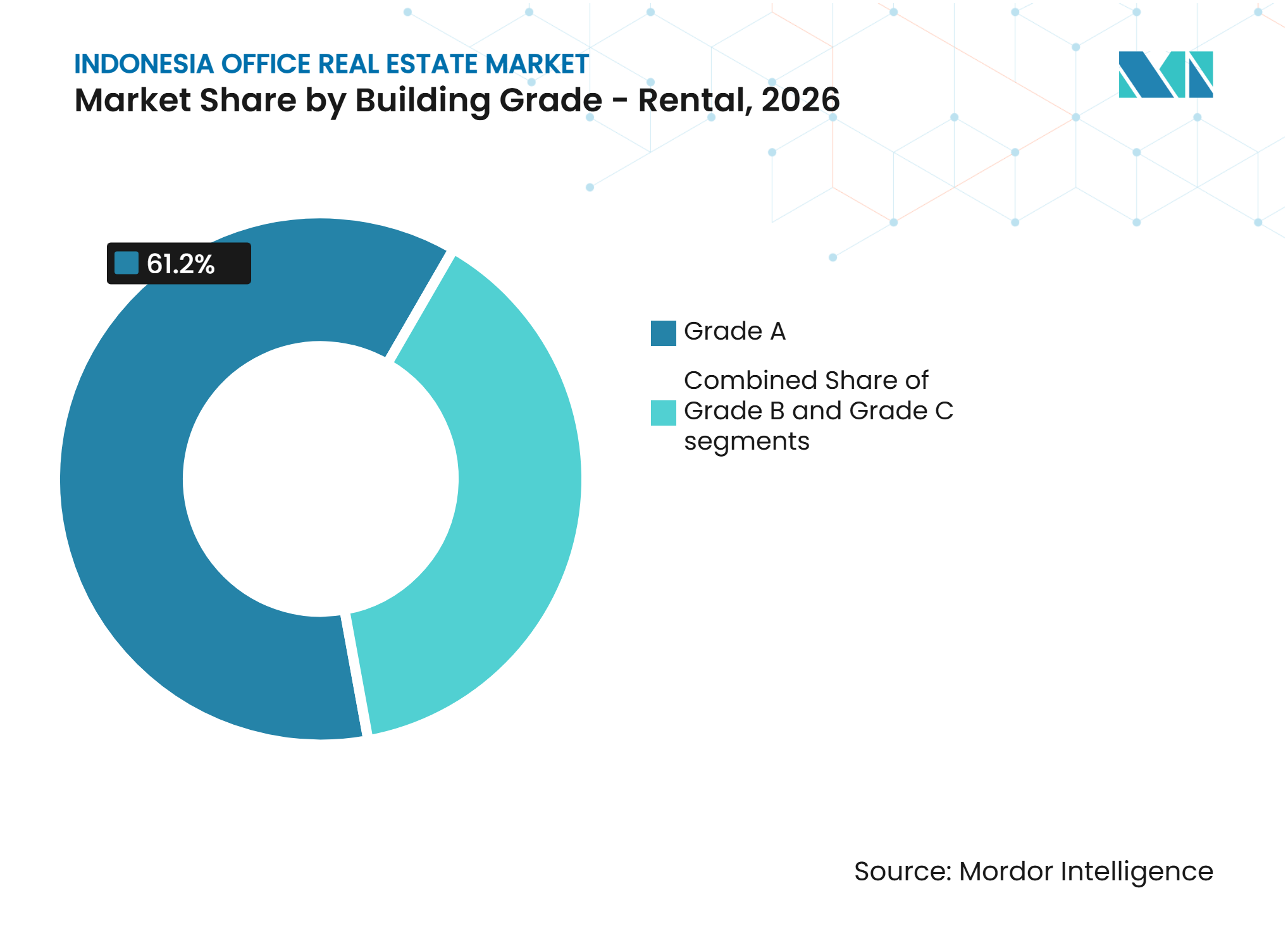
- By building grade in the rental segment, Grade A held a 61.2% share of the Indonesia office real estate market in 2026 and is projected to grow at a 6.39% CAGR through 2032, reinforcing its leading position in the rental segment.
- By end use in the rental segment, information technology (IT and ITES) held a 29.9% share of the Indonesia office real estate market in 2026 and is projected to grow at a 6.51% CAGR through 2032, reinforcing its position as the largest end-use segment.
- By region in the rental segment, Jakarta accounted for a 75.8% share of the Indonesia office real estate market size in 2026, while the Rest of Indonesia is forecast to expand at a 6.97% CAGR through 2032.
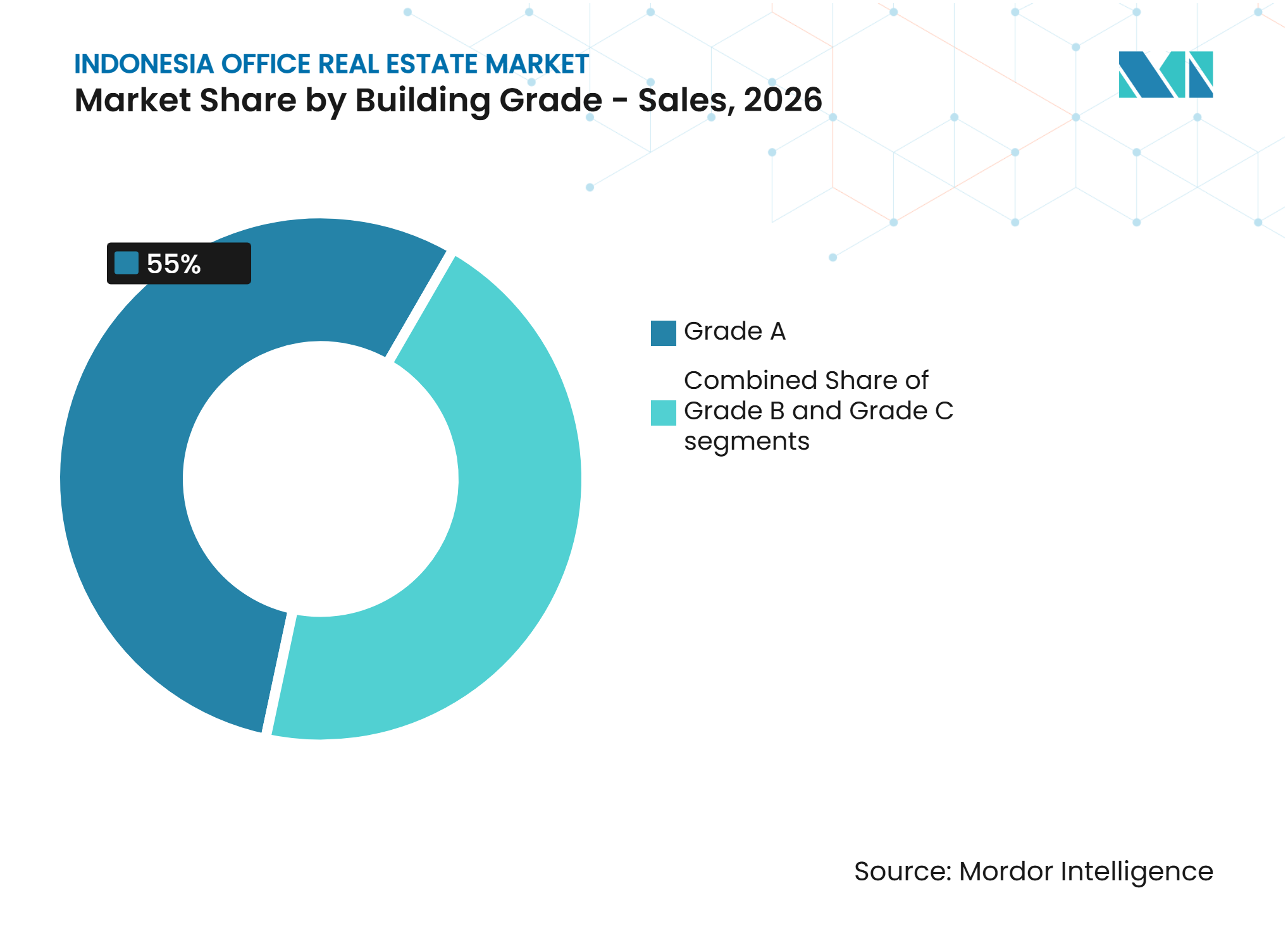
- By building grade in the sales segment, Grade A accounted for a 55.0% Indonesia office real estate market share in 2026 and is projected to grow at a 6.21% CAGR through 2032, maintaining its leading position.
Note: Market numbers in this report are based on Mordor Intelligence's proprietary estimation framework, which combines nine months of actuals with Q4 projections for base year 2026.
Market Trends and Insights
Drivers Impact Analysis of Indonesia Office Real Estate Market*
| Drivers | (~) % Impact on CAGR Forecast | Geographic Relevance | Impact Timeline |
|---|---|---|---|
| Multinational Expansion and Foreign Investment | +1.4% | Global, with core impact in Jakarta CBD and spillover to Surabaya and Batam | Medium term (2-4 years) |
| Corporate Flight to Quality | +1.2% | Jakarta CBD, Jakarta non-CBD, and Grade A cities nationally | Medium term (2-4 years) |
| Growth of Financial and Professional Services | +1.0% | Jakarta CBD, with gains in Surabaya and Bandung | Long term (≥ 4 years) |
| Mass Rapid Transit and Light Rail Transit Network Development | +0.8% | Greater Jakarta transit corridors and emerging nodes in Surabaya and Bandung | Long term (≥ 4 years) |
| Corporate Sustainability Requirements | +0.7% | Jakarta CBD and certified assets in key cities | Long term (≥ 4 years) |
| Flexible and Serviced Office Expansion | +0.5% | Jakarta CBD, Jakarta non-CBD, and national locations | Short term (≤ 2 years) |
| Source: Mordor Intelligence | |||
Multinational Corporate Expansion and Foreign Investment
Indonesia is gaining attention from multinational companies as supply chains and regional operating models adjust across Southeast Asia. Investment realization data published by the Investment Coordinating Board, known as BKPM, recorded continued foreign investment across technology, financial services, and manufacturing during 2025. These industries are important office users because they typically need regional management, engineering, client service, and support teams. A foreign investment commitment can be followed by a headquarters or project-office decision, which gives the Indonesia office real estate market a pipeline of potential demand. Large international tenants also tend to assess building access, operational resilience, and environmental standards before choosing space. Government Regulation No. 78 of 2019 provides tax-holiday support for qualifying pioneer industries, which strengthens Indonesia’s appeal for long-term investment.
Corporate Flight to Quality
Companies are increasingly moving from older offices toward modern Grade A properties with efficient floor plates and easier public-transport access. The shift is particularly visible where tenants can obtain stronger building systems, better employee access, and green certification in one location. GREENSHIP recognition from Green Building Council Indonesia, known as GBCI, gives owners a clearer way to demonstrate the environmental performance of their assets[1]. This requirement is more important for occupiers that report environmental, social, and governance performance to global investors or parent companies. The Indonesia office real estate market therefore rewards newer premium buildings more clearly than properties that meet an older Grade A classification but no longer meet current tenant expectations. Landlords with older assets face a choice between targeted upgrades and a longer period of lower occupancy.
Financial, Professional, and Technology Services Demand
Domestic financial services continue to need office locations, although their demand is changing from branch expansion toward technology-enabled operations. Bank branch offices declined to 23,675 by May 2025, down 475 from the prior year, as lenders rationalized physical networks and increased investment in digital channels. CIMB Niaga opened a digital branch in Denpasar-Thamrin during 2025, showing how banks are combining customer service with technology-led formats[2]. Additiv also opened a Jakarta office in District 8 to support clients in banking, wealth management, and insurance. Professional services firms add steady demand through smaller office requirements, while technology businesses need space for engineering, operations, and customer teams. These patterns support well-equipped headquarters and processing locations rather than broad growth in conventional branch office space.
Transit Access, Sustainability, and Flexible Space
Mass rapid transit and light rail transit development is making office locations near stations more attractive to employers and staff. The Dukuh Atas area connects mass rapid transit, light rail transit, Transjakarta, commuter rail, and airport rail within an integrated urban hub[3]. Research on Jakarta’s transit-oriented development identifies mobility integration as a central part of more sustainable urban development. Better connectivity can reduce commuting friction and improve access to a broader workforce. It also supports office projects that combine workspace with retail, housing, and public transport. These advantages strengthen demand for well-located offices in Jakarta and emerging transit nodes in Surabaya and Bandung.
Restraints Impact Analysis of Indonesia Office Real Estate Market*
| Restraints | (~) % Impact on CAGR Forecast | Geographic Relevance | Impact Timeline |
|---|---|---|---|
| Elevated Jakarta Office Vacancy | -1.2% | Jakarta non-CBD and secondary cities including Surabaya and Bandung | Long term (≥ 4 years) |
| Hybrid Work and Space Optimization | -1.0% | Jakarta CBD, Jakarta non-CBD, and national locations | Medium term (2-4 years) |
| High Fit-Out and Relocation Costs | -0.7% | Jakarta CBD, Jakarta non-CBD, and national locations | Short term (≤ 2 years) |
| Financing Costs and Cautious Lending | -0.5% | Jakarta development, IKN, and secondary markets | Medium term (2-4 years) |
| Source: Mordor Intelligence | |||
Elevated Jakarta Office Vacancy
Vacancy remains concentrated in older buildings that have weaker connectivity, less efficient layouts, or limited environmental credentials. This condition creates a two-track market because premium space can improve while older Grade B and Grade C properties remain difficult to fill. Owners of non-certified assets may need to improve building quality to regain tenant interest. The restraint is not a lack of demand for every type of space, but a mismatch between available stock and the specifications sought by modern occupiers. This mismatch limits rental growth and prolongs the absorption cycle for owners that cannot reposition their buildings.
Hybrid Work and Space Optimization
Hybrid work has weakened the direct link between employee growth and additional leased floor area. Companies can use shared desks, higher seat utilization, and digital collaboration tools to support teams in a smaller office. This allows occupiers to adjust their space needs without taking substantially larger premises. The Indonesia office real estate market therefore faces a slower conversion of corporate growth into occupied office space. Flexible offices can absorb some of this demand, but they do not remove the pressure on conventional leases in older buildings.
*Our forecasts treat driver/restraint impacts as directional, not additive. The impact forecasts reflect baseline growth, mix effects, and variable interactions.
Indonesia Office Real Estate Market Segment Analysis
By Building Grade, Rental:
Grade A Strengthens its Premium PositionGrade A held 61.2% of the rental value in 2026, and its Indonesia office real estate market size is forecast to grow at a 6.39% CAGR through 2032. This position reflects corporate demand for reliable building systems, larger connected floor plates, and better access to rail and road networks. Multinational users increasingly assess certification and employee accessibility when renewing leases. Grade A supply is also constrained in Jakarta’s core business districts until 2028, which supports leasing conditions for buildings that are already well occupied. The segment benefits from corporate relocations out of outdated offices, particularly where tenants want to strengthen recruitment and staff retention. Green-building recognition gives premium landlords an added advantage when serving companies with formal environmental reporting requirements.
The Grade A category is not uniform, because buildings that are older or lack current features can compete more like lower-grade stock. This explains why some buildings with a Grade A label continue to face meaningful vacancy while newer properties attract leasing activity. Grade B offices retain a place among domestic tenants that value central locations but have tighter budgets. Grade C buildings face pressure from both upgraded Grade A space and serviced-office alternatives that provide smaller commitments. Owners can respond by improving energy performance, access, building management, and tenant facilities. The segment’s future performance depends on whether landlords can make those investments and clearly communicate their relevance to tenants.



By End Use, Rental:
Information Technology (IT and ITES) Lead Leasing DemandInformation Technology (IT and ITES) accounted for a 29.9% share of the rental market in 2026 and is projected to grow at a 6.51% CAGR through 2032. The segment includes businesses that need software development, cloud support, engineering, operations, and client-service space. Its leading position reflects the country’s expanding digital economy and the need for office-based teams that support technology infrastructure. Digital Realty formed a 50:50 joint venture with Bersama Digital Infrastructure Asia in March 2025 and committed USD 100 million to develop Jakarta data centers. The CGK11 facility launched with 5 megawatts of information technology load and is designed to reach 32 megawatts at full expansion. Such investment can create demand from engineering and operations teams that work close to digital infrastructure.
Banking, financial services, and insurance tenants remain relevant, but their requirements increasingly favor higher-quality technology and headquarters space. Digital branches and back-office consolidation reduce demand for conventional low-specification locations while supporting investment in technology-enabled sites. Additiv’s Jakarta office opening in 2025 provides an example of a financial technology provider selecting a Grade A mixed-use complex. Business consulting, legal, and other professional services produce stable demand through smaller offices and client-facing locations. Energy, retail support, life sciences, and other services make the demand base broader, even though their individual shares are smaller. The Indonesia office real estate industry is therefore supported by a mix of digital expansion, financial modernization, and professional services activity rather than a single occupier group.
By Building Grade, Sales:
Grade A Strata-Title Offices Attract CapitalGrade A represented 55.0% of the strata-title sales segment in 2026 and is forecast to grow at a 6.21% CAGR through 2032. Buyers value ownership certainty when premium rental supply is tight, and well-located new inventory is limited. This segment serves institutional investors, corporate owner-occupiers, small and medium enterprises, and professional firms. The limited delivery of major Grade A projects in Jakarta before 2028 can support the appeal of existing premium strata-title stock. Buyers also consider the ability to sublease space and generate recurring income. Buildings with strong management, visible locations, and recognized environmental attributes are better positioned to attract demand.
Grade B strata-title offices are relevant for buyers seeking central locations at a lower entry cost. Grade C properties face weaker interest because aging assets have a less certain long-term value outlook. PT Ciputra Development Tbk’s portfolio includes landmark office assets at Ciputra World Jakarta 1 and Ciputra World Jakarta 2, which shows the role of major mixed-use projects in this segment. The strata-title market differs from rental leasing because investment decisions depend on ownership strategy, expected resale value, and financing access. It also remains linked to the same quality divide seen in rentals, since buyers place greater value on buildings that can attract tenants or support their own operations. This makes Grade A the central category for capital-value growth in the Indonesia office real estate market.

Geography Analysis
Jakarta
Jakarta held 75.8% of the Indonesia office real estate market size in 2026. The city contains the largest concentration of multinational tenants, financial institutions, government-linked agencies, and Grade A office assets. This base gives Jakarta a strong advantage in headquarters demand and client-facing business activity. The central business district is also becoming more dependent on access to integrated transit systems. The Dukuh Atas transit-oriented development area connects several public transport modes and is a focal point for mixed-use development. Buildings within a walkable route to stations have a stronger case when companies review employee travel needs. Green-building standards add another selection factor for occupiers with formal environmental requirements. United Tractors received GreenShip awards in 2025 for its eco-friendly building, reflecting the company's ongoing commitment to green building credentials. The city still carries significant vacancy in older offices, which limits a broad-based recovery. Premium supply constraints before 2028 can nevertheless improve conditions in modern, well-occupied buildings. Mitsubishi Estate and its partners launched the Two Sudirman Private Residences project in 2025, which includes office floors, serviced apartments, and an Andaz Hotel, with completion targeted for the end of 2028. This development reflects continued investor interest in transit-linked, mixed-use assets. Jakarta’s outlook therefore depends on quality, transport access, and the ability of older buildings to remain relevant.
Rest of Indonesia
The rest of Indonesia is forecast to grow at a 6.97% CAGR through 2032, the fastest rate among the rental geographies. Commercial development is extending into Sumatra, Kalimantan, Sulawesi, Bali, and other urban centers outside Jakarta. IKN in East Kalimantan is a major source of potential office activity because government and private-sector functions need new commercial support. Regulatory direction from the IKN Authority and national spatial planning will influence the timing and nature of private projects. PT Pakuwon Jati Tbk has committed to a major integrated project in the IKN government-core area, supporting retail, hospitality, housing, and commercial activity. The project illustrates how office demand can arise as part of larger mixed-use investment rather than as a standalone building. Batam is another important location because of its links to Singapore and submarine-cable infrastructure. Data-center investment there can support demand for engineering, operations, and professional services space. Stronger transport links also make regional cities more accessible to companies building national operating networks. The share of the Indonesia office real estate market held by these cities remains smaller than Jakarta’s. Still, the growth opportunity is more directly linked to new infrastructure and development corridors. Their performance will depend on whether planned projects attract durable private-sector occupiers after construction activity ends. These locations offer higher potential growth but require careful assessment of project execution and local tenant depth.
Surabaya and Bandung
Surabaya and Bandung are developing through different but complementary office demand patterns. Surabaya has no new office supply expected through 2028, which gives existing landlords more time to absorb vacant space. This helps stabilize rental conditions because owners do not need to compete with a large wave of new projects. PT Intiland Development Tbk entered a partnership with ION Network to develop a data center in Surabaya, which supports the city’s role in technology infrastructure. Data-center activity can support adjacent demand from information technology operations and engineering teams. Bandung is attracting technology start-ups and digital-economy back offices through lower regional labor costs, university-linked talent, and improving road access. This makes Bandung more suited to flexible and cost-conscious office requirements. Medan and Makassar are at an earlier stage, with resource processing and regional investment creating potential demand for professional services and back-office functions. The different city profiles reduce reliance on a single source of regional growth. They also require developers to match office supply with local economic specialization rather than repeat Jakarta’s model. Innovation in these locations is more likely to come through infrastructure-linked commercial development, digital operations, and smaller flexible-space formats. A successful regional strategy will combine disciplined supply planning with buildings that meet changing requirements for transport, technology, and sustainability.
Competitive Landscape
Market Concentration
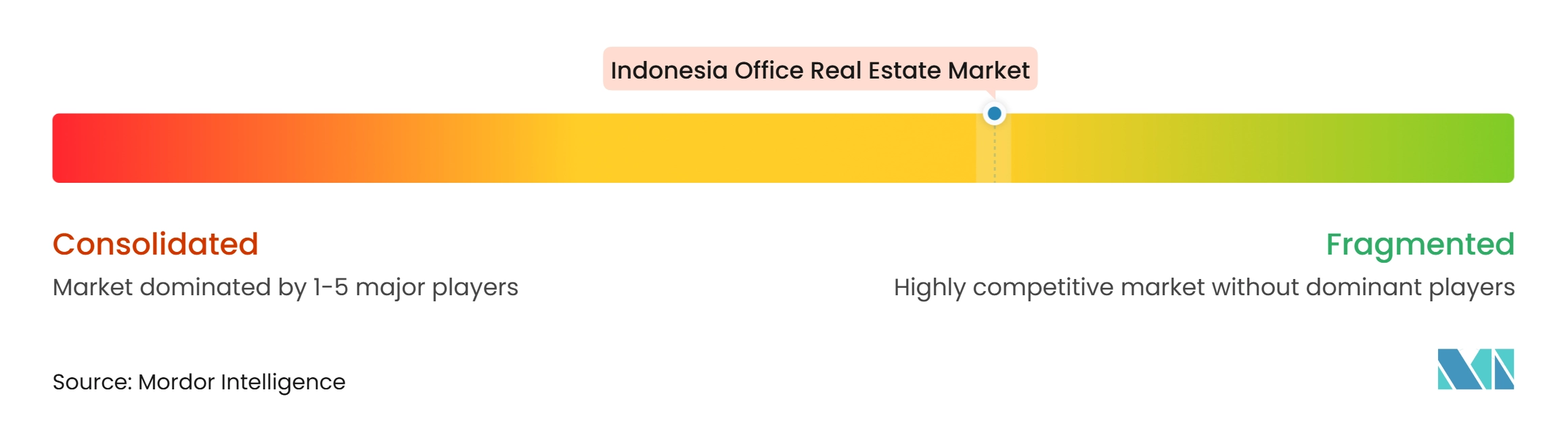
Indonesia’s office real estate market is moderately fragmented because a group of large domestic developers operates major Grade A projects while many smaller owners hold Grade B and Grade C assets. PT Ciputra Development Tbk, PT Pakuwon Jati Tbk, PT Bumi Serpong Damai Tbk, and PT Intiland Development Tbk are among the prominent domestic participants. Their portfolios span offices, retail, housing, hotels, and mixed-use schemes, which allows them to link office projects to wider urban developments. Competition is increasingly shaped by the quality of buildings rather than by the number of assets alone. Developers are using green certification, smart building management, tenant facilities, and transport access to differentiate premium space. PT Ciputra Development Tbk reported pressure in its leased office segment in its 2025 annual report, indicating that even large owners face softer demand in properties below the premium tier. This makes active asset management and selective upgrades important competitive tools. No single landlord dominates the Indonesia office real estate market, and asset-level quality determines a large share of competitive outcomes.
International capital is focusing on highly visible premium projects that combine office use with hotels, homes, retail, and transport access. Mitsubishi Estate, PT Mitsubishi Estate Indonesia, PT Taspen, PT Taspen Properti Indonesia, and PT Benhil Property are developing Two Sudirman, a 74-story, 330-meter-tall mixed-use tower on Jl. Jenderal Sudirman No. 2. The project is designed to include premium offices, serviced apartments, and an Andaz Hotel, with completion planned for the end of 2028. This approach targets the limited ultra-premium end of Jakarta’s market rather than the larger stock of conventional offices. PT Pakuwon Jati Tbk also opened Four Points by Sheraton at Pakuwon Mall Bekasi in 2025, completing an integrated superblock that includes office towers, hotels, apartments, and retail. These projects show a preference for mixed-use formats that can draw activity throughout the day. They also make tenant experience, accessibility, and supporting services part of the office proposition. Such strategies are most relevant where developers have the capital and land position to create large, integrated districts.
Technology infrastructure is another route through which companies are shaping office demand. Digital Realty’s joint venture with Bersama Digital Infrastructure Asia created Digital Realty Bersama to develop facilities in Jakarta. PT Intiland Development Tbk’s partnership with ION Network in Surabaya shows a comparable effort to align property development with data-center infrastructure. Flexible-office operators also compete for start-ups, pilot teams, and hybrid workers who need shorter commitments than a standard lease. Their presence can raise building occupancy by serving tenants that may not take a direct floor plate. The leading owners are responding by offering higher-quality, better-connected, and more adaptable assets.
Indonesia Office Real Estate Industry Leaders
-
PT Ciputra Development Tbk
-
PT Bumi Serpong Damai Tbk
-
PT Pakuwon Jati Tbk
-
PT Lippo Karawaci Tbk
-
PT Intiland Development Tbk
- *Disclaimer: Major Players sorted in no particular order
Indonesia Office Real Estate Market Companies Covered in this Report
- PT Ciputra Development Tbk
- PT Bumi Serpong Damai Tbk
- PT Pakuwon Jati Tbk
- PT Lippo Karawaci Tbk
- PT Intiland Development Tbk
- PT Agung Podomoro Land Tbk
- PT Alam Sutera Realty Tbk
- PT Summarecon Agung Tbk
- PT Metropolitan Land Tbk
- PT Jakarta Setiabudi Internasional Tbk
- PT PP Properti Tbk
- PT Adhi Commuter Properti Tbk
- PT Jababeka Tbk
- PT Modernland Realty Tbk
- PT MNC Land Tbk
- PT Cowell Development Tbk
- Agung Sedayu Group
- PT Sinarmas Land
- PT Taspen (Persero)
- Mitsubishi Estate Co., Ltd.
Recent Industry Developments in Indonesia Office Real Estate Market
- July 2026: Astra Property inaugurated Arumaya Financial Center (AFC) in the RA Kartini area of South Jakarta, adding 33,485 m² of leasable office space to the city's non-CBD market. The 23-floor development, located along the TB Simatupang corridor, has achieved the Green Building Council Indonesia's (GBCI) Greenship Gold certification and incorporates sustainability features such as wastewater recycling, rainwater harvesting, solar panels, motion sensors, and energy-efficient MEP systems.
- June 2026: Pacific Century Premium Developments (PCPD) completed the sale of Pacific Century Place Jakarta to an investment platform associated with China Merchants Bank International (CMBI), for a total consideration of USD 400 million. The transaction involved the 40-floor Grade A office tower in Jakarta's Sudirman Central Business District (SCBD), which has a gross floor area of approximately 93,316 m² and houses multinational corporate tenants.
- April 2026: PT Senayan Trikarya Sempana invested approximately USD 1.17 million to upgrade Sentral Senayan I, an office building that has been operating since October 1997, enabling it to achieve Greenship Existing Building (EB) Platinum certification from the Green Building Council Indonesia (GBCI) with a score of 90 points. The improvements included upgrading the heating, ventilation, and air-conditioning (HVAC) systems, replacing conventional lighting with LED fixtures, and installing solar panels to improve energy efficiency.
Indonesia Office Real Estate Market Report Scope
Segmentation Overview
| Grade A |
| Grade B |
| Grade C |
| By Building Grade, Sales | Grade A |
| Grade B | |
| Grade C |
Key Questions Answered in the Report
What is the forecast growth rate for Indonesia office real estate through 2032?
The Indonesia office real estate market is forecast to grow at a 5.84% CAGR from 2027 to 2032, reaching USD 16.22 billion by 2032.
Which office building grade leads rental demand in Indonesia?
Grade A led the rental segment with a 61.2% share in 2026 and is forecast to grow at a 6.39% CAGR through 2032.
Why are Grade A offices gaining tenant interest?
Companies favor modern buildings with green credentials, stronger building systems, flexible layouts, and access to transit.
Which occupier group has the largest rental share?
Information technology (IT and ITES) held 29.9% of rental demand in 2026 and is projected to grow at a 6.51% CAGR through 2032.
Which geography will grow fastest through 2032?
The rest of Indonesia is projected to expand at a 6.97% CAGR as IKN, transport links, and digital infrastructure support commercial growth.
What is constraining demand for conventional offices in Indonesia?
Older vacant buildings, hybrid work, high fit-out costs, and cautious development financing limit growth for conventional office