
Indonesia Less-than Container Load (LCL) Market Size and Share
Market Overview
| Study Period | 2020 - 2031 |
|---|---|
| Forecast Data Period | 2026 - 2031 |
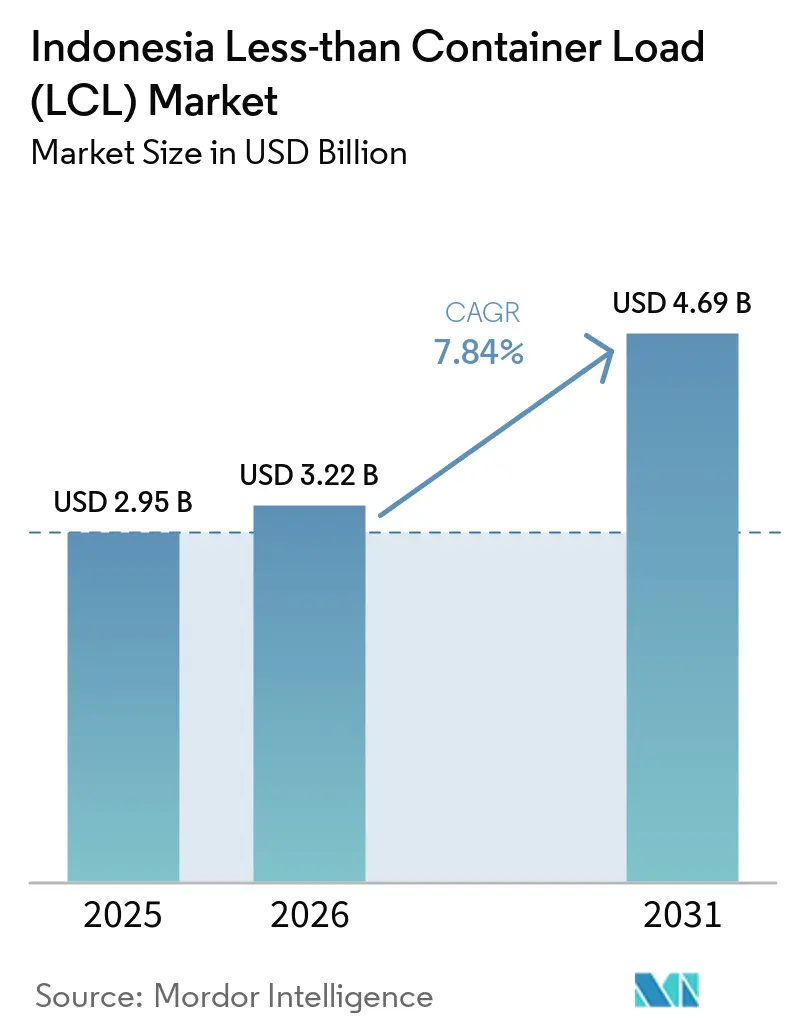
| Base Year Market Size (2025) | USD 2.95 Billion |
| Market Size (2026) | USD 3.22 Billion |
| Market Size (2031) | USD 4.69 Billion |
| Growth Rate (2026 - 2031) | 7.84 % |
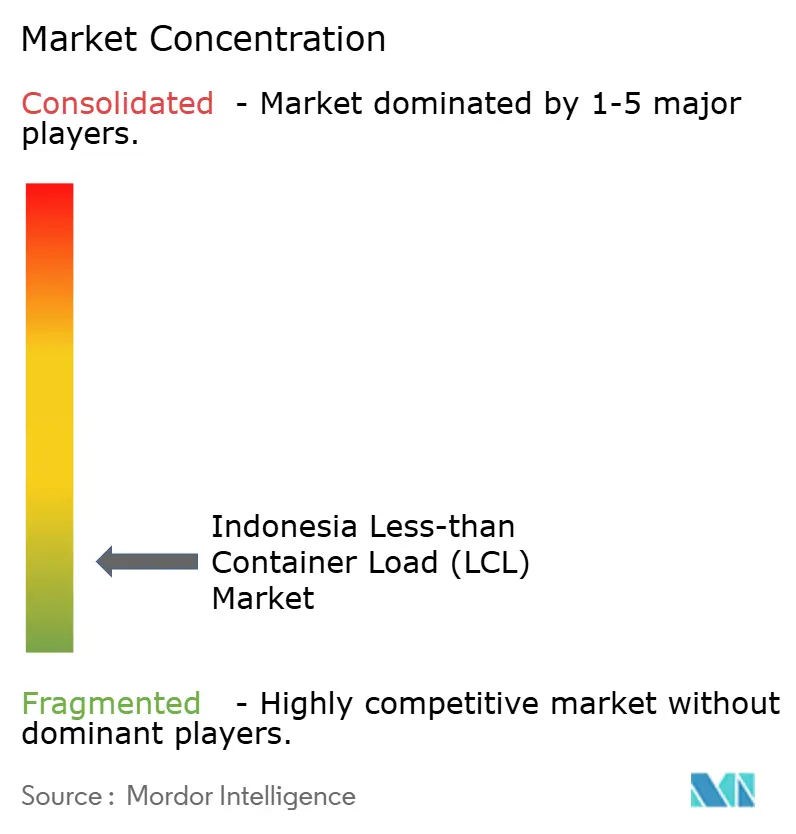
| Market Concentration | Low |
Major Players *Disclaimer: Major Players sorted in no particular order Image © Mordor Intelligence. Reuse requires attribution under CC BY 4.0. | |
Indonesia Less-than Container Load (LCL) Market Analysis by Mordor Intelligence
The Indonesia less-than container load (LCL) market was valued at USD 2.95 billion in 2025 and is estimated to grow from USD 3.22 billion in 2026 to reach USD 4.69 billion by 2031, at a CAGR of 7.84% during the forecast period (2026-2031).
Indonesia’s island geography makes consolidated shipments practical for traders whose cargo does not justify a dedicated container. The country also combines export manufacturing with demand for imported industrial inputs and consumer goods, which supports both outbound and inbound cargo flows. New manufacturing locations can create shipments from several origins that need to be combined before export. Larger operators are responding by strengthening customs handling, container freight station capacity, and shipment visibility. The Indonesia less-than container load (LCL) market, therefore, offers room for providers that can serve both established Java gateways and less developed outer-island routes.
Key Report Takeaways
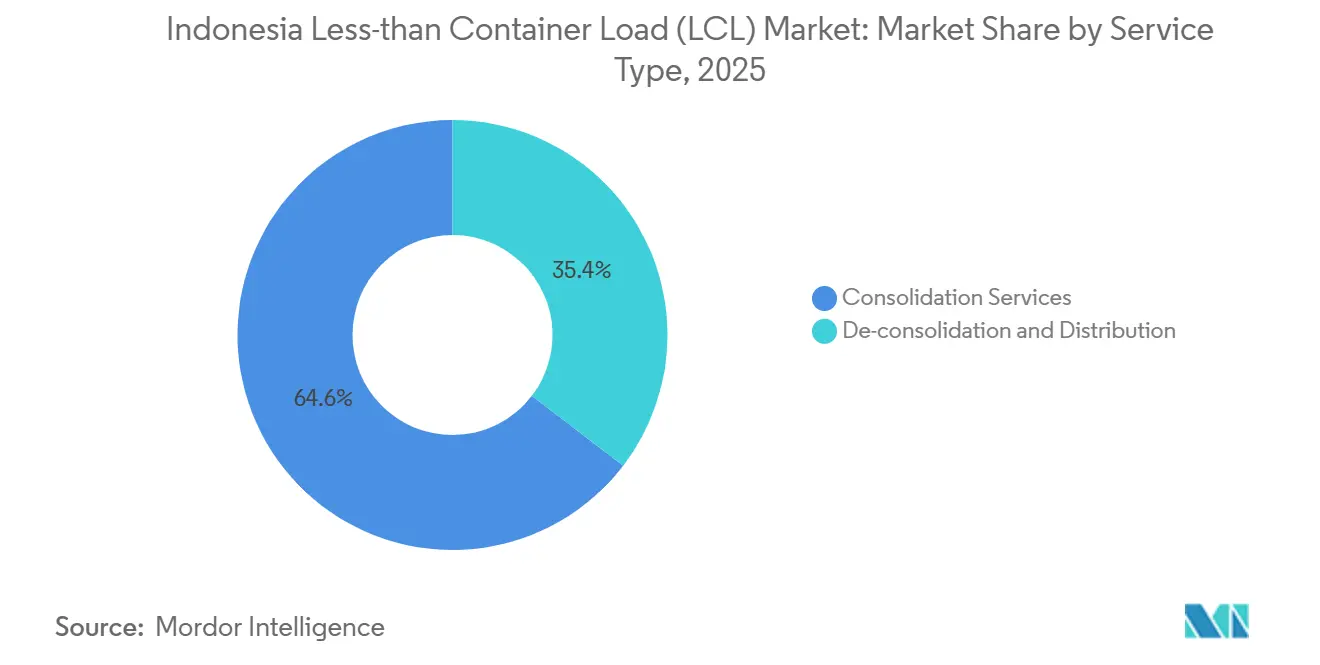
- By service type, consolidation services held 64.59% of the Indonesia less-than container load (LCL) market share in 2025, while the de-consolidation and distribution segment is forecast to register a 9.87% CAGR through 2031.
- By destination, international LCL accounted for 62.37% of the Indonesia less-than container load (LCL) market size in 2025, while domestic LCL is projected to record the highest CAGR at 10.97% through 2031.
- By nature of business, freight forwarding commanded 92.43% of the Indonesia less-than container load (LCL) market share in 2025, while NVOCCs are forecast to expand at 11.74% CAGR through 2031.
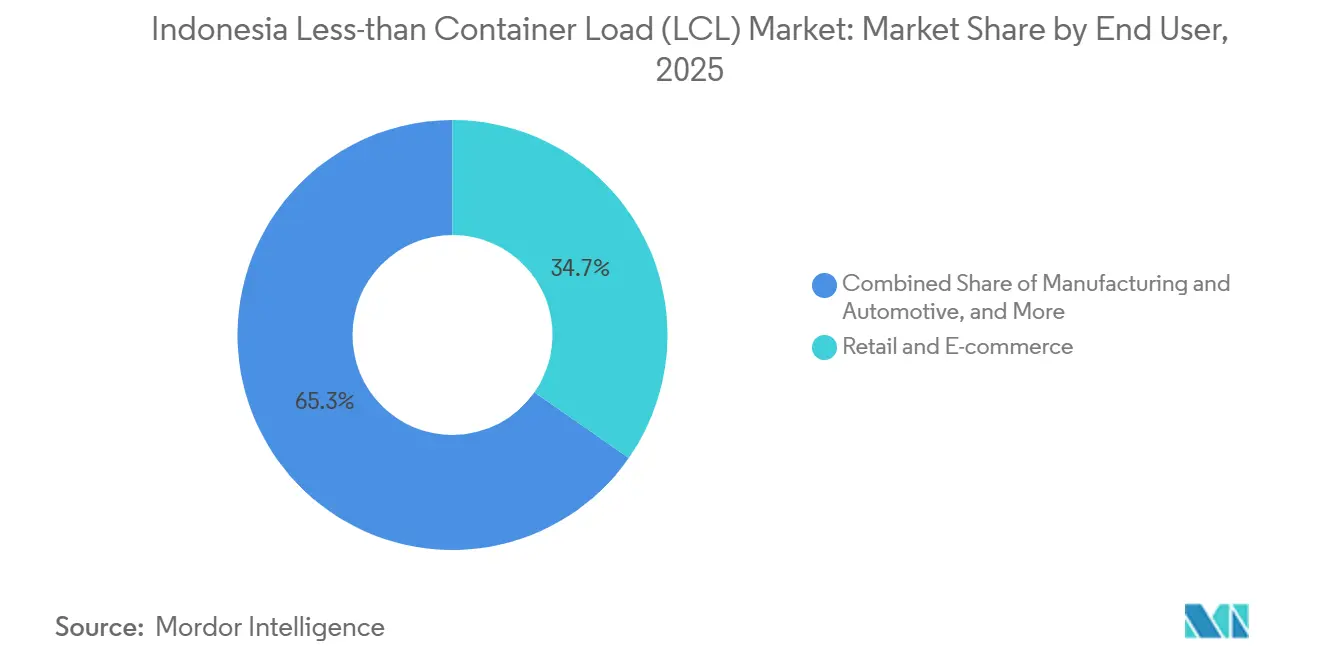
- By end user, retail and e-commerce held 34.69% of the Indonesia less-than container load (LCL) market size in 2025, while the healthcare and pharmaceuticals segment is expected to register a 9.78% CAGR through 2031.
- By cargo type, general cargo represented 71.36% of revenue in 2025, while temperature-controlled cargo is set to register a 9.11% CAGR through 2031.
- By region, Java (Jakarta and BOD) held 40.72% of regional revenue in 2025, while Sulawesi is projected to register a 10.68% CAGR through 2031.
Note: Market size and forecast figures in this report are generated using Mordor Intelligence’s proprietary estimation framework, updated with the latest available data and insights as of January 2026.
Indonesia Less-than Container Load (LCL) Market Trends and Insights
Drivers Impact Analysis*
| Driver | (~) % Impact on CAGR Forecast | Geographic Relevance | Impact Timeline |
|---|---|---|---|
| E-Commerce Growth Increasing Cross-Border LCL Shipment Demand | +2.2% | National, concentrated in Java, Jakarta, Surabaya, and Sumatra | Short term (≤ 2 years) |
| Manufacturing Diversification Expanding Multi-Origin Consolidation Requirements | +1.8% | Java, Cikarang and Batam corridor, Sulawesi, and Kalimantan | Medium term (2-4 years) |
| Port Infrastructure Expansion Supporting LCL Network Development | +1% | Java, Tanjung Priok and Tanjung Perak, Kalimantan, and Sulawesi | Medium term (2-4 years) |
| Digital Freight Integration Improving LCL Shipment Coordination | +0.8% | National, with early leadership in Jakarta and Surabaya | Short term (≤ 2 years) |
| Low Backhaul Utilization Increasing Cargo Consolidation Demand | +0.6% | Eastern Indonesia, Sulawesi, and Kalimantan | Medium term (2-4 years) |
| Eastern Indonesia Distribution Gaps Creating LCL Opportunities | +0.5% | Papua region, Maluku Islands, Bali, and Nusa Tenggara | Long term (≥ 4 years) |
| Source: Mordor Intelligence | |||
E-Commerce Growth Increasing Cross-Border LCL Shipment Demand
Indonesia led Southeast Asia’s cross-border e-commerce activity in 2025, which supported demand for consolidated cargo from smaller online orders. Retailers increasingly source from several suppliers and place more frequent orders, which raises the need for flexible shipment planning. Short booking windows at major container freight stations place greater value on prompt cargo acceptance and accurate documentation. The Indonesia less-than container load (LCL) market benefits when forwarders can combine these orders without slowing the release process. DHL identified e-commerce and retail as priorities in Indonesia’s trade development, alongside the country’s expected role in global trade growth. Providers that connect booking information with customs workflows can make frequent small shipments easier for shippers to manage.
Manufacturing Diversification Expanding Multi-Origin Consolidation Requirements
Mainland China and Hong Kong investment in Indonesia reached USD 11.5 billion in the first half of 2026, compared with USD 4.1 billion in the same period of 2025, as manufacturers considered Indonesia within China-plus-one supply-chain plans[1]. New production sites in Cikarang, Batam, Kendal, and Sulawesi can generate cargo from several factory locations for the same overseas buyer. Electronics, automotive components, and textile assembly often need inbound components as well as export shipping, which can support two-way consolidation on a corridor. This pattern favors operators that can collect smaller lots, plan stuffing, and issue a single bill of lading for a combined shipment. In the Indonesia less-than container load (LCL) market, container freight station networks close to industrial estates can reduce handling steps before the cargo reaches a gateway port.
Port Infrastructure Expansion Supporting LCL Network Development
Pelindo began trial operations at Container Terminal 2 in Tanjung Priok in August 2026, with a 200-meter operational quay and an 8,425-TEU container yard[2]. Additional terminal capacity can support more predictable container handling when consolidated shipments move through Indonesia’s principal gateway. Pelindo’s Network Pendulum strategy also targets new shipping corridors by late 2026, which can make hub-and-spoke services more practical for secondary ports. The Kijing Terminal in West Kalimantan is intended to strengthen its role as an international logistics hub, extending the network beyond the Java and Sumatra core. The New Priok Eastern Access road is targeted for completion in December 2026, and is expected to improve the connection between Kalibaru and the Cibitung-Cilincing toll road. These projects can lower landside friction for the Indonesia less-than container load (LCL) market, especially for cargo collected from Cikarang industrial estates.
Digital Freight Integration Improving LCL Shipment Coordination
Digital freight systems can bring customs declarations, release tracking, and stuffing schedules into one workflow for LCL operators. This can reduce repeated document entry and help operators respond faster when cargo details change before departure. The advantage is relevant to smaller providers because standardized digital processes can reduce their reliance on large manual documentation teams. Early adoption is concentrated in Jakarta and Surabaya, where the largest container freight stations and shipper bases are located. The Indonesia less-than container load (LCL) market can also benefit as booking and clearance records improve the timing of consolidation decisions. Operators that do not improve their digital process risk higher administrative costs when customers expect shipment status updates and faster document handling.
Restraints Impact Analysis*
| Restraint | (~) % Impact on CAGR Forecast | Geographic Relevance | Impact Timeline |
|---|---|---|---|
| Port Congestion and Truck Delays Increasing Transit Times | -1% | Java, Tanjung Priok and Tanjung Perak, and Sumatra, Belawan | Short term (≤ 2 years) |
| Fuel and Ocean Rate Volatility Pressuring LCL Costs | -0.9% | Global, affecting all Indonesia trade lanes | Short term (≤ 2 years) |
| Fragmented CFS Regulations Increasing Customs Documentation Complexity | -0.7% | National, concentrated at Tanjung Priok and Tanjung Perak | Medium term (2-4 years) |
| Container Imbalances Reducing Inter-Island Backhaul Efficiency | -0.6% | Eastern Indonesia, Sulawesi, and Kalimantan | Long term (≥ 4 years) |
| Source: Mordor Intelligence | |||
Port Congestion and Truck Delays Increasing Transit Times
Indonesia’s customs rules can add uncertainty to clearance scheduling because dutiable values may be assessed using 90-day historical import price benchmarks instead of declared transaction values[3]. Truck queues at container freight station gates also create idle time that consolidators need to absorb or pass on through their pricing. The problem is most visible at Tanjung Priok, Tanjung Perak, and Belawan, where a delay can affect several smaller consignments in one container. Road conditions and truck availability can widen the transit gap between Java and secondary ports. This is difficult for high-frequency online retail shipments that require dependable delivery timing. Better stuffing schedules and collection times can help providers limit the effect, but the Indonesian less-than container load (LCL) market remains exposed to congestion until landside improvements are completed.
Fuel and Ocean Rate Volatility Pressuring LCL Costs
Fuel charges, bunker adjustments, and war-risk levies can change the cost of an LCL shipment when carriers adjust their pricing in response to disruption. Small importers and exporters are especially exposed because they usually have limited leverage to seek surcharge waivers. UNCTAD identified fuel-compliance costs from the European Union Emissions Trading System and FuelEU Maritime as structural influences on freight-rate formation. These costs can reach Indonesian trade lanes through carrier pricing even when the cargo does not move directly to Europe. Agricultural shippers and smaller importers may be less able to accept sudden surcharges, which limits a consolidator’s ability to protect margin. Rate-lock arrangements and clear pass-through terms can, therefore, be important for operators in the Indonesia less-than container load (LCL) market.
*Our forecasts treat driver/restraint impacts as directional, not additive. The impact forecasts reflect baseline growth, mix effects, and variable interactions.
Segment Analysis
By Service Type: Consolidation Services Lead Established Import Handling
Consolidation services held 64.59% of the Indonesia less-than container load (LCL) market share in 2025. The result reflects the importance of inbound cargo that arrives in mixed-shipper containers from Northeast and Southeast Asian origins. Co-loading at places such as Guangzhou, Yiwu, or Singapore means Indonesian importers depend on performance at origin container freight stations as well as local handling. Local providers earn much of their value from unstuffing, customs coordination, and delivery after discharge. This creates an advantage for operators with efficient links between container freight stations and customer locations across Java.
De-consolidation and distribution is projected to register a 9.87% CAGR from 2026 to 2031, the highest rate within this service segmentation. The Indonesia less-than container load (LCL) market size for this service is supported by cargo moving from port discharge to tier-2 and tier-3 cities. Healthcare supply chains, agricultural flows, and online fulfillment all create demand for sorting, inspection, repackaging, and storage after arrival. These services offer revenue beyond base freight charges when they are completed accurately and within the requested delivery window. The need is strongest where final customers are located far from the main port gateway.
By Destination: International Shipments Retain Scale While Domestic Routes Gain Pace
International LCL accounted for 62.37% of the Indonesia less-than container load (LCL) market size in 2025. Trade-oriented manufacturing and demand for imported industrial inputs, consumer electronics, and fast-moving consumer goods supported that position. International shipments often move through container freight station networks near the principal gateways. Higher per-cubic-meter pricing on intra-Asia consolidation lanes also helps set the near-term pricing floor for this business. New industrial clusters in Sulawesi and Kalimantan are broadening the origin base for export cargo that once moved mainly through Java.
Domestic LCL is forecast to register a 10.97% CAGR from 2026 to 2031, the fastest destination segment. Inter-island consumer goods distribution, expanding Sea Toll routes, and online fulfillment needs outside Jakarta and Surabaya support this outlook. Government-backed route development can create cargo flows that operators can serve through scheduled consolidation. The segment also has room to grow because several areas have historically had less frequent logistics coverage. Domestic demand includes project cargo purchases and replenishment shipments that may not need a full container.
By Nature Of Business: Freight Forwarders Hold Scale As NVOCCs Expand Digital Services
Freight forwarding commanded 92.43% of the Indonesia less-than container load (LCL) market share by nature of business in 2025. Licensing requirements, established carrier relationships, and customs-broker capabilities create barriers for new entrants. Certified entities can submit declarations through customs systems, which makes compliance knowledge valuable to shippers. This position allows forwarders to coordinate ocean transport, documentation, clearance, and delivery under one service relationship. Their broad operating role is particularly important when import rules require additional checks for certain goods.
NVOCCs are projected to register a 11.74% CAGR from 2026 to 2031, the fastest rate in this segmentation. E-commerce shippers, healthcare buyers, and procurement teams increasingly seek transparent booking and shipment updates. NX Group merged PT NX Lemo Indonesia Logistik and PT Nippon Express Indonesia into a unified entity effective March 2026, under its One Indonesia initiative. The combined entity provides a single contact point for air and ocean freight forwarding. This move shows how international providers are combining functions to respond faster to Indonesian manufacturing and e-commerce customers.
By End User: Retail And E-Commerce Lead Volume While Healthcare Gains Momentum
The retail and e-commerce segment was the largest end-user segment with 34.69% of the Indonesia less-than container load (LCL) market size in 2025. Small and midsized online retailers often buy quantities that are too large for express delivery but too small for a full container. This creates steady demand for shared-container services from Asian manufacturing locations. Live-stream shopping and social commerce can shorten the planning cycle for retail replenishment. Consolidators serving this segment need to balance speed with documentation accuracy.
The healthcare and pharmaceuticals segment is expected to register a 9.78% CAGR from 2026 to 2031, the highest rate among end-user segments. DHL’s Jakarta Life Sciences and Healthcare Competency Centre supports storage at 2-8 °C and 15-25 °C, reflecting the handling conditions required for health-related products. Pharmaceutical manufacturing, medical-device imports, and the need for controlled distribution support demand for specialist logistics. Smaller multi-SKU consignments are often suited to LCL when the operator can preserve the required conditions. Qualified cold-chain container freight stations can, therefore, serve a higher-value part of the cargo base.

By Cargo Type: General Cargo Remains Predominant As Temperature-Controlled Cargo Grows
General cargo represented 71.36% of the Indonesia less-than container load (LCL) market share by cargo type in 2025. Manufactured goods and packaged consumer products make up much of this cargo flow. General cargo infrastructure is also more widely available than specialized facilities at Indonesian ports. Dense capacity at Tanjung Priok makes it easier for consolidators to fill containers with standard shipments. Shippers with moderate delivery requirements can provide flexible cargo windows that help operators improve utilization.
Temperature-controlled cargo is projected to register a 9.11% CAGR from 2026 to 2031, the fastest cargo type. Pharmaceutical imports, frozen seafood exports from Sulawesi and Maluku, and cold-chain agricultural flows support demand for reefer LCL solutions. Meratus expanded cold-chain assets in 2025, including vessels and reefer equipment, to support this part of the logistics system. Temperature control requires equipment, monitoring, and careful cargo compatibility checks. These needs make specialized capacity less common than standard general-cargo handling.
Geography Analysis
Java, including Jakarta and BOD, held 40.72% of the Indonesia less-than container load (LCL) market share in 2025. Tanjung Priok is the country’s principal trade gateway and is supported by industrial estates and bonded zones in Bekasi and Karawang. Java has the country’s densest concentration of container freight stations and logistics centers. Tanjung Priok capacity additions are intended to support growing cargo volumes, even if outer islands gain a larger share over time. Sumatra complements Java through agricultural exports from Medan, Palembang, and Pekanbaru, as well as electronics-related import demand from Batam. The Cikarang-to-Patimban corridor is also providing another access point for shippers after Patimban received its first international container vessel call in March 2026[4].
Sulawesi is forecast to register a 10.68% CAGR from 2026 to 2031, the fastest regional rate. Nickel smelting and battery-precursor production in Morowali and Weda Bay require inbound industrial inputs and can generate exports for Northeast Asian buyers. Makassar’s Soekarno-Hatta International Port can serve as a consolidation hub for these flows. Pelindo’s planned network corridors can help translate industrial demand into regular routes over time. Kalimantan is supported by coal exports, palm oil processing, and material inflows connected with Nusantara. The Indonesia less-than container load (LCL) market size in these regions will depend on whether regular services can aggregate demand from several dispersed locations.
Bali and Nusa Tenggara have steady LCL demand from hospitality and tourism supply chains, including food and beverage, hotel equipment, and consumer goods. The Papua region and the Maluku Islands face limited port capacity, less frequent vessel calls, and persistent container imbalances. This creates a structural cost challenge because inbound cargo exceeds return volumes. The PELNI and Meratus Hub and Spoke partnership on Sea Toll routes S4A and S4B is improving cargo aggregation in 2026. Wider commercial viability will still require better road links and cold-storage infrastructure beyond port upgrades. The Indonesia less-than container load (LCL) market has long-term potential in these areas, but operational economics remain more difficult than in Java.
Competitive Landscape
The Indonesia less-than container load (LCL) market is highly fragmented, with global forwarders competing against domestic shipping lines, regional NVOCCs, and technology-enabled logistics platforms. International firms use global shipper relationships and carrier access to serve large manufacturing and retail accounts. Domestic companies compete through local port handling knowledge, customs-broker capabilities, and lower costs on domestic and regional routes. This mix makes execution quality important in the Indonesia less-than container load (LCL) market because customers often need both global coordination and local service.
In March 2026, Kuehne+Nagel renewed a 4-year LNG resupply contract in Indonesia, extending its oil and gas supply-base operations in the country. Moreover, in July 2026, the company began deploying its cloud-native KN SwiftLOG contract logistics solution across more than 1,000 warehouse sites globally. DSV completed its acquisition of DB Schenker in 2025, joining two forwarding networks under one commercial organization. NX Group’s One Indonesia merger, effective March 1, 2026, is another example of a provider combining operations to offer faster air and ocean freight response. These moves show that major providers are using specialization, technology, and organizational integration to compete for Indonesian freight customers.
Opportunities remain in temperature-controlled consolidation outside Java, pharmaceutical-grade LCL in Sulawesi and Kalimantan, and agricultural exports from eastern production areas. Emerging digital providers are also offering online booking, real-time visibility, and customs integration. The Indonesia less-than container load (LCL) market will reward companies that apply these tools while preserving dependable cargo handling at local ports. Service gaps in less developed regions can create room for new entrants, but they also require investment in equipment, networks, and trained staff.
Indonesia Less-than Container Load (LCL) Industry Leaders
-
DHL Group
-
Kuehne+Nagel International AG
-
DSV A/S
-
PT Samudera Indonesia Tbk
-
Meratus Group
- *Disclaimer: Major Players sorted in no particular order
Recent Industry Developments
- July 2026: Waresix raised USD 27.4 million from existing investors Granite Asia, Jungle Ventures, and East Ventures through its Singapore holding company, extending the runway for its subsidiary WBSA's post-IPO growth strategy. The round was valued at a lower implied per-share price than the prior round, reflecting investor caution alongside continued strategic commitment.
- March 2026: NX Group (Nippon Express Holdings) merged PT NX Lemo Indonesia Logistik and PT Nippon Express Indonesia into a single unified entity effective March 1, 2026, under its "One Indonesia" initiative. The merger creates a one-stop air and ocean freight forwarding provider, improving response speed for Indonesian manufacturing and e-commerce clients.
- February 2026: PT Samudera Indonesia announced approximately USD 300 million in 2026 capital expenditure for 3–5 container vessels and 2 chemical tankers ordered from Chinese shipyards, alongside a Patimban container terminal development and Madura shipyard construction at 27% progress.
- June 2025: DHL Group formally committed to Indonesia's EV, life sciences, and e-commerce sectors under Strategy 2030, activating a Jakarta Life Sciences and Healthcare Competency Centre at 2-8 °C and 15-25 °C storage standards. The commitment was backed by a EUR 500 million (USD 588.2 million) group-level Asia-Pacific life sciences investment program.
Indonesia Less-than Container Load (LCL) Market Report Scope
| Consolidation Services |
| De-consolidation and Distribution |
| Domestic |
| International |
| Freight Forwarding |
| NVOCCs |
| Manufacturing and Automotive |
| Retail and E-commerce |
| Healthcare and Pharmaceuticals |
| Agriculture and Forestry |
| Other End Users |
| General Cargo |
| Temperature-Controlled Cargo |
| Hazardous Cargo |
| High-Value and Sensitive Cargo |
| Java (Jakarta and BOD) |
| Sumatra |
| Kalimantan |
| Sulawesi |
| Bali and Nusa Tenggara |
| Papua Region and Maluku Islands |
| By Service Type | Consolidation Services |
| De-consolidation and Distribution | |
| By Destination | Domestic |
| International | |
| By Nature of Business | Freight Forwarding |
| NVOCCs | |
| By End User | Manufacturing and Automotive |
| Retail and E-commerce | |
| Healthcare and Pharmaceuticals | |
| Agriculture and Forestry | |
| Other End Users | |
| By Cargo Type | General Cargo |
| Temperature-Controlled Cargo | |
| Hazardous Cargo | |
| High-Value and Sensitive Cargo | |
| By Region | Java (Jakarta and BOD) |
| Sumatra | |
| Kalimantan | |
| Sulawesi | |
| Bali and Nusa Tenggara | |
| Papua Region and Maluku Islands |
Key Questions Answered in the Report
What is the outlook for Indonesia less-than container load services?
The Indonesia less-than container load (LCL) market is forecast to reach USD 4.69 billion by 2031, expanding at a 7.84% CAGR from 2026.
Which service has the largest share in Indonesia’s LCL sector?
Consolidation services held 64.59% of revenue in 2025 because inbound mixed-shipper containers remain important to Indonesia’s trade flows.
Which destination segment is growing fastest for LCL providers?
Domestic LCL is forecast to register a 10.97% CAGR through 2031, supported by inter-island distribution and e-commerce fulfillment needs.
Why do freight forwarders hold most LCL activity in Indonesia?
Freight forwarding held 92.43% of revenue in 2025 because licensing, customs handling, and carrier relationships are important to delivery execution.
What cargo type offers the strongest growth potential?
Temperature-controlled cargo is projected to register a 9.11% CAGR through 2031 as pharmaceutical, seafood, and agricultural flows require cold-chain handling.
Which Indonesian region is forecast to grow fastest for LCL services?
Sulawesi is projected to register a 10.68% CAGR through 2031, supported by nickel, battery-precursor, and industrial-input cargo flows.