
Indonesia Islamic Finance Market Size and Share
Market Overview
| Study Period | 2021 - 2032 |
|---|---|
| Forecast Data Period | 2027 - 2032 |
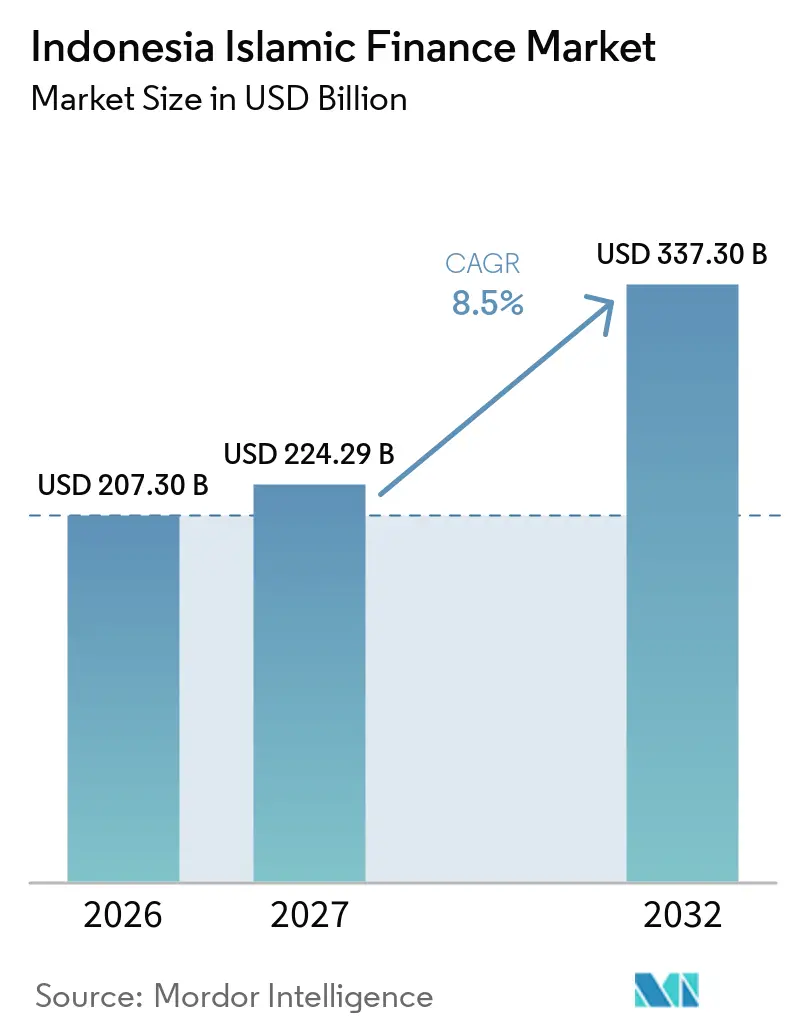
| Base Year Market Size (2026) | USD 207.30 Billion |
| Market Size (2027) | USD 224.29 Billion |
| Market Size (2032) | USD 337.30 Billion |
| Growth Rate (2027 - 2032) | 8.50 % |
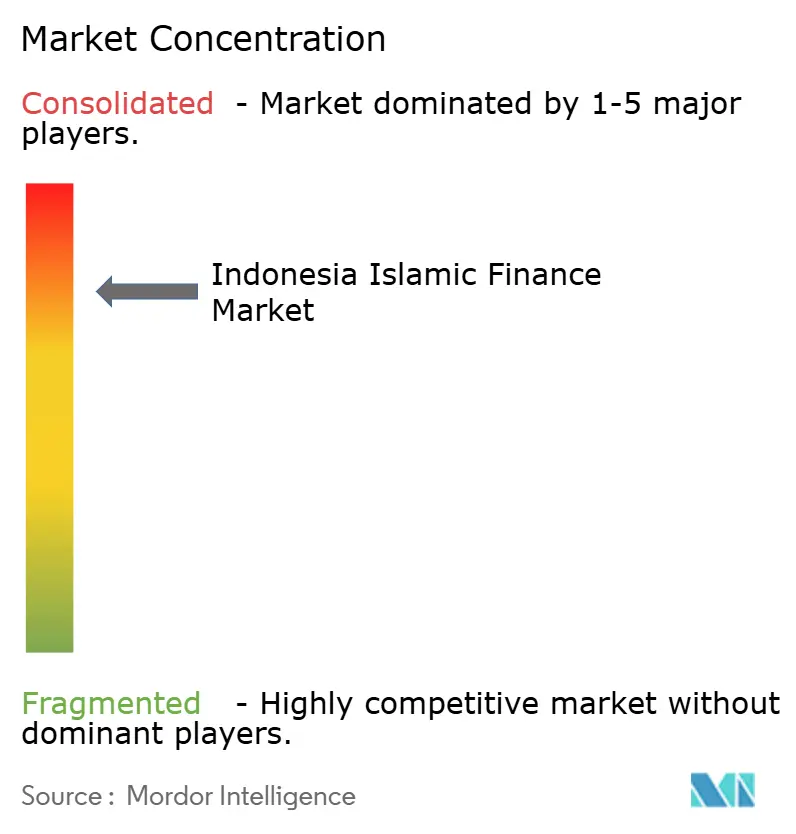
| Market Concentration | High |
Major Players *Disclaimer: Major Players sorted in no particular order Image © Mordor Intelligence. Reuse requires attribution under CC BY 4.0. | |
Indonesia Islamic Finance Market Analysis by Mordor Intelligence
The Indonesia Islamic Finance Market size is projected to expand from USD 207.30 billion in 2026 and USD 224.29 billion in 2027 to USD 337.30 billion by 2032, registering a CAGR of 8.5% between 2027 and 2032.
Indonesia has the world's largest Muslim population, with approximately 240 million Muslims. Islamic finance has significant growth potential. OJK reported that national Islamic financial assets reached IDR 3,131.02 trillion (USD 192.09 billion) in 2025, accounting for 11.47% of the national financial industry as of June 2025. Islamic banking assets reached IDR 1,067.73 trillion (USD 65.51 billion), while Islamic capital-market assets, excluding Sharia stock capitalization, reached IDR 1,875.25 trillion (USD 115.05 billion). Regulatory reforms, Islamic capital-market development, growing retail participation, digital distribution, halal value-chain financing, and integration with the halal economy support the market. Government policy increasingly focuses on improving the scale, competitiveness, governance, and product depth of the Islamic financial ecosystem. Sovereign Sukuk provides benchmark instruments, supports Islamic liquidity management, and offers institutional and retail investors Sharia-compliant government securities. Digital channels, Islamic banking applications, gold and bullion services, retail Sukuk, Islamic crowdfunding, and Sharia-compliant MSME financing are expanding customer distribution options.
Key Report Takeaways
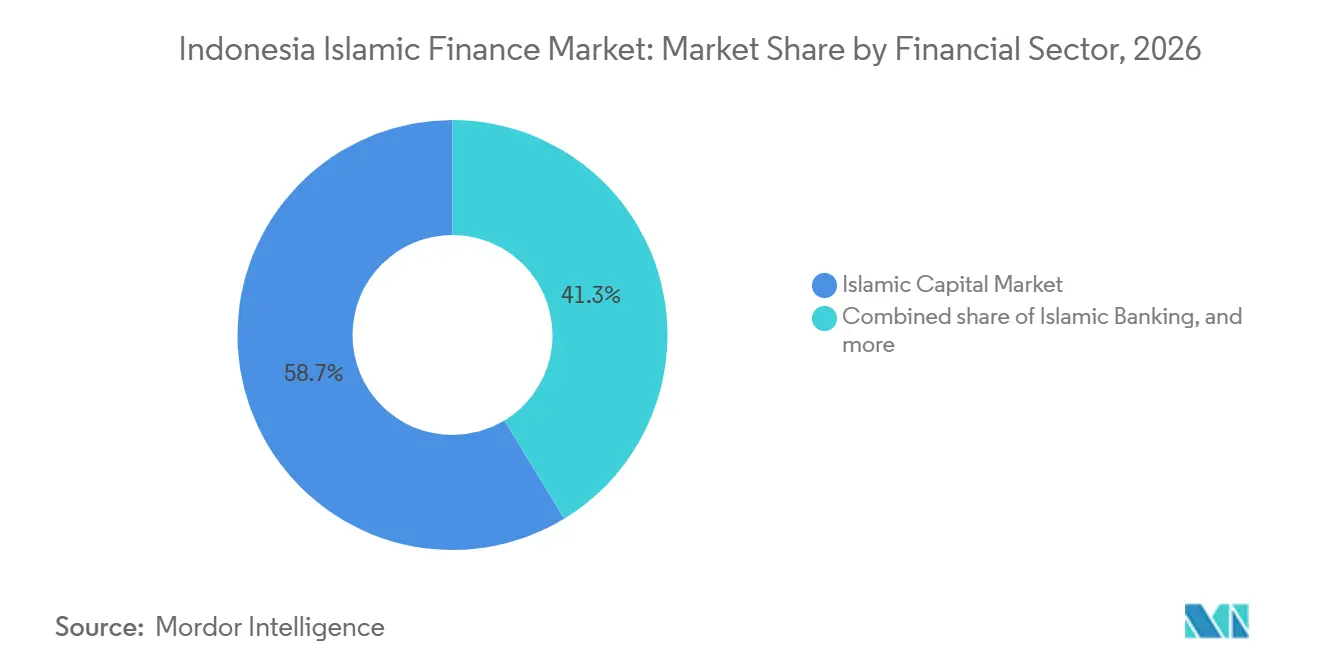
- By financial sector, Islamic capital markets captured 58.7% of the Indonesia Islamic finance market in 2026, while Islamic non-bank financial institutions are projected to grow at a 10.6% CAGR through 2032.
- By customer type, government and government-related entities held 54.5% of the Indonesia Islamic finance market in 2026, while retail and individual customers are projected to grow at a 9.8% CAGR through 2032.
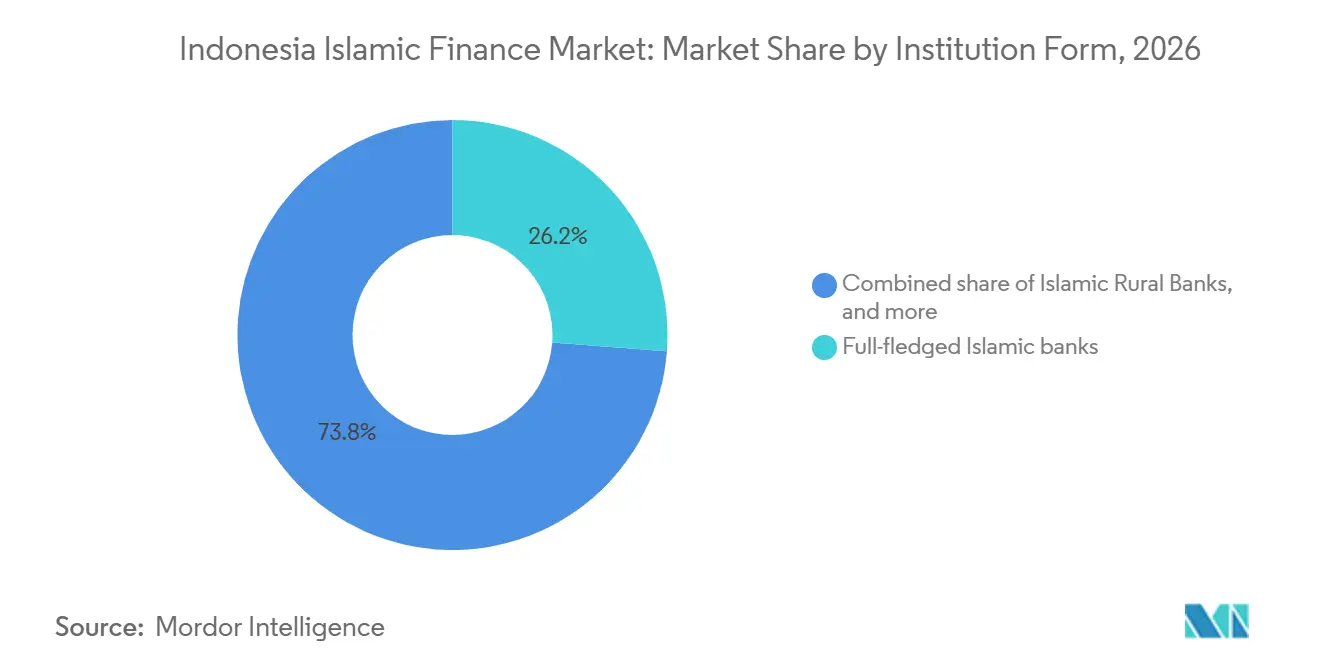
- By institution form, full-fledged Islamic banks captured 26.2% of the Indonesia Islamic finance market in 2026, while other Islamic financial institutions are projected to grow at a 10.1% CAGR through 2032.
- By geography, Java captured 67.8% of the Indonesia Islamic finance market in 2026, while Sumatra is projected to grow at an 11.2% CAGR through 2032.
Note: Market numbers in this report are based on Mordor Intelligence's proprietary estimation framework, which combines nine months of actuals with Q4 projections for base year 2026.
Market Trends and Insights
Drivers Impact Analysis of Indonesia Islamic Finance Market*
| Driver | (~) % Impact on CAGR Forecast | Geographic Relevance | Impact Timeline |
|---|---|---|---|
| Government-Led Islamic Finance Deepening | +2.1% | National, with early gains in Java and Aceh | Medium term (2-4 years) |
| Expanding Halal Value-Chain Financing | +1.8% | Java, Sumatra, and Sulawesi halal agricultural clusters | Medium term (2-4 years) |
| Digital Distribution for Underserved Muslim Consumers and MSMEs | +1.5% | National, with the largest uptake in Java and Sumatra | Short term (≤ 2 years) |
| Sovereign Sukuk as a Scalable Funding and Liquidity Anchor | +1.6% | Global USD issuance and national retail Sukuk | Long term (≥ 4 years) |
| Institutional Demand From Hajj, Zakat, and Waqf Funds | +0.9% | National, with spillover to GCC through BPKH placements | Long term (≥ 4 years) |
| Product Innovation Across Gold, Green, and Embedded Islamic Finance | +0.7% | Urban Java for gold and embedded finance, national for green Sukuk | Medium term (2-4 years) |
| Source: Mordor Intelligence | |||
Government-Led Islamic Finance Deepening
Law No. 4 of 2023 on Financial Sector Development and Strengthening established an important foundation for strengthening Indonesia's Islamic financial ecosystem. OJK subsequently established the Sharia Financial Development Committee in July 2025 to improve coordination, policy integration, governance, and alignment between regulation and Sharia principles. POJK No. 12/2023 strengthened the institutional framework for Sharia business units and established requirements relating to capital, governance, and separation of qualifying Sharia business units. The regulation requires conventional banks with qualifying Sharia business units to undertake separation under specified conditions, supporting the creation of standalone Islamic banking institutions and further industry consolidation. Product innovation is also expanding. DSN-MUI Fatwa No. 166/DSN-MUI/II/2026 provides Sharia guidance for bullion business activities, supporting the development of Islamic gold-related financial products.
Expanding Halal Value-Chain Financing
Islamic finance is increasingly integrated with Indonesia's halal value chain, including halal food, agriculture, trade, services, MSMEs, and Islamic boarding schools. This creates opportunities for Sharia-compliant working-capital financing and other products tailored to halal businesses. BSI is expanding financing across retail, MSME, micro, commercial, education, healthcare, and government-linked segments. As of February 2026, the bank reported total financing of IDR 323 trillion (USD 19.8 billion), including IDR 52.43 trillion (USD 3.2 billion) for retail and MSMEs[1]. Halal certification and business formalization may further increase financing demand to support certification, production, inventory, distribution, and market access.
Digital Distribution for Underserved Muslim Consumers and MSMEs
Digital distribution is becoming an important channel for expanding access to Islamic financial products without relying exclusively on physical branches. The latest World Bank Global Findex data show that 56.33% of Indonesian adults had an account in 2024, indicating that a substantial proportion of adults remained outside formal account ownership. Islamic financial institutions are responding through mobile banking, digital payments, embedded finance, crowdfunding, digital zakat, and digital Hajj-related services. Maybank Indonesia Syariah has partnered with Muslim Pro through its Islamic Banking-as-a-Service model to provide Amanah Pro, linking financial planning and Hajj-related financial services with a digital Muslim lifestyle platform. BSI is also expanding its BYOND digital banking platform and digital gold services. By February 2026, BSI reported 6.3 million BYOND users and 125.4 million transactions[2].
Sovereign Sukuk as a Scalable Funding and Liquidity Anchor
Indonesia's sovereign sukuk market provides an important source of funding for the government and a benchmark for the broader Islamic capital market. Government sukuk outstanding stood at IDR 1,627.68 trillion (USD 101.73 billion) at the end of 2024 and increased further during 2025. Indonesia also remains an active issuer of global and retail sukuk. In September 2026, the government raised IDR 29.77 trillion (USD 1.86 billion) through SR025 from 93,548 investors, with IDR 24.94 trillion (USD 1.56 billion) raised through the three-year tranche and IDR 4.83 trillion (USD 0.30 billion) through the five-year tranche[3]. The breadth of the retail investor base demonstrates the ability of sovereign sukuk to mobilize domestic savings while supporting the development of the Islamic capital market.
Restraints Impact Analysis of Indonesia Islamic Finance Market*
| Restraint | (~) % Impact on CAGR Forecast | Geographic Relevance | Impact Timeline |
|---|---|---|---|
| Limited Distribution Reach Outside Java | -0.8% | Eastern Indonesia, Kalimantan, and Sulawesi | Long term (≥ 4 years) |
| Small Average Scale of Islamic Banks | -0.7% | National, most acute for Islamic rural banks outside Java | Medium term (2-4 years) |
| Product and Service Gaps Versus Conventional Banks | -0.5% | National, particularly in wealth management and trade finance | Medium term (2-4 years) |
| Fragmented Regulation and Governance Across Commercial and Social Finance | -0.4% | National, including cross-institutional coordination gaps | Medium term (2-4 years) |
| Source: Mordor Intelligence | |||
Limited Distribution Reach Outside Java
Java remains the largest center of Indonesia's financial and economic activity and accounts for a substantial share of Islamic financial activity. The concentration of banking, capital-market infrastructure, corporate headquarters, regulators, and large institutional customers creates a significant scale advantage for financial institutions operating in Java. BWI reported that 4.8% of 435,768 registered waqf land sites were used for productive economic activity in 2025[4]. Outside Java, differences in financial infrastructure, digital connectivity, institutional capacity, and access to specialized Islamic financial services can constrain market penetration. These limitations are particularly relevant in eastern Indonesia and less-developed provincial markets.
Small Average Scale of Islamic Banks
BSI’s assets reached IDR 464.5 trillion (USD 28.50 billion) in June 2026, making it significantly larger than most other full-fledged Islamic banks. Bank Syariah Nasional (BSN), formed through the spin-off of BTN Syariah and the integration with Bank Victoria Syariah, had projected assets of approximately IDR 71.3 trillion (USD 4.37 billion), equivalent to around one-sixth of BSI’s asset scale. Smaller balance sheets can constrain lending capacity, trade finance activity, capital-market participation, technology investment, and loss-absorption capacity. The spin-off requirements are creating new standalone Islamic banking entities, but smaller institutions may require several years to build capital, scale operations, strengthen technology capabilities, and compete for larger corporate customers.
*Our forecasts treat driver/restraint impacts as directional, not additive. The impact forecasts reflect baseline growth, mix effects, and variable interactions.
Indonesia Islamic Finance Market Segment Analysis
By Financial Sector:
Sovereign Sukuk and Capital Markets Define ScaleThe Islamic capital market captured 58.7% of the Indonesia Islamic finance market share in 2026. Government Sukuk outstanding reached IDR 1,627.68 trillion (USD 101.7 billion) at the end of 2024, which exceeded the asset base of the Islamic banking sector. Corporate Sukuk outstanding reached IDR 55.27 trillion (USD 3.5 billion) at the end of 2024, following substantial growth over the preceding 5 years. Islamic banking assets reached IDR 1,067.73 trillion (USD 66.7 billion) in December 2025. The large sovereign Sukuk base explains why capital markets carry greater weight in Indonesia than in some other Islamic finance systems.
Islamic non-bank financial institutions are projected to grow at a 10.6% CAGR through 2032, making them the fastest-growing financial sector segment. By October 2026, 21 insurance companies had completed Islamic unit separations, including 11 new entities and 10 portfolio transfers. Takaful life and general insurance assets reached IDR 50.9 trillion (USD 3.2 billion) in mid-2026, an increase of 7.1% year on year. Sharia financing institutions, venture capital, and microfinance entities held IDR 124.51 trillion (USD 7.8 billion) in 2025 and grew 10.29% year on year. Their expansion is supported by PNM Mekaar Syariah and rising QRIS-linked Sharia payment activity.
By Customer Type:
State-Anchored Demand Meets Retail GrowthGovernment and government-related entities accounted for 54.5% of the Indonesia Islamic finance market size in 2026. Sovereign Sukuk concentration was the primary reason for this position. BPKH managed IDR 184 trillion (USD 11.5 billion) in September 2026 and placed 70% of its portfolio in SBSN. A February 2026 BPKH regulation required all Hajj fund deposits to be placed in Islamic banks and Sharia business units. Large corporates and financial institutions also contributed through syndicated Islamic finance and corporate Sukuk issuance.
Retail and individual customers are projected to grow at a 9.8% CAGR through 2032. SR025 raised IDR 29.77 trillion (USD 1.9 billion) from 93,548 investors in September 2026, demonstrating broad retail participation in Islamic securities. Indonesia had 64 million MSMEs that generated 61% of GDP, but suitable Sharia-compliant working-capital products remained limited. Profit-sharing structures often require detailed financial records that many MSMEs cannot provide. POJK No. 12/2023 could encourage more consistent Islamic MSME credit assessment as institutions adjust their compliance practices.
By Institution Form:
Consolidation Reshapes the Institutional LandscapeFull-fledged Islamic banks held 26.2% of the total in 2026. BSI reported 14.8% year-on-year asset growth to IDR 460 trillion (USD 28.8 billion) in the first quarter of 2026 and entered Indonesia’s 5 largest national banks by assets. BSI’s Corporate Plan 2026-2030 targets a place among the world’s 5 largest Islamic banks by market capitalization by 2030. Its OJK-licensed bullion banking service managed 22.5 tonnes of gold in March 2026. This product category distinguishes the bank’s offer because Sharia compliance is integral to the service.
Other Islamic financial institutions are projected to grow at a 10.1% CAGR through 2032. BSN began operating in December 2025 after BTN spun off its Sharia unit and merged it with Bank Victoria Syariah, which BTN had acquired for IDR 1.6 trillion (USD 100 million). The new bank became the second-largest Islamic commercial bank on launch, with IDR 71.3 trillion (USD 4.5 billion) in assets. CIMB Niaga received OJK’s in-principle approval in January 2026 to spin off PT Bank CIMB Niaga Syariah. Islamic windows remained important during the transition, and Permata Bank Syariah had assets of IDR 37 trillion (USD 2.3 billion) while retaining flexibility on its separation timetable.
Geography Analysis
Java captured 67.8% of the Indonesia Islamic finance market share in 2026. Java remains the dominant center of Indonesia’s Islamic finance ecosystem, supported by its large population base and the country’s deepest concentration of banking, capital-market, regulatory, corporate, and Islamic financial infrastructure. The island benefits from strong urban demand and a high concentration of Islamic banks, financial institutions, MSMEs, and halal-economy activities, particularly across Jakarta, West Java, Central Java, and East Java. East Java also has a substantial pesantren ecosystem and an established Islamic economy that supports demand for Sharia-compliant financing, halal products, and community-based financial services. Digital adoption is strengthening Islamic finance penetration across Java through mobile banking, digital payment platforms, and Sharia QRIS merchants, while Bank Indonesia continues to promote greater financial inclusion through MSMEs, pesantren, women-led businesses, and community networks.
Sumatra is projected to grow at an 11.2% CAGR through 2032. Aceh’s distinctive Sharia-based financial framework and the expanding economic activity of North Sumatra, Riau, and South Sumatra. Aceh requires financial institutions operating in the province to comply with Sharia principles, creating a structurally strong base for Islamic banking and other Sharia-compliant financial services. Across the wider island, agriculture, plantations, fisheries, food processing, and MSMEs provide opportunities for Sharia financing across production, working capital, trade, and investment requirements. Expanding digital financial services and agent-based distribution in provincial cities and underserved areas should further improve access, although Islamic finance penetration remains uneven across the region.
Kalimantan, Sulawesi, Bali and Nusa Tenggara, Maluku, and Papua collectively represent smaller but increasingly relevant markets, with demand shaped by regional economic structures and varying levels of financial infrastructure. Kalimantan is gaining importance as economic activity develops around Nusantara and as government and private-sector investment expands in the region, while Sulawesi offers opportunities linked to agriculture, fisheries, food processing, and MSME halal value chains. Bali and Nusa Tenggara provide opportunities through Muslim-friendly tourism, hospitality, retail, and growing MSME activity, while Maluku and Papua remain emerging markets where digital financial services, agent banking, financial inclusion, and halal-economy initiatives can help broaden access. Bank Indonesia and regional authorities are increasingly supporting Islamic economic development outside Java through MSME financing, halal certification, business matching, and regional Sharia-economy programs, creating a broader foundation for geographic expansion of Islamic finance.
Competitive Landscape
Indonesia’s Islamic finance sector is concentrated in banking. BSI held 57.27% of Indonesia’s Islamic banking assets in December 2025, alongside 54.79% of Islamic banking financing and 54.16% of third-party funds, giving it a substantial advantage in deposits, distribution, and product breadth. BSN emerged as the second-largest Islamic commercial bank following the transfer of BTN’s Sharia business unit and its combination with Bank Victoria Syariah, with projected assets of IDR 71.3 trillion (USD 4.5 billion). CIMB Niaga also obtained OJK approval to separate its Sharia business unit into an independent Islamic commercial bank and signed the spin-off deed in January 2026, indicating continued restructuring among major Islamic banking businesses. Regional institutions such as Bank Aceh Syariah and Bank Riau Kepri Syariah continue to benefit from established regional relationships, although their geographic reach remains more limited than that of national players.
Regulatory restructuring is reshaping the competitive structure of Indonesia’s Islamic banking market. BSI formally became PT Bank Syariah Indonesia (Persero) Tbk in January 2026, following shareholder approval and government authorization, and subsequently strengthened its position within the state-owned financial ecosystem under Danantara. BTN’s spin-off created BSN as the second-largest Islamic commercial bank, while CIMB Niaga’s separation process is creating another large standalone Islamic bank. These developments are increasing the scale and competitiveness of full-fledged Islamic banks while reducing reliance on Islamic windows operated within conventional banking groups.
BSI is broadening its role beyond traditional Islamic banking through bullion banking, digital banking, and Islamic capital-market distribution. Its bullion business managed 22.5 tonnes of gold by March 2026, following the launch of its bullion banking service in February 2025. BSI also recorded more than IDR 4.9 trillion (USD 306 million) in retail SBSN sales during 2025, reinforcing its position in the Islamic capital market. The bank continues to expand digital services through BYOND and develop Sharia financing solutions for MSMEs and the halal economy, including integrated support covering business development, halal certification, financing, digitalization, and market access. Beyond banking, opportunities remain in Sharia-compliant MSME financing, green and sustainable sukuk, Islamic insurance, waqf-linked financial products, and digital Islamic financial services, where the market remains less concentrated than Islamic banking.
Indonesia Islamic Finance Industry Leaders
-
PT Bank Syariah Indonesia (Persero) Tbk
-
PT Bank Muamalat Indonesia Tbk
-
PT Bank BTPN Syariah Tbk
-
PT Bank Aladin Syariah Tbk
-
PT Bank Panin Dubai Syariah Tbk
- *Disclaimer: Major Players sorted in no particular order
Indonesia Islamic Finance Market Companies Covered in this Report
- PT Bank Syariah Indonesia (Persero) Tbk
- PT Bank Syariah Nasional
- PT Bank CIMB Niaga Tbk
- PT Bank Muamalat Indonesia Tbk
- PT Bank Maybank Indonesia Tbk
- PT Bank Permata Tbk
- PT Bank BTPN Syariah Tbk
- PT Bank Aceh Syariah
- PT Bank Riau Kepri Syariah
- PT Bank BCA Syariah
- PT Bank Mega Syariah
- PT Bank Jabar Banten Syariah
- PT Bank Panin Dubai Syariah Tbk
- PT Pegadaian
- PT Permodalan Nasional Madani (Persero)
- PT Prudential Sharia Life Assurance
- PT Asuransi Allianz Life Syariah Indonesia
- PT Manulife Aset Manajemen Indonesia
- PT Bahana TCW Investment Management
- PT Mandiri Manajemen Investasi
Recent Industry Developments in Indonesia Islamic Finance Market
- September 2026: Indonesia's retail Sukuk series SR025 raised a record IDR 29.77 trillion (USD 1.9 billion) from 93,548 investors, comprising IDR 24.94 trillion (USD 1.6 billion) in the 3-year tranche (SR025T3) and IDR 4.83 trillion (USD 301.9 million) in the 5-year tranche (SR025T5). The result reinforces Indonesia's position as the world's most active retail Sukuk issuer and demonstrates sustained retail demand even during equity-market softness.
- August 2026: BSI reported IDR 5.30 trillion (USD 331.3 million) in net profit through August 2026, up 10.07% year on year, with third-party funds growing 17.71% to IDR 389 trillion (USD 24.3 billion). Fee-based income grew 38.16% year on year through June 2026, reducing dependence on net financing margin.
- March 2026: BSI announced its OJK-licensed bullion banking service reached 22.5 tonnes of gold under management after 1 year of operations, covering custody, trading, and gold savings accounts.
- January 2026: BSI formally became PT Bank Syariah Indonesia (Persero) Tbk on January 23, 2026, joining Himbara as Indonesia's fifth state-owned bank. The Persero status aligns BSI with Indonesia's Danantara state-investment framework and deepens its access to government-linked halal-economy mandates.
Indonesia Islamic Finance Market Report Scope
Segmentation Overview
| Islamic Banking | |
| Islamic Capital Market | Sukuk |
| Islamic Funds | |
| Islamic Non-Bank Financial Institutions | Takaful / Islamic Insurance |
| Others (Pension, Financing Companies, etc.) |
| Retail / Individual Customers |
| MSMEs |
| Large Corporates |
| Government & Government-Related Entities |
| Financial Institutions |
| Other Customer Types |
| Full-Fledged Islamic Banks |
| Islamic Windows of Conventional Banks |
| Islamic Rural Banks |
| Other Islamic Financial Institutions (Takaful, Fund Managers, and Other Licensed Non-Banks) |
| Sumatra |
| Java |
| Kalimantan |
| Sulawesi |
| Bali and Nusa Tenggara |
| Maluku |
| Papua |
| By Financial Sector | Islamic Banking | |
| Islamic Capital Market | Sukuk | |
| Islamic Funds | ||
| Islamic Non-Bank Financial Institutions | Takaful / Islamic Insurance | |
| Others (Pension, Financing Companies, etc.) | ||
| By Customer Type | Retail / Individual Customers | |
| MSMEs | ||
| Large Corporates | ||
| Government & Government-Related Entities | ||
| Financial Institutions | ||
| Other Customer Types | ||
| By Institution Form | Full-Fledged Islamic Banks | |
| Islamic Windows of Conventional Banks | ||
| Islamic Rural Banks | ||
| Other Islamic Financial Institutions (Takaful, Fund Managers, and Other Licensed Non-Banks) | ||
| By Geography | Sumatra | |
| Java | ||
| Kalimantan | ||
| Sulawesi | ||
| Bali and Nusa Tenggara | ||
| Maluku | ||
| Papua | ||
Key Questions Answered in the Report
What is the projected value of Indonesia Islamic finance by 2032?
The Indonesia Islamic Finance market is projected to reach USD 337.3 billion by 2032, growing at an 8.5% CAGR from 2027 to 2032.
Which financial sector leads Islamic finance in Indonesia?
Islamic capital markets led with 58.7% share in 2025, supported by the large base of government Sukuk outstanding.
Which customer group is growing fastest in Indonesia’s Sharia financial services?
Retail and individual customers are projected to grow at a 9.8% CAGR through 2032, supported by digital access and retail Sukuk participation.
Why is Sumatra expected to grow faster than other Indonesian regions?
Sumatra is projected to grow at an 11.2% CAGR through 2032 because of lower current penetration, halal agricultural activity, and broader access through branch and digital-agent networks.
How large is BSI’s position in Islamic banking?
BSI held 57.3% of Islamic banking industry assets and reported IDR 460 trillion (USD 28.8 billion) in assets in the first quarter of 2026.
What is driving new Islamic financial institutions in Indonesia?
OJK’s spin-off requirements are encouraging new standalone Islamic entities, with 21 insurance unit spin-offs completed by October 2026.