
Indonesia Inter-Island Logistics Market Size and Share
Market Overview
| Study Period | 2020 - 2031 |
|---|---|
| Forecast Data Period | 2026 - 2031 |
| Base Year Market Size (2025) | USD 38.68 Billion |
| Market Size (2026) | USD 41.67 Billion |
| Market Size (2031) | USD 58.40 Billion |
| Growth Rate (2026 - 2031) | 6.99 % |
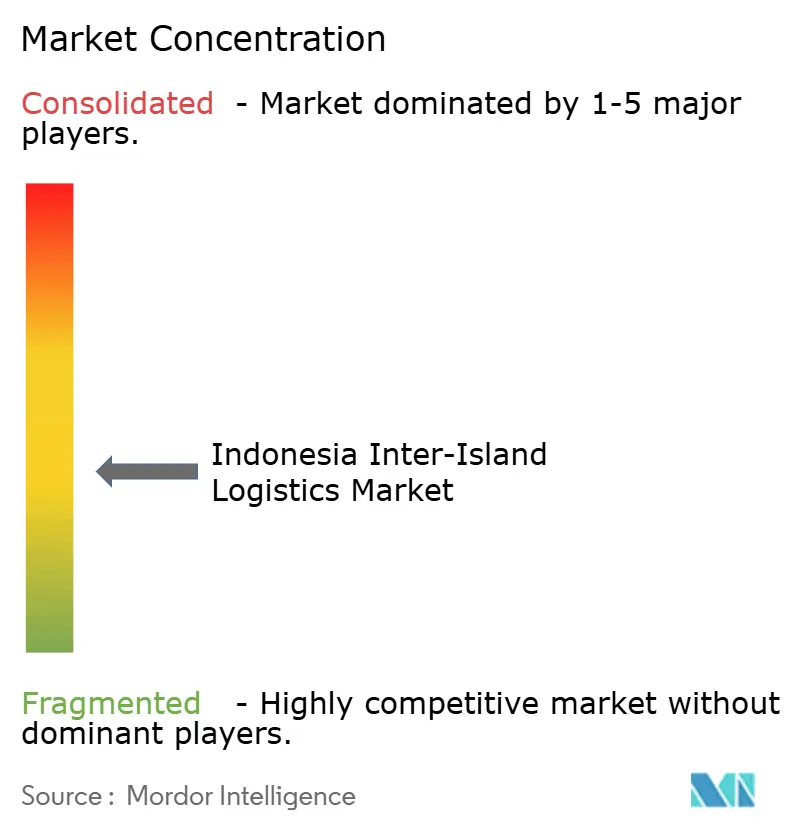
| Market Concentration | Medium |
Major Players *Disclaimer: Major Players sorted in no particular order Image © Mordor Intelligence. Reuse requires attribution under CC BY 4.0. | |
Indonesia Inter-Island Logistics Market Analysis by Mordor Intelligence
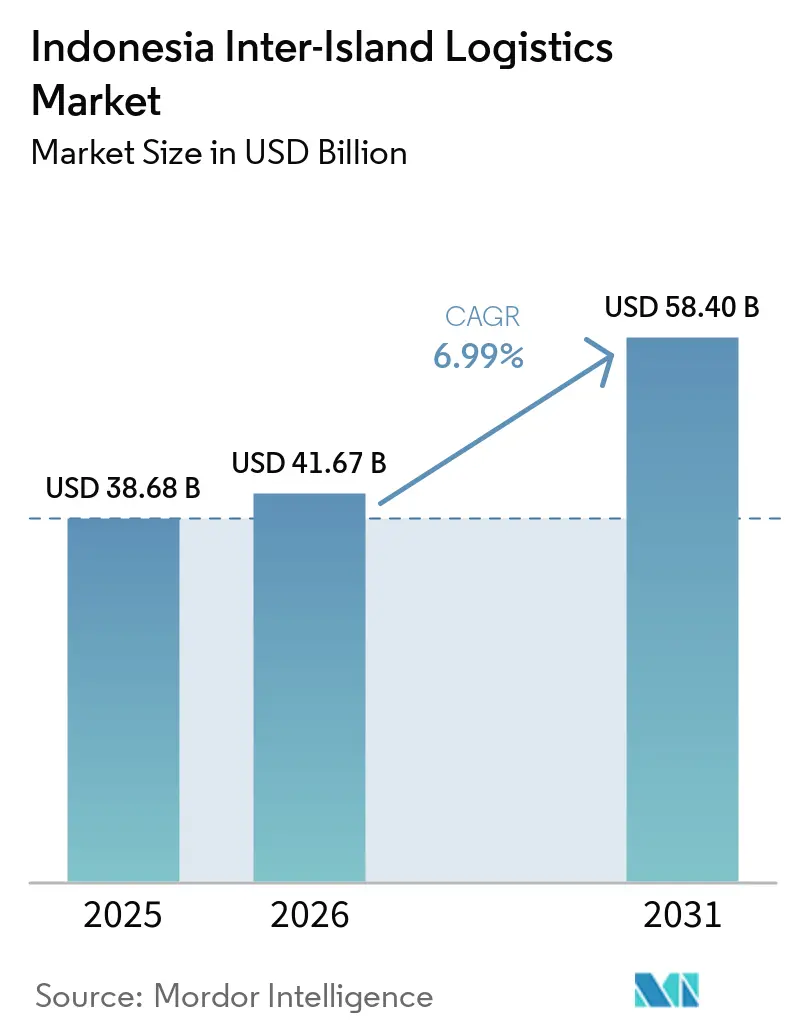
The Indonesia inter-island logistics market size was valued at USD 38.68 billion in 2025 and is estimated to grow from USD 41.67 billion in 2026 to reach USD 58.40 billion by 2031, at a CAGR of 6.99% during the forecast period 2026 to 2031.
Indonesia’s archipelagic geography makes maritime and multimodal links essential to economic activity, so freight demand is tied to the movement of goods between islands rather than to a single transport mode. Pelindo processed 19.8 million TEUs in 2025, while domestic sea freight handled 508.4 million tons, showing the scale of container, bulk, and parcel flows across Indonesian supply chains. The Indonesia inter-island logistics market is moving toward integrated services as manufacturers and online retailers need transport, storage, cargo handling, and shipment visibility in one service chain. Public investment in ports, ferries, and route networks can improve access to eastern provinces, while high fuel costs and limited return cargo continue to affect carrier economics. Competition differs by service layer, with domestic operators retaining route and fleet advantages and international providers competing through specialized multimodal services.
Key Report Takeaways
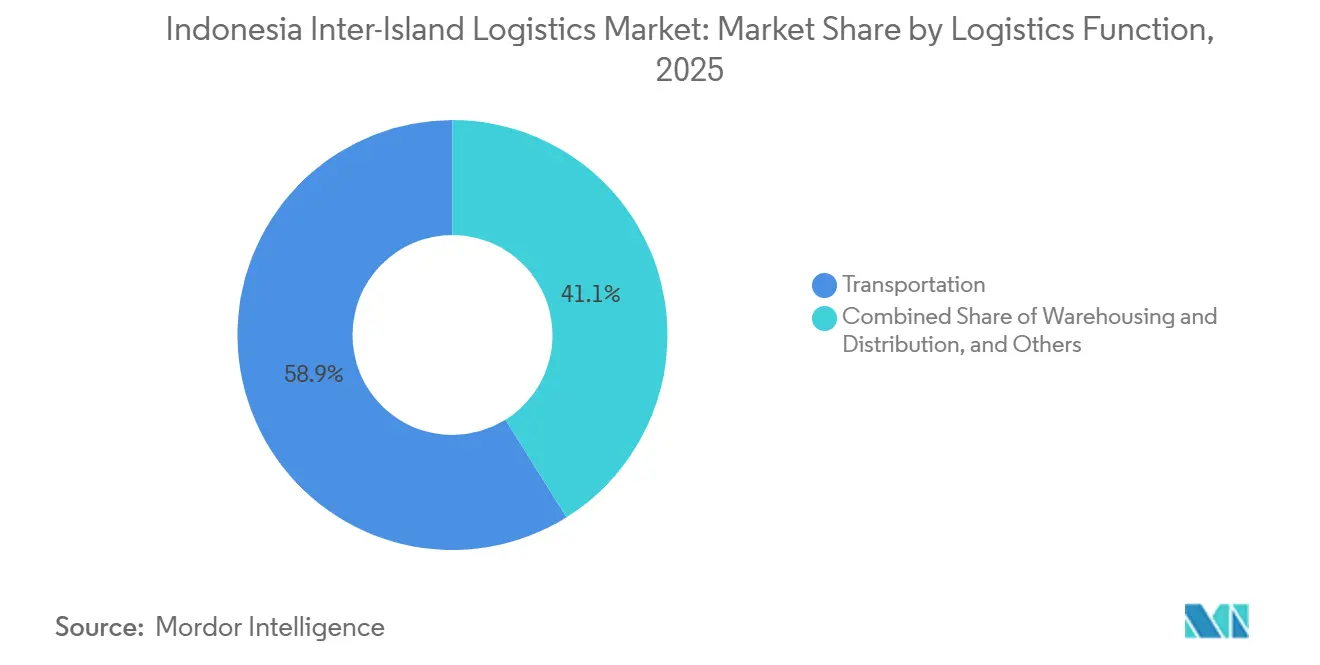
- By logistics function, transportation held 58.95% of the Indonesia inter-island logistics market share in 2025, while value-added logistics services are forecast to register at a 10.37% CAGR through 2031.
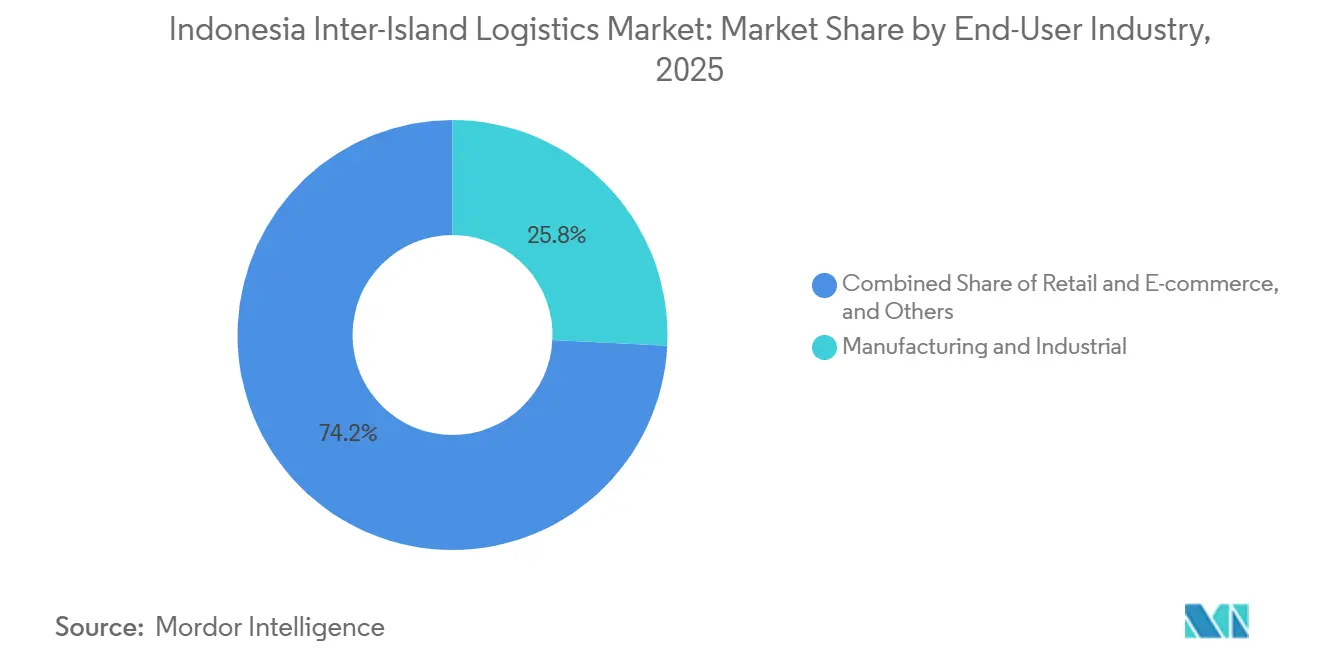
- By end-user industry, manufacturing and industrial held 25.78% of the Indonesia inter-island logistics market size in 2025, while retail and e-commerce are forecast to register at an 11.38% CAGR through 2031.
- By inter-island corridor, Java–Bali and Nusa Tenggara held 62.37% of the Indonesia inter-island logistics market share in 2025, while Java–Sulawesi is forecast to register at a 10.68% CAGR through 2031.
Note: Market size and forecast figures in this report are generated using Mordor Intelligence’s proprietary estimation framework, updated with the latest available data and insights as of January 2026.
Indonesia Inter-Island Logistics Market Trends and Insights
Drivers Impact Analysis*
| Driver | (~) % Impact on CAGR Forecast | Geographic Relevance | Impact Timeline |
|---|---|---|---|
| E-commerce Expansion Increasing Inter-Island Distribution Demand | +1.8% | National, concentrated in Java, Sumatra, and Kalimantan corridors, and expanding to Sulawesi. | Short term (≤ 2 years) |
| Industrial Growth Expanding Inter-Island Freight Movement Requirements | +1.4% | West Java, Central Java, and North Sulawesi | Medium term (2-4 years) |
| Infrastructure Investment Strengthening Inter-Island Logistics Connectivity | +1.1% | National, with priority gains in eastern Indonesia, Sumatra, and the Riau Islands | Medium term (2-4 years) |
| Logistics Digitalization Improving Port and Shipment Coordination | +0.9% | National, with early gains in Tanjung Priok, Tanjung Perak, and Makassar | Medium term (2-4 years) |
| Low Backhaul Utilization Increasing Consolidation Service Demand | +0.7% | Eastern Indonesia, Sumatra, and Kalimantan outbound corridors | Short term (≤ 2 years) |
| Hub-and-Spoke Networks Expanding Eastern Indonesia Distribution Reach | +0.6% | Sulawesi, Maluku, Papua, and Nusa Tenggara | Long term (≥ 4 years) |
| Source: Mordor Intelligence | |||
E-commerce Expansion Increasing Inter-Island Distribution Demand
Indonesia’s e-commerce platforms are extending distribution systems beyond Java, increasing the need for coordinated parcel movements between major islands and remote cities. Shopee Express serves 487 cities nationally, which means that many deliveries outside Java require an inter-island movement before local distribution begins. The Indonesia inter-island logistics market benefits because online retail demand connects urban sorting sites with places that have fewer physical retail options. This need is strongest where consumers rely on multi-leg delivery routes to reach goods from major fulfillment centers. As platforms add route coverage, freight operators can gain demand for scheduled line-haul transport, regional warehousing, and final distribution support.
Industrial Growth Expanding Inter-Island Freight Movement Requirements
Manufacturing growth is increasing demand for the movement of inputs, components, and finished products across Indonesia’s island network. The Central Bureau of Statistics and the Ministry of Industry reported that non-oil and gas manufacturing grew 5.3% year-over-year in the second quarter of 2026, slightly exceeding Indonesia's 5.29% GDP growth. In August 2026, the Kendal Special Economic Zone and Batang Integrated Industrial Park reached 100% land utilization, which supported a pipeline of cargo through Java’s port system. The Batang Industropolis dry port is designed for an initial capacity of 600,000 to 650,000 TEUs and can create a consolidation point between industrial production and sea freight[1]. In Sulawesi, more complex nickel processing for electric vehicle supply chains can shift freight from bulk movement toward containerized cargo. That change supports higher-value logistics activity on the Java–Sulawesi corridor and encourages fleet investment by operators with suitable equipment.
Infrastructure Investment Strengthening Inter-Island Logistics Connectivity
Port and ferry investment is expanding the physical capacity of the Indonesia inter-island logistics market. PT ASDP Indonesia Ferry disclosed an investment plan of IDR 23.49 trillion (USD 1.41 billion), through 2030, for 46 vessels and 55 port projects at 35 facilities[2]. Pelindo’s New Priok Container Terminal phases 2 and 3 target 3 million TEUs of additional annual capacity with an indicative investment of USD 1.2 billion. Capacity additions at Kuala Tanjung, Patimban, and Tanjung Carat can give Sumatra and West Java manufacturers alternatives to congested Jakarta gateways. The Tanjung Carat New Port was designated a National Strategic Project in September 2025 and is being developed through a Pelindo-led consortium. These assets can support more direct cargo routing, although the commercial outcome will depend on regular cargo volumes and connections with inland facilities.
Logistics Digitalization Improving Port and Shipment Coordination
Digital systems are becoming more relevant as cargo moves through ports, depots, vessels, warehouses, and final delivery networks. Pelindo Solusi Digital and the Indonesian Container Depots Association signed an agreement in September 2026 to connect port and depot systems through the Adhara platform. The planned link is intended to provide container tracking and visibility across the maritime chain. Indonesia also launched the Indonesia Open Network in July 2026, which connected logistics providers, e-commerce platforms, and payment systems through an interoperable architecture. For the Indonesia inter-island logistics market, improved data sharing can reduce information gaps between cargo owners and operators and support better equipment planning. It can also make smaller routes more workable when freight can be combined from multiple shippers, although operators still need consistent port and depot participation to realize those benefits.
Restraints Impact Analysis*
| Restraint | (~) % Impact on CAGR Forecast | Geographic Relevance | Impact Timeline |
|---|---|---|---|
| Infrastructure Gaps Increasing Inter-Island Logistics Transit Inefficiencies | -1.4% | Eastern Indonesia, Papua, Maluku, Nusa Tenggara, and the frontier islands | Long term (≥ 4 years) |
| Fuel Volatility Raising Inter-Island Transportation Operating Costs | -1.1% | Global, with greater exposure in Kalimantan, Sulawesi, and Papua | Short term (≤ 2 years) |
| Empty Backhaul Imbalances Reducing Network Operating Efficiency | -0.8% | Eastern Indonesia outbound routes and Sumatra commodity corridors | Medium term (2-4 years) |
| Regional Rule Variations Increasing Cargo Handling Complexity | -0.5% | National, concentrated in port authority and depot jurisdictions | Medium term (2-4 years) |
| Source: Mordor Intelligence | |||
Infrastructure Gaps Increasing Inter-Island Logistics Transit Inefficiencies
Infrastructure quality remains uneven across the network, especially in eastern Indonesia and frontier regions. A peer-reviewed assessment of the Sea Toll program, published in 2025, found that 58.7% of Indonesian ports were adequately equipped for modern cargo handling. Gaps in equipment and port capability can lengthen transit times, increase handling costs, and create a greater risk of cargo damage on lower-volume routes. ASDP's pioneer ferry services in Nusa Tenggara Timur were temporarily disrupted in early July 2026 because of funding constraints, before services resumed on July 20, 2026, following additional government support. The episode shows the reliance of frontier connections on public service support. When infrastructure and service funding are insufficient, return cargo is also harder to build, which makes private operations less attractive on routes without subsidy access.
Fuel Volatility Raising Inter-Island Transportation Operating Costs
Fuel costs can quickly affect carrier margins because vessels and trucks are central to inter-island freight operations. Singapore marine bunker high-sulphur fuel oil rose 100%, while low-sulphur fuel increased 99% between late February and early March 2026, following Middle East supply disruptions. Fuel distribution costs make non-subsidized Pertamax prices higher in Sulawesi than in Java. A 30% increase in diesel prices can raise freight costs by 10.5% to 12% when fuel represents 35% to 40% of vessel and truck operating costs. This exposure is particularly difficult on thin-margin eastern routes, where demand and cargo balance are less predictable. It can also lead operators to introduce emergency fuel surcharges, which may reduce volumes on price-sensitive corridors.
*Our forecasts treat driver/restraint impacts as directional, not additive. The impact forecasts reflect baseline growth, mix effects, and variable interactions.
Segment Analysis
By Logistics Function: Transportation Scale Anchors, Value-Added Services Lead Growth
Transportation accounted for 58.95% of the Indonesia inter-island logistics market share in 2025. Transportation remains central to cross-island supply chains, with domestic sea freight handling substantial containerized and non-containerized cargo, supported by ferry and RoRo services across shorter sea routes. Domestic air freight serves time-sensitive shipments, including healthcare products and electronics. The scale of transportation activity supports established operators with broad route coverage, vessel availability, and port access. In contrast, fleet registration, vessel classification, and maritime compliance requirements favor providers with established operational capabilities.
Value-added logistics services are forecast to register a 10.37% CAGR through 2031. These services are gaining importance as manufacturers and online retailers seek integrated solutions covering packaging, labeling, cargo handling, inventory management, and post-shipment support. Industrial development in Batang and Karawang is supporting demand for bonded warehousing and cross-dock facilities near port connections. Investments in modern vessel capacity and automated logistics hubs are also strengthening the integration of transportation, warehousing, sorting, and inter-island distribution services.

By End-User Industry: Manufacturing Holds Structural Weight, E-commerce Drives Incremental Growth
Manufacturing and industrial users accounted for 25.78% of the Indonesia inter-island logistics market size in 2025. Manufacturing demand is supported by Java’s industrial clusters in Bekasi, Karawang, and Purwakarta, which generate recurring inbound movements of raw materials from Sumatra and Kalimantan and outbound distribution across the archipelago. Regular production schedules create consistent demand for inter-island transportation of parts, materials, and finished goods, linking logistics activity closely with industrial investment across Java and other manufacturing centers.
Retail and e-commerce are projected to record the highest end-user growth at an 11.38% CAGR through 2031. This segment is expected to expand as logistics connectivity improves across Kalimantan, Sulawesi, and eastern Indonesia, enabling online retail networks to reach markets beyond major Java cities. Food and beverage, agriculture and forestry, and chemicals and petrochemicals generate significant bulk and temperature-sensitive freight volumes. Automotive and component logistics can benefit from the development of Patimban Port’s vehicle-handling capacity, while electronics and electrical shipments are supported by production activity in Batam and Subang. Healthcare and pharmaceutical shipments represent smaller volumes but require specialized services because cold-chain handling and regulatory documentation require qualified temperature-controlled infrastructure.
Geography Analysis
The Java–Bali and Nusa Tenggara corridor held 62.37% of the Indonesia inter-island logistics market share in 2025, supported by Java’s manufacturing base and consumer demand. Tanjung Priok and Tanjung Perak handle major containerized inter-island throughput. New Priok Container Terminal phases 2 and 3 are planned to add 3 million TEUs of annual capacity through an indicative USD 1.2 billion investment. Patimban’s planned vehicle terminal can handle up to 600,000 vehicles annually and can provide West Java with an additional automotive freight gateway. The Letung and Sedanau ferry ports were inaugurated in November 2025, strengthening the Tanjung Uban–Sedanau–Serasan–Sintete route in the Riau Islands.
Java–Sumatra and Java–Kalimantan form the commodity freight backbone of the Indonesia inter-island logistics market. Sumatra’s commodity outflows exceed inbound general cargo in several routes, requiring empty container repositioning and increasing costs. A peer-reviewed study found that port-centered commodity processing can reduce logistics costs by 30% to 40% by creating more backhaul cargo, which might support the case for logistics and industrial infrastructure at Tanjung Carat. PT Samudera Indonesia launched a weekly Kuala Tanjung–Singapore–Penang service in May 2026, giving North Sumatran industrial tenants a direct export option. Better connections can reduce dependence on Jakarta, although return cargo remains important for route economics.
Java–Sulawesi is forecast to expand at a 10.68% CAGR through 2031 and is the strongest growth area in the Indonesia inter-island logistics market size by corridor. The Sulampua region launched a January 2026 initiative that targeted a 30% reduction in logistics costs and used Bitung Port’s connections with East Asia. Maluku announced an integrated logistics hub in August 2026 with support from Bappenas and World Bank financing, with groundbreaking targeted for 2027 and a projected 5,000 to 6,000 jobs[3]. Return cargo on eastern Sea Toll routes averaged below 25% utilization in 2025, with the PELNI–Meratus partnership targeting the gap through cargo consolidation and hub-and-spoke operations.
Competitive Landscape
The Indonesia inter-island logistics market is moderately fragmented among established domestic and state-linked operators, while value-added services and warehousing have more participants. Meratus Group operates almost 100 vessels on more than 45 trade routes as of H1 2026, giving it a dense domestic network. PT SPIL, PT TEMAS Tbk, and PT Tanto Intim Line are established on eastern-oriented corridors through long-standing relationships with cargo owners. PT ASDP Indonesia Ferry has a strong position in RoRo services through government route concessions, and its IDR 23.49 trillion (USD 1.41 billion) investment plan reflects the need to renew vessels and port assets.
International providers compete differently from domestic shipping operators. DHL Group has more than 70 daily flights, 7 gateway facilities, and around 180 locations across Indonesia, with a focus on multimodal visibility and solutions for electric vehicles, life sciences, and e-commerce. The Indonesia inter-island logistics industry also offers room for cold-chain services for healthcare and food processing. Digital freight brokerage can help small cargo owners combine loads on routes with low demand. At the same time, new facilities at Tanjung Carat, Kuala Tanjung, and Patimban can create opportunities for port-based value-added logistics.
PT TEMAS commissioned MV Digul Mas in August 2026 and planned IDR 2.5 trillion (USD 152.4 million) in capital expenditure for 2026[4]. The plan includes fleet additions, port equipment, and the extension of a Tanjung Priok berth from 340 m to 485 m through a build-operate-transfer arrangement with Pelindo Terminal Petikemas. PT TEMAS also commissioned a Surabaya LNG liquefaction plant with IDR 1 trillion (USD 61 million) in capital expenditure and targeted commercial operations in May 2026. PT Samudera Indonesia allocated USD 300 million b 2026 capital expenditure for vessel orders, a Patimban terminal, and a Madura shipyard. Smaller operators with limited digital capability face a risk of losing cargo to platform-owned networks that provide integrated service coverage.
Indonesia Inter-Island Logistics Industry Leaders
-
Meratus Group
-
PT Salam Pacific Indonesia Lines (SPIL)
-
PT TEMAS Tbk
-
PT Samudera Indonesia Tbk
-
PT ASDP Indonesia Ferry (Persero)
- *Disclaimer: Major Players sorted in no particular order
Recent Industry Developments
- August 2026: PT TEMAS Tbk commissioned MV Digul Mas (468 TEUs, LNG single-fuel, electrically propelled) on the Surabaya–Kendari–Gorontalo domestic route, and set IDR 2.5 trillion (USD 152.4 million) capex for 2026, including fleet additions, port equipment, and Tanjung Priok berth extension from 340 m to 485 m via BOT with Pelindo Terminal Petikemas.
- June 2026: PT ASDP Indonesia Ferry announced an IDR 23.49 trillion (USD 1.41 billion) investment plan through 2030 for 46 new vessels and 55 port projects at 35 facilities.
- April 2026: PT PELNI and Meratus Line signed a Hub & Spoke Cooperation Agreement for Sea Toll routes S4A (Kupang–Rote–Sabu) and S4B (Kupang–Larantuka–Lembata–Kalabahi), targeting lower operating costs and accelerated distribution to eastern Indonesia. In 2025, the Sea Toll program reduced price disparities in frontier (3TP) regions by 20% to 40%.
- November 2025: DHL Express Indonesia committed to new processing centers in Surabaya, Denpasar, and Batam, and opened a 6,000 m² Batam facility with a daily cargo vessel service on the Batam–Singapore route.
Indonesia Inter-Island Logistics Market Report Scope
| Transportation | Domestic Sea Freight | Containerized Cargo |
| Non-Containerized Cargo | ||
| Ferry and RoRo Freight | ||
| Domestic Air Freight | ||
| Warehousing & Distribution | ||
| Value-Added Logistics Services (Packaging, labeling, handling, etc.) |
| Manufacturing and Industrial |
| Retail and E-commerce |
| Food and Beverage |
| Automotive and Components |
| Chemicals and Petrochemicals |
| Electronics and Electrical |
| Agriculture and Forestry |
| Healthcare and Pharmaceuticals |
| Other End Users |
| Java-Sumatra |
| Java-Kalimantan |
| Java-Sulawesi |
| Java-Bali and Nusa Tenggara |
| Sulawesi-Maluku and Papua |
| Other Inter-Island Corridors |
| By Logistics Function | Transportation | Domestic Sea Freight | Containerized Cargo |
| Non-Containerized Cargo | |||
| Ferry and RoRo Freight | |||
| Domestic Air Freight | |||
| Warehousing & Distribution | |||
| Value-Added Logistics Services (Packaging, labeling, handling, etc.) | |||
| By End-User Industry | Manufacturing and Industrial | ||
| Retail and E-commerce | |||
| Food and Beverage | |||
| Automotive and Components | |||
| Chemicals and Petrochemicals | |||
| Electronics and Electrical | |||
| Agriculture and Forestry | |||
| Healthcare and Pharmaceuticals | |||
| Other End Users | |||
| By Inter-Island Corridor | Java-Sumatra | ||
| Java-Kalimantan | |||
| Java-Sulawesi | |||
| Java-Bali and Nusa Tenggara | |||
| Sulawesi-Maluku and Papua | |||
| Other Inter-Island Corridors |
Key Questions Answered in the Report
What is the size of Indonesia’s inter-island logistics sector?
The Indonesia inter-island logistics market was valued at USD 38.68 billion in 2025 and is estimated at USD 41.67 billion in 2026. It is forecast to reach USD 58.40 billion by 2031 at a 6.99% CAGR.
Which logistics function has the largest role in Indonesia?
Transportation held 58.95% of revenue in 2025 because cross-island supply chains depend on sea, ferry, RoRo, and related freight links.
Which customer group is growing fastest?
Retail and e-commerce are forecast to register at an 11.38% CAGR through 2031 as networks expand beyond major Java cities.
Which corridor is growing the fastest?
Java–Sulawesi is forecast to expand at a 10.68% CAGR through 2031, supported by industrial activity and port traffic in Sulawesi.
What factors limit cross-island freight efficiency?
Uneven port capability, fuel price volatility, empty return voyages, and differences in local handling requirements can raise costs and reduce schedule reliability.
How is digitalization changing inter-island freight services?
Port and depot integration, container tracking, and interoperable systems can improve shipment visibility, cargo consolidation, and equipment planning across multi-island supply chains.