
Indonesia Full Container Load (FCL) Market Size and Share
Market Overview
| Study Period | 2020 - 2031 |
|---|---|
| Forecast Data Period | 2026 - 2031 |
| Base Year Market Size (2025) | USD 5.32 Billion |
| Market Size (2026) | USD 5.72 Billion |
| Market Size (2031) | USD 7.82 Billion |
| Growth Rate (2026 - 2031) | 6.45 % |
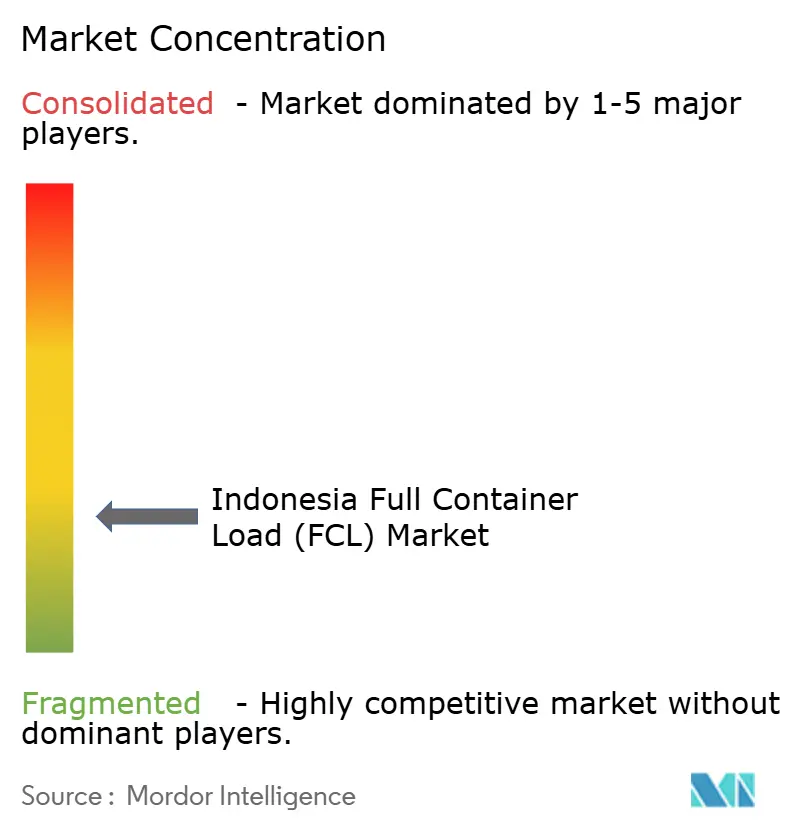
| Market Concentration | Low |
Major Players *Disclaimer: Major Players sorted in no particular order Image © Mordor Intelligence. Reuse requires attribution under CC BY 4.0. | |
Indonesia Full Container Load (FCL) Market Analysis by Mordor Intelligence
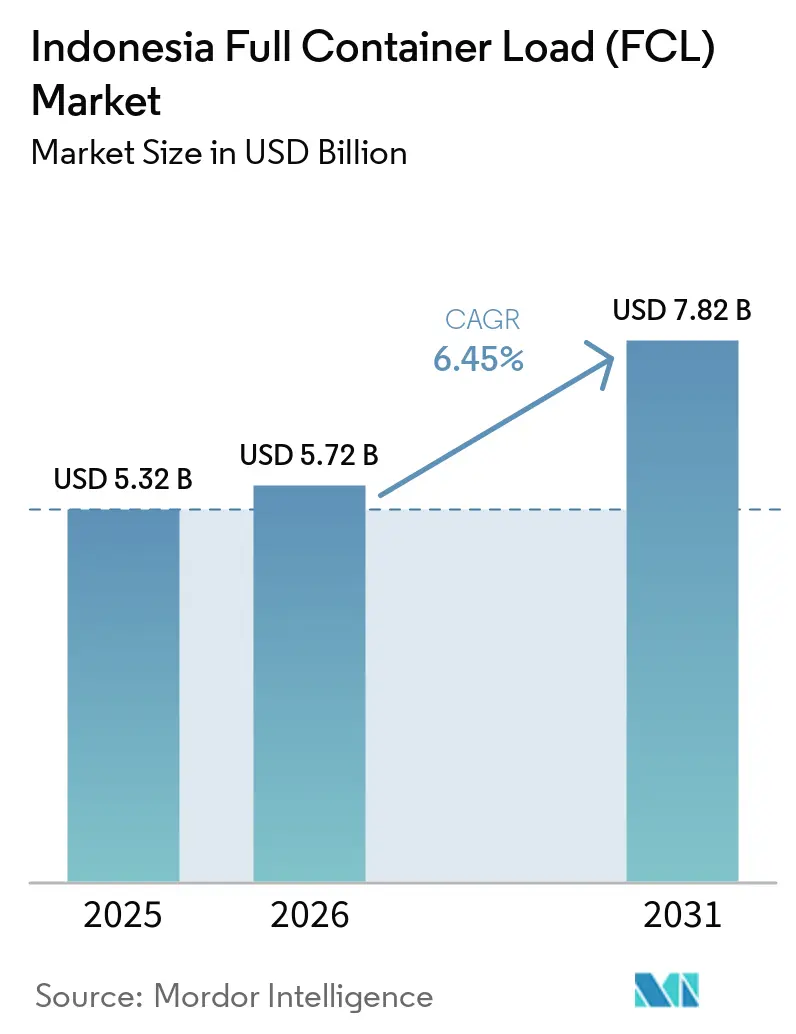
The Indonesia full container load (FCL) market size was valued at USD 5.32 billion in 2025 and is estimated to grow from USD 5.72 billion in 2026 to reach USD 7.82 billion by 2031, at a CAGR of 6.45% during the forecast period from 2026 to 2031.
The Indonesia full container load (FCL) market is supported by rising container use, industrial processing investment, and trade among Indonesia’s islands, where freight patterns vary sharply by corridor, export base, and local handling capacity. Manufacturing exports are increasing the need for scheduled full-container transport with defined handling requirements, as industrial cargo has more consistent timing, packaging, and delivery conditions than many unprocessed commodity shipments. Port investment is widening capacity at major gateways and improving the commercial case for services beyond Java. However, national gains remain dependent on practical links between terminals, industrial zones, depots, and destination markets. Digital documentation and vessel coordination can reduce repeated paperwork and improve shipment visibility, helping carriers and shippers plan container release, customs processing, and inland collection with fewer manual handoffs. Empty repositioning, road connections, and customs procedures still limit the ability of the Indonesia full container load (FCL) market to convert cargo demand into efficient container movements, particularly where reverse cargo does not offset the cost of returning equipment to Western hubs.
Key Report Takeaways
- By trade flow, domestic and inter-island services held 65.89% of the Indonesia full container load (FCL) market share in 2025, while international services are projected to register at an 8.94% CAGR through 2031.
- By container type, dry containers held 82.37% of the Indonesia full container load (FCL) market share in 2025, while refrigerated containers are forecast to expand at a 9.45% CAGR through 2031.
- By container size, 40-foot containers accounted for 59.76% of the Indonesia full container load (FCL) market size in 2025 and are projected to register at an 8.39% CAGR through 2031.
- By end-user industry, manufacturing and industrial users held 23.46% of the Indonesia full container load (FCL) market size in 2025, while healthcare and pharmaceuticals are forecast to expand at a 10.87% CAGR through 2031.
- By geography, Java, including Jakarta and BOD, held 67.34% of the Indonesia full container load (FCL) market in 2025, while Sulawesi is projected to register at a 9.89% CAGR through 2031.
Note: Market size and forecast figures in this report are generated using Mordor Intelligence’s proprietary estimation framework, updated with the latest available data and insights as of January 2026.
Indonesia Full Container Load (FCL) Market Trends and Insights
Drivers Impact Analysis*
| Driver | (~) % Impact on CAGR Forecast | Geographic Relevance | Impact Timeline |
|---|---|---|---|
| Containerization Growth in Domestic and Export FCL Volumes | +1.8% | Global, concentrated in Java and Sumatra | Medium term (2-4 years) |
| Port Expansion in Container Handling Capacity and Efficiency | +1.5% | National, with early gains in Jakarta, Surabaya, and North Sumatra | Medium term (2-4 years) |
| Industrial Investment in Export-Oriented Containerized Cargo | +1.2% | Java-centric, with spillover to Sumatra and Kalimantan | Medium term (2-4 years) |
| Digitalization of Port-Hinterland Coordination and Shipment Visibility | +0.7% | National, led by Greater Jakarta and Surabaya | Short term (≤ 2 years) |
| Sea-Toll Development in Eastern Indonesia: Connectivity | +0.5% | Sulawesi, Papua, Maluku, and Nusa Tenggara | Long term (≥ 4 years) |
| Reefer Demand in Specialized Container Shipping | +0.4% | Sumatra and Java, with national relevance | Short term (≤ 2 years) |
| Source: Mordor Intelligence | |||
Containerization Growth Increasing Domestic and Export FCL Volumes
Domestic cargo is shifting from break-bulk handling toward containerized movements, creating bookings that do not depend only on overall trade growth. TPK Semarang reported a 13.7% year-over-year increase in export containers to 189,162 TEUs from January to May 2026. More manufacturers are selecting dedicated full-container shipments as service frequency, and reliability improves at secondary ports. This shift gives Indonesia full container load (FCL) market a steadier demand base than cargo flows linked mainly to commodity prices. It also supports capacity planning because operators can align vessel deployment with repeat industrial shipments.
Port Expansion Improving Container Handling Capacity and Efficiency
New terminal capacity is changing the supply structure of the Indonesia full container load (FCL) market. Pelindo began operating Terminal 2 Petikemas at Tanjung Priok in August 2026, adding a 517.5 m berth and 98,700 m² of yard space[1]. Pelindo’s Indonesia Network Pendulum plan also targets 20 inter-island shipping corridors, including 7 planned by the end of 2026. Patimban has an initial installed capacity of 200,000 TEUs and is planned to expand to 600,000 TEUs in its next phase. Additional gateways can reduce dependence on a single hub, but their benefit depends on road, rail, and depot connections. Investment at secondary ports is, therefore, important because it determines whether new capacity removes bottlenecks or moves them inland.
Industrial Investment Increasing Export-Oriented Containerized Cargo Demand
Industrial development is increasing the volume of cargo that needs controlled full-container transport. Indonesia’s manufacturing sector outpaced national economic growth in the second quarter of 2026 and contributed 0.97 percentage points to national growth. 1,236 industrial enterprises entering construction during 2025 began production in early 2026, and IDR 551.9 trillion (USD 33.11 billion) of non-oil and gas processing investment entered production stage. These products require reliable transit times and cargo specifications, which makes industrial investment a durable source of demand for the Indonesia full container load (FCL) market.
Digitalization Improving Port-Hinterland Coordination and Shipment Visibility
Digital systems can reduce friction across the documentation chain for the Indonesia full container load (FCL) market. Indonesia National Single Window services consolidate export and import processes through a single submission framework. This framework operated at 41 ports and 21 airports in September 2026[2]. Inaportnet, the electronic system, supports vessel reporting and single billing at major ports, while Tanjung Priok integration is progressing. Presidential Regulation No. 41 of 2026 strengthens national logistics governance within the INSW framework. Better links between customs, ports, and logistics providers can limit repeated filings and make container processing more predictable.
Restraints Impact Analysis*
| Restraint | (~) % Impact on CAGR Forecast | Geographic Relevance | Impact Timeline |
|---|---|---|---|
| Empty Container Imbalances Raising Repositioning and Backhaul Costs | -0.8% | Eastern Indonesia and Sumatra | Long term (≥ 4 years) |
| Port-Hinterland Delays Raising Container Logistics Costs | -0.5% | Greater Jakarta, Surabaya, and secondary Java ports | Medium term (2-4 years) |
| Regional Infrastructure Gaps Limiting Container Accessibility | -0.4% | Papua, Maluku, Nusa Tenggara, and the Kalimantan interior | Long term (≥ 4 years) |
| Customs and Documentation Complexity Raising Processing Friction | -0.3% | National, especially Tanjung Priok and Belawan | Short term (≤ 2 years) |
| Source: Mordor Intelligence | |||
Empty Container Imbalances Increasing Repositioning and Backhaul Costs
East-to-west trade imbalances remain a persistent cost issue for the Indonesia full container load (FCL) market. This indicates that east-to-west load factors remain near 30%, leaving many containers to return empty from eastern ports. PELNI data for 2025 showed 9,103 TEUs of outbound cargo and 4,039 TEUs of return cargo on Tol Laut routes. This imbalance increased repositioning expenses and raised freight charges for exporters. Academic research also identifies market structure and empty backhauls as important factors in trucking cost efficiency. The constraint is particularly relevant for remote production areas, where a return load is less certain than on Java-based corridors.
Port-Hinterland Delays Increasing Overall Container Logistics Costs
Terminal expansion alone cannot resolve delays across the Indonesia full container load (FCL) market. The Patimban road connection to the national highway network is not expected until mid-2027, limiting the port’s ability to draw cargo away from Tanjung Priok in the near term[3]. Tanjung Emas reported stronger international throughput in early 2026, but vessel queues and slower cargo movement still affected the wider logistics chain. Coordinated road, rail, depot, and digital investments are needed to reduce these delays. Limited channel depth, crane availability, and power supply create related constraints in Papua, Maluku, and other remote areas. Customs complexity may add further friction where documentation systems are not used consistently across agencies.
*Our forecasts treat driver/restraint impacts as directional, not additive. The impact forecasts reflect baseline growth, mix effects, and variable interactions.
Segment Analysis
By Trade Flow: Inter-Island Volumes Lead, International FCL Accelerates Faster
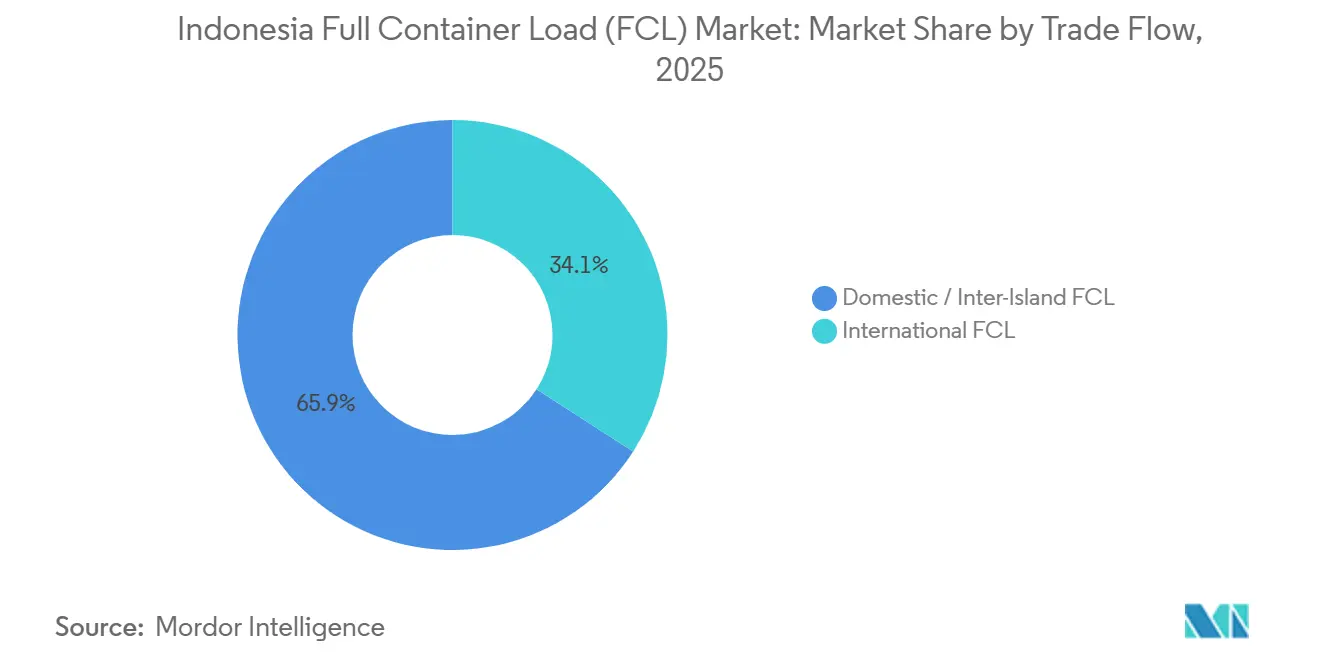
Domestic and inter-island services held 65.89% of the Indonesia full container load (FCL) market share in 2025. The Tol Laut program served 104 ports in 2025 and received IDR 623.4 billion (USD 37.40 million) in subsidy support. Its 2026 allocation changed to IDR 525.0 billion (USD 31.50 million) under a cargo consignment mechanism. The program can open commercially viable routes to private operators as demand becomes established. Return cargo represented only 31% of Tol Laut volumes in 2025, showing the challenge of assembling cargo in the reverse direction.
International services are the faster-growing trade flow, with an 8.94% CAGR projected from 2026 to 2031. International services carry raw materials and capital goods on the import leg as well as processed products on the export leg. This mix requires carriers to manage both regular industrial demand and trade-lane imbalances. The Indonesia full container load (FCL) market can benefit where operators can combine outbound volumes and secure dependable backhaul cargo. That requirement may remain central to private investment decisions on eastern routes.

By Container Type: Dry Container Backbone, Reefer Volumes Accelerating
Dry containers held 82.37% of the Indonesia full container load (FCL) market size in 2025. Java and Sumatra offer stronger reefer yields because they have more developed cold storage and compliant logistics facilities. Pharmaceutical handling is becoming more demanding as service providers meet Good Distribution Practice requirements. These requirements can favor operators with validated handling procedures and equipment.
Refrigerated containers are expected to register at a 9.45% CAGR through 2031, the highest rate among container types. Pharmaceutical distribution, seafood, processed food, and nutrition-program logistics support demand for temperature-controlled capacity. 30% of pharmaceutical shipments still encounter temperature-storage issues during transit. This gap creates demand for more consistent reefer services in eastern corridors. The Indonesia full container load (FCL) market, therefore, has room for specialized capacity even as dry containers remain the principal volume base.
By Container Size: 40-Foot Standard Consolidates Scale Efficiency
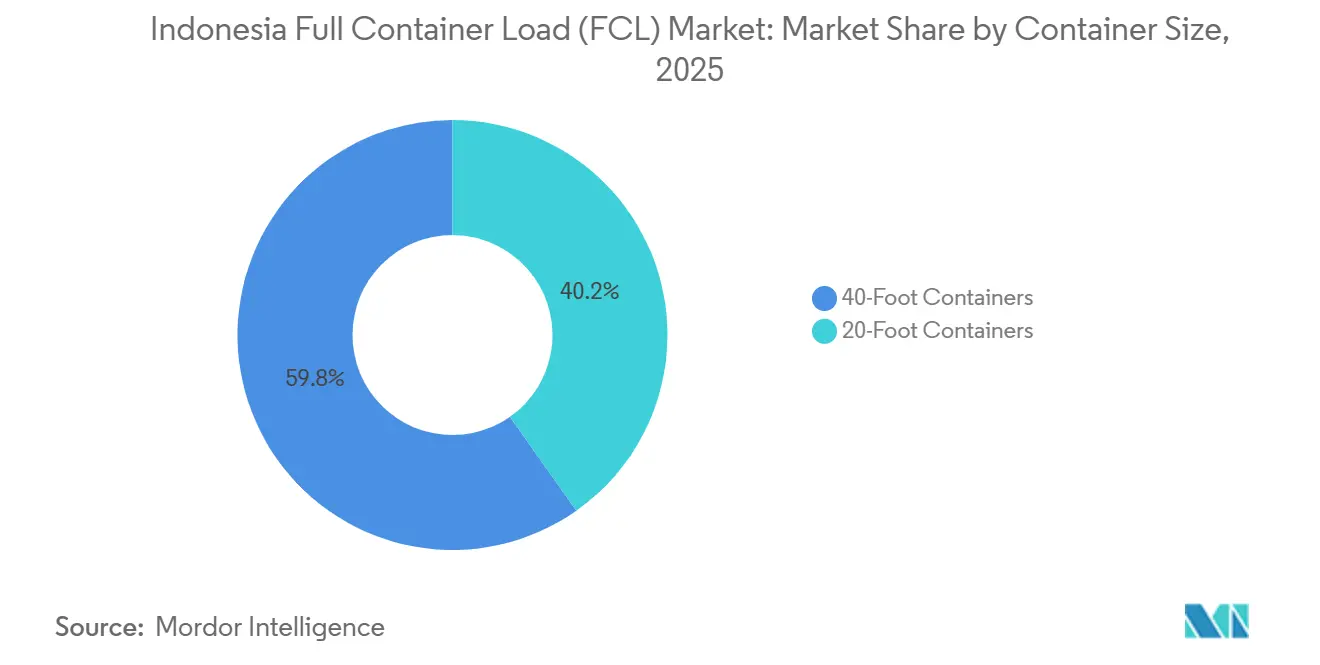
The 40-foot format held 59.76% of the Indonesia full container load (FCL) market size in 2025. It is also forecast to register at an 8.39% CAGR through 2031, the fastest rate among size formats. Shippers are consolidating cargo into larger units for inter-island and export movements. Larger containers can improve vessel-slot economics when schedules and port operations are reliable. Industrial-zone dry ports, including Cikarang, support cargo aggregation before export.
The 20-foot format remains useful for smaller shipments, hazardous cargo, and ports with berth or crane limitations. Its relative position is under pressure as infrastructure and carrier networks improve. Container weight verification requirements also reinforce the value of planned and compliant loading practices. These conditions favor heavy FCL shipments where cargo density and handling requirements allow their use.
By End-User Industry: Manufacturing Anchors Volumes, Healthcare Lifts Value
Manufacturing and industrial users held 23.46% of the Indonesia full container load (FCL) market share in 2025. Retail and consumer goods, alongside food and beverages, remain substantial cargo sources for domestic distribution. Automotive shipments benefitted from Patimban’s vehicle terminal, which handled 204,774 vehicles in 2025. Chemicals, petrochemicals, electronics, and electrical goods require specialized containers and hazardous-goods compliance. Agriculture and forestry create high volumes but face greater exposure to empty repositioning on eastern routes.
Healthcare and pharmaceuticals are forecast to register at a 10.87% CAGR through 2031, the highest rate among end-user industries. Healthcare logistics needs documented and temperature-controlled handling, which can turn pharmaceutical transport into a higher-value FCL service. Manufacturing still provides the largest volume base because production investment is concentrated in industrial centers. Project cargo and energy equipment remain a specialized opportunity for forwarders with appropriate handling capabilities. These varied cargo needs broaden the customer base of the Indonesia full container load (FCL) market without reducing the importance of manufacturing demand.
Geography Analysis
Java, including Jakarta and its surrounding area, held 67.34% of the Indonesia full container load (FCL) market share in 2025. Manufacturing concentration, consumer demand, and gateway infrastructure keep the island at the center of national container flows. Terminal 2 Petikemas began operations at Tanjung Priok in August 2026 with a 517.5 m berth and 98,700 m² of yard space. Planned capacity additions at Tanjung Priok and Patimban can change the pricing and service structure of Java’s gateways.
Sumatra and Kalimantan have container patterns shaped by trade imbalances more than gateway capacity limits. Sumatra exports palm oil, rubber, coffee, and coal, but inbound containerized cargo is insufficient to match those flows. This imbalance adds to empty container availability and freight costs. CMA CGM’s CNC unit introduced the BBX3 service from Kuala Tanjung to South China in May 2026. Panjang Port recorded 17.4% growth in container throughput during the first half of 2026. Kalimantan is tied to coal, palm oil, timber derivatives, and a growing share of processed output from downstream investment.
Sulawesi is the fastest-growing regional part of the Indonesia full container load (FCL) market, with a projected 9.89% CAGR through 2031. New services and National Strategic Projects support its cargo volumes. Bali and Nusa Tenggara generate demand from food, handicrafts, and tourism-linked supply chains. Papua and Maluku remain longer-term opportunities supported by Tol Laut routes and food-estate cargo movements. The Indonesia full container load (FCL) market faces shallow channels, limited cranes, and unstable power supply in these regions. These operating limits make growth more dependent on public infrastructure and policy support than in Java.
Competitive Landscape
The Indonesia full container load (FCL) market is fragmented. International alliances influence capacity and rate conditions on overseas routes. Domestic carriers compete through inter-island coverage, local operating experience, and regulatory familiarity. The Gemini Cooperation includes Maersk and Hapag-Lloyd, while the Premier Alliance includes ONE, HMM, and Yang Ming. MSC, CMA CGM, COSCO, Evergreen, ZIM, and Wan Hai also serve relevant international routes. Service reliability, digital booking, vessel utilization, and cargo tracking have become core requirements rather than optional features.
Specific service launches increased competitive activity in H1 2026. MSC began Patimban’s first scheduled international liner service in July 2026, connecting the port with Singapore, Port Klang, Laem Chabang, and Hong Kong. COSCO introduced the ECNX service connecting Jakarta with Shanghai and Ningbo in April 2026. CMA CGM’s CNC unit launched its Kuala Tanjung to South China service in May 2026[4]. ONE enhanced its Thailand-Indonesia 1 service in April 2026, creating a direct Jakarta, Vietnam, and Thailand connection. These moves provide more routing choices for shippers and increase competition among gateways.
Samudera Indonesia planned USD 200 million in February 2026 capital expenditure for vessels, later revised to USD 300 million, a Patimban terminal, and a Madura shipyard. PT TEMAS allocated IDR 2.5 trillion (USD 151.5 million) for vessels, equipment, and port infrastructure in June 2026. Freight forwarders, including DHL Global Forwarding, Kuehne+Nagel, and DSV, aggregate demand across Indonesian trade lanes. DHL committed more than USD 20 million for Jakarta facilities and more than USD 10 million for Surabaya facilities in 2025.
Indonesia Full Container Load (FCL) Industry Leaders
-
Mediterranean Shipping Company (MSC)
-
A.P. Moller - Maersk
-
PT Salam Pacific Indonesia Lines (SPIL)
-
Meratus Group
-
PT TEMAS Tbk
- *Disclaimer: Major Players sorted in no particular order
Recent Industry Developments
- August 2026: Pelindo launched Terminal 2 Petikemas (T2 Petikemas) at Tanjung Priok, Jakarta, adding a 517.5 m berth and 98,700 m² of yard as part of the PINP strategy targeting 20 new inter-island shipping corridors.
- August 2026: CMA CGM explored strategic collaboration with Cikarang Dry Port (CDP) and subsidiary CCIS, including coordination for VinFast's first container shipment through the dry port, targeting stronger port-hinterland FCL connectivity for international automotive cargo in Greater Jakarta.
- April 2026: ONE enhanced its Thailand Indonesia 1 (TID1) service effective April 2026, replacing Surabaya with Singapore and Ho Chi Minh City, creating a direct Jakarta–Vietnam–Thailand FCL corridor and improving Indonesia-Vietnam bilateral trade connectivity.
- June 2025: DHL Express Indonesia deployed 28 electric vehicles for last-mile deliveries. It invested over USD 20 million in Jakarta gateway facilities and over USD 10 million in Surabaya gateway facilities to build FCL forwarding capability in premium healthcare and EV cargo segments.
Indonesia Full Container Load (FCL) Market Report Scope
| Domestic / Inter-Island FCL | |
| International FCL | Import Flow |
| Export Flow |
| Dry Containers |
| Refrigerated Containers |
| Tank Containers |
| Special Equipment Containers |
| 20-Foot Containers |
| 40-Foot Containers |
| Manufacturing and Industrial |
| Retail and Consumer Goods |
| Food and Beverage |
| Automotive and Components |
| Chemicals and Petrochemicals |
| Electronics and Electrical |
| Agriculture and Forestry |
| Healthcare and Pharmaceuticals |
| Other End Users |
| Java (Jakarta and BOD) |
| Sumatra |
| Kalimantan |
| Sulawesi |
| Bali and Nusa Tenggara |
| Papua Region and Maluku Islands |
| By Trade Flow | Domestic / Inter-Island FCL | |
| International FCL | Import Flow | |
| Export Flow | ||
| By Container Type | Dry Containers | |
| Refrigerated Containers | ||
| Tank Containers | ||
| Special Equipment Containers | ||
| By Container Size | 20-Foot Containers | |
| 40-Foot Containers | ||
| By End-User Industry | Manufacturing and Industrial | |
| Retail and Consumer Goods | ||
| Food and Beverage | ||
| Automotive and Components | ||
| Chemicals and Petrochemicals | ||
| Electronics and Electrical | ||
| Agriculture and Forestry | ||
| Healthcare and Pharmaceuticals | ||
| Other End Users | ||
| By Region | Java (Jakarta and BOD) | |
| Sumatra | ||
| Kalimantan | ||
| Sulawesi | ||
| Bali and Nusa Tenggara | ||
| Papua Region and Maluku Islands | ||
Key Questions Answered in the Report
What is the forecast growth rate for full container load services in Indonesia?
The Indonesia full container load (FCL) market is projected to register a 6.45% CAGR from 2026 to 2031.
Which trade flow is the largest for full container load services in Indonesia?
Domestic and inter-island movements held 65.89% in 2025, reflecting the scale of trade across the archipelago. International services are forecast to register at an 8.94% CAGR as manufacturing exports require more scheduled container movements.
Which container type is growing fastest in Indonesia?
Refrigerated containers are forecast to register at a 9.45% CAGR through 2031, supported by pharmaceutical, seafood, processed-food, and nutrition-program logistics. Dry containers held 82.37% of the 2025 value, so specialized reefer growth develops from a much smaller base.
Which Indonesian region is growing fastest for FCL services?
Sulawesi is projected to register at a 9.89% CAGR through 2031, supported by service additions and project logistics demand. Its growth case differs from Java because it depends more directly on eastern network development and strategic project cargo.
What is the main logistics constraint for exporters in eastern Indonesia?
Empty container repositioning is a major constraint because return cargo volumes are often insufficient to balance outbound flows. Tol Laut figures for 2025 showed 9,103 TEUs of outbound cargo and 4,039 TEUs of return cargo, reinforcing the scale of the imbalance.
Why are 40-foot containers gaining importance in Indonesia?
The 40-foot format held 59.76% in 2025 and is growing at an 8.39% CAGR as shippers consolidate cargo for inter-island and export routes. Improving port operations and cargo aggregation at industrial dry ports supports this preference, where cargo characteristics permit.