
Indonesia Air Freight Transport Market Size and Share
Market Overview
| Study Period | 2020 - 2031 |
|---|---|
| Forecast Data Period | 2026 - 2031 |
| Base Year Market Size (2025) | USD 0.79 Billion |
| Market Size (2026) | USD 0.86 Billion |
| Market Size (2031) | USD 1.24 Billion |
| Growth Rate (2026 - 2031) | 7.69 % |
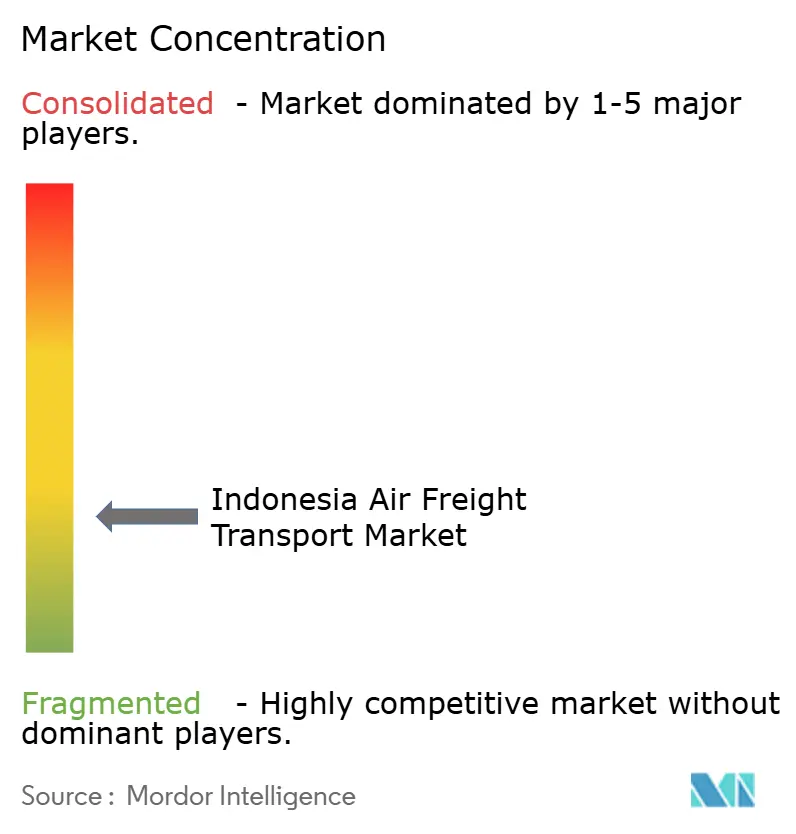
| Market Concentration | Low |
Major Players *Disclaimer: Major Players sorted in no particular order Image © Mordor Intelligence. Reuse requires attribution under CC BY 4.0. | |
Indonesia Air Freight Transport Market Analysis by Mordor Intelligence
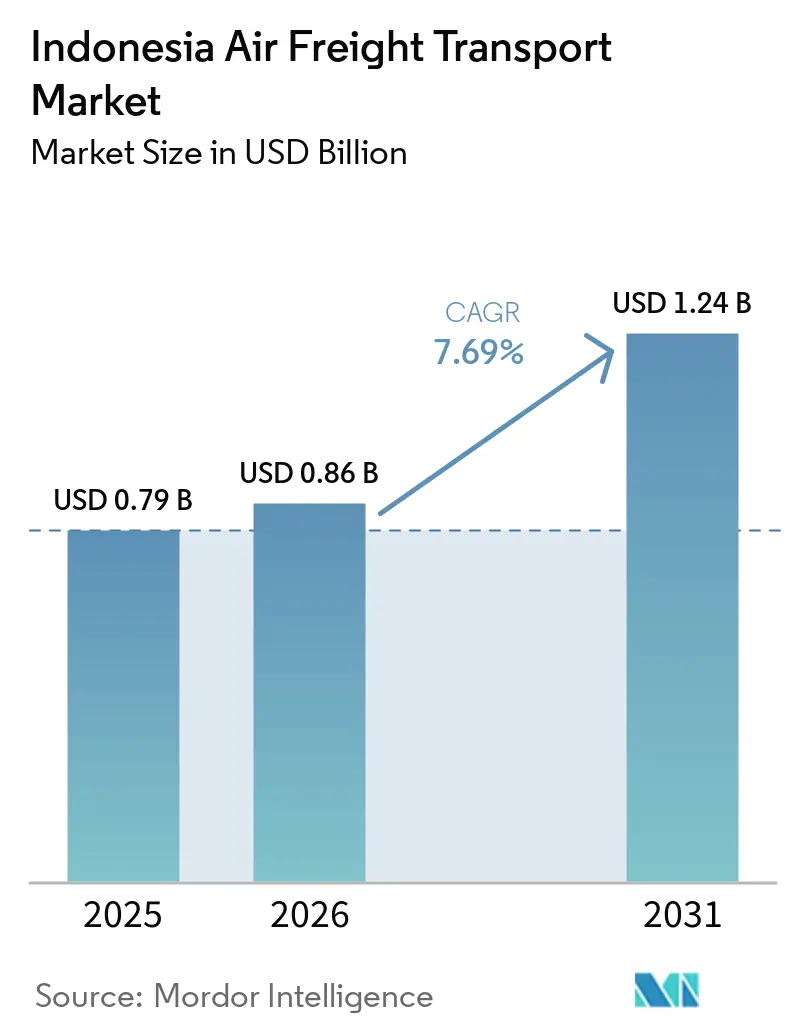
The Indonesia air freight transport market size was valued at USD 0.79 billion in 2025, and is estimated to grow from USD 0.86 billion in 2026 to reach USD 1.24 billion by 2031, at a CAGR of 7.69% during the forecast period (2026-2031).
Indonesia’s island geography makes air transport important for deliveries that need a defined arrival time. Online commerce, export manufacturing, and healthcare distribution are increasing the need for reliable air cargo networks. Airport investment can improve capacity, but carriers also need to manage aircraft availability and higher operating costs. The Indonesia air freight transport market is moving toward more specialized handling, especially for temperature-sensitive and high-value shipments. Competition is strongest where domestic networks meet international express, forwarding, and freighter services.
Key Report Takeaways
- By service, freight transport (cargo/CEP) held 71.25% of the Indonesia air freight transport market share in 2025, while other value-added services are forecast to register at a 9.78% CAGR through 2031.
- By destination, domestic routes accounted for 55.26% of the Indonesia air freight transport market size in 2025, while international routes are forecast to register at a 8.87% CAGR through 2031.
- By carrier type, belly cargo held 68.33% of the Indonesia air freight transport market share in 2025, while freighter operations are forecast to register at a 9.56% CAGR through 2031.
- By cargo type, general cargo held 75.27% of Indonesia air freight transport market size in 2025, while reefer cargo is forecast to register at a 10.24% CAGR through 2031.
- By end-user industry, e-commerce and retail held 28.64% of the Indonesia air freight transport market share in 2025, while healthcare and pharmaceuticals are forecast to register at an 8.97% CAGR through 2031.
- By region, Java held 64.32% of the Indonesia air freight transport market share in 2025, while Sulawesi is forecast to register at an 8.74% CAGR through 2031.
Note: Market size and forecast figures in this report are generated using Mordor Intelligence’s proprietary estimation framework, updated with the latest available data and insights as of January 2026.
Indonesia Air Freight Transport Market Trends and Insights
Drivers Impact Analysis*
| Driver | (~) % Impact on CAGR Forecast | Geographic Relevance | Impact Timeline |
|---|---|---|---|
| E-Commerce And Time-Definite Delivery Expansion | +2.1% | Java core, with spillover to Sumatra, Kalimantan, and Sulawesi | Short term (≤ 2 years) |
| Archipelago Connectivity And Inter-Island Service Need | +1.4% | National, with acute need in Eastern Indonesia and the outer islands | Long term (≥ 4 years) |
| Electronics, Semiconductor, And Automotive Export Recovery | +1.0% | Java, Jakarta, Batam, and Bali gateway routes | Medium term (2-4 years) |
| Healthcare, Pharmaceutical, And Cold-Chain Intensity | +0.9% | National, with early gains in Jakarta, Surabaya, and Makassar hubs | Medium term (2-4 years) |
| Airport Cargo-Terminal Modernization And Network Expansion | +0.7% | Java, Sumatra, Kalimantan, and Sulawesi | Long term (≥ 4 years) |
| Digital Customs And Shipment-Visibility Adoption | +0.5% | National, with CGK as the leading gateway | Medium term (2-4 years) |
| Source: Mordor Intelligence | |||
E-Commerce and Time-Definite Delivery Expansion
The Indonesia air freight transport market benefits when online sellers need delivery commitments that sea and road networks cannot meet across distant islands. Demand is no longer concentrated only in major Java cities, because logistics access is broadening in Sumatra, Kalimantan, and Sulawesi. This creates a wider base of parcels and commercial shipments that require dependable uplift between islands. Airlines and forwarders need to manage short delivery windows, variable daily volumes, and service recovery when an onward flight is delayed. The operational need is not limited to moving a parcel from one airport to another, because sellers also need a predictable handover to local delivery networks after arrival. The shift supports investments in booking systems, airport handling, and scheduled services that can respond to uneven demand without making service commitments unreliable. It also makes service reliability more important for the Indonesia air freight transport market, since a missed connection can affect delivery across several island legs.
Archipelago Connectivity And Inter-Island Service Need
Indonesia has more than 17,000 islands spread across a wide maritime area, which limits the practical reach of road and rail distribution. Eastern Indonesia, including Sulawesi, Papua, and the Maluku Islands, has fewer surface transport links than Java and faces longer transport distances between population centers. Air services are therefore necessary for urgent, high-value, or perishable cargo where slower movement is not suitable. As healthcare distributors, seafood exporters, and electronics businesses extend their operations eastward, the need for regular cargo flights can increase and provide a clearer case for dedicated capacity. The Maleo Airport upgrade in Central Sulawesi extended the runway by 300 meters and improved cargo handling, allowing larger aircraft to serve the area[1]RRI, “Indonesia, China Expand Maleo Airport To Boost Industry, Connectivity,” RRI, rri.co.id. Such improvements can make new freight routes commercially viable, give local producers access to more regular services, and support the Indonesia air freight transport market outside established gateways.
Electronics, Semiconductor, And Automotive Export Recovery
Indonesia’s semiconductor exports reached USD 526.7 million in February 2026, rising 34% from the same period in 2025. Semiconductor assembly and testing activities require dependable movement of imported inputs, including wafers and dies, as well as finished components that need to reach overseas customers promptly. Batam is a key location because its free trade status and manufacturing base connect Indonesia with regional supply chains. DHL identified the country’s semiconductor export potential and described investment activity that supports manufacturing output. GAIKINDO also reported export activity across several automotive brands in the first half of 2026, which supported demand for time-sensitive parts movement. These supply chains provide the Indonesian air freight transport market with cargo that is less dependent on consumer parcel cycles and more closely connected to production schedules, border processing, and regional flight availability.
Healthcare, Pharmaceutical, And Cold-Chain Intensity
Biologics, insulin, vaccines, and specialty injectables need consistent temperature control throughout distribution. This is difficult to maintain over multiple island legs when transit time is long, handling conditions differ, or storage facilities lack validated temperature monitoring. The 2025 revision of drug distribution practice requirements increased attention to cold-chain documentation and monitoring[2]Journal of World Science, “The Implementation of Proper Drug Distribution Methods in Handling Cold Chain Products at a Major Pharmaceutical Distributor in Manado City,” Journal of World Science, doi.org. Air services can support the speed and handling discipline needed for these products, particularly when a short temperature window makes a long surface journey unsuitable. The Indonesia air freight transport market consequently requires more temperature-controlled storage, trained personnel, validated monitoring systems, and procedures that preserve documentation at each transfer point. Providers without controlled 2 °C to 8 °C handling areas may find it harder to qualify for pharmaceutical contracts as compliance expectations rise and product owners assess the full distribution chain.
Restraints Impact Analysis*
| Restraint | (~) % Impact on CAGR Forecast | Geographic Relevance | Impact Timeline |
|---|---|---|---|
| Aircraft Serviceability And Fleet Availability Constraints | -0.9% | National, with the largest effect on outer-island routes in Sulawesi and Papua | Short term (≤ 2 years) |
| Aviation-Turbine-Fuel, Foreign-Exchange, And Spare-Parts Cost Exposure | -1.3% | Global, with a larger effect on Indonesia’s import-cost structure | Short term (≤ 2 years) |
| High Inter-Island Cargo Charges And Inconsistent Volumetric-Weight Rules | -0.7% | Eastern Indonesia and secondary routes, with spillover to MSME shippers nationally | Medium term (2-4 years) |
| Uneven Cold-Chain And Cargo-Handling Capability Outside Major Gateways | -0.5% | Kalimantan, Sulawesi, Papua, and Maluku | Long term (≥ 4 years) |
| Source: Mordor Intelligence | |||
Aircraft Serviceability And Fleet Availability Constraints
Fleet availability remains important because cargo schedules depend on aircraft that can enter service consistently and connect remote destinations without frequent cancellation. Smaller routes can be affected more severely when an aircraft is unavailable, because substitute capacity may not be readily available, and customers may have few practical alternatives. Maintenance lead times and the foreign-currency cost of aircraft parts add pressure to operating budgets and affect decisions on aircraft use. These constraints are especially relevant for older aircraft that serve short-runway routes in outer-island locations. A planned maintenance, repair, and overhaul hub at Kertajati offers a longer-term response, but it does not immediately resolve near-term serviceability limits.
Aviation-Turbine-Fuel, Foreign-Exchange, And Spare-Parts Cost Exposure
Fuel, maintenance, and spare parts costs affect the price that carriers and forwarders can offer to shippers and the financial case for keeping aircraft on lower-volume routes. Imported components are usually priced in USD or EUR so that currency movements can raise costs in Indonesian rupiah terms. Fuel surcharges can pass some of this burden to customers, but they make price-sensitive inter-island shipments less attractive and can encourage some discretionary freight to move by sea. Forwarders also face difficulty in committing to long-term pricing when surcharge adjustments lag current fuel costs and customer budgets require stable transport rates. Smaller operators have less flexibility to absorb these changes than carriers with broader networks or hedging capacity. Cost pressure can therefore slow volume growth in the Indonesia air freight transport market without removing the need for urgent, high-value, perishable, or specialized air shipments.
*Our forecasts treat driver/restraint impacts as directional, not additive. The impact forecasts reflect baseline growth, mix effects, and variable interactions.
Segment Analysis
By Service: Value-Added Layers Outrun Core Transport Growth
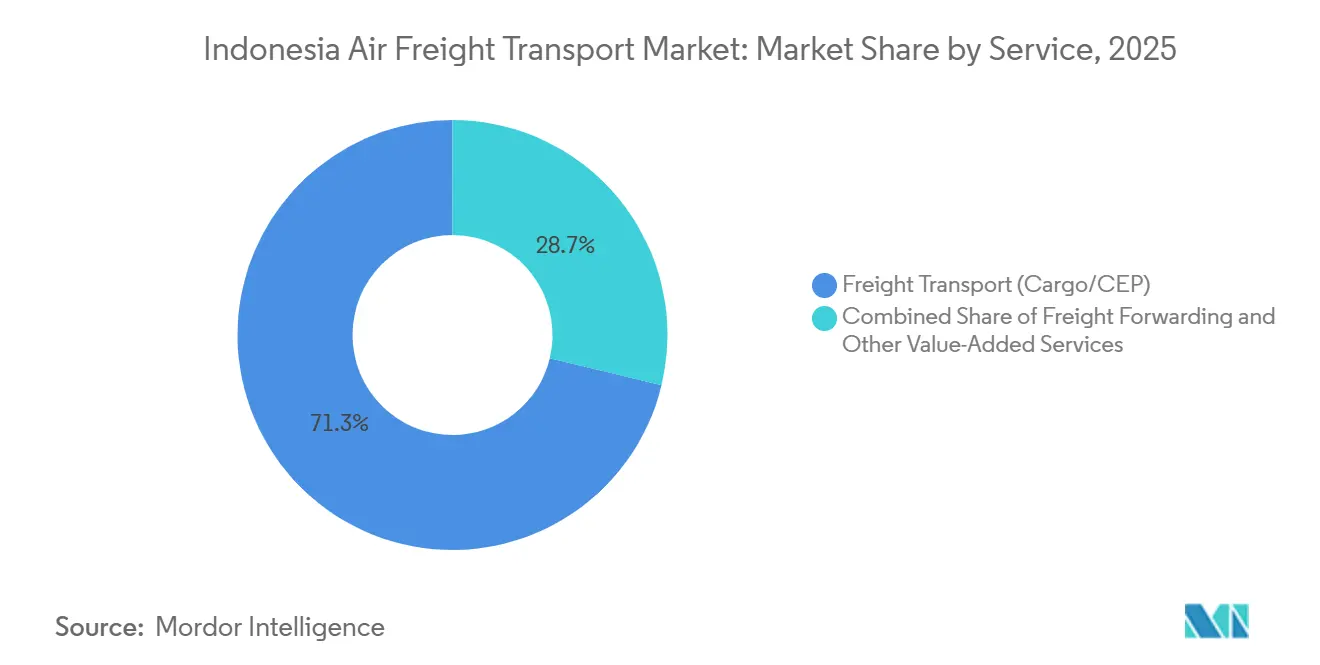
Freight transport (cargo/CEP) held 71.25% of the Indonesia air freight transport market share in 2025, making it the largest service category in the market, while other value-added services are forecast to register at a 9.78% CAGR through 2031. Freight forwarding remains important because it coordinates shipments that use air, sea, and road links. Customs brokerage, insurance, and specialty handling are included within the growing value-added category. Shippers increasingly need visibility, compliance support, and protection against cargo loss alongside physical transport. This changes the revenue model from a transport-only transaction to a broader service relationship.
The Indonesia air freight transport industry can gain more value when providers combine cargo movement with documentation and tracking that remains available throughout the shipment journey. Such services can help customers manage customs processes, insurance needs, special handling instructions, and delivery evidence through one provider rather than several separate parties. Heavy shipments also need a clear commercial option when they exceed standard express parcel thresholds but still require time-definite air movement. Digital shipment visibility can reduce uncertainty for cargo owners by making handoffs and movement status easier to follow. The fastest-growing service area shows why transport providers need operational, customer-service, and compliance capabilities in addition to aircraft access, because the customer’s requirement often covers export documentation, cargo acceptance, regulatory checks, insurance, customs coordination, tracking, and delivery confirmation, as well as the flight itself. This need is especially relevant for exporters that coordinate documents and cargo movement across an Indonesian origin, an international gateway, and a foreign destination.



By Destination: Domestic Strength Coexists With Accelerating International Lanes
Domestic routes accounted for 55.26% of the Indonesia air freight transport market size in 2025, reflecting the central role of inter-island distribution, while international routes are forecast to expand at an 8.87% CAGR through 2031. Domestic shipments serve consumer markets and commercial activity across islands that do not have continuous road or rail connections. International traffic is supported by electronics, pharmaceuticals, and e-commerce exports moving through Jakarta and Batam.
International expansion can improve the wider air cargo network when carriers add frequencies on trade lanes and make their capacity visible to more freight forwarders. Inbound aircraft can provide capacity that supports domestic redistribution after international cargo is unloaded and processed at the gateway. Garuda Indonesia Cargo listed its international cargo capacity exclusively on WebCargo by Freightos in September 2025. The listing covered routes to Singapore, Tokyo, Jeddah, Shanghai, Sydney, and Hong Kong. It gave freight forwarders access to real-time booking for these services and reduced the reliance on manual capacity inquiries. Network quality can improve when international carriers and integrators build stronger operations at Indonesian gateways, because domestic customers can use better-connected airport facilities and schedules, and because greater international frequency can improve access to capacity, ground handling, information, and onward connections that support the national distribution network.
By Carrier Type: Belly Dependence Masks A Fast-Moving Freighter Build-Out
Belly cargo held 68.33% of the Indonesia air freight transport market share in 2025, confirming its established role in the Indonesia air freight transport market, while freighter operations are forecast to register at a 9.56% CAGR through 2031. Passenger flights provide useful capacity for routine cargo and connect major domestic locations. Dedicated freighters are better suited to goods that need priority handling or do not fit easily in passenger aircraft holds. Reefer shipments, dangerous goods, oversized loads, and e-commerce peaks can all need dedicated capacity. The carrier mix will depend on how effectively scheduled passenger services can meet these specialized requirements.
Garuda Indonesia and Citilink signed an MoU in the first half of 2026 to explore Citilink’s operation of a dedicated Boeing 737-500 freighter with 13.5 tons of capacity within the Garuda Group cargo network. The proposal responds to cargo needs that belly capacity alone may not serve, particularly when a customer needs predictable space rather than access to residual passenger-flight capacity. Emirates SkyCargo added 5 Boeing 777 freighters in FY 2026 and increased its all-cargo capacity by 13% year-over-year. Its expanded network can strengthen dedicated capacity on routes linked to Indonesian gateways. Belly-only domestic strategies may become less competitive in premium lanes where speed, reliability, and product handling matter. The Indonesia air freight transport market is therefore likely to require a balance of passenger-belly capacity and dedicated freighter services across both local and international flows, with passenger networks serving recurring routine shipments and freighter capacity supporting cargo that needs greater certainty, specialist equipment, priority treatment, or space during demand peaks.
By Cargo Type: Reefer Cargo Leads Growth As Temperature-Compliance Costs Rise
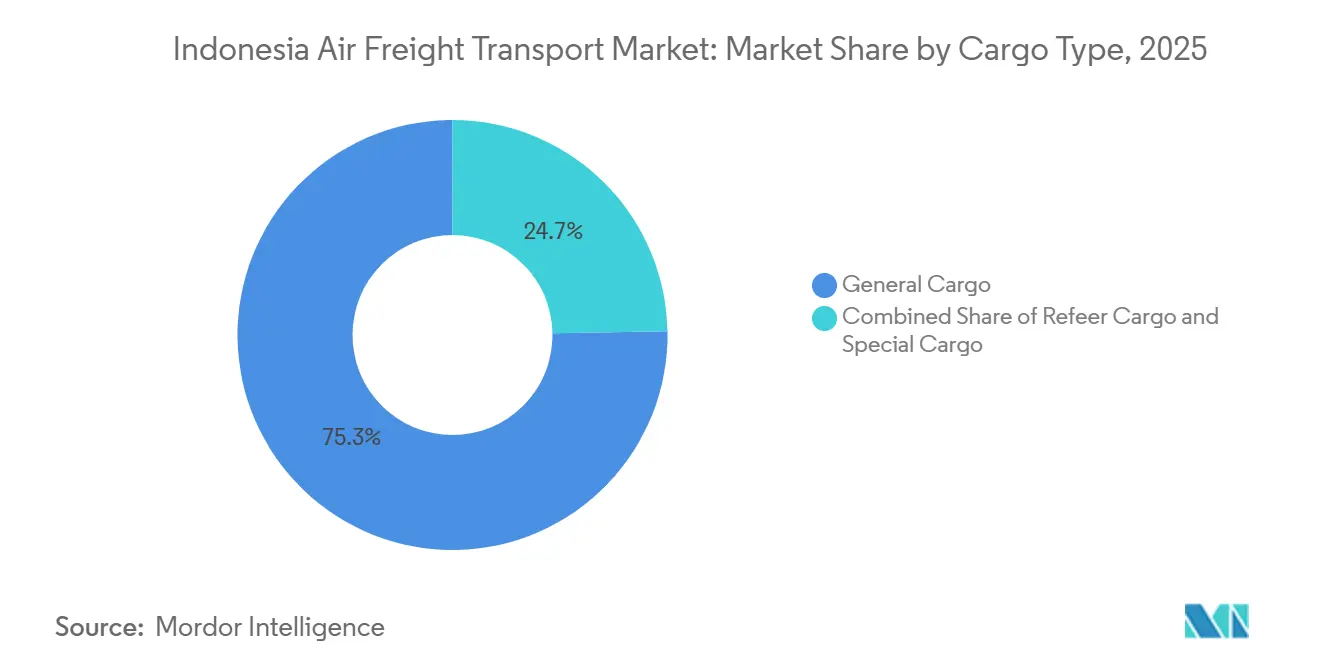
General cargo held 75.27% of the Indonesia air freight transport market size in 2025, while reefer cargo is forecast to expand at a 10.24% CAGR through 2031. This was the highest projected growth rate among the reported segments. General cargo includes manufactured products, textiles, and standard parcels that can move under standard handling conditions. Reefer cargo is supported by pharmaceutical distribution and fresh produce exports. Special cargo includes dangerous goods, high-value consignments, and oversized items. The Indonesia air freight transport market size for reefer cargo depends on facilities that can protect product quality during airport handling.
Cold-chain infrastructure requires refrigerated zones, monitoring systems, trained personnel, and handling processes that protect cargo during acceptance, storage, transfer, and release. These capabilities can be difficult and costly to add to standard cargo facilities because the equipment and procedures need to work consistently across every handoff. Celebi Aviation opened an 8,000 m² cargo terminal at Kualanamu International Airport in Medan in 2025[3]Çelebi Aviation, “Çelebi Aviation Strengthens Its Presence in Indonesia with New Cargo Terminal in Kualanamu,” Çelebi Aviation, celebiaviation.com. The facility includes cold-chain logistics, dangerous-goods handling, and an advanced warehouse management system with real-time visibility. The investment sets a relevant standard for handlers competing for specialized cargo. Airports outside the largest hubs may face a competitive gap if their temperature-controlled capability does not improve, particularly as pharmaceutical customers expect documented compliance, consistent storage conditions, trained staff, and reliable handoffs between the airline, handler, forwarder, customs authorities, and the final distribution provider.
By End-User Industry: E-Commerce Leads While Pharma Reshapes Freight Economics
E-commerce and retail held 28.64% of the Indonesia air freight transport market share in 2025, the largest share among reported user groups, while healthcare and pharmaceuticals are forecast to register at an 8.97% CAGR through 2031. Online retail supports recurring parcel flows across the archipelago. Healthcare demand requires services that can protect temperature-sensitive products and maintain documented handling. Manufacturing and automotive, perishables and fresh produce, and high-tech and electronics add separate cargo requirements. Other users include oil and gas equipment and humanitarian goods.
The largest end-user category includes both routine express parcels and higher-service freight, so the same network needs to accommodate distinct service expectations. Pharmaceutical and electronics shipments require greater control, even when their volumes are smaller than standard e-commerce parcels, and their shipment pattern is less regular. Kualanamu’s position in North Sumatra supports fishery and agricultural exports that need cold-chain handling. DHL Express Indonesia operates more than 70 daily flights and 7 gateways in the country. The Indonesia air freight transport market has room for providers that can serve different end-user needs without treating every shipment as a standard parcel. This mix favors network operators that can combine gateway capacity, customer service, document support, and specialized handling when a shipment requires more than basic uplift, especially where a product needs controlled temperatures, high-security processes, priority loading, or rapid release after it arrives at an Indonesian or overseas airport.
Geography Analysis
Java held 64.32% of revenue in 2025, giving it the largest Indonesia air freight transport market share because Soekarno-Hatta serves the manufacturing centers of Greater Jakarta, Bandung, and Surabaya. InJourney Airports Program is carrying out a 2026 revitalization program at 4 airports, including Soekarno-Hatta, while PT PP secured an IDR 1.19 trillion (USD 67 million) contract in August 2026 to revitalize Terminal 1A. The work forms part of the Integrated Cargo Village project, which is planned to lift annual cargo handling capacity to 1.5 million tons and provide greater support for the airport’s role as the main national gateway. DHL Express also launched a direct Singapore to Semarang cargo route that connects Central Java manufacturers with international supply chains. The route can reduce dependence on Soekarno-Hatta for textile, garment, and footwear exporters that need international access from the Central Java industrial cluster.
Sumatra is the second-largest air freight region, and Kualanamu is a key cargo location for an island with fisheries, palm oil, and rubber export activity. The airport handled 58,000 tons of cargo annually and added Celebi Aviation’s 8,000 m² cold-chain-capable cargo terminal in 2025, giving exporters access to facilities for specialized handling. Kalimantan’s cargo needs are centered on mining, energy, construction equipment, and chemical shipments, where the cost of delay can support air movement for priority goods.
Sulawesi is forecast to register at an 8.74% CAGR through 2031, the fastest regional rate in the Indonesia air freight transport market, with airport investment, seafood exports, consumer demand, and public connectivity programs supporting the increase. The Maleo Airport improvement offers a practical example of added capacity in Eastern Indonesia and enables larger aircraft to serve Central Sulawesi. Bali and Nusa Tenggara handle high-value perishables, luxury goods, specialty shipments, and a smaller e-commerce base that is linked to tourism and regional trade. Ngurah Rai’s terminal expansion is planned to increase passenger capacity to 32 million each year, which can increase belly cargo availability on routes to Australia, Japan, and Greater China. This can make Bali a stronger export gateway for eastern Java and Lombok producers that need access to international passenger networks. Papua and Maluku are the most isolated freight areas because road and rail access is minimal, making air essential for many goods despite high freight costs and limited cargo-handling capability.
Competitive Landscape
The Indonesia air freight transport market is fragmented, with Garuda Indonesia Cargo and Lion Air Cargo leading domestic belly-hold volumes. At the same time, DHL Group, FedEx, and DSV compete in premium express and international forwarding services. Domestic inter-island routes rely heavily on national carriers and scheduled passenger capacity, whereas international lanes attract global operators that invest in gateways, digital distribution, and dedicated freighters. DSV completed the integration of DB Schenker in Indonesia in May 2026 and formed PT DSV Transport Indonesia for air and sea freight operations. The combined business increases scale in forwarding and can place pressure on mid-tier operators that lack comparable network reach or co-loading options. Competition differs by route because the same providers do not supply domestic coverage, international reach, and specialized handling.
Garuda Indonesia Cargo made its international capacity available exclusively through WebCargo by Freightos in September 2025, giving 10,000 freight-forwarder offices real-time eBooking access. Emirates SkyCargo signed a preferred partnership with Teleport in April 2025, extending its reach to more than 100 Southeast Asian destinations, including Indonesian secondary and tertiary airports[4]Emirates SkyCargo, “Emirates SkyCargo Signs Preferred Partnership with Teleport,” Emirates SkyCargo Media Centre, skycargo.com. This approach provides broad network access without requiring owned ground infrastructure at every location and demonstrates the value of global-local partnerships in an archipelago. Celebi Aviation’s Kualanamu facility shows that specialized terminal investment, including cold-chain and dangerous-goods capability, is also a competitive tool. These moves show why digital access, local partnerships, compliant handling, and appropriate aircraft capacity are central to competition in the Indonesia air freight transport market.
Cold-chain infrastructure outside Java remains an important opening for airport handlers and forwarders. At the same time, dedicated freighter services on Sulawesi and Kalimantan routes could address demand that passenger-belly networks do not serve consistently. Integrated customs brokerage and air transport can be relevant for pharmaceutical importers and exporters that need documented handling and reliable clearance processes. DGCA requirements and IATA e-AWB standards place more importance on digital compliance and shipment visibility for contracts involving pharmaceutical manufacturers, electronics original equipment manufacturers, and e-commerce platforms. Smaller companies can compete through specialization, but they need sufficient network access, handling controls, and consistent operating performance to do so.
Indonesia Air Freight Transport Industry Leaders
Garuda Indonesia Cargo
Lion Air Cargo
DHL Global Forwarding
Kuehne+Nagel Indonesia
DSV A/S
- *Disclaimer: Major Players sorted in no particular order

Recent Industry Developments
- June 2026: Emirates SkyCargo expanded its freighter network across East and Southeast Asia, boosting frequencies and adding destinations in response to growing manufacturing-hub demand. The carrier moved over 439,000 tons of cargo from 12 East and Southeast Asian markets in FY 2026, a 5% increase year-over-year.
- December 2025: Celebi Aviation opened a new 8,000 m² cargo terminal at Kualanamu International Airport in Medan, North Sumatra, its second Indonesia operation after entering with ground handling in 2024. The terminal includes cold-chain logistics zones, dangerous-goods capability, an Advanced Warehouse Management System with real-time tracking, and biometric access security.
- September 2025: Garuda Indonesia Cargo listed its international cargo capacity exclusively on WebCargo by Freightos, granting real-time eBooking access to 10,000 freight-forwarder offices across key routes, including Jakarta–Singapore, Tokyo, Jeddah, Shanghai, Sydney, and Denpasar–Sydney, Hong Kong, and Tokyo Narita. The platform integration digitizes capacity allocation, pricing transparency, and booking confirmation for Garuda's international cargo lanes.
- April 2025: Emirates SkyCargo signed a preferred partnership MoU with Teleport, AirAsia's exclusive cargo arm. The agreement expands Emirates SkyCargo's effective reach to over 100 Southeast Asian destinations, including Indonesian secondary and tertiary airports served by Indonesia AirAsia, creating a hub-and-spoke cargo network connecting Indonesian origins to Emirates' global freighter network via Dubai.


Indonesia Air Freight Transport Market Report Scope
| Freight Transport (Cargo/CEP) |
| Freight Forwarding |
| Other Value-Added Services (Customs Brokerage, Insurance, etc.) |
| Domestic |
| International |
| Belly Cargo |
| Freighter |
| General Cargo |
| Reefer Cargo |
| Special Cargo (Dangerous, High Value, Oversized, etc.) |
| E-commerce and Retail |
| Manufacturing and Automotive |
| Healthcare and Pharmaceuticals |
| Perishables and Fresh Produce |
| High-Tech and Electronics |
| Others |
| Java (Jakarta & BOD) |
| Sumatra |
| Kalimantan |
| Sulawesi |
| Bali and Nusa Tenggara |
| Papua Region and Maluku Islands |
| By Service | Freight Transport (Cargo/CEP) |
| Freight Forwarding | |
| Other Value-Added Services (Customs Brokerage, Insurance, etc.) | |
| By Destination | Domestic |
| International | |
| By Carrier Type | Belly Cargo |
| Freighter | |
| By Cargo Type | General Cargo |
| Reefer Cargo | |
| Special Cargo (Dangerous, High Value, Oversized, etc.) | |
| By End-User Industry | E-commerce and Retail |
| Manufacturing and Automotive | |
| Healthcare and Pharmaceuticals | |
| Perishables and Fresh Produce | |
| High-Tech and Electronics | |
| Others | |
| By Region | Java (Jakarta & BOD) |
| Sumatra | |
| Kalimantan | |
| Sulawesi | |
| Bali and Nusa Tenggara | |
| Papua Region and Maluku Islands |


Key Questions Answered in the Report
What is the forecast growth rate for air freight transport in Indonesia?
The Indonesia air freight transport market is forecast to register at a 7.69% CAGR from 2026 to 2031, rising from USD 0.86 billion in 2026 to USD 1.24 billion by 2031. Inter-island delivery needs, export activity, and specialized healthcare distribution support growth.
Which service category has the largest share of revenue?
Freight transport (cargo/CEP) led service revenue with a 71.25% share in 2025, while value-added services have the highest forecast to register at 9.78% CAGR. Brokerage, insurance, specialty handling, and tracking are increasingly relevant to customers.
Why is reefer cargo growing faster than other cargo types?
Reefer cargo is forecast to register at a 10.24% CAGR through 2031 because pharmaceutical products and fresh exports require controlled temperatures and rapid handling. Airports need refrigerated storage, monitoring, and trained personnel to meet these needs.
Which Indonesian region leads air cargo activity?
Java led with a 64.32% share in 2025 because Soekarno-Hatta and the Jakarta, Bandung, and Surabaya corridor concentrate manufacturing and gateway activity. Terminal revitalization and the Integrated Cargo Village project are planned to strengthen this role.
Which region is expected to grow the fastest?
Sulawesi is forecast to register at 8.74% CAGR through 2031, supported by resource logistics, seafood exports, consumer demand, and airport investment. Airport improvements can allow larger aircraft to connect Central Sulawesi with the wider network.
How are dedicated freighters affecting cargo services?
Freighter operations are forecast to register at 9.56% CAGR through 2031 as they support reefer, dangerous, oversized, and peak e-commerce shipments that need more certainty than belly capacity provides. They complement scheduled passenger services rather than replacing them.
Page last updated on:





