
Individual Health Insurance Market Size and Share
Market Overview
| Study Period | 2021 - 2032 |
|---|---|
| Market Size (2027) | USD 356.30 Billion |
| Market Size (2032) | USD 459.10 Billion |
| Growth Rate (2027 - 2032) | 5.20 % |
| Fastest Growing Market | Asia-Pacific |
| Largest Market | North America |
| Market Concentration | Low |
Major Players *Disclaimer: Major Players sorted in no particular order Image © Mordor Intelligence. Reuse requires attribution under CC BY 4.0. | |
Individual Health Insurance Market Analysis by Mordor Intelligence
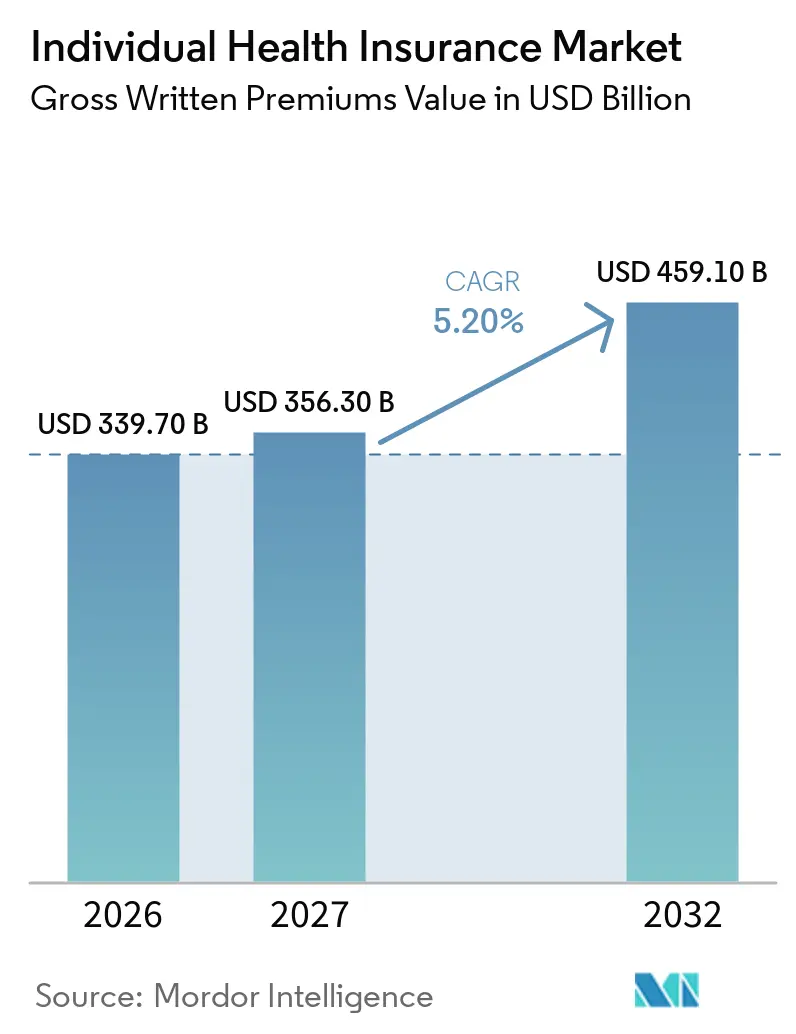
The Individual Health Insurance Market size in terms of gross written premiums value is projected to be USD 339.70 billion in 2026, USD 356.30 billion in 2027, and reach USD 459.10 billion by 2032, growing at a CAGR of 5.20% from 2027 to 2032.
Demand is supported by chronic disease, population aging, and household exposure to out-of-pocket medical costs. Coverage needs are rising across the Asia-Pacific region as disposable income increases and insurance protection gaps remain wide. In the United States, the expiration of enhanced premium tax credits has reduced affordability for many buyers, which has constrained enrollment. Insurers are responding with digital enrollment tools, modular benefits, care management, and health-service partnerships that make plan selection and ongoing support more practical for customers. These approaches give the individual health insurance market opportunities to serve buyers who need portable and more flexible coverage while supporting longer relationships across changing health and employment needs, income patterns, family structures, service expectations, local regulation, and evolving consumer preferences.
Key Report Takeaways
- By product type, comprehensive medical expense plans captured 60.4% of the individual health insurance market share in 2026, while hybrid and other individual health plans are projected to grow at a 7.3% CAGR through 2032.
- By policyholder type, individual policies captured 54.8% of the individual health insurance market share in 2026, while family policies are projected to grow at a 5.8% CAGR through 2032.
- By distribution channel, agents and brokers captured a 41.7% of the individual health insurance market share in 2026, while digital aggregators and insurtech platforms are projected to grow at an 8.5% CAGR through 2032.
- By policy duration, annual renewable health insurance captured a 70.6% of the individual health insurance market share in 2026, while long-term and lifetime health insurance is projected to grow at a 6.2% CAGR through 2032.
- By geography, North America captured a 38.7% of the individual health insurance market share in 2026, while Asia-Pacific is projected to grow at a 6.8% CAGR through 2032.
Note: Market numbers in this report are based on Mordor Intelligence's proprietary estimation framework, which combines nine months of actuals with Q4 projections for base year 2026.
Market Trends and Insights
Drivers Impact Analysis of Individual Health Insurance Market*
| Driver | (~) % Impact on CAGR Forecast | Geographic Relevance | Impact Timeline |
|---|---|---|---|
| Rising Chronic Disease Prevalence and Recurring Treatment Costs | +1.3% | Global, with the greatest intensity in North America, Western Europe, and Japan | Long term (≥ 4 years) |
| Population Aging and Demand for Individual Medical Coverage | +1.0% | Japan, China, Western Europe, and Australia | Long term (≥ 4 years) |
| Out-of-Pocket Healthcare Costs and Need for Financial Protection | +0.9% | Asia-Pacific emerging markets, the Middle East, and Latin America | Medium term (2-4 years) |
| Digital Insurance Marketplaces and Direct-to-Consumer Distribution | +0.8% | Global, with early gains in North America, Southeast Asia, and Western Europe | Short term (≤ 2 years) |
| Self-Employment, Gig Work, and Individually Purchased Coverage | +0.6% | North America, Western Europe, and India | Medium term (2-4 years) |
| Flexible, Modular, and Personalized Health Insurance Plans | +0.5% | Global, led by technology-forward markets in Asia and North America | Medium term (2-4 years) |
| Source: Mordor Intelligence | |||
Chronic Disease Burden Reshaping the Individual Coverage Imperative
Chronic illness is increasing both the need for coverage and the cost of serving individual policyholders. The current policy environment points to sustained demand for benefits that support recurring treatment, ongoing medication access, and care coordination. The Centers for Disease Control and Prevention reports that chronic and mental health conditions account for 90% of annual healthcare spending in the United States, creating a continuing financial-protection need for households[1]. In China, health insurers are expanding coverage around oncology, cardiovascular care, and other high-cost treatments as part of a broader shift toward more active health support. Plans that combine reimbursement with disease management, access to appropriate treatments, and navigation services can support retention in the individual health insurance market. This need is especially relevant where a policyholder's care extends across hospital, outpatient, pharmacy, and follow-up services.
Aging Demographics Intensifying Demand for Continuous Coverage
Older populations are changing benefit needs rather than merely adding more customers to existing insurance rolls. Japan has a large older population, and supplemental individual policies address services that public coverage does not fully meet, including premium hospital access and longer-term care needs. China is also seeing demand from middle-income households for benefits beyond the basic social insurance entitlement. These conditions increase interest in guaranteed renewability, stable premiums, age-appropriate benefits, and benefits that remain relevant as treatment needs change. The individual health insurance market is therefore moving toward products that can support long treatment periods and predictable access to care. Insurers that align coverage design with changing household health needs can build stronger long-term customer relationships.
Digital Distribution Disrupting the Established Broker Channel
Digital enrollment is changing how buyers compare and select individual health insurance plans. Oscar Health increased its individual membership from approximately 1.6 million in June 2024 to roughly 3 million in June 2026 through the individual market[2]. The company introduced Oswell, a personal AI health agent, in October 2025. Oswell uses member medical records and benefit documents to provide guidance. These tools make plan information easier to access and can reduce friction during enrollment. They also make opaque designs less competitive because consumers can compare coverage details more easily. The individual health insurance market is likely to reward insurers that combine clear benefits with simple digital service.
Self-Employment and Gig Work Creating a Structural Individual-Market Base
Self-employed and gig workers form an important group of buyers because their access to employer-sponsored benefits is less consistent. The Center on Budget and Policy Priorities estimated that 5 million small-business owners and self-employed workers enrolled in Affordable Care Act marketplaces at some point during 2025[3]. The same group faces income variation, which can make fixed premium commitments more difficult to manage. Portable benefits, flexible payment terms, and direct enrollment can improve the fit for these buyers. Growth in this customer base supports demand for individual health insurance market offerings that are not connected to a single employer. Insurers also need designs that recognize that the buyer, payer, and beneficiary may be the same person.
Restraints Impact Analysis of Individual Health Insurance Market*
| Restraint | (~) % Impact on CAGR Forecast | Geographic Relevance | Impact Timeline |
|---|---|---|---|
| Premium Affordability, Underinsurance, and Policy Lapses | -1.5% | North America, Latin America, South Asia, and Southeast Asia | Medium term (2-4 years) |
| Medical Cost Inflation and High-Cost Treatment Spending | -1.2% | North America, Western Europe, and Australia | Long term (≥ 4 years) |
| Adverse Selection and Weakening Individual-Market Risk Pools | -0.7% | North America and European markets with guaranteed-issue provisions | Short term (≤ 2 years) |
| Restricted Provider Networks and Uneven Access to Quality Healthcare | -0.4% | Emerging markets and rural areas globally | Long term (≥ 4 years) |
| Source: Mordor Intelligence | |||
Premium Affordability Straining Enrollment Sustainability
Premium affordability remains a significant constraint on household participation. The Commonwealth Fund reported a median proposed premium increase of 18% for 2026 in the United States, as insurers accounted for higher claims costs and likely enrollment losses after enhanced premium tax credits ended. Enrollment fell from 25.2 million in June 2025 to 20.5 million in June 2026, a decline of 18%[4]. KFF also found that 61% of marketplace participants reported difficulty affording deductibles and out-of-pocket costs, while 51% found premiums difficult to manage in 2025. These pressures can lead buyers to delay enrollment, reduce benefits, or allow policies to lapse. The individual health insurance market needs lower-cost options that retain meaningful protection for price-sensitive households.
Medical Cost Inflation Compressing Underwriting Margins
Medical inflation creates a difficult balance between premiums that households can afford and rates that cover treatment costs. High-cost oncology therapies, GLP-1 medicines, and gene therapies increase claims exposure for insurers and raise the importance of active management of prescription and specialist-care costs. These treatments also make pricing harder when benefit cycles and clinical costs change at different speeds. Insurers are responding with pharmacy benefit negotiations, care programs, fraud controls, and more focused benefit design. The individual health insurance market may face greater pressure where insurers cannot manage these costs or consumers cannot absorb higher premiums. Better coordination between coverage, treatment pathways, and provider networks can reduce some of this pressure.
*Our forecasts treat driver/restraint impacts as directional, not additive. The impact forecasts reflect baseline growth, mix effects, and variable interactions.
Individual Health Insurance Market Segment Analysis
By Product Type:
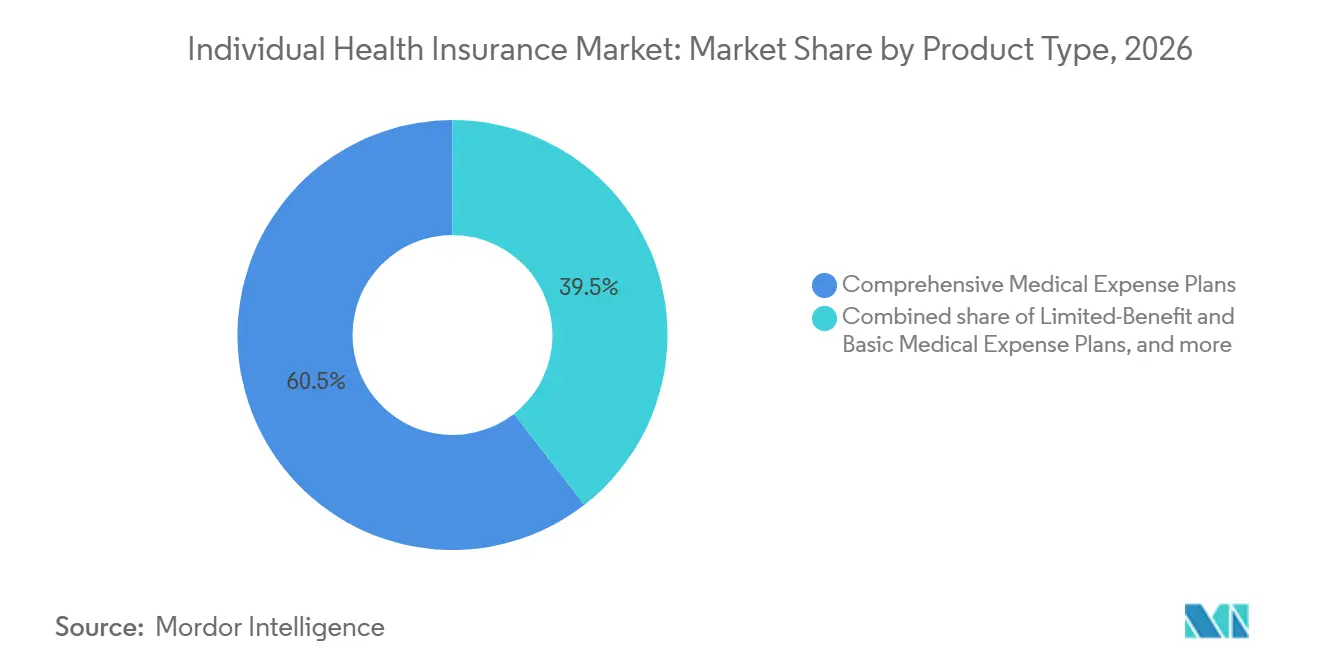
Modular Designs Challenging Comprehensive Plan DominanceComprehensive medical expense plans held 60.4% of the individual health insurance market share in 2026. Their position reflects minimum benefit requirements, established hospital reimbursement networks, and buyer familiarity with broad medical coverage in mature countries. Many policyholders also remain in comprehensive plans because comparing complex benefits takes time and effort. Limited-benefit and basic medical expense plans serve buyers who need some protection but cannot afford broad coverage. Fixed-benefit hospital indemnity plans and specified-disease and named-illness plans remain relevant where underwriting rules allow greater product flexibility.
Hybrid and other individual health plans are projected to grow at a 7.3% CAGR through 2032. These plans allow carriers to combine hospitalization benefits with telemedicine, chronic disease support, and wellness features that can be selected based on a policyholder's circumstances. They are relevant for gig workers, self-employed buyers, and families seeking coverage beyond fixed benefits. AIA Life China launched Zhixuan Yisheng in September 2025 with a core hospitalization benefit and optional layers for premium hospital access, outpatient drugs and devices, and global specialty drugs. Ping An also introduced disease-specific AI products in July 2026 for cardiovascular and oncology patients, combining health monitoring, risk scoring, and insurance benefits. Such products show how the individual health insurance market can move from reimbursement-only coverage toward active health support.
By Policyholder Type:
Family Coverage Demand Driven by Multi-Risk HouseholdsIndividual policies accounted for 54.8% of the individual health insurance market size in 2026. Demand comes from single buyers, self-employed people, workers between jobs, and households without sufficient employer-sponsored coverage. In India, individual retail policies covered 6.01 crore lives in FY2024-25, compared with 27.51 crore lives under group employer plans. Retail premiums reached INR 46,611 crore (USD 5.6 billion) in the same period. This gap indicates continued opportunity for individual retail coverage where public and group protection is limited.
Family policies are forecast to grow at a 5.8% CAGR through 2032. Families can use one plan to simplify payment, claims, and administration across household members with different care needs. The value of this approach rises when households manage different health needs at the same time. Benefit designs that include pediatric wellness, prenatal support, and senior-care options can make family coverage more relevant. Individual health insurance industry participants that tailor plans for changing family health needs can strengthen their appeal. Family plans also give insurers an opportunity to build relationships across more than 1 household member.
By Distribution Channel:
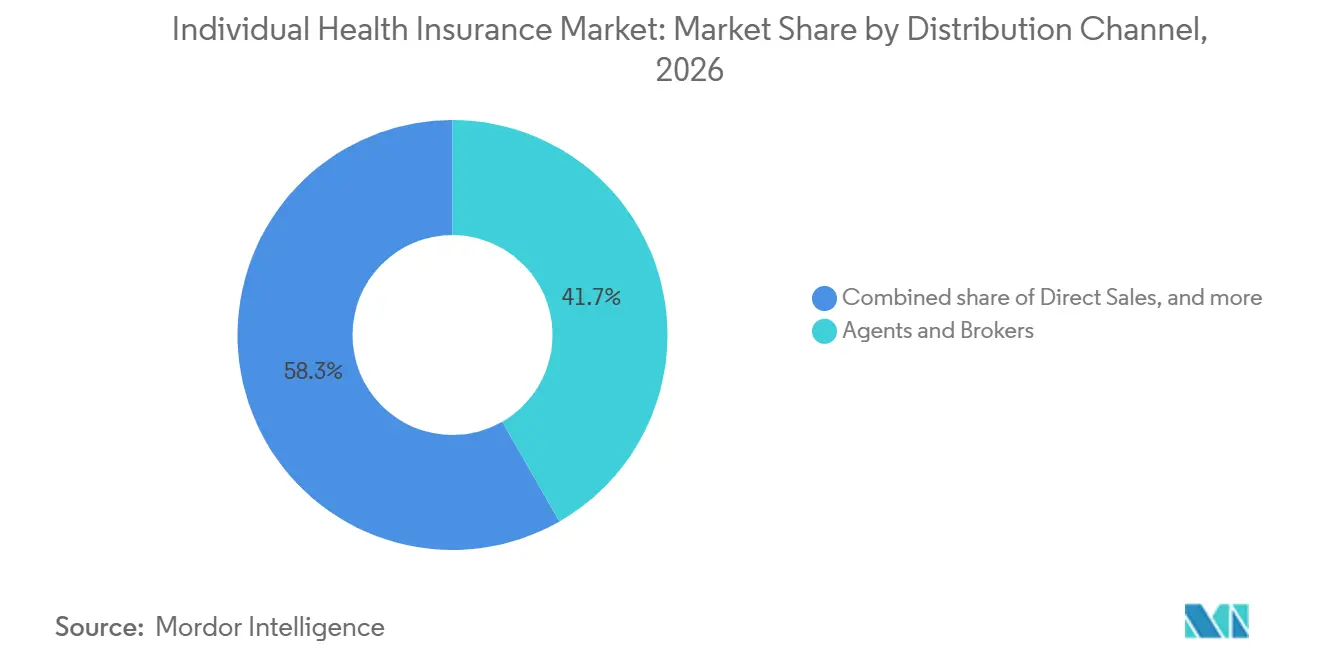
Insurtech Platforms Compressing Broker MarginsAgents and brokers held 41.7% share of the individual health insurance market in 2026. Their role remains important because plan selection can involve provider networks, deductibles, formularies, and cost-sharing rules. Broker support can be especially useful for older customers and people choosing comprehensive coverage. Direct sales offer another route for buyers who can navigate simple digital products without extensive assistance. Bancassurance and other partnerships can extend insurance access where banks have wide physical distribution.
Digital aggregators and insurtech platforms are projected to grow at an 8.5% CAGR through 2032. Their growth reflects consumer demand for self-service comparison, faster purchasing, and clearer access to plan details. Oscar Health launched the Lucie marketplace in 2026 to aggregate Affordable Care Act medical, dental, vision, and supplemental coverage for consumers and brokers. The model brings several coverage categories into a single purchase path. The individual health insurance market will favor platforms that give consumers clear information while also fitting into banking, employer-contribution, or personal-finance workflows.
By Policy Duration:
Long-Term Structures Gaining Ground as Risk Stability ImprovesAnnual renewable health insurance accounted for 70.6% of the individual health insurance market size in 2026. Open-enrollment rules in the United States and annual renewal systems in European countries support this structure. Short-term health insurance serves people in transition between employer plans, after graduation, or before retirement. However, tighter rules in markets with guaranteed-issue protections can limit the use of short-term cover. Annual structures continue to give insurers a familiar way to reassess price and benefit conditions each year.
Long-term and lifetime health insurance is projected to grow at a 6.2% CAGR through 2032. These policies can give older policyholders and people with chronic conditions greater certainty over renewal and premiums. Insurers can benefit from lower acquisition costs per retained customer and a better ability to invest in long-term care management. Singapore's individual health insurance premiums grew 19% year-on-year in 2025, and Integrated Shield Plans covered 3 million of 3.34 million individually insured lives. This model supports stable renewal revenue and continued engagement with policyholders. The individual health insurance market can use similar structures where regulation and consumer demand support longer coverage periods.
Geography Analysis
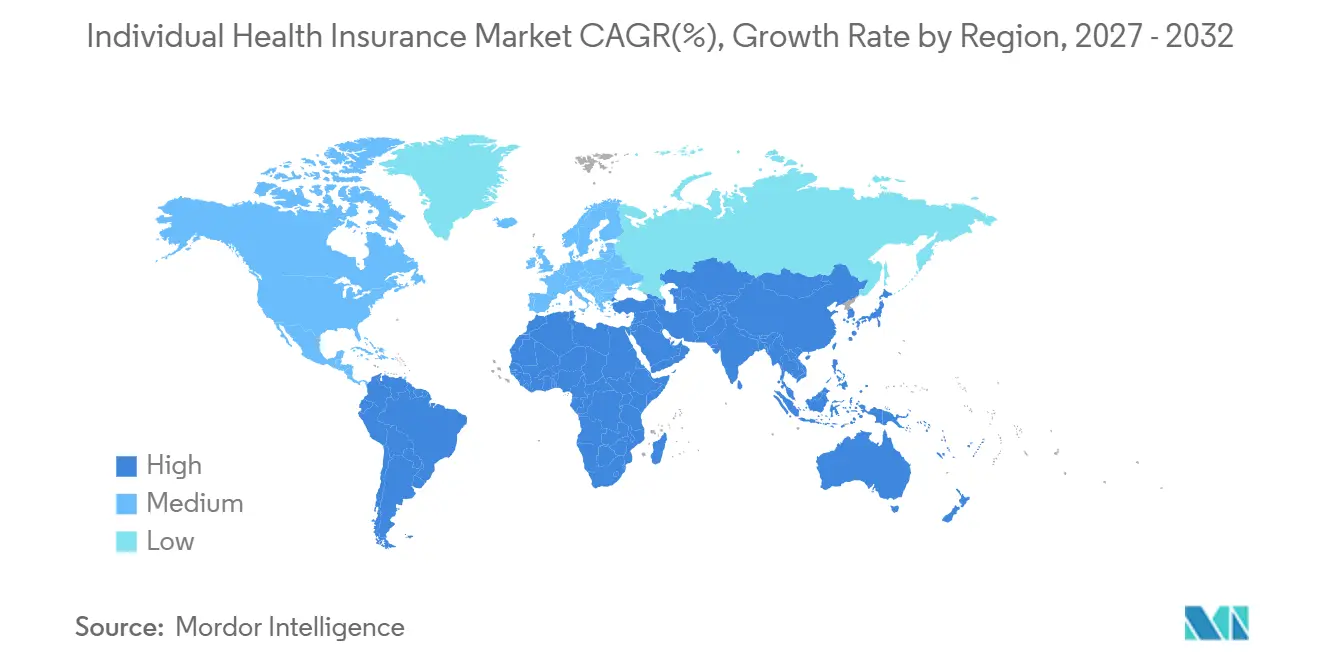
North America accounts for a 38.7% share of the individual health insurance market in 2026. The United States accounts for most regional premium activity, but enrollment declined from 25.2 million in June 2025 to 20.5 million in June 2026 after enhanced premium tax credits expired. This decline shows how strongly affordability and subsidy policy influence individual coverage decisions. The United States needs lower-cost plans and better re-enrollment strategies to stabilize participation. Canada and Mexico provide secondary demand for supplemental private benefits within public coverage systems.
Asia-Pacific is projected to grow at a 6.8% CAGR through 2032, the highest rate among regions. Regional insurance premiums are projected to rise 14% in 2026 to USD 1.4 trillion. India's health insurance gross written premium reached INR 1,17,505 crore (USD 14.1 billion) in FY2024-25, rising 9.19% year-on-year. Singapore's individual health premiums grew 19% in 2025, supported by the scale of Integrated Shield Plans. The Asia-Pacific region has a large protection gap, rising household income, and growing demand for services not fully covered by public systems.
Europe and other regions show more varied demand patterns because public coverage and household income differ widely. France's health insurance and provident contributions reached EUR 89.1 billion (USD 97.1 billion) in 2025, with individual contracts growing 2.4%. Poland's private health insurance gross written premium reached PLN 2.65 billion (USD 657 million) in 2025, while insured lives exceeded 5.8 million. South America faces demand for private coverage but also currency volatility and uneven incomes. The Middle East and Africa are supported by mandatory coverage expansion in Gulf Cooperation Council countries, while digital and embedded distribution may help extend protection in lower-penetration African markets.
Competitive Landscape
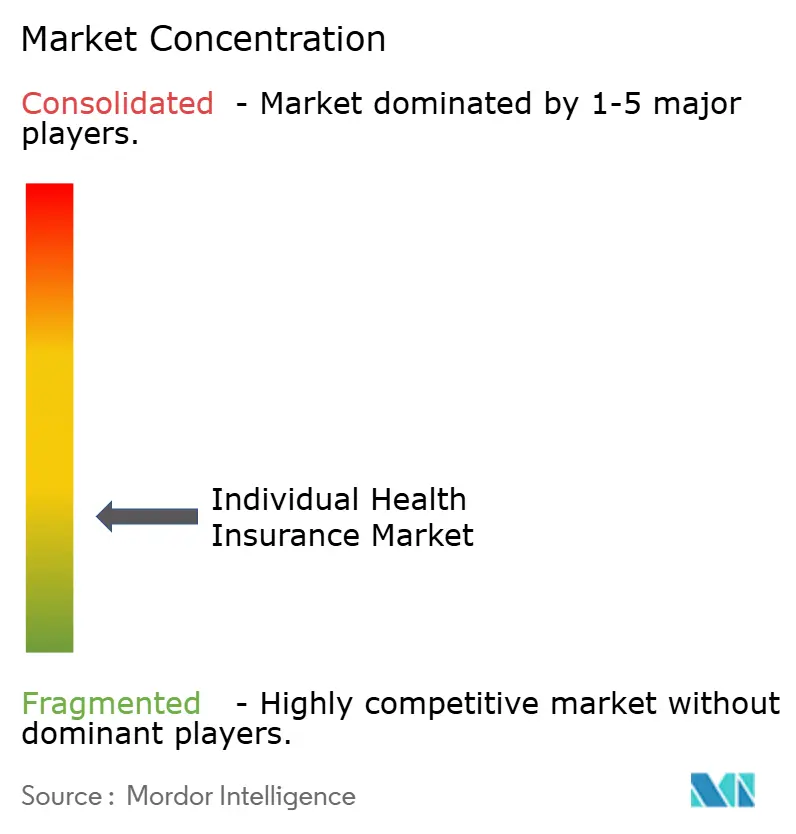
The individual health insurance market is fragmented globally, with competitive structures varying across countries due to differences in regulation, healthcare financing, provider networks, and distribution channels. Although established insurers maintain strong positions in certain national markets, competition remains distributed across regional carriers, specialist health insurers, and digital-first providers. In the United States, the American Medical Association reported that 97% of metropolitan commercial health insurance markets were highly concentrated in 2024, highlighting the strength of local incumbents. However, concentration within individual countries does not translate into global dominance, as insurers face different regulatory requirements and competitive conditions across markets.
Digital innovation, acquisitions, and product expansion are reshaping competition. Oscar Health reported membership growth of 56% year-on-year in the first quarter of 2026, reaching approximately 3 million members, reflecting the potential for technology-enabled distribution and customer engagement. Its launch of Oswell in October 2025 and Lucie in 2026 illustrates the industry's shift toward integrated digital support and purchasing experiences. Meanwhile, Ping An introduced disease-specific artificial intelligence products in 2026, combining health monitoring, risk assessment, and insurance coverage. These developments demonstrate how insurers are differentiating themselves through technology, specialized products, and customer experience rather than relying solely on premiums and provider networks.
Established international insurers are also pursuing acquisitions and product enhancements to strengthen their competitive positions. Bupa completed its acquisition of New Victoria Hospital in the United Kingdom in June 2025, expanding its healthcare delivery capabilities and reinforcing its integrated insurance and care model. AIA introduced its SelectWise Scheme in Hong Kong in February 2026, offering greater flexibility in covered benefits through the removal of individual sub-limits on benefit items. Such initiatives highlight the range of strategies used by insurers to expand distribution, improve customer value, and differentiate their offerings. Overall, the individual health insurance market remains fragmented globally, with opportunities for digital-first insurers, regional specialists, and established carriers to expand through targeted acquisitions, strategic partnerships, portable cross-border coverage, modular outpatient products, and mental health-focused policies.
Individual Health Insurance Industry Leaders
-
UnitedHealth Group Incorporated
-
Centene Corporation
-
AXA SA
-
Bupa
-
AIA Group Limited
- *Disclaimer: Major Players sorted in no particular order
Individual Health Insurance Market Companies Covered in this Report
- UnitedHealth Group Incorporated (UnitedHealthcare)
- Centene Corporation (Ambetter Health)
- Elevance Health, Inc.
- Health Care Service Corporation
- Molina Healthcare, Inc.
- Oscar Health, Inc.
- Bupa Group
- AXA SA
- Allianz SE (Allianz Care)
- DKV Deutsche Krankenversicherung AG
- Vitality Health Limited
- CZ Groep
- Medibank Private Limited
- HCF
- Ping An Insurance (Group) Company of China, Ltd.
- China Life Insurance Company Limited
- AIA Group Limited
- Star Health and Allied Insurance Company Limited
- HDFC ERGO General Insurance Company Limited
- Care Health Insurance Limited
Recent Industry Developments in Individual Health Insurance Market
- August 2026: Ping An Life upgraded "Anyi Bao" medical insurance series, integrating medical, accident, and critical illness protection into a single combination package with dedicated health service coverage for appointment booking, medical escorts, claims handling, and prescription services; the company simultaneously appointed actor Wang Yaoquing as service experience ambassador for its "An You Yi" health management platform.
- July 2026: Ping An unveiled a disease-specific AI product portfolio at the World AI Conference 2026, targeting cardiovascular conditions and critical illnesses with a three-layer product structure: disease prediction tools, disease-specific insurance coverage, and clinical pathway access in partnership with Peking Union Medical College-affiliated services.
- June 2026: Oscar Health membership grew 56% year-on-year in Q1 2026 to 3 million individual market members. Oscar disclosed plans to expand into 400 to 600 additional United States counties by 2029, extending its potential addressable population from 9.6 million to 16 million lives, and to introduce more than 250 off-exchange products for the 2027 plan year.
- May 2026: Ping An Health Insurance launched its “Vibrant Longevity” health protection initiative in China, combining preventive healthcare, medical support, and critical illness management. The company also introduced “Taixiang Xinan,” a managed cardiovascular insurance product for people with chronic conditions such as hypertension and coronary heart disease, integrating insurance coverage with AI-enabled health monitoring, risk alerts, and coordinated medical support. The initiative reflects Ping An’s strategy to integrate healthcare services with insurance products and strengthen proactive disease management.
Global Individual Health Insurance Market Report Scope
Segmentation Overview
| Comprehensive Medical Expense Plans |
| Limited-Benefit and Basic Medical Expense Plans |
| Fixed-Benefit Hospital Indemnity and Confinement Plans |
| Specified-Disease and Named-Illness Plans |
| Hybrid and Other Individual Health Plans |
| Individual Policies |
| Family Policies |
| Direct Sales |
| Agents and Brokers |
| Digital Aggregators and Insurtech Platforms |
| Bancassurance and Other Partnership Channels |
| Short-Term Health Insurance |
| Annual Renewable Health Insurance |
| Long-Term / Lifetime Health Insurance |
| North America | United States |
| Canada | |
| Mexico | |
| South America | Brazil |
| Argentina | |
| Rest of South America | |
| Europe | United Kingdom |
| Germany | |
| France | |
| Italy | |
| Spain | |
| Rest of Europe | |
| Asia-Pacific | China |
| India | |
| Japan | |
| Australia | |
| Rest of Asia-Pacific | |
| Middle East & Africa | United Arab Emirates |
| Saudi Arabia | |
| South Africa | |
| Rest of Middle East & Africa |
| By Product Type | Comprehensive Medical Expense Plans | |
| Limited-Benefit and Basic Medical Expense Plans | ||
| Fixed-Benefit Hospital Indemnity and Confinement Plans | ||
| Specified-Disease and Named-Illness Plans | ||
| Hybrid and Other Individual Health Plans | ||
| By Policyholder Type | Individual Policies | |
| Family Policies | ||
| By Distribution Channel | Direct Sales | |
| Agents and Brokers | ||
| Digital Aggregators and Insurtech Platforms | ||
| Bancassurance and Other Partnership Channels | ||
| By Policy Duration | Short-Term Health Insurance | |
| Annual Renewable Health Insurance | ||
| Long-Term / Lifetime Health Insurance | ||
| By Geography | North America | United States |
| Canada | ||
| Mexico | ||
| South America | Brazil | |
| Argentina | ||
| Rest of South America | ||
| Europe | United Kingdom | |
| Germany | ||
| France | ||
| Italy | ||
| Spain | ||
| Rest of Europe | ||
| Asia-Pacific | China | |
| India | ||
| Japan | ||
| Australia | ||
| Rest of Asia-Pacific | ||
| Middle East & Africa | United Arab Emirates | |
| Saudi Arabia | ||
| South Africa | ||
| Rest of Middle East & Africa | ||
Key Questions Answered in the Report
What is the projected value of the individual health insurance market by 2032?
The individual health insurance market is projected to reach USD 459.1 billion by 2032, expanding at a 5.2% CAGR from 2027.
Which product type leads individual health insurance coverage?
Comprehensive Medical Expense Plans lead with 60.4% share in 2026, supported by established benefit rules and hospital networks.
Which distribution channel is growing fastest?
Digital Aggregators and Insurtech Platforms are projected to grow at an 8.5% CAGR through 2032 as buyers seek easier comparison and enrollment.
Why are family policies gaining demand?
Family Policies are forecast to grow at a 5.8% CAGR through 2032 because they combine coverage, payment, and claims administration for household members.
Which region is expanding fastest?
Asia-Pacific is expected to grow at a 6.8% CAGR through 2032, supported by protection gaps, rising household income, and demand for supplemental coverage.