
India Virtual Classroom Market Size and Share
Market Overview
| Study Period | 2022 - 2032 |
|---|---|
| Forecast Data Period | 2027 - 2032 |
| Base Year Market Size (2026) | USD 4.32 Billion |
| Market Size (2027) | USD 4.57 Billion |
| Market Size (2032) | USD 8.81 Billion |
| Growth Rate (2027 - 2032) | 14.03 % |
| Market Concentration | Medium |
Major Players *Disclaimer: Major Players sorted in no particular order Image © Mordor Intelligence. Reuse requires attribution under CC BY 4.0. | |
India Virtual Classroom Market Analysis by Mordor Intelligence
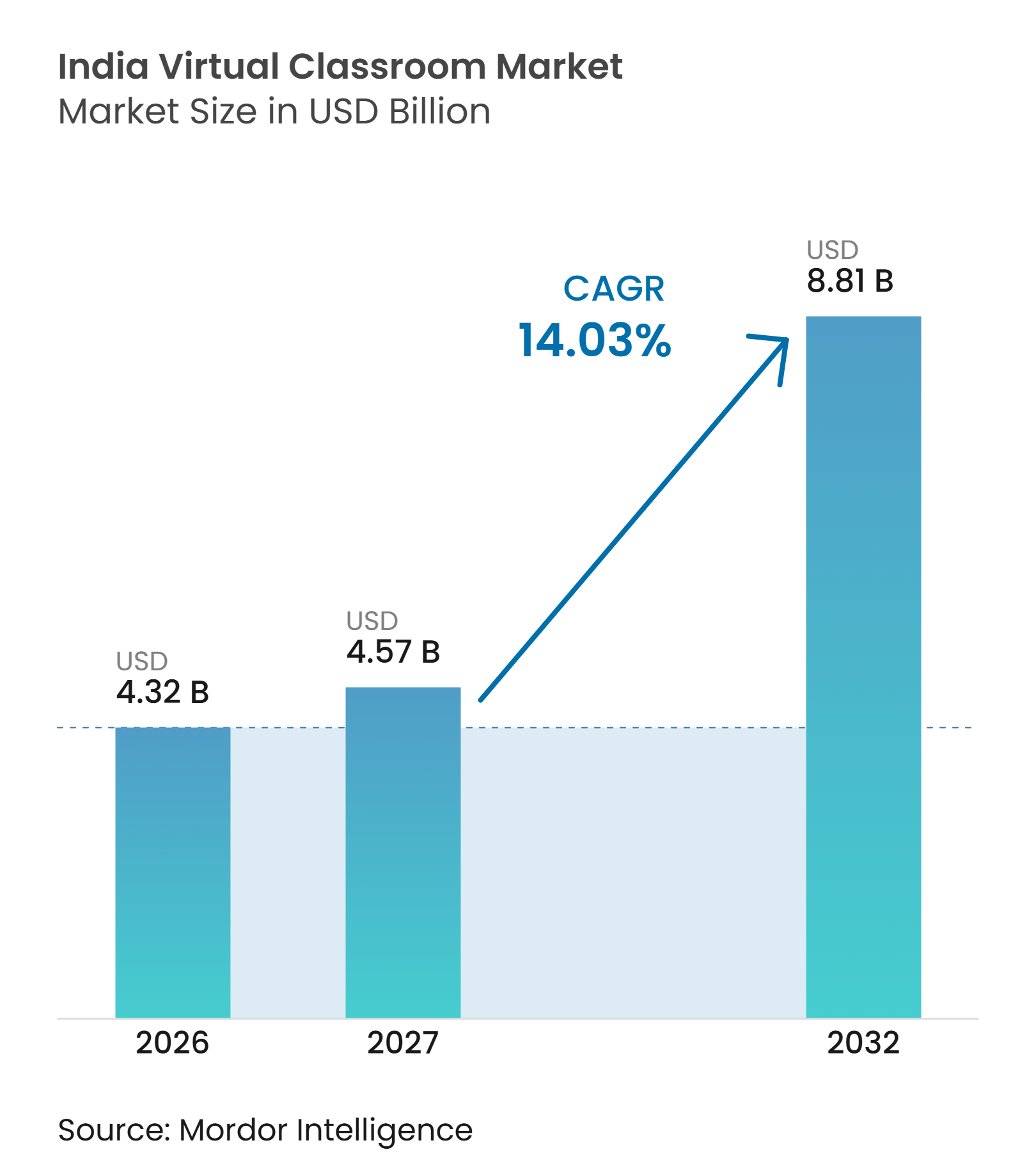
The India virtual classroom market size is projected to expand from USD 4.32 billion in 2026 and USD 4.57 billion in 2027 to USD 8.81 billion by 2032, registering a CAGR of 14.03% between 2027 and 2032. Growth rests on the continued spread of mobile broadband, public investment in school connectivity, and institutional demand for learning formats that can serve students and employees at scale. Virtual delivery is becoming a regular channel for test preparation, corporate training, and higher education support rather than a temporary substitute for classroom teaching. Providers that can operate reliably on smartphones and weaker networks have a wider opportunity in smaller cities and underserved states. The competitive field remains fragmented because collaboration platforms, education technology companies, telecom-led ecosystems, and enterprise learning vendors address different parts of the learner journey. Data protection rules, teacher capability gaps, and uneven school connectivity will continue to shape how quickly platforms can convert demand into paid use.
Key Report Takeaways
- By education services, K-12 Education held 32.1% of the India virtual classroom market share in 2026, while Higher Education is projected to grow at a 14.94% CAGR through 2032.
- By end user, Academic Institutions accounted for 64.4% of the India virtual classroom market share in 2026, while Corporates are forecast to expand at a 15.13% CAGR through 2032.
- By delivery mode, Live Instructor-Led delivery held 57.4% of the India virtual classroom market share in 2026, while Self-Paced delivery is expected to grow at a 15.65% CAGR through 2032.
- By geography, South India held 34.2% of the India virtual classroom market share in 2026, while East & North-East India is forecast to expand at a 15.21% CAGR through 2032.
Note: Market numbers in this report are based on Mordor Intelligence's proprietary estimation framework, which combines nine months of actuals with Q4 projections for base year 2026.
Market Trends and Insights
Drivers Impact Analysis of India Virtual Classroom Market*
| Driver | (~) % Impact on CAGR Forecast | Geographic Relevance | Impact Timeline |
|---|---|---|---|
| Affordable Mobile Broadband and Smartphone-Led Learning | +2.8% | National, with primary gains in North, West, and Central India | Short term (≤ 2 years) |
| Government-Led Digital Education Infrastructure Investment | +2.2% | National, with concentrated gains in rural and semi-urban geographies | Medium term (2-4 years) |
| Competitive Examination and Professional Skill Development Demand | +2.5% | National, with early gains in Delhi NCR, Bengaluru, Hyderabad, Pune, and Tier 2 cities | Short term (≤ 2 years) |
| Institutional Shift Toward Hybrid and Flexible Learning Delivery | +1.5% | National, led by South and West India enterprise clusters | Medium term (2-4 years) |
| Regional Language and Low-Bandwidth Virtual Classroom Adoption | +0.9% | India, concentrated in Tier 2, Tier 3, and North-East India | Long term (≥ 4 years) |
| Outcome-Linked Virtual Classroom Procurement by Institutions and Employers | +0.7% | National, with early adoption in large enterprises and premium private institutions | Medium term (2-4 years) |
| Source: Mordor Intelligence | |||
Expansion of Affordable Mobile Broadband and Smartphone-Led Learning
India recorded 1,003.65 million broadband subscribers in November 2025, compared with 924.07 million in March 2024, widening the base for smartphone-based learning access[1]. The Ministry of Statistics and Programme Implementation found that 85.5% of households owned at least 1 smartphone during January to March 2025[2]. The same survey reported internet use by 92.7% of rural people aged 15-29 in the preceding 3 months, which matters for a category that depends on regular access rather than occasional connectivity. The India virtual classroom market therefore depends increasingly on mobile-first design, including adaptive streaming, downloadable material, and low-latency doubt resolution. Providers that retain desktop-heavy delivery models risk weaker adoption in Tier 2 and Tier 3 locations, where the phone is often the main learning device.
Government-Led Digital Education Infrastructure Investment
The Union Budget 2025-26 set out a plan to extend BharatNet connectivity to government secondary schools in rural areas, connecting education delivery to a wider national broadband program[3]. Samagra Shiksha had approved 146,040 smart classrooms across states and union territories, with USD 2,671 in nonrecurring support and USD 422 in recurring support for each eligible school. UDISE+ data show that 64.7% of schools had functional computer facilities in 2024-25, leaving a large group that still requires hardware and network readiness. The Ministry of Education also reported 51.5 million cumulative SWAYAM enrollments across more than 16,530 courses, while 401 universities allowed up to 40% credit transfer[4]. These measures give schools and universities a clearer route to incorporate virtual instruction into formal learning plans.
Demand for Competitive Examination and Professional Skill Development
Competitive examination preparation remains a large use case because students value scheduled teaching, rapid doubt resolution, and access to instructors beyond their immediate location. The Ministry of Education reported that the SATHEE platform, developed with IIT Kanpur, registered 1.599 million students for JEE, NEET, and state entrance preparation. PhysicsWallah reported annual JEE and NEET course prices of USD 46 to USD 50, showing how virtual delivery can serve price-sensitive learners at scale. The company also provides the Alakh AI suite, which supports learners through AI-enabled assistance alongside live class delivery. Corporate demand is also strengthening as employers need training on changing technologies, compliance requirements, and distributed work practices. This combination supports the India virtual classroom market across student and professional learner groups without relying on a single education pathway.
Institutional Shift Toward Hybrid and Flexible Learning Delivery
India had 70,018 higher education institutions by June 2025, compared with 51,534 in 2014-15, expanding the institutional base that can procure digital learning systems. The Ministry of Education reported that 102 institutions offered 544 online degree programs and 116 offered 1,149 open and distance learning programs. These programs have benefited more than 1.9 million students, indicating that remote and blended learning already has a formal institutional role. Hybrid delivery allows institutions to combine recorded content with live sessions, which can provide flexibility while retaining instructor contact. It also gives enterprise buyers a practical way to mix self-paced material with instructor-led workshops for larger and geographically dispersed teams.
Restraints Impact Analysis of India Virtual Classroom Market*
| Restraint | (~) % Impact on CAGR Forecast | Geographic Relevance | Impact Timeline |
|---|---|---|---|
| Uneven Last-Mile Connectivity and Device Access | -1.8% | North-East India, rural Bihar, Uttar Pradesh, and Jharkhand | Short term (≤ 2 years) |
| Teacher Readiness and Digital Pedagogy Gaps | -1.2% | National, most pronounced in government school systems in nonmetropolitan states | Medium term (2-4 years) |
| Learner Engagement, Attendance, And Completion Challenges | -0.9% | National, with corporate and higher education segments most affected | Medium term (2-4 years) |
| Data Privacy, Child Safety, And Platform Trust Concerns | -0.6% | National, with compliance costs most acute for small and midsize education technology vendors. | Long term (≥ 4 years) |
| Source: Mordor Intelligence | |||
Uneven Last-Mile Connectivity and Device Access
UDISE+ reported that 36.5% of Indian schools lacked internet access in 2024-25, limiting the reach of synchronous virtual instruction. School computer availability was 36.7% in Manipur and 19.7% in Meghalaya, illustrating the practical gap between national digital ambition and local readiness. The government stated that 3,841 of 45,934 villages in the North-East lacked mobile connectivity in June 2025, although 2,485 towers had been commissioned under the Digital Bharat Nidhi scheme. As a result, urban and semi-urban institutions can use full-featured live classrooms more easily than those in remote areas. Low-bandwidth, asynchronous, and device-agnostic products are therefore important for providers seeking to reach the next group of users.
Teacher Readiness and Digital Pedagogy Gaps
A virtual classroom requires more than connectivity because teachers must be able to plan lessons, use digital tools, and sustain participation. India employed 10,122,420 school teachers in 2024-25 across a very large and varied school system. The availability of computers at 64.7% of schools shows that many teachers still work in settings where regular use of classroom technology is not assured. Smart classroom grants can create the physical base, but training and local implementation determine whether the equipment is used effectively. Vendors can reduce this barrier with simple instructor workflows, lesson templates, and support that helps educators use technology without adding unnecessary administrative work.
*Our forecasts treat driver/restraint impacts as directional, not additive. The impact forecasts reflect baseline growth, mix effects, and variable interactions.
Student & Learner Behavior Analysis
K-12 enrollment reached 24.69 crore students in 2024-25, giving virtual classroom providers a large potential learner population. Private unaided schools enrolled 95.86 million students and remain an important institutional segment for paid classroom technology. Integrated program enrollment grew 301.36% between 2014-15 and 2023-24, indicating growing participation in flexible academic structures. PhD enrollment also increased 192.89% over the same period. These learner groups can support demand for synchronous and asynchronous formats where specialized teaching or flexible scheduling is needed.
Learners increasingly use both digital and physical touchpoints rather than choosing one format alone. There is a shift toward hybrid networks in which online delivery builds awareness, and local centers help complete enrollment. PhysicsWallah’s FY2027 plan for more than 75 new centers across 24 states is consistent with this mixed delivery approach. Live instruction supports accountability and rapid questions, while self-paced formats support learners with work, college, or location constraints. Providers that coordinate these formats can serve different learner preferences without forcing a single path.
Education Performance Intelligence
The national pupil-teacher ratio was 24.0 in 2024-25, with 10,122,420 teachers serving 24.69 crore enrolled students across Class 1 to Class 12. State-level differences mean that classroom capacity is uneven, particularly in systems with higher pupil-teacher ratios. Virtual delivery can help institutions provide access to instructional material and specialist teaching where local capacity is constrained. It does not replace the need for trained teachers, but it can extend the reach of existing faculty. The India virtual classroom market benefits when institutions use technology as a support for teacher capacity rather than as a stand-alone substitute.
Higher education institutions and research activity are concentrated in southern and western states, particularly Tamil Nadu, Karnataka, Andhra Pradesh, and Maharashtra. This geographic density supports demand for higher education-linked virtual classes, professional programs, and supplementary tutoring. Doctoral enrollment reached 343,000 in 2023-24 after rising 192.89% from 2014-15. PhysicsWallah’s USD 46 to USD 50 annual course pricing shows how virtual delivery can lower the cost barrier for JEE and NEET preparation. Providers serving these states can combine online reach with locally relevant student support and institutional relationships.
India Virtual Classroom Market Segment Analysis
By Education Services:
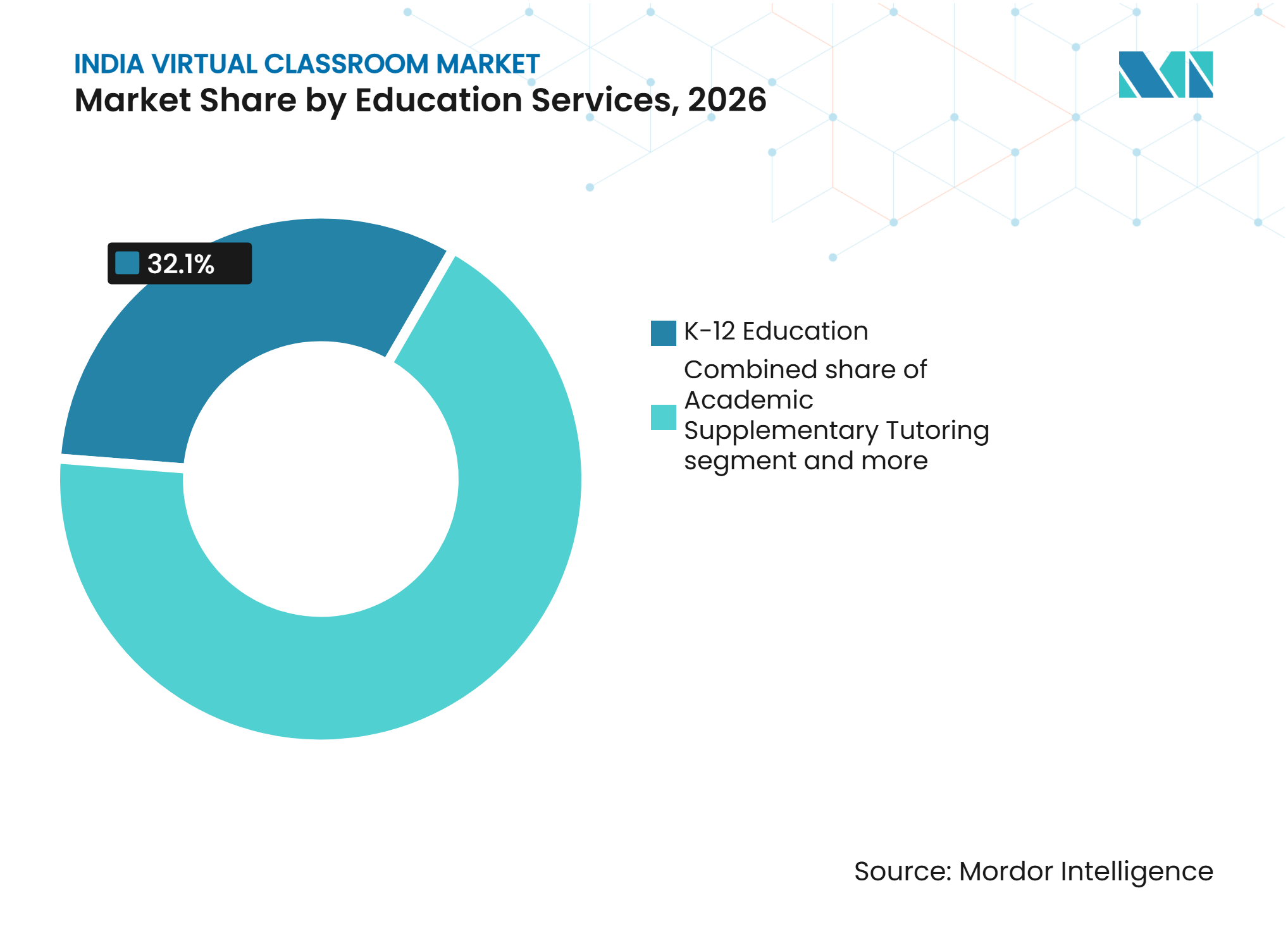
K-12 Education Leads While Higher Education ExpandsK-12 Education accounted for 32.1% of the India virtual classroom market size in 2026. Its position reflects the scale of school education, with 24.69 crore students enrolled from Class 1 to Class 12 in 2024-25. Private unaided schools enrolled 95.86 million students, which creates a substantial institutional buyer base for classroom tools. Smart classroom approvals under Samagra Shiksha offer a public infrastructure route for digital classroom adoption. The segment benefits when platforms can support teacher-led lessons and operate within school budgets and connectivity conditions.
Higher Education is forecast to grow at a 14.94% CAGR through 2032. The gross enrollment ratio reached 30.0% in 2023-24, while the National Education Policy 2020 targets 50% by 2035. This expansion increases the need for scalable teaching capacity without matching growth in physical infrastructure. Up to 40% of program credits can be transferred from SWAYAM courses at 401 universities, placing online learning within formal academic pathways. Academic supplementary tutoring, skill development, and test preparation extend the addressable base beyond degree programs.



By End User:
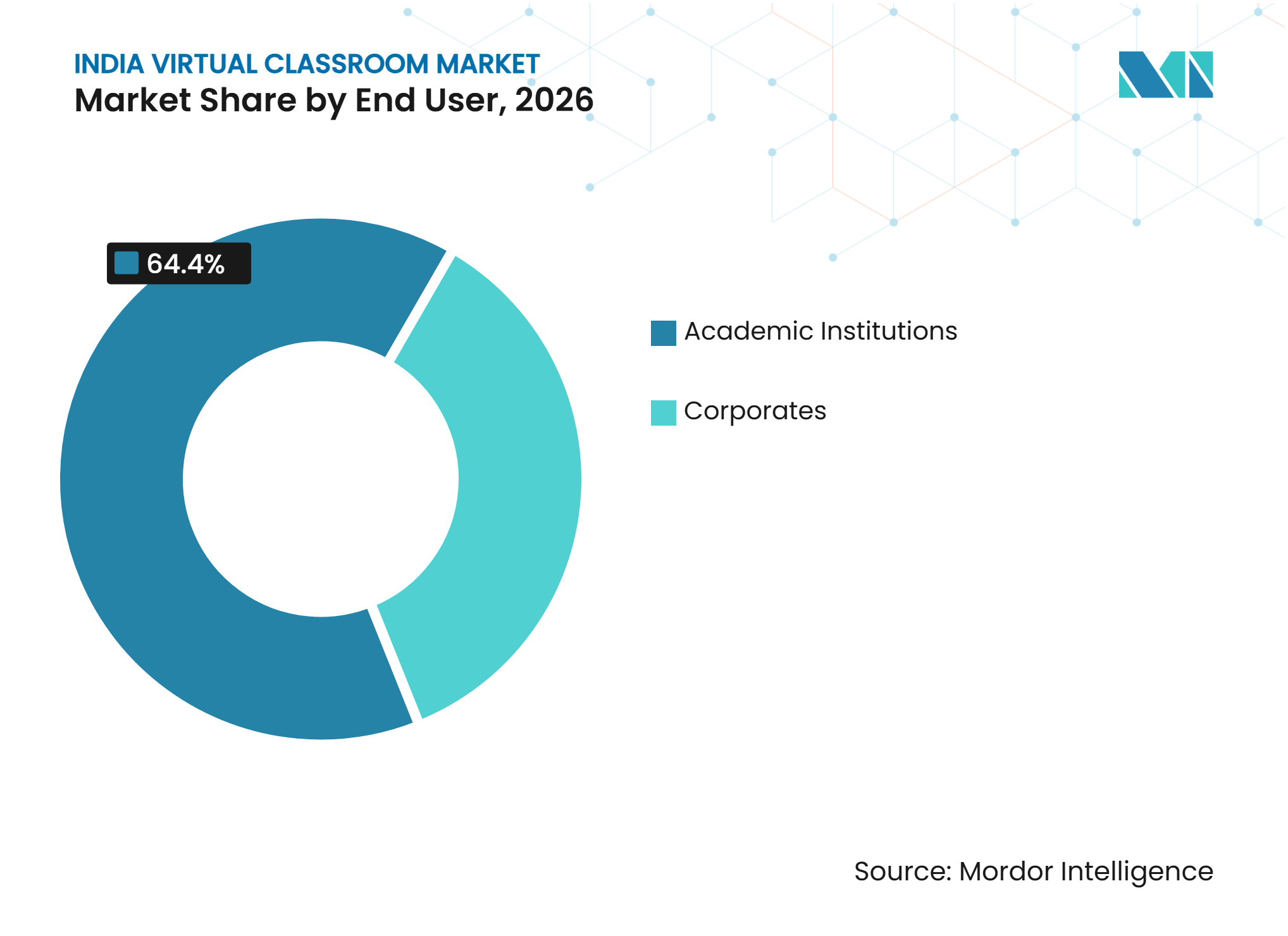
Academic Institutions Retain Scale While Corporate Demand GrowsAcademic Institutions captured 64.4% of the India virtual classroom market share in 2026. Schools and universities remain the largest buyer group because they need systems that serve defined cohorts and can support formal curriculum delivery. India’s 70,018 higher education institutions give platform suppliers a broad institutional base. Government digital infrastructure programs further support adoption by improving classroom connectivity and equipment. Vendors serving this segment need to align with teaching practice, procurement rules, and student-data obligations.
Corporates are projected to grow at a 15.13% CAGR through 2032. Distributed work, technology change, and compliance obligations make virtual instructor-led training more relevant to employer learning programs. Online delivery enables enterprises to reach employees in multiple locations while retaining a common learning framework. Flexible delivery is particularly useful where organizations need a mix of live workshops, short courses, and asynchronous learning. The segment creates an opportunity for platforms that can show learning progress and connect training with workforce skills requirements.

By Delivery Mode:
Live Instruction Retains Scale as Self-Paced Learning GainsLive Instructor-Led delivery held 57.4% of the India virtual classroom market share in 2026. The format remains important for test preparation, where learners value real-time questions, fixed schedules, and direct instructor guidance. PhysicsWallah and Microsoft collaborated to develop AI-based tutoring capabilities that can support student queries during virtual learning. Live delivery can also help institutions monitor attendance and maintain cohort-based learning. Its role is strongest where learners need immediate feedback or structured preparation for high-stakes examinations.
Self-Paced delivery is forecast to grow at a 15.65% CAGR through 2032. It fits learners who need to study around work, college schedules, or regional access constraints. SWAYAM offers more than 16,530 courses and has reached 51.5 million cumulative enrollments, demonstrating the scale available to an anytime-access model. The best self-paced offerings combine video, assessment, progress tracking, and access to support. This delivery model can widen access, but it also depends on strong engagement design to reduce drop-off.
Geography Analysis
South India held 34.2% of the India virtual classroom market size in 2026. The region benefits from a dense higher education network and major technology employment centers in Bengaluru, Hyderabad, and Chennai. Andhra Pradesh reported 99.0% school internet connectivity in 2024-25, providing a stronger base for school-level digital learning than many states. The concentration of technology and global capability center activity supports demand for employee learning as well as test preparation. PhysicsWallah plans 13 new centers across Telangana, Karnataka, Andhra Pradesh, Tamil Nadu, and Kerala in FY2027, targeting 12,000 to 15,000 additional enrollments. Hybrid delivery can be effective in this region because online engagement can be reinforced through local centers and institutional partnerships.
East & North-East India is projected to grow at a 15.21% CAGR through 2032. The region has a need for access to teaching resources that are not always available through local physical infrastructure. By June 2025, the government had commissioned 2,485 mobile towers under the Digital Bharat Nidhi program, bringing 4G connectivity to 40,663 villages in the North-East. School computer availability remained 19.7% in Meghalaya and 36.7% in Manipur, so smartphones will remain an important access device. C-DOT established an indigenous 5G laboratory at Gauhati University, which adds a longer-term capability-building element to the regional digital ecosystem. Providers that use low-bandwidth design and regional-language support can address the gap between growing network coverage and limited institutional hardware.
North India combines a large competitive examination base with a dense coaching ecosystem, while West India has substantial corporate learning demand from financial services, manufacturing, and technology clusters. SATHEE had registered 1.599 million learners for entrance preparation, supporting the relevance of digital preparation services across major aspirant locations. Maharashtra had 5,155 smart classrooms approved under Samagra Shiksha, which supports wider classroom technology deployment.
Education Infrastructure & Development Intelligence
The Union Budget 2025-26 linked rural government secondary schools to BharatNet connectivity, strengthening the infrastructure base for digital learning. The supplied program description identified a USD 16.1 billion investment for the rural broadband program. The Ministry of Education and BSNL are responsible for mapping eligible schools to the network and supporting service availability in connected areas. Samagra Shiksha support for 146,040 smart classrooms creates a more predictable public procurement base for classroom equipment and content. These measures favor providers that can combine reliable deployment, teacher support, and content suited to public-school requirements.
Private investment is focused on extending learning access and developing AI-enabled products. PhysicsWallah reported H1 FY2026 revenue of USD 211 million and Q2 FY2026 standalone revenue of USD 116 million. The company also announced plans for more than 75 learning centers across 24 states in FY2027. Microsoft Research’s work with PhysicsWallah on AI tutoring tools shows how education providers are incorporating AI features into live and digital learning environments. These investments align product development with the need for responsive, scalable learner support.
Competitive Landscape
Market Concentration
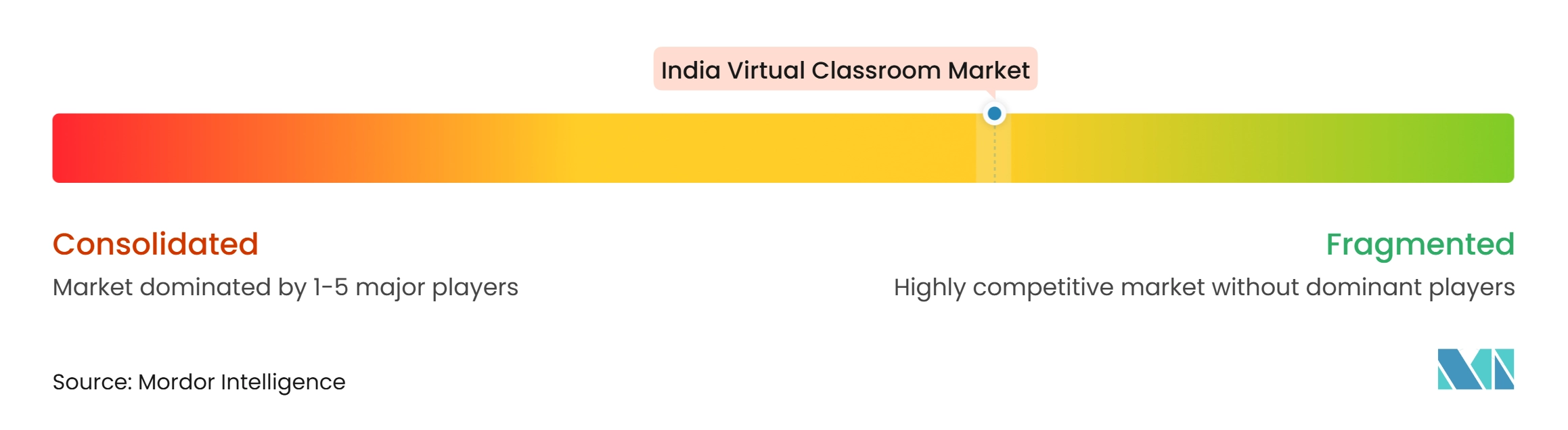
Google, Microsoft, Zoom, and Cisco supply collaboration infrastructure that institutions and enterprises can integrate into their learning workflows. Teachmint, PhysicsWallah, and Vedantu compete through education-focused content, class operations, and learner support. Jio Platforms brings a telecom-led digital ecosystem to the field, while upGrad, Simplilearn, and NIIT focus on workforce learning. Competition therefore spans infrastructure, content, pedagogy, and enterprise delivery rather than a single product category. Product integration is a key strategic route for India-focused providers. Teachmint moved toward integrated classroom infrastructure, combining hardware and software rather than operating only as a software provider.
Regulatory readiness is becoming another competitive factor. The Digital Personal Data Protection Rules set requirements for child-data consent, restrictions on behavioral tracking, and oversight for Significant Data Fiduciaries. Platforms that can document privacy controls and handle consent reliably may be better positioned with schools, universities, and corporate buyers. Outcome evidence is also likely to matter, particularly for buyers that need to assess completion, examination preparation, certification, or skills development. Regional-language content and low-bandwidth performance provide additional ways to differentiate in markets where access is uneven. The field is likely to remain fragmented because no single provider currently addresses every layer of learning delivery.
India Virtual Classroom Industry Leaders
-
Google LLC
-
Microsoft Corporation
-
Zoom Video Communications, Inc.
-
Teachmint Technologies Private Limited
-
Jio Platforms Limited
- *Disclaimer: Major Players sorted in no particular order
India Virtual Classroom Market Companies Covered in this Report
- Microsoft Corporation
- Google LLC
- Zoom Video Communications, Inc.
- Cisco Systems, Inc.
- Adobe Inc.
- Jio Platforms Limited
- Teachmint Technologies Private Limited
- Vedantu Innovations Private Limited
- PhysicsWallah Limited
- Sorting Hat Technologies Private Limited
- Extramarks Education India Private Limited
- Bunch Microtechnologies Private Limited
- Next Education India Private Limited
- Schoolnet India Limited
- Leadership Boulevard Private Limited
- upGrad Education Private Limited
- Simplilearn Solutions Private Limited
- Veranda Learning Solutions Limited
- NIIT Limited
- DO Little Technologies Private Limited
Recent Industry Developments in India Virtual Classroom Market
- November 2025: India notified the Digital Personal Data Protection Rules, beginning an 18-month implementation timeline for virtual classroom and education technology platforms that process student data.
- October 2025: PhysicsWallah acquired a 40% stake in Sarrthi IAS for USD 10.5 million, expanding its presence in civil services preparation.
- July 2025: The Ministry of Education launched the AI-powered ViBe platform at IIT Ropar and introduced the TARA App Portal for AI- and machine learning-based reading fluency support for Grades 3-8.
- February 2025: Microsoft Research and PhysicsWallah collaborated on AI-based tutoring tools, including the AI Guru tutor and Smart Doubt Engine, for use in PhysicsWallah’s learning environment.
Key Questions Answered in the Report
What is the projected value of the India virtual classroom market by 2032?
The India virtual classroom market is projected to reach USD 8.81 billion by 2032, from USD 4.57 billion in 2027, at a 14.03% CAGR.
Which education service has the largest share in India?
K-12 Education held the largest share at 32.1% in 2026, supported by the scale of school enrollment and institutional digital classroom adoption.
Which end user is growing fastest for virtual classroom services?
Corporate use is forecast to grow at a 15.13% CAGR through 2032 as employers expand flexible skills and compliance training.
Why is South India important for virtual learning providers?
South India held 34.2% of the 2026 value, supported by higher education density, technology employment centers, and strong school connectivity in states such as Andhra Pradesh.
What limits adoption in remote parts of India?
Limited connectivity and devices remain constraints. UDISE+ reported that 36.5% of schools lacked internet access in 2024-25.
How do India’s data protection rules affect education platforms?
The DPDP Rules require verifiable parental consent for children’s data, restrict behavioral tracking of minors, and create governance responsibilities for covered platforms.