
India Table Grapes Market Size and Share
India Table Grapes Market Analysis by Mordor Intelligence
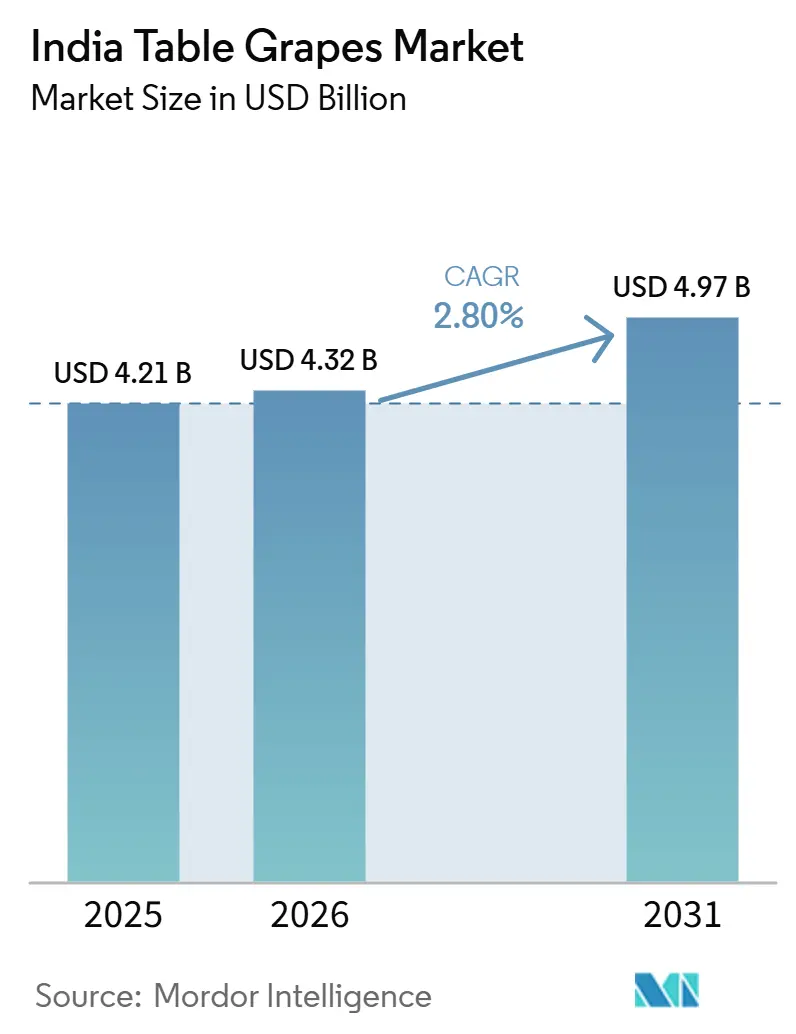
The India Table Grapes Market size is expected to grow from USD 4.21 billion in 2025 to USD 4.32 billion in 2026 and is forecast to reach USD 4.97 billion by 2031 at 2.80% CAGR over 2026-2031. As per the International Organization of Vine and Wine (OIV), India remained the world's second-largest table grape producer, with an estimated production of 3.2 million metric tons in 2024. This strong production base supports both domestic consumption and a growing export market[1]Source: International Organisation of Vine and Wine, “OIV Statistical Brief: Wine, Table Grapes and Dried Grapes in 2024,” oiv.int. Maharashtra supplied the majority of national output, meaning the India table grape market is built around a highly concentrated production belt with clear advantages in packhouses, reefer logistics, and export compliance. Export concentration is still visible, with the Netherlands and Bangladesh taking the largest shares of shipments, but new access to Vietnam and rising demand across Southeast Asia are opening a wider sales corridor for the India table grapes market. Competition remains fragmented at the farm level and tighter among organized exporters and processors, pushing the India table grapes market toward stronger integration, better traceability, and more disciplined quality control.
Key Report Takeaways
- According to the National Horticulture Board (NHB), Ministry of Agriculture & Farmers Welfare, Maharashtra was the largest producing state, accounting for 70% of national production in MY 2025/26. The state's dominance in production is attributed to its favorable agroclimatic conditions, well-established farming practices, and strong supply chain infrastructure that supports large-scale output.
Note: Market size and forecast figures in this report are generated using Mordor Intelligence’s proprietary estimation framework, updated with the latest available data and insights as of January 2026.
India Table Grapes Market Trends and Insights
Drivers Impact Analysis*
| Driver | (~) % Impact on CAGR Forecast | Geographic Relevance | Impact Timeline |
|---|---|---|---|
| Rising export demand for fresh table grapes | +1.8% | Global, with strong relevance in the European Union, Russia, Southeast Asia, and the Middle East | Medium term (2-4 years) |
| Expansion of seedless and premium varieties | +1.4% | Maharashtra and Karnataka | Long term (≥ 4 years) |
| Adoption of drip irrigation and precision vineyard practices | +0.9% | Maharashtra, Karnataka, and Tamil Nadu | Medium term (2-4 years) |
| Strengthening packhouse, cold chain, and residue compliance infrastructure | +0.8% | Maharashtra first, with expansion into Karnataka | Long term (≥ 4 years) |
| Longer export window versus Northern Hemisphere suppliers | +0.7% | Global, especially against European Union, Chile, and South Africa supply windows | Short term (≤ 2 years) |
| Digital traceability and buyer-led quality audits | +0.5% | National, with concentration in the Nashik, Pune, and Sangli export belt | Short term (≤ 2 years) |
| Source: Mordor Intelligence | |||
Rising Export Demand for Fresh Table Grapes
India harvests grapes from January to April, which gives the India table grapes market a clear timing edge when Northern Hemisphere orchards are not supplying stores. This supply window helps Indian exporters place fruit in European Union retail chains when competing availability is lower, and buyer interest is steadier. According to the Agricultural and Processed Food Products Export Development Authority (APEDA), Southeast Asia has become more important because grape imports across the Philippines, Indonesia, Vietnam, and Malaysia rose at a 5-13% CAGR from 2021 to 2026, while Bangladesh also recorded strong growth over the same period. Vietnam granted market access to Indian fresh grapes effective May 6, 2026, with mandatory cold treatment at 1.1°C pulp temperature for 15 consecutive days, which raises the bar for shipment discipline but also opens a certified demand lane for the India table grapes market. The Association of Southeast Asian Nations-India Free Trade Agreement improves pricing competitiveness against suppliers such as Australia and Chile in several target markets. Stronger export pull also supports farmgate realizations, which keep acreage economics attractive in Maharashtra and support value growth in the India table grapes market.
Expansion of Seedless and Premium Varieties
The shift toward seedless and patented premium grapes is changing the commercial structure of the India table grapes market. Thompson Seedless and Sonaka accounted for 55% of the cultivated area, but buyer preference in the European Union is shifting toward longer berries, firmer texture, and higher sweetness levels. The 2025–26 season highlighted the vulnerability of traditional Thompson Seedless vineyards in Nashik's Dindori and Satara belts, where prolonged monsoon rainfall reportedly reduced yields by 45–55%[2]Source: Agricultural and Processed Food Products Export Development Authority, “Procedures for Export of Fresh Table Grapes to the European Union,” apeda.gov.in. Industry reports indicate that newer patented grape varieties demonstrated greater resilience under the same conditions, supporting increased adoption of improved genetics in India's table grape sector. This means the varietal mix will shape future pricing power in the India table grapes market more than simple area expansion. Maharashtra orchard registrations for the 2025-26 season fell 28% year over year, which suggests that weather-sensitive farms are being pressured faster than resilient premium orchards are being added.
Adoption of Drip Irrigation and Precision Vineyard Practices
Water availability remains central to grape quality, as the main vineyard belts in Maharashtra and Karnataka experience irregular rainfall and recurring moisture stress. Drip irrigation is therefore moving from an efficiency tool to a quality requirement for the India table grapes market. The National Horticulture Board-backed Grapes Cluster Development Program, launched in Nashik on March 24, 2026, supports the development of new varieties, drip irrigation systems, good agricultural practices, integrated pest management, and post-harvest infrastructure. Controlled fertigation through drip lines helps growers manage canopy behavior and berry size with greater consistency, which matters because export buyers closely inspect the physical appearance. Precision systems are also easier to integrate with soil moisture monitoring and remote crop observation, further widening the quality gap between organized export farms and traditional domestic supply farms. Over time, that gap is likely to support a more formal and quality-led India table grapes market.
Strengthening Packhouse, Cold Chain, and Residue Compliance Infrastructure
Fresh export grapes lose value quickly if pre-cooling is delayed, so packhouse access remains one of the most important commercial filters in the India table grapes market. India had a cold storage capacity of 37 million metric tons, against an annual perishable output of 104 million metric tons, underscoring why horticulture exporters still face bottlenecks outside the best-developed clusters. The Pradhan Mantri Kisan SAMPADA Yojana (PMKSY)) The Integrated Cold Chain and Value Addition Infrastructure scheme, updated in May 2025, provides a stronger policy base for private investment in storage and linked processing assets. Sahyadri Farms Post Harvest Care Ltd raised USD 47.8 million in January 2024 to expand packhouse capacity, processing lines, and climate-resilient variety cultivation, reflecting where capital is moving in the India table grapes market. The Agricultural and Processed Food Products Export Development Authority's traceability system, GrapeNet, now maps export consignments to farm plots and supports residue checks before phytosanitary clearance, helping sharply lower rejection rates over time. Better infrastructure does not remove compliance pressure, but it makes the India table grape market better able to meet strict buyer and border requirements.
Restraints Impact Analysis*
| Restraint | (~) % Impact on CAGR Forecast | Geographic Relevance | Impact Timeline |
|---|---|---|---|
| Climate volatility and water stress in vineyard belts | -1.5% | Maharashtra, especially Nashik, Satara, and Dindori, and also Karnataka | Long term (≥ 4 years) |
| Residue compliance and rejection risk in export markets | -0.9% | National, with strongest effect in European Union-facing export clusters in Maharashtra | Short term (≤ 2 years) |
| Fragmented farmer base and uneven farm-level standardization | -0.7% | National, especially outside Maharashtra | Long term (≥ 4 years) |
| High post-harvest losses and logistics bottlenecks | -0.8% | National, with sharper effect in Karnataka and inland non-export belts | Medium term (2-4 years) |
| Source: Mordor Intelligence | |||
Climate Volatility and Water Stress in Vineyard Belts
The 2025-26 season exposed how vulnerable the India table grapes market remains to weather swings. Continuous rainfall from May to mid-October 2025 in Maharashtra's major grape-growing regions, followed by hailstorms between 19 March and 3 April 2026, reduced fruit quality and shortened the export window. As a result, Nashik's grape exports declined by 9.6% in the 2025–26 season, falling from 160,000 metric tons to 140,000 metric tons. The damage was not limited to current harvest losses, as abnormal rainfall patterns also weakened bud fertility and reduced usable bunch formation in traditional varieties. Many growers operate on farms of about 1 hectare, so multi-season varietal change and water risk adaptation remain difficult without support from farmer-producer organizations and public co-investment. This keeps climate volatility as the heaviest structural restraint on the India table grapes market.
Residue Compliance and Rejection Risk in Export Markets
Residue management is now a permanent operating burden for the India table grapes market rather than a periodic export challenge. The European Commission's Directorate-General for Health and Food Safety (DG SANTE) conducted Audit 2024-7978 in India between 24 September and 4 October 2024 to evaluate the official control system for pesticide residues in plant products exported to the European Union, reflecting the EU's stringent regulatory oversight of imported agricultural products. European Union Regulation 396/2005 applies a default maximum residue limit of 0.01 milligram per kilogram for active ingredients not specifically authorized on grapes, and any breach can lead to rejection, destruction, and rapid alert escalation[3]Source: European Commission Food and Feed Safety Audits, “Audit Report, India 2024-7978, Evaluate the Controls of Pesticide Residues in Food of Plant Origin Intended for Export from India to the European Union,” ec.europa.eu. India’s approved agrochemical use list does not always align with destination-country lists, so exporters must plan spray schedules and lab checks well before harvest APEDA. Exporters serving Russia, the United Arab Emirates, the United Kingdom, and the European Union simultaneously face multiple residue regimes, which raise costs and favor larger, integrated operators. That cost pressure is one reason the India table grapes market is consolidating faster among organized exporters than among growers.
*Our forecasts treat driver/restraint impacts as directional, not additive. The impact forecasts reflect baseline growth, mix effects, and variable interactions.
Geography Analysis
Maharashtra was the largest producing state and contributed 70% of the national output in 2025, making it the main production anchor of the India table grapes market, according to the National Horticulture Board (NHB), Ministry of Agriculture & Farmers Welfare. Nashik district alone had 58,367 hectares under grape cultivation, with major concentration in Niphad, Dindori, the Nashik city belt, and Chandwad. This cluster benefits from proximity to the Mumbai port, which shortens the logistics route for reefer exports to Europe and reduces handling risk. Maharashtra also has the deepest ecosystem of registered packhouses, cold stores, and accredited laboratories, which gives the state a stronger compliance capacity than any other producing belt. That scale continues to pull most organized investment toward the state.
According to the Agricultural and Processed Food Products Export Development Authority (APEDA), based on Ministry of Agriculture & Farmers Welfare (MoA&FW) statistics for 2023–24, Karnataka was India's second-largest grape-producing state, contributing 31.37% of national grape production. The state's strong production base, particularly in districts such as Vijayapura, Bagalkote, Belagavi, and Chikkaballapur, makes it the second most important production hub in the Indian table grape market, although its commercial profile differs from Maharashtra's due to its greater focus on raisin production. The state is more closely linked to domestic consumption and local wine production because varieties such as Bangalore Blue and Bangalore Purple are more common there than export-standard Thompson Seedless. Sula Vineyards Limited expanded its Karnataka wine tourism presence in January 2026 with a new tasting room at Domaine Sula near Bengaluru, demonstrating how regional value creation can extend beyond fresh exports. Tamil Nadu, Andhra Pradesh, Telangana, Punjab, and Mizoram contribute smaller volumes and mainly serve regional fresh markets with limited export infrastructure.
According to the Agricultural and Processed Food Products Export Development Authority (APEDA) Market Intelligence Cell (MIC), the Netherlands remained the primary European entry point for Indian grapes, handling 60,153 metric tons in the 2025-26 season through mid-June 2026, retaining its position as the largest external distribution hub for the India table grapes market. Russia and the United Arab Emirates continued to matter, although shipping disruptions linked to West Asian conflict slowed some Gulf movement during 2026. According to the APEDA, Southeast Asia was the fastest external demand corridor because import growth in key countries ran at 7% CAGR from 2021 to 2026. Vietnam’s market opening in May 2026 gave exporters a new regulated route at a time when diversification beyond Europe and the Gulf has become more urgent. If exporters scale compliance and cold treatment effectively, this shift could change the destination mix of the India table grapes market by the end of the forecast period.
Competitive Landscape
The India table grapes market is fragmented at the farm level but is consolidating among export-facing processors, platforms, and organized buyers. Sahyadri Farms Post Harvest Care Ltd is the clearest example of vertical integration, working with more than 30,000 registered farmers across 40,000 acres and exporting to 42 countries, giving it meaningful scale in sourcing, packing, processing, and market access. Mahagrapes Farmers’ Producer Company Ltd remains important through the cooperative route, while Kay Bee Exports Private Limited, Puretrop Fruits Limited, and Rajdheer Exports compete through buyer relationships, handling discipline, and reliability in compliance. Entry barriers are rising because farm traceability, laboratory validation, residue planning, and cold-chain readiness now matter as much as raw fruit procurement. This means the India table grapes market still looks broad in participant count, but commercial power is moving toward companies with systems, infrastructure, and destination access.
Varietal control is becoming another important source of advantage in the India table grapes market. Bloom Fresh’s proprietary genetics point to a future where premium grape access depends not only on acreage and packhouse assets but also on licensed plant material and better weather resilience. Sahyadri Farms Post Harvest Care Ltd’s January 2024 funding round supports that direction because the capital was earmarked for climate-resilient varieties and expanded post-harvest capacity. Puretrop Fruits Limited’s role in the Nashik cluster program also shows how cluster-led development can reinforce varietal transition and farm standardization. These moves suggest that competition in the India table grapes market is shifting from simple export presence toward stronger control over quality outcomes.
The wine and downstream processing tier adds another layer to the India table grapes market because value creation there does not depend only on fresh fruit shipments. Sula Vineyards Limited signed a definitive agreement in March 2026 to acquire Chandon’s 19-acre estate in Dindori, Nashik, including a winery with current capacity of 450,000 liters that can scale to 1.3 million liters annually, which marks a clear capacity-led consolidation move. Sula Vineyards Limited also expanded its direct-to-consumer base through a new tasting room in Karnataka and continued building hospitality assets in Nashik, which links grape demand more closely to tourism and premium experiences. Reliance Retail Ventures Limited, BigBasket.com (Tata Digital Limited), Agro Star Private Limited, and Nature’s Basket Limited (Spencer’s Retail Limited) are shaping domestic distribution through premium sourcing and faster movement to consumers. White space still exists in farm-to-retail cold logistics and in large-scale processing of non-export-grade fruit, so the India table grapes market retains room for new capacity even as organized players gain ground.
Recent Industry Developments
- May 2026: The Agricultural and Processed Food Products Export Development Authority (APEDA) announced that Vietnam granted market access for fresh grapes from India. Under the agreed phytosanitary protocol, exports must comply with a systems approach for pest risk management, including mandatory in-transit cold treatment at a pulp temperature of 1.1°C for 15 consecutive days.
- March 2026: BLOOM FRES International announced that its proprietary table grape varieties reached commercial-scale production in India. The commercial rollout included Allison (Sheegene 20), Timco (Sheegene 13), Timpson (Sheegene 2), and Ivory (Sheegene 21), which are intended to strengthen India's premium table grape exports to international markets.
- March 2026: DeHaat launched a Grapes Cluster Development Program in Nashik in partnership with the National Horticulture Board (NHB), Ministry of Agriculture & Farmers Welfare. The initiative supports premium grape varieties through NHB-backed assistance for varietal planting, drip irrigation, and post-harvest infrastructure to strengthen India's table grape export competitiveness.


India Table Grapes Market Report Scope
Table grapes are grape varieties cultivated primarily for fresh consumption. They are characterized by their large berries, crisp texture, sweet flavor, and attractive appearance, making them suitable for the fresh fruit market. India Table Grapes Market Report Covers Production Analysis (Volume), Consumption Analysis (Value and Volume), Import Analysis (Value and Volume), Export Analysis (Value and Volume), Wholesale Price Trend Analysis, and More. The Market Forecasts are Provided in Terms of Value (USD) and Volume (Metric Tons).
| Production Analysis (Volume) | Overview | |
| Area Harvested and Yield | ||
| Consumption Analysis (Value and Volume) | ||
| Trade Analysis (Value and Volume) | Import Market Analysis | Overview |
| Key Supplying Markets | ||
| Export Market Analysis | Overview | |
| Key Destinations Markets | ||
| Wholesale Price Trend Analysis & Forecast | ||
| Seasonality Analysis | ||
| India | Production Analysis (Volume) | Overview | |
| Area Harvested and Yield | |||
| Consumption Analysis (Value and Volume) | |||
| Trade Analysis (Value and Volume) | Import Market Analysis | Overview | |
| Key Supplying Markets | |||
| Export Market Analysis | Overview | ||
| Key Destinations Markets | |||
| Wholesale Price Trend Analysis & Forecast | |||
| Seasonality Analysis | |||


Key Questions Answered in the Report
What is the current value of the India table grapes space?
The India table grapes market size stood at USD 4.32 billion in 2026 and is forecast to reach USD 4.97 billion by 2031 at a 2.8% CAGR.
Which state drives grape production in India?
Maharashtra is the largest producing state and contributed 70% of national output, supported by Nashik's export ecosystem and port connectivity.
Which application generates the highest demand for grapes in India?
Fresh consumption is the largest application of total grape production by volume in 2025.
Why is Southeast Asia becoming more important for exporters?
Southeast Asia recorded grape import growth during 2021-2026, and Vietnam opened formal market access for Indian fresh grapes in May 2026.
What is the biggest operational challenge for exporters?
Climate volatility and strict residue compliance remain the main risks because they affect yields, shipment acceptance, and the cost of serving multiple export markets.
Page last updated on:





