
India STATCOM Market Size and Share
Market Overview
| Study Period | 2021 - 2032 |
|---|---|
| Forecast Data Period | 2027 - 2032 |
| Base Year Market Size (2026) | USD 162.43 Million |
| Market Size (2027) | USD 178.53 Million |
| Market Size (2032) | USD 285.74 Million |
| Growth Rate (2027 - 2032) | 9.86 % |
| Market Concentration | Medium |
Major Players *Disclaimer: Major Players sorted in no particular order Image © Mordor Intelligence. Reuse requires attribution under CC BY 4.0. | |
India STATCOM Market Analysis by Mordor Intelligence
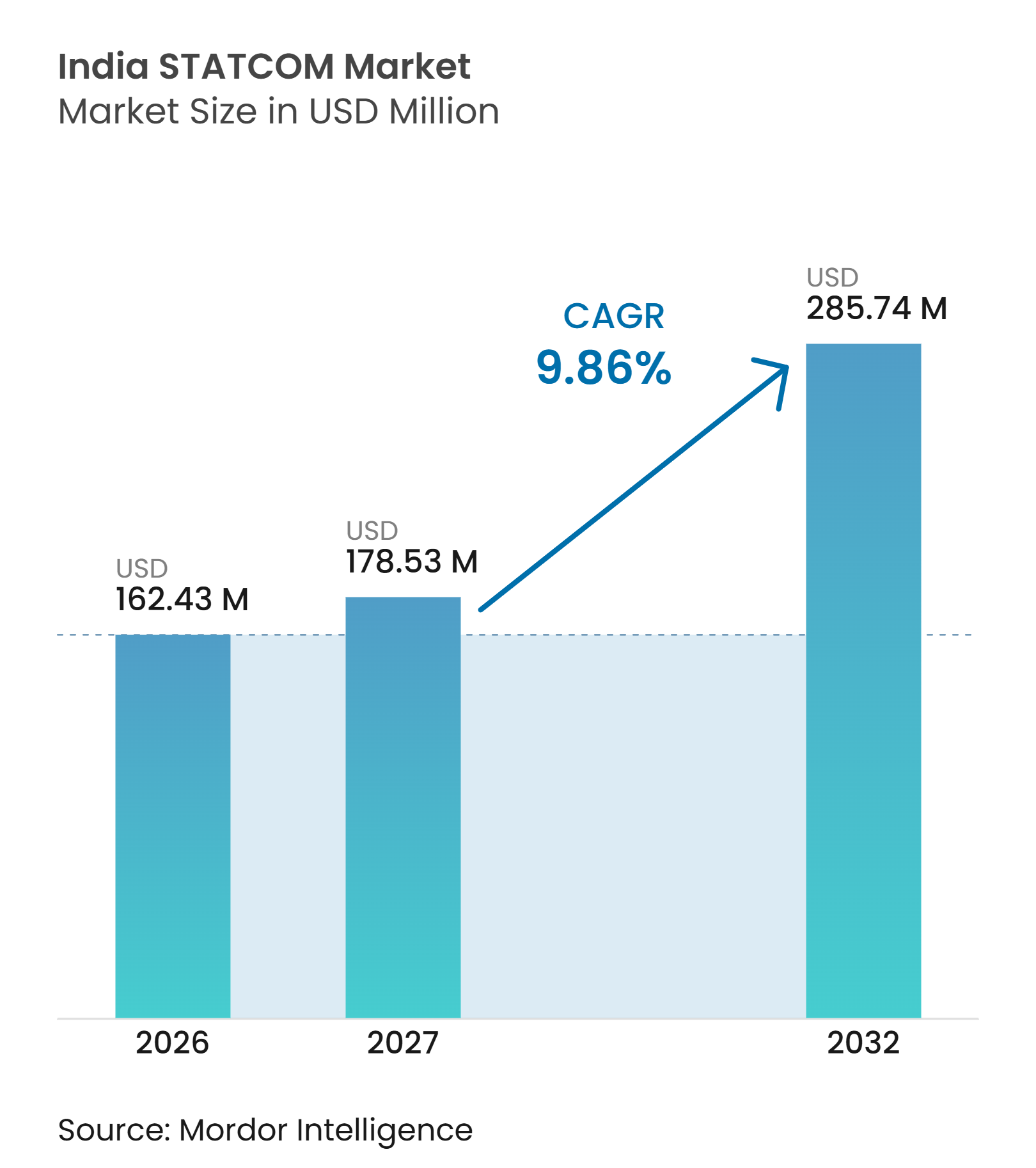
The India STATCOM market size was valued at USD 162.43 million in 2026 and is forecast to reach USD 285.74 million by 2032, at a CAGR of 9.86% during 2027-2032. India’s power system is adding renewable generation faster than transmission capacity at several pooling substations, increasing the need for dynamic voltage support. The planned buildout of 400 kV and 765 kV transmission corridors is creating a larger base of high-voltage projects where advanced reactive-power equipment is required. Grid rules are also moving reactive-power capability from a technical preference toward a connection requirement for inverter-based resources. Suppliers with locally integrated capabilities in valves, transformers, controls, and testing are better positioned to compete for utility projects. Tender timing, high upfront costs, and competition from synchronous condensers, SVCs, capacitors, and reactors remain material limits on India STATCOM market growth.
Key Report Takeaways
- By technology type, modular multilevel converter and other multilevel VSC topologies held 39.84% of the India STATCOM market share in 2026, while the draft identifies grid-forming STATCOM and E-STATCOM as the fastest-growing technology type without a disclosed CAGR.
- By reactive power rating, large-scale transmission STATCOMs held 47.62% market share in 2026, while small-scale distribution and industrial STATCOMs are projected to expand at a 10.62% CAGR through 2032.
- By application, transmission and grid infrastructure remained the largest application by procurement value, while renewable energy integration is projected to expand at a 10.76% CAGR through 2032.
- By component, power electronic converter valves held 38.93% market share in 2026, while control, protection, and monitoring systems are projected to expand at a 10.83% CAGR through 2032.
Note: Market numbers in this report are based on Mordor Intelligence's proprietary estimation framework, which combines nine months of actuals with Q4 projections for base year 2026.
Market Trends and Insights
Drivers Impact Analysis of India STATCOM Market*
| Driver | (~) % Impact on CAGR Forecast | Geographic Relevance | Impact Timeline |
|---|---|---|---|
| Renewable-Energy Evacuation and Grid-Strengthening Investments | +3.2% | National, concentrated in Rajasthan, Gujarat, and Karnataka | Medium term (2-4 years) |
| Mandatory Dynamic Reactive-Power Capability at High-Voltage Interconnections | +2.4% | National, early adoption in Madhya Pradesh, Rajasthan, and Gujarat | Short term (≤ 2 years) |
| Expansion of 765 kV and 400 kV Renewable Transmission Corridors | +2.0% | National, with early gains in Rajasthan, Gujarat, Karnataka, and Andhra Pradesh | Medium term (2-4 years) |
| Weak-Grid Conditions in Renewable-Rich Northwestern India | +1.5% | Concentrated in Rajasthan and Gujarat, spillover to Punjab and Haryana | Short term (≤ 2 years) |
| STATCOM Localization and India-Based Valve Manufacturing | +0.9% | National | Long term (≥ 4 years) |
| Data-Center and Industrial Power-Quality Requirements | +0.7% | National, with early gains in Mumbai, Chennai, Hyderabad, and Bengaluru | Long term (≥ 4 years) |
| Source: Mordor Intelligence | |||
Renewable-Energy Evacuation and Grid-Strengthening Investments
The National Electricity Plan provides for INR 4.9 lakh crore (USD 52.22 billion) of transmission capital expenditure during 2027-2032 and includes 76,787 circuit kilometers of additional transmission lines and 497,855 MVA of transformation capacity. Each new transmission connection does not automatically require a STATCOM, but renewable-heavy nodes often need fast reactive support when local grid strength is low. Larger evacuation projects also connect variable generation over longer distances, which can make voltage management needs more apparent during operating studies. The India STATCOM market therefore benefits when evacuation schemes progress from planning to equipment specifications and project tenders. PGCIL’s Khavda-Nagpur HVDC project also received a loan commitment of up to JPY 80 billion (USD 0.5 billion) from the Japan Bank for International Cooperation, which supports transmission investment along the Gujarat-Maharashtra corridor.
Mandatory Dynamic Reactive-Power Capability at High-Voltage Interconnections
Draft CEA connectivity standards in 2026 required inverter-based resources to provide dynamic reactive power across their operating range and to inject reactive current within 30 milliseconds during voltage disturbances. This requirement makes voltage support a core part of project design for solar, wind, and battery projects. Developers can meet some needs through inverter functions, but dedicated STATCOMs remain relevant where network studies show a need for stronger or faster support. The Madhya Pradesh framework described in the draft also introduced incentives and penalties for reactive-power performance, thereby making compliance more commercially visible to renewable generators. GRID-India’s discussion of grid-forming capability for battery projects above 50 MW adds a further reason to assess E-STATCOM solutions besides conventional compensation systems.[1] The India STATCOM market gains from this shift because specification decisions are increasingly tied to interconnection approval, plant design, and ongoing grid performance.
Expansion of 765 kV and 400 kV Renewable Transmission Corridors
India’s transmission network exceeded 500,000 circuit-kilometers of lines rated 220 kV and above in January 2026, following the entry into service of the Bhadla II-Sikar II 765 kV line. The network expansion is important because high-voltage renewable corridors operate under more demanding voltage and fault-ride-through conditions than many lower-voltage systems. MMC-based STATCOMs are well-suited to projects that require rapid and precise compensation at 400 kV and 765 kV levels. New corridors can also increase the consequences of poor short-circuit strength at remote renewable zones, especially where several projects share a pooling point. Odisha’s 2026 decision to expand its transmission network, including 3 new 765 kV substations, shows that this requirement is moving beyond Rajasthan and Gujarat. This wider buildout supports a broader opportunity base for the India STATCOM market.
Weak-Grid Conditions in Renewable-Rich Northwestern India
Rajasthan and Gujarat have become the immediate center of demand because several renewable pooling substations have low projected short-circuit ratios. The CEA’s grid requirements make a short-circuit ratio of 5 an important reference point, and scenarios for Bikaner-II, Bhadla-III, Khavda, and Lakadia-II identified pressure at major pooling locations. The operational issue is not limited to a planning model, as India recorded 68 major renewable-grid disturbances through 2025-2026, and generation losses reached up to 7 GW during extreme incidents. Fast-reacting compensation is therefore becoming more relevant before renewable capacity at these sites reaches its planned scale. The India STATCOM market is particularly exposed to project decisions in this region because additions of wind and solar capacity can trigger new system-strength studies. Earlier installations also give utilities local operating experience that can support repeat procurement and more detailed performance specifications.
Restraints Impact Analysis of India STATCOM Market*
| Restraint | (~) % Impact on CAGR Forecast | Geographic Relevance | Impact Timeline |
|---|---|---|---|
| High Upfront Capital Cost and Long Payback Periods | -1.3% | National | Medium term (2-4 years) |
| Competition from SVCs, Synchronous Condensers, and Switched Compensation | -0.8% | National, concentrated in Rajasthan and Gujarat | Medium term (2-4 years) |
| Limited Specialist Commissioning and Grid-Study Capability | -0.5% | National | Long term (≥ 4 years) |
| Project-Specific Procurement Timing and Technical-Approval Delays | -0.4% | National | Short term (≤ 2 years) |
| Source: Mordor Intelligence | |||
High Upfront Capital Cost and Long Payback Periods
A ±300 MVAr transmission STATCOM requires converter transformers, valves, cooling equipment, control systems, and civil works, so it usually costs more than a similarly rated SVC or switched capacitor bank. This difference matters most for financially constrained distribution utilities and smaller independent power producers. Solar inverters can provide a degree of dynamic reactive support, which can reduce the case for dedicated equipment in cost-sensitive projects. The tariff-based competitive bidding framework can also extend project implementation and defer revenue realization for suppliers. Distribution-level projects face a separate constraint because their commercial case may depend on customer power-quality agreements rather than regulated transmission charges. These conditions can delay projects even where a technical need for the India STATCOM market solution is evident, particularly when customers cannot clearly assign the financial benefit of improved voltage performance.
Competition From SVCs, Synchronous Condensers, and Switched Compensation
Synchronous condensers gained greater visibility in 2026 when India completed bidding for a TBCB scheme dedicated to SynCon units at the Fatehgarh-II pooling station. That process gives future procurers a clearer basis for comparing the economics of synchronous condensers and STATCOMs. The northern-region compensation discussion also evaluated whether SynCons could substitute for equipment at Bhadla-III, Ramgarh, and Fatehgarh-IV. Mechanically switched capacitors and bus reactors are commonly included in large compensation schemes and can meet lower-rating needs at a lower cost. Medium-voltage SVG systems also compete in renewable and industrial projects that do not require utility-scale performance. Alternative technologies will remain relevant across the India STATCOM market because buyers select equipment based on grid studies, operating needs, cost, tender structure, and the value placed on fast dynamic response.
*Our forecasts treat driver/restraint impacts as directional, not additive. The impact forecasts reflect baseline growth, mix effects, and variable interactions.
India STATCOM Market Segment Analysis
By Technology Type:
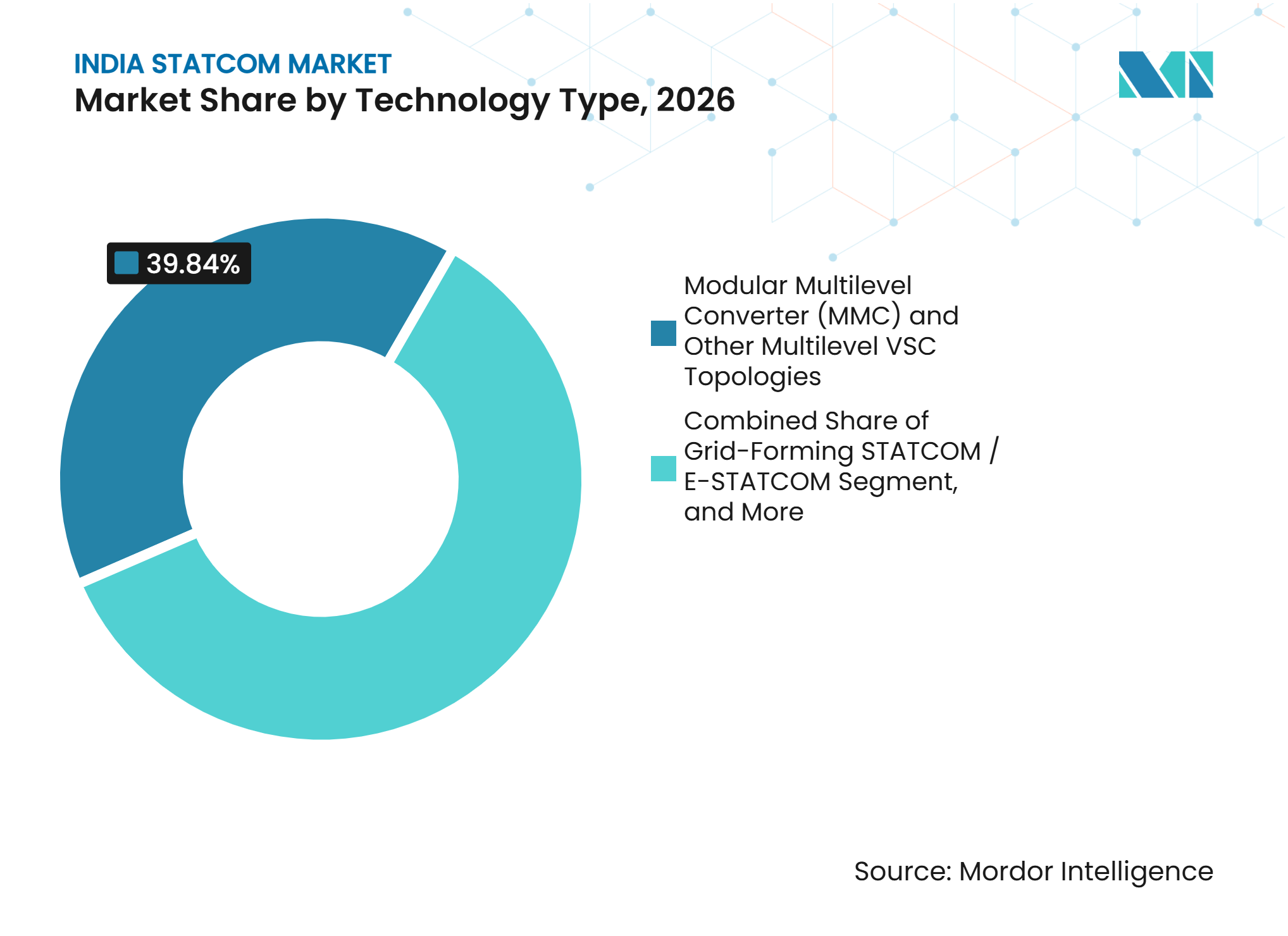
Grid-Forming Capability Changes Technology SelectionModular multilevel converter and other multilevel VSC topologies accounted for 39.84% of India's STATCOM market share in 2026. Their lead reflects the requirements of 400 kV and 765 kV interconnections, where harmonic performance, fault ride-through, and rapid response are important. These converters are suitable where lower-specification equipment cannot meet network-study requirements, while conventional VSC systems remain relevant in mid-tier projects. Medium-voltage and distribution systems serve urban industrial loads and power-factor correction needs. Technology selection will continue to depend on rating, voltage level, fault level, and operating requirements.
Grid-forming STATCOM and E-STATCOM represent the fastest-growing technology type in the supplied material, although no growth rate is disclosed. The 2026 CEA construction standards and GRID-India discussion on batteries above 50 MW raise the profile of grid-forming functions in new projects. A 2025 CIGRE paper found that grid-forming enhanced STATCOMs can improve wind-plant stability by suppressing sub-synchronous resonance, DC voltage transients, and new oscillatory modes. These functions place E-STATCOMs closer to synchronous condensers in the system-strength discussion. Local valve production, engineering support, and performance testing are becoming more important, as GE Vernova’s Chennai investment demonstrates.



By Reactive Power Rating:
Pooling-Station Projects Support Large UnitsLarge-scale transmission STATCOMs captured 47.62% of the segment in 2026, consistent with interstate projects requiring high ratings at 400 kV and 765 kV substations. The approved northern-region scheme described in the supplied material calls for 8 units rated at ±300 MVAr across 5 substations. Large equipment is favored when a small number of substations must meet a substantial combined compensation requirement, and such projects can yield high revenue per contract for qualified suppliers. They also depend on transmission approvals, site readiness, and the final TBCB award structure.
Small-scale distribution and industrial STATCOMs are projected to record a 10.62% CAGR through 2032. Their growth is linked to medium-voltage SVG requirements at renewable plants and to power-quality needs in manufacturing sites, data centers, and railway traction applications. The draft CEA connectivity standards require inverter-based resources to maintain reactive capability of ±33% of rated active power across their operating range. Passive capacitors cannot consistently provide this dynamic response under changing system conditions. The segment remains more fragmented than high-voltage transmission projects because each installation has a different load profile and commercial model. Broader adoption will depend on commissioning skills, measurable savings from power-quality improvement, and financing options for customers outside regulated transmission.
By Application:
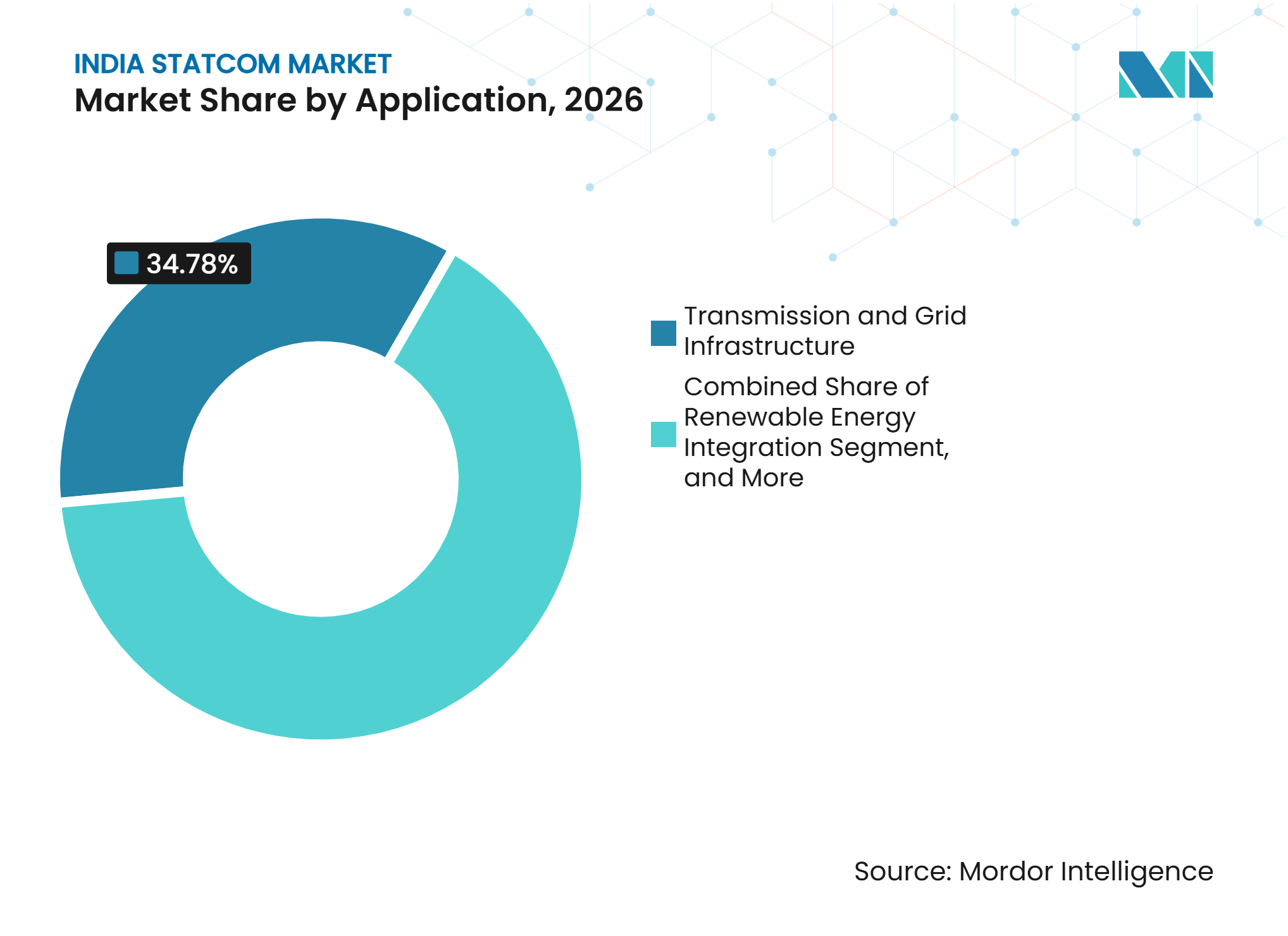
Renewable Integration Increases Demand for Dynamic SupportRenewable energy integration is projected to be the fastest-growing application in the India STATCOM market, at a 10.76% CAGR through 2032. India’s 288.6 GW renewable base has already increased the need for voltage support around major pooling substations. Grid disturbances during 2025-2026 showed the operational cost of weak voltage control in renewable-heavy areas. STATCOM systems can support voltage stability and help renewable plants meet interconnection requirements. This use case will remain linked to the progress of solar, wind, battery, and evacuation projects, particularly in Rajasthan and Gujarat.
Transmission and grid infrastructure remains the largest application by procurement value in the supplied material. This reflects the scale of interstate packages and the need for high-rating equipment at major substations. Industrial and manufacturing users deploy medium-voltage systems to manage flicker, harmonic distortion, and fluctuating reactive demand. Data centers and commercial facilities are emerging applications, while the Ministry of Power projected an additional 26.3 GW of AI-driven data-center load by FY32. Railway electrification remains a smaller application, but higher-speed corridors can create power-quality challenges due to single-phase traction loads.

By Component:
Digital Controls Add Value Beyond Equipment SupplyPower electronic converter valves accounted for 38.93% of the segment in 2026, as valves determine much of the converter’s switching and dynamic performance. Their importance has made domestic manufacturing a strategic issue for suppliers. GE Vernova announced a USD 16 million investment to establish a VSC STATCOM and LCC HVDC valve manufacturing line at Chennai Pallavaram, with commissioning targeted for early 2027. Hitachi Energy also stated that its Chennai facility supports local manufacture of valves, transformers, and control systems for STATCOM projects.[2] Semiconductor-grade devices remain an import exposure even as more assembly and engineering work is localized.
Control, protection, and monitoring systems are projected to expand at a 10.83% CAGR through 2032. Utilities value platforms that coordinate with renewable plant controllers and support power-oscillation damping, automated dispatch, and grid-forming operation. These systems can provide recurring service, upgrade, and support revenue after the original equipment is delivered. Converter transformers and reactors remain important for high-voltage power flow, while cooling systems, capacitors, filters, and auxiliaries support fleet reliability. Component support and modernization may become more relevant as early installations approach maintenance cycles in the late 2020s.
Geography Analysis
Northwestern India: Renewable Zones Drive Near-Term Deployment
Northwestern India remains the leading deployment area for the India STATCOM market because Rajasthan and Gujarat combine large renewable clusters with weaker short-circuit conditions. Projected scenarios at Bikaner-II, Bhadla-III, Khavda, and Lakadia-II indicated pressure against the CEA reference threshold for short-circuit ratio. Gujarat Energy Transmission Corporation had installed a STATCOM at Timbdi and planned further projects at Tharad, Deodar, Sagapara, Kheralu, Kukma, and Dhangadhra in the supplied material. The Khavda transmission complex is central to the planned ±800 kV, 6,000 MW Khavda-Nagpur HVDC link, and JBIC’s June 2026 financing commitment supports infrastructure across the Gujarat-Maharashtra corridor. High levels of renewable energy concentration make the region an important reference market for utility-scale equipment and domestic project execution.
Northern Region: Policy-Led Procurement Supports High-Voltage Projects
The northern region has a major policy-led pipeline that connects Rajasthan’s renewable zones to high-demand centers in Delhi-NCR, Uttar Pradesh, Haryana, and Punjab. The supplied material identifies an INR 4,378 crore (USD 527 million) compensation scheme for 8 ± 300 MVAr STATCOMs at 5 interstate substations, indicating a preference for large units where system studies show a material dynamic compensation gap. The Bhadla II-Sikar II 765 kV line entered service in January 2026, strengthening the corridor toward northern load centers. The Bhadla-Fatehpur HVDC link heightens the need for voltage control at the receiving end, while CEA and Indian Electricity Grid Code requirements influence scheme design and testing.
Southern, Western, and Eastern India: Demand Broadens Beyond Core Renewable Zones
Southern, western, and eastern states are increasing their role in the India STATCOM market through renewable interconnection, industrial growth, and digital infrastructure. Karnataka’s Bellary and Davanagere schemes, the Krishnagiri project in Andhra Pradesh, and Odisha’s 3 new 765 kV substations add high-voltage interconnection points. Mumbai’s data-center clusters and railway traction loads create power-quality considerations that differ from those at renewable pooling stations. An IEEE study of the Tata Power Mumbai network assessed imbalances caused by single-phase railway loads, illustrating the role of dynamic compensation in urban networks.[3] This mix widens opportunities for medium-voltage and specialized applications, although Rajasthan and Gujarat remain the most active areas.
Competitive Landscape
Market Concentration
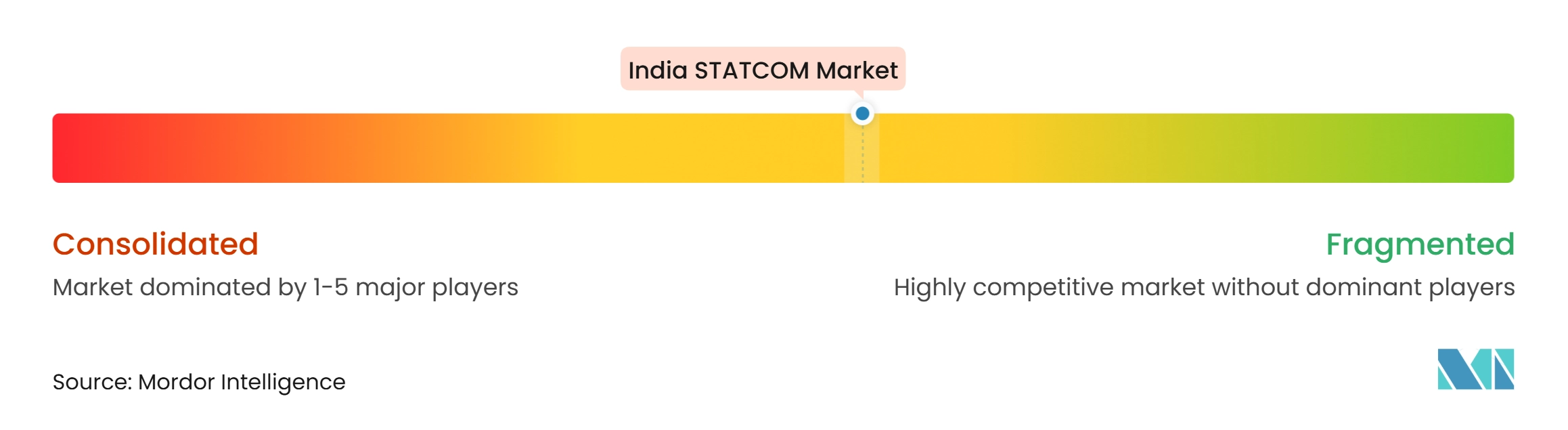
The India STATCOM market is moderately concentrated around Hitachi Energy India Limited, Siemens Energy India Limited, and GE Vernova T&D India Limited in high-voltage procurement. Larsen and Toubro and BHEL also participate through engineering, procurement, construction, and local manufacturing capabilities.[4] Established companies benefit from experience with high-voltage valves, converter transformers, protection systems, controls, factory testing, and grid studies. Semiconductor-grade components remain largely imported, so local competitiveness depends on the ability to engineer, test, and support a larger share of the equipment package in India.
Hitachi Energy’s Chennai facility supplies STATCOM-related valves, converter transformers, and control systems for Indian projects. The company reported a large STATCOM order in May 2025 and said its India project execution covers valves, transformers, and complete engineering. GE Vernova announced its USD 16 million investment in a Chennai valve line and a Noida engineering and test laboratory, strengthening its local presence in high-value components. Larsen and Toubro demonstrated high-specification delivery capability through its September 2025 STATCOM and SCADA orders.
Smaller companies have room in distribution-level and medium-voltage applications, where order sizes are smaller, and projects are more dispersed. Grid-forming capability may bring battery integrators and STATCOM suppliers closer together, but entrants must still demonstrate reliability, protection coordination, commissioning, and local grid performance. Tender approvals, land acquisition, and tariff decisions can delay orders, while synchronous condensers, SVCs, capacitors, and reactors add pressure on bids. Third-party performance testing and system study requirements also favor suppliers with proven local execution capabilities.
India STATCOM Industry Leaders
-
Hitachi Energy India Limited
-
Siemens Energy India Limited
-
Bharat Heavy Electricals Limited
-
Larsen & Toubro Limited
-
CG Power and Industrial Solutions Limited
- *Disclaimer: Major Players sorted in no particular order
India STATCOM Market Companies Covered in this Report
- Hitachi Energy India Limited
- Siemens Energy India Limited
- Bharat Heavy Electricals Limited
- Larsen & Toubro Limited
- CG Power and Industrial Solutions Limited
- GE T&D India Limited
- Mitsubishi Electric India Private Limited
- TMEIC Industrial Systems India Private Limited
- Schneider Electric India Private Limited
- American Superconductor Corporation
- Hyosung Heavy Industries Corporation
- Ingeteam Power Technology, S.A.
- JEMA Energy, S.A.
- S&C Electric Company
- Nidec ASI S.p.A.
- Clariant Power System Limited
- CosPower Engineering Limited
Recent Industry Developments in India STATCOM Market
- October 2026: Resonia Ltd. commissioned a ±600 MVAr STATCOM at the Fatehgarh III substation in Rajasthan as part of its Beawar Transmission Limited (BTL) special purpose vehicle. Integrated alongside a 765 kV double-circuit transmission corridor and a 3,000 MVA substation, the system supports 4.5 GW of renewable energy evacuation and stabilizes voltage across Rajasthan's high-penetration solar and wind grid.
- September 2026: BNC Power Projects Limited, in consortium with Siemens Energy India Limited, secured two turnkey EPC contracts from Maharashtra State Electricity Transmission Company Limited (MSETCL). The awards cover the installation of a ±300 MVAr STATCOM at the 400 kV Lonikand-II substation in Pune and a ±200 MVAr STATCOM with associated 400 kV air-insulated switchgear bays to strengthen reactive power support across Maharashtra's transmission network.
- June 2026: The Japan Bank for International Cooperation signed a loan agreement up to JPY 80 billion (USD 0.5 billion) with PGCIL for the Khavda-Nagpur ±800 kV HVDC project, one of the world’s largest HVDC projects, which will generate adjacent STATCOM demand at pooling substations and converter terminals across the Gujarat-Maharashtra corridor.
- April 2026: POWERGRID invited open tenders for STATCOM Package ST-18T to deploy high-capacity dynamic reactive power compensation equipment at the Ananthapuram-III Pooling Station. The turnkey works package targets grid stability and voltage regulation for large-scale renewable power pooling hubs in southern India.
India STATCOM Market Report Scope
A static synchronous compensator (STATCOM) is a power electronic device that provides dynamic reactive power compensation to regulate voltage levels, improve power quality, and enhance grid stability. In India, STATCOM systems support the integration of renewable energy, reduce transmission losses, and strengthen the reliability of the power transmission and distribution network.
The India STATCOM Market Report is Segmented by Technology Type (Modular Multilevel Converter (MMC) and Other Multilevel VSC Topologies, Conventional Voltage Source Converter (VSC)-Based STATCOM, Grid-Forming STATCOM / E-STATCOM, and Medium-Voltage and Distribution STATCOM), Reactive Power Rating (Large-Scale Transmission STATCOM, Medium-Scale STATCOM, and Small-Scale Distribution and Industrial STATCOM), Application (Transmission and Grid Infrastructure, Renewable Energy Integration, Industrial and Manufacturing, Data Centers and Commercial Infrastructure, and Railway Electrification and Other Applications), and Component (Power Electronic Converter Valves, Converter Transformers and Reactors, Capacitors and Harmonic Filters, Control, Protection, and Monitoring Systems, and Cooling Systems and Auxiliary Components). The Market Forecasts are Provided in Terms of Value (USD).
Segmentation Overview
| Modular Multilevel Converter (MMC) and Other Multilevel VSC Topologies |
| Conventional Voltage Source Converter (VSC)-Based STATCOM |
| Grid-Forming STATCOM / E-STATCOM |
| Medium-Voltage and Distribution STATCOM |
| Large-Scale Transmission STATCOM |
| Medium-Scale STATCOM |
| Small-Scale Distribution and Industrial STATCOM |
| Transmission and Grid Infrastructure |
| Renewable Energy Integration |
| Industrial and Manufacturing |
| Data Centers and Commercial Infrastructure |
| Railway Electrification and Other Applications |
| Power Electronic Converter Valves |
| Converter Transformers and Reactors |
| Capacitors and Harmonic Filters |
| Control, Protection, and Monitoring Systems |
| Cooling Systems and Auxiliary Components |
| By Technology Type | Modular Multilevel Converter (MMC) and Other Multilevel VSC Topologies |
| Conventional Voltage Source Converter (VSC)-Based STATCOM | |
| Grid-Forming STATCOM / E-STATCOM | |
| Medium-Voltage and Distribution STATCOM | |
| By Reactive Power Rating | Large-Scale Transmission STATCOM |
| Medium-Scale STATCOM | |
| Small-Scale Distribution and Industrial STATCOM | |
| By Application | Transmission and Grid Infrastructure |
| Renewable Energy Integration | |
| Industrial and Manufacturing | |
| Data Centers and Commercial Infrastructure | |
| Railway Electrification and Other Applications | |
| By Component | Power Electronic Converter Valves |
| Converter Transformers and Reactors | |
| Capacitors and Harmonic Filters | |
| Control, Protection, and Monitoring Systems | |
| Cooling Systems and Auxiliary Components |
Key Questions Answered in the Report
What is the India STATCOM market size?
The India STATCOM market was valued at USD 162.43 million in 2026 and is forecast to reach USD 285.74 million by 2032, growing at a 9.86% CAGR during 2027-2032. The outlook reflects demand for grid-strengthening equipment across renewable-energy transmission projects.
Which STATCOM technology leads in India?
Modular multilevel converter and other multilevel VSC topologies held 39.84% share in 2026 because they suit demanding high-voltage interconnections. The India STATCOM market is also shifting toward grid-forming STATCOM and E-STATCOM systems.
Which application is growing fastest for STATCOM systems in India?
Renewable energy integration is projected to grow at a 10.76% CAGR through 2032 as pooling substations require stronger voltage support. Transmission and grid infrastructure remains the largest application by procurement value.
Which Indian regions have the strongest STATCOM demand?
Rajasthan and Gujarat are the main deployment areas because of large renewable zones and low short-circuit ratios at major pooling substations. Northern transmission links also connect these zones to important demand centers.
Who are the leading STATCOM suppliers in India?
Hitachi Energy India, Siemens Energy India, and GE Vernova T&D India are prominent in high-voltage procurement. Larsen and Toubro and BHEL also compete through project delivery and local manufacturing capability.