
India Liquid Packaging Cartons Market Size and Share
Market Overview
| Study Period | 2021 - 2032 |
|---|---|
| Forecast Data Period | 2027 - 2032 |
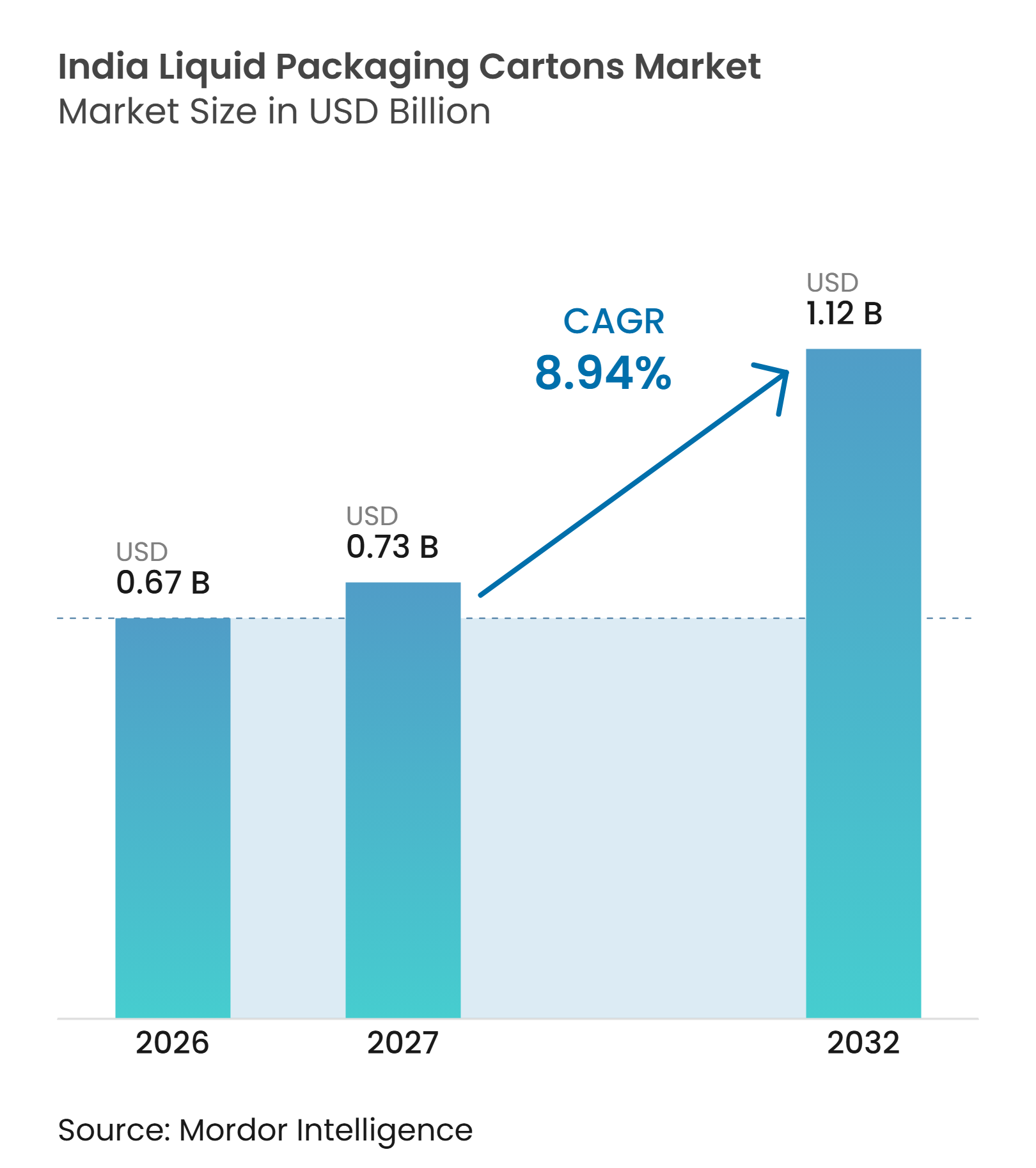
| Base Year Market Size (2026) | USD 0.67 Billion |
| Market Size (2027) | USD 0.73 Billion |
| Market Size (2032) | USD 1.12 Billion |
| Growth Rate (2027 - 2032) | 8.94 % |
| Market Concentration | Medium |
Major Players *Disclaimer: Major Players sorted in no particular order Image © Mordor Intelligence. Reuse requires attribution under CC BY 4.0. | |
India Liquid Packaging Cartons Market Analysis by Mordor Intelligence
The India liquid packaging cartons market size was valued at USD 0.67 billion in 2026 and is estimated to grow from USD 0.73 billion in 2027 to reach USD 1.12 billion by 2032, at a CAGR of 8.94% during the forecast period (2027-2032). The shift from loose milk to branded packaged milk supports demand because hygiene and product assurance increasingly shape household purchasing decisions. Ambient distribution also allows dairy and beverage brands to enter locations where dependable refrigerated logistics remain limited. New carton manufacturing investments are increasing local supply and reducing the distance between packaging producers and food and beverage customers. Smaller packs remain important for affordable purchase occasions, while larger everyday formats are gaining relevance as carton use expands beyond impulse consumption. Competition is increasing as global suppliers, domestic converters, and roll-fed carton providers pursue different combinations of equipment, material supply, capacity, and customer service.
Key Report Takeaways
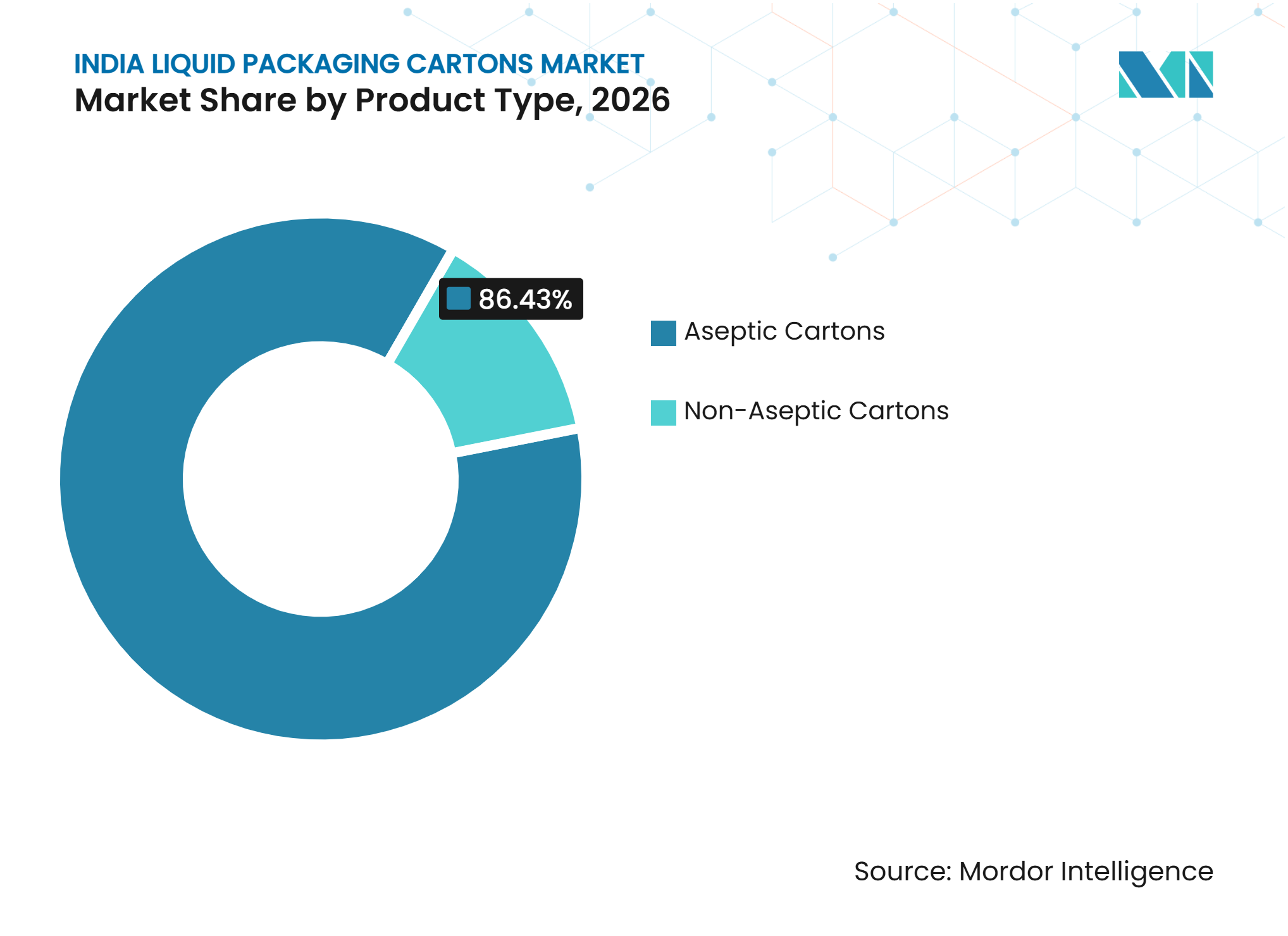
- By product type, aseptic cartons held 86.43% of the India liquid packaging cartons market share in 2026 and are projected to expand at a 9.48% CAGR through 2032.
- By application, milk accounted for 37.62% of the India liquid packaging cartons market size in 2026, while plant-based beverages are projected to expand at a 9.63% CAGR through 2032.
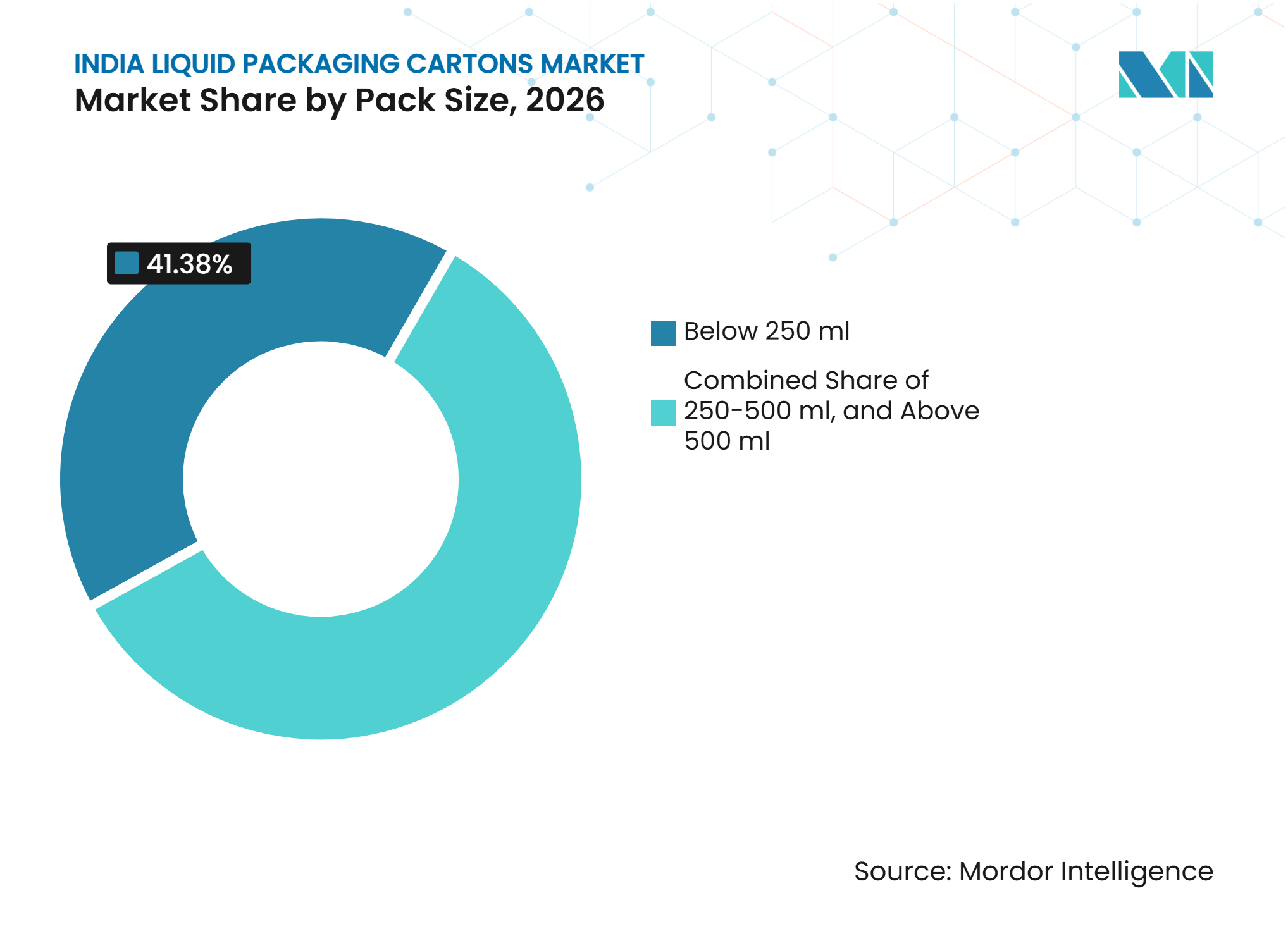
- By pack size, below-250 ml formats held 41.38% of the India liquid packaging cartons market share in 2026, while 250-500 ml formats are projected to grow at a 9.57% CAGR through 2032.
Note: Market numbers in this report are based on Mordor Intelligence's proprietary estimation framework, which combines nine months of actuals with Q4 projections for base year 2026.
Market Trends and Insights
Drivers Impact Analysis of India Liquid Packaging Cartons Market*
| Driver | (~) % Impact on CAGR Forecast | Geographic Relevance | Impact Timeline |
|---|---|---|---|
| Shift From Loose to Packaged Milk Consumption | +2.8% | National, with early gains in Maharashtra, Gujarat, and Delhi NCR | Medium term (2-4 years) |
| Expansion of Ambient Dairy and Beverage Distribution | +2.0% | National, strongest in Tier 2 and Tier 3 cities across northern and western belts | Medium term (2-4 years) |
| Rising Demand for Small-Format Affordable Packs | +1.4% | National, highest impact in Tier 2 and Tier 3 cities in Uttar Pradesh, Madhya Pradesh, Rajasthan, and Andhra Pradesh | Short term (≤ 2 years) |
| Growth of Regional and Tier 2 and Tier 3 Beverage Brands | +1.1% | National, concentrated in the Hindi belt and South India | Medium term (2-4 years) |
| Local Aseptic Carton Manufacturing Capacity Expansion | +0.9% | Gujarat, including Ahmedabad and Sanand, and Maharashtra, including Pune | Long term (≥ 4 years) |
| Increased Adoption of Shelf-Stable Plant-Based and Functional Beverages | +0.7% | Metro cities including Bengaluru, Mumbai, Delhi, Hyderabad, and Chennai | Medium term (2-4 years) |
| Source: Mordor Intelligence | |||
Shift From Loose to Packaged Milk Consumption
The move from loose to packaged milk remains a central source of demand for the India liquid packaging cartons market. A 2025 study of milk consumers in Latur district, Maharashtra, found that 60.83% of respondents still preferred loose milk, which indicates considerable room for conversion in an urban-adjacent market.[1] Packaged milk gives consumers a clearer connection between hygiene, traceability, and a known brand at the point of purchase. This distinction matters because household decisions are increasingly linked to confidence in food handling and product consistency rather than convenience alone. A continuing migration to branded milk would create recurring demand for aseptic and fresh-dairy cartons across large consumption centers, district towns, and smaller cities. Carton suppliers can benefit when dairy companies need to preserve product quality during storage, transport, and neighborhood retail distribution. The India liquid packaging cartons market therefore benefits from a long-term change in how households assess milk quality.
Expansion of Ambient Dairy and Beverage Distribution
Ambient distribution is widening the practical reach of the India liquid packaging cartons market, particularly beyond metropolitan areas. Aseptic cartons can preserve products at room temperature for extended periods, reducing reliance on refrigerated storage during transport, warehousing, and retail distribution. This feature is valuable in Tier 2 and Tier 3 locations where cold-chain coverage, electricity reliability, and temperature control remain uneven. Dairy and beverage brands can place shelf-stable products in kirana stores without requiring the retailer to invest in dedicated refrigeration. The result is a distribution model that can expand independently of modern retail growth while giving local stores a broader beverage selection. SIG’s Ahmedabad facility has been positioned to serve domestic demand and neighboring Asian markets, reflecting the operational relevance of ambient supply chains.[2]
Rising Demand for Small-Format Affordable Packs
Affordable small packs support volume growth in the India liquid packaging cartons market because they align with frequent, low-value purchase occasions. Below-250 ml cartons serve beverages and dairy products bought for immediate consumption, school breaks, travel, and short shopping trips. Brands use compact formats to preserve accessible price points while giving products a shelf-stable package that travels through ordinary retail channels. Lower carton weight and longer ambient shelf life can also reduce losses on distribution routes with unreliable refrigeration. These formats help newer products reach consumers who may be trying a category, flavor, or brand for the first time. Demand for small packs remains especially relevant in price-sensitive retail channels and in cities with high reliance on neighborhood stores.
Growth of Regional and Tier 2 and Tier 3 Beverage Brands
Regional beverage companies are becoming a relevant customer base for the India liquid packaging cartons market. These companies build demand through local flavors, small packs, and distribution that is adapted to regional retail patterns and seasonal consumption. As their volumes rise, cartons can help them extend shelf life and reach wider territories without a full cold chain. The format can also provide a standardized package for brands that want to strengthen their quality positioning with retailers and consumers. This change increases the number of potential packaging customers beyond national beverage groups and established dairy companies. It also supports contract-filling opportunities for companies that do not have the scale or capital to install their own aseptic lines.
Restraints Impact Analysis of India Liquid Packaging Cartons Market*
| Restraint | (~) % Impact on CAGR Forecast | Geographic Relevance | Impact Timeline |
|---|---|---|---|
| High Cost of Aseptic Filling Systems and Minimum Efficient Run Sizes | -2.0% | National, most acute in eastern and central India where dairy cooperatives dominate | Long term (≥ 4 years) |
| Fragmented Collection and Inconsistent Carton Recycling Economics | -1.3% | National, with collection gaps widest in Tier 3 and rural markets | Medium term (2-4 years) |
| Competition From PET Bottles, Pouches, Glass, and Metal Containers | -1.1% | National, strongest in price-sensitive rural and semi-urban markets | Medium term (2-4 years) |
| Intense Price Competition From Established and New Carton Suppliers | -0.9% | National | Short term (≤ 2 years) |
| Source: Mordor Intelligence | |||
High Cost of Aseptic Filling Systems and Minimum Efficient Run Sizes
The capital needed for aseptic filling systems limits participation in the India liquid packaging cartons market. A complete line needs filling equipment, sterilization systems, clean utilities, validated packaging supply, technical operating controls, and suitable site infrastructure. The cost can be difficult for small dairy cooperatives and regional beverage processors to absorb without long-term volume visibility. Minimum production runs can also reduce the appeal of the technology for brands with modest volumes, seasonal sales, or volatile demand. FSSAI food-safety requirements add validation and audit costs to ongoing operations, requiring closer process control than many small processors maintain. Shared filling arrangements can lower the barrier for some customers, but they remain a limited option rather than a widely standardized model.
Fragmented Collection and Inconsistent Carton Recycling Economics
Collection and recycling gaps create a continuing restraint for the India liquid packaging cartons market. A 2025 TERI study reported a national used beverage carton recycling rate of 48%.[3] The same assessment recorded a 63.66% rate across the 24 cities surveyed, showing that organized collection systems perform better than national coverage. The difference points to weak collection infrastructure in smaller cities and rural areas, where carton consumption is expanding but recovery systems remain less developed. Producers must account for evolving Extended Producer Responsibility obligations and the cost of recovering, sorting, and processing multilayer packaging. Improved material recovery capacity, paper-mill technology, local collection networks, and links with informal waste workers remain necessary for wider collection coverage.
*Our forecasts treat driver/restraint impacts as directional, not additive. The impact forecasts reflect baseline growth, mix effects, and variable interactions.
India Liquid Packaging Cartons Market Segment Analysis
By Product Type:
Aseptic Cartons Retain a Clear LeadAseptic cartons held 86.43% of segment value in 2026 and are projected to grow at a 9.48% CAGR through 2032. Their position reflects the need for shelf-stable distribution in areas where a fully integrated cold chain is unavailable. The technology lets dairy and beverage brands move products over long distances without continuous refrigeration. SIG opened its first Indian aseptic carton plant in Ahmedabad in February 2025 with annual capacity of 4 billion packs and announced EUR 40 million, equivalent to USD 43.6 million, for a local extrusion line targeted for 2027. These investments indicate continuing demand for local aseptic carton supply.
Non-aseptic cartons represented the remaining 13.57% of value in 2026 and are used mainly for fresh dairy, juices, and specialty liquids with shorter shelf-life requirements. Their resealable construction and printable surfaces support product differentiation in organized retail. Domestic suppliers have expanded gable-top carton offerings across small and large pack sizes. FSSAI food-contact requirements and material quality expectations remain relevant for both aseptic and non-aseptic formats. The India liquid packaging cartons industry therefore includes a large ambient-packaging base alongside a smaller fresh-product niche.


By Application:
Milk Provides the Base While Plant-Based Beverages Grow FasterMilk accounted for 37.62% of market value in 2026. Its role is supported by the scale of national milk consumption and the gradual formalization of dairy retail. The Latur consumer study found that loose milk remained the preference for 60.83% of respondents, showing room for packaged milk growth in a state with established dairy infrastructure. Juices, dairy products other than milk, energy and functional drinks, liquid food, and other uses account for the remaining application demand. Their adoption varies with retail access, consumer preferences, and the availability of suitable distribution systems.
Plant-based beverages are projected to record the fastest application CAGR at 9.63% through 2032. The category is supported by urban interest in dairy alternatives and by the need for a stable format that can travel without refrigeration. Aseptic cartons can support a longer shelf life for these products during wider distribution. Tetra Pak’s April 2026 collaboration with Drools introduced fresh pet food in Tetra Recart packaging without cold-chain logistics, showing how carton technology can support adjacent uses beyond mainstream beverages. Application diversity gives the India liquid packaging cartons market several paths for demand growth.
By Pack Size:
Small Formats Lead While Mid-Size Packs AdvanceBelow-250 ml cartons accounted for 41.38% of segment value in 2026. The segment benefits from demand for single-serve formats sold through high-frequency retail channels. Small packs are suited to impulse purchases and help brands maintain accessible consumer price points. They also help brands test flavors and new beverage variants in local markets. Their established role makes them important to the category’s volume base.
The 250-500 ml segment is projected to grow at a 9.57% CAGR through 2032. This range is associated with everyday-carry consumption and a gradual move beyond immediate-use formats. Larger unit sizes can improve revenue per carton and support utilization of filling lines. The above-500 ml range remains relevant for food service, institutional use, and household purchases, including 1-liter UHT milk. Pack dimensions will continue to reflect consumer affordability, retail space, filling-line efficiency, and product use occasion.

Geography Analysis
Western India
Western India is the principal production and consumption hub for the India liquid packaging cartons market. Gujarat hosts SIG’s Ahmedabad plant in the Sanand-Ahmedabad industrial corridor. SIG opened the facility in 2025 with capacity for 4 billion packs annually and described it as a domestic supply point with export potential. Maharashtra adds a major manufacturing and equipment base through Tetra Pak’s Chakan, Pune facility. The region combines organized retail, urban consumption, and established dairy networks. This concentration shortens supply links among carton suppliers, filling equipment providers, dairy processors, and beverage companies.
Northern India
Northern India provides a large demand base because Punjab, Haryana, Uttar Pradesh, and Delhi NCR form a major dairy belt. Elopak stated in its March 2026 trading update that India experienced lower volume and continued margin pressure in its non-system Roll Fed business. Its Pure-Pak system strategy is intended to build deeper customer relationships over time. The shift from material supply toward integrated systems could change how suppliers compete with northern dairy customers.
Southern India and Emerging Hinterlands
Southern India supports demand through higher beverage consumption, established organized retail, and interest in flavored dairy and plant-based options. Bengaluru was among the stronger recycling locations in TERI’s 2025 assessment, reflecting the value of organized collection systems. Eastern India and the northeast remain earlier in carton adoption, where ambient cartons can help local brands establish distribution without extensive cold-chain infrastructure. FSSAI packaging and food-contact requirements provide a common compliance baseline as these markets develop.
Competitive Landscape
Market Concentration
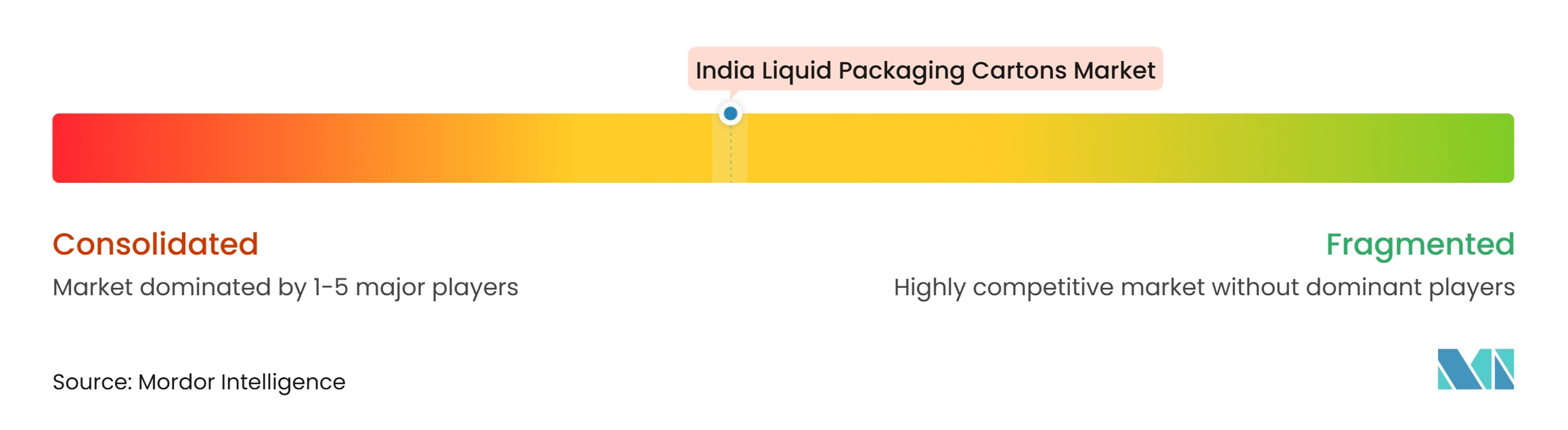
The India liquid packaging cartons market is moderately concentrated among global suppliers, while domestic conversion and gable-top activity is more dispersed. Tetra Pak has an installed-base advantage because equipment placements, packaging material supply, and customer relationships are closely connected. SIG is expanding its Indian presence through its Ahmedabad plant and planned local extrusion capacity. UFlex’s Asepto business is another active competitor with manufacturing capacity in Gujarat. The competitive focus is moving beyond pack supply toward local availability, equipment integration, and service support.
Elopak is pursuing a system-selling approach through Pure-Pak placements rather than relying only on Roll Fed material. Its March 2026 trading update confirmed that this transition remained a strategic priority despite pressure in the non-system business. SIG’s planned extrusion investment is a second strategic move that increases local integration within its Indian supply chain. Tetra Pak’s collaboration with Drools is a third example, extending carton use into fresh pet food. These actions show that suppliers are seeking demand through new applications as well as traditional dairy and beverage accounts.
Regional dairy cooperatives and growing beverage brands create an opening for contract filling and packaging services. Price competition remains intense in roll-fed material, particularly where customers can compare domestic and imported supply. Material composition is becoming a competitive consideration as producers respond to collection obligations and recycling expectations. Tetra Pak introduced packaging with certified recycled polymers in India in February 2025, providing one material-focused response.
India Liquid Packaging Cartons Industry Leaders
-
Tetra Pak International SA
-
UFlex Limited
-
SIG Group AG
-
GLS Elopak Pvt. Ltd.
-
Greatview Aseptic Packaging Co. Ltd.
- *Disclaimer: Major Players sorted in no particular order
India Liquid Packaging Cartons Market Companies Covered in this Report
- Tetra Pak International SA
- SIG Group AG
- Elopak ASA
- Greatview Aseptic Packaging Co. Ltd.
- UFlex Limited
- Nippon Paper Industries Co., Ltd.
- IPI Srl
- Lami Packaging (Kunshan) Co. Ltd.
- Shandong Bihai Packaging Materials Co. Ltd.
- Lamipak (SuZhou) Co., Ltd.
- Xiamen Hexing Packaging Group Co., Ltd.
- Parksons Packaging Ltd.
- Italpack Srl
Recent Industry Developments in India Liquid Packaging Cartons Market
- October 2026: Alternicq Limited partnered with Pulpex Limited to introduce recyclable pulp fiber bottle technology in India, expanding packaging options for liquid products. This development is relevant to the India Liquid Packaging Cartons Market, supporting demand for fiber-based materials and liquid packaging formats.
- May 2026: Parag Milk Foods, in partnership with Tetra Pak, launched an aseptic protein drink in a Tetra Prisma Aseptic carton format, targeting the sports nutrition and wellness segment. This development expands aseptic carton use in protein beverages and supports demand for shelf-stable liquid packaging in dairy and functional beverage categories.
- April 2026: Drools, one of India’s fastest-growing pet food companies, announced an INR 180 crore (USD 21.3 million) investment in processing and packaging infrastructure, entering a strategic collaboration with Tetra Pak to introduce fresh pet food in Tetra Recart packaging, making Drools the first pet food brand in Asia to deploy this format. The partnership removes the need for cold-chain logistics, extending Tetra Pak’s aseptic technology into a new application category in the Indian market.
- March 2026: Elopak ASA’s Q1 2026 trading update noted reduced volume and continued margin pressure in India due to imbalances in the non-system Roll Fed market, while affirming that Pure-Pak system selling in India remains a core strategic priority and expressing continued confidence in India’s long-term demand trajectory.
India Liquid Packaging Cartons Market Report Scope
The India Liquid Packaging Cartons Market encompasses the manufacturing and supply of paperboard-based packaging solutions designed for the safe storage, transportation, and distribution of liquid beverages and food products. These cartons provide product protection, extended shelf life, and convenient handling while supporting efficient packaging and distribution. The market includes packaging solutions designed to maintain product freshness, prevent contamination, and meet evolving food safety and sustainability requirements. Growing consumption of packaged beverages, increasing demand for convenient and shelf-stable products, and the shift toward recyclable packaging materials drive market growth across India.
The India Liquid Packaging Cartons Market Report is Segmented by Product Type (Aseptic Cartons, and Non-Aseptic Cartons), Applications (Milk, Juices, Plant Based Beverages, Dairy Products Excluding Milk, Energy and Functional Drinks, Liquid Food, and Other Applications), and Pack Size (Below 250 ml, 250-500 ml, and Above 500 ml). The Market Forecasts are Provided in Terms of Value (USD).
Segmentation Overview
| Aseptic Cartons |
| Non-Aseptic Cartons |
| Milk |
| Juices |
| Plant Based Beverages |
| Dairy Products (Excluding Milk) |
| Energy and Functional Drinks |
| Liquid Food |
| Other Applications |
| Below 250 ml |
| 250-500 ml |
| Above 500 ml |
| By Product Type | Aseptic Cartons |
| Non-Aseptic Cartons | |
| By Applications | Milk |
| Juices | |
| Plant Based Beverages | |
| Dairy Products (Excluding Milk) | |
| Energy and Functional Drinks | |
| Liquid Food | |
| Other Applications | |
| By Pack Size | Below 250 ml |
| 250-500 ml | |
| Above 500 ml |
Key Questions Answered in the Report
What is the India liquid packaging cartons market size?
The India liquid packaging cartons market size is estimated at USD 0.73 billion in 2027 and is forecast to reach USD 1.12 billion by 2032, growing at a 8.94% CAGR.
What is the size of India's liquid packaging cartons market?
The market is estimated at USD 0.73 billion in 2027 and is forecast to reach USD 1.12 billion by 2032, growing at a 8.94% CAGR.
Why are aseptic cartons important for dairy and beverages in India?
They enable ambient distribution and longer shelf life, which helps brands reach areas where refrigerated logistics are limited.
Which application is expanding fastest for liquid cartons in India?
Plant-based beverages are projected to record the fastest growth at a 9.63% CAGR through 2032.
Which pack size is most widely used in India?
Below-250 ml packs lead with a 41.38% share in 2026, reflecting demand for affordable single-serve formats.
What limits wider use of aseptic cartons in India?
High filling-line investment, minimum production runs, collection gaps, and competition from other package formats remain key constraints.