
India K-12 Edtech Market Size and Share
Market Overview
| Study Period | 2022 - 2032 |
|---|---|
| Forecast Data Period | 2027 - 2032 |
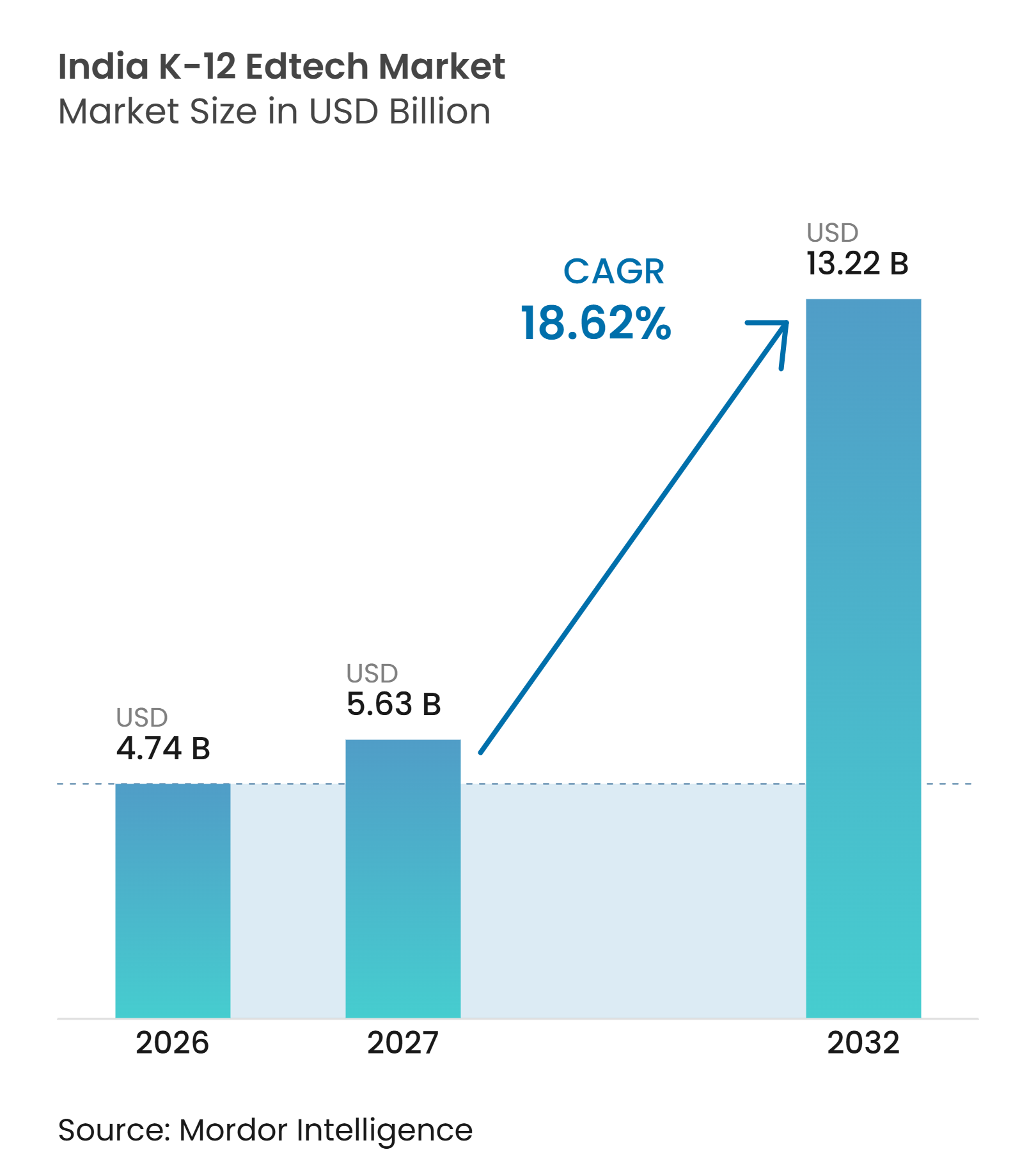
| Base Year Market Size (2026) | USD 4.74 Billion |
| Market Size (2027) | USD 5.63 Billion |
| Market Size (2032) | USD 13.22 Billion |
| Growth Rate (2027 - 2032) | 18.62 % |
| Market Concentration | Medium |
Major Players *Disclaimer: Major Players sorted in no particular order Image © Mordor Intelligence. Reuse requires attribution under CC BY 4.0. | |
India K-12 Edtech Market Analysis by Mordor Intelligence
The India K-12 EdTech market size was valued at USD 4.74 billion in 2026 and is estimated to grow from USD 5.63 billion in 2027 to reach USD 13.22 billion by 2032, at a CAGR of 18.62% during the forecast period (2027-2032). Growth is driven by youth smartphone access, public digital learning infrastructure, and household spending on supplementary education. The Ministry of Statistics and Programme Implementation reported that 95.5% of rural mobile phone owners aged 15-29 owned smartphones, while 92.7% of rural residents in the same age group had used the internet during the preceding three months, indicating potential for digital learning adoption beyond major cities[1]. The INR 78,572 crore (USD 8.74 billion) allocation for school education in the Union Budget 2025–2026 was accompanied by initiatives to strengthen digital learning infrastructure, including an INR 500 crore (USD 55.65 million) Center of Excellence in AI for Education, 50,000 planned Atal Tinkering Labs in government schools, and broadband connectivity for all government secondary schools under BharatNet.
Key Report Takeaways
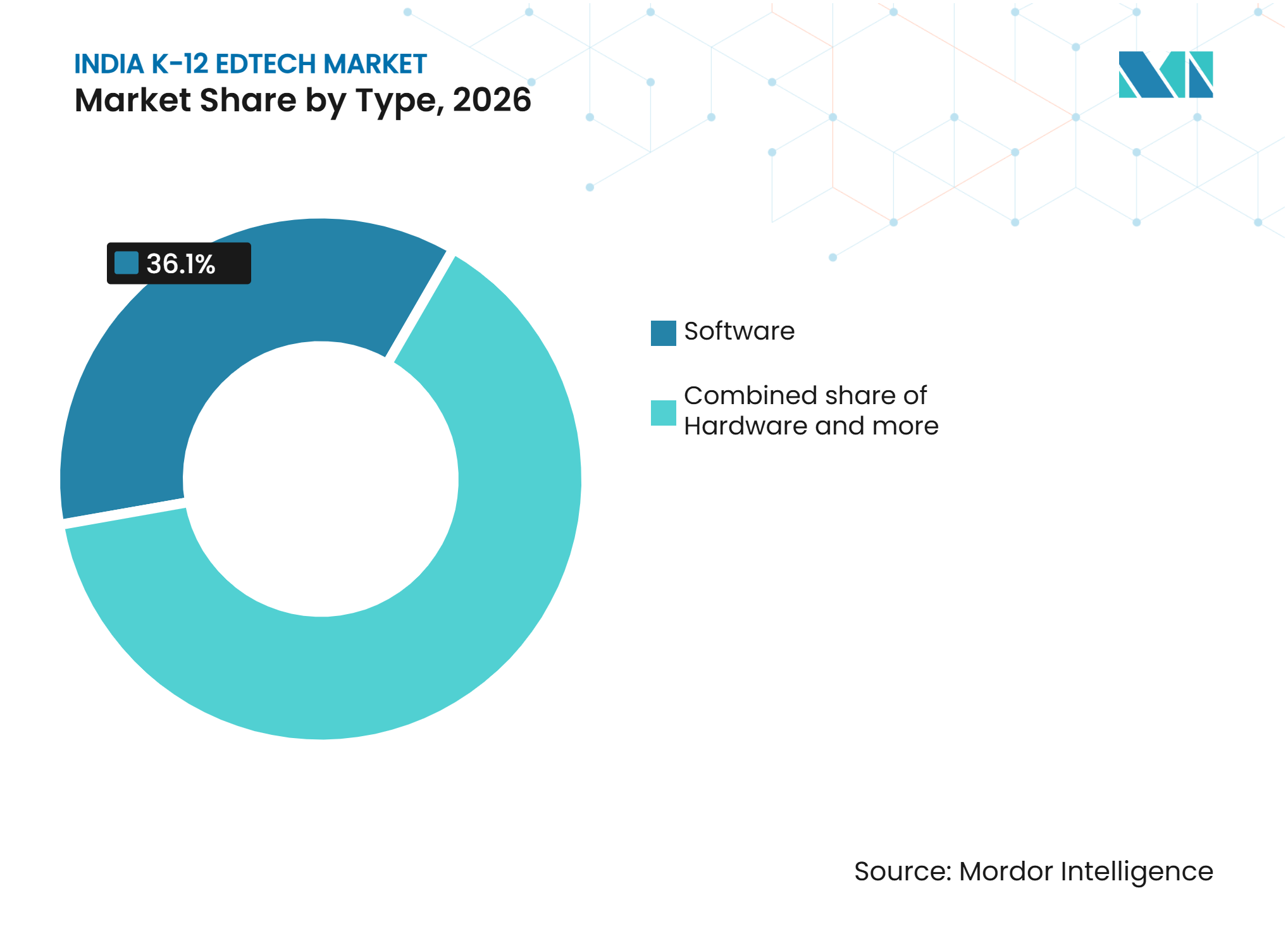
- By type, Software accounted for 36.10% of the India K-12 EdTech market share in 2026 and is projected to grow at a 20.12% CAGR through 2032.
- By deployment model, Cloud-based deployment accounted for 76.60% of the India K-12 EdTech market size in 2026 and is projected to grow at a 20.70% CAGR through 2032.
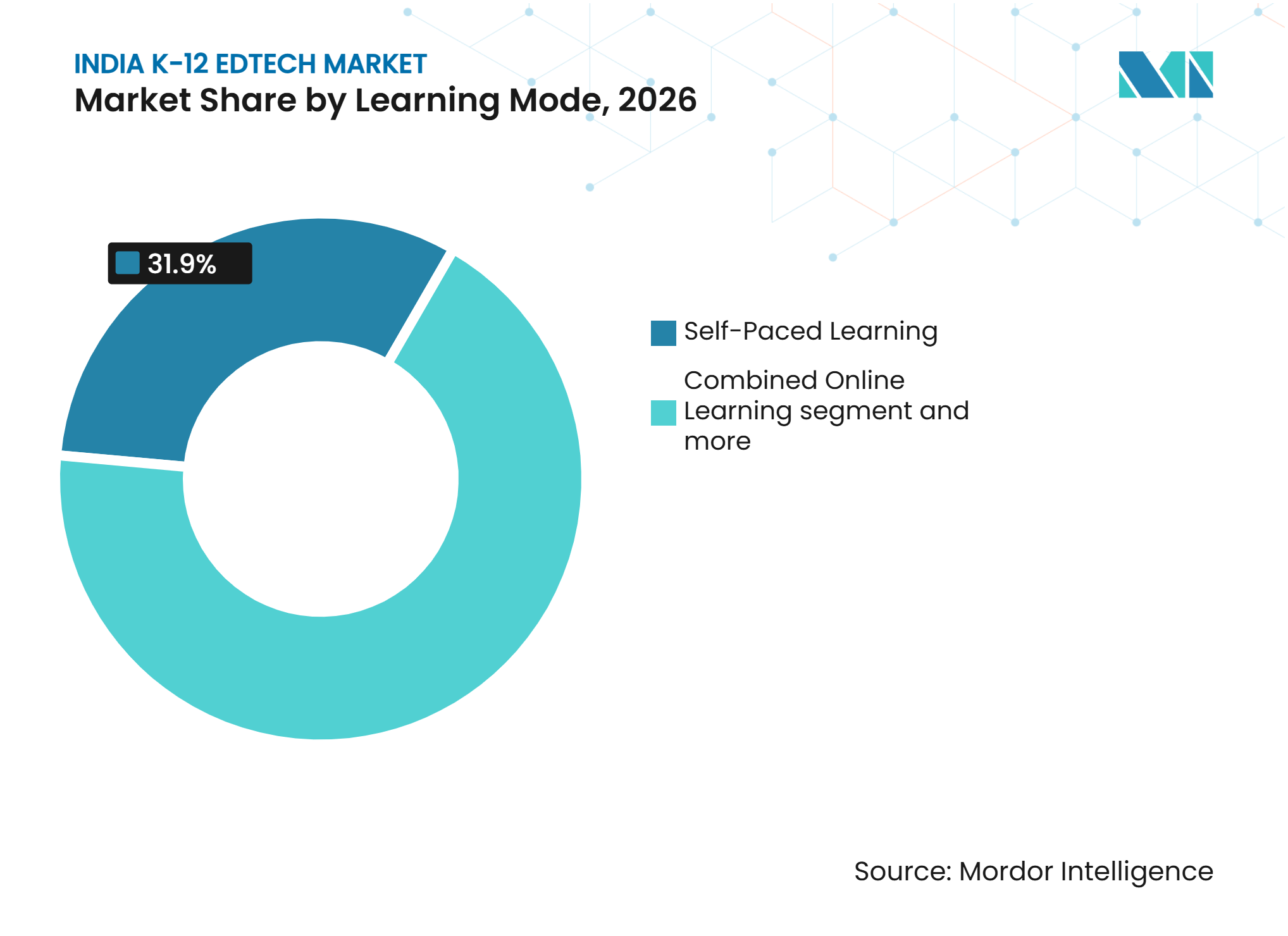
- By learning mode, Self-Paced Learning accounted for 31.90% of the India K-12 EdTech market share in 2026, while Blended and Hybrid Learning are projected to grow at a 21.90% CAGR through 2032.
- By end-user, the Consumer segment accounted for 62.90% of the India K-12 EdTech market share in 2026 and is projected to grow at a 19.10% CAGR through 2032.
- By geography, North India accounted for 30.20% of the India K-12 EdTech market size in 2026, while East India is projected to grow at a 20.20% CAGR through 2032.
Note: Market numbers in this report are based on Mordor Intelligence's proprietary estimation framework, which combines nine months of actuals with Q4 projections for base year 2026.
Market Trends and Insights
Drivers Impact Analysis of India K-12 Edtech Market*
| Driver | (~) % Impact on CAGR Forecast | Geographic Relevance | Impact Timeline |
|---|---|---|---|
| Expansion of Affordable Smartphone and Mobile-Internet Access | +3.2% | National, with disproportionate gains in Tier-2 and Tier-3 cities and rural belts of North and East India | Short term (≤ 2 years) |
| Government-Led School Digitization and Digital Public Infrastructure | +2.5% | National, with the highest lift in government-school-dense states including Uttar Pradesh, Bihar, and Madhya Pradesh | Medium term (2-4 years) |
| Demand for Supplementary Learning and Examination Preparation | +3.5% | North and South India, expanding to East India and Tier-3 geographies | Short term (≤ 2 years) |
| Growth of Hybrid School and Coaching Delivery Models | +2.0% | National, with strength in metro and Tier-1 cities and growing reach in Tier-2 and Tier-3 areas | Medium term (2-4 years) |
| Vernacular and Board-Specific Content Localization | +1.8% | South India, West India, and East India | Medium term (2-4 years) |
| AI-Assisted Personalization, Assessment, and Teacher Workflows | +2.3% | National, beginning in private urban schools and extending through state deployments | Long term (≥ 4 years) |
| Source: Mordor Intelligence | |||
Expansion of Affordable Smartphone and Mobile-Internet Access
Expanding smartphone penetration and affordable mobile internet are extending the reach of the India K-12 EdTech industry beyond areas served by physical coaching centers. Improved connectivity enables students in rural and underserved locations to access online tutoring, recorded lessons, and digital assessments. This allows providers to reach new users without investing in physical infrastructure. However, inconsistent network quality and affordability constraints may limit regular platform usage. Providers offering low-bandwidth content, mobile-friendly learning experiences, and affordable subscriptions are better positioned to convert digital access into sustained adoption.
Government-Led School Digitization and Digital Public Infrastructure
Government digitization is expanding institutional opportunities in the India K-12 EdTech market. The Ministry of Education reported that the share of schools with internet connectivity increased to 63.5% in 2024-2025 from 53.9% in the previous year, while the share of schools with functional computers rose to 64.7% from 57.2%. The Union Budget 2025-26 allocated INR 78,572 crore (USD 8.74 billion) to school education, including INR 500 crore (USD 55.65 million) for a Center of Excellence in AI for Education, along with commitments to BharatNet and 50,000 Atal[2]. Public digital learning initiatives raise the baseline services that private offerings must exceed. NEP 2020 and PARAKH strengthen the outcomes and assessment framework for platforms seeking school-system contracts. This environment favors vendors that integrate digital tools with teacher workflows, curriculum implementation, and auditable learning-progress tracking.
Demand for Supplementary Learning and Examination Preparation
Supplementary learning remains a key revenue driver for the India K-12 EdTech industry, as household demand extends beyond entrance exam coaching. Families seek academic support alongside formal schooling, while remediation needs before the senior secondary stage expand the role of supplementary learning tools. North India generates exam-preparation volumes through established coaching clusters, while smaller cities provide a growing base of first-time digital customers. Platforms can reduce reliance on a narrow JEE and NEET proposition by combining board exam preparation, foundational learning support, and parent-facing performance reporting. This broader offering makes regional curriculum alignment and affordability critical to customer acquisition.
Growth of Hybrid School and Coaching Delivery Models
Hybrid delivery is gaining relevance as families continue to value local academic support and personal interaction. The India K-12 EdTech market benefits when online practice modules, recorded content, and assessment tools extend school and coaching center instruction. Increasing internet availability in schools supports technology-enabled instruction across more locations. Digital delivery also enables centralized faculty and content teams to support learners beyond a single classroom. In smaller cities, hybrid models can meet parents’ preference for local accountability while retaining the scale advantages of shared digital content. This model is most sustainable when offline settings focus on doubt resolution, mentoring, practical instruction, and supervised assessments rather than serving solely as sales channels.
Restraints Impact Analysis of India K-12 Edtech Market*
| Restraint | (~) % Impact on CAGR Forecast | Geographic Relevance | Impact Timeline |
|---|---|---|---|
| Digital Access Gaps Across Rural, Low-Income, and Government-School Learners | -2.5% | East India, Central India, the Northeast, and states with low school internet penetration | Medium term (2-4 years) |
| Parent Trust, Outcome Proof, and Willingness-to-Pay Pressure | -1.8% | National, especially Tier-2 and Tier-3 markets | Medium term (2-4 years) |
| Fragmented School Procurement and Long Institutional Sales Cycles | -1.2% | National, with greater effect in government-school and rural segments | Long term (≥ 4 years) |
| Board-Syllabus Fragmentation and Assessment-Data Interoperability Risk | -0.9% | National, especially multi-board states including Maharashtra and Karnataka | Medium term (2-4 years) |
| Source: Mordor Intelligence | |||
Digital Access Gaps Across Rural, Low-Income, and Government-School Learners
Uneven digital access, despite broader device ownership, restrains the India K-12 EdTech market. National school internet connectivity reached 63.5% in 2024-2025, but this average masked significant differences in infrastructure quality and access availability. The cited Unified District Information System for Education Plus (UDISE+) evidence showed that government schools had materially lower digital infrastructure availability than private schools, limiting consistent school-based EdTech deployment[3]. Disparities in access across geographies, genders, and income groups remain significant, particularly for rural learners. These gaps require offline downloads, small-file formats, mobile-first interfaces, and content that functions under intermittent connectivity. Platforms that treat low-bandwidth design as a core product requirement can serve a larger share of public-school and lower-income learners.
Parent Trust, Outcome Proof, and Willingness-to-Pay Pressure
Household willingness to pay depends on credible evidence that a product improves learning outcomes. The Bharat EdTech Survey reported widespread use of education technology among children and teachers but identified the conversion of free users to paid users as an ongoing commercial challenge. Free public learning content raises expectations for paid content and services. In price-sensitive locations, parents compare subscription costs with local tuition fees, school fees, and free digital alternatives. Transparent diagnostic assessments, regular progress reports, and clearly defined renewal benefits can build trust without broad outcome claims. This constraint is strongest where learners need support, but household cash flows are irregular, increasing the importance of flexible, low-risk pricing.
*Our forecasts treat driver/restraint impacts as directional, not additive. The impact forecasts reflect baseline growth, mix effects, and variable interactions.
Student & Learner Behavior Analysis
India had approximately 24.8 crore school students in 2023-2024. The gross enrollment ratio declined from 93% at the primary level to 66.5% at the secondary level, before rising to 68.5% in 2024-2025. This progression gap highlights secondary-grade participation and examination readiness as key demand areas in the India K-12 EdTech market. The K-12 EdTech segment was valued at approximately USD 3.2 billion in 2024 and is projected to grow through 2032. Providers can address this opportunity through grade-specific learning pathways, diagnostic practice, and curriculum-aligned revision.
Average annual household spending on private coaching increased from INR 859 (USD 9.56) in 2011-2012 to INR 2,321 (USD 25.83) in 2022-2023. Its share of education expenditure rose from 11.87% to 13.53%. Rural households allocated 15.32% of education budgets to coaching, compared with 12.02% in urban households. In 2025, 27% of students used private coaching, rising to 37.8% at the secondary level. This demand supports affordable subject-specific subscriptions, flexible payment options, and progress reporting.
Education Performance Intelligence
According to UDISE+ data published by the Ministry of Education, India had 1,01,22,420 teachers across approximately 14.71 lakh schools in 2024-2025. The pupil-teacher ratio was 10:1 at the Foundational stage, 13:1 at the Preparatory stage, 17:1 at the Middle stage, and 21:1 at the Secondary stage. The higher ratios at advanced stages highlighted the need for subject-specific support and targeted practice. This created opportunities in the India K-12 EdTech market for diagnostic assessments, automated feedback, and personalized revision tools that complemented classroom instruction.
India’s school network included 14.71 lakh schools and 24.69 crore students in 2024–2025. Government schools accounted for approximately 69% of institutions, while private schools represented 26%. Uttar Pradesh had approximately 2.62 lakh schools and 4.28 crore students, supporting demand for scalable learning solutions. The substantial government-school base also created opportunities for institutional contracts. Localized content, curriculum alignment, and delivery models suited to regional infrastructure remained essential for converting student volumes into sustainable demand.
India K-12 Edtech Market Segment Analysis
By Type:
Software Scales Through Recurring Platform UseSoftware accounted for 36.10% of the India K-12 EdTech sector in 2026, making it the largest product category. Digital platforms support learning content, assessments, administration, and teacher workflows through recurring access models. Cloud-based delivery enables providers to deploy updates without replacing classroom equipment. AI-enabled functions help teachers identify learning gaps and tailor practice to student progress. Software also provides vendors with more predictable revenue than one-time device purchases. Effective implementation support and appropriate data management practices remain essential in schools.
Software is projected to grow at a 20.12% CAGR through 2032. Hardware remains relevant where smart classrooms, displays, devices, or offline access enable digital instruction. However, it faces procurement delays, installation requirements, maintenance needs, and uneven connectivity. Content remains essential, although free public repositories reduce the value of undifferentiated video libraries. Public digital learning initiatives increase demand for commercial content that is adaptive, board-specific, or integrated with teacher support. The India K-12 EdTech sector can combine software, content, and selected hardware based on classroom requirements. In institutional settings, curriculum mapping and local implementation capabilities remain as important as technology.



By Deployment Model:
Cloud-Based Delivery Leads on Cost and ReachCloud-based deployment accounted for 76.60% of the India K-12 EdTech sector share in 2026. Cloud services reduce upfront infrastructure requirements for providers and schools while enabling centralized content updates. This model supports learners across cities and smaller towns. National digital education initiatives show that large-scale public learning systems use centrally managed delivery. As school connectivity expands, cloud platforms can support sector growth. However, providers must address reliability, data privacy, and local-language usability.
Cloud-based deployment is projected to grow at 20.70% CAGR through 2032. These models remain relevant where internet connectivity is unreliable or schools require strict data control. Providers use local coaching, downloadable modules, and private-cloud arrangements to address these needs. These formats improve access for rural institutions and lower-income learners who share household devices. They also allow schools to adopt technology gradually. While cloud-based delivery remains the long-term direction, flexible deployment models are essential for India’s diverse education system.
By Learning Mode:
Blended Learning Expands as Families Seek AccountabilityBlended and hybrid learning accounted for 31.90% of the India K-12 EdTech sector share in 2026. The India K-12 EdTech sector grows in this format when digital practice is combined with classroom sessions, mentoring, or monitored tests. Families have a local point of accountability, while students access digital materials beyond scheduled classes. Rising school internet availability supports technology-enabled instruction. Providers can also deploy a common digital curriculum across multiple locations. Maintaining consistent teaching quality across centers and schools remains a key operating challenge.
Blended and hybrid Learning is projected to grow at 21.90% CAGR through 2032. It provides flexible access to recorded lessons, revision materials, and practice tests. The format supports exam preparation by allowing students to repeat modules and study around school schedules. However, completion rates may decline when adult support or feedback is limited. Adaptive pathways and regular diagnostic checks can improve its usefulness for students with uneven foundational learning. Live online and in-person technology-enabled learning serve distinct use cases where access to local centers or stable connectivity varies.

By End-User:
Consumer Demand Leads Revenue While Institutions Add StabilityThe Consumer segment accounted for 62.90% of the India K-12 EdTech industry share in 2026. Household spending on supplementary tuition supports this position, as many families seek academic support alongside formal schooling. Demand is strongest when families perceive a gap between school instruction and examination requirements. Affordable pricing, trusted content, and demonstrable learner progress also influence demand. Parent communication is important as families compare subscriptions with local tuition options. Consumer offerings must demonstrate value during each academic term.
The Consumer segment is projected to grow at a CAGR of 19.10% through 2032. The Business segment includes school-system platforms, institutional content licensing, and public-sector deployments. Although it accounts for a smaller revenue share, institutional contracts can support longer-term relationships when vendors integrate into routine teaching and assessment. Government-school digitization expands the potential customer base, with 63.5% of schools having internet access in 2024-2025. This model requires longer sales cycles, procurement compliance, teacher training, and local service capacity. It also supports reporting, curriculum delivery, and administrative workflows. A balanced portfolio can reduce reliance on a single acquisition channel.
Geography Analysis
North India accounted for a 30.20% share of the India K-12 EdTech market in 2026. Examination-preparation activity in Uttar Pradesh, Rajasthan, and the Delhi National Capital Region supports demand for supplementary learning products. High student volumes create a broad user base, but affordability and government-school connectivity vary. Hindi-first content, low-data functionality, accessible pricing, and local coaching partnerships support hybrid delivery. Ministry of Education data on increased school internet and computer availability indicates institutional potential, although uneven infrastructure limits cloud-only models. Providers require differentiated strategies for examination-preparation users, private schools, and government-school learners.
East India is projected to grow at a 20.20% CAGR through 2032. Improving smartphone access supports first-time digital learners in West Bengal, Bihar, Odisha, and Jharkhand. Mobile-first services, simple interfaces, regional-language content, and lower-priced offerings can address varying digital readiness. Although UDISE+ reports national connectivity improvements, local access varies. Downloadable lessons, phone-based assessments, local support, and state-syllabus alignment can build trust and regular usage.
South and West India offer distinct digital learning opportunities. Karnataka’s Technology Assisted Learning Program and Andhra Pradesh’s adaptive learning deployment across 1,502 schools using 45,060 tablets illustrate South India’s digital education initiatives. In West India, Maharashtra’s approximately 108,000 schools and Gujarat’s 53,355 schools present institutional opportunities for EdTech providers. State-specific curriculum alignment, regional-language content, and adaptive learning solutions can help providers address differing educational requirements across these markets[4]. EdTech providers should validate spending and procurement priorities before tailoring strategies. Curriculum alignment, language, board requirements, procurement practices, learning standards, and student-data management are key considerations. School-focused tools, teacher workflows, accessibility features, consumer subscriptions, and scalable localization can address diverse regional needs.
Education Infrastructure & Development Intelligence
India’s Union Budget 2025-2026 allocated INR 1,28,650 crore (USD 14.32 billion) to the Ministry of Education, a 6.22% year-on-year increase. It included INR 78,572 crore (USD 8.74 billion) for school education, up 7% from the previous budget estimate. Allocations for Samagra Shiksha and Prime Minister Schools for Rising India (PM-SHRI) increased by INR 3,750 crore (USD 417.37 million) and INR 1,450 crore (USD 161.38 million), respectively, while INR 500 crore (USD 55.65 million) was earmarked for an AI Center of Excellence in Education. The government also announced 50,000 Atal Tinkering Labs over five years and broadband connectivity for government secondary schools through BharatNet. These measures expanded opportunities for STEM learning, AI-enabled educational tools, and institutional EdTech procurement, subject to implementation and tender availability.
Digital education infrastructure also improved. In 2024-2025, 64.7% of schools had computer access, up from 57.2%, while internet connectivity reached 63.5%, compared with 53.9% previously. The national Digital Infrastructure for Knowledge Sharing (DIKSHA) platform had more than 2 crore registered users by March 2026, strengthening the reach of public digital learning infrastructure. For the India K-12 EdTech Market, these developments created opportunities in digital assessments, multilingual content, blended learning, and teacher-support solutions. However, uneven connectivity and school readiness continued to drive demand for offline-compatible products and implementation services.
Competitive Landscape
Market Concentration
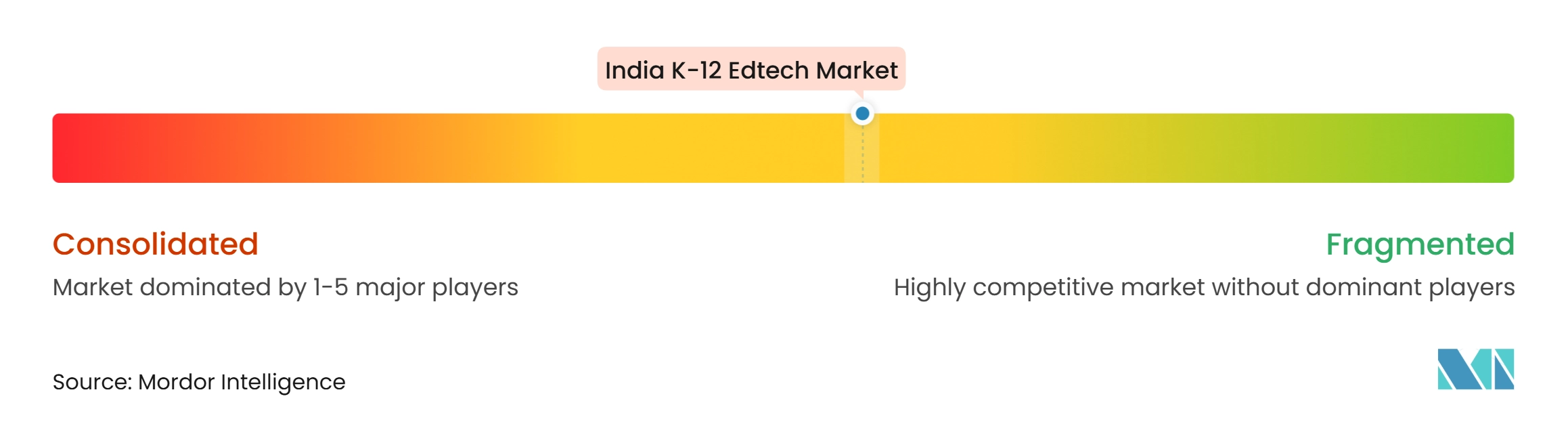
The India K-12 EdTech market has a moderate concentration level, with no single company holding a dominant national position across consumer and institutional offerings. Competition spans supplementary learning platforms and school-linked solution providers. Public digital infrastructure pressures companies to demonstrate the added value of paid products. Providers differentiate through hybrid delivery, regional-language access, assessments, and teacher support. Operational quality and measurable learning outcomes are increasingly more important than content volume. Companies that can serve large consumer bases and complex institutional requirements without compromising quality are better positioned.
Providers are expanding regional-language and hybrid delivery models as families value local relevance and accountability. These models serve learners who do not prefer standard Hindi- or English-language content. School-focused providers compete through technology that aligns with teaching routines, curriculum sequencing, and administrative requirements. Government education policies favor vendors aligned with national learning and assessment frameworks. Providers also need implementation support to maintain quality while expanding across states.
Uneven access, parent trust, and fragmented procurement shape competitive risk. Digital access gaps limit the reach of cloud-only platforms despite improving national connectivity. Free public content reduces demand for generic subscriptions but sustains demand for structured support and assessments. Data protection, curriculum alignment, and teacher acceptance influence the durability of school deployments. The market is likely to remain competitive across multiple business models rather than rapidly consolidating around a single national offering.
India K-12 Edtech Industry Leaders
-
PhysicsWallah Limited
-
BYJU’S
-
Vedantu Innovations Pvt. Ltd.
-
LEAD School
-
Aakash Educational Services Limited
- *Disclaimer: Major Players sorted in no particular order
India K-12 Edtech Market Companies Covered in this Report
- PhysicsWallah Limited
- BYJU'S
- Vedantu Innovations Pvt. Ltd.
- LEAD School
- Aakash Educational Services Limited
- Allen Career Institute
- Cuemath
- Extramarks Education India Pvt. Ltd.
- Unacademy
- Teachmint Technologies Private Limited
- Classplus
- Embibe
- Toppr Technologies Pvt. Ltd.
- Khan Academy
- Google LLC
- Microsoft Corporation
- Pearson plc
- McGraw Hill Education
- Next Education India Pvt. Ltd.
- Eupheus Learning
Recent Industry Developments in India K-12 Edtech Market
- May 2026: Google announced AI training partnerships across five Indian state-level education partners, with courses localized into six Indian languages. The initiative creates opportunities for responsible AI adoption, multilingual teacher enablement, and AI-supported classroom learning.
- January 2026: LEAD targeted 1,200 additional partner schools in 2026, aiming to approach 10,000 schools. Its existing network served 3.8 million students, with 90% of partner schools outside metropolitan areas, supporting regional institutional EdTech expansion.
- November 2025: PhysicsWallah filed for an INR 3,480 crore (USD 387.30 million) IPO, including INR 3,100 crore (USD 345.02 million) in fresh capital. Planned allocations included INR 460.5 crore (USD 51.25 million) for offline-center expansion and INR 200.1 crore (USD 22.27 million) for cloud infrastructure, supporting hybrid delivery and technology scaling.
- March 2025: Aakash planned INR 800-1,000 crore (USD 89.04-111.30 million) in investment over three years for infrastructure, digital capabilities, and AI-driven learning. Its target of raising online and hybrid learning revenue contribution from 5% to 20-25% signals a stronger omnichannel strategy.
India K-12 Edtech Market Report Scope
The India K-12 EdTech market report analyzes digital learning products and services for school-level education, including hardware, software, digital content, online learning, technology-enabled classroom learning, blended delivery, and self-paced learning. The market is segmented by type, deployment model, learning mode, end-user, and geography, covering North, South, West, and East India. The study examines drivers such as affordable smartphone and mobile-internet access, government-led school digitization, examination-preparation demand, hybrid learning adoption, vernacular content localization, and AI-assisted personalization, alongside restraints including digital access gaps, parental trust and affordability concerns, fragmented institutional procurement, and syllabus interoperability challenges. It evaluates education infrastructure and investment, student–teacher ratios, educational institution density, student enrolment, and tuition expenditure. The report provides market size and growth forecasts, regional analyses, competitive landscape assessments, market concentration, market shares, strategic developments, and company profiles. It also explores opportunities in multilingual, offline-first learning, school-integrated assessment, and teacher-productivity platforms. Market estimates and forecasts are presented in value across all covered segments for 2022–2032.
Segmentation Overview
Key Questions Answered in the Report
What is the projected value of the India K-12 EdTech sector by 2032?
The India K-12 EdTech market is forecast to reach USD 13.22 billion by 2032, growing at an 18.62% CAGR from 2027 to 2032.
Which product category has the largest share in India K-12 EdTech?
Software accounted for 36.10% share in 2026, supported by recurring platform use for learning, assessment, and teacher workflows.
Why is blended learning growing in India?
Blended and Hybrid Learning is forecast to grow at a 21.90% CAGR through 2032 because it combines digital access with local academic support and accountability.
Which region is growing fastest in India K-12 EdTech?
East India is forecast to expand at a 20.20% CAGR through 2032, supported by smartphone adoption and a growing base of first-time digital learners.
What limits digital learning adoption in Indian schools?
Uneven connectivity, device access, gender gaps, parent trust, and varying school readiness continue to constrain adoption.
How important is paid tuition to K-12 digital learning demand?
Paid supplementary learning shows that households continue to seek academic support alongside formal schooling.