
India Hydroponics Market Size and Share
Market Overview
| Study Period | 2022 - 2032 |
|---|---|
| Forecast Data Period | 2027 - 2032 |
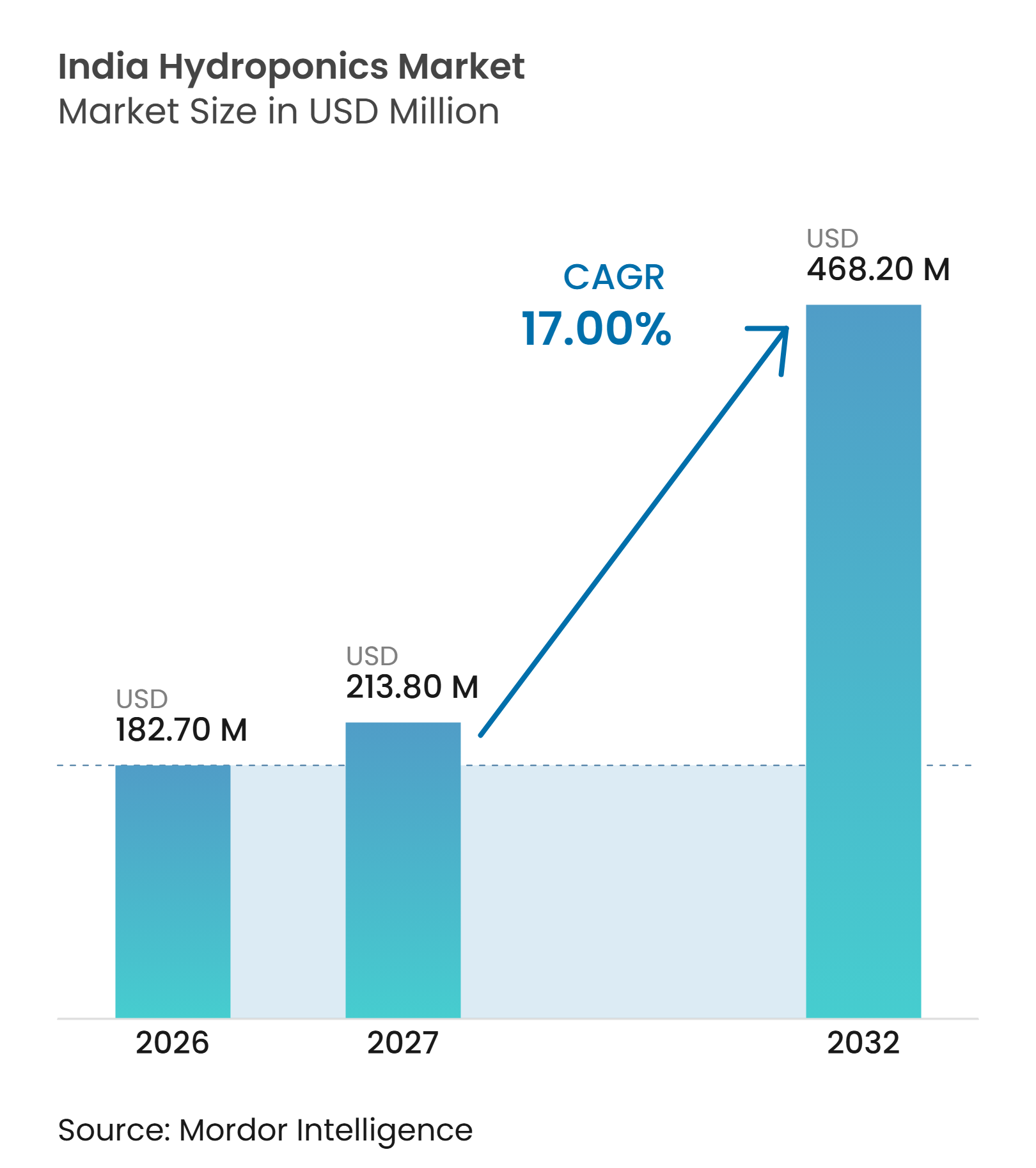
| Base Year Market Size (2026) | USD 182.70 Million |
| Market Size (2027) | USD 213.80 Million |
| Market Size (2032) | USD 468.20 Million |
| Growth Rate (2027 - 2032) | 17.00 % |
| Market Concentration | Low |
Major Players *Disclaimer: Major Players sorted in no particular order Image © Mordor Intelligence. Reuse requires attribution under CC BY 4.0. | |
India Hydroponics Market Analysis by Mordor Intelligence
The India hydroponics market size is projected to expand from USD 182.7 million in 2026 to USD 468.2 million by 2032, registering a CAGR of 17.0% between 2027 and 2032. The India hydroponics market is moving toward commercial production near major cities, where operators can supply retailers, food-service buyers, and quick-commerce platforms with consistent fresh produce. This is changing project planning for growers, lenders, equipment suppliers, and buyers that rely on fresh, perishable products. Government assistance for protected cultivation is lowering entry barriers for eligible projects, while equipment conformity requirements are raising procurement standards. Water stress is strengthening the business case for recirculating systems in states where groundwater pressure and irrigation risk affect farm planning. Retailers and hotel, restaurant, and catering buyers are placing greater value on traceability, supply consistency, and residue control. This setting favors operators that combine reliable crop protocols, local distribution, compliant equipment, and established buyer relationships.
Key Report Takeaways
-
By system type, Aggregate Systems held 58% of the India hydroponics market share in 2026, while Liquid Systems are forecast to grow at 18.6% CAGR through 2032.
-
By crop type, Lettuce and Leafy Vegetables held 55% revenue share in 2026, while Herbs and Microgreens are forecast to grow at 17.9% CAGR through 2032.
-
By farming environment, Controlled Greenhouse Hydroponics held 68.3% revenue share in 2026, while Fully Indoor Vertical Farms are forecast to grow at 13.4% CAGR through 2032.
-
By component, Irrigation, Pumps, and Fertigation held 35% revenue share in 2026, while Climate Control and Ventilation are forecast to grow at 12.8% CAGR through 2032.
-
By end user, Large Commercial Growers held 60% revenue share in 2026, while Research and Educational Institutes are forecast to grow at 6.5% CAGR through 2032.
-
By production scale, Large Project Farms held 42% revenue share in 2026, while Micro and Rooftop Farms are forecast to grow at 21.5% CAGR through 2032.
Note: Market numbers in this report are based on Mordor Intelligence's proprietary estimation framework, which combines nine months of actuals with Q4 projections for base year 2026.
Market Trends and Insights
Drivers Impact Analysis of India Hydroponics Market*
| Driver | (~) % Impact on CAGR Forecast | Geographic Relevance | Impact Timeline |
|---|---|---|---|
| Demand for Pesticide-Residue-Controlled Produce | +2.10% | National, with strong demand in Bengaluru, Mumbai, Delhi NCR, Hyderabad, and Chennai | Short term (≤ 2 years) |
| Water Stress and Recirculating Nutrient Delivery | +2.80% | Punjab, Haryana, Rajasthan, Gujarat, Maharashtra, Andhra Pradesh, and Tamil Nadu | Medium term (2-4 years) |
| Premium Urban HoReCa and Organized Retail Demand | +2.50% | Delhi NCR, Mumbai, Bengaluru, Hyderabad, Chennai, and other Tier 1 cities | Short term (≤ 2 years) |
| Protected Cultivation and Digital Agriculture Support | +2.20% | National, with early adoption in Tamil Nadu, Telangana, Maharashtra, Karnataka, and Gujarat | Medium term (2-4 years) |
| Farm-to-Fork Freshness and Supply-Chain Localization | +1.80% | Metro-adjacent areas around NCR, Mumbai, Pune, Bengaluru, and Mysuru | Medium term (2-4 years) |
| Climate-Specific System Engineering for Indian Conditions | +1.90% | Gujarat, Rajasthan, Maharashtra, Himachal Pradesh, Punjab, and Kerala | Long term (≥ 4 years) |
| Source: Mordor Intelligence | |||
Demand for Pesticide-Residue-Controlled Produce
Institutional and retail buyers increasingly treat pesticide-residue compliance as a procurement requirement. India tested 86,401 food commodity samples between 2022 and 2025, and 2.8% exceeded notified maximum residue limits[1]. That result creates a commercial risk for branded retailers, cloud kitchens, and food-service groups that need defensible sourcing processes. Hydroponic cultivation allows operators to manage nutrient delivery and crop protection in a controlled growing environment. The India hydroponics market therefore benefits when buyers request documented production practices and traceable supply. Quick-commerce operators also need produce that can remain saleable through short, frequent fulfillment cycles. Farms that can supply predictable quality close to consumption centers can strengthen customer retention and reduce rejected deliveries.
Water Stress and Recirculating Nutrient Delivery
Water availability is a structural agricultural issue across several major producing states. Agriculture accounts for 80% to 90% of India’s water withdrawals, while per-capita water availability has declined sharply since 1970. The NCAER identifies groundwater depletion and gaps in water governance as serious concerns for agricultural sustainability. Recirculating hydroponic systems can use substantially less water than open-field irrigation when they are properly designed and operated. This advantage is material in Gujarat, Maharashtra, Rajasthan, Punjab, and Haryana, where groundwater conditions shape farm investment decisions. The India hydroponics market can gain from projects that combine water treatment, recirculation, and crop planning suited to local water constraints.
Premium Urban HoReCa and Organized Retail Demand
Hotels, restaurants, caterers, organized retailers, and quick-commerce services need regular supplies of leafy greens, herbs, and specialty vegetables. India’s hotel, restaurant, and institutional food-service sector was valued at USD 24.2 billion in 2025 and is projected to reach USD 45.4 billion by 2030[2].These buyers place value on consistent quality, product appearance, and dependable delivery schedules. Open-field supply can be disrupted by seasonal heat, rainfall, and logistics conditions. Peri-urban hydroponic farms can shorten procurement routes for metropolitan buyers. The India hydroponics market gains when farm operators secure supply agreements that match crop calendars with buyer demand.
Climate-Specific System Engineering for Indian Conditions
Hydroponic systems require adaptation to India’s varied temperature and humidity conditions. High summer temperatures in Gujarat and Rajasthan can raise cooling requirements within protected structures. Humid conditions in Kerala can increase fungal pressure without suitable ventilation and crop management. Winter cropping conditions in Himachal Pradesh and Punjab call for different operational settings. These local conditions increase the value of proven system designs, climate controls, and crop protocols. The India hydroponics market can reward operators that build local performance data rather than apply standard designs without adjustment. Climate-appropriate engineering also supports more stable yields and protects project economics over multiple crop cycles.
Restraints Impact Analysis of India Hydroponics Market*
| Restraint | (~) % Impact on CAGR Forecast | Geographic Relevance | Impact Timeline |
|---|---|---|---|
| High Upfront Infrastructure and Working-Capital Requirements | -2.40% | National, especially East and Northeast India and Tier 2 and Tier 3 cities | Medium term (2-4 years) |
| Electricity and Backup-Power Exposure in Indoor Farms | -1.80% | Maharashtra, Rajasthan, West Bengal, Uttar Pradesh, and Madhya Pradesh | Medium term (2-4 years) |
| Agronomy Skills and Post-Installation Service Gaps | -1.60% | National, especially West and Central India and East and Northeast India | Long term (≥ 4 years) |
| Fragmented Standards, Inputs, and Quality Benchmarks | -1.20% | National, especially the system-integrator and equipment-supplier base | Long term (≥ 4 years) |
| Source: Mordor Intelligence | |||
High Upfront Infrastructure and Working-Capital Requirements
A 1,000-square-meter commercial hydroponic setup typically requires INR 5 million to INR 6 million before produce revenue begins. This equals INR 5 million to INR 6 million (USD 59,500 to USD 71,500) using the conversion presented in the supplied material. The cited project economics indicate a typical payback period of 3 to 5 years under favorable conditions. MIDH support reduces costs for qualifying components, but high-specification climate systems and automation layers may remain outside support ceilings[3]. Farms must also finance recurring purchases of nutrients, seed, electricity, and operating labor. Buyer payment delays or limited credit can strain operations even where demand and production results are sound.
Agronomy Skills and Post-Installation Service Gaps
Commercial performance depends on agronomists who can manage nutrient concentration, pH, electrical conductivity, crop schedules, and pest risk. These skills remain unevenly available outside established production clusters. Service gaps can be acute in Tier 2 locations, where system providers may complete installation but cannot provide frequent on-site support. ICAR-IIMR and Shunya Agritech signed an August 2025 memorandum for hydroponic maize fodder research, reflecting the need for science-based cultivation protocols. Remote monitoring and crop diagnostics may improve support coverage over time. Until such services become broadly accessible, weak post-installation support can reduce farm yields and investor confidence.
*Our forecasts treat driver/restraint impacts as directional, not additive. The impact forecasts reflect baseline growth, mix effects, and variable interactions.
India Hydroponics Market Segment Analysis
By Hydroponic System Type:
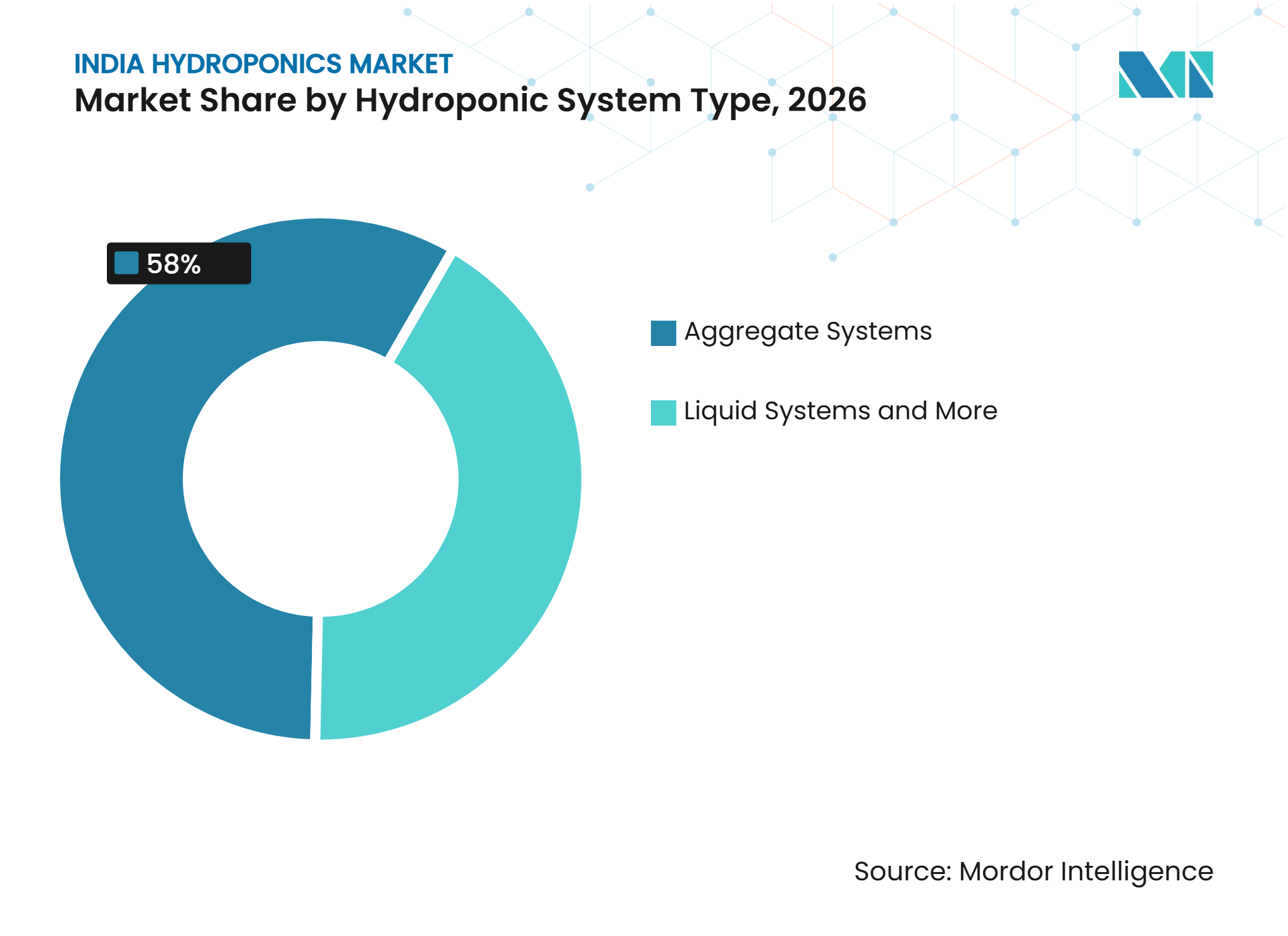
Aggregate Systems Lead Current RevenuesAggregate Systems accounted for 58% of system-type revenue in 2026. Their position reflects the use of drip-irrigated Dutch Bucket and substrate-bed configurations in commercial polyhouse cultivation. These systems are used for tomatoes, cucumbers, and capsicum across South and West India. Closed aggregate designs are gaining attention because they can recover and recirculate drainage water. This supports input management in water-stressed locations. Aggregate setups also have lower entry costs than some advanced systems. That helps explain their continuing relevance for first-generation commercial growers. The India hydroponics industry remains dependent on these accessible systems as newer formats scale.
Liquid Systems are projected to grow at 18.6% CAGR through 2032, the fastest rate in the system category. Nutrient Film Technique, Deep Water Culture, drip systems, Dutch Bucket systems, and Ebb and Flow systems support different crop and production requirements. Liquid systems are well suited to lettuce and leafy vegetable production in controlled greenhouses. The 2025 NLHortiRoad2India initiative introduced high-value greenhouse pilots near Chennai, Bengaluru, and Chandigarh for crops including strawberry, cherry tomato, and colored capsicum. Aeroponic systems remain specialized because they require stronger control over the growing environment. Hybrid designs allow larger farms to use more than one configuration and adjust crop schedules. The India hydroponics market is likely to see a gradual shift toward liquid and aeroponic formats as operators build capability.



By Crop Type:
Leafy Vegetables Hold the Largest BaseLettuce and Leafy Vegetables accounted for 55% of crop-type revenue in 2026. Their position is supported by short crop cycles, predictable yields, and acceptance among retailers and food-service buyers. These crops can be supplied to organized retail, quick-commerce platforms, and hotel breakfast operations. They also suit Nutrient Film Technique layouts in protected structures. Reliable availability is valuable for buyers that require standardized presentation and recurring supply. The crop category remains central to commercial farm planning in major metropolitan corridors. It provides an established starting point for operators entering the India hydroponics market. Demand still depends on crop quality, pricing, and local procurement relationships.
Herbs and Microgreens are forecast to expand at 17.9% CAGR through 2032. Premium menus, cloud kitchens, and direct-to-consumer subscription services support demand for diverse, harvest-fresh products. Tomatoes remain a meaningful commercial crop in greenhouse parks, especially where cherry tomatoes are sold to premium buyers. The NLHortiRoad2India pilots also focus on high-value tomatoes and colored capsicum. Cucumbers, peppers, and colored capsicum remain relevant for food-service contracts that value consistent size and appearance. Specialty fruits and flowers are smaller segments with specific local and export-oriented uses. Crop diversification can help commercial farms serve multiple buyer types without relying on a single product line.
By Farming Environment:
Controlled Greenhouses Remain the CoreControlled Greenhouse Hydroponics held 68.3% revenue share in 2026. This reflects the broad use of naturally ventilated polyhouses and fan-and-pad greenhouses across established growing regions. These structures have benefited from protected-cultivation support under MIDH and related horticulture programs. Fan-and-pad installations have particular relevance in Maharashtra and Tamil Nadu during hotter periods. They can support lettuce and herb production when passive ventilation is not sufficient. Greenhouse systems also provide a practical route for operators that need larger crop areas than indoor facilities can offer. Their installed base continues to shape the current India hydroponics market.
Fully Indoor Vertical Farms are projected to grow at 13.4% CAGR through 2032. Operators use modular indoor systems where urban proximity and land limitations can support higher energy costs. Container and modular farms offer an alternative for smaller sites that cannot justify a full polyhouse investment. NITI Aayog identifies container and modular formats as options for peri-urban food security and technology-led agriculture. Naturally ventilated polyhouses remain an accessible route for new commercial growers. Rooftop farms are still early-stage, but they align with demand for shorter delivery distances in dense urban locations. Operators must weigh energy costs, operating capability, and buyer premiums before selecting an environment.
By Component:
Fertigation Systems Hold the Largest PositionIrrigation, Pumps, and Fertigation accounted for 35% of component revenue in 2026. These systems are essential across commercial configurations, from basic polyhouse operations to automated large-project farms. Drip delivery and fertigation allow growers to control water and nutrient application. Nutrient solutions and growing media form another important component group. Coco coir is a commercially relevant substrate because it is available from India’s coconut-processing base. Local availability can reduce reliance on imported rockwool and mineral-based media. Component procurement affects both farm performance and the operating costs of the India hydroponics industry. Equipment compatibility and service availability remain important selection criteria.
Climate Control and Ventilation are forecast to grow at 12.8% CAGR through 2032. This growth reflects a move from passive ventilation toward fan-and-pad systems and, in indoor farms, more controlled heating, ventilation, and air-conditioning arrangements. LED grow lights are tied closely to the expansion of indoor production environments. Sensors, automation, and control software allow operators to monitor pH, electrical conductivity, and nutrient delivery remotely. Farm-level monitoring also supports records needed for traceability and quality management. Water treatment and recirculation equipment gain importance as farms focus on consistent water quality. The component mix is becoming more sophisticated as operators move from basic production setups to managed growing systems.
By End User:
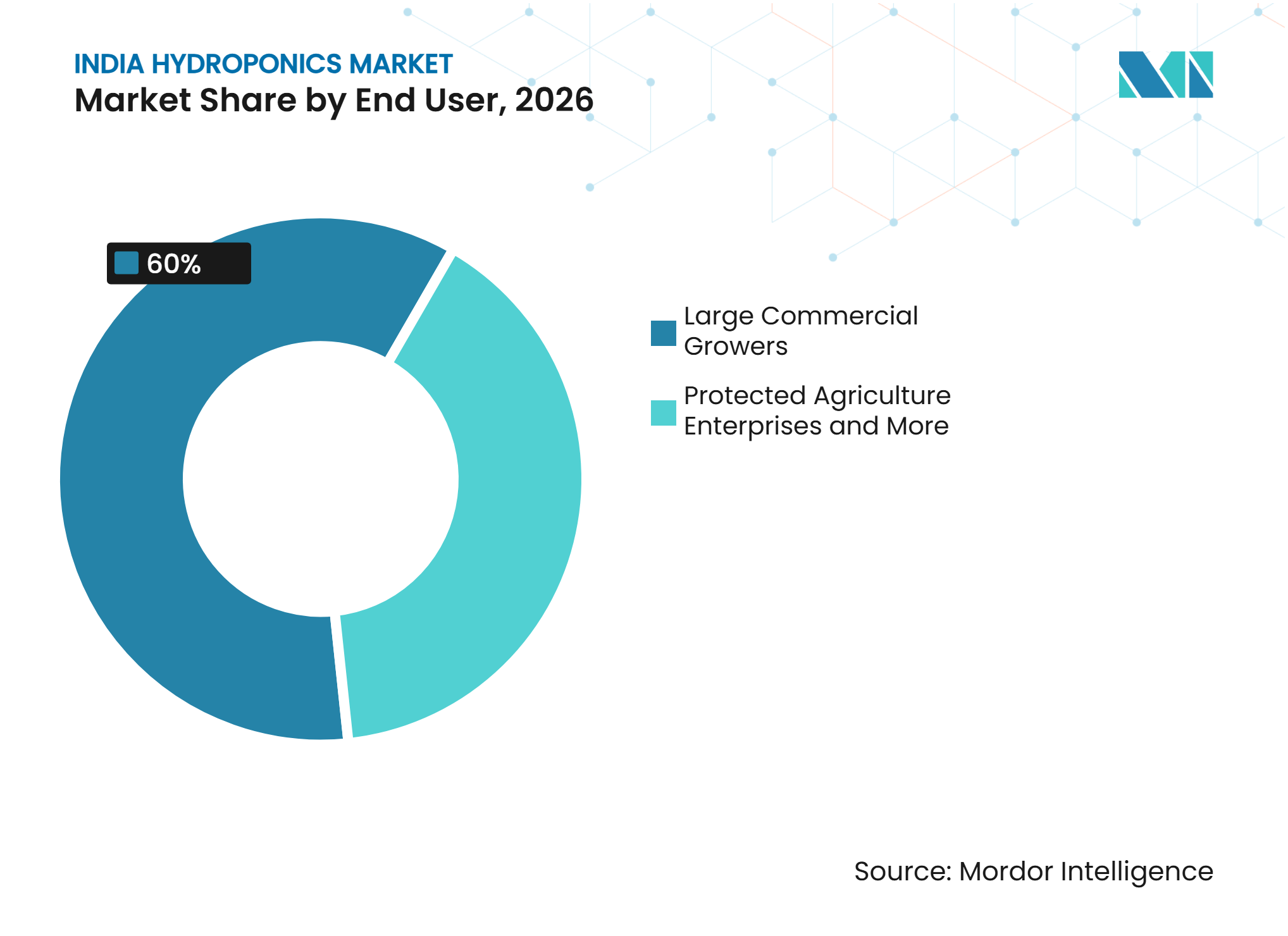
Large Commercial Growers Generate the Most RevenueLarge Commercial Growers held 60% of end-user revenue in 2026. Their share reflects the capital requirements and buyer volumes associated with commercial hydroponic farming. These operators commonly have larger farm footprints and formal supply arrangements. Protected Agriculture Enterprises form another major user group because they can combine project development with farm management. Retail and quick-commerce suppliers are also adding hydroponic produce to their sourcing systems. NutriFresh Farm Tech India Private Limited supplies buyers that include Swiggy, Zepto, Flipkart Minutes, BigBasket, and Reliance Fresh across 15 states. The India hydroponics market benefits when operators can match production volume with contracted demand.
Research and Educational Institutes are forecast to grow at 6.5% CAGR through 2032. Institutional participation can help establish tested cultivation protocols and support workforce development. The ICAR-IIMR collaboration with Shunya Agritech is focused on hydroponic maize green fodder research. Hotels, restaurants, and institutional buyers are also using supply contracts to secure consistent produce. Residential and hobby users remain a small part of demand. Their participation is linked to compact systems for homes, offices, and learning environments. Institutional adoption can support longer-term capability even if it does not yet match commercial grower revenue.

By Production Scale:
Large Project Farms Hold the Largest Revenue BaseLarge Project Farms accounted for 42% of production-scale revenue in 2026. These commercial operations generally exceed 5 acres of cultivated area. Their scale supports dedicated agronomy, procurement, logistics, and buyer management functions. Larger sites can also spread climate-control and monitoring costs across more production area. Brio Agri Producer Company Limited’s FOCO model requires a minimum commitment of INR 50 million (USD 595,000) and 30 acres of land per investor unit. This model illustrates the capital structure associated with large managed farm formats. The India hydroponics market currently derives much of its commercial value from such scaled operations.
Micro and Rooftop Farms are forecast to grow at 21.5% CAGR through 2032. Their potential is linked to compact automated systems, urban farming interest, and demand for production closer to consumers. Smaller facilities can operate in locations where large parcels are unavailable. They may also offer entry points for operators that cannot fund extensive commercial farms. Mid-scale farms from 1 to 5 acres and smaller farms from 0.5 to 1 acre remain important transitional categories. These farms often face higher support and working-capital risk because they are too large for informal management yet too small for specialized in-house teams. Consolidation, franchise affiliation, or debt-backed growth may become options for successful operators in these segments.
Geography Analysis
Karnataka, Telangana, Tamil Nadu, Andhra Pradesh, and Kerala support the region’s established agritech base. Bengaluru and Hyderabad combine food-service demand, organized retail concentration, and technology capabilities that support automation adoption. Moderate conditions in some corridors can reduce cooling needs relative to North India’s peak summer environment. NutriFresh Farm Tech India Private Limited supplies hotel, restaurant, modern retail, and quick-commerce buyers across 15 states from Pune-adjacent clusters and is expanding into southern markets. MIDH support and Bureau of Indian Standards conformity requirements influence equipment selection for qualifying projects. The regional combination of buyer density, protected cultivation, and technology services supports its leading position.
Maharashtra and Gujarat face water constraints that strengthen the economic case for recirculating systems. Brio’s Unnati Hi-Tech Hydroponics Park near Talod in Gujarat spans 100 acres and includes managed half-acre units starting at INR 5.9 million (USD 70,000). NutriFresh reported a proposed 1,000-acre smart-agriculture project in Maharashtra with a first investment tranche from the U.S. International Development Finance Corporation. Rajasthan is also seeing controlled-environment development suited to high-heat conditions. Regional growth depends on climate-adapted engineering, reliable energy planning, and effective water management. State-level protected-cultivation support can further influence project feasibility.
Delhi NCR, Haryana, Punjab, Uttar Pradesh, and Himachal Pradesh have dense food-service and organized retail demand, while Himachal Pradesh has a niche in specialty herbs and strawberries. Groundwater extraction exceeds recharge by 66% in Punjab and 34% in Haryana, reinforcing interest in recirculating farm designs. East and Northeast India remain smaller because farm infrastructure, logistics, and access to system integrators are limited. Assam and nearby markets offer lower land costs and rising demand around Guwahati. The India hydroponics market size in these areas will depend on service networks and practical protected-cultivation models. National horticulture support and equipment compliance factors can help standardize new project development.
Competitive Landscape
Market Concentration
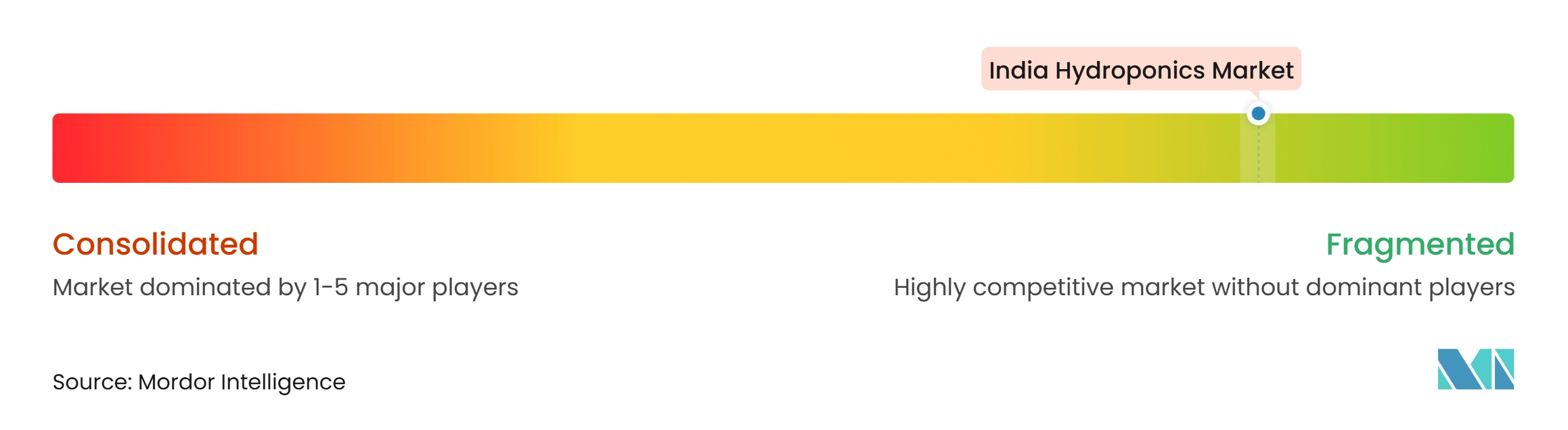
The India hydroponics market is highly fragmented, with Triton Foodworks Private Limited, Rise Hydroponics Private Limited, Kryzen Biotech Private Limited, Brio Agri Producer Company Limited, and UrbanKisaan Farms Private Limited accounting for a significant share of the organized market. The competitive landscape also includes numerous local hydroponic farm operators, regional engineering, procurement, and construction providers, nutrient and growing-media suppliers, greenhouse fabricators, and controlled-environment agriculture technology companies. Jain Irrigation Systems Limited, Netafim Limited, Priva Holding B.V., and Signify N.V. participate through irrigation, fertigation, climate control, automation, and lighting solutions. Market participants commonly compete through turnkey project execution, farm management services, investor-backed commercial farming models, technology integration, and produce supply agreements with hotels, restaurants, organized retailers, and quick-commerce platforms. The presence of a large number of regional and specialized participants limits the influence of any single company and contributes to the fragmented nature of the market.
Technology is becoming more important as farms move beyond basic protected-cultivation installations. Brio’s managed FOCO format is a strategic model, combining investor capital with company-managed agronomy, operations, logistics, and market access. The NLHortiRoad2India partnership began 3 pilot greenhouses near Chennai, Bengaluru, and Chandigarh in 2025 and plans a wider rollout of high-tech greenhouse units. Priva’s fertigation and monitoring systems and Signify’s GrowWise controls are technology benchmarks for larger projects. Competitive strength therefore depends on engineering performance, crop knowledge, buyer access, and dependable post-installation support.
Open opportunities remain in Tier 2 and Tier 3 cities, where standardized and affordable modular solutions are limited. The agronomy-as-a-service layer is also dispersed, despite a clear need for ongoing crop advice and remote support. MIDH’s equipment conformity provisions may favor suppliers able to meet documented standards in assisted projects. Large farms can benefit from scale, but smaller operators can compete where they secure local customers and manage quality closely. The combined top 5 share remains below the threshold associated with concentrated competition. Partnerships with technology providers, financiers, and food buyers can improve the ability of smaller firms to scale. Market consolidation could occur where operators can demonstrate stable yields, service capability, and reliable customer contracts.
India Hydroponics Industry Leaders
-
Triton Foodworks Private Limited
-
Rise Hydroponics Private Limited
-
Kryzen Biotech Private Limited
-
Brio Agri Producer Company Limited
-
UrbanKisaan Farms Private Limited
- *Disclaimer: Major Players sorted in no particular order
India Hydroponics Market Companies Covered in this Report
- Agriplast Tech India Private Limited
- Barton Breeze Private Limited
- Brio Agri Producer Company Limited
- Eeki Foods Private Limited
- FutureFarms India Private Limited
- Integrated Hydroponics India Private Limited
- Kryzen Biotech Private Limited
- NutriFresh Farm Tech India Private Limited
- Rise Hydroponics Private Limited
- Triton Foodworks Private Limited
- UrbanKisaan Farms Private Limited (UrbanKisaan Inc.)
- Jain Irrigation Systems Limited
- Netafim Limited (Orbia Advance Corporation, S.A.B. de C.V.)
- Priva Holding B.V.
- Signify N.V.
Recent Industry Developments in India Hydroponics Market
- October 2026: NutriFresh Farm Tech India Private Limited secured an INR 900 million (USD 10.7 million) first tranche from the U.S. International Development Finance Corporation as part of a proposed INR 4 billion (USD 47.6 million) investment package and expanded its precision-cultivation clusters near Pune.
- November 2025: The NLHortiRoad2India Dutch public-private partnership initiated three high-tech greenhouse pilot projects near Chennai, Bengaluru, and Chandigarh and outlined a national roadmap for developing 350-400 high-tech greenhouse units across India.
- August 2025: Shunya Agritech signed a memorandum of understanding with ICAR-Indian Institute of Millets Research (ICAR-IIMR) to jointly develop hydroponic maize green fodder solutions and climate-resilient cultivation protocols for dairy farmers.
India Hydroponics Market Report Scope
Hydroponics is a soil-free cultivation method that enables crops to grow using nutrient-rich water solutions in controlled environments. The technology is increasingly being adopted in India for the production of leafy vegetables, herbs, fruits, flowers, and specialty crops due to its efficient water use, higher yields, and ability to support year-round cultivation. The India Hydroponics Market report includes analysis of hydroponic systems, greenhouse infrastructure, nutrient and growing media, production practices, supply-demand dynamics, pricing trends, regulatory framework, technology developments, competitive landscape, company profiles, and recent industry developments. The market is segmented by Hydroponic System Type (Aggregate Systems, Liquid Systems, Aeroponic Systems, and Hybrid Systems), Crop Type (Lettuce and Leafy Vegetables, Herbs and Microgreens, Tomatoes, Cucumbers, Peppers and Colored Capsicum, Strawberries and Other Specialty Fruits, and Flowers and Ornamentals), Farming Environment, Component, End User, Production Scale, and Geography (North India, West and Central India, South India, and East and Northeast India). The market forecasts are provided in terms of value (USD) and volume.
Segmentation Overview
| Aggregate Systems |
| Open Aggregate Systems |
| Closed Aggregate Systems |
| Liquid Systems |
| Nutrient Film Technique |
| Deep Water Culture |
| Drip and Dutch Bucket Systems |
| Ebb and Flow Systems |
| Aeroponic Systems |
| Hybrid Systems |
| Lettuce and Leafy Vegetables |
| Herbs and Microgreens |
| Tomatoes |
| Cucumbers |
| Peppers and Colored Capsicum |
| Strawberries and Other Specialty Fruits |
| Flowers and Ornamentals |
| Controlled Greenhouse Hydroponics |
| Naturally Ventilated Polyhouse Hydroponics |
| Fan-and-Pad Greenhouse Hydroponics |
| Fully Indoor Vertical Farms |
| Container and Modular Farms |
| Rooftop and Urban Farms |
| Irrigation, Pumps, and Fertigation |
| Nutrient Solutions and Growing Media |
| Climate Control and Ventilation |
| LED Grow Lights |
| Sensors, Automation, and Control Software |
| Structural Components and Covering Materials |
| Water Treatment and Recirculation |
| Services, Agronomy, Training, and Maintenance |
| Large Commercial Growers |
| Protected Agriculture Enterprises |
| Retail and Quick-Commerce Suppliers |
| HoReCa and Institutional Buyers |
| Research and Educational Institutes |
| Residential and Hobby Growers |
| Micro and Rooftop Farms |
| Small Farms |
| Mid-Scale Farms |
| Large Project Farms |
| Hydroponic System Type | Aggregate Systems |
| Open Aggregate Systems | |
| Closed Aggregate Systems | |
| Liquid Systems | |
| Nutrient Film Technique | |
| Deep Water Culture | |
| Drip and Dutch Bucket Systems | |
| Ebb and Flow Systems | |
| Aeroponic Systems | |
| Hybrid Systems | |
| Crop Type | Lettuce and Leafy Vegetables |
| Herbs and Microgreens | |
| Tomatoes | |
| Cucumbers | |
| Peppers and Colored Capsicum | |
| Strawberries and Other Specialty Fruits | |
| Flowers and Ornamentals | |
| Farming Environment | Controlled Greenhouse Hydroponics |
| Naturally Ventilated Polyhouse Hydroponics | |
| Fan-and-Pad Greenhouse Hydroponics | |
| Fully Indoor Vertical Farms | |
| Container and Modular Farms | |
| Rooftop and Urban Farms | |
| Component | Irrigation, Pumps, and Fertigation |
| Nutrient Solutions and Growing Media | |
| Climate Control and Ventilation | |
| LED Grow Lights | |
| Sensors, Automation, and Control Software | |
| Structural Components and Covering Materials | |
| Water Treatment and Recirculation | |
| Services, Agronomy, Training, and Maintenance | |
| End User | Large Commercial Growers |
| Protected Agriculture Enterprises | |
| Retail and Quick-Commerce Suppliers | |
| HoReCa and Institutional Buyers | |
| Research and Educational Institutes | |
| Residential and Hobby Growers | |
| Production Scale | Micro and Rooftop Farms |
| Small Farms | |
| Mid-Scale Farms | |
| Large Project Farms |
Key Questions Answered in the Report
What is the India hydroponics market size in 2026?
The India hydroponics market is valued at USD 182.7 million in 2026 and is forecast to reach USD 468.2 million by 2032.
What is the projected growth rate for hydroponics in India?
The forecast CAGR is 17.0% for 2027 to 2032.
Which hydroponic system is the largest in India?
Aggregate Systems lead the category with 58% share in 2026, while Liquid Systems have the highest forecast CAGR at 18.6%.
What are the main barriers to hydroponic farm expansion?
High infrastructure costs, electricity exposure, shortages of skilled agronomy support, and fragmented operating standards can limit project performance.