
Market Overview
| Study Period | 2021 - 2031 |
|---|---|
| Forecast Data Period | 2026 - 2031 |
| Historical Data Period | 2021 - 2024 |
| Growth Rate | 4.32 % |
Major Players *Disclaimer: Major Players sorted in no particular order Image © Mordor Intelligence. Reuse requires attribution under CC BY 4.0. | |
India Gas Generator Market Analysis by Mordor Intelligence
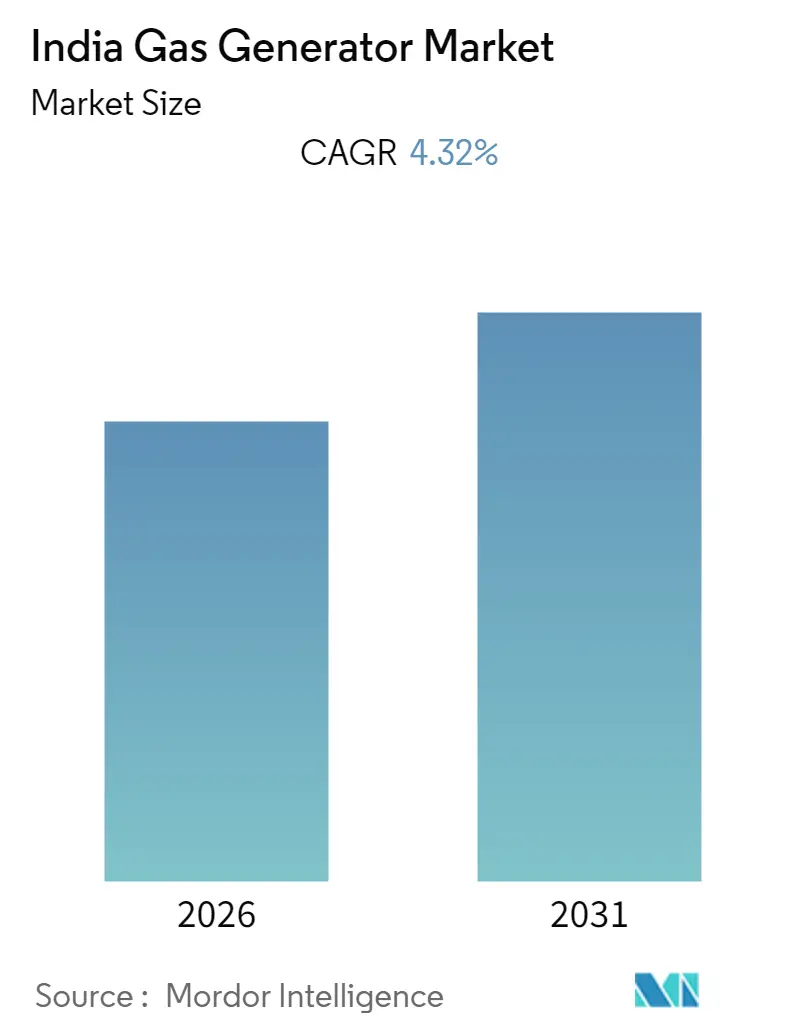
The India Gas Generator Market size is expected to register a CAGR of 4.32% during the forecast period.
- In recent years, the demand for gas generators has grown because more people know that natural gas is a clean and reliable fuel, more people are worried about diesel maintenance and refueling problems, the price of natural gas fuel has gone down, and people want to be more responsible for the environment in general.
- But the gas generator market is likely to face problems in the coming years due to the lack of pipeline connections to the gas grid. This makes it hard to get fuel.
- Future opportunities for market participants are likely to come from the commercial and industrial sectors of emerging economies, the residential sectors of developed economies, and the growing need for power in defense operations.
Note: Market size and forecast figures in this report are generated using Mordor Intelligence’s proprietary estimation framework, updated with the latest available data and insights as of 2026.
India Gas Generator Market Trends and Insights
Below 75 kVA Capacity Gas Generator to Witness Significant Growth
- Less than or equal to 75 kVA gas generators are used in the telecommunication sector, commercial complexes, small restaurants, small-scale industries, and petrol stations, primarily as backup power in grid-connected areas and as the primary power source in off-grid areas.
- The demand for less than or equal to 75 kVA gas generators is expected to increase, with the change in the landscape for small businesses, especially in developing countries like India. As power failure is common in some parts of India, most households and shops prefer portable and affordable small generators.
- The building and construction market is rising in India due to current government initiatives, such as smart cities and green building initiatives, which are expected to create the demand for gas generators during the forecast period and drive the market.
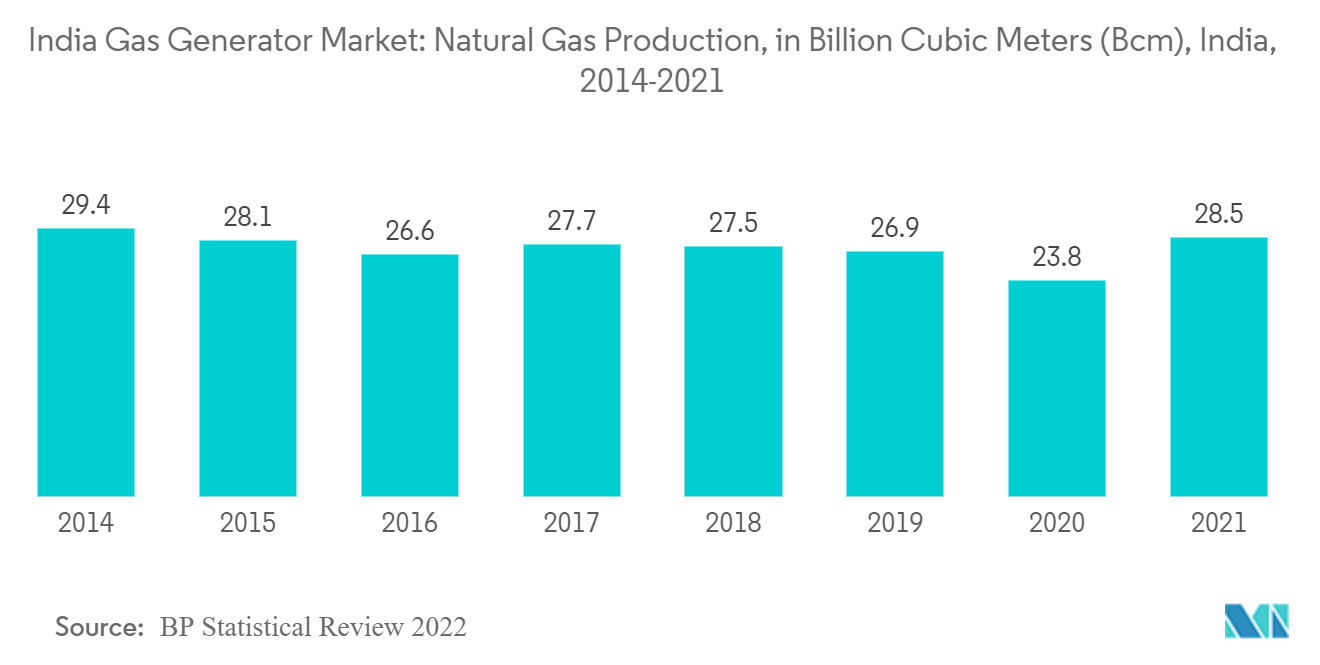
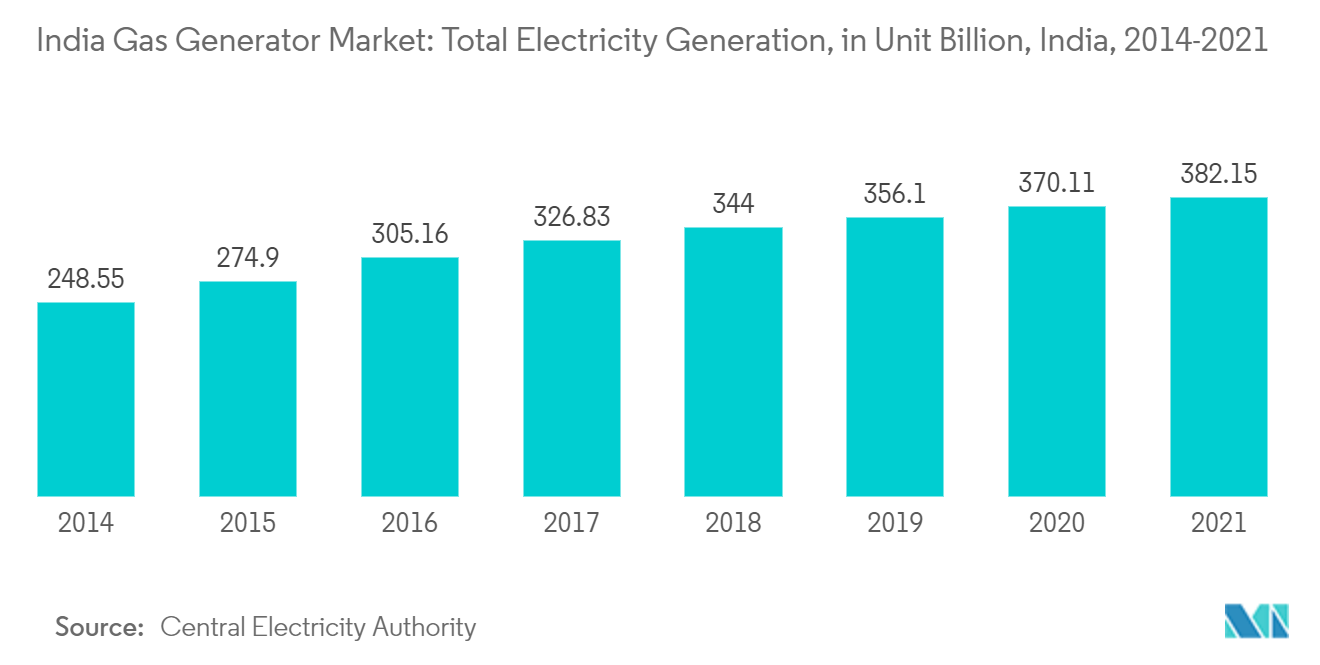
- India is the third-largest producer and second-largest consumer of electricity worldwide. As of 2021, India has an installed power capacity of 382.15 GW. Further, power consumption is estimated to reach 1,894.7 TWh in 2022. Additionally, with 28.5 billion cubic meters of gas production in 2021, the application of gas generators is expected to increase significantly in the forecast period.
- With a reduction in natural gas prices and upcoming residential construction projects, governmental investments in small-scale manufacturing are witnessing robust growth.


Stringent Government Regulations for Diesel Generators will Drive the market
- In 2022, the government of India announced its net-zero policy, which aims to achieve net-zero emissions by 2070. Furthermore, the government has set five targets to reach 500 GW of non-fossil fuel electricity capacity by 2030.
- Furthermore, increasing awareness regarding the use of natural gas in power generation, as it is a clean and reliable fuel, coupled with increased concerns over diesel generator maintenance and its negative impact on the environment, is expected to drive the generator market in the forecast period.
- In February 2022, the Indian environment ministry revised the norms for emissions from power generators which would be effective from July 2023, under which generators of up to 800 kW will have to comply with these new norms. The India Genset Emission Standards- IV+ will apply for generators running on all fuels, including hydrogen. The new emission standards have been issued to tackle air pollution, as the ministry has identified diesel gensets as one of the primary reasons for rampant air pollution. The new emission standards set limits on certain pollutants such as Nitrous Oxide (NO), hydrocarbons (HCs), Carbon Monoxide (CO), and particulate matter (PM) and technical specifications such as compression ignition (CI) and positive ignition (PI).
- Additionally, to curb the rampant air pollution in the Delhi-NCR region, in February 2022, the Central Pollution Control Board (CPCB) proposed a strategy to reduce pollution from diesel gensets via a 3-pronged approach: scrapping diesel gen-sets older than 15 years, mandating the retrofitting of gensets up to 800 kW with emission control devices and impose tighter emission standards for newer gensets which need.
- The country's power generation capacity is dominated by more than 61% of thermal power plants, followed by renewable energy sources (24.7%) and hydropower (12%). Although the country's peak power deficit has been substantially reduced from 16.6% in the financial year (FY) 2008 to 0.4% in FY 2021, the reliability of electricity is still low compared with international standards. Moreover, the country's electricity demand is increasing rapidly due to the increasing population. Existing power grid systems are under pressure to meet the energy requirement, leading to an imbalance of supply, thereby affecting the consumers with load shedding and unbalanced voltage. Such factors are expected to drive the gas generator market in India during the forecast period.
Regulatory Landscape
India gas generator compliance is anchored to the Central Pollution Control Board (CPCB) and the Ministry of Environment, Forest and Climate Change (MoEFCC) emission framework for generator-set engines. MoEFCC notified GSR 804(E) (November 2022), and CPCB issued the associated system and procedure for power generating set engines up to 800 kW (published March 28, 2023). This underpins the India Genset Emission Standards IV+ regime (effective July 2023 per the report context) and applies across fuels, setting pollutant limits and anti-tampering requirements for certified configurations.
On fuel and operating oversight, gas supply and safety requirements intersect with the Petroleum and Explosives Safety Organization (PESO) and gas network connection practices for alternate fuels. The Gas Cylinder Rules, 2016 are commonly referenced for CNG/LPG cylinder approvals in genset applications. Separately, the Ministry of Power has used Section 11 of the Electricity Act, 2003 to direct gas-based generating stations to operate at maximum generation during peak-demand periods (for example, May 26 to June 30, 2025), which can raise utilization of gas-based assets when grid security is prioritized.
Value Chain Analysis
The India gas generator value chain begins with engine and alternator OEMs, followed by controls and emissions after-treatment suppliers, and package assemblers. It then extends through system integrators, EPC partners, and a dealer and service network that supports installation, commissioning, and lifecycle maintenance. On the demand side, commercial and industrial customers (including telecom, commercial buildings, and large standby power users) typically procure packaged gensets bundled with controls, synchronization panels, and remote monitoring, while smaller capacities (below 75 kVA) tend to emphasize channel availability, portability, and service reach.
Fuel access and quality act as key linking nodes. City gas distribution and pipeline connectivity affect total cost of ownership and feasibility, while alternate fuels (CNG/LPG/biogas) add safety and gas-handling requirements. Recent domestic capacity additions and portfolio shifts toward CPCB IV+ compliant models and digital monitoring strengthen local assembly, testing, and after-sales capability. Equipment specification mismatches and gas-quality management (for example, contaminants in biogas streams) still constrain adoption, pushing buyers toward suppliers with stronger application engineering and service coverage.
Competitive Landscape
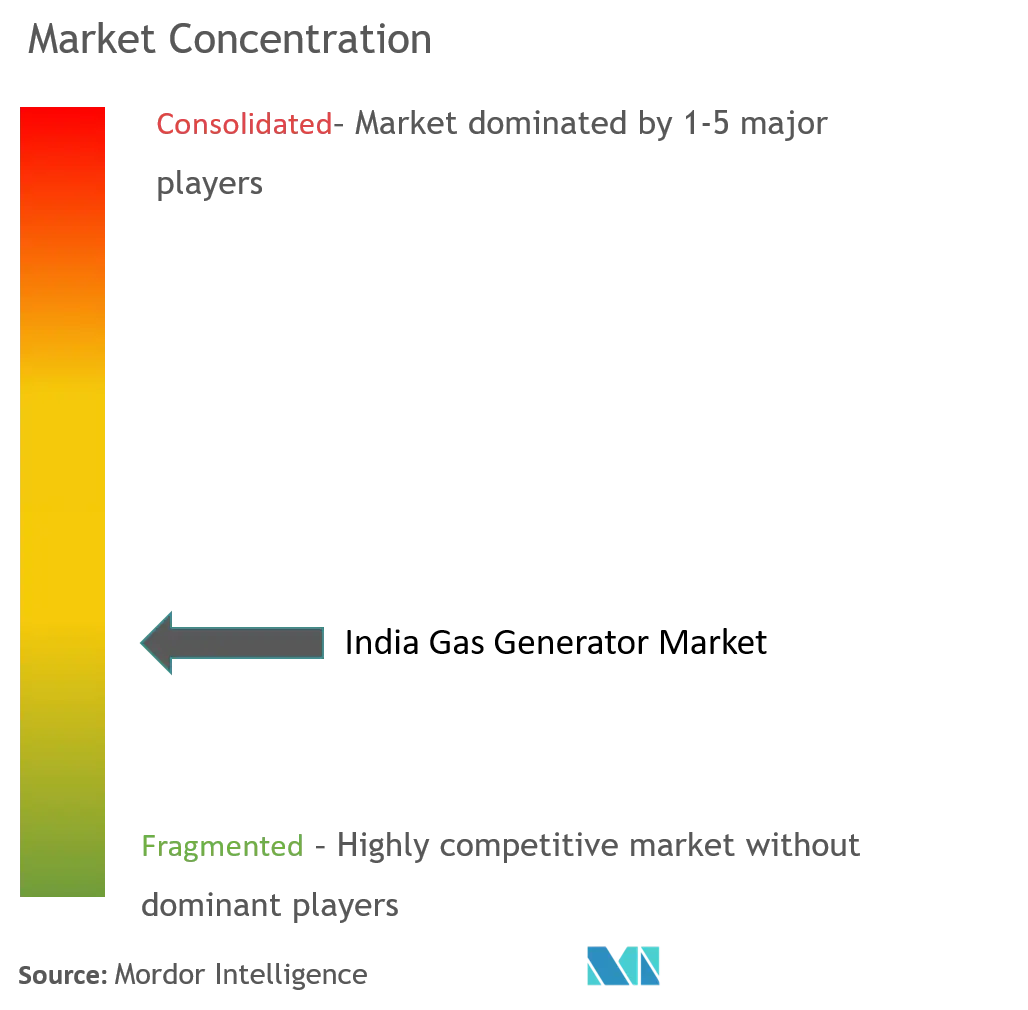
The Indian gas generator market is moderately fragmented. Some of the major companies (in no particular order) include Kohler Co, Kirloskar Electric Company Limited, Cummins Inc, Caterpillar Inc, and General Electric Company.
India Gas Generator Industry Leaders
Kirloskar Electric Company Limited
Cummins Inc
Caterpillar Inc
General Electric Company
Kohler Co
- *Disclaimer: Major Players sorted in no particular order

Market Opportunities and Future Outlook
A near-term whitespace for gas generators in India is tied to grid-balancing and peak-demand support programs that activate gas-based generation, which can translate into downstream demand for flexible, fast-start backup and captive power solutions when gas is available. The Ministry of Power has used Section 11 directions to run gas-based generating stations during peak periods (for example, May 26 to June 30, 2025). In addition, government reporting cited higher peak-demand procurement from gas-based plants during 2025 versus 2024, reinforcing use-cases where reliable dispatch and rapid ramping are valued.
Opportunities also connect to gas availability and infrastructure initiatives that reduce fuel-access friction for end users. A concrete supply-side marker is ONGC commencing gas production from the Daman Upside Development Project in March 2026, including new wellhead platforms and pipelines feeding the Hazira plant, which supports incremental availability into west-coast networks. On the planning side, the Central Electricity Authority's National Generation Adequacy Plan (released January 2026) keeps gas-based installed capacity at 20 GW through 2035-36, framing gas as a balancing resource rather than a baseload growth story and reinforcing emphasis on high-efficiency, emissions-compliant, digitally monitored gensets for commercial and industrial reliability needs.
Recent Industry Developments
- June 2026: Kirloskar Oil Engines Limited disclosed a data center power order from HyperNext for 192 MW, covering 96 units of 2500 kVA Optiprime Dual Core power systems. The win points to rising demand for high-capacity standby and prime solutions in digital infrastructure and increases competitive pressure among large-format genset suppliers in India.
- May 2026: Kirloskar Electric Company Limited announced completion of the merger of four wholly owned subsidiaries, with effect from April 1, 2024, aimed at operational efficiencies. Consolidation can streamline manufacturing, sales, and service operations, supporting faster response and cost control in the domestic power equipment portfolio.
- February 2025: GAIL (India) Limited and Accelera by Cummins signed a memorandum of understanding to collaborate on clean energy transition technologies, including hydrogen production and blending. The collaboration signals deeper ecosystem activity around gaseous fuels and decarbonization pathways that can influence future generator fuel strategies and compatible engine platforms.


Research Methodology Framework and Report Scope
Market Definition and Coverage
For this study, the market means revenue earned from gas generators sold and installed in India, where the prime mover is designed to run on natural gas and the set is supplied as a power generation solution for end users.
Scope exclusions: We exclude diesel and gasoline gensets, pure service-only revenues (AMC without parts), and upstream gas production or pipeline infrastructure spending.
Segmentation Overview
- Capacity Rating
- Less than 75 kVA
- Between 75-375 kVA
- Above 375 kVA
- End-User
- Industrial
- Commercial
- Residential
Data Sources, Market Sizing, and Validation
Desk Research
Desk work started with building a factual base on India power demand, outage patterns, and gas availability, then matching that with genset shipment and pricing signals. Public sources such as the Central Electricity Authority (CEA), the Ministry of Power, the Petroleum Planning and Analysis Cell (PPAC), the Ministry of Statistics and Programme Implementation (MOSPI), and Customs trade statistics helped anchor fuel and equipment context.
We also reviewed company annual reports, investor presentations, product catalogs, and reputable press coverage to map common kVA ratings and typical use cases in industrial and commercial sites. Where public detail was thin, paid subscriptions for company financials and intelligence, news and financials, patents, and shipment-level import and export data were used to cross-check company footprints and technology activity. These desk research sources are illustrative, and many other public references were used to clarify and validate assumptions.
Primary Interviews and Surveys
Primary discussions were held with OEM-side executives, packagers and channel partners, EPC and project firms, and end users operating captive and standby power in factories, buildings, and institutions. We used these inputs to confirm adoption triggers, fuel-switching behavior, realistic runtime patterns, and price ranges by kVA class across major Indian demand pockets.
Distribution of primary research fieldwork respondents
| Company type | Respondent position |
|---|---|
| Top tier: 36% | CXOs: 13% |
| Mid tier: 43% | Functional/Unit leaders: 27% |
| Smaller Players: 21% | Managers: 60% |
Market-Sizing & Forecasting
Sizing was built using a top-down approach where India power reliability signals, captive power usage, and natural gas availability were translated into an addressable demand pool for gas gensets. Once the demand pool was framed, revenue was derived using kVA mix assumptions and typical price ranges, and then adjusted for on-ground conversion constraints such as gas connectivity and switching economics.
To keep the totals realistic, we corroborated the model using selective bottom-up checks, including sampled channel feedback on unit movement, indicative supplier rollups by common kVA bands, and project-led demand visibility in commercial and industrial locations. Key inputs tracked include kVA rating mix, average selling price movement by kVA range, natural gas price and availability signals, outage frequency and backup runtime behavior, and adoption pace in industrial and commercial end users.
For forecasting, scenario analysis was used because growth depends on a few practical drivers that can swing, such as gas supply stability, grid reliability improvements, and capex cycles in factories and buildings. Where primary responses showed gaps in unit visibility, we bridged them using conservative ranges for utilization and replacement demand, then rechecked the implied revenue against price sanity checks.
Data Validation & Update Cycle
Validation was done in layers, so that one weak input does not drive the final number. Our analysts compared outputs against independent signals such as equipment trade flow direction, typical installed-base replacement behavior, and pricing consistency across common kVA ranges, then investigated outliers before sign-off.
A second review pass was conducted to keep assumptions consistent across years and avoid unrealistic step changes. Reports are refreshed annually, with interim updates when material events occur, and a final pre-delivery pass is done so clients receive the most current view possible.
Mordor Intelligence's India Gas Generator Market Sizing Compared With Other Published Estimates
Published market sizes can differ even when the same product name is used, because boundaries and counting rules change across studies. In this market, gaps usually come from what is treated as a gas generator versus adjacent genset revenues, how kVA mix and pricing are applied, and whether the forecast starts from a normalized year or from a demand spike year.
By tracking kVA mix, runtime assumptions, and India gas availability signals, Mordor Intelligence keeps the estimate tied to gas-fueled generator revenues only, instead of blending in diesel gensets, aftermarket-only streams, or broader generator set totals.
Benchmark comparison
| Source | Market Size | Gaps in Research Methodology |
|---|---|---|
| Mordor Intelligence | USD 0.00 B (2024) | |
| Industry Association A | USD 0.08 B (2024) | Often based on member-reported shipments and may include gas engine generator packages plus parts and service revenues, which inflates the revenue base when compared with equipment-only treatment. |
| Trade Journal B | USD 0.05 B (2023) | Commonly uses limited project announcements and a fixed ASP per kVA, and it may not recheck kVA mix shifts or currency timing, which can understate or overstate annual revenue. |
The spread in the table is mainly explained by scope control and by how pricing and kVA mix are refreshed year to year. With clear inclusion rules and repeatable checks against demand and price indicators, the final size is easier to trace back to practical market drivers.


Key Questions Answered in the Report
What is the current India Gas Generator Market size?
The India Gas Generator Market is projected to register a CAGR of 4.32% during the forecast period (2026-2031)
Who are the key players in India Gas Generator Market?
Kirloskar Electric Company Limited, Cummins Inc, Caterpillar Inc, General Electric Company and Kohler Co are the major companies operating in the India Gas Generator Market.
What years does this India Gas Generator Market cover?
The report covers the India Gas Generator Market historical market size for years: 2020, 2021, 2022, 2023 and 2024. The report also forecasts the India Gas Generator Market size for years: 2026, 2027, 2028, 2029, 2030 and 2031.
Page last updated on:


 Your data is secure and never sold or shared.


