
India Energy Retrofit Tools Market Size and Share
Market Overview
| Study Period | 2022 - 2032 |
|---|---|
| Forecast Data Period | 2027 - 2032 |
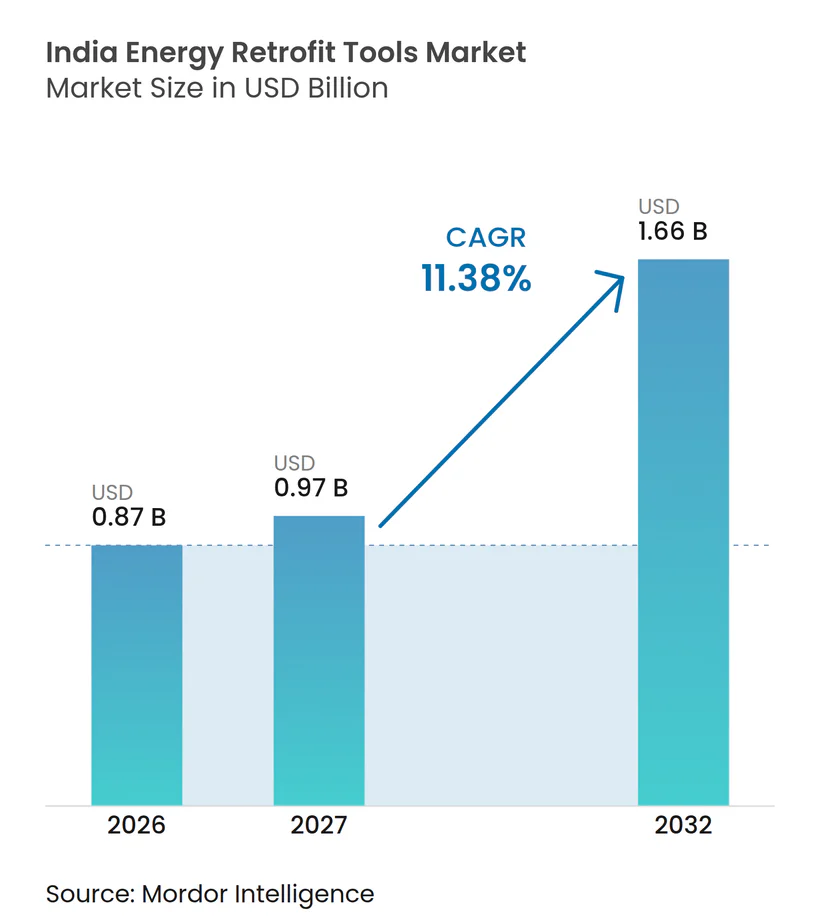
| Base Year Market Size (2026) | USD 0.87 Billion |
| Market Size (2027) | USD 0.97 Billion |
| Market Size (2032) | USD 1.66 Billion |
| Growth Rate (2027 - 2032) | 11.38 % |
| Market Concentration | Medium |
Major Players *Disclaimer: Major Players sorted in no particular order Image © Mordor Intelligence. Reuse requires attribution under CC BY 4.0. | |
India Energy Retrofit Tools Market Analysis by Mordor Intelligence
The India Energy Retrofit Tools Market size is expected to increase from USD 0.87 billion in 2026 to USD 0.97 billion in 2027 and reach USD 1.66 billion by 2032, at a CAGR of 11.38% over 2027-2032. The India energy retrofit tools market is supported by higher commercial power costs, building-code requirements, connected sensors, and a large stock of older properties that need performance upgrades. The Ministry of Power’s July 2026 draft amendment proposes 3-star to 5-star Bureau of Energy Efficiency ratings for buildings larger than 20,000 sq m, which would strengthen retrofit requirements for large offices, commercial properties, and residential buildings[1]. Building energy data is becoming more important to owners because compliance, operational control, and reporting now depend on measured performance. The India energy retrofit tools market, therefore, favors products that connect audits, metering, building controls, and performance reporting. Competition is moving beyond individual devices toward service arrangements that link technology deployment to verified energy results.
Key Report Takeaways
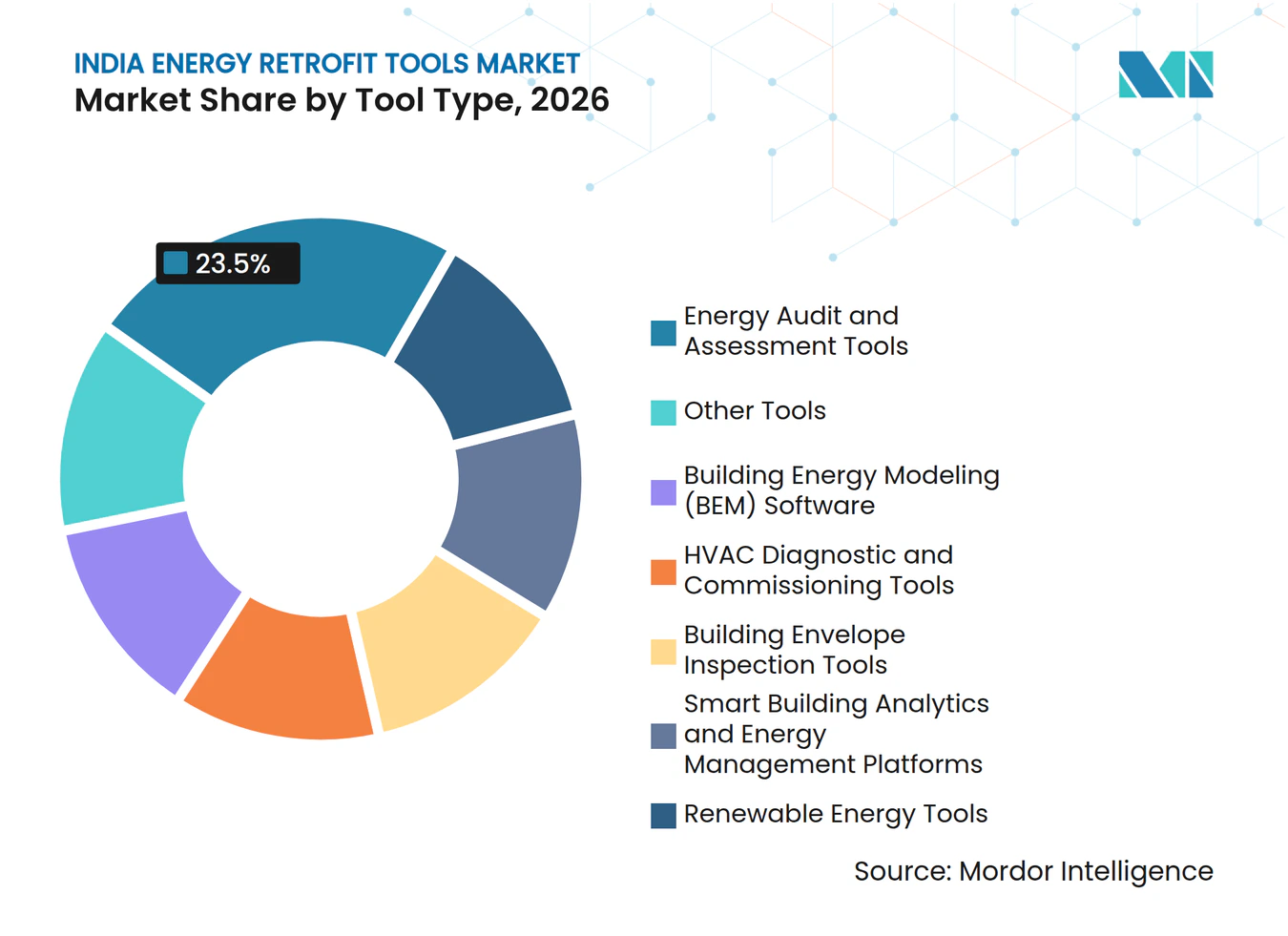
- By tool type, Energy Audit and Assessment Tools held 23.5% of India energy retrofit tools market share in 2026, while Smart Building Analytics and Energy Management Platforms are projected to grow at a 14.6% CAGR through 2032.
- By application, HVAC Retrofit accounted for 24.7% of revenue in 2026, while Renewable Energy Integration is forecast to grow at a 14.2% CAGR through 2032.
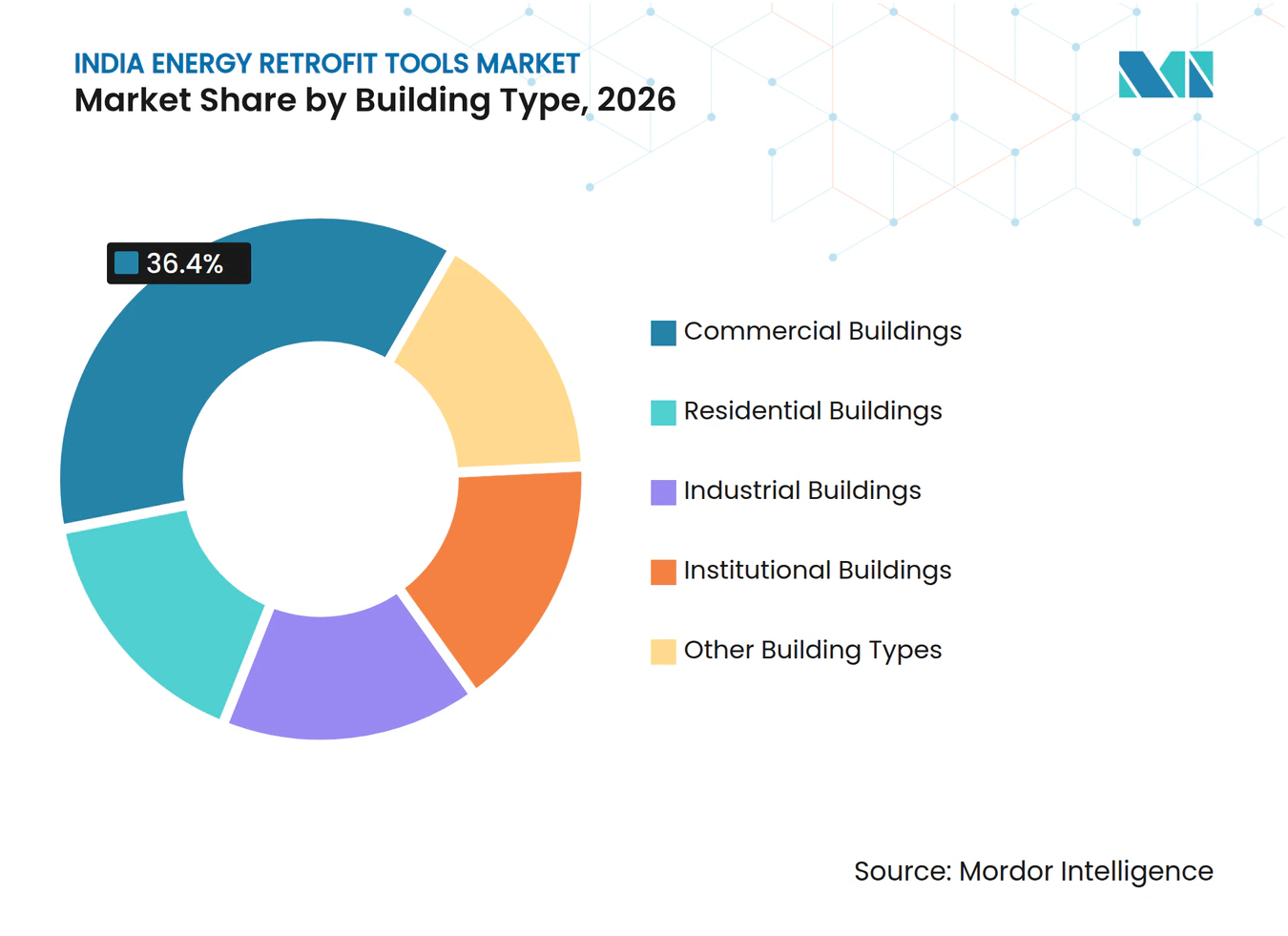
- By building type, Commercial Buildings represented 36.4% of revenue in 2026, while Industrial Buildings are forecast to grow at a 13.6% CAGR through 2032.
Note: Market numbers in this report are based on Mordor Intelligence's proprietary estimation framework, which combines nine months of actuals with Q4 projections for base year 2026.
India Energy Retrofit Tools Market Trends and Insights
Drivers Impact Analysis*
| Driver | (~) % Impact on CAGR Forecast | Geographic Relevance | Impact Timeline |
|---|---|---|---|
| Rising Energy Costs and Peak-Demand Charges | +2.10% | Pan-India, with highest intensity in Delhi-NCR, Maharashtra, Karnataka, and Tamil Nadu | Short term (≤ 2 years) |
| ECBC, ECSBC and Energy-Efficiency Compliance Requirements | +2.40% | National, with early gains in states that have formally notified ECSBC: Karnataka, Uttar Pradesh, Tamil Nadu, Kerala, Rajasthan | Medium term (2–4 years) |
| Smart-Meter, IoT and Connected-Building Adoption | +1.80% | APAC core — strong in Uttar Pradesh, Maharashtra, Tamil Nadu DISCOMs; spill-over to tier-2 utility areas under RDSS | Short to medium term |
| Corporate Net-Zero, BRSR and Supply-Chain Reporting Requirements | +1.50% | National, with greatest concentration in BSE/NSE-listed commercial and industrial enterprises across top-six metros | Medium term (2–4 years) |
| Retrofit-Heavy Commercial and Industrial Building Stock | +1.60% | Bengaluru, Delhi-NCR, Mumbai MMR, Hyderabad, Chennai, Pune, Kolkata; spill-over to industrial corridors in Gujarat and Andhra Pradesh | Medium to long term |
| Energy-as-a-Service and Performance-Contracting Models | +1.20% | National, with concentration in C&I segments in Rajasthan, Maharashtra, Karnataka, and Andhra Pradesh | Long term (≥ 4 years) |
| Source: Mordor Intelligence | |||
Rising Energy Costs and Peak-Demand Charges
Commercial electricity tariffs in Delhi rose from USD 0.09 per unit in 2022 to USD 0.14 per unit in 2026, a 42% increase across the cited distribution-company orders. This change makes energy control equipment more relevant to operating budgets in the India energy retrofit tools market, particularly where electricity expenditure is tracked at a site or tenant level. Time-of-day pricing for larger commercial consumers can increase the cost of peak-period consumption, including the morning and evening demand windows described in the source material, and make demand monitoring more valuable. Low power factor can also create financial charges, which increases interest in reactive-power monitoring within electrical-system upgrades and adds a practical reason to measure equipment performance. Facility managers are therefore more likely to assess retrofit tools against savings and payback, including avoided peak charges and power-factor penalties, rather than defer spending solely because of the initial cost. This dynamic can shorten buying cycles where energy use is measured closely, and the resulting savings can be verified against the property’s own consumption data.
ECSBC and Energy-Efficiency Compliance Requirements
The Bureau of Energy Efficiency operationalized the Energy Conservation and Sustainable Building Code 2024, which replaced the ECBC 2017 framework and covers commercial buildings with connected loads of 100 kW or more[2]. The code includes ECSBC, ECSBC+, and Super ECSBC performance tiers, which give building owners distinct compliance targets rather than a single basic requirement. This structure benefits the India energy retrofit tools market, as assessment, modeling, and verification become practical requirements for demonstrating building performance under these pathways. Rajasthan's incentive structure links higher code compliance to additional floor-area ratio, aligning energy upgrades with development economics and shifting focus from basic compliance toward better-performing buildings. Kerala notified the KSECBC 2025 rules in January 2025, replacing the state's 2017 code. BEE's energy-auditor framework further supports recurring demand for audit equipment, supporting software, and documented evidence required when a property's energy performance is reviewed.
Smart-Meter, IoT, and Connected-Building Adoption
The India energy retrofit tools market gains a broader data foundation as smart meters and building sensors become more common across commercial and industrial properties. Smart meters create consumption data that can be paired with building-level sensors and analytics systems, bringing utility-side and facility-side information closer together. This connection helps asset managers identify load patterns, locate equipment-level losses, and verify whether an upgrade is producing savings after installation. Sub-metering and load-disaggregation tools can make energy waste visible at the equipment level, rather than only at the site level, which improves the basis for selecting a retrofit. Connected data can extend analytics adoption from premium office buildings into mid-sized commercial properties and larger industrial sites where facility teams need clearer operating information. The resulting demand is strongest where integration costs are manageable, data can be shared securely, and facility operators can act on the information provided.
Corporate Net-Zero, BRSR, and Supply-Chain Reporting Requirements
SEBI’s Business Responsibility and Sustainability Reporting framework applies to India’s top 1,000 listed companies by market capitalization, bringing energy information into a more formal corporate reporting process. Research covering FY 2022-23 and FY 2023-24 found high Scope 1 and Scope 2 reporting, while Scope 3 reporting increased across sectors[3]. The India energy retrofit tools market is supported by the need for energy information that can withstand assurance processes and be traced back to building operations. BRSR Core requires third-party assurance for selected energy-intensity metrics, making estimated energy values less suitable for regulated disclosures and increasing the value of calibrated records. Calibrated meters, audit tools, and measurement and verification platforms can improve the quality of facility-level records while reducing reliance on engineering estimates. This need is especially relevant to listed companies that must reconcile building operations, supply-chain expectations, and public sustainability reporting.
Restraints Impact Analysis*
| Restraint | (~) % Impact on CAGR Forecast | Geographic Relevance | Impact Timeline |
|---|---|---|---|
| High Upfront Cost and Long Payback Periods | -1.20% | Pan-India, disproportionately affecting tier-2/3 cities and SME-scale commercial buildings | Medium term (2–4 years) |
| Legacy BMS, SCADA and Metering Interoperability Gaps | -0.80% | National, with highest friction in government-owned institutional buildings and legacy industrial campuses in eastern India | Short to medium term |
| Cybersecurity and Data-Sovereignty Exposure | -0.60% | National, with rising regulatory scrutiny in connected energy infrastructure across all building types | Short to medium term |
| Shortage of Integrated Energy and Data-Analytics Skills | -0.70% | Pan-India, with the most acute shortfall in tier-2/3 cities and outside the major technical institution clusters | Long term (≥ 4 years) |
| Source: Mordor Intelligence | |||
High Upfront Cost and Long Payback Periods
Capital cost remains a significant barrier for smaller commercial buildings and small industrial users in the India energy retrofit tools market, particularly where owners cannot spread costs across a large portfolio. Large Grade A retrofit projects can have payback periods of around 3–5 years, while smaller properties may have weaker economics due to lower energy consumption and limited potential savings. Lower occupancy, fragmented ownership, and limited internal technical capacity can make it difficult to coordinate investment decisions and determine how financial benefits are distributed. Energy-as-a-Service contracts can reduce upfront customer spending by tying payments to verified savings and placing performance responsibility with the service provider. However, these models are generally more viable for larger commercial and industrial accounts that meet project-size thresholds and can support long-term contracts. Small and medium enterprises in the building sector also have more limited access to financing support designed for designated energy-intensive industries, leaving the mid-market exposed to a continuing funding gap.
Legacy BMS, SCADA, and Metering Interoperability Gaps
Modern assessment and analytics products can be difficult to integrate with older building management systems, even when customers identify clear energy-saving opportunities. Older sites may use proprietary systems, including Modbus RTU, older BACnet versions, or closed vendor platforms, each with different data formats and connection requirements. A single campus can contain conventional meters, early automated meter-reading devices, and new smart meters simultaneously, complicating data consolidation. This increases the technical work, specialist support, and costs required to produce a unified energy dashboard that operators can use reliably. Forthcoming cybersecurity requirements for connected operational technology can add another layer of integration cost, particularly where existing control systems were not designed for secure data exchange. These challenges can delay upgrades and increase the total cost of smart analytics platforms beyond the initial purchase price, particularly in public institutions and older industrial campuses.
*Our forecasts treat driver/restraint impacts as directional, not additive. The impact forecasts reflect baseline growth, mix effects, and variable interactions.
Segment Analysis
By Tool Type: Analytics Platforms Move Beyond Standalone Auditing
Energy Audit and Assessment Tools accounted for 23.5% of 2026 revenue, reflecting recurring audits linked to compliance and energy-intensity verification across commercial and industrial properties. This portion of the India energy retrofit tools industry includes portable power analyzers, thermal imaging cameras, blower-door equipment, and digital audit-management software used to document conditions before improvements are made. BEE’s commercial code provides a Whole Building Performance pathway for demonstrating code compliance[4]. Building energy modeling software supports this work by helping architects and energy consultants evaluate building performance before or during an upgrade, including the effect of proposed changes on whole-building results. HVAC diagnostic and commissioning tools serve existing systems that do not operate at their intended efficiency and help identify whether controls, maintenance, or replacement is required. Envelope inspection tools also gain relevance where thermal performance standards require verification, while renewable-energy tools are increasingly included in performance-contracting projects that combine several measures.
Smart Building Analytics and Energy Management Platforms are the fastest-growing tool category, with a projected 14.6% CAGR for 2027-2032. The India energy retrofit tools market size for these platforms is supported by the need to connect energy, power, and building-system data so that property teams can work from a common operating view. Open protocols such as BACnet, Modbus TCP, and MQTT can reduce connection barriers at older properties and make a wider range of equipment visible to the analytics layer. Vendors are moving from single-purpose products to supervisory platforms that support facility-wide operations, energy tracking, and the comparison of measured results over time. Schneider Electric introduced EcoStruxure Foresight in India in 2026 as a platform that combines energy, power, and building systems. This direction supports product demand where live metering and building controls are already available, while also increasing the importance of systems integration, data quality, and ongoing service.



By Application: HVAC Remains the Largest Use Case While Renewable Integration Expands
HVAC Retrofit held 24.7% of 2026 application revenue because heating, ventilation, and air-conditioning systems are significant energy users in commercial buildings. The India energy retrofit tools market continues to require commissioning and diagnostic tools as older systems are replaced or upgraded, especially in properties that have accumulated several generations of equipment. Variable refrigerant flow replacements can require more detailed commissioning than conventional chilled-water systems because performance depends on correct setup and operating control. Lighting retrofit activity remains relevant where early LED installations lack dimming or occupancy sensing, leaving further efficiency improvements available. Building envelope work is linked to tighter thermal-performance requirements and the need to verify whether a completed upgrade delivers the intended result. Electrical-system upgrades also support power-factor monitoring and related compliance needs, which broadens demand beyond the mechanical systems that have historically received the most attention.
Renewable Energy Integration is expected to expand at a 14.2% CAGR through 2032. This segment of the India energy retrofit tools market includes solar generation monitoring software, battery management platforms, and net metering dashboards that allow users to view generation and building demand together. Demand is driven by rooftop solar deployment and on-site solar-plus-storage systems at commercial and industrial campuses, where retrofit projects can address both energy consumption and supply. The growth of these systems increases the need for tools that can exchange data between inverters, batteries, meters, and building controls. This requirement adds a distinct layer to the conventional retrofit stack rather than replacing existing audit or HVAC products. Water heating and service hot water applications are also emerging in institutional and hospitality settings through heat pump retrofits, where diagnostics can help evaluate equipment performance and operating savings.
By Building Type: Industrial Sites Provide the Fastest Growth Opportunity
Commercial Buildings represented 36.4% of 2026 revenue, supported by code compliance, corporate energy reporting, and the need to upgrade office properties. The India energy retrofit tools market serves these sites with audit, metering, commissioning, and analytics products that can be used from initial assessment through ongoing operations. Certification frameworks for existing buildings, including GRIHA, can require energy-performance verification and give owners a recognized process for recording improvement. GRIHA’s existing buildings manual provides the assessment approach for these properties. Residential buildings are a smaller application base, although Eco Niwas Samhita 2024 applies to new residential buildings with connected loads of 20 kW or more and creates upstream demand for modeling and verification. Institutional properties, including hospitals, campuses, and government offices, also have a substantial energy-savings opportunity because their operations can involve large and varied equipment loads.
Industrial Buildings are forecast to grow at a 13.6% CAGR through 2032. The India energy retrofit tools market can benefit when new plants include energy management from the start, rather than attempting a complex retrofit after commissioning and after operating patterns have become established. Production-linked incentive beneficiaries in electronics, pharmaceuticals, food processing, and battery manufacturing are part of this opportunity because energy cost and energy performance receive attention during facility design. Perform, Achieve and Trade obligations also require designated energy-intensive facilities to establish baselines and undertake audits, which creates recurring work rather than a single initial assessment. These conditions support demand for energy-audit instruments, HVAC diagnostics, and modeling software in factory environments that need to balance production requirements with energy control. Honeywell was selected by Exide Energy in December 2024 to provide building automation for a lithium-ion gigafactory campus in Bengaluru.

Geography Analysis
The seven major metropolitan areas of Bengaluru, Mumbai, Delhi-NCR, Hyderabad, Chennai, Pune, and Kolkata form the largest demand base for the India energy retrofit tools market. These cities combine Grade A office stock with listed-company occupiers that need more reliable energy data for reporting and that can finance upgrades across larger building portfolios. Delhi’s commercial tariff increase strengthens the savings case for audit and HVAC commissioning tools, including for smaller commercial occupiers that are closely exposed to power costs. Bengaluru’s concentration of technology businesses and real estate investment trusts supports the use of connected building analytics because asset managers need repeatable methods of monitoring properties. Large property portfolios can justify metering and software investments because operators manage multiple facilities, compare performance among sites, and can use common data processes. This geographic base also has more established energy-auditor and systems-integration capabilities than smaller urban markets, making it easier to move from an initial audit to a completed project.
The India energy retrofit tools market share is also developing in industrial corridors across Gujarat, Tamil Nadu, Maharashtra, and Andhra Pradesh. Manufacturing projects supported by production-linked incentives create new demand for audits, diagnostics, and analytics as facilities seek energy efficiency from the start and build energy management into their operational design. Tamil Nadu’s formal code notification can provide a clearer procurement trigger than voluntary adoption elsewhere because it gives owners and project teams a defined compliance basis. Honeywell’s December 2024 building-automation contract for Exide Energy’s 80-acre Bengaluru lithium-ion gigafactory illustrates the scale of relevant industrial-campus deployments.. Emerson’s Ovation Green SCADA software supports Adani Green Energy’s 3.55 GWh battery storage system at Khavda, Gujarat. These deployments show the connection between site-level energy management, industrial controls, and larger renewable-energy infrastructure, even though the projects operate at different points in the value chain.
Tier-2 and tier-3 cities such as Coimbatore, Surat, Jaipur, Nagpur, Lucknow, and Ahmedabad represent an emerging but relatively slower-growing demand base for the India energy retrofit tools market. Lower tariff sensitivity, fragmented ownership, and limited availability of certified energy auditors can delay adoption, as smaller building owners often have less capacity to plan, procure, and manage multi-component retrofit projects. Rajasthan's floor-area-ratio incentive model is relevant to developer decision-making in Jaipur and Jodhpur, where land-use benefits can increase the commercial relevance of building performance improvements. Kerala's January 2025 rules extend code requirements to commercial buildings with connected loads of 100 kW or more. Smart-meter and connected-device deployments can gradually improve data visibility in smaller utility areas by providing operators with more consistent records of load and energy consumption. Improved data availability can expand the addressable market for analytics tools beyond major cities, although access to skilled auditors and local integration partners remains an important consideration.
Competitive Landscape
Market Concentration
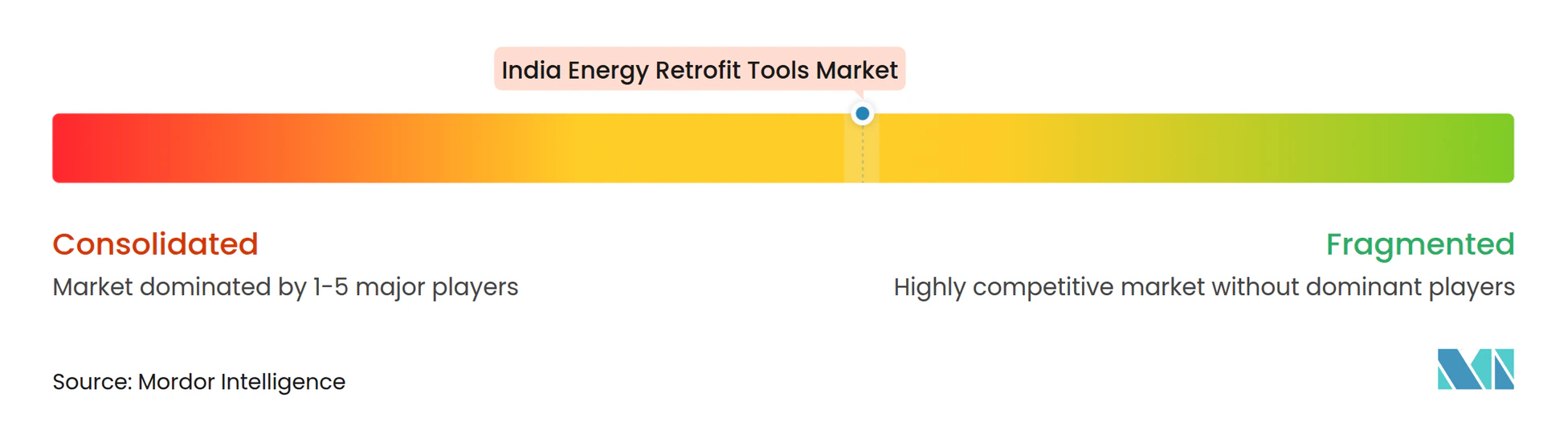
The India energy retrofit tools market is moderately consolidated at the product layer and more concentrated where vendors provide integrated platforms or Energy-as-a-Service contracts. Honeywell, Schneider Electric, Siemens, Johnson Controls, and ABB have established positions in building management, energy management, and HVAC controls, giving them visibility across several elements of a building’s operating systems. Their installed bases and service relationships help them sell upgrades into existing commercial properties because customers can prefer compatibility with equipment that is already in place. The India energy retrofit tools market also includes energy-service specialists that package deployment with outcome-linked contracts and assume more responsibility for verifying savings. This structure can reduce the upfront capital barrier for customers, especially in larger commercial and industrial accounts that have enough scale for a performance-based arrangement. Interoperability, cybersecurity, and compliance capability can influence vendor selection as connected deployments become more complex and building owners seek to limit operational risk.
Schneider Electric introduced EcoStruxure Foresight in 2026, combining energy, power, and building functions in one supervisory platform. Honeywell’s Exide Energy project provides an example of vendors expanding from controls into integrated site management at a complex manufacturing campus. Emerson’s Khavda deployment is another example linking industrial software with renewable-storage operations. These moves place greater value on software, data handling, lifecycle support, and the ability to manage information from several types of operating equipment. They also increase competitive pressure on firms that offer only individual devices because customers can favor a more integrated operating model. The shift does not eliminate the need for specialized tools, but it places those tools within a wider system of monitoring, controls, reporting, and service.
HVAC-focused suppliers are expanding local manufacturing and development activity as the retrofit cycle grows. Daikin-Rechi India started construction of a rotary-compressor facility in Sri City in March 2026, with phase-one capacity of 2 million compressors annually. Local supply can support the availability of equipment used alongside diagnostic and commissioning tools and may reduce lead times for project delivery. The India energy retrofit tools market still has open areas in energy digital twins, integrated measurement and verification systems, and cybersecurity-ready building IoT middleware. BEE auditor requirements and future connected-asset rules can favor providers with proven compliance, data-management, and technical-integration capability.
India Energy Retrofit Tools Industry Leaders
-
Schneider Electric SE
-
Siemens AG
-
Honeywell International Inc.
-
Johnson Controls International plc
-
ABB Ltd.
- *Disclaimer: Major Players sorted in no particular order
Recent Industry Developments
- July 2026: Emerson's Ovation Green SCADA software supports Adani Green Energy's 3.55 GWh BESS at Khavda, Gujarat, the world's largest single-location battery energy storage deployment outside China, delivered in 10 months; the deployment marks India's largest convergence of industrial energy management tools and utility-scale renewable storage to date.
- July 2026: Ministry of Power releases draft ECSBC amendment proposing mandatory BEE star ratings, 3-star to 5-star, for all buildings above 20,000 sq m, covering new office and commercial constructions; the amendment signals a significant tightening of the building energy compliance regime.
- March 2026: Daikin-Rechi India commences construction of RS 547 crore rotary compressor plant in Sri City, Andhra Pradesh, targeting annual production of 2 million compressors in phase one; the facility supports localization of HVAC supply chains and will directly reduce retrofit tool deployment costs for HVAC diagnostic and commissioning activities.
- January 2026: Government of Kerala notifies KSECBC 2025 rules, superseding the 2017 Kerala State Energy Conservation Building Code; the new rules extend ECSBC-aligned requirements to commercial buildings with connected loads of 100 kW or above across the state.
India Energy Retrofit Tools Market Report Scope
The Energy Retrofit Tools Market encompasses software, diagnostic equipment, analytical platforms, and assessment tools used to identify, evaluate, plan, design, implement, monitor, and optimize energy-efficiency improvements in existing buildings and facilities. These tools assess current energy performance and identify opportunities to reduce energy consumption, operating costs, and emissions through upgrades to systems such as HVAC, lighting, building envelopes, controls, and renewable energy installations.
The India Energy Retrofit Tools Market is segmented by tool type, application, and building type. By tool type, the market is segmented into building energy modeling (BEM) software, energy audit tools, HVAC diagnostic tools, building envelope inspection tools, smart building analytics, and renewable energy tools. By application, the market is segmented into HVAC retrofit, lighting retrofit, envelope retrofit, heating systems, electrical systems, and renewable energy integration. By building type, the market is segmented into residential, commercial, industrial, and institutional. For each segment, the market sizing and forecasts have been provided on the basis of value (USD).
| Building Energy Modeling (BEM) Software |
| Energy Audit and Assessment Tools |
| HVAC Diagnostic and Commissioning Tools |
| Building Envelope Inspection Tools |
| Smart Building Analytics and Energy Management Platforms |
| Renewable Energy Tools |
| Other Tools |
| HVAC Retrofit |
| Lighting Retrofit |
| Building Envelope Retrofit |
| Heating and Cooling Systems |
| Water Heating and Service Hot Water |
| Electrical Systems and Equipment |
| Renewable Energy Integration |
| Other Applications |
| Residential Buildings |
| Commercial Buildings |
| Industrial Buildings |
| Institutional Buildings |
| Other Building Types |
| By Tool Type | Building Energy Modeling (BEM) Software |
| Energy Audit and Assessment Tools | |
| HVAC Diagnostic and Commissioning Tools | |
| Building Envelope Inspection Tools | |
| Smart Building Analytics and Energy Management Platforms | |
| Renewable Energy Tools | |
| Other Tools | |
| By Application | HVAC Retrofit |
| Lighting Retrofit | |
| Building Envelope Retrofit | |
| Heating and Cooling Systems | |
| Water Heating and Service Hot Water | |
| Electrical Systems and Equipment | |
| Renewable Energy Integration | |
| Other Applications | |
| By Building Type | Residential Buildings |
| Commercial Buildings | |
| Industrial Buildings | |
| Institutional Buildings | |
| Other Building Types |
Key Questions Answered in the Report
What is the projected value of India’s energy retrofit tools sector by 2032?
It is projected to reach USD 1.66 billion by 2032, rising from USD 0.97 billion in 2027 at an 11.38% CAGR.
Which tool category is growing fastest in India?
Smart Building Analytics and Energy Management Platforms are projected to grow at a 14.6% CAGR through 2032.
Which application has the largest revenue base?
HVAC Retrofit held 24.7% of 2026 application revenue, supported by the energy use of existing commercial HVAC systems.
Why are energy audit tools important for building owners?
They support code compliance, energy-intensity verification, and decisions on upgrades based on measured building performance.
Which building type is expanding fastest?
Industrial Buildings are forecast to grow at a 13.6% CAGR through 2032, supported by new manufacturing facilities and audit requirements.
How do Indian building rules affect retrofit demand?
ECSBC requirements and state-level code notifications increase the need for energy assessment, modeling, metering, and performance verification tools.