
India Energy Retrofit Market Size and Share
Market Overview
| Study Period | 2022 - 2032 |
|---|---|
| Forecast Data Period | 2027 - 2032 |
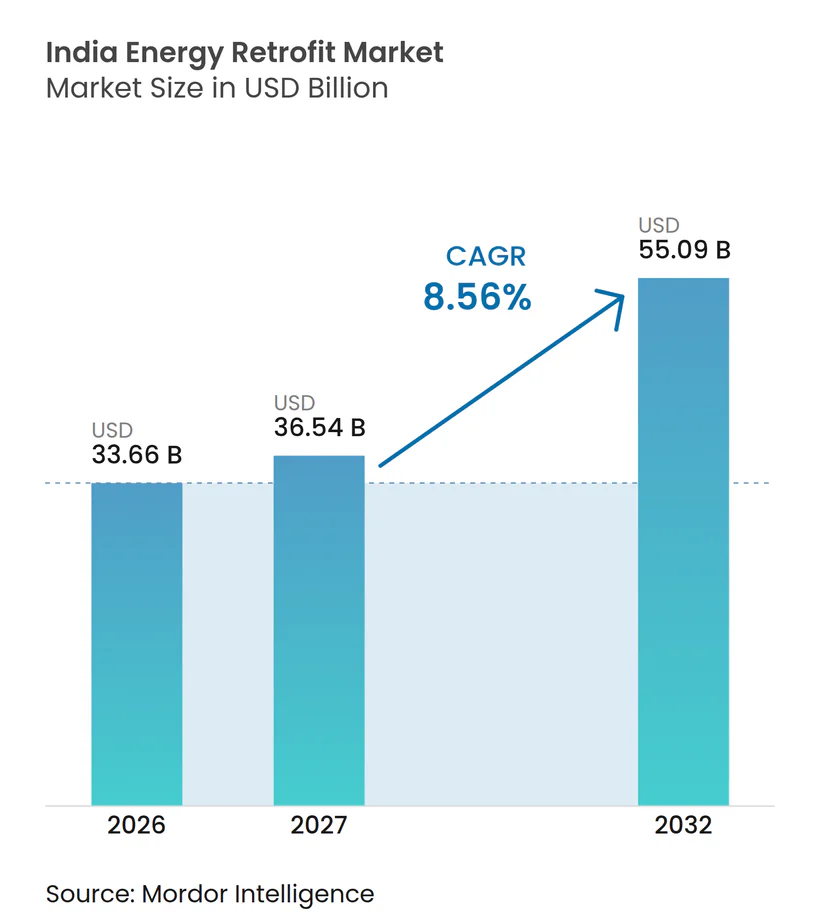
| Base Year Market Size (2026) | USD 33.66 Billion |
| Market Size (2027) | USD 36.54 Billion |
| Market Size (2032) | USD 55.09 Billion |
| Growth Rate (2027 - 2032) | 8.56 % |
| Market Concentration | Low |
Major Players *Disclaimer: Major Players sorted in no particular order Image © Mordor Intelligence. Reuse requires attribution under CC BY 4.0. | |
India Energy Retrofit Market Analysis by Mordor Intelligence
The India Energy Retrofit Market size was valued at USD 33.66 billion in 2026 and is estimated to grow from USD 36.54 billion in 2027 to reach USD 55.09 billion by 2032, at a CAGR of 8.56% during the forecast period (2027-2032). The India energy retrofit market is being shaped by higher commercial power costs, policy changes, and growing demand for better-performing buildings. Carbon credit trading and proposed building energy ratings could make efficiency projects more relevant to asset owners who need to manage operating costs and meet compliance requirements. Commercial property owners are also facing stronger tenant expectations for certified, lower-energy workplaces. The India energy retrofit market, therefore, offers opportunities for firms that can combine equipment, digital controls, measurement, and financing in one project model. Competition is likely to depend less on equipment price alone and more on verified savings, delivery capacity, and the ability to work across multiple sites..
Key Report Takeaways
- By retrofit depth, Shallow/Light Energy Retrofits held 68.2% of India energy retrofit market share in 2026, while Deep Energy Retrofits are projected to grow at a 10.8% CAGR through 2032.
- By technology, HVAC Systems accounted for 30.7% of the India energy retrofit market size in 2026, while Smart Building Controls and IoT are projected to expand at a 12.4% CAGR through 2032.
- By application, Commercial Buildings held 38.4% of India energy retrofit market share in 2026, while Industrial Facilities are forecast to grow at a 9.6% CAGR through 2032.
Note: Market numbers in this report are based on Mordor Intelligence's proprietary estimation framework, which combines nine months of actuals with Q4 projections for base year 2026.
India Energy Retrofit Market Trends and Insights
Drivers Impact Analysis*
| Driver | (~) % Impact on CAGR Forecast | Geographic Relevance | Impact Timeline |
|---|---|---|---|
| Rising Energy Costs and Peak-Demand Charges | +2.00% | National, with sharpest effect in Maharashtra, Karnataka, Madhya Pradesh, and J&K | Short term (≤ 2 years) |
| Government Efficiency Codes, Incentives and Carbon-Market Signals | +1.60% | National; early gains in states with mandatory ECBC notification - Karnataka, Tamil Nadu, Andhra Pradesh, Telangana | Medium term (2-4 years) |
| Corporate Net-Zero Commitments and Green-Building Certification | +1.40% | Metro and tier-1 commercial hubs - Bengaluru, Delhi NCR, Mumbai, Chennai, Hyderabad, Pune | Medium term (2-4 years) |
| Falling Cost of LED, Controls, Sensors and Efficient HVAC | +1.10% | National | Short term (≤ 2 years) |
| ESCO and Savings-Backed Financing for Public-Building Portfolios | +0.90% | National; concentrated in states with active EESL programs - Gujarat, Maharashtra, Punjab, Rajasthan, Karnataka | Medium term (2-4 years) |
| Retrofit Data Interoperability Creating Scalable Multi-Site Programs | +0.60% | National; strongest uptake in multi-site corporate portfolios in metro markets | Long term (≥ 4 years) |
| Source: Mordor Intelligence | |||
Rising Energy Costs and Peak-Demand Charges
Commercial electricity costs are increasing the value placed on lower energy use in offices, factories, and institutional buildings. Tariff revisions in several states have made operating costs a more immediate consideration for property owners and occupiers. HVAC systems remain a central target because cooling can represent a large part of electricity use in buildings exposed to hot weather. High demand during peak periods also makes scheduling and load management more important than a simple reduction in total consumption. The India energy retrofit market benefits when building managers can connect controls to a clear operating-cost outcome. Digital platforms can support that approach by adjusting equipment operation to occupancy, weather, and demand conditions.
Government Efficiency Codes, Incentives and Carbon-Market Signals
Government programs are bringing codes, financing support, and carbon-market mechanisms closer together. The Bureau of Energy Efficiency launched Carbon Credit Certificate trading under the Indian Carbon Credit Trading Scheme in July 2026, creating a compliance framework for designated energy-intensive sectors[1]. The scheme makes verified emissions performance more material for industrial facility owners that must meet greenhouse-gas intensity requirements. Proposed energy-rating requirements for large new buildings could also give developers a stronger reason to consider energy performance before construction is completed. The India energy retrofit market may gain from this policy direction because owners of weaker-performing buildings will need clearer plans for energy upgrades. Code enforcement will remain important, since the pace of adoption can differ across states.
Corporate Net-Zero Commitments and Green-Building Certification
Corporate sustainability commitments are increasing attention to building energy use, particularly in large office portfolios. Green certification can affect leasing decisions when occupiers seek space that supports internal environmental targets. India ranked second outside the United States for LEED-certified space in the U.S. Green Building Council’s 2025 tally, which included 611 newly certified projects covering more than 16 million gross square meters[2]. This certification activity indicates that energy performance has become more visible in major commercial districts. The India energy retrofit market can benefit as older buildings seek to remain competitive with newly certified space. Green lease provisions can also align landlord and tenant interests by defining responsibilities for energy data, operating practices, and agreed improvements.
Falling Cost of LED, Controls, Sensors and Efficient HVAC
Equipment improvements are widening the range of projects that can be considered by commercial and institutional owners. Efficient lighting, sensors, controls, and HVAC equipment can be installed in phases, which helps owners limit disruption. Digital controls can also improve an existing system without requiring a full replacement at the start of a project. Siemens reported that 57% of organizations surveyed planned to increase investment in smart building technologies in 2026[3]. This investment interest supports wider use of connected energy management systems. The India energy retrofit market is likely to see demand for solutions that make savings visible and manageable after installation.
Restraints Impact Analysis*
| Restraint | (~) % Impact on CAGR Forecast | Geographic Relevance | Impact Timeline |
|---|---|---|---|
| High Upfront Capital Requirements and Long Payback Periods | -2.30% | National; most acute in MSME clusters and Tier-2/3 cities lacking structured project finance | Short term (≤ 2 years) |
| Limited Access to Project Finance and Bankable Performance Data | -1.70% | National; most restrictive outside metro markets and BEE-empanelled ESCO networks | Medium term (2-4 years) |
| Landlord-Tenant Split Incentives in Leased Buildings | -1.20% | National; most impactful in metro commercial leasing markets - Bengaluru, Delhi NCR, Mumbai | Medium term (2-4 years) |
| Inconsistent Measurement, Verification and Interoperability Standards | -0.90% | National; most limiting for multi-site corporate and institutional portfolio programs | Long term (≥ 4 years) |
| Source: Mordor Intelligence | |||
High Upfront Capital Requirements and Long Payback Periods
Large retrofits can require substantial spending on HVAC replacement, insulation, glazing, and building management systems. Many owners prefer projects with short payback periods, especially where occupancy arrangements or operating conditions are uncertain. This creates a barrier for deep upgrades that need longer planning and installation periods. The Indian energy retrofit market is also constrained because smaller firms cannot combine individual projects into a financeable portfolio. Standardized contracts and independent verification can improve confidence in projected savings. Financing models that recognize verified operating savings can help, but they need credible performance data and clear risk allocation.
Limited Access to Project Finance and Bankable Performance Data
Access to finance is limited when lenders cannot compare savings projections across projects. Smaller sites often lack the energy audits, meter data, and contract history needed to support a financing decision. This is more difficult outside established metropolitan markets and mature energy service company networks. The OECD has identified a need for public finance measures that crowd in private capital for clean-energy investment in India[4]. Project aggregation can help by creating a larger and more diversified pool of retrofit investments. The India energy retrofit market will need common reporting and verification practices if lenders are to evaluate these portfolios consistently.
*Our forecasts treat driver/restraint impacts as directional, not additive. The impact forecasts reflect baseline growth, mix effects, and variable interactions.
Segment Analysis
By Retrofit Depth: Shallow Scale Dominates Revenue While Deep Upgrades Define the Transition
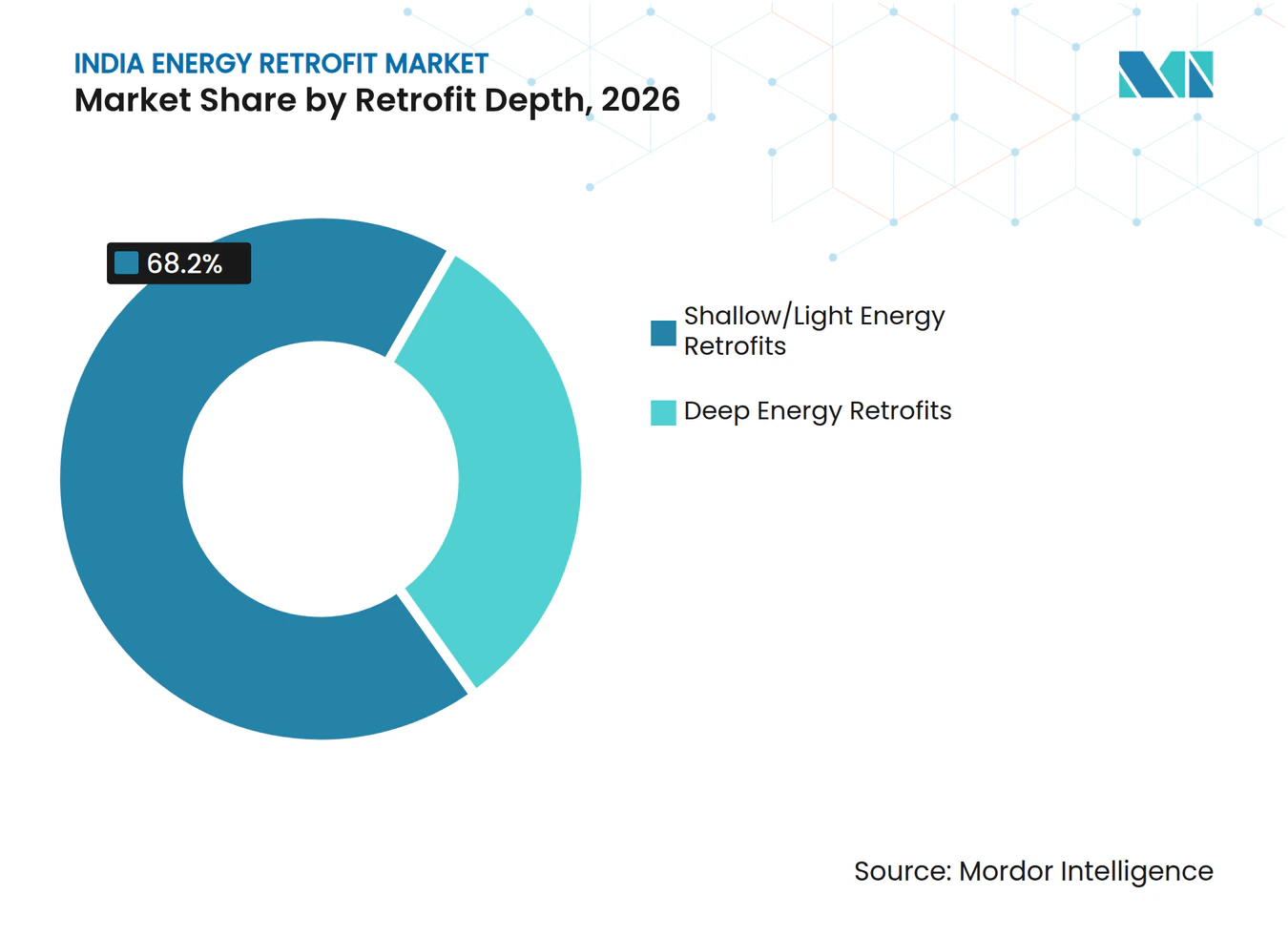
Shallow/Light Energy Retrofits held 68.2% of the India energy retrofit market in 2026. These projects commonly include LED replacements, HVAC controls, occupancy sensors, air sealing, and related measures with limited disruption. They suit owners who favor short capital-planning cycles and rapid operating improvements. They are also easier to apply across occupied commercial and institutional properties. Deep Energy Retrofits are forecast to grow at a 10.8% CAGR through 2032. This faster growth reflects interest in broader upgrades that can improve the performance of an entire building.
Deep projects can include major HVAC changes, insulation, glazing, controls integration, and wider building management upgrades. They require stronger project planning because installation may affect occupied space and involve more than one building system. Proposed building ratings could make partial upgrades less sufficient for assets that need a higher energy-performance level. Savings-backed contracting can make deep projects more accessible when payment is linked to verified results. The India energy retrofit industry also needs technical capacity to design, install, and monitor these projects. The transition toward deeper work will depend on stronger measurement, financing, and contractor coordination. Shallow measures will remain relevant where owners need immediate upgrades with lower disruption.



By Technology: HVAC Systems Anchor Revenue While Smart Controls Redefine the Value Stack
HVAC Systems accounted for 30.7% of the India energy retrofit market in 2026. Cooling equipment is a significant energy user in commercial and industrial buildings, particularly in areas with persistent heat. HVAC retrofits can include replacement equipment, variable-speed systems, chillers, controls, and improved maintenance practices. These options give owners several routes to improve performance without adopting the same project scope. Smart Building Controls and IoT are expected to grow at a 12.4% CAGR through 2032. Their growth shows the increasing value placed on continuous monitoring and automated operation.
Controls can use operating data to adjust equipment to occupancy, weather conditions, and demand requirements. Siemens has emphasized the role of connected building technologies in organizations’ planned infrastructure spending. Siemens also presented building-system tools designed to support interoperable integration across HVAC, lighting, and security systems. Building envelope improvements and renewable integration provide additional opportunities where owners need to manage cooling loads and energy supply together. Water heating upgrades can be relevant in industrial and process settings that have substantial thermal demand. The India energy retrofit industry is moving toward technology packages that link physical equipment with ongoing operating data. This approach can help owners prioritize the parts of a building that need intervention first.
By Application: Commercial Buildings Lead While Industrial Facilities Respond to Carbon Signals
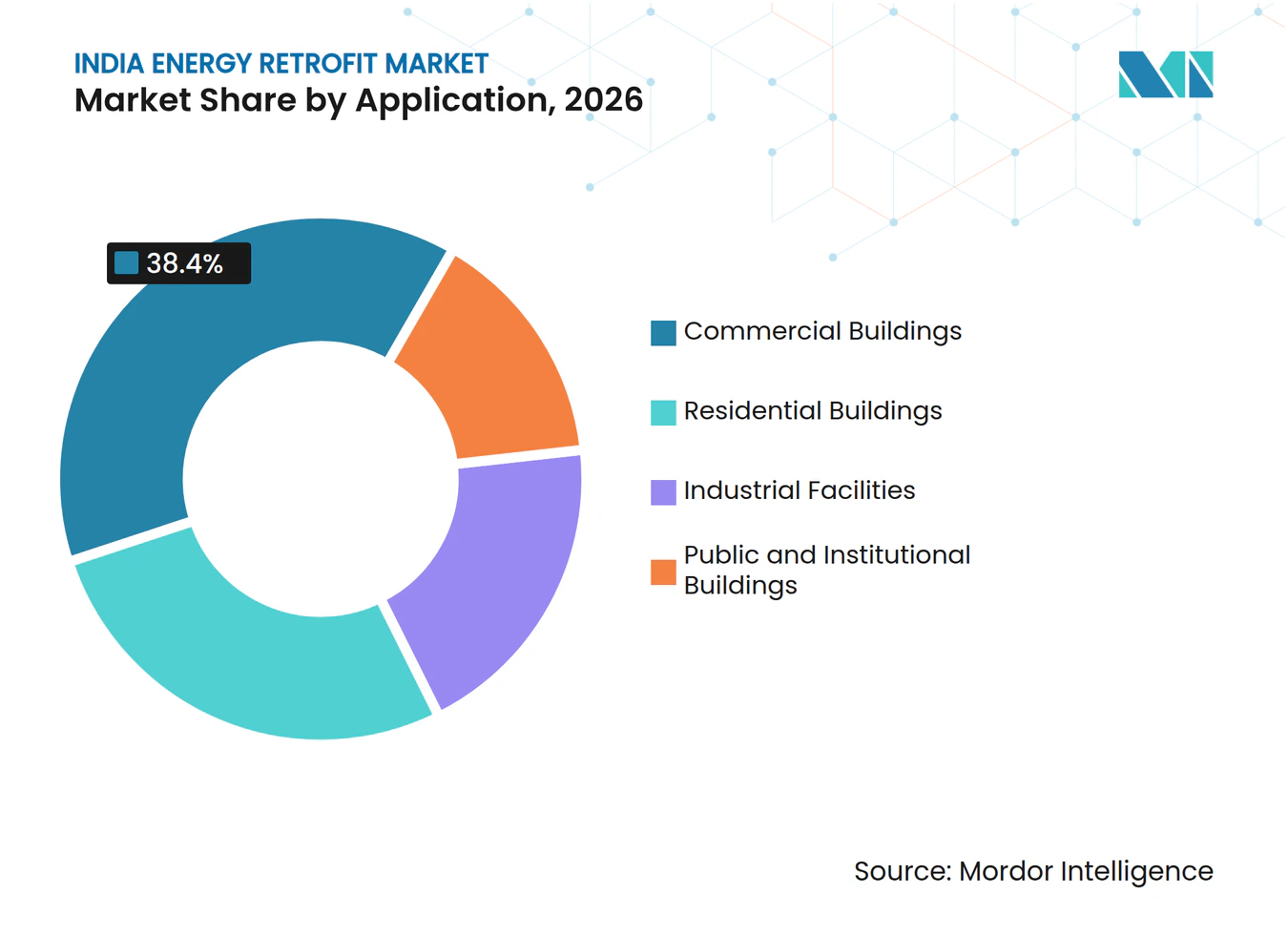
Commercial Buildings held 38.4% of the India energy retrofit market in 2026. Older office stock in Bengaluru, Delhi NCR, Mumbai, Chennai, Hyderabad, and Pune creates a broad base for building-system upgrades. Owners in these locations must consider tenant expectations, operating costs, and the competitive value of certification. The largest projects can combine HVAC, controls, lighting, and envelope measures under a single plan. Industrial Facilities are projected to grow at a 9.6% CAGR through 2032. The sector is affected by carbon-performance requirements for designated energy-intensive activities under the Indian Carbon Credit Trading Scheme.
Residential buildings represent a large potential base, but household-level financing and awareness can limit uptake. Public and institutional facilities can provide useful portfolio opportunities because similar sites may be bundled under an energy service arrangement. The Bureau of Energy Efficiency’s policy direction also supports closer attention to energy use in larger buildings and industrial facilities. Industrial buyers may focus on process-related savings, while commercial owners may place more weight on tenant experience and building ratings. The India energy retrofit market needs different project and financing approaches for these buyer groups. Commercial demand will remain tied to office modernization and leasing needs. Industrial demand will be shaped by compliance, process efficiency, and the ability to verify energy outcomes.

Geography Analysis
Bengaluru and Delhi NCR together account for 45% of India’s office inventory that is more than 10 years old, making them central locations for commercial energy retrofit activity. Large corporate occupiers and institutional owners in these markets have a strong reason to track building performance. Their concentration of established office space creates opportunities for HVAC modernization, controls, and certification-related improvements. India’s 2025 standing for LEED-certified space outside the United States also reflects the importance of major commercial corridors. Mumbai, Chennai, Hyderabad, and Pune form a second group of important commercial markets for the India energy retrofit market.
Tata Power and Keppel, through a consortium partnership with Tata Realty and Infrastructure, are deploying a 12,100 TR Cooling-as-a-Service solution at Intellion Park in Chennai under a 15-year contract. The project shows how service-based cooling arrangements can be used in a major office development. Karnataka, Maharashtra, and Tamil Nadu are relevant because tariff conditions and building-code implementation can affect the business case for retrofits. States that have formally notified the Energy Conservation Building Code can create more compliance-led demand than states that rely on voluntary action.
Industrial demand is spread across energy-intensive clusters in Maharashtra, Gujarat, Tamil Nadu, Karnataka, Telangana, and Andhra Pradesh. These locations combine industrial activity with greater relevance for energy-efficiency programs and carbon-performance requirements. The India energy retrofit market can expand beyond metro areas when smaller projects can be grouped for financing and monitoring. Tier-2 and Tier-3 cities may need stronger audit capacity and more accessible project finance before this occurs at scale. Rooftop solar and building efficiency can be combined where local rules support commercial and industrial energy projects. The geographic pattern will remain uneven because state-level enforcement, technical capacity, and financing conditions vary. A wider network of verified project data could help lenders assess opportunities in areas that currently receive less investment.
Competitive Landscape
Market Concentration
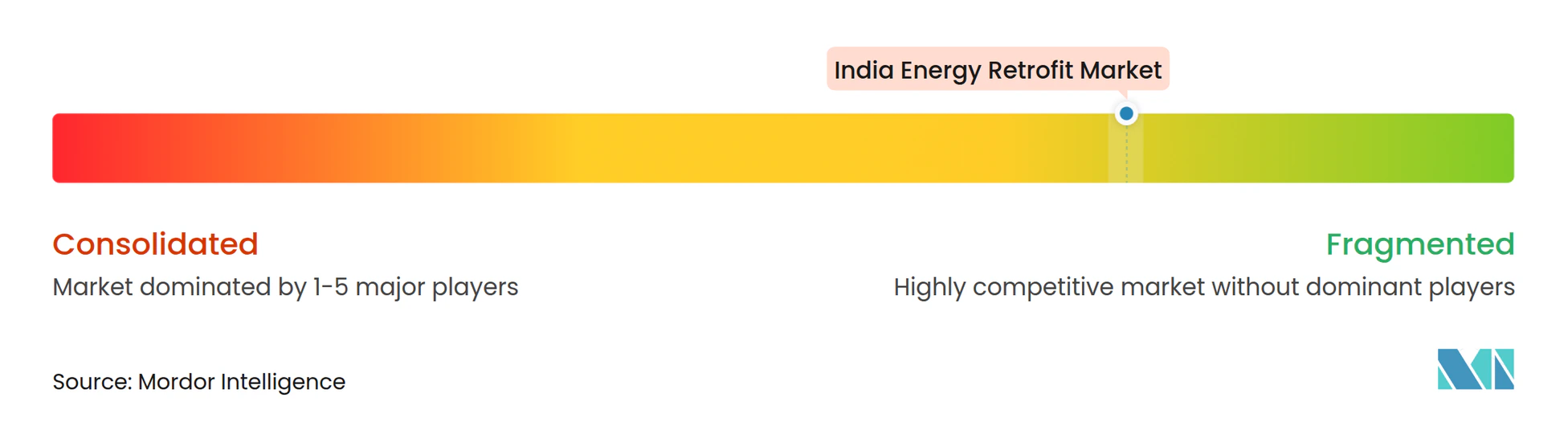
The India energy retrofit market is fragmented. Schneider Electric, Honeywell, Johnson Controls, Siemens, ABB, and Trane Technologies compete through controls, analytics, equipment, and performance-oriented service models. Larger suppliers can bring established platforms and broad product portfolios to complex building projects. Specialist providers can be more flexible in smaller projects where financing and local delivery are central. The India energy retrofit market remains fragmented across building types, technologies, and regional project pipelines.
ABB announced USD 75 million of investment in India in 2026 after USD 35 million in 2025, supporting manufacturing and research and development across electrification, motion, and automation activities. This investment supports ABB’s local delivery capacity for equipment relevant to energy and automation projects. Siemens has continued to develop its building-management offering around interoperability for existing building systems. Tata Power and Keppel’s Chennai cooling project provides another example of an outcome-based model that can reduce the need for a customer to operate a cooling asset directly.
India-focused energy service companies and project developers are important in industrial and MSME work because they can structure smaller contracts and connect projects to financing. Thermax Onsite Energy Solutions, Energeia, ENGIE India, and EESL operate in areas related to onsite utilities, energy services, or public efficiency programs. The International Energy Agency has noted that energy service company development remains uneven across countries, which reinforces the importance of local project structures. Firms that can bundle projects, measure savings, and provide credible data may have an advantage in underserved buyer groups. The India energy retrofit market will not be defined by a single technology provider because projects require equipment, data management, installation, and financing. Competitive differentiation is therefore likely to center on reliable execution and verified performance. This competitive structure is consistent with a market in which no single group of suppliers controls all parts of the value chain.
India Energy Retrofit Industry Leaders
-
Johnson Controls India Pvt. Ltd.
-
Schneider Electric India Pvt. Ltd.
-
Siemens Limited
-
Honeywell Automation India Ltd.
-
Energy Efficiency Services Limited
- *Disclaimer: Major Players sorted in no particular order
Recent Industry Developments
- July 2026: BEE formally launches Carbon Credit Certificate (CCC) trading under the Indian Carbon Credit Trading Scheme (CCTS), transitioning from the PAT-based Energy Saving Certificate mechanism. Nine energy-intensive sectors, including aluminium, cement, iron and steel, and textiles, are transitioning to the compliance mechanism, creating a direct financial return on verified industrial energy-efficiency retrofits.
- April 2026: Tata Power Trading Company and Keppel Limited partner with Tata Realty and Infrastructure to deploy a 12,100 TR Cooling-as-a-Service (CaaS) solution at Intellion Park, Chennai (25.27 acres, Taramani IT corridor), under a 15-year contract targeting 20% overall energy reduction. The project is scheduled to go live in October 2026.
- March 2026: ABB announces USD 75 million in India investments for 2026, following USD 35 million in 2025, expanding manufacturing and R&D in Bengaluru (Motion facility in Peenya, Nelamangala Campus 2), Hyderabad (12,400+ sq m R&D hub), Nashik (circuit breaker production), and Vadodara (generators and motors) across electrification, motion, and automation segments.
India Energy Retrofit Market Report Scope
Energy retrofit refers to the process of upgrading or modifying existing buildings, facilities, or energy systems to improve energy efficiency, reduce energy consumption and operating costs, and lower greenhouse gas emissions. Retrofits can involve replacing outdated equipment, improving building insulation and windows, upgrading HVAC and lighting systems, installing smart energy controls, and integrating renewable energy technologies such as solar PV.
The India Energy Retrofit Market is segmented by retrofit depth, technology, and application. By retrofit depth, the market is segmented into deep energy retrofits and shallow/light energy retrofits. By technology, the market is segmented into HVAC systems, lighting systems, building envelope, renewable integration, smart building controls, IoT, and water heating and plumbing. By application, the market is segmented into residential, commercial, industrial, and public and institutional buildings. For each segment, the market sizing and forecasts have been provided on the basis of value (USD).
| Deep Energy Retrofits |
| Shallow/Light Energy Retrofits |
| HVAC Systems |
| Lighting Systems |
| Building Envelope (Insulation and Glazing) |
| Renewable Integration (Solar PV, Solar Thermal) |
| Smart Building Controls and IoT |
| Water Heating and Plumbing |
| Residential Buildings |
| Commercial Buildings |
| Industrial Facilities |
| Public and Institutional Buildings |
| By Retrofit Depth | Deep Energy Retrofits |
| Shallow/Light Energy Retrofits | |
| By Technology | HVAC Systems |
| Lighting Systems | |
| Building Envelope (Insulation and Glazing) | |
| Renewable Integration (Solar PV, Solar Thermal) | |
| Smart Building Controls and IoT | |
| Water Heating and Plumbing | |
| By Application | Residential Buildings |
| Commercial Buildings | |
| Industrial Facilities | |
| Public and Institutional Buildings |
Key Questions Answered in the Report
How large is the India energy retrofit market in 2027?
The India energy retrofit market size is estimated at USD 36.54 billion in 2027 and is forecast to reach USD 55.09 billion by 2032.
What is driving energy retrofit activity in India?
Higher operating costs, building-performance expectations, policy developments, and financing models that link repayment to verified savings are supporting demand.
Which retrofit depth has the largest share?
Shallow/Light Energy Retrofits held 68.2% in 2026 because they can be implemented with less disruption and shorter planning cycles.
Which technology is growing fastest?
Smart Building Controls and IoT are forecast to grow at a 12.4% CAGR through 2032, supported by demand for continuous monitoring and automated operation.
Why are commercial buildings important for retrofit providers?
Commercial Buildings held 38.4% in 2026, with older office stock and tenant expectations creating demand for HVAC, controls, lighting, and certification-related upgrades.
Why are industrial facilities expected to grow quickly?
Industrial Facilities are projected to grow at a 9.6% CAGR through 2032 as energy-intensive sectors respond to carbon-performance requirements and energy-cost pressures.