
India Coffee Market Size and Share
Market Overview
| Study Period | 2022 - 2032 |
|---|---|
| Forecast Data Period | 2027 - 2032 |
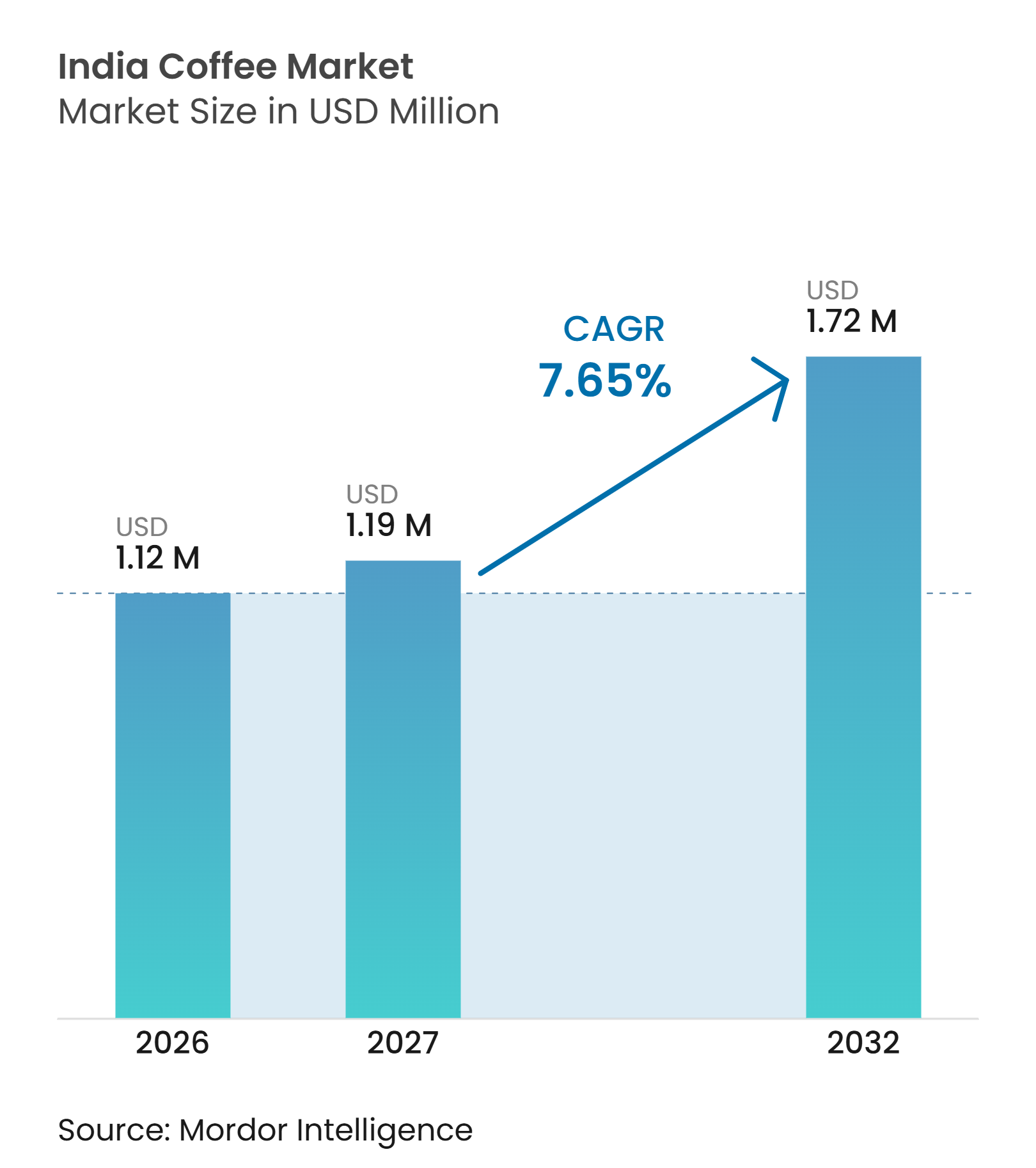
| Base Year Market Size (2026) | USD 1.12 Million |
| Market Size (2027) | USD 1.19 Million |
| Market Size (2032) | USD 1.72 Million |
| Growth Rate (2027 - 2032) | 7.65 % |
| Market Concentration | Medium |
Major Players *Disclaimer: Major Players sorted in no particular order Image © Mordor Intelligence. Reuse requires attribution under CC BY 4.0. | |
India Coffee Market Analysis by Mordor Intelligence
The Indian coffee market is projected to grow from USD 1.12 billion in 2026 and USD 1.20 billion in 2027 to USD 1.72 billion by 2032, registering a CAGR of 7.65% during the forecast period (2027–2032). Urban consumers are driving demand as they increasingly visit coffee shops for social occasions and purchase packaged coffee products for at-home consumption. Soluble coffee remains significant due to its affordability and ease of preparation, while ready-to-drink coffee and coffee capsules are expanding consumption occasions. The market also offers substantial growth potential, as India’s per capita coffee consumption stood at 0.07 kg in 2025, compared with the global average of 1.3 kg, according to the United States Department of Agriculture[1]. Companies are responding by expanding premium product portfolios, improving accessibility through online channels, and opening coffee shops in new cities. However, supply-side conditions remain a concern, as weather-related disruptions and coffee bean price volatility can increase costs and constrain the availability of high-quality beans.
Key Report Takeaways
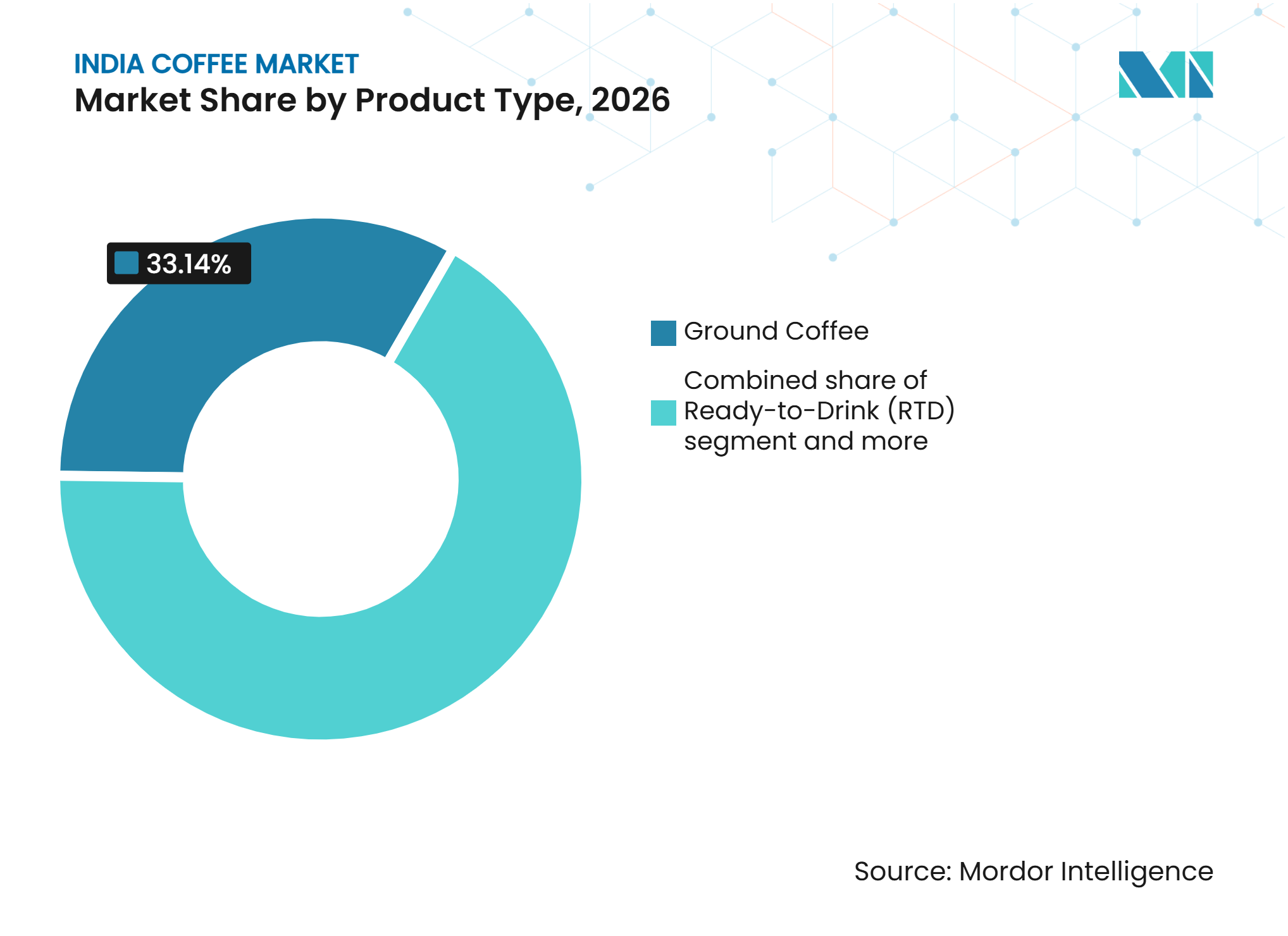
- By product type, ground coffee held 33.14% of the Indian coffee market share in 2026, while ready-to-drink coffee is forecast to grow at an 8.61% CAGR through 2032.
- By coffee species, Arabica held a 59.42% share in 2026, while Robusta is forecast to grow at an 8.30% CAGR through 2032.
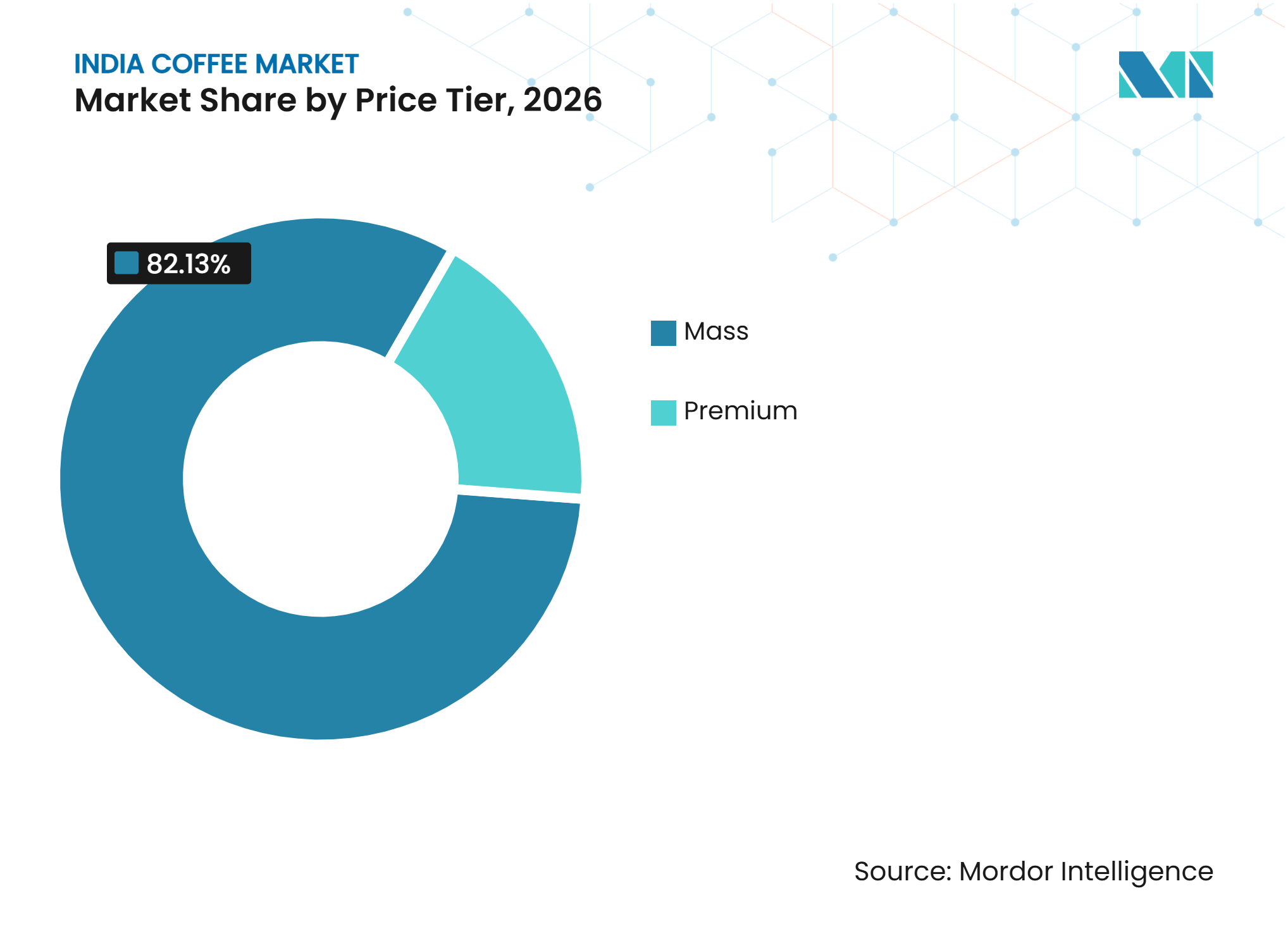
- By price tier, mass formats accounted for 82.13% of the Indian coffee market size in 2026, while premium formats are forecast to grow at an 8.79% CAGR through 2032.
- By distribution channel, off-trade accounted for 81.45% in 2026, while on-trade is forecast to grow at a 9.12% CAGR through 2032.
Note: Market numbers in this report are based on Mordor Intelligence's proprietary estimation framework, which combines nine months of actuals with Q4 projections for base year 2026.
Market Trends and Insights
Drivers Impact Analysis of India Coffee Market*
| Driver | (~) % Impact on CAGR Forecast | Geographic Relevance | Impact Timeline |
|---|---|---|---|
| Rising Urban Coffee Adoption and Café Culture | +1.8% | National, with highest intensity in Tier-1 and Tier-2 cities | Medium term (2-4 years) |
| Premiumization of Instant, Specialty, and Origin-Led Coffee | +1.4% | National, led by Mumbai, Delhi NCR, and Bengaluru | Long term (≥ 4 years) |
| Convenience Demand for Soluble, Single-Serve, and RTD Formats | +1.2% | National, accelerated in urban corridors and Tier-2 cities | Short term (≤ 2 years) |
| Expansion of Organized Coffee Shop Chains | +1.0% | National, with density gains in Delhi NCR, Bengaluru, Hyderabad, and Mumbai | Medium term (2-4 years) |
| Growing Preference for Specialty Coffee Varieties | +0.8% | Metros and Tier-1 cities, with pockets in Tier-2 cities | Long term (≥ 4 years) |
| Expansion of E-Commerce and Quick-Commerce Distribution Channels | +1.3% | National, with the highest velocity in metros with dense quick-commerce coverage | Short term (≤ 2 years) |
| Source: Mordor Intelligence | |||
Rising Urban Coffee Adoption and Café Culture
India’s expanding café culture is driving coffee consumption beyond traditional morning occasions. Branded cafés serve as venues for meetings, studying, and socializing, giving younger consumers more reasons to consume coffee throughout the day. This shift also familiarizes consumers with formats such as cold brew and single-origin coffee, which may subsequently translate into retail purchases. The Indian coffee market benefits as café chains expand into Tier-2 cities, allowing local consumers to experience premium coffee formats before purchasing them for at-home consumption. Organized chains are increasing their physical presence, including Third Wave Coffee’s planned expansion into nine new cities following its anticipated Series D funding round in August 2026. This expansion connects on-trade consumption with the growth of packaged coffee and ready-to-drink products sold through other distribution channels.
Premiumization of Instant, Specialty, and Origin-Led Coffee
Premium demand is growing across flavored instant coffee, specialty blends, capsules, and estate-specific offerings. For instance, Nestlé is expected to open its first Nespresso boutique in New Delhi in early 2025 and partner with Thakral Innovation to expand distribution in India. Tata Starbucks is also expected to introduce three estate-exclusive whole-bean coffees from Kodagu in October 2025, sourced from the Nullore, Margolly, and Karadibetta estates. These launches are expected to increase consumer visibility into coffee origin, growing area, and processing methods. Higher green coffee prices are likely to narrow the price gap between specialty and standard coffee in 2025, increasing the importance of traceability and product differentiation. Consequently, the Indian coffee market is developing premium products through both international distribution systems and Indian estate-led offerings.
Convenience Demand for Soluble, Single-Serve, and Ready-to-Drink Formats
Convenience remains a key demand driver, as consumers can prepare instant coffee quickly or purchase ready-to-drink products that require no preparation. In April 2025, Nestlé identified India as a priority market for Nescafé ready-to-drink coffee and described the opportunity as largely untapped. Single-serve packs, coffee concentrates, and capsules cater to consumers seeking portable, easy-to-use portions. These formats particularly appeal to younger consumers who may not own coffee-brewing equipment or have time to prepare beverages at home. They also enable brands to offer premium experiences in smaller pack sizes, reducing the initial purchase barrier. The Indian coffee market is likely to retain soluble coffee products as its volume base, while ready-to-drink coffee creates new consumption occasions.
Expansion of E-Commerce and Quick-Commerce Distribution Channels
Online retail and quick-commerce services expand the availability of coffee products beyond supermarkets and cafés. These channels enable smaller coffee brands to reach consumers without establishing an extensive physical distribution network. They are particularly suitable for cold coffee, concentrates, and premium packs that consumers frequently reorder. Moreover, Nestlé has identified quick commerce as a fast-growing channel for Nescafé products and has expanded its reach beyond major metropolitan areas. Online visibility has become increasingly important, as consumers can compare brands and purchase products shortly after trying similar formats at cafés. Consequently, the Indian coffee market can expand into cities with limited organized retail or specialty café presence.
Restraints Impact Analysis of India Coffee Market*
| Restraint | (~) % Impact on CAGR Forecast | Geographic Relevance | Impact Timeline |
|---|---|---|---|
| Volatility in Arabica and Robusta Prices | -1.5% | National, with supply-side pressure in Karnataka and Kerala production belts | Short term (≤ 2 years) and Medium term (2-4 years) |
| Climate Change Affecting Coffee Production | -1.2% | Karnataka, Kerala, and Tamil Nadu production districts | Long term (≥ 4 years) |
| Tea Preference and Low Per-Capita Coffee Consumption | -0.9% | National, with strongest effect in North and East India | Medium term (2-4 years) and Long term (≥ 4 years) |
| High Dependence on Southern Producing Regions | -0.6% | Chikkamagaluru, Hassan, and Kodagu in Karnataka, plus Wayanad in Kerala | Long term (≥ 4 years) |
| Source: Mordor Intelligence | |||
Volatility in Arabica and Robusta Prices
Coffee bean prices are expected to remain highly volatile in 2025 and continue affecting costs in 2026. According to the USDA Foreign Agricultural Service’s India Coffee Annual 2026, domestic farmgate prices for Arabica parchment and Robusta cherry are projected to decline by 16% and 11%, respectively, from October 2025 levels[2]. This decline reflects expectations of higher coffee output in major producing countries and elevated domestic inventories. However, price corrections may not immediately reduce retail costs, as brands may continue selling inventory purchased when bean prices were higher. Blue Tokai is expected to increase packet prices by 10% to 20% in July 2026 due to its higher-cost harvest-season inventory. International supply conditions, weather-related risks, and uncertainty surrounding U.S. tariffs on Brazilian coffee are also expected to contribute to price pressures. The Indian coffee market may face margin pressure when brands cannot pass these costs on to price-sensitive consumers.
Climate Change Affecting Coffee Production
Increasing climate variability is disrupting coffee cultivation across India's major producing regions, particularly Karnataka and Kerala. According to the USDA Foreign Agricultural Service's Coffee Semi-Annual Report 2025, excessive monsoon rainfall during 2025 caused berry drop and increased fungal disease incidence across coffee plantations, threatening crop development and yields. The report's rainfall data, sourced from the India Meteorological Department, also highlighted significant deviations from normal rainfall across major coffee-growing districts. Such irregular weather patterns disrupt flowering, fruit setting, and bean maturation, increasing crop losses, production uncertainty, and financial risks for Indian coffee growers.
*Our forecasts treat driver/restraint impacts as directional, not additive. The impact forecasts reflect baseline growth, mix effects, and variable interactions.
India Coffee Market Segment Analysis
By Product Type:
Ground Coffee Holds the Largest Share While Ready-to-Drink Coffee Leads GrowthGround coffee accounted for a 33.14% share in 2026, supported by established filter-coffee consumption routines in South Indian households and broader availability across modern retail channels. Ready-to-drink coffee is projected to grow at an 8.61% CAGR through 2032, driven by demand for cold, single-serve beverages that require no home preparation. Instant coffee remains a major volume contributor due to its affordability and widespread availability across urban and smaller-city retail outlets. Soluble formats also introduce coffee to first-time consumers, who may subsequently trade up to ground, whole-bean, or specialty coffee products.
Whole-bean coffee is gaining visibility among urban consumers seeking to replicate café-style brewing at home. The Nespresso boutique in New Delhi provides capsule systems with a higher-profile entry point into the country. Coffee pods and capsules can drive demand among professionals who value consistent portions and minimal preparation time. In August 2025, the Food Safety and Standards Authority of India (FSSAI) amended labeling requirements for coffee-chicory products, with the requirements taking effect in July 2026. The amendment requires manufacturers to clearly disclose coffee and chicory percentages on the front of packs. This requirement can help consumers compare blended and pure-coffee formats more easily.



By Coffee Species:
Arabica Leads Current Demand While Robusta Gains From Accessible FormatsArabica is projected to hold a 59.42% share in 2026, supported by its use in specialty cafés, capsule systems, and origin-led retail ranges. Robusta is forecast to grow at a CAGR of 8.30% through 2032, driven by its suitability for instant coffee and ready-to-drink blends that require consistent flavor, cost efficiency, and high soluble yield. This trend indicates that Robusta demand is closely linked to the adoption of mass-market formats rather than solely to premium coffee consumption. The coffee industry uses both species to address distinct consumer requirements.
Karnataka and Kerala are key cultivation regions for both Arabica and Robusta. Arabica is expected to face additional pressure during 2025-26 as the crop enters its biennial off-year cycle. Weather-related disruptions may affect the availability and quality of both species. Tata Starbucks’ planned launch of Kodagu estate coffees in October 2025 is expected to increase the focus on Arabica provenance and regional identity. Robusta continues to support a broader range of accessible packaged coffee formats. Consequently, brands can use Arabica to strengthen premium positioning while leveraging Robusta to meet widespread household demand.
By Price Tier:
Mass Products Support Volume While Premium Products Build ValueMass products accounted for 82.13% of the Indian coffee market in 2026. Affordable instant coffee supports this segment’s broad household penetration, particularly in smaller cities. The premium segment is forecast to expand at a CAGR of 8.79% through 2032, driven by specialty blends, capsules, whole beans, and products that emphasize coffee origin. This growth differential indicates that consumers are likely to continue purchasing entry-level coffee, while a smaller consumer base increasingly shifts toward higher-value offerings. This two-tier market structure enables suppliers to maintain volume while improving their product mix.
Premium single-serve packs can facilitate product trials by eliminating the need for consumers to purchase large bags or brewing equipment. Coffee shops also increase product exposure, which can encourage subsequent premium coffee purchases for home consumption. Nestlé’s Nespresso launch and Tata Starbucks’ estate-specific coffee launches demonstrate how global and local coffee narratives can coexist in the Indian coffee market. Rising commodity prices may narrow the visible price gap between standard and specialty coffee. In response, brands are emphasizing taste, quality assurance, and provenance. Consequently, the market is developing a broader price ladder rather than shifting entirely away from mass products.

By Distribution Channel:
Off-Trade Provides Reach While On-Trade Adds New OccasionsOff-trade channels are projected to account for 81.45% of the Indian coffee market in 2026. Supermarkets, hypermarkets, and neighborhood stores provide the broadest access to instant coffee, ground coffee, and other packaged products. The on-trade channel is forecast to grow at a CAGR of 9.12% through 2032. Café chains are shifting coffee consumption from a functional beverage occasion to a social purchase. Their expansion supports demand for cold coffee, specialty beverages, and food-pairing occasions. Consequently, the Indian coffee market relies on off-trade channels for household volume and on-trade channels for product and format discovery.
Online retail and quick-commerce platforms operate within the off-trade channel but differ from traditional retail stores. These platforms enable consumers to reorder products quickly while providing smaller brands with nationwide visibility without requiring equivalent investment in extensive store networks. Nescafé has identified quick commerce as an increasingly important channel for ready-to-drink products in India. Specialty stores also remain relevant for consumers seeking artisanal ground coffee and single-origin beans. On-trade chains can support retail channels by introducing consumers to new products. Companies that combine a café presence with online availability can address both product discovery and repeat purchases through different channels.
Geography Analysis
South India
South India accounts for the majority of domestic coffee consumption. Tamil Nadu has India’s largest coffee-drinking population, followed by Karnataka, Andhra Pradesh, and Kerala. Karnataka produces most of the country’s coffee output, making national supply and prices highly sensitive to weather conditions in the region. Bengaluru and Hyderabad have established active specialty café markets, where domestic chains and international operators compete for premium consumers. Wayanad and Araku offer distinct regional coffee narratives that support premium retail and export positioning. FSSAI’s coffee-chicory labeling amendment will also influence packaged blended coffee sales in this major consumption region[3]. Extended rainfall in 2025 damaged coffee output in Chikkamagaluru, Hassan, and Kodagu, which collectively account for most of India’s coffee production. South India’s share of the Indian coffee market is supported by deeply entrenched household consumption habits; however, the concentration of production in the region remains a structural supply risk.
North and West India
North and West India are becoming increasingly important for coffee consumption growth as coffee chains expand across Delhi NCR, Mumbai, Pune, and other cities. Young consumers in these regions are purchasing home-brewing equipment, roast-and-ground coffee, and whole beans. This trend supports demand beyond café visits and fosters more established at-home coffee consumption habits. Third Wave Coffee’s 2026 expansion plan includes Ludhiana, Jalandhar, Amritsar, and Lucknow, supported by its INR 408 crore Series D funding round. This expansion indicates that organized operators recognize opportunities beyond the established southern market. Consumers in these cities are also gaining exposure to international coffee styles through travel, cafés, and digital channels. The coffee market in North and West India is becoming less reliant on basic instant coffee as interest in brewing methods and premium formats increases. Brands offering convenient packaging and clear product information can effectively target consumers who are still developing regular coffee consumption habits.
East and Central India
East India remains an early-stage coffee market, where café expansion and online availability are beginning to generate demand. In June 2026, Third Wave Coffee opened three cafés in Kolkata and identified Guwahati, Ranchi, Patna, and Bhubaneswar as potential locations for future expansion. Central Indian cities, such as Nagpur, can also support coffee consumption through local café and retail activity. Quick-commerce platforms can reach consumers in markets where specialty stores and organized retail remain limited. Nestlé has expanded Nescafé’s quick-commerce distribution beyond major metropolitan areas, creating a pathway for packaged coffee to gain visibility in smaller cities. This combination of physical cafés and delivery access can build consumer awareness before a mature retail network develops. Tea preferences remain strong across these geographies. Therefore, companies need to offer products that are easy to trial and priced to encourage repeat purchases. The Indian coffee market can achieve broader national reach if brands adapt their offerings to local purchasing power and consumers’ limited familiarity with coffee formats.
Competitive Landscape
Market Concentration
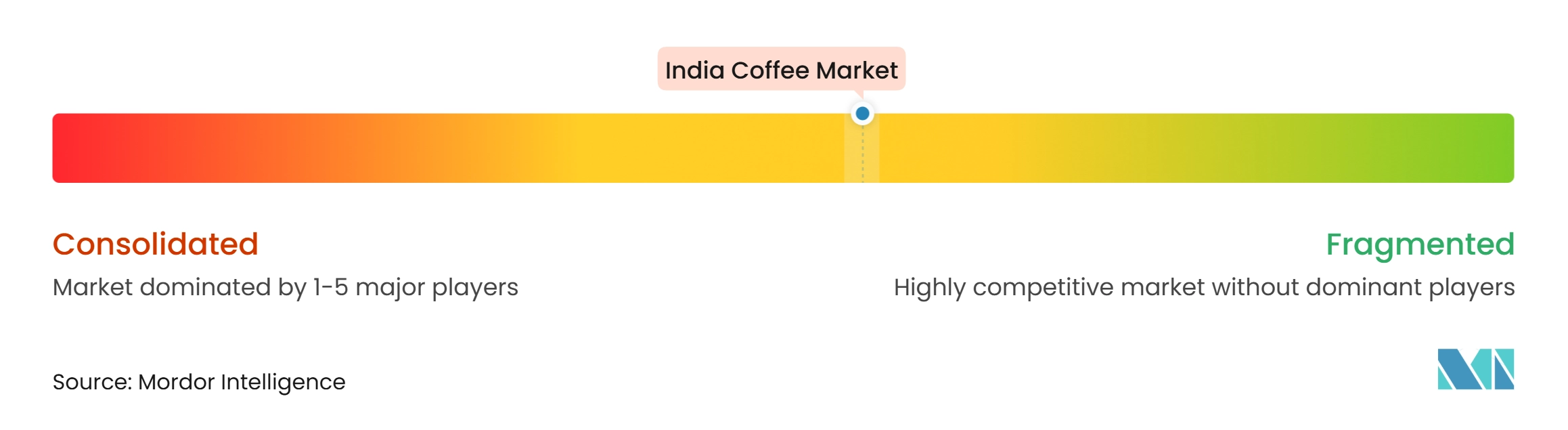
The Indian coffee market features a moderately concentrated packaged coffee segment, while the specialty café and direct-to-consumer segments remain more fragmented. Nestlé India, Hindustan Unilever, and Tata Consumer Products maintain national packaged brands with extensive retail access. Smaller specialty operators compete through coffee quality, origin stories, café experiences, and online distribution. Nestlé follows a dual strategy by expanding Nescafé ready-to-drink coffee and introducing the Nespresso boutique model in India. This approach enables the company to participate in both mass-market convenience and premium capsule coffee formats. Tata Starbucks has also added estate-specific Kodagu coffees to its portfolio, demonstrating how a major café chain can invest in premium Indian-origin coffee.
The competitive landscape includes Nestlé India Limited, Hindustan Unilever Limited, Tata Consumer Products Limited, CCL Products (India) Limited, and SLN Coffee Private Limited. These companies operate across different parts of the value chain, including instant coffee production, regional blending, specialty roasting, café operations, and digital sales. Third Wave Coffee’s INR 408 crore funding round provides resources to expand its store network and enter new cities. Regional roasters can compete through heritage blends and strong local consumer familiarity. Specialty brands use direct online sales to build customer relationships without relying solely on supermarket shelf space. Established companies retain advantages in procurement, distribution, marketing resources, and the ability to extend their brands across multiple price points.
Quick-commerce platforms are reshaping competition by placing challenger products alongside large packaged coffee brands. Compact cold-brew concentrates, pour-over bags, and flavored instant coffee packs are well suited to online discovery and repeat purchases. Companies also use digital loyalty programs and subscription models to encourage repeat purchases and better understand consumer preferences. Capsule brewing creates higher entry barriers, as proprietary systems and specialized equipment require investments in product development and distribution. FSSAI labeling requirements add a compliance consideration for coffee-chicory products and encourage companies to improve front-of-pack clarity. Competition will depend on companies’ ability to combine accessible pricing, reliable supply, convenient availability, and differentiated products. Retailers, café operators, and packaged coffee suppliers each influence the speed at which new products progress from consumer trial to repeat purchase. Overall, the available material characterizes the packaged coffee segment as moderately concentrated, while specialty cafés and direct-to-consumer brands remain fragmented.
India Coffee Industry Leaders
-
Nestlé India Limited
-
Hindustan Unilever Limited
-
Tata Consumer Products Limited
-
CCL Products (India) Limited
-
SLN Coffee Private Limited
- *Disclaimer: Major Players sorted in no particular order
India Coffee Market Companies Covered in this Report
- Nestlé India Limited
- Hindustan Unilever Limited
- Tata Consumer Products Limited
- CCL Products (India) Limited
- SLN Coffee Private Limited
- Cothas Coffee Co.
- Sri Narasu’s Coffee Company Private Limited
- Bayar’s Coffee
- Blue Tokai Coffee Roasters
- Sleepy Owl Coffee
- Rage Coffee
- Levista Coffee
- Starbucks Coffee Company
- Café Coffee Day
- Third Wave Coffee
- Costa Coffee
- Tim Hortons
- Araku Coffee
- Country Bean Coffee
- Lavazza
Recent Industry Developments in India Coffee Market
- May 2026: Nespresso expanded its Indian retail presence by opening its first Mumbai store at Jio World Drive, Bandra Kurla Complex. The new outlet strengthened access to its premium coffee capsules, machines, and accessories while offering personalized coffee experiences and product consultations.
- November 2025: Starbucks established a Farmer Support Partnership with Tata Starbucks, targeting support for 10,000 Indian coffee farmers by 2030. The initiative included plans to distribute one million high-yield Arabica seedlings and promote improved farming practices, productivity and climate resilience. The company also announced the opening of its 500th Indian coffeehouse.
- April 2025: Nestlé expanded its Nescafé Ready-to-Drink coffee portfolio into India, alongside Brazil and the Middle East and North Africa, targeting younger consumers seeking convenient, on-the-go cold coffee beverages.
India Coffee Market Report Scope
Coffee is a beverage made by percolation, infusion, or decoction from the roasted and ground seeds of a coffee plant. The Indian Coffee market is segmented by product type, coffee species, price tier, and distribution channel. By product type, the market is segmented into whole-bean, ground coffee, instant coffee, ready-to-drink (RTD), and coffee pods and capsules. By coffee species, the market is segmented into arabica, robusta, and other coffee species. By price tier, the market is segmented into mass and premium. By Distribution channel, the market is segmented into on-trade and off-trade. The market forecasts are provided in terms of value (USD) and volume.
Segmentation Overview
| Whole-bean |
| Ground Coffee |
| Instant Coffee |
| Ready-to-Drink (RTD) |
| Coffee Pod and Capsules |
| Arabica |
| Robusta |
| Other Coffee Species |
| Mass |
| Premium |
| On-Trade | |
| Off-Trade | Supermarkets/Hypermarkets |
| Convenience Stores | |
| Specialty Stores | |
| Online Retail Stores | |
| Other Distribution Channels |
| By Product Type | Whole-bean | |
| Ground Coffee | ||
| Instant Coffee | ||
| Ready-to-Drink (RTD) | ||
| Coffee Pod and Capsules | ||
| By Coffee Species | Arabica | |
| Robusta | ||
| Other Coffee Species | ||
| By Price Tier | Mass | |
| Premium | ||
| By Distribution Channel | On-Trade | |
| Off-Trade | Supermarkets/Hypermarkets | |
| Convenience Stores | ||
| Specialty Stores | ||
| Online Retail Stores | ||
| Other Distribution Channels | ||
Key Questions Answered in the Report
What is driving growth in the Indian coffee market?
Urban café use, convenient soluble and ready-to-drink products, online availability, and premium product launches support projected 7.65% CAGR growth from 2027 to 2032.
Which coffee product is growing fastest in India?
Ready-to-drink coffee is the fastest-growing product type, with an 8.61% CAGR forecast through 2032.
Which coffee species leads demand in India?
Arabica held 59.42% share in 2026, while Robusta is forecast to grow faster at an 8.30% CAGR through 2032.
Why is ready-to-drink coffee important in India?
It offers a cold, single-serve product that requires no preparation, and companies such as Nestlé are expanding ready-to-drink offerings in India.