
India Cash Logistics Market Size and Share
Market Overview
| Study Period | 2020 - 2031 |
|---|---|
| Forecast Data Period | 2026 - 2031 |
| Base Year Market Size (2025) | USD 422.73 Million |
| Market Size (2026) | USD 451.90 Million |
| Market Size (2031) | USD 642.44 Million |
| Growth Rate (2026 - 2031) | 7.29 % |
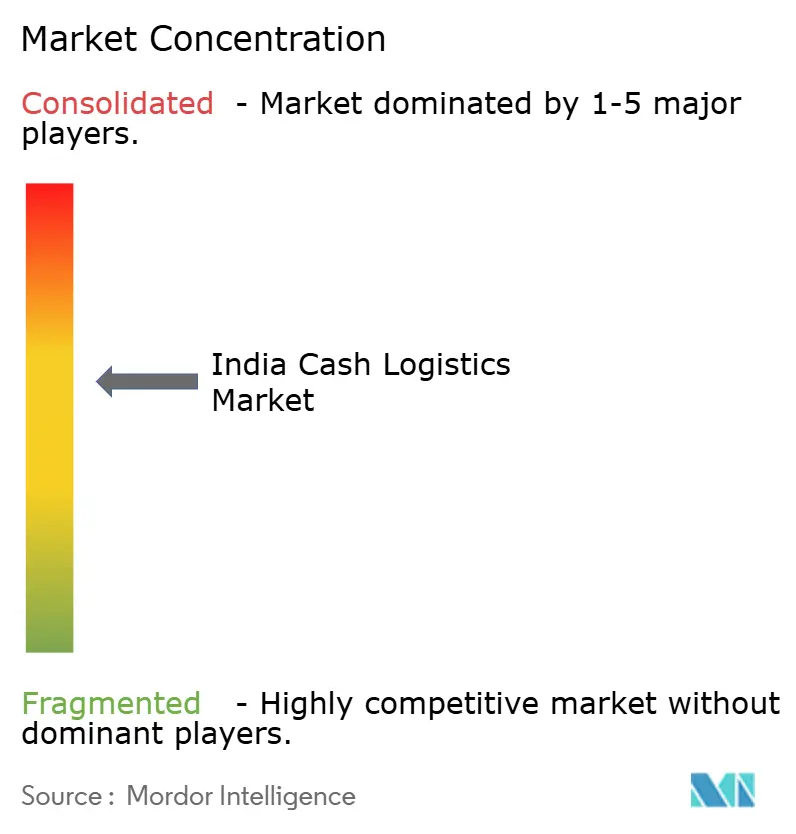
| Market Concentration | Medium |
Major Players *Disclaimer: Major Players sorted in no particular order Image © Mordor Intelligence. Reuse requires attribution under CC BY 4.0. | |
India Cash Logistics Market Analysis by Mordor Intelligence
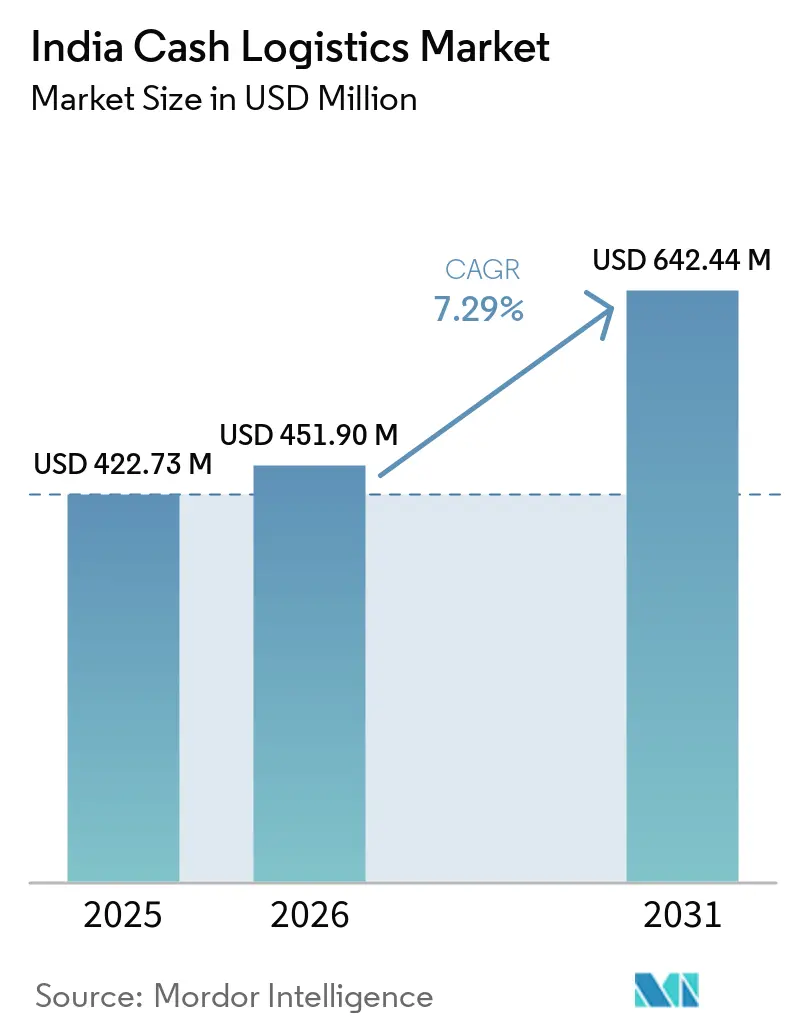
The India cash logistics market size was valued at USD 422.73 million in 2025, and is expected to grow from USD 451.90 million in 2026 to reach USD 642.44 million by 2031 at 7.29% CAGR over 2026-2031.
Sustained use of physical currency supports service demand even as digital payments expand across the country. Banks are assigning more ATM replenishment, cash processing, and monitoring work to specialist providers. The India cash logistics market also has room to expand in Tier 2 and Tier 3 cities, where organized coverage remains uneven. Providers are competing through long contracts, broader service networks, and cash forecasting tools that improve ATM availability. Rising fuel, labor, and compliance costs make route efficiency and contract pricing important to profitability.
Key Report Takeaways
- By service type, ATM services held 43.50% of the India cash logistics market share in 2025 and recorded the highest forecast CAGR of 8.10% through 2031.
- By end user, financial institutions held 58.15% of the India cash logistics market size in 2025, while retail recorded the highest projected CAGR at 8.40% through 2031.
- By mode of transit, roadways held 91.50% of the revenue share of the India cash logistics market in 2025, while railways recorded the highest projected CAGR at 7.80% through 2031.
Note: Market size and forecast figures in this report are generated using Mordor Intelligence’s proprietary estimation framework, updated with the latest available data and insights as of January 2026.
India Cash Logistics Market Trends and Insights
Drivers Impact Analysis*
| Driver | (~) % Impact on CAGR Forecast | Geographic Relevance | Impact Timeline |
|---|---|---|---|
| Persistent Cash Usage in Informal and Semi-Formal Commerce | +1.9% | Pan-India, with concentration in Northern states, rural belts, and semi-urban markets | Long term (≥ 4 years) |
| Expansion of ATM Networks in Tier 2 and Tier 3 Cities | +1.6% | Tier 2 and Tier 3 cities, rural areas, Eastern and Central India | Medium term (2-4 years) |
| Outsourcing of Non-Core Cash Handling by Banks and Retailers | +1.2% | National, with early concentration in metro and large Tier 2 financial hubs | Medium term (2-4 years) |
| Regulatory Push for Secure Cash Handling and Traceability | +0.9% | National, with early gains in high-transaction urban corridors | Short term (≤ 2 years) |
| AI-Enabled Route Optimization and Demand-Led Replenishment | +0.6% | National, with early application in high-density urban ATM networks | Medium term (2-4 years) |
| Festive, Election, and Seasonal Currency Circulation Spikes | +0.4% | National, with peaks in politically and commercially active states | Short term (≤ 2 years) |
| Source: Mordor Intelligence | |||
Persistent Cash Usage in Informal and Semi-Formal Commerce
Physical currency remained embedded in informal and semi-formal trade across India during FY 2025-26. The value of banknotes in circulation rose 11.9%, and note volume rose 10.5% during the same time period.[1]Reserve Bank of India, “Annual Report 2025-26,” Reserve Bank of India, rbi.org.in The Reserve Bank of India recorded continued preference for cash among individuals and small retail sellers. Digital payment use does not eliminate the need for currency in small-value retail, local services, and many semi-urban transactions. Cash collection and redistribution, therefore, remain recurring operating requirements for banks and merchants. This pattern supports the India cash logistics market across collection, processing, transport, and ATM service activities.
Network Expansion and Demand-Led Replenishment
India’s ATM network is shifting from conventional dispensers toward cash recyclers. Public sector bank requests for proposals covered 17,350 ATMs in recent cycles, and 13,100 of those machines specified cash recyclers. These machines need coordinated forecasting, replenishment, software integration, and monitoring. The Reserve Bank of India maintained 2,599 currency chests and 2,119 Small Coin Depots as of March 31, 2026. That national distribution network supports a larger role for specialist operators in cash movement. The India cash logistics market benefits when banks use demand-led replenishment to improve availability in smaller cities.
Outsourced Cash Handling by Banks and Retailers
Banks are moving direct cash handling work into technology-supported service mandates. CMS Info Systems’ State Bank of India cash outsourcing contract became operational in January 2026. The 10-year contract covers 5,000 ATMs and is valued at INR 1,000 crore (USD 111.30 million). CMS also reported a five-year HDFC Bank-managed ATM services mandate for 6,000 ATMs. Organized retailers similarly need secure cash pickup, note authentication, and faster deposit handling as their operations extend beyond major metros. These contracts support the India cash logistics market because they combine transport with monitoring, forecasting, and service accountability.
Secure Handling Standards and Technology Adoption
Licensed providers operate within requirements for secure transport, verified personnel, and disciplined cash handling. These requirements favor operators with trained teams, secure fleets, and established operating systems. The Reserve Bank of India reported that it initiated research and development work for innovation in currency management and the indigenization of security features during FY 2025-26. Technology also helps operators plan routes and predict machine-level cash demand. CMS reported that its HAWKAI Vision AI offering supports currency forecasting and route optimization. The India cash logistics market favors providers that connect secure field operations with practical data tools.
Restraints Impact Analysis*
| Restraint | (~) % Impact on CAGR Forecast | Geographic Relevance | Impact Timeline |
|---|---|---|---|
| Digital Payment Substitution Reducing Transaction Density | -1.1% | National, with higher intensity in metro cities and digitally mature states | Long term (≥ 4 years) |
| Rising Fuel and Wage Costs | -0.8% | National, with greater exposure in high-frequency ATM replenishment corridors | Short term (≤ 2 years) |
| Security Risks, Theft Exposure, and Insurance Pressure | -0.5% | National, with a concentration in high-value transit routes across North and Central India | Medium term (2-4 years) |
| Compliance Burden for Licensed Cash Logistics Operators | -0.3% | National | Medium term (2-4 years) |
| Source: Mordor Intelligence | |||
Digital Payment Substitution and Lower Transaction Density
Digital payments reduce some high-frequency cash withdrawal activity, especially in metro markets. Reserve Bank of India staff found a statistically significant negative relationship between UPI adoption and cash demand at national and subnational levels.[2]Reserve Bank of India, “Impact of UPI on Cash Demand Evidence from National and Subnational Levels,” RBI Bulletin, m.rbi.org.in The study also found that this effect moderated as digital adoption matured because of behavioral inertia and saturation. UPI adoption remained concentrated in 10 states that represented 80% of transaction volumes in the cited analysis. Lower ATM withdrawal frequency can pressure volume-led revenue in more digitally mature locations. The India cash logistics market must therefore balance lower transaction density with continued growth in total currency circulation and underserved locations.
Fuel, Wage, Security, and Compliance Costs
Cash logistics depend on secure road operations, specialized staff, insurance, and compliant processes. The Department for Promotion of Industry and Internal Trade found that fuel accounted for 42.1% of road transport costs in its September 2025 logistics cost assessment.[3]Department for Promotion of Industry and Internal Trade, “Assessment of Logistics Cost in India,” Ministry of Commerce and Industry, dpiit.gov.in This exposes cash van operations to changes in fuel costs and route intensity. Security requirements and theft exposure also require spending on trained personnel, vehicles, controls, and insurance. Compliance can raise the cost of operating a licensed network, although it also distinguishes organized providers from informal alternatives. The India cash logistics market rewards operators that improve utilization while protecting service quality and security.
*Our forecasts treat driver/restraint impacts as directional, not additive. The impact forecasts reflect baseline growth, mix effects, and variable interactions.
Segment Analysis
By Service Type: ATM Managed Services Lead the Outsourcing Shift
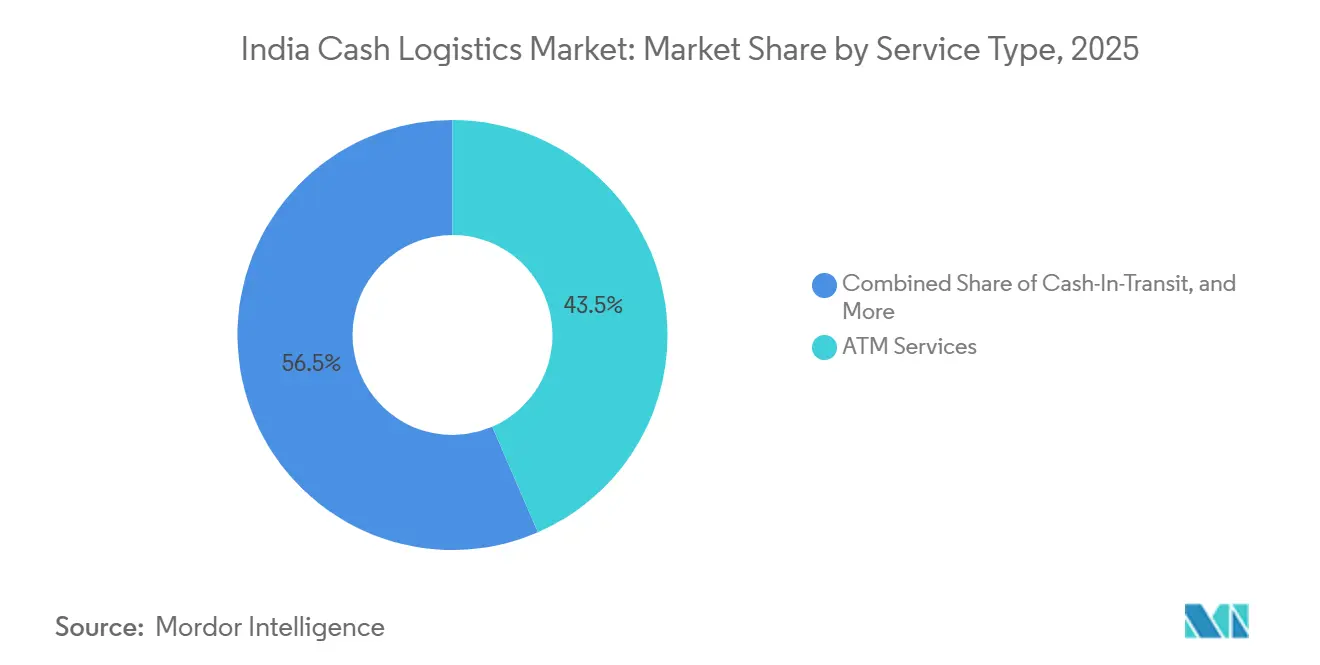
ATM services held 43.50% of the India cash logistics market size in 2025 and are forecast to grow at 8.10% CAGR through 2031. It includes ATM replenishment, machine monitoring, cash forecasting, and related managed services. Banks use these services to reduce the direct operating burden of managing dispersed ATM estates. Cash recyclers add further operational complexity because they accept, authenticate, and reuse notes for withdrawals. That changes the planning needed for cash loading and machine availability. Public sector bank procurement has increasingly specified recycler machines in new ATM requirements. The India cash logistics industry, therefore, needs capabilities beyond physical transport alone. Operators that combine field execution with software-led monitoring are better placed to serve these mandates.
Cash-in-transit remains important because banks, retailers, and other institutions need the protected movement of physical currency. The service supports scheduled ATM replenishment, branch transfers, retail cash collection, and transfers involving currency chests. Cash Management Services cover vault operations, note authentication, reconciliation, and currency-related processing. These activities remain important for institutions handling large note inventories and maintaining operational controls. Other Services include bullion transport and high-value cargo work. Those activities provide diversification for companies with relevant security capabilities. CMS stated that HAWKAI Vision AI revenue reached INR 20 crore (USD 2.23 million) in FY 2025-26.[4]CMS Info Systems Limited, “FY26 Results Media Release,” CMS Info Systems, cms.com The result reflects the growing use of forecasting and route tools within managed ATM work. ATM services are supported by long-term bank outsourcing rather than short-term transport demand alone.



By End User: Financial Institutions Retain the Largest Demand Base
Financial institutions accounted for 58.15% of the India cash logistics market share in 2025. Banks are the principal buyers of ATM services, cash transport, vault management, and reconciliation support. Their national branch and ATM networks require reliable recurring service coverage. The State Bank of India contract awarded to CMS covers 5,000 ATMs over 10 years. The agreement began operating in January 2026. HDFC Bank also awarded CMS an integrated managed ATM services mandate for 6,000 ATMs. These mandates show why bank clients retain the leading position in the India cash logistics industry. They also show why contract execution, service reliability, and technology integration matter to providers.
Retail is forecast to expand at 8.40% CAGR through 2031, making it the fastest-growing end-user category. Organized retailers need dependable daily collection, note counting, authentication, and deposit processes. Hypermarkets, fuel retail networks, and fulfillment locations can handle material cash volumes even when card and UPI payments are widely available. Structured pickup reduces the need for store staff to move collections through informal channels. It can also shorten the time between store collection and bank deposit. Hospitality creates regular collection needs at hotels, entertainment venues, and gaming establishments. Government and Public Institutions use cash-related services for treasury activity, rural financial access, and public-facing payment points. Business correspondent networks and post office operations add service needs in locations where banking infrastructure is developing. The India cash logistics market gains a wider customer base when retailers and public institutions formalize their cash processes.
By Mode of Transit: Roadways Lead While Railways Grow Faster
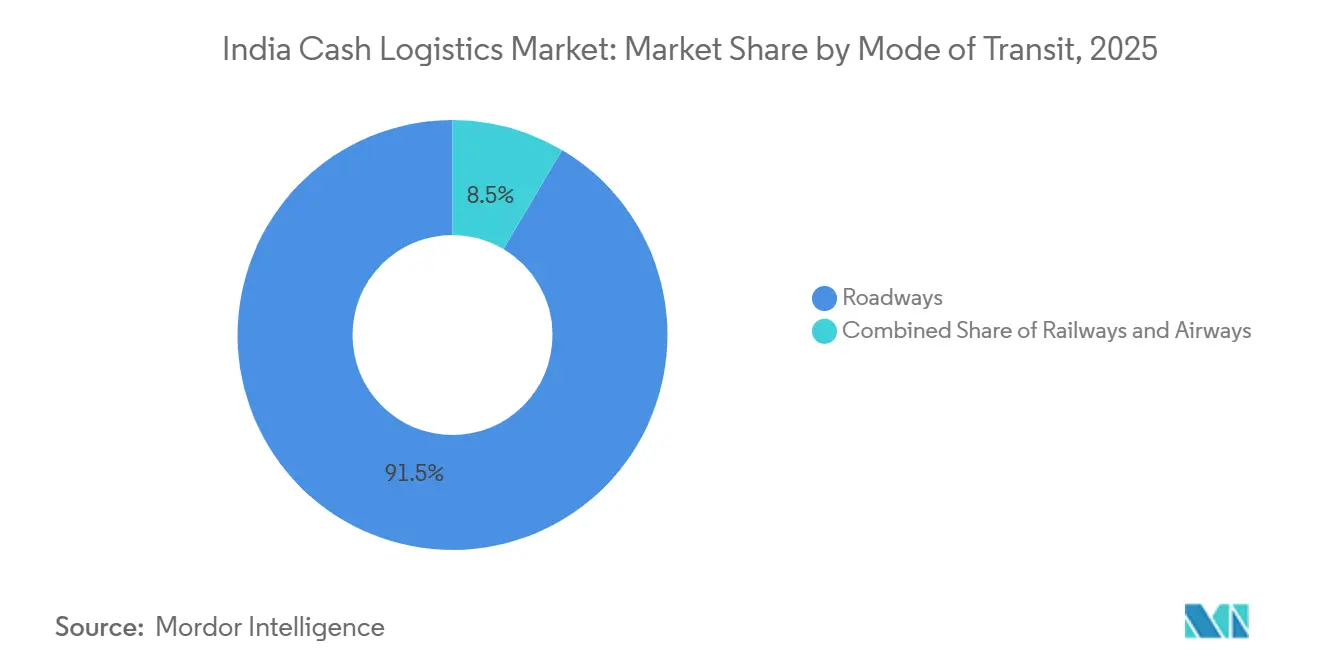
Roadways held 91.50% of the India cash logistics market size in 2025. Cash vans provide the flexibility needed for last-mile ATM loading, branch movement, and retail collections. Road service can reach widely dispersed locations and accommodate frequent route changes. This makes it central to daily operations across urban, semi-urban, and rural areas. Its scale also leaves providers exposed to vehicle utilization, fuel costs, and route planning. The DPIIT assessment found fuel represented 42.1% of road transport costs. Better routing and demand-based scheduling can reduce unnecessary movements. The India cash logistics market continues to rely on roadways because cash movement needs secure and flexible last-mile coverage. That reliance places operational discipline at the center of road-based service economics.
Railways are forecast to grow at 7.80% CAGR through 2031. Rail transport supports bulk movement between currency chests and regional distribution centers. It can be useful on longer interregional routes where road transit takes more time or has greater security exposure. The Reserve Bank of India maintained 2,599 currency chests as of March 31, 2026. These facilities create a national network of potential bulk currency origins and destinations. Railway growth does not remove the need for road-based last-mile delivery. Instead, it provides a complementary option for selected long-distance flows. Airways remain the smallest mode and address time-sensitive, high-value shipments on metro routes. The Reserve Bank of India’s 19 Issue Offices support rapid distribution needs during periods of elevated currency demand. The India cash logistics market can use multiple transit modes as operators adapt service designs to the distance, volume, and urgency of each movement.
Geography Analysis
The India cash logistics market had its largest organized activity in the commercial corridors of Mumbai, Delhi, and Bengaluru in 2025. These metros concentrate bank branches, ATMs, organized retail activity, and high-value transport needs. The value of currency in circulation reached INR 43.02 lakh crore (USD 478.51 billion) in May 2026, up 12% from INR 38.35 lakh crore (USD 426.84 billion) a year earlier. Mumbai, Pune, and Nashik form an active western corridor because of financial institutions, manufacturing sites, and organized retail operations. Bengaluru, Chennai, and Hyderabad support demand for technology-integrated operations across dense private-sector banking networks.
Tier 2 and Tier 3 cities offer the clearest medium-term expansion area for the India cash logistics market. These locations can have uneven ATM availability and more limited organized service coverage. Banks face service and regulatory pressure when smaller-city ATMs cannot meet local withdrawal demand. Specialized operators can respond through local route planning and machine-level demand forecasting. Cash recyclers and remotely monitored ATMs can improve service discipline in these networks. Organized providers can expand their presence when smaller-city clients replace fragmented arrangements with contracted service models.
Rural and semi-urban areas remain a long-term demand frontier. RBI staff found that UPI adoption was concentrated in 10 states, representing 80% of transaction volumes in the referenced assessment. The Reserve Bank of India also noted continued preference for cash among individuals and small retail sellers. Business correspondent networks, Jan Dhan account servicing, direct benefit cash-out points, and post office operations create recurring requirements in underserved areas. Providers need compact, secure vehicles, local staffing, and demand-led scheduling to serve these locations consistently.
Competitive Landscape
The India cash logistics market has a moderately concentrated organized segment. CMS managed 73,000 ATMs as of March 2025. Its scale gives it a strong position in large outsourced ATM mandates and related services. SIS Cash Services and Brink’s India operate alongside CMS in the organized part of the sector. Regional providers such as Radiant Cash Management Services, G4S India, and S&IB Services address mid-market clients and local cash-management requirements.
CMS has used contract wins and technology investments to deepen its position. Its State Bank of India contract went live in January 2026 and announced to cover 5,000 ATMs for 10 years. The company also reported an HDFC Bank mandate for 6,000 ATMs that includes forecasting, logistics, and HAWKAI Vision AI capabilities. In March 2026, CMS announced an agreement to acquire Financial Software and Systems’ ATM Managed Services business for up to INR 115 crore (USD 12.80 million). The transaction was intended to expand its managed services portfolio from 31,000 to 39,000 units. These moves show how larger providers are building scale through long mandates, acquired portfolios, and integrated operating platforms.
Technology is an important competitive factor because it can improve route planning, currency forecasting, and service monitoring. CMS stated that technology and payment solutions increased from 7% to 16% of its revenue during the two years reported through FY 2025-26. The shift shows a move beyond a transport-only service model. Regional providers can compete where local coverage, customer relationships, and tailored operating plans matter more than national scale. Smaller financial institutions, NBFCs, and regional retail clients can represent relevant opportunities for those providers. The competitive position of each operator depends on security execution, geographic reach, technology, and pricing discipline. The India cash logistics market remains suited to established providers, but it retains room for specialists in underserved geographies and customer groups.
India Cash Logistics Industry Leaders
CMS Info Systems Ltd.
SIS Cash Services Ltd.
Securevalue India Ltd.
Brink’s India Pvt. Ltd.
Hitachi Cash Management Services Pvt. Ltd.
- *Disclaimer: Major Players sorted in no particular order

Recent Industry Developments
- August 2026: Brink's established a Global Shared Services Centre in Hyderabad in partnership with ANSR to support global technology, HR, finance, and analytics functions, with active hiring underway across leadership, operations, and technology roles, positioning India as a strategic capability hub within Brink's global operational network.
- May 2026: HDFC Bank awarded CMS Info Systems a five-year integrated ATM managed services mandate worth INR 400 crore (USD 44.52 million) covering 6,000 ATMs, incorporating currency forecasting, logistics, and the HAWKAI Vision AI solution, bringing CMS to mandates at three of India's largest banks simultaneously.
- March 2026: CMS Info Systems acquired the ATM Managed Services business of Financial Software and Systems Private Limited for a consideration of up to INR 115 crore (USD 12.8 million), growing its managed services portfolio from approximately 31,000 to 39,000 units and adding new private sector banking client relationships.
- February 2026: Radiant Cash Management secured a PSU bank mandate valued at INR 35 crore (USD 3.89 million) per annum, with deployment commenced in April 2026, adding approximately INR 20 crore (USD 2.23 million) in incremental annual revenue, and signaling expanding direct-to-institution business capabilities.


India Cash Logistics Market Report Scope
| Cash-In-Transit |
| Cash Management Services |
| ATM Services |
| Other Services |
| Financial Institutions |
| Retail |
| Hospitality |
| Government and Public Institutions |
| Other End Users |
| Roadways |
| Railways |
| Airways |
| By Service Type | Cash-In-Transit |
| Cash Management Services | |
| ATM Services | |
| Other Services | |
| By End User | Financial Institutions |
| Retail | |
| Hospitality | |
| Government and Public Institutions | |
| Other End Users | |
| By Mode of Transit | Roadways |
| Railways | |
| Airways |


Key Questions Answered in the Report
What is the forecast for the India cash logistics market through 2031?
The sector is forecast to grow from USD 451.90 million in 2026 to USD 642.44 million by 2031, at a 7.29% CAGR. Bank outsourcing and wider organized coverage in smaller cities support this forecast.
Why does cash logistics remain relevant as UPI expands in India?
RBI reported that banknotes in circulation increased 11.9% in value during FY 2025-26, and it noted continued cash preference among individuals and small retail sellers. Digital and cash payments continue to serve different transaction needs across locations.
Which service category leads cash logistics demand in India?
ATM services led with 43.50% share in 2025 and have the highest forecast CAGR of 8.10% through 2031. The category includes replenishment, monitoring, forecasting, and related managed ATM work.
Which customer group uses the most cash logistics services?
Financial institutions held 58.15% share in 2025 because they require ATM servicing, cash transport, vault support, and reconciliation. Large bank networks also create recurring contracts for specialist service providers.
What transport mode is used most for cash movement in India?
Roadways held 91.50% share in 2025 because secure vans provide essential last-mile access for ATMs, branches, and retail sites. Railways complement road operations for selected bulk interregional movements.
Page last updated on:





