
India Beer Market Size and Share
Market Overview
| Study Period | 2022 - 2032 |
|---|---|
| Base Year Market Size (2026) | USD 7.14 Billion |
| Historical Data Period | 2022 - 2025 |
| Market Size (2027) | USD 7.59 Billion |
| Market Size (2032) | USD 10.38 Billion |
| Market Concentration | High |
Major Players *Disclaimer: Major Players sorted in no particular order Image © Mordor Intelligence. Reuse requires attribution under CC BY 4.0. | |
India Beer Market Analysis by Mordor Intelligence
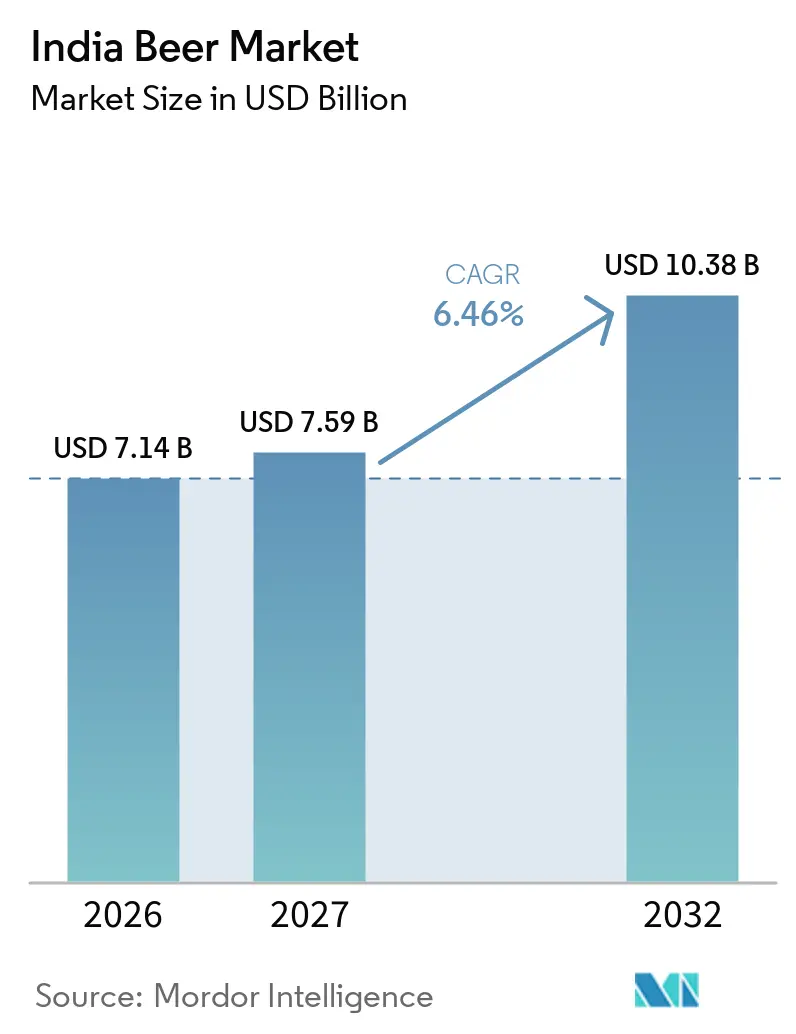
The Indian beer market size was valued at USD 7.14 billion in 2026 and estimated to grow from USD 7.59 billion in 2027 to reach USD 10.38 billion by 2032, at a CAGR of 6.46% during the forecast period (2027-2032). The Indian beer market is deepening as urban consumers increasingly choose premium offerings, flavored styles, moderated-alcohol options, and brands that suit social dining occasions, while standard beer continues to serve a large price-conscious consumer base. State policy changes can alter retail prices, product mix, brewery investment, and the relative appeal of beer against spirits more quickly than changes in underlying demand, making local regulatory conditions central to commercial planning. Investment in local production, cooling equipment, canning capacity, and licensed retail availability is making premium brands more visible across metropolitan and larger tier-2 cities, while regional capacity additions are also improving the reliability of product supply. The Indian beer market also benefits from restaurants, bars, and entertainment venues, where higher-priced products can drive trial, enhance food-pairing relevance, and encourage repeat purchases among younger consumers before the same brands reach broader off-trade distribution. High excise duties, separate state rules, ingredient inflation, and packaging costs remain material limits on affordability, consistent pricing, brewer margins, and the ability of smaller producers to compete with companies that have national scale.
Key Report Takeaways
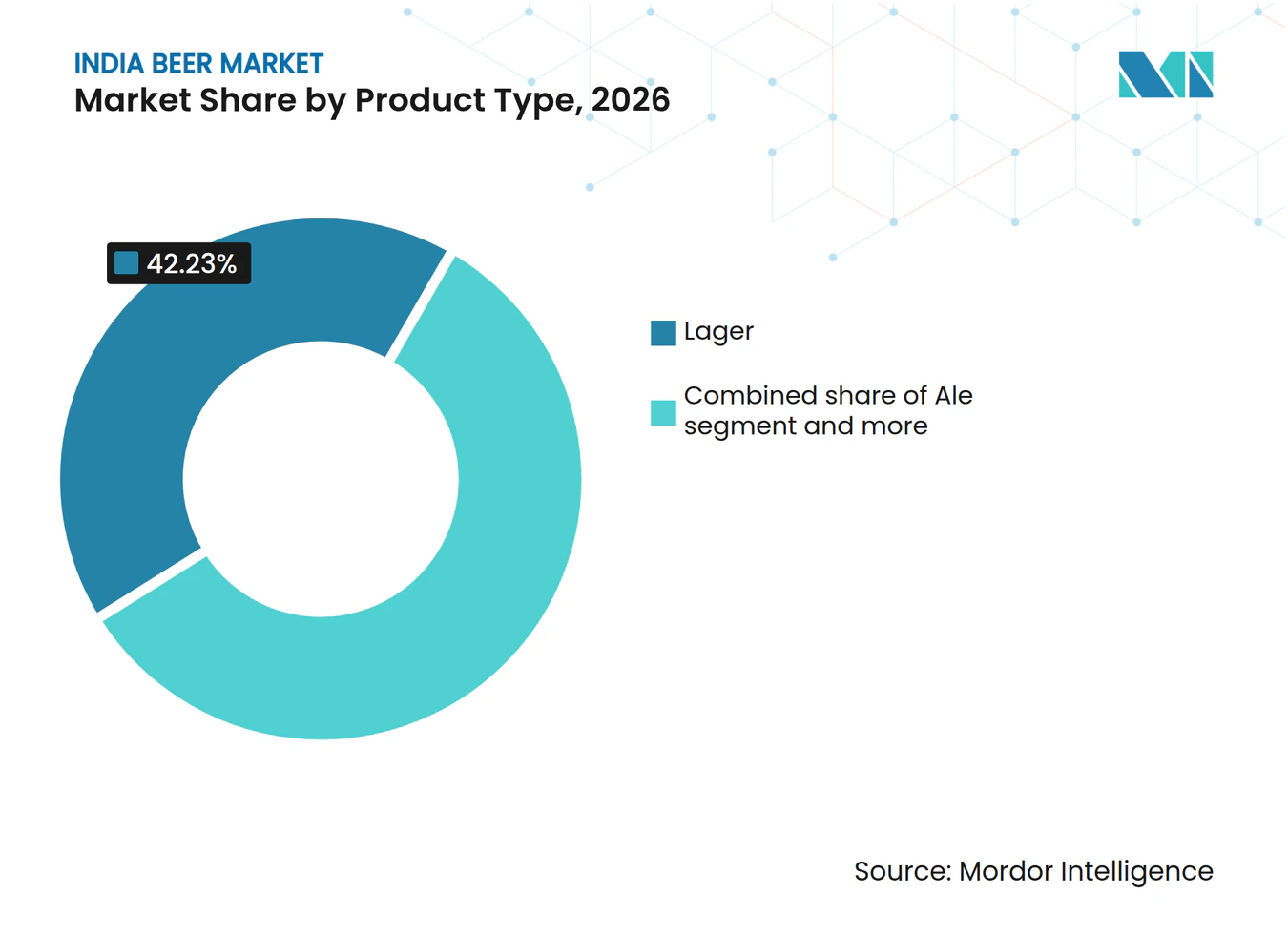
- By product type, lager held 42.23% of the India beer market in 2026, while non/low alcoholic beer is projected to grow at a 7.32% CAGR through 2032.
- By category, standard beer represented 67.28% of the India beer market in 2026, while premium beer is forecast to expand at a 7.68% CAGR through 2032.
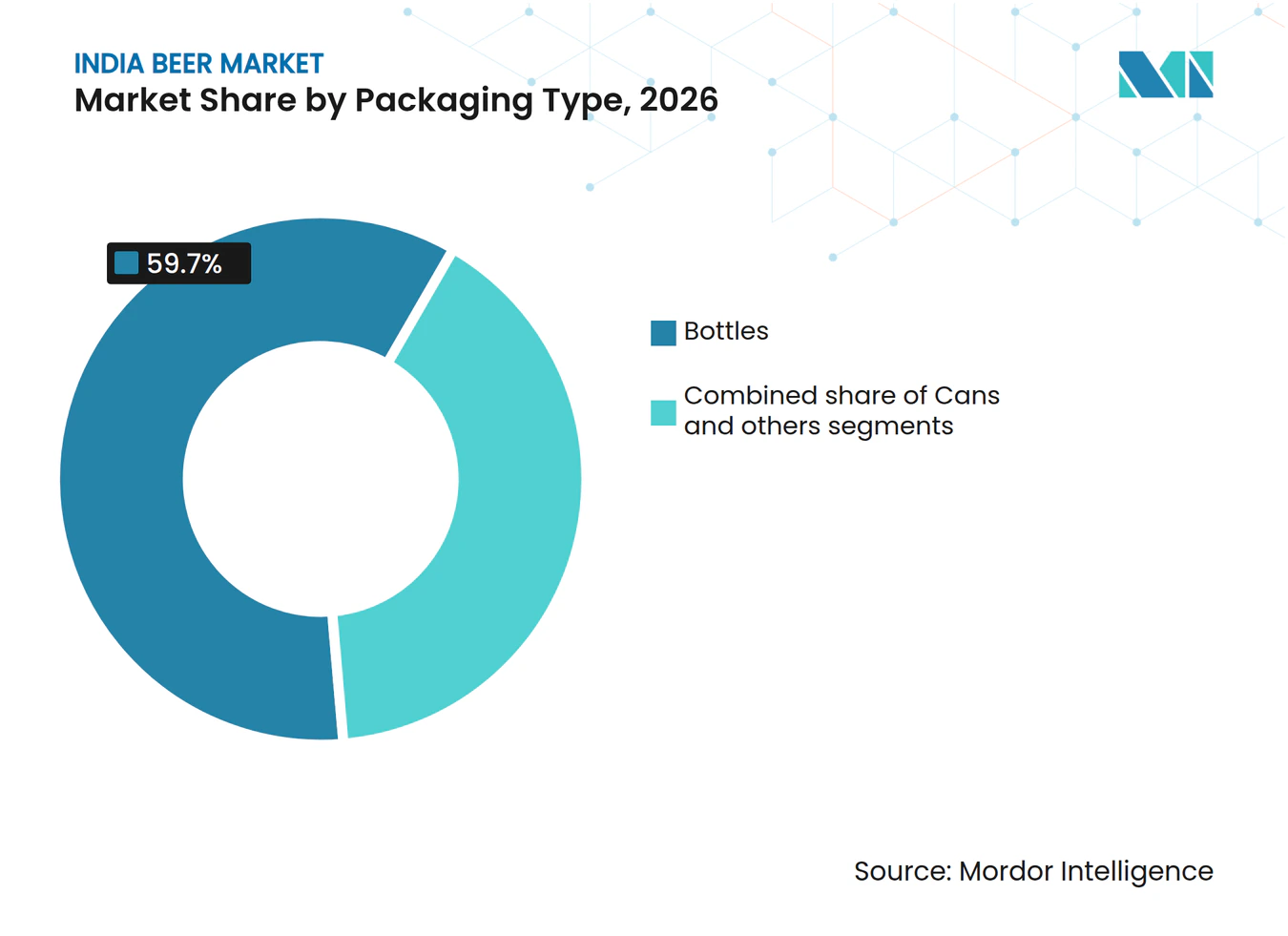
- By packaging type, bottles accounted for 59.65% of the India beer market in 2026, while cans are anticipated to grow at a 7.43% CAGR through 2032.
- By distribution channel, off-trade channels held 64.87% of the India beer market in 2026, while on-trade channels are projected to advance at a 7.79% CAGR through 2032.
Note: Market numbers in this report are based on Mordor Intelligence's proprietary estimation framework, which combines nine months of actuals with Q4 projections for base year 2026.
India Beer Market Trends and Insights
Drivers Impact Analysis*
| Driver | (~) % Impact on CAGR Forecast | Geographic Relevance | Impact Timeline |
|---|---|---|---|
| Rising Demand for Premium and Super-Premium Beer Across Urban Markets | +1.1% | National, concentrated in Maharashtra, Karnataka, Delhi NCR, and Telangana | Medium term (2-4 years) |
| Increasing Disposable Incomes and Consumer Willingness to Trade Up | +0.9% | National, strongest in tier-1 and rapidly growing tier-2 cities | Long term (≥ 4 years) |
| Growth in Dining, Hospitality, and Entertainment Occasions | +0.8% | National, anchored in urban South and West India | Medium term (2-4 years) |
| Increasing Availability of International Premium Beer Brands | +0.7% | North India, West India, and South India gateway metros | Medium term (2-4 years) |
| Growing Product Innovation in Wheat Beer, IPA, and Flavored Beer | +0.5% | Major metros, with expansion to tier-2 cities in South and West India | Short term (≤ 2 years) |
| Increasing Adoption of Convenient Canned Beer Formats | +0.5% | National, with early gains in Maharashtra, Karnataka, and Delhi NCR | Short term (≤ 2 years) |
| Source: Mordor Intelligence | |||
Rising Demand for Premium and Super-Premium Beer Across Urban Markets
Premium beer is moving from a narrow urban niche into a larger value pool in the Indian beer market, especially where licensed retail and hospitality infrastructure are established. United Breweries has stated that it expects premium portfolio growth of 20-25% annually over the next 3-5 years, supporting continued investment in product assortment, retail execution, and brand visibility[1]. Carlsberg reported that premium beer accounted for 43% of its Maharashtra volume mix in the first half of 2025, indicating stronger acceptance of higher-priced products in the state. This gives brewers reason to prioritize states where the availability of coolers, licensed outlets, entertainment venues, and consumer spending support a premium offering. Premium sales also give companies greater scope to invest in better packaging, outlet presentation, and locally produced international labels. The Indian beer market depends not only on greater beer consumption, but also on more occasions where consumers accept a better product mix.
Increasing Disposable Incomes and Consumer Willingness to Trade Up
Rising incomes support trade-up when premium beer is visible, served cold, and available through trusted licensed outlets. SOM Distilleries reported stronger premium adoption in tier-2 cities and linked it to premium walk-in stores and on-premise outlets, indicating that retail quality shapes demand as much as income alone. United Breweries expanded its premium cooler footprint to 37,000 stores by the second quarter of fiscal year 2026, up from 15,000 previously. Wider cooling coverage makes a premium choice more practical, as the product is ready for consumption at the point of purchase. It also lets brewers deepen sales in existing urban centers rather than relying solely on expansion into new states. As tier-2 preferences shift toward tier-1 consumption patterns, the Indian beer market gains access to potential premium buyers without expanding into untapped rural territories.
Growth in Dining, Hospitality, and Entertainment Occasions
Restaurant, bar, and event settings give brands a platform where consumers can try products with food and in social groups. The Restaurant Association of India identified family and colleague gatherings as a core reason that diners eat out, supporting beer consumption in shared settings. Craft breweries and hotel partnerships can introduce wheat beers, ales, and other styles in an environment where staff can explain the product and food pairing. These occasions can help consumers move from familiar mainstream lager toward a broader range of formats and price points. On-trade locations also provide brand owners with a more visible way to establish premium cues before consumers choose the same product in retail. The Indian beer market benefits when hospitality growth creates repeat occasions rather than only occasional product trial.
Increasing Availability of International Premium Beer Brands
International brands are becoming more accessible as brewers localize production and build distribution around Indian demand centers. Local supply can reduce price and availability constraints associated with imported products while retaining recognizable global brand names. Carlsberg’s India presentation described a rise in its premium market share from 21% in 2019 to 25% in the first half of 2025[2]. This approach allows companies to coordinate cans, bottles, and draft formats across stores, restaurants, and bars in the same state. It also supports a more consistent product supply when imported inventory or international freight conditions change. Greater availability strengthens the Indian beer market when product quality, cold-chain coverage, and state approvals keep pace with brand launches.
Restraints Impact Analysis*
| Restraint | (~) % Impact on CAGR Forecast | Geographic Relevance | Impact Timeline |
|---|---|---|---|
| High State Excise Duties and Disproportionate Taxation on Beer | -1.5% | National, most acute in Maharashtra, Rajasthan, and eastern states | Long term (≥ 4 years) |
| Fragmented State-Wise Alcohol Regulations and Licensing Requirements | -1.1% | National, with high complexity in Uttar Pradesh, Karnataka, and Andhra Pradesh | Medium term (2-4 years) |
| Restrictions on Alcohol Advertising, Brand Promotion, and Marketing | -0.8% | National, with limits on digital and broadcast brand building | Medium term (2-4 years) |
| Volatility in Barley, Malt, Hops, and Other Brewing Ingredient Costs | -0.7% | National, with exposure to imported hops and aluminum | Short term (≤ 2 years) |
| Source: Mordor Intelligence | |||
High State Excise Duties and Disproportionate Taxation on Beer
Beer's structural tax disadvantage relative to spirits is the market's most persistent demand suppressor. Excise duties on beer range from 65% ad valorem in West Bengal to 235% of manufacturing cost for strong beer in Maharashtra under the 2026 government schedules, per state notifications compiled by GST Munshi in 2026, with Rajasthan levying 200% of ex-brewery price on strong beer. The Brewers Association of India has consistently noted that alcohol in beer is taxed at a higher effective per-unit rate than in spirits, a structural inequity that limits beer's price competitiveness against hard liquor in the mass-market tier. India's constitutional framework, which places alcoholic beverages outside GST under Article 366(12A), gives each of India's 28 states full autonomy to set distinct excise structures, creating 36 separate compliance environments unique among consumer categories. Karnataka's May 2026 AIB duty reform is credible proof of concept that rationalization is achievable, but replication requires sustained political will in states where alcohol excise is among the top three revenue sources.
Volatility in Barley, Malt, Hops and Other Brewing Ingredient Costs
Inflation in brewing ingredient costs is a differentiated risk that mid-tier producers cannot absorb as effectively as large multinationals. Raw materials account for approximately 50-60% of total operational expenditure in an Indian brewery, with barley the most price-sensitive input. India grows virtually no hops commercially, making all hop procurement import-dependent and fully exposed to global freight and currency movements. UBL's Q2 FY2026 investor call flagged higher barley and aluminum prices as limiting gross margin recovery, even as premiumization improved net revenue per case. A global aluminum price increase of approximately 47-50% year-on-year to around USD 3,600 per tonne in 2025 created a potential INR 11,500 crore supply disruption risk for India's beer and beverage sector, particularly acute for the fast-growing canned format, where scale economies in hedging give multinational players a structural cost advantage over craft and independent brewers.
*Our forecasts treat driver/restraint impacts as directional, not additive. The impact forecasts reflect baseline growth, mix effects, and variable interactions.
Segment Analysis
By Product Type: Lager Leads Scale While Non/Low Alcoholic Beer Expands the Consumer Base
Lager held 42.23% of the Indian beer market share in 2026, making it the largest product type. Its lead reflects established mass-market brands, broad cold-chain coverage, and familiarity among consumers who prefer a straightforward beer choice. Strong lager above 5% ABV represented close to 80% of total beer volume, according to Carlsberg’s India presentation. The segment provides the volume base for brewery utilization, licensed retail distribution, and brand extensions, while ales, wheat beers, and specialty products add choice through craft and food-led venues. Lager’s broad acceptance therefore rests on consumer habit, accessible pricing, and a supply system designed for high-volume mainstream sales.
Non/low alcoholic beer is forecast to grow at a 7.32% CAGR between 2027 and 2032, the fastest rate among product types. Moderation widens the potential audience by serving regular beer drinkers on selected occasions and consumers seeking an adult beverage without a full-strength option. Local launches of non-alcoholic variants show that established brewers see a credible role for the category in urban consumption occasions. Craft operators are also entering the category with low-alcohol wheat beer formats, broadening the choice available to consumers seeking moderation. Product classification, labeling requirements, and state rules will determine the pace at which this segment reaches more locations.



By Category: Standard Beer Retains Reach While Premium Beer Builds Value
Standard beer accounted for 67.28% of the Indian beer market size in 2026. The segment remains important because a large consumer base is price sensitive and buys through traditional licensed stores. United Breweries stated that the economy and mainstream categories should grow at low single-digit rates while remaining essential to broader category participation. Standard brands support different price points within each state and benefit from strong lager preferences and established returnable glass bottle systems. The segment remains the volume anchor, enabling brewers to serve consumers beyond affluent neighborhoods and leading on-premise locations.
Premium beer is expected to expand at a 7.68% CAGR through 2032, the highest rate by category. It is supported by younger urban consumers, more premium-licensed stores, and wider availability of global and locally produced labels. Carlsberg has positioned its Carlsberg brand as a premium choice while maintaining Tuborg’s appeal among younger consumers. Premiumization supports investment in visual merchandising, cooling equipment, and differentiated packs that can improve the purchase experience. The Indian beer market can increase value through this category even if mainstream volume growth stays more modest.
By Packaging Type: Bottles Remain the Main Format While Cans Gain Relevance
Bottles held 59.65% of the Indian beer market share in 2026. Returnable glass infrastructure gives bottles a cost and distribution advantage, particularly for mainstream brands moving through local retail channels. The format supports several pack sizes, aligns with consumer expectations for certain beer styles, and is deeply integrated into brewery and distributor operations. Keg and draft formats still matter in premium bars, restaurants, and microbreweries because fresh service can command higher margins. Bottles remain central to the Indian beer market because they combine established logistics with wide consumer acceptance.
Cans are projected to grow at a 7.43% CAGR through 2032, the fastest rate among packaging types. Their portability and rapid chilling make them suitable for outdoor, travel, event, and modern retail occasions. Carlsberg India inaugurated a 22,000-cans-per-hour line at its Mysuru brewery in January 2026 after investing INR 100 crore in the facility. Cans provide a clear platform for premium branding and smaller trial-oriented packs, but higher aluminum costs can limit their price advantage. Stable packaging supply and careful pricing will be important if the can use continues to rise.

By Distribution Channel: Off-Trade Retains Scale While On-Trade Supports Premium Trial
Off-trade channels accounted for 64.87% of the Indian beer market size in 2026. Government-licensed specialty and liquor stores remain the main legal retail format for packaged beer in most states. Their reach and ability to stock mainstream and premium products make them the most important channel for regular purchases. United Breweries’ 37,000 in-store coolers support this channel by improving the likelihood that beer is cold when consumers are ready to buy. Off-trade stores will remain the volume foundation of the Indian beer market even as social venues become more important.
On-trade channels are expected to grow at a 7.79% CAGR through 2032, the highest rate among distribution channels. Bars, restaurants, hotels, and brewery taprooms allow consumers to sample premium, craft, and non/low alcoholic products in a social setting. The Restaurant Association of India has identified dining with family or colleagues as a major reason for eating out, with a preference for drinks suited to shared occasions. On-trade placement supports food pairing, staff recommendations, and a higher-value trial that a retail shelf cannot easily provide. These venues give brands a way to convert experience-led consumption into longer-term preference.
Geography Analysis
South India accounted for a significant share of national beer volumes in 2026 and remains the Indian beer market’s largest regional base. Karnataka, Telangana, and Andhra Pradesh support this position through large urban populations, established consumption, and developed brewery and outlet networks. Carlsberg’s new can line in Mysuru adds 22,000 cans per hour of capacity and demonstrates Karnataka’s value as a production location. Karnataka’s 2026 alcohol-in-beverage duty reform indicates how state policy can affect product choice and pricing, while licensing and retail conditions still require local operating approaches. The region offers an established base for standard and premium beer and a testing ground for cans, wheat beers, and low-alcohol products.
North India and West India are the fastest-growing regional demand centers for the Indian beer market. Maharashtra is a major premium opportunity, as Carlsberg reported that premium beer accounted for 43% of its state volume mix in the first half of 2025. AB InBev signed a memorandum of understanding with the Uttar Pradesh government in January 2025 to invest INR 1,000 crore in a new manufacturing plant. Uttar Pradesh offered capital subsidies of up to 42% and 100% SGST refunds under its investment policy[3]. SOM Distilleries started commercial production at its Farrukhabad facility in fiscal year 2026-27, adding 10 million cases of annual capacity that can shorten delivery distances and support wider availability.
East India remains a smaller contributor to the India beer market relative to its population, with lower incomes and a less developed premium hospitality base affecting demand. Carlsberg signed an INR 1,250 crore memorandum of understanding that includes INR 400 crore for a brownfield expansion in Hoogly, West Bengal. SOM Distilleries expanded annual capacity at its Odisha brewery from 60 lakh to 90 lakh cases in fiscal year 2025-26. Companies that tailor products, packs, and distribution to each state can benefit from the region’s lower penetration and need for accessible price points.
Competitive Landscape
Market Concentration
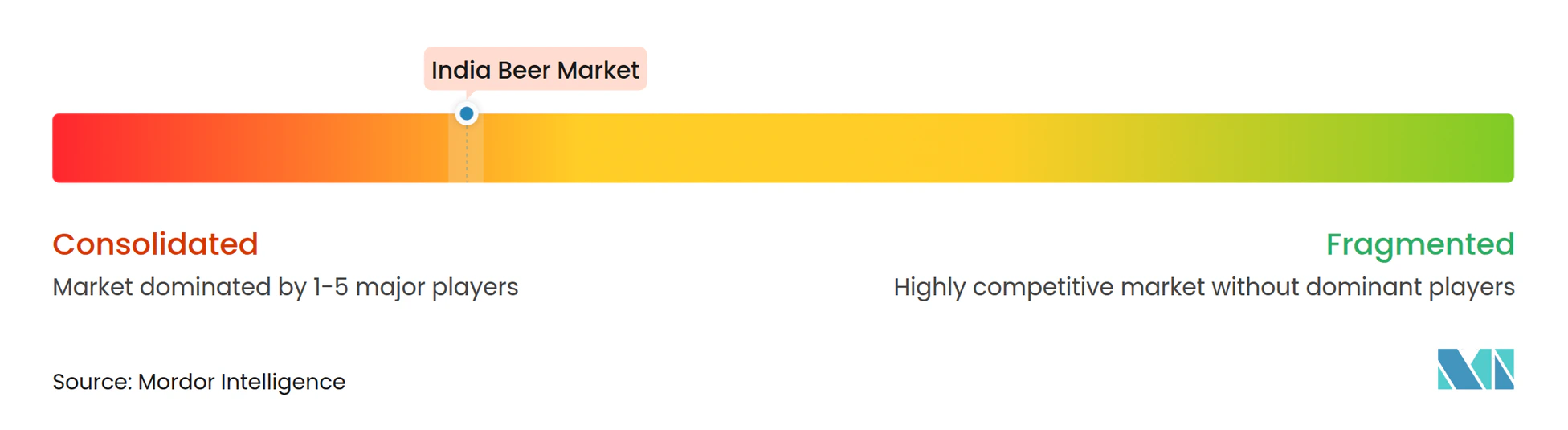
The Indian beer market is concentrated around United Breweries, AB InBev, and Carlsberg, which collectively control the majority of the market volume. State licensing, brewery investment, cooling infrastructure, and compliance capabilities reinforce the advantage of these established companies. United Breweries has expanded its cooler network to 37,000 stores, supporting mainstream and premium availability at retail. Carlsberg competes through Tuborg, Carlsberg, and premium offerings, while AB InBev uses global brands and planned manufacturing capacity in Uttar Pradesh. Portfolio mix, state access, cold availability, and the ability to fund local manufacturing are now central competitive factors.
Carlsberg India inaugurated a 22,000-cans-per-hour Mysuru line with an INR 100 crore investment in January 2026. The line formed part of a broader INR 350 crore expansion commitment for the facility. In September 2025, the company announced an INR 1,250 crore capacity plan covering Maharashtra, West Bengal, and Karnataka. AB InBev’s Uttar Pradesh memorandum of understanding provides another example of brewers securing capacity and policy support in high-potential states. These investments improve supply reliability and freight economics but raise the capital threshold for smaller brewers.
Smaller companies compete through local relevance, distinctive beer styles, and on-premise experiences rather than national distribution scale. Craft brands such as Ironhill India can use non-alcoholic and specialty launches to attract consumers seeking variety in beer styles and alcohol strength. Their limited procurement scale, restricted state access, and exposure to cost changes remain significant constraints. The India beer market retains space for differentiated local brands, but national scale requires disciplined expansion across state boundaries and continued investment in compliance and distribution.
India Beer Industry Leaders
-
Heineken NV
-
Carlsberg A/S
-
Anheuser-Busch InBev NV
-
Som Distilleries & Breweries Ltd
-
Inbrew Beverages Pvt Ltd
- *Disclaimer: Major Players sorted in no particular order
Recent Industry Developments
- September 2026: AB InBev restarted its Rajasthan brewery in August 2026 after seven years of idling due to unfavorable taxation and packaging policy, deploying approximately USD 20 million in fresh investment.
- January 2026: Carlsberg India commissioned a 22,000-cans-per-hour line at its Mysuru Brewery in Nanjangud taluk, Karnataka, backed by an INR 100 crore investment, as part of a broader INR 350 crore facility expansion pledged at Invest Karnataka 2025.
- January 2025: Carlsberg launched Kronenbourg 1664 Blanc, a French wheat beer, in Karnataka's market in 2025, targeting the super-premium on-trade segment and building on the brand equity of its Tuborg and Carlsberg brands in the state.
India Beer Market Report Scope
Beer is an alcoholic beverage typically produced by fermenting malted grains, hops, yeast, and water, and is available in a range of styles, alcohol strengths, and price categories. The Indian Beer Market is segmented by product type, category, packaging type, and distribution channel. By product type, the market includes Ale, Lager, Non-alcoholic or Low-Alcoholic Beer, and Other Beer Types. By category, the market is segmented into Standard and Premium. By packaging type, the market is categorized into Bottles, Cans, and Others. By distribution channel, the market is divided into On-Trade and Off-Trade, with Off-Trade further segmented into Specialty/Liquor Stores and Other Off-Trade Channels. The market sizing has been done in value terms in USD and volume terms in liters for all the abovementioned segments.
| Ale |
| Lager |
| Non/Low Alcoholic Beer |
| Other Beer Types |
| Standard |
| Premium |
| Bottles |
| Cans |
| Others |
| On-Trade | |
| Off-Trade | Specialty/Liquor Stores |
| Other Off-Trade Channels |
| By Product Type | Ale | |
| Lager | ||
| Non/Low Alcoholic Beer | ||
| Other Beer Types | ||
| By Category | Standard | |
| Premium | ||
| By Packaging Type | Bottles | |
| Cans | ||
| Others | ||
| By Distribution Channel | On-Trade | |
| Off-Trade | Specialty/Liquor Stores | |
| Other Off-Trade Channels | ||
Key Questions Answered in the Report
What is the projected value of the India beer market by 2032?
The India beer market is projected to reach USD 10.38 billion by 2032, growing at a 6.46% CAGR from 2027 as premiumization, wider availability, and on-trade occasions support value growth.
Which beer product type has the largest share in India?
Lager is the largest product type, with a 42.23% share in 2026, supported by mass-market familiarity, broad retail distribution, and established cold-chain infrastructure.
Which beer category is growing fastest in India?
Premium beer is expected to grow at a 7.68% CAGR through 2032 because consumers are trading up in urban areas and companies are expanding premium portfolios and cooling coverage.
Why are cans gaining use in India?
Cans are forecast to grow at a 7.43% CAGR because they suit portable, event, and modern retail occasions, although aluminum costs can affect pricing and margins.