
Market Overview
| Study Period | 2020 - 2031 |
|---|---|
| Forecast Data Period | 2026 - 2031 |
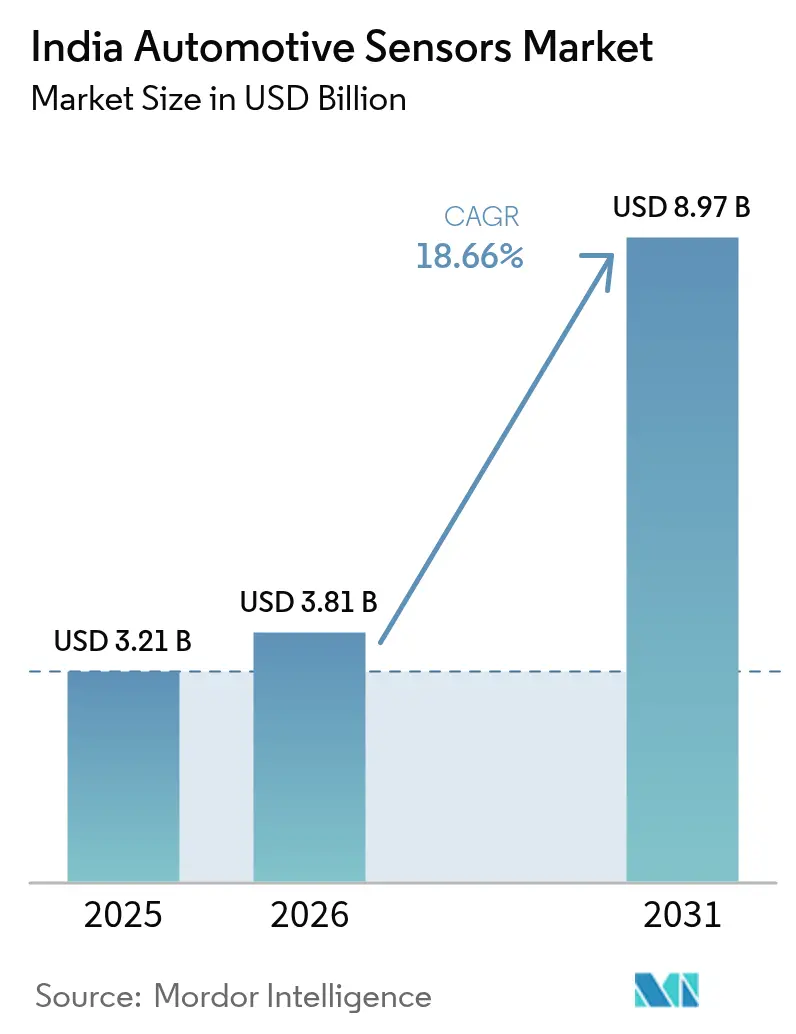
| Base Year Market Size (2025) | USD 3.21 Billion |
| Market Size (2026) | USD 3.81 Billion |
| Market Size (2031) | USD 8.97 Billion |
| Growth Rate (2026 - 2031) | 18.66 % |
| Market Concentration | Medium |
Major Players *Disclaimer: Major Players sorted in no particular order Image © Mordor Intelligence. Reuse requires attribution under CC BY 4.0. | |
India Automotive Sensors Market Analysis by Mordor Intelligence
The India Automotive Sensors Market size was valued at USD 3.21 billion in 2025 and estimated to grow from USD 3.81 billion in 2026 to reach USD 8.97 billion by 2031, at a CAGR of 18.66% during the forecast period (2026-2031). Regulatory mandates, electrification of two- and three-wheelers, and supply-chain localization initiatives are together propelling the India automotive sensors market toward its strongest multi-year expansion on record. Steady enforcement of AIS-145 safety standards obliges OEMs to embed radar, camera, and pressure sensors across commercial and passenger platforms. Parallel growth in electric-vehicle production, led by two-wheeler volumes that grew significantly in FY2025, increases sensor content per vehicle by three-fifth. Government Production Linked Incentive (PLI) and SPECS programs encourage domestic MEMS fabrication, trimming landed costs and shortening lead times. Global suppliers, concerned about China-centric risk, have begun reallocating capital toward India, reinforcing the long-term competitiveness of the India automotive sensors market[1].
Key Report Takeaways
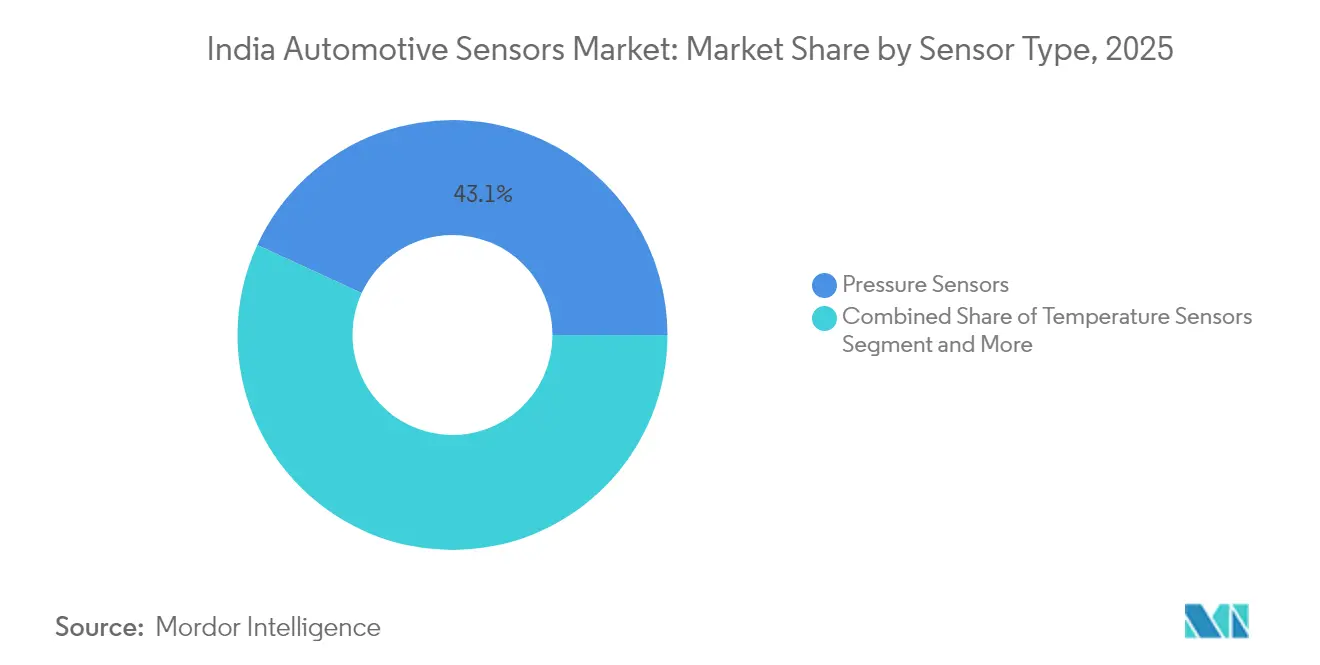
- By sensor type, pressure sensors captured 43.12% of the India automotive sensors market share in 2025, whereas electro-optical sensors are poised to grow at an 18.79% CAGR through 2031.
- By vehicle drivetrain, internal combustion engine vehicles held a 62.58% share of the India automotive sensors market in 2025, while electric vehicles registered the fastest 18.71% CAGR to 2031.
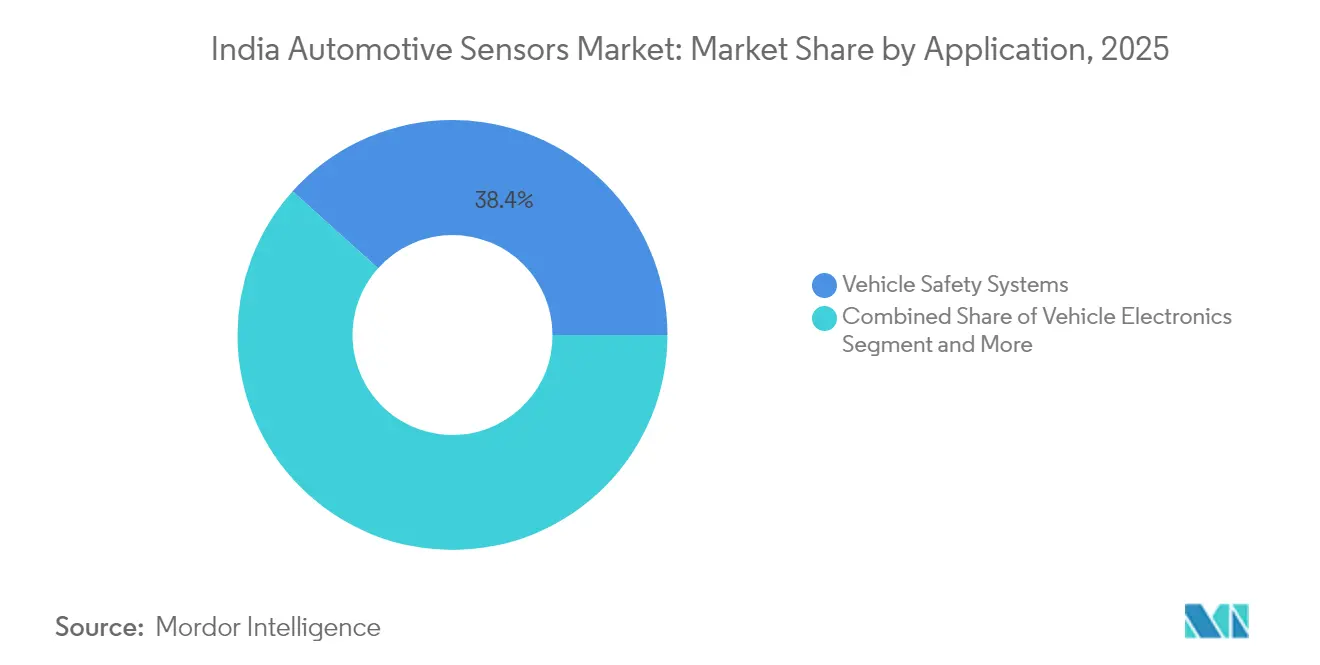
- By application, vehicle safety systems accounted for 38.35% of the India automotive sensors market share in 2025 and are advancing at an 18.74% CAGR through 2031.
- By vehicle type, passenger cars led with 56.72% of the India automotive sensors market share in 2025; two-wheelers are projected to expand at an 18.80% CAGR to 2031.
Note: Market size and forecast figures in this report are generated using Mordor Intelligence’s proprietary estimation framework, updated with the latest available data and insights as of 2026.
Market Trends and Insights
Drivers Impact Analysis of India Automotive Sensors Market*
| Driver | (~) % Impact on CAGR Forecast | Geographic Relevance | Impact Timeline |
|---|---|---|---|
| Mandatory ADAS and TPMS Regulations | +4.2% | National, with early adoption in commercial vehicle segments | Medium term (2-4 years) |
| Rapid Electrification Of India's Two- & Three-Wheeler Fleet | +3.8% | National, concentrated in urban centers and delivery ecosystems | Short term (≤ 2 years) |
| PLI & SPECS Incentives | +2.9% | Manufacturing hubs in Gujarat, Tamil Nadu, Karnataka | Long term (≥ 4 years) |
| OEM-Led Shift To Domain/Zone E-E Architectures | +2.1% | Tier-1 cities and premium vehicle segments initially | Medium term (2-4 years) |
| Ultra-Low-Cost 8-Bit MCUs Enabling Sensor Fusion | +1.7% | National, targeting cost-sensitive passenger car segment | Short term (≤ 2 years) |
| Usage-Based-Insurance (UBI) Adoption | +1.4% | Urban markets with high insurance penetration | Medium term (2-4 years) |
| Source: Mordor Intelligence | |||
Mandatory ADAS & TPMS Regulations Post-AIS-145
Ministry of Road Transport and Highways (MoRTH) has proposed amendments to the Central Motor Vehicles Rules (CMVR), which obliges vehicles exceeding eight seats to integrate advanced emergency braking, lane departure, and driver-drowsiness warning systems from April 2026. Traditionally late adopters, commercial fleets must now deploy radar, camera, and inertial sensors across platforms. TPMS rules augment demand for wheel-mounted pressure sensors that generate a continuing aftermarket. The regulation coincides with a vehicle scrappage program that cycles older trucks out of service, accelerating new sensor uptake. Suppliers able to certify ISO 26262 compliance and functional-safety performance are likely to capture premium contracts.
Rapid Electrification of India’s Two- & Three-Wheeler Fleet
Electric two-wheeler sales surged to 1.14 million units in FY2025, and the segment now integrates up to 20 sensors per vehicle versus 8 in comparable ICE models. Battery-thermal, cell-voltage, and motor-position sensors dominate the bill of materials, while regenerative braking systems add torque and wheel-speed sensing. Three-wheelers accounted for more than half of new registrations in 2024, concentrating demand in urban last-mile networks. Price-sensitive OEMs favor domestically packaged MEMS devices to contain costs, spurring capacity additions at new Indian fabs.
PLI & SPECS Incentives Localising MEMS Sensor Production
Value-addition thresholds doubled to two-fifths, nudging global vendors to commit to clean-room investments. Micron and Tata’s chip projects promise a domestic supply of automotive-grade substrates. Local silicon-carbide development further lessens import dependence for high-temperature pressure and exhaust-gas sensors, strengthening the Indian automotive sensors market[2].
OEM-Led Shift to Domain/Zone E-E Architectures
Continental and Infineon pilot zone-controller designs that aggregate inputs from up to 12 sensor domains, trimming wiring weight and cost. Centralized compute enables over-the-air updates that can unlock new sensor-driven features after sale. Infineon’s TRAVEO T2G MCU line supplies the processing bandwidth for real-time camera-radar fusion, positioning India as a development base for software-defined vehicles. Domestic tier-1s benefit through joint-engineering programs to tailor firmware to local road conditions.
Restraints Impact Analysis of India Automotive Sensors Market*
| Restraint | (~) % Impact on CAGR Forecast | Geographic Relevance | Impact Timeline |
|---|---|---|---|
| Cost-Sensitive OEM Pricing | -2.8% | National, particularly affecting mass-market vehicle segments | Short term (≤ 2 years) |
| Lag In Tier-II Wafer-Level Packaging Capacity | -1.9% | Manufacturing clusters lacking advanced packaging infrastructure | Medium term (2-4 years) |
| Fragmented After-Sales Service Network | -1.5% | Rural and Tier-II/III cities with limited automotive service infrastructure | Long term (≥ 4 years) |
| Import Duties On Sensor-Grade Silicon Wafers | -1.2% | National, with higher impact on cost-sensitive domestic manufacturers | Medium term (2-4 years) |
| Source: Mordor Intelligence | |||
Cost-Sensitive OEM Pricing and Razor-Thin Supplier Margins
Six leading automakers controlled the majority of domestic sales in FY2024, creating monopsony power that compels vendors to price sensors more than one-fifth below global averages. Electric models add 3–4 times more sensor content yet must hold retail prices flat to win mass-market acceptance. Higher logistics and energy costs render Indian parts costlier than Mexican equivalents, squeezing exporter profit. Sustained margin pressure limits R&D budgets, delaying next-generation sensor rollouts.
Lag in Tier-II Wafer-Level Packaging Capacity
India’s focus on front-end fabs leaves a gap in automotive-grade back-end assembly and testing. Dependence on Southeast Asian OSAT plants extends lead times by up to 20 days and inflates landed costs by one-tenth. Import duties on specialty substrates elevate BOM prices, and capacity clashes with smartphone sensors during demand spikes. Without rapid packaging expansion, the Indian automotive sensors industry faces supply-chain exposure that could curtail near-term growth.
*Our forecasts treat driver/restraint impacts as directional, not additive. The impact forecasts reflect baseline growth, mix effects, and variable interactions.
India Automotive Sensors Market Segment Analysis
By Sensor Type:
Pressure Sensors Lead Despite Electro-Optical SurgePressure sensors dominated the India automotive sensors market in 2025 with a 43.12% share, largely due to mandatory TPMS adoption and widespread engine-management use cases. This legacy base ensures steady volume even as electric powertrains add battery-coolant monitoring and brake-pressure sensing. Electro-optical sensors, including cameras and infrared modules, log the fastest 18.79% CAGR through 2031 as ADAS features cascade into mid-segment models. Temperature and speed sensors continue incremental gains tied to Bharat Stage VI emission control and anti-lock braking mandates.
Electromagnetic devices capture share through proximity and position applications such as e-axle monitoring and automated parking assist. Emerging inertial and gas sensors populate the “other” category, where cabin-air-quality and vehicle-dynamics functions highlight rising customer expectations. Domestic players like Sona Comstar now prototype short-range radar for blind-spot detection, underlining India’s shift from commodity sensing to advanced perception modules within the India automotive sensors market.

By Vehicle Drive-Train:
ICE Dominance Yields to EV MomentumInternal-combustion platforms held 62.58% of India automotive sensors market size in 2025, buoyed by established fueling infrastructure and slower rural electrification. Electric vehicles lead growth at an 18.71% CAGR as two- and three-wheelers proliferate in cities. EVs integrate three-fifths more sensors per unit, spanning battery voltage, pack temperature, and high-voltage isolation monitoring. Hybrid variants, though niche, layer both ICE and EV sensing, representing the most complex bill of materials.
ICE vehicles nonetheless sustain high sensor content through particulate-filter monitoring and advanced fuel-injection control demanded by BS-VI norms. As charging networks widen and battery prices fall, OEMs project EV volumes to top one-fifth of new registrations by 2030, creating a structural pivot for suppliers focused on drivetrain-specific sensors within the India automotive sensors market.
By Application:
Safety Systems Drive Growth Across All SegmentsSafety-system installations accounted for 38.35% of India automotive sensors market size in 2025 and are set to post an 18.74% CAGR to 2031. Radar, camera, ultrasonic, and driver-monitoring units underpin emergency braking and lane-keeping functions stipulated under AIS-145. Engine and drivetrain uses retain significant volume through exhaust-gas, knock, and transmission sensors that remain mandatory across ICE and hybrid fleets.
Vehicle electronics applications spanning infotainment, HVAC, and body electronics grow steadily as usage-based insurance and telematics platforms demand additional motion and environmental sensing. Emerging predictive maintenance and cabin wellness features further diversify sales channels, ensuring that sensor suppliers serve multiple value pools within the Indian automotive sensors market.
By Vehicle Type:
Passenger Cars Lead While Two-Wheelers AcceleratePassenger cars delivered 56.72% of the India automotive sensors market share in 2025 due to higher per-vehicle sensor counts and growing premiumization. Two-wheelers register the fastest 18.80% CAGR, reflecting electrification and adoption of safety tech such as ABS and TPMS in scooters and motorcycles. Light-commercial-vehicle uptake benefits from e-commerce logistics, while heavy trucks integrate ADAS and telematics for fleet efficiency.
Two-wheeler electrification compels OEMs to integrate battery-management and motor-position sensors previously absent from low-cost models. Marquardt’s domestic battery-BMS rollout illustrates vendor adaptation to this swift shift in the India automotive sensors market.
Geography Analysis
Concentration in Tamil Nadu, Karnataka, Gujarat, and Maharashtra anchors the India automotive sensors market, supported by OEM hubs in Chennai, Bengaluru, Pune, and Sanand. These clusters supply both domestic and export demand, with total vehicle output growing drastically in 2024. State-level incentives such as Tamil Nadu’s EV policy and Gujarat’s semiconductor subsidies accelerate sensor adoption by reducing capex for tier-1 suppliers.
Second-tier regions, including Telangana and Andhra Pradesh, are courting investments through land-cost rebates and power-tariff concessions. Localization under the Atmanirbhar Bharat initiative enabled crores of substitution of imports in 2024, though a simultaneous rise in high-value electronic imports underscores ongoing reliance on foreign wafer fabrication. Export competitiveness is improving, with component shipments targeted to grow exponentially by 2030.
The India Semiconductor Mission’s placement of advanced fabs in Gujarat and Assam promises upstream supply security for sensor manufacturers. Closer material sources lower logistics cost and cut cycle times, making the India automotive sensors market attractive for global design wins. Urban aftermarket demand clusters in Delhi-NCR, Mumbai, and Bengaluru ensure broad geographic distribution of service revenue streams.
Regulatory Landscape
India automotive sensor demand is closely linked to the Central Motor Vehicles Rules (CMVR) framework, where Automotive Industry Standards (AIS) guide safety and component type approval. The Automotive Industry Standards Committee (AISC) Secretariat is hosted by ARAI, with participation from MoRTH, MHI, BIS, and ACMA. Within this setup, AIS-145 related safety requirements (as reflected in the report scope) continue to shape the fitment of sensing hardware in ADAS and safety systems, raising expectations for validation, calibration, and functional-safety performance among suppliers.
Beyond safety mandates, 2026 regulatory actions broaden compliance into software and electronics localization. On June 22, 2026, MoRTH issued a draft notification proposing AIS-189 for cybersecurity management systems (CSMS) and software update management systems (SUMS) for M, N, and T categories, with a phased compliance timeline that increases requirements for sensor-connected ECUs and OTA-capable architectures. Separately, on April 29, 2026, the Ministry of Heavy Industries notified that domestic manufacturing of key EV electronics such as BMS, DC-DC converters, and VCUs becomes mandatory from September 1, 2026 for e-truck scheme incentives, reinforcing local sourcing of sensor-adjacent electronics and PCB-level assembly.
Value Chain Analysis
The India automotive sensors value chain covers materials and semiconductor inputs (sensor-grade wafers, substrates, and packaging), device design and wafer fabrication (often global), and domestic assembly, calibration, and validation before shipment to tier-1s and OEM plants. Integration clusters include Chennai, Bengaluru, Pune, and NCR (Faridabad-Manesar), with domestic participants ranging from sensor and electronics players such as TVS Sensing Solutions (Tamil Nadu), Indication Instruments Limited (Haryana), Tau Power Electronics (Pune), and KYOCERA AVX Components (New Delhi). Demand flows through OEM and tier-1 programs tied to safety, powertrain, and connected-vehicle electronics, with increasing emphasis on ADAS and EV subsystems.
Localization policies influence upstream and midstream economics. The PLI Scheme for Automobile and Auto Components, launched in September 2021 with an outlay of INR 25,938 crore, supports domestic manufacturing of advanced components, while EV-focused subsidy programs such as PM E-DRIVE (budgeted at about USD 1.3 billion) expand the addressable vehicle base for electronics-heavy architectures. Bottlenecks remain concentrated in automotive-grade back-end assembly and testing, as well as in specialized imported inputs, which can extend lead times and keep domestic players tied to overseas packaging ecosystems even as OEMs and tier-1s push for higher local value addition.
Competitive Landscape
The India automotive sensors market shows moderate concentration: multinational leaders dominate high-tech niches, while local firms compete in volume segments. Bosch, Continental, DENSO, and Infineon employ global R&D assets to deliver radar, lidar, and 3-axis MEMS gyros that meet ISO 26262 and ASIL-B/C levels. Simultaneously, they localize packaging and calibration to pare down costs for mass-segment cars.
Domestic contenders such as Awesense Five and Axiro Semiconductor enter with cost-optimized pressure and temperature sensors, leveraging PLI benefits to narrow the technology gap. Strategic partnerships are multiplying: Infineon is evaluating wafer-fab collaboration with Tata Group, and Continental is co-developing zone-controller firmware with Indian engineering centers. Suppliers differentiate through speed-to-market, price tiers, and functional-safety certification, forging a two-tier structure across the India automotive sensors market.
White-space opportunities arise in telematics and predictive-maintenance sensors, where telecom carriers and SaaS providers seek integrated hardware-software bundles. The confluence of EV growth, ADAS mandates, and semiconductor localization intensifies competition, but the large and diversified demand base sustains room for incumbents and newcomers alike.
India Automotive Sensors Industry Leaders
-
Continental AG
-
DENSO Corporation
-
Aptiv
-
Robert Bosch
-
Hyundai Mobis
- *Disclaimer: Major Players sorted in no particular order

India Automotive Sensors Market Companies Covered in this Report
- Robert Bosch GmbH
- Continental AG
- DENSO Corporation
- Infineon Technologies AG
- Sensata Technologies Inc.
- Aptiv plc
- Hitachi Astemo Ltd.
- Hella GmbH & Co. KGaA
- Hyundai Mobis Co. Ltd.
- CTS Corporation
- Allegro MicroSystems LLC
- NXP Semiconductors N.V.
- Texas Instruments Inc.
- Renesas Electronics Corp.
- TE Connectivity Ltd.
- Murata Manufacturing Co. Ltd.
- Valeo SA
- Analog Devices Inc.
- IC Haus GmbH
Market Opportunities and Future Outlook
ADAS and safety sensing create a direct adoption channel as standards and enabling infrastructure advance together. In June 2026, the Department of Telecommunications de-licensed the 77-81 GHz band for short-range automotive radar systems, lowering a deployment barrier for radar-based features and supporting a broader supplier base for radar modules and related sensor fusion stacks. Alongside MoRTH's June 2026 draft move toward AIS-189 (CSMS and SUMS) for OTA-enabled vehicles, the opportunity shifts from discrete sensors toward secure sensor-to-ECU systems, validation services, and software-linked sensing architectures.
Localization and electronics platform manufacturing also open room for domestic packaging, test, and module assembly tied to sensor-rich vehicle domains. In February 2026, Qualcomm Technologies and Tata Electronics announced a manufacturing partnership for Qualcomm Automotive Modules at Tata Electronics upcoming OSAT facility in Jagiroad, Assam, which supports a larger local ecosystem for automotive-grade electronics manufacturing that interfaces with camera, radar, inertial, and environmental sensor content. On the demand side, electrification and EV electronics local-content rules, including MHI conditions tied to incentives from September 2026 for BMS, DC-DC, and VCUs in e-trucks, increase pull-through for current, voltage, temperature, pressure, and position sensing in battery and drivetrain systems. This also requires suppliers to qualify India-based manufacturing, calibration, and reliability screening to meet OEM sourcing requirements.
Recent Industry Developments in India Automotive Sensors Market
- June 2026: The Department of Telecommunications de-licensed the 77-81 GHz frequency band for short-range automotive radar systems in India. This removes a licensing hurdle for radar deployment and supports wider commercialization of radar-enabled ADAS features. It also expands the addressable market for radar sensors and related validation and integration services across OEM and tier-1 programs.
- August 2025: Aptiv unveiled a new advanced safety and user experience (AS/UX) technical centre in Chennai focused on ADAS and perception engineering. The facility expansion strengthens local development capacity for sensor-heavy platforms, including camera and radar-driven functions. Building engineering scale in India also supports faster localization and potential export-oriented program execution for global OEM customers.
- June 2024: Continental expanded production of its Tire Pressure Monitoring System (TPMS) at its Bangalore plant by adding a new assembly line with an initial capacity of 3.3 million units per year. The expansion increases local availability of wheel-mounted pressure sensing hardware aligned with TPMS fitment requirements. Higher domestic capacity also helps shorten lead times for OEM and aftermarket channels compared with import-dependent supply.
India Automotive Sensors Market Report Scope and Research Methodology
Market Definition and Coverage
In this methodology, the India automotive sensors market is counted as the value of sensors that are designed and sold for use in on-road vehicles operating in India, across OEM fitment and replacement demand, and captured in USD terms.
Scope exclusions: This scope does not include sensors used mainly for off-highway equipment, rail, marine, or standalone industrial sensing applications even if similar components are manufactured locally.
Segments Covered in This Report
- By Sensor Type
- Pressure Sensors
- Temperature Sensors
- Speed Sensors
- Electro-Optical Sensors
- Electro-Magnetic Sensors
- Other Sensors
- By Vehicle Drive-train
- ICE Vehicles
- Electric Vehicles
- By Application
- Engine & Drivetrain
- Vehicle Electronics
- Vehicle Safety Systems
- Other Applications
- By Vehicle Type
- Two-Wheelers
- Passenger Cars
- Light Commercial Vehicles
- Medium and Heavy Commercial Vehicles
Data Sources, Market Sizing, and Validation
Desk Research
Desk research was used to build the base structure of the market and to anchor demand drivers that are observable in public data. We referred to sources such as the Ministry of Road Transport and Highways road and vehicle statistics, SIAM production and sales releases, Automotive Research Association of India publications (including AIS notifications), and customs trade statistics published by the Government of India. Supporting context was also taken from patent databases, peer reviewed journals on MEMS and sensing, and broader policy releases that talk about local electronics manufacturing.
Company annual reports, investor presentations, and credible press were used to understand product mix shifts and pricing direction at a high level, especially for safety and electronics related sensors. In parallel, paid subscriptions for company financials and news were used to cross-check revenue exposure and timeline of key program wins, and an import export shipment-level database was used selectively to sanity check component flows where public trade codes were too broad. The desk research sources cited here are illustrative only, and many other public and paid references were also used for data collection, validation, and clarification.
Primary Interviews and Surveys
Primary work focused on validating what is actually being fitted per vehicle and how that is changing with safety regulation and electrification. We spoke with a mix of component suppliers, OEM and Tier supplier ecosystem participants, distributors, and service-side stakeholders to confirm application shares, typical sensor counts, and how replacement demand behaves across vehicle classes.
Given this is an India-only market, discussions were intentionally balanced across major manufacturing clusters and end-demand pockets, and then used to test assumptions taken from public production, sales, and trade indicators before finalizing the model.
Distribution of primary research fieldwork respondents
| Company type | Respondent position |
|---|---|
| Top tier: 32% | CXOs: 14% |
| Mid tier: 51% | Functional/Unit leaders: 33% |
| Smaller Players: 17% | Managers: 53% |
Market-Sizing & Forecasting
Sizing was built using a top-down demand pool approach where vehicle production and parc signals were reconstructed, and then converted into sensor demand using fitment rates by application and vehicle category. For example, two-wheeler and passenger vehicle build volumes, the share of models with added safety content, and the penetration of EV powertrains were translated into sensor units, which are then valued using reasonable ASP bands gathered from channel checks and expert inputs. Selective bottom-up approximations were used to corroborate totals, such as sampled supplier revenue exposure to India programs, distributor sell-through direction, and a small set of application-level ASP times volume checks.
Key inputs included India vehicle production and sales trends, safety regulation adoption (including AIS-145 related requirements), EV mix shifts that change sensor needs in powertrain and thermal management, electronics content growth in body and safety systems, and import dependency signals for certain sensor types. When bottom-up views were incomplete for smaller applications, gaps were handled by using conservative fitment assumptions tied back to vehicle platform features, followed by checks against the total implied sensor value per vehicle so outliers could be corrected. Forecasts were prepared using scenario analysis that links volumes, fitment, and pricing progression to a few clear drivers, and then refined using primary feedback on how quickly new features are likely to move from premium trims into mass segments.
Data Validation & Update Cycle
Outputs were validated through multiple checks, starting with internal consistency tests across vehicle categories, applications, and implied sensor value per vehicle. We then compared results against independent signals such as production and registration direction, trade movement for key sensor categories where observable, and commentary from industry bodies, before the model was finalized.
Anomalies are reviewed in steps, first by the analyst building the model and then through a secondary review that challenges assumptions like penetration rates, ASP ranges, and mix shifts. Reports are refreshed annually, and if a material event occurs (for example, a regulation change, a sharp demand swing, or a supply disruption), the assumptions are revisited and experts may be re-contacted. Before delivery, a fresh review pass is done so clients receive an updated view that matches the latest available public and interview inputs.
Mordor Intelligence's India Automotive Sensors Market Size Measured Against Other Published Estimates
Different published numbers for India automotive sensors can look far apart because the boundaries are not always the same, and the input signals used to build the model can vary by source. In practice, the biggest swings usually come from what is counted as an automotive sensor, how OEM versus aftermarket is treated, and the year and currency timing used for conversion.
Vehicle production totals, regulation-led safety fitment checkpoints, and trade-direction checks are the evidence used to keep Mordor Intelligence aligned to an India-only demand pool, which avoids pulling in adjacent electronics that sit outside the sensor bill of materials.
Benchmark comparison
| Source | Market Size | Gaps in Research Methodology |
|---|---|---|
| Mordor Intelligence | USD 3.21 B (2025) | |
| Industry Publisher A | USD 1.50 B (2025) | The estimate appears to apply a narrower included scope by sensor category and may use more conservative ASP bands for India, which can understate value when safety and electronics content is rising in newer models. |
| Advisory Firm B | USD 18.78 B (2026) | This figure is presented as a 2026 outcome with a broad type and application list, and it may also be counting wider electronics and control content, or using aggressive volume and pricing assumptions that inflate the implied sensor value per vehicle. |
Taken together, the spread mainly reflects scope boundaries and the strength of assumed pricing and content growth, not just arithmetic differences. Our approach stays traceable to observable vehicle and regulation signals, and then gets pressure-tested through interviews and channel checks, so the final number can be repeated and explained without relying on hidden inputs.
Key Questions Answered in the Report
How large is the India automotive sensors market in 2026?
The India automotive sensors market size is USD 3.81 billion in 2026.
What CAGR is projected for automotive sensors in India through 2031?
The market is expected to advance at an 18.66% CAGR to 2031.
Which sensor type currently leads volume sales?
Pressure sensors lead with a 43.12% share in 2025.
Which drive-train category is growing fastest for sensor demand?
Electric vehicles show the fastest 18.71% CAGR through 2031.
What regulation is most influential for safety-sensor uptake?
The AIS-145 standard mandating ADAS and TPMS features starting April 2026.
How will localization incentives affect sensor supply chains?
PLI and SPECS subsidies encourage domestic MEMS fabrication, lowering costs and lead times for sensor suppliers.