
Identity Security Posture Management Market Size and Share
Market Overview
| Study Period | 2021 - 2032 |
|---|---|
| Market Size (2027) | USD 1.36 Billion |
| Market Size (2032) | USD 3.73 Billion |
| Growth Rate (2027 - 2032) | 22.36 % |
| Fastest Growing Market | Asia-Pacific |
| Largest Market | North America |
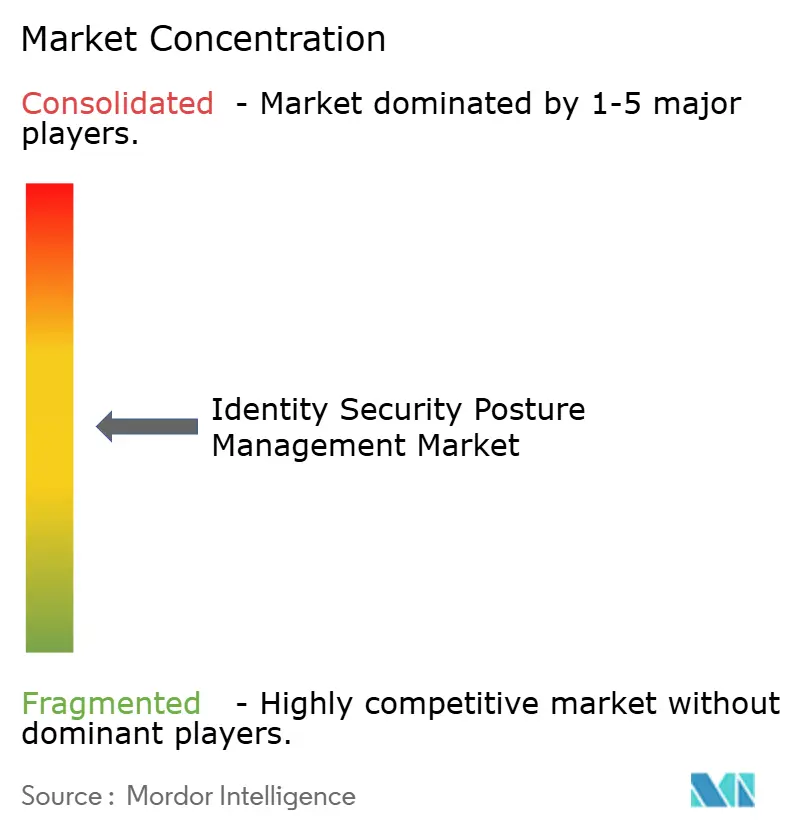
| Market Concentration | Medium |
Major Players *Disclaimer: Major Players sorted in no particular order Image © Mordor Intelligence. Reuse requires attribution under CC BY 4.0. | |
Identity Security Posture Management Market Analysis by Mordor Intelligence
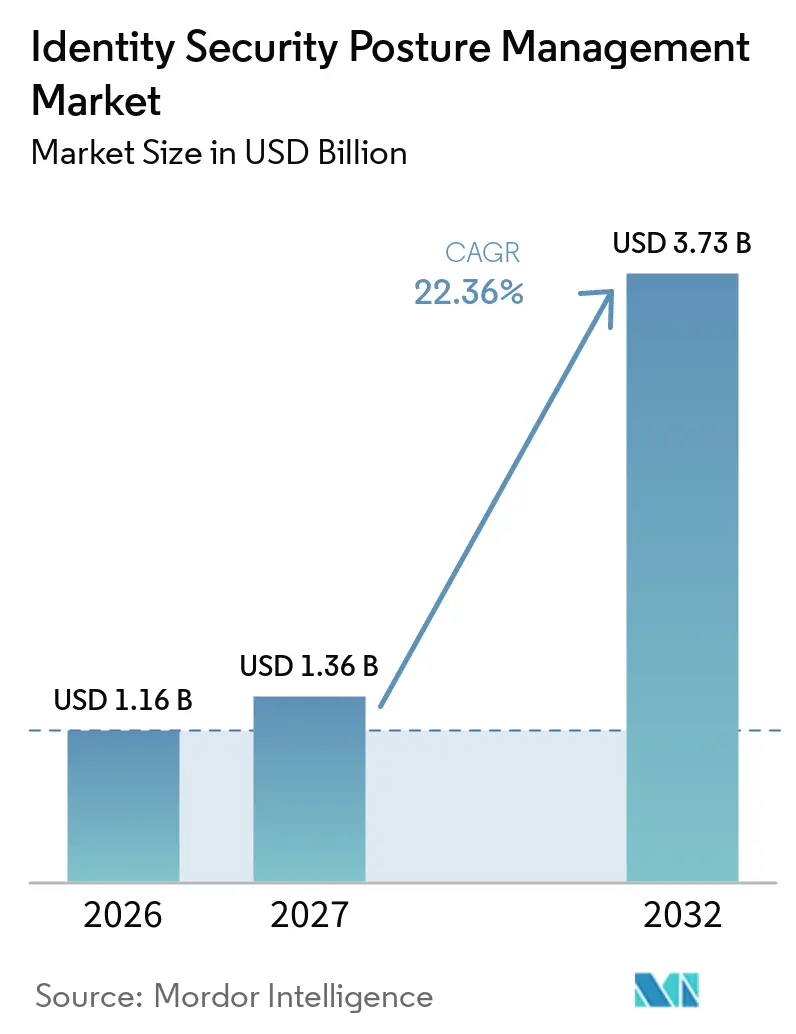
The identity security posture management market size is projected to be USD 1.16 billion in 2026, USD 1.36 billion in 2027, and reach USD 3.73 billion by 2032, growing at a CAGR of 22.36% from 2027 to 2032. Credential theft has become more industrialized, while zero-trust programs require organizations to make identity controls work continuously across their environments. Machine identities and AI agents are expanding faster than most governance processes, leaving a less supervised attack surface than that of human accounts. The identity security posture management market is also moving closer to security operations, where teams can address identity findings through AI-assisted workflows instead of moving each issue through separate IT service processes. Larger vendors are responding through acquisitions that combine privileged access, identity governance, non-human identity security, and posture capabilities. Integration across older identity systems and limits on continuous personal-data monitoring remain important constraints, especially in Europe.
Key Report Takeaways
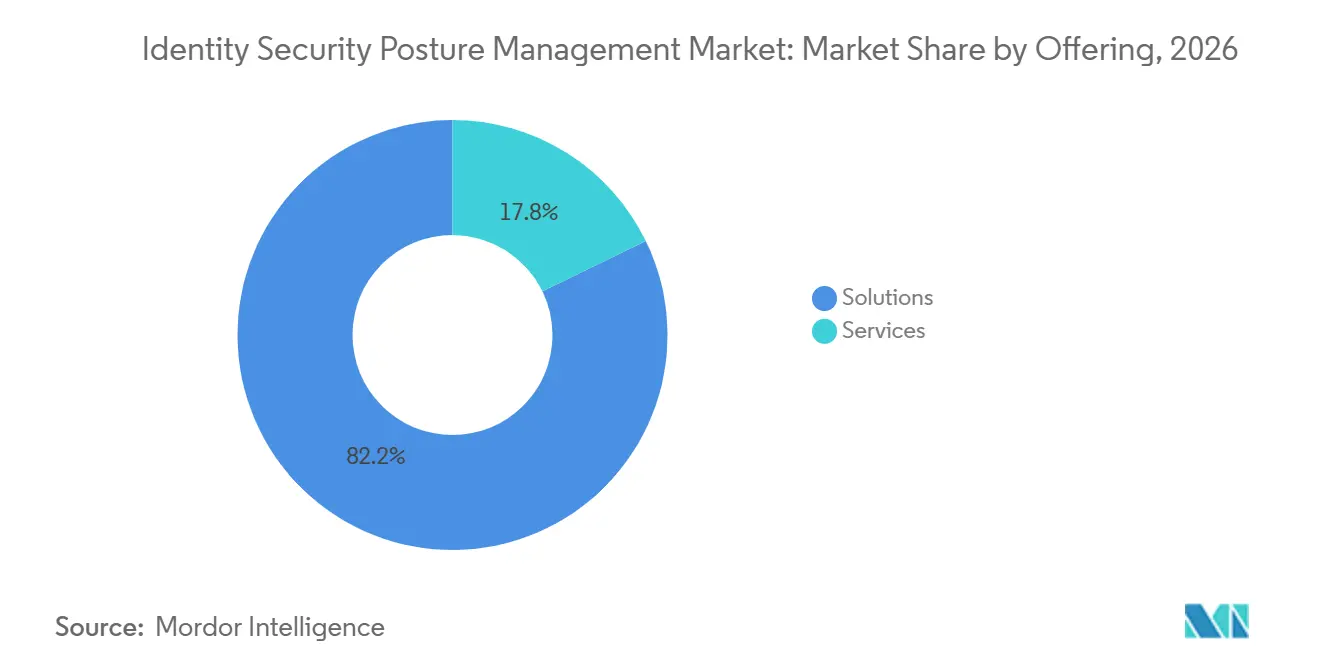
- By offering, solutions held 82.21% share in 2026, while services are projected to expand at a 22.76% CAGR through 2032.
- By capability, identity posture assessment accounted for 32.78% share in 2026, while identity misconfiguration remediation is projected to expand at a 22.64% CAGR through 2032.
- By deployment model, cloud deployment held 77.34% share in 2026 and is projected to expand at a 22.83% CAGR through 2032.
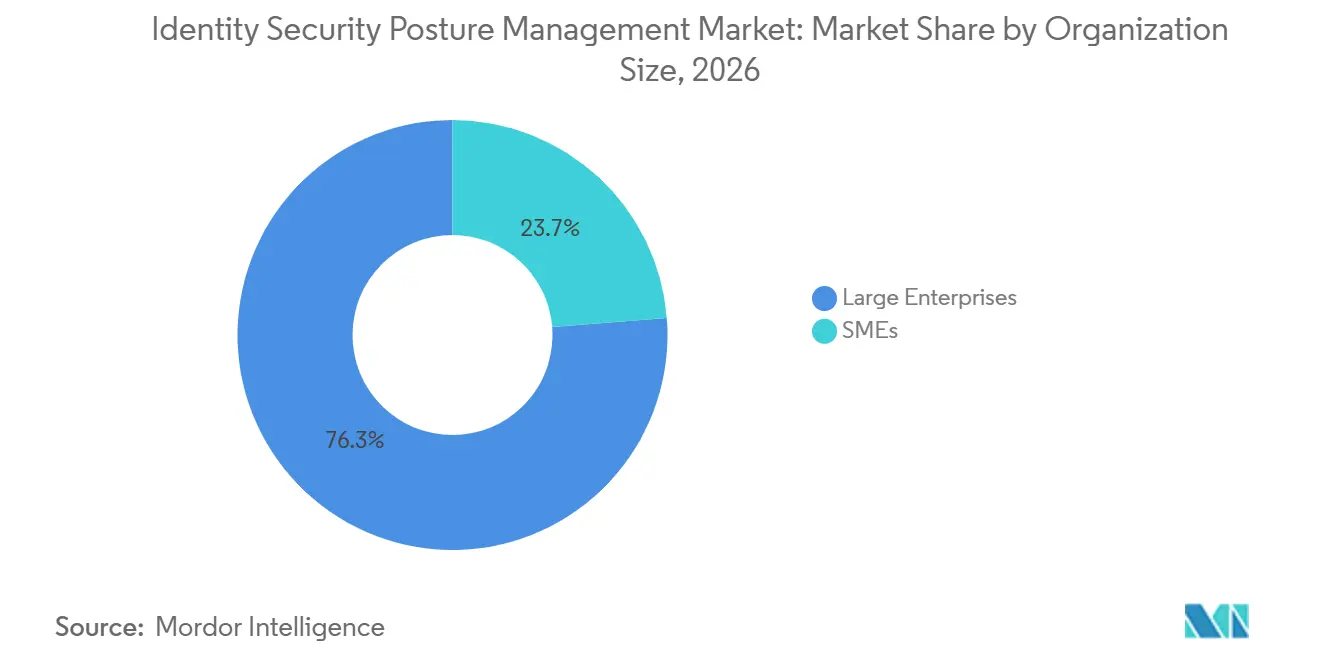
- By organization size, large enterprises held 76.26% share in 2026, while small and medium-sized enterprises are projected to expand at a 22.96% CAGR through 2032.
- By industry vertical, banking, financial services, and insurance held 23.47% share in 2026, while government and defense is projected to expand at a 22.77% CAGR through 2032.
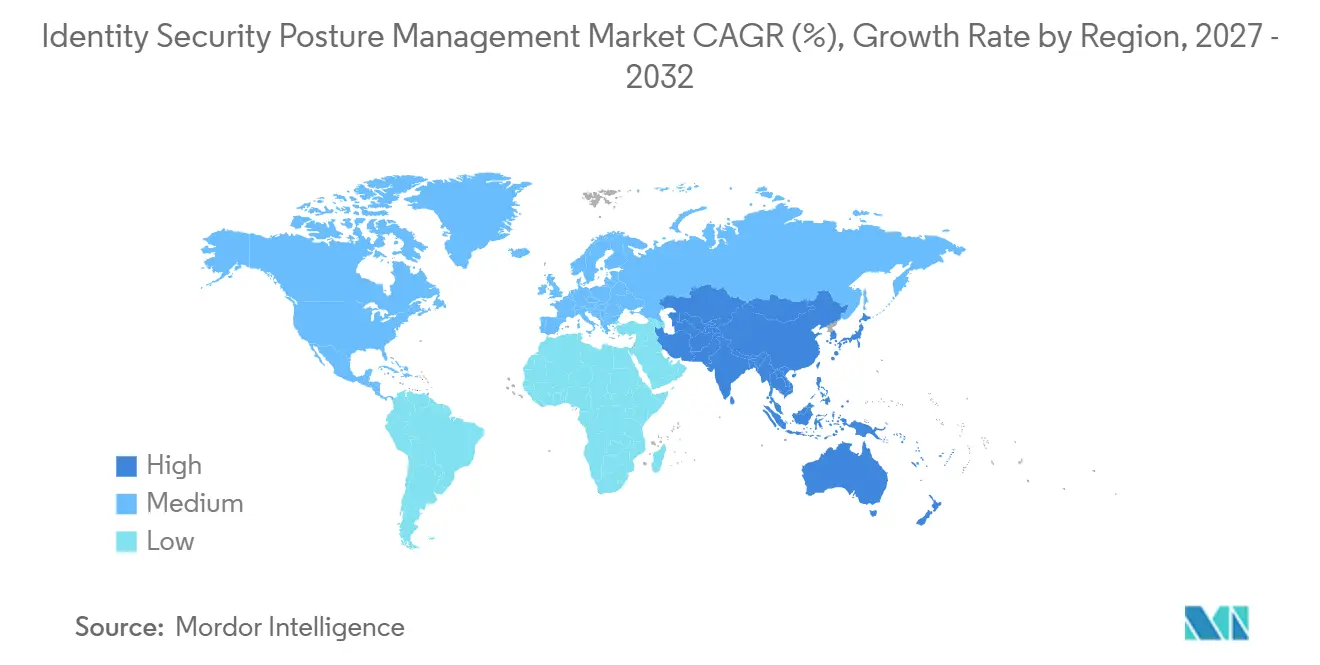
- By geography, North America held 43.81% share in 2026, while Asia-Pacific is projected to expand at a 22.98% CAGR through 2032.
Note: Market numbers in this report are based on Mordor Intelligence's proprietary estimation framework, which combines nine months of actuals with Q4 projections for base year 2026.
Global Identity Security Posture Management Market Trends and Insights
Drivers Impact Analysis*
| Driver | (~) % Impact on CAGR Forecast | Geographic Relevance | Impact Timeline |
|---|---|---|---|
| Increasing Frequency and Sophistication of Identity-Based Attacks | +8.5% | Global | Short term (≤ 2 years) |
| Rising Adoption of Zero Trust Security Architectures | +5.2% | North America and Europe, spill-over to Asia-Pacific | Medium term (2-4 years) |
| Machine and Non-Human Identity Sprawl Across APIs, Workloads, and Devices | +4.1% | Global, concentrated in Asia-Pacific core and North America | Medium term (2-4 years) |
| Expansion of Cloud, SaaS, and Hybrid Work Environments | +2.8% | Global | Short term (≤ 2 years) |
| Intensifying Regulatory and Cyber-Insurance Requirements | +2.3% | North America and EU, spill-over to Asia-Pacific and MEA | Medium term (2-4 years) |
| Identity Graphs and AI-Assisted Remediation Reducing Mean Time to Risk Reduction | +1.9% | North America and EU | Long term (≥ 4 years) |
| Source: Mordor Intelligence | |||
Increasing Frequency and Sophistication of Identity-Based Attacks
Identity-based attacks are now a leading security concern because legitimate authentication sessions can bypass many conventional controls. Red Canary reported that identity threats increased 850% from the previous year and represented 53% of detection volume across the environments it analyzed in 2025.[1] SpyCloud found that 91% of organizations experienced an identity-related incident during the prior year.[2] Huntress reported that many organizations could not detect identity threats until an attacker had established persistence. These conditions make the identity security posture management market relevant before a breach occurs because periodic identity hygiene reviews do not address exposure at the same speed. The identity security posture management market therefore benefits when security teams need continuous visibility into dormant accounts, excessive entitlements, and compromised credentials.
Rising Adoption of Zero Trust Security Architectures
Zero trust is becoming an operating model rather than a conceptual framework, and identity posture tools provide the evidence needed to apply it consistently. Continuous verification reveals entitlement drift and inactive accounts that periodic access reviews can miss. This creates recurring remediation requirements for the identity security posture management market, particularly where tools link posture findings to security workflows. The US Department of Defense also requires target-level zero trust across its networks by the end of fiscal year 2027 under Directive-Type Memorandum 25-003.[3] This policy direction supports the identity security posture management market, where organizations must translate zero-trust principles into operating controls.
Machine and Non-Human Identity Sprawl Across APIs, Workloads, and Devices
Service accounts, API keys, AI agents, bots, and connected devices have extended identity risk beyond conventional employee accounts. OWASP identifies credential mismanagement and a lack of dedicated monitoring as critical non-human identity failure modes. Veza reported that a substantial share of accounts were dormant, permissions were ungoverned, and the average enterprise identity held a significant number of permissions. Such identities can be created without a clear owner and can retain more access than their function requires. The identity security posture management market addresses this gap through continuous discovery and analysis across cloud and hybrid environments. Its value increases when organizations need to govern identities that operate without routine human oversight.
Expansion of Cloud, SaaS, and Hybrid Work Environments
Cloud adoption has spread identity activity across software-as-a-service applications, cloud platforms, endpoints, and personal devices. The Cloud Security Alliance identified insecure identities and risky permissions as leading cloud security risks in its survey. LayerX found that a significant share of corporate login events occurred without single sign-on, while many SaaS applications within organizational networks were accessed with personal credentials. Microsoft linked hybrid and remote work to an increase in identity-related security incidents. The identity security posture management market serves as a common control layer when security teams need to assess access across these disconnected environments. This need is particularly strong where cloud configurations and access privileges change faster than manual reviews can keep pace.
Restraints Impact Analysis*
| Restraint | (~) % Impact on CAGR Forecast | Geographic Relevance | Impact Timeline |
|---|---|---|---|
| Integration Complexity Across Legacy IAM, Active Directory, and Security Tools | -1.8% | Global, most acute in Europe and North America | Medium term (2-4 years) |
| Privacy and Data-Minimization Concerns in Continuous Identity Monitoring | -0.9% | EU core, spill-over to North America | Medium term (2-4 years) |
| Shortage of Identity-Security Engineering and Detection Talent | -0.5% | Global | Long term (≥ 4 years) |
| User Friction from Continuous Authentication and Least-Privilege Controls | -0.3% | Global | Short term (≤ 2 years) |
| Source: Mordor Intelligence | |||
Integration Complexity Across Legacy IAM, Active Directory, and Security Tools
Integration remains a practical limit on adoption because large organizations commonly operate layered identity systems. Zilla Security identified integration and customization difficulty as the primary reasons identity leaders do not automate identity governance. The same report highlighted challenges in connecting SaaS and cloud applications, while indicating that only a limited share of organizations with deployed identity governance had integrated most of their applications. Attribute mapping conflicts between on-premises Active Directory and cloud identity providers can leave gaps in posture data. Many large deployments, therefore, begin with cloud-native systems while on-premises systems remain less visible. The identity security posture management market must accommodate these staged deployments and support integration with existing security tools.
Privacy and Data-Minimization Concerns in Continuous Identity Monitoring
Continuous monitoring collects detailed information on user activity, which can conflict with data-protection requirements. Article 5(1)(c) of the General Data Protection Regulation requires personal data to be limited to what is necessary for a specified purpose. A 2025 study in the Journal of Digital Technologies and Law described data minimization as difficult in behavioral monitoring because less data can reduce anomaly-detection accuracy. The European Data Protection Board stated in its 2025 guidance that technically justified processing must still use measures that protect personal data and prevent unnecessary reuse. Vendors serving European customers need monitoring designs that limit collection and clarify purpose without losing the signals required for risk assessment. These requirements can extend deployment periods and increase the legal and technical work required for the identity security posture management market.
*Our forecasts treat driver/restraint impacts as directional, not additive. The impact forecasts reflect baseline growth, mix effects, and variable interactions.
Segment Analysis
By Offering: Solutions Lead Adoption While Services Extend Delivery Capacity
Solutions command 82.21% of the identity security posture management market size for the offering segment in 2026. Enterprises use these platforms to connect IAM integration, privileged access management integration, identity analytics, and risk intelligence. IAM integration is the usual entry point because organizations first need posture data from their identity providers. They can then extend coverage to privileged access controls and analytics functions. This sequence supports a platform-led buying pattern in the identity security posture management industry.
Services are projected to expand at a 22.76% CAGR through 2032. Managed services are increasingly relevant as non-human identity complexity and specialist staffing needs prompt organizations to outsource parts of posture operations. 1Password described an access-trust gap between the access security teams that can govern and the actual use of SaaS and AI tools. Service providers can help customers identify that gap and manage ongoing access reviews. The identity security posture management market can therefore reach organizations that lack the resources to operate a broad internal identity security function.
By Capability: Assessment Establishes the Starting Point and Remediation Gains Priority
Identity posture assessment holds 32.78% of the identity security posture management market share for capabilities in 2026. Organizations commonly begin with an assessment to measure identity risk before committing resources to remediation. This capability gives teams a view of privileged access, inactive identities, and policy exceptions. It also establishes the baseline for compliance and governance activity. Identity threat detection and response is moving closer to posture functions as vendors combine risk and threat signals.
Identity misconfiguration remediation is projected to expand at a 22.64% CAGR through 2032. Platforms are connecting to security operations center and security orchestration tools so that teams can fix issues rather than only receive advisory findings. Okta reported that 75% of critical identity issues were resolved within weeks of platform deployment in its April 2025 solution brief. Compliance and governance remain important in regulated sectors. Risk-based identity management is also emerging as a way to convert posture findings into real-time access decisions for human and non-human identities.
By Deployment Model: Cloud Leads While On-Premises Systems Remain Relevant
Cloud deployment holds 77.34% of the identity security posture management market size for deployment models in 2026. It is also projected to expand at a 22.83% CAGR through 2032. Cloud architecture aligns with the multi-cloud environments that these products monitor and supports continuous telemetry from non-human identities. It can process identity signals at scales that older on-premises tools may not match. This makes cloud deployment central to the identity security posture management market.
On-premises deployment remains relevant in government and defense, healthcare, and banking, financial services, and insurance. Data sovereignty requirements and the handling of classified information can slow cloud adoption in these settings. Many enterprises instead use hybrid architectures that join on-premises Active Directory with cloud identity providers. CISA treats identity as a core pillar of zero trust in its Zero Trust Maturity Model. These standards shape deployment decisions for government agencies and contractors.
By Organization Size: Large Enterprises Lead While SMEs Adopt Managed Models
Large enterprises hold 76.26% of the the organization size segment in 2026. Their multi-cloud estates, large non-human identity populations, and regulatory responsibilities make continuous identity assessment necessary. These buyers need to collect signals from IAM systems, privileged access tools, cloud providers, and SaaS applications. A unified view helps security operations teams prioritize the most significant access risks. Identity graphs from Okta, CrowdStrike, and Veza support this type of connected analysis at enterprise scale.
Small and medium-sized enterprises are projected to expand at a 22.96% CAGR through 2032. SaaS-native products and managed delivery services reduce the deployment burden that historically limited smaller buyers. Huntress found that many organizations could not identify an identity threat before an attacker established persistence. This risk is concentrated among organizations without large dedicated security teams. The identity security posture management market offers these buyers a more accessible route to continuous monitoring and response.
By Industry Vertical: Financial Services Leads and Government Demand Accelerates
Banking, financial services, and insurance holds 23.47% of the industry vertical segment in 2026. The sector faces overlapping obligations under the Digital Operational Resilience Act and the NIS2 framework. Article 21 of the Digital Operational Resilience Act requires unique identification and authentication of users and systems, least-privilege access, and segregation of duties. These requirements correspond directly with the core capabilities of posture management. Thales reported that financial services leaders face simultaneous pressure from regulation, threat actors, and expanding digital identity use.
Government and defense is projected to expand at a 22.77% CAGR through 2032. Directive-Type Memorandum 25-003 sets a fiscal year 2027 target for zero trust across Department of Defense networks. IT and telecommunications is projected to expand at a 23.14% CAGR because API-led infrastructure creates dense non-human identity environments. Healthcare and life sciences, energy and utilities, and retail and e-commerce remain at earlier stages of adoption. Connected-device growth and sector-specific cyber-insurance requirements are increasing the need for identity controls.
Geography Analysis
North America holds 43.81% of the identity security posture management market share in 2026. The region has a high concentration of cloud-mature enterprises, a deep vendor base, and active policy direction from CISA, the Office of Management and Budget, and financial regulators. Federal zero trust policy and Directive-Type Memorandum 25-003 structure procurement, with a fiscal year 2027 deadline for defense contexts. The United States is the region's main buyer, while Canada shows increasing public-sector activity and Mexico presents a medium-term opportunity through fintech and regulated banking.
Asia-Pacific is projected to expand at a 22.98% CAGR from 2027 to 2032. India’s financial services digitization, Australia’s Cyber Security Act 2024, and Japan’s public-sector digital transformation create separate demand pools for identity posture products. Australia's Cyber Security Act 2024 establishes new cybersecurity obligations for relevant entities. Japan and Australia are near-term commercial priorities, while China is developing domestic capabilities and limits cross-border access through localization requirements. Singapore, Indonesia, Thailand, and South Korea are increasing attention to identity security as cloud-native financial services, e-commerce, and critical infrastructure expand.
Europe is a regulation-dense region where NIS2, the Digital Operational Resilience Act, and the General Data Protection Regulation both stimulate demand and define how continuous monitoring can be designed. The United Kingdom, Germany, France, and Italy lead adoption, while ENISA issued technical guidance on NIS2 risk-management measures in 2025. Middle Eastern demand is strongest in Saudi Arabia and the United Arab Emirates, with Turkey emerging as banking becomes more digital. Africa remains early stage with South Africa led by financial services, while Brazil and Argentina lead South America through financial services and telecommunications as cloud migration and national cybersecurity frameworks mature.
Competitive Landscape
The identity security posture management market is moderately fragmented, although it is consolidating more quickly than many other cybersecurity categories. Large platforms are combining privileged access management, identity governance and administration, non-human identity security, and posture capabilities into wider identity offerings, making identity security a portfolio priority for broad technology platforms and dedicated security suppliers. ServiceNow closed its acquisition of Veza for USD 1.2 billion in March 2026. Palo Alto Networks announced an agreement in February 2026 to acquire CyberArk for USD 25 billion. SailPoint completed its acquisition of Entro Security for USD 200 million in June 2026.
The identity graph is becoming a key competitive architecture because it links human identities, machine identities, and AI agents with their effective entitlements across systems. This approach supports context-based risk scoring rather than a simple count of permissions. Endpoint vendors can use their telemetry depth to extend into posture intelligence, while established identity vendors are developing comparable capabilities. The identity security posture management market has open areas in agentic AI governance, cross-cloud non-human identity lifecycle management, and real-time authorization for AI-based workflows.
SaaS-native vendors such as Grip Security, Adaptive Shield, and Zilla Security focus on mid-market buyers through rapid implementation and targeted coverage. Okta announced its agreement to acquire Permiso Security in July 2026 and closed the acquisition in August 2026. The acquisition added more than 2,500 research-driven threat detection signals across 70 identity partners and extended Okta’s focus toward behavioral analytics and real-time threat response. Competition in the identity security posture management market is increasingly centered on how quickly vendors can convert identity findings into operational action.
Identity Security Posture Management Industry Leaders
-
Microsoft Corporation
-
SailPoint Technologies Holdings Inc.
-
IBM Corporation
-
Oracle Corporation
-
SAP SE
- *Disclaimer: Major Players sorted in no particular order
Recent Industry Developments
- October 2026: Oleria and SecureOS announced a strategic partnership to modernize identity governance and accelerate ISPM deployments, combining Oleria's AI-native governance platform with SecureOS's forward-deployed identity engineering services across IGA, PAM, and NHI domains.
- September 2026: Cyera completed its acquisition of Oasis Security, an NHI management specialist, at a valuation of USD 1 billion, integrating machine identity governance into Cyera's data security platform to establish a combined data-plus-identity security offering for cloud environments.
- August 2026: Okta closed its acquisition of Permiso Security, adding more than 2,500 research-driven threat detection signals across 70+ identity partners and extending Okta's ISPM capabilities into behavioral analytics and runtime threat detection for human, non-human, and agentic identities.
- July 2026: Okta announced a definitive agreement to acquire Permiso Security to embed real-time identity threat detection within its ISPM platform and extend its footprint into Security Operations Center workflows beyond authentication.
Global Identity Security Posture Management Market Report Scope
The Identity Security Posture Management (ISPM) Market comprises cybersecurity solutions that continuously assess, monitor, and remediate identity-related risks across an organization’s cloud, SaaS, on-premises, and hybrid IT environments.
The Identity Provisioning Market Report is Segmented by Component (Solutions, Services), Deployment Model (Cloud, On-Premises, Hybrid), Identity Type (Workforce, Privileged, Third-Party, Machine, AI-Agent), Organization Size (Large Enterprises, SMEs), Service Type (Professional, Managed, Implementation, Training/Consulting), End User (BFSI, IT and Telecom, Healthcare, Government, Retail, Manufacturing, Others), and Geography (North America, South America, Europe, Asia-Pacific, Middle East, Africa). The Market Forecasts are Provided in Terms of Value (USD).
| Solutions | IAM Integration |
| PAM Integration | |
| Identity Analytics and Risk Intelligence | |
| Services | Professional Services |
| Managed Services |
| Identity Posture Assessment |
| Identity Misconfiguration Remediation |
| Compliance and Governance |
| Identity Threat Detection and Response |
| Risk-Based Identity Management |
| Cloud Deployment |
| On-Premises Deployment |
| Large Enterprises |
| Small and Medium-Sized Enterprises |
| Banking, Financial Services, and Insurance |
| Retail and E-Commerce |
| Government and Defense |
| IT and Telecommunications |
| Energy and Utilities |
| Healthcare and Life Sciences |
| Other Industry Verticals |
| North America | United States |
| Canada | |
| Mexico | |
| Europe | United Kingdom |
| Germany | |
| France | |
| Italy | |
| Russia | |
| Rest of Europe | |
| Asia-Pacific | China |
| Japan | |
| India | |
| Australia | |
| Rest of Asia-Pacific | |
| Middle East | Turkey |
| Saudi Arabia | |
| United Arab Emirates | |
| Rest of Middle East | |
| Africa | South Africa |
| Rest of Africa | |
| South America | Brazil |
| Argentina | |
| Rest of South America |
| By Offering | Solutions | IAM Integration |
| PAM Integration | ||
| Identity Analytics and Risk Intelligence | ||
| Services | Professional Services | |
| Managed Services | ||
| By Capability | Identity Posture Assessment | |
| Identity Misconfiguration Remediation | ||
| Compliance and Governance | ||
| Identity Threat Detection and Response | ||
| Risk-Based Identity Management | ||
| By Deployment Model | Cloud Deployment | |
| On-Premises Deployment | ||
| By Organization Size | Large Enterprises | |
| Small and Medium-Sized Enterprises | ||
| By Industry Vertical | Banking, Financial Services, and Insurance | |
| Retail and E-Commerce | ||
| Government and Defense | ||
| IT and Telecommunications | ||
| Energy and Utilities | ||
| Healthcare and Life Sciences | ||
| Other Industry Verticals | ||
| By Geography | North America | United States |
| Canada | ||
| Mexico | ||
| Europe | United Kingdom | |
| Germany | ||
| France | ||
| Italy | ||
| Russia | ||
| Rest of Europe | ||
| Asia-Pacific | China | |
| Japan | ||
| India | ||
| Australia | ||
| Rest of Asia-Pacific | ||
| Middle East | Turkey | |
| Saudi Arabia | ||
| United Arab Emirates | ||
| Rest of Middle East | ||
| Africa | South Africa | |
| Rest of Africa | ||
| South America | Brazil | |
| Argentina | ||
| Rest of South America | ||
Key Questions Answered in the Report
What is the 2026 size of the identity security posture management market?
The identity security posture management market is valued at USD 1.16 billion in 2026 and is projected to reach USD 3.73 billion by 2032 at a 22.36% CAGR.
What is driving demand for identity security posture management?
Identity-based attacks, zero trust programs, non-human identities, and cloud-based access are increasing the need for continuous identity visibility and remediation.
Which offering leads identity security posture management adoption?
Solutions lead with 82.21% share in 2026, while services are projected to expand at a 22.76% CAGR through 2032.
Why are non-human identities important to security teams?
API keys, service accounts, bots, AI agents, and connected devices can retain excessive or unmanaged access. OWASP identifies credential mismanagement and missing monitoring as critical risks.
Which region has the strongest identity security posture management demand?
North America holds 43.81% share in 2026, while Asia-Pacific is projected to expand at the fastest regional CAGR of 22.98% through 2032.
Which vertical is adopting identity posture solutions most quickly?
Banking, financial services, and insurance leads with 23.47% share, while government and defense is projected to expand at a 22.77% CAGR through 2032.