
Identity Proofing Market Size and Share
Market Overview
| Study Period | 2021 - 2032 |
|---|---|
| Market Size (2027) | USD 12.23 Billion |
| Market Size (2032) | USD 24.78 Billion |
| Growth Rate (2027 - 2032) | 15.17 % |
| Fastest Growing Market | Asia-Pacific |
| Largest Market | North America |
| Market Concentration | Medium |
Major Players *Disclaimer: Major Players sorted in no particular order Image © Mordor Intelligence. Reuse requires attribution under CC BY 4.0. | |
Identity Proofing Market Analysis by Mordor Intelligence
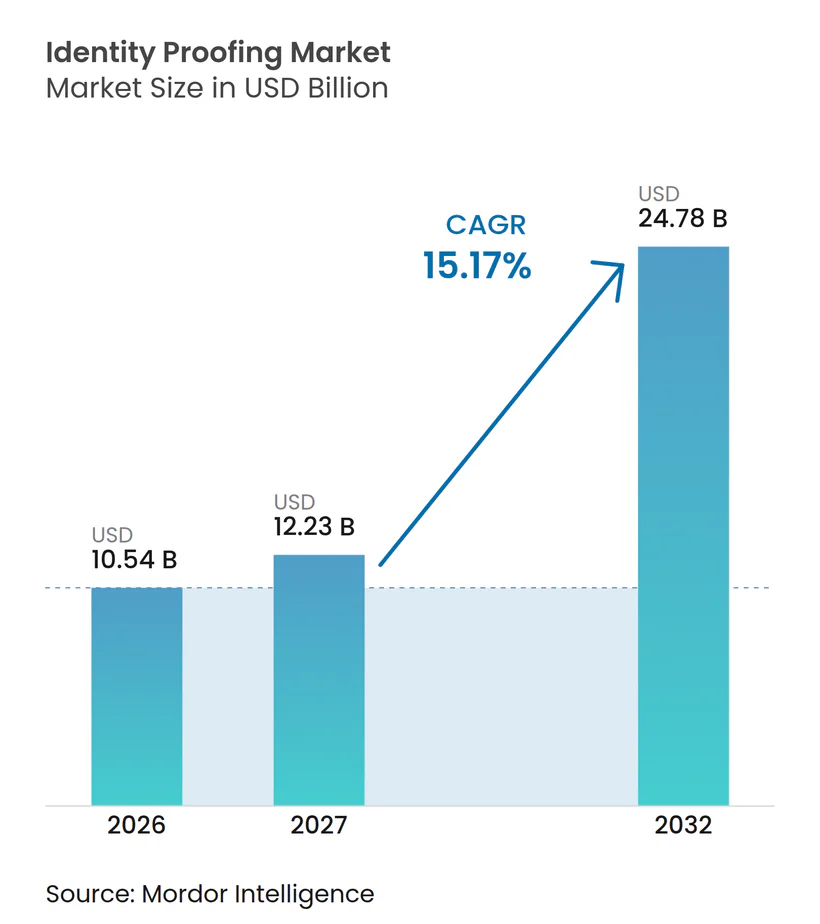
The identity proofing market size is expected to increase from USD 10.54 billion in 2026 to USD 12.23 billion in 2027 and reach USD 24.78 billion by 2032, growing at a CAGR of 15.17% over 2027-2032. Regulatory requirements, wider digital onboarding, and more sophisticated fraud are increasing the need for reliable checks at account opening and throughout the customer relationship. The identity proofing market is also being shaped by the shift from document-only checks to biometric, device, network, and database signals that can be combined into a single workflow. New rules in Europe, the United States, and India are making reusable credentials and secure remote verification more relevant to regulated institutions. Providers are responding by adding managed services, cloud delivery, and cross-border capabilities that reduce the burden on internal compliance teams. Data residency, privacy obligations, and the cost of integration remain material constraints, especially for smaller organizations and deployments across multiple jurisdictions.
Key Report Takeaways
- By offering, solutions held 64.91% of the identity proofing market share in 2026, while services are projected to expand at an 18.39% CAGR through 2032.
- By verification component, document and identity verification held 26.97% in 2026, while biometric verification and liveness detection are projected to expand at a 19.37% CAGR through 2032.
- By deployment mode, cloud-based deployment accounted for 28.41% of the identity proofing market in 2026 and is projected to expand at a 21.24% CAGR through 2032.
- By organization size, large enterprises held 68.54% in 2026, while SMEs are projected to expand at an 18.83% CAGR through 2032.
- By industry vertical, BFSI held 29.31% in 2026, while government and public administration are projected to expand at a 17.92% CAGR through 2032.
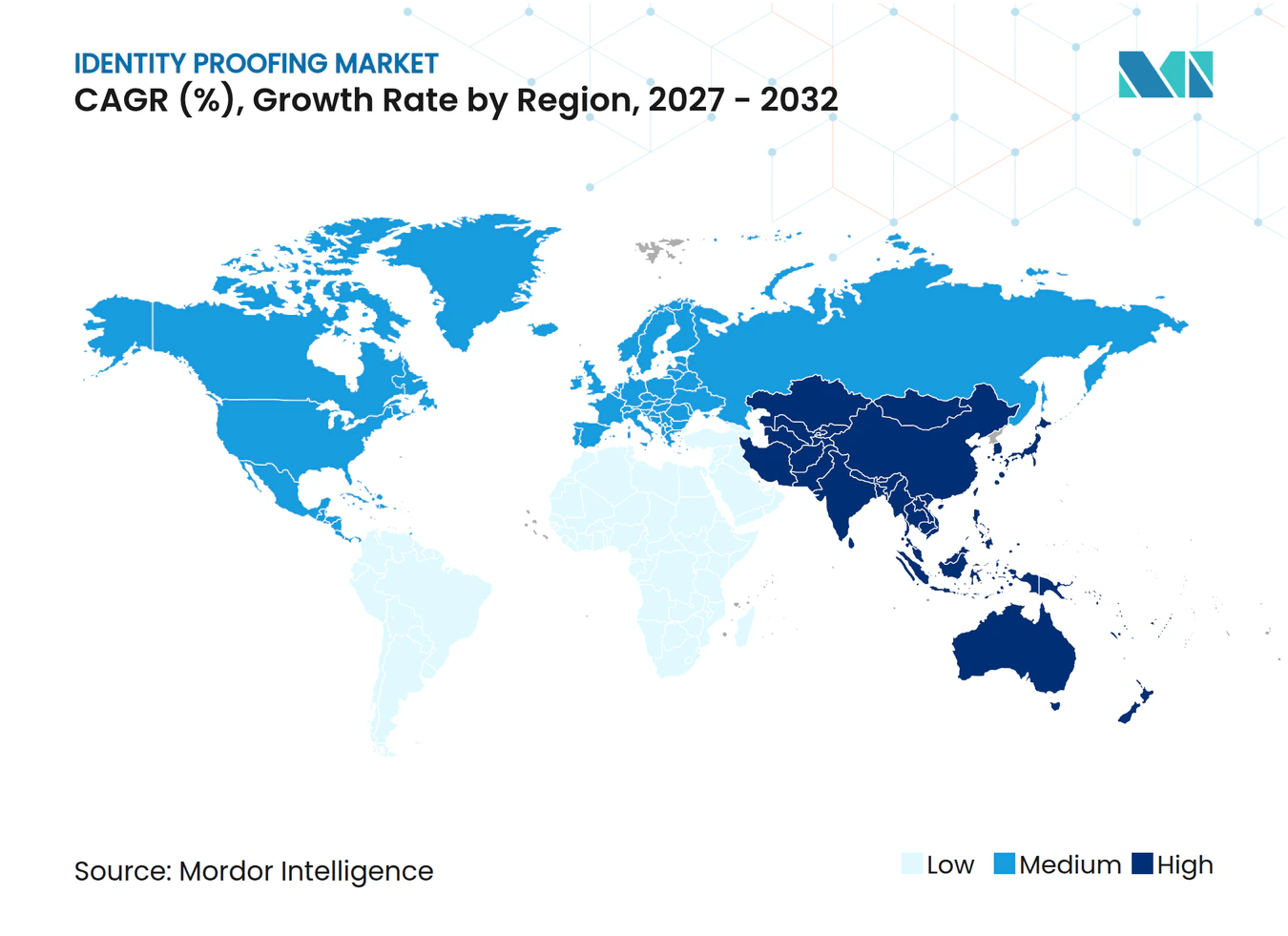
- By geography, North America held 39.81% in the identity proofing market in 2026, while Asia-Pacific is projected to expand at a 21.49% CAGR through 2032.
Note: Market numbers in this report are based on Mordor Intelligence's proprietary estimation framework, which combines nine months of actuals with Q4 projections for base year 2026.
Market Trends and Insights
Drivers Impact Analysis of Identity Proofing Market*
| Driver | (~) % Impact on CAGR Forecast | Geographic Relevance | Impact Timeline |
|---|---|---|---|
| Tightening AML, KYC, and Age-Assurance Enforcement | +3.2% | Global, most intense in Europe, North America, and Gulf Cooperation Council states | Medium term (2-4 years) |
| Rising Digital Onboarding and E-KYC | +2.8% | Global, led by India, Southeast Asia, and Sub-Saharan Africa | Short term (≤ 2 years) |
| Escalating Synthetic-Identity and Deepfake Fraud | +2.4% | Global, most acute in North America and Asia-Pacific | Short term (≤ 2 years) |
| Growth of Cross-Border Digital Services | +1.9% | Asia-Pacific core, with spillover to South America and Middle East and Africa | Medium term (2-4 years) |
| Reusable Digital Identity Wallets and Verifiable Credentials | +1.5% | Europe and North America, early stage in Asia-Pacific | Long term (≥ 4 years) |
| AI-Agent Identity and Machine-to-Machine Trust | +1.2% | Global, with North America leading enterprise deployments | Long term (≥ 4 years) |
| Source: Mordor Intelligence | |||
Tightening AML, KYC, and Age-Assurance Enforcement
Regulatory convergence is a durable source of demand for the identity proofing market. Regulation (EU) 2024/1624 will apply from July 10, 2027, bringing a more consistent anti-money-laundering framework across the 27 European Union member states. The change makes remote customer identification a more immediate procurement issue for banks, payment firms, and public bodies. The U.S. banking agencies confirmed in September 2026 that verifiable digital credentials can satisfy Customer Identification Program requirements, which broadens the acceptable technology options for financial institutions.[1] These parallel requirements can shorten vendor response windows because compliance teams need products that work across several legal environments. The identity proofing market therefore benefits when buyers replace separate country-level processes with common policy controls and evidence trails.
Rising Digital Onboarding and E-KYC
Digital onboarding has become an operating requirement for financial services, telecommunications, marketplaces, and government services. UIDAI launched the Aadhaar Face Authentication Software Development Kit and Sandbox in September 2026, enabling participating institutions to embed AI- and ML-based facial authentication in mobile applications.[2] The program indicated that Kotak Mahindra Bank, Bajaj Finance Limited, and Airtel Payments Bank had completed early proof-of-concept work. Japan's Financial Services Agency also published results from an experiment using verifiable credentials for financial institution identity checks in March 2026. These developments allow organizations to separate proof of identity from the repeated submission of documents in every new interaction. The identity proofing market benefits from this transition, as digital verification can be integrated into account recovery, payment approval, and other recurring customer journeys.
Escalating Synthetic-Identity and Deepfake Fraud
Synthetic identities, presentation attacks, and deepfakes are raising the bar for verification providers. Entrust reported that 1 in 5 biometric fraud attempts in its 2026 Identity Fraud Report involved a deepfake, while injection attacks increased 40% year over year. The evidence supports the demand for liveness detection that can identify attacks occurring between a device camera and the verification service. A document image alone cannot reliably address manipulated media or fraud that uses stolen personal details. Buyers are consequently combining document review with face matching, device intelligence, network signals, and risk controls. The identity proofing market is moving toward these combined workflows because they provide risk teams with multiple control points when a fraud method bypasses a single check.
Growth of Cross-Border Digital Services
Cross-border commerce, financial services, travel, and labor mobility create verification needs that domestic systems do not always cover. Institutions need to assess identities presented through different document types, national identifiers, and local authentication methods. Singapore and Shenzhen launched a cross-border data validation platform in January 2026, covering more than 2,300 transactions across 19 institutions, according to the supplied research. The model shows how public digital infrastructure can support verification beyond a single national database. Providers are adapting their platforms to support both reusable credentials and multiple national identity schemes within a single onboarding sequence. This creates an opportunity in the identity proofing market, where multinational clients need a single control layer while still meeting local requirements.
Restraints Impact Analysis of Identity Proofing Market*
| Restraint | (~) % Impact on CAGR Forecast | Geographic Relevance | Impact Timeline |
|---|---|---|---|
| Privacy, Consent, and Data-Residency Constraints | -1.8% | Europe and data-protection jurisdictions globally, with spillover through multinational operations | Medium term (2-4 years) |
| High Implementation and Maintenance Costs | -1.5% | Global, with a disproportionate effect in SME-heavy South American, African, and Southeast Asian markets | Short term (≤ 2 years) |
| Morphing and Injection Attacks Erode Trust | -0.9% | Global, most acute in mature digital-adoption markets | Short term (≤ 2 years) |
| Demographic Bias and Accessibility Gaps in Biometric Proofing | -0.6% | Sub-Saharan Africa, South and Southeast Asia, and rural markets globally | Long term (≥ 4 years) |
| Source: Mordor Intelligence | |||
Privacy, Consent, and Data-Residency Constraints
Privacy rules make biometric verification difficult to standardize across national borders. In the European Union, biometric data is subject to the special-category protections in Article 9 of the General Data Protection Regulation, which brings stronger consent, purpose limitation, and data minimization obligations. These obligations affect where a provider can process, store, and transfer facial images and related identity records. Brazil's data protection authority has also highlighted biometrics and AI governance in its 2025-2027 enforcement work, according to the supplied research. Providers often need regional processing options, in-country cloud capacity, or on-premises delivery for one global customer. Those requirements add cost and can slow purchasing decisions in the identity proofing market.
High Implementation and Maintenance Costs
A broad identity proofing deployment can require document checks, biometric matching, screening, and continuous monitoring to work together. The implementation period can also be difficult for smaller organizations that do not have large compliance or engineering teams. Integration with account-opening systems, customer records, and fraud controls often requires policy design before the software is ready for production. Certification requirements such as ISO 27001 and SOC 2 Type II add another layer of preparation for providers entering regulated customer accounts. Usage-based products and low-code software development kits can reduce the initial burden for smaller buyers. Even so, cost remains a restraint for the identity proofing market when transaction volume is too limited to support a full enterprise deployment.
*Our forecasts treat driver/restraint impacts as directional, not additive. The impact forecasts reflect baseline growth, mix effects, and variable interactions.
Identity Proofing Market Segment Analysis
By Offering:
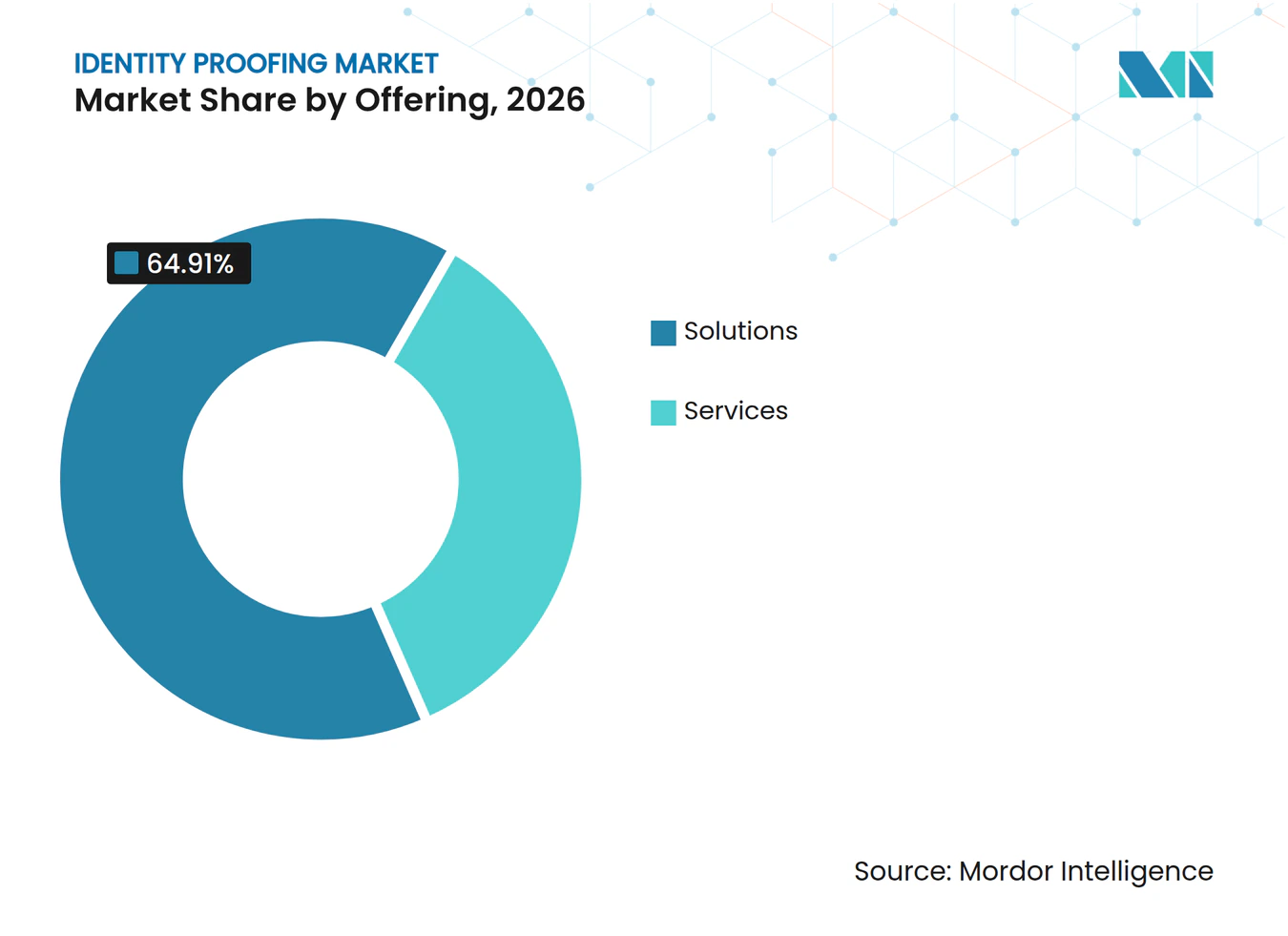
Services Increase the Importance of Ongoing SupportSolutions accounted for 64.91% of the global identity proofing market in 2026. This position reflects long-standing investment by banks and government organizations in platforms for KYC, AML, and biometric identity management. These organizations often use established systems that are integrated with core records, case management, audit processes, internal access controls, customer-service procedures, and the documented investigation paths required after a verification exception. Solutions also provide the rules, workflow controls, and interfaces that allow a customer to manage verification at scale. The identity proofing market size for solutions is driven by the need for a durable software foundation in large, regulated operations. Platform buyers commonly value internal control over policy configuration, evidence retention, review queues, user permissions, reporting formats, and the ability to apply different verification rules to distinct products, customer groups, risk levels, and jurisdictions. Their procurement decisions can therefore favor products that fit a wider risk and compliance architecture. The identity proofing industry continues to rely on solutions for the core steps of collecting evidence, assessing risk, and documenting a decision.
Services are projected to expand at an 18.39% CAGR through 2032. Demand is tied to organizations that need help with fraud-model tuning, exception review, regulatory change management, and continuous re-verification. Managed service arrangements can shift a portion of operational work from a customer team to a specialist provider, including exception handling, quality checks, ongoing policy maintenance, specialist review, and adjustment of fraud controls when an attack pattern changes. They may also create recurring relationships instead of one-time implementation projects. Hosted and no-code workflows reduce the effort needed to launch a new verification journey. This can make it easier for a buyer to test new policies without a major application rebuild. The identity proofing market benefits as service providers bundle operational support with the underlying platform. The identity proofing industry may see service quality become more important when software functions are widely available. This does not replace solutions, but it changes how buyers assess the support required after deployment. As regulatory requirements, fraud patterns, and customer expectations change, organizations can use this combination of technology and specialist support to keep a verification process current without moving every operational responsibility into an internal team that may have limited capacity for continuous review.


By Verification Component:
Biometrics Address Risks Beyond Document ReviewDocument and identity verification accounted for 26.97% of the identity proofing market in 2026. Document review has a large installed base because it is familiar to banking KYC teams, border-control programs, and public-sector services. It remains important for confirming the authenticity and consistency of a credential presented by an applicant. The category also supports review of document security features, extracted data, image quality, data consistency, document validity, and potential tampering, allowing a risk team to assess whether the credential can serve as credible evidence in the wider onboarding record. For many lower-risk workflows, a document check remains the first control in a broader proofing process. This established use gives the category a central role in the identity proofing market. Organizations may also use document verification when no national digital identity system can be queried. Its continuing relevance reflects the uneven availability of trusted digital credentials across countries.
Biometric verification and liveness detection are projected to expand at a 19.37% CAGR through 2032. The segment responds to attacks that can pass a document review while using a stolen, fabricated, or manipulated identity. Entrust reported that deepfakes were involved in 1 in 5 biometric fraud attempts, which highlights why remote processes need stronger presentation-attack controls.[3] Device, fraud, and network intelligence adds context by looking for bot activity, emulators, repeated device use, unusual connections, irregular network characteristics, and behavioral signs that suggest a workflow is being manipulated rather than completed by a genuine applicant. AML and PEP screening, data and database verification, and address and source-of-funds verification can then be arranged with document and biometric checks in one high-risk workflow. The identity proofing market size for liveness tools is supported by the need to test whether a real person is present during a remote interaction. Certification under ISO/IEC 30107-3 and iBeta PAD Level 2 is increasingly relevant in enterprise evaluation. The result is a layered approach in which each component covers a different weakness in the onboarding process. A clear document may establish the starting identity claim, biometrics may test that a real person is present, and data, device, and network controls may identify surrounding risk, giving a compliance team a fuller record for deciding whether additional review is necessary.
By Deployment Mode:
Cloud Delivery Supports Variable DemandCloud-based deployment accounted for 28.41% of the identity proofing market in 2026. It also provides a way to manage changes in onboarding volume without maintaining a large, fixed infrastructure. Customers can use vendor-managed updates when rules, document formats, fraud patterns, customer journeys, or local verification expectations change, thereby reducing the internal effort required to keep a distributed onboarding process aligned with current operating requirements. This is relevant for digital banks, e-commerce platforms, and public services that face temporary spikes in verification traffic. Cloud systems may also shorten the time required to connect new verification components and data sources. These factors explain the role of cloud delivery in the identity proofing market.
Cloud-based deployment is projected to expand at a 21.24% CAGR through 2032, making it both the largest and fastest-expanding deployment category. The supplied research noted that a public-sector analysis of MOSIP found cloud-based identity systems could reduce up-front infrastructure costs and shorten implementation timelines. Cloud adoption does not remove the need for local controls over personal data. On-premises systems remain relevant where a jurisdiction requires domestic processing or a buyer needs direct infrastructure control. Hybrid designs address this tradeoff by linking localized data handling to a global operating model, enabling a multinational buyer to preserve local processing requirements while using common policies, reporting, integration standards, and operational oversight across its larger customer base. Thales partnered with Goaco in August 2025 to extend biometric onboarding tools to SMEs through REST APIs and software development kits, according to the supplied research. The identity proofing market can therefore serve a wider customer base through flexible delivery methods. API-first orchestration also allows buyers to combine specialized tools without depending on one monolithic platform. This can be useful where a customer needs to retain a preferred database, screening provider, biometric control, or regional processing arrangement while still applying one common set of workflow rules, case outcomes, monitoring practices, and reporting controls across the overall verification journey.
By Organization Size:
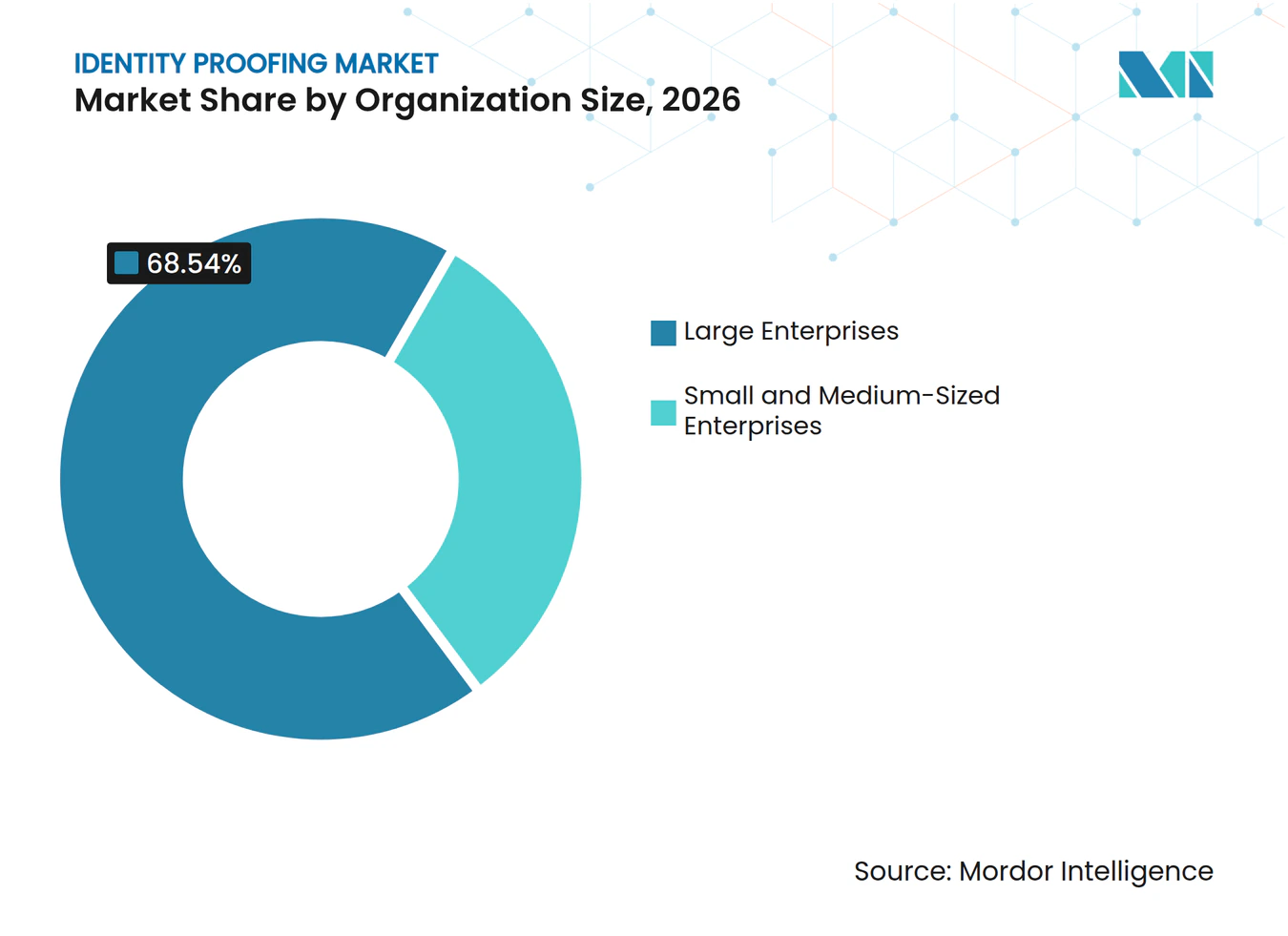
SME Adoption Expands Beyond Enterprise ProgramsLarge enterprises accounted for 68.54% of the identity proofing market in 2026. They tend to operate across multiple products, countries, and regulated customer journeys, which increases the value of integrated verification systems. Large buyers also have the budget to connect identity proofing to core banking, fraud, customer-service, and case-management systems. Long contracts and jointly developed compliance configurations can make these relationships difficult to replace because a provider may be embedded in account opening, escalation rules, customer communications, evidence retention, fraud review, and the reporting routines used by multiple internal control teams. Their scale supports recurring revenue for established providers. The identity proofing market share held by large enterprises also reflects their earlier adoption of formal KYC and AML controls. Enterprise requirements commonly include auditability, broad document coverage, service-level commitments, and data-residency options. These demands favor vendors with deep implementation experience and extensive operational support.
SMEs are projected to expand at an 18.83% CAGR through 2032. Fintechs, gig marketplaces, online sellers, and digital lenders increasingly need verification that is simple to buy and simple to connect. Low-code software development kits and application programming interfaces reduce the need for a large internal development project. These buyers are using identity checks for account recovery, payment approval, and higher-value transactions, not only initial registration. Usage-based pricing can align the cost of proofing with transaction volume, which is particularly relevant for smaller organizations that need reliable verification but cannot commit to the fixed implementation cost, specialist staff, and lengthy procurement process associated with a full enterprise program. Unico's September 2026 partnership with Didit extended biometric verification to Brazilian SMEs through a no-code interface, according to the supplied research. This product approach helps the identity proofing market reach customers that cannot manage a long enterprise procurement process. It also encourages providers to design self-service tools alongside high-touch offerings. Wider SME participation expands the number of use cases while keeping price sensitivity high. Providers must therefore make the initial user journey, integration path, commercial model, and access to operating support clear enough for a smaller customer to use identity proofing reliably, while leaving room for that customer to add deeper controls as transaction volume, geographic coverage, and regulatory obligations increase.

By Industry Vertical:
BFSI Retains Scale While Government Use ExpandsBFSI accounted for 29.31% of the identity proofing market in 2026. Financial institutions face long-established KYC and AML obligations, and errors can create direct regulatory, fraud, and customer-loss exposure. Banks, lenders, insurers, payment providers, and digital asset services therefore use proofing across a wide range of account and transaction processes. The sector also has a high need for continuous monitoring and reliable audit records. Its early adoption and high verification volumes support its position in the identity proofing market. Financial-service buyers often require a product that can connect identity evidence to sanctions screening, fraud management, case review, customer records, and ongoing monitoring, since these functions collectively determine whether a firm can make and document a defensible customer acceptance decision. The sector's requirements continue to influence product road maps for accuracy, evidence retention, and case review. As a result, BFSI remains an anchor customer group even as other verticals increase adoption.
Government and public administration are projected to expand at a 17.92% CAGR through 2032. National digital identity programs are extending from civil registration into benefits delivery, financial inclusion, and online public services. The Philippines central bank proposed in August 2026 that supervised financial institutions connect to PhilSys National ID Authentication Services for customer due diligence, according to the supplied research. This kind of integration can make a government-issued credential part of everyday private-sector onboarding. Healthcare, retail and e-commerce, telecommunications, travel, gaming, and Web3 are also using proofing for fraud control and access decisions. Telecommunications is influenced by SIM registration requirements across Asia-Pacific. The identity proofing market gains from these use cases because verification becomes a direct operational control rather than a narrow compliance task. In retail and digital platforms, it can protect revenue by reducing account takeover and misuse. Government programs can also provide a trust anchor that private providers use in their own customer workflows, allowing a bank, retailer, telecommunications firm, or public service to use trusted national identity evidence while applying its own risk rules and service requirements.
Geography Analysis
The Americas Identity Proofing Market
North America held 39.81% of the identity proofing market in 2026. The region combines mature AML and KYC enforcement, large financial institutions, extensive digital-service adoption, and public-sector digitization. U.S. regulators confirmed in September 2026 that state-issued mobile driver's licenses and verifiable digital credentials may satisfy Customer Identification Program obligations for banks. ID.me stated that it supported 20 federal agencies, 45 state agencies, and more than 70 healthcare organizations when it announced its September 2025 financing.[4] South America is also moving toward formal digital identity use through Brazil's CIN program, wider Gov.br participation, and regional expansion by providers such as Unico.
APAC Identity Proofing Market
Asia-Pacific is projected to expand at a 21.49% CAGR through 2032. Government-backed identity infrastructure is a major feature of the region, particularly in India, Japan, Indonesia, the Philippines, Singapore, and South Korea. UIDAI's September 2026 release of the Aadhaar Face Authentication Software Development Kit and Sandbox enables participating BFSI organizations to add AI and ML-based facial authentication to mobile applications. Japan's Financial Services Agency's experiment on verifiable credentials gives financial institutions a tested path toward reusable identity evidence. OCBC Indonesia and Dukcapil launched Digital Population Identity for account opening in February 2025, linking government digital identity to private-sector KYC.
EMEA Identity Proofing Market
Europe is preparing for AMLR's July 2027 application date, and its approach emphasizes privacy, qualified trust services, and compliant remote identification. IDnow stated that it had achieved ETSI 119 461 v2.1.1 certification under eIDAS 2.0, demonstrating the role of technical compliance in European procurement. In the Middle East, AML and counter-terrorism-financing enforcement is encouraging stronger financial-services onboarding controls. Africa's longer-term opportunity is linked to fintech-led onboarding and remaining gaps in formal digital identity access, since the World Bank reported that 2.8 billion people globally lacked access to digital ID systems in 2025.
Competitive Landscape
Market Concentration
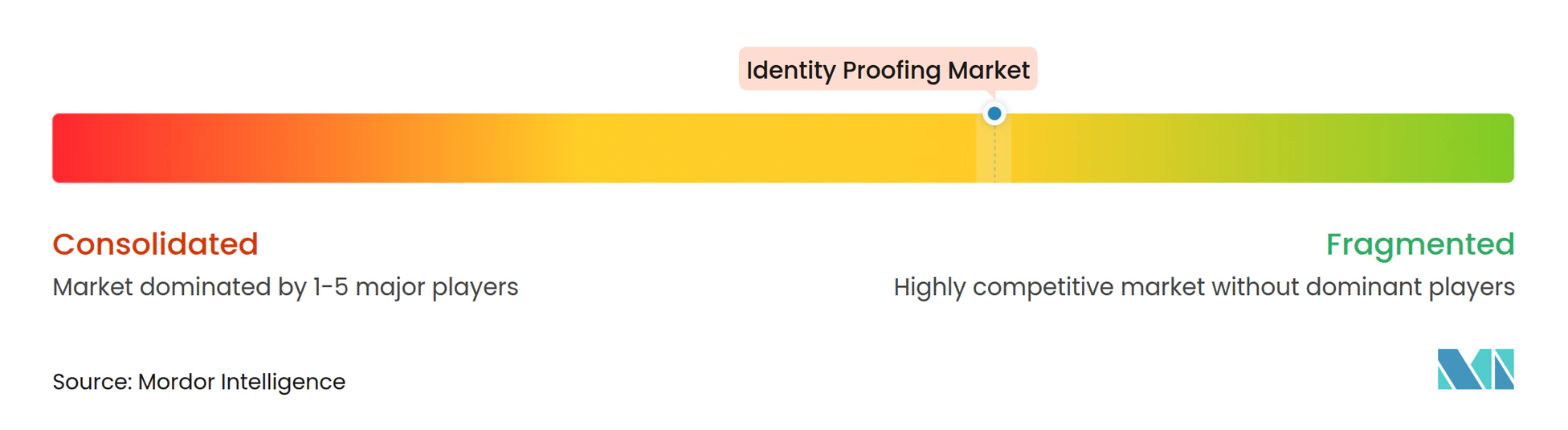
The identity proofing market is moderately fragmented because providers differ in document coverage, biometric capabilities, fraud data, customer focus, and geographic reach. No single company has a dominant position across all verification methods and buyer groups. Socure, Jumio, IDEMIA, LexisNexis Risk Solutions, Entrust, Thales, and Trulioo compete through combinations of document review, biometric verification, screening, and fraud intelligence. The ability to combine these functions in one application programming interface is increasingly important for customers seeking simpler integration. Large organizations need identity evidence, risk signals, and operational controls to work together in a consistent workflow.
Product strategies increasingly focus on reusable credentials, privacy controls, and stronger liveness detection. Jumio integrated Trinsic's verifiable credential infrastructure in June 2026, enabling businesses to issue and accept decentralized credentials that comply with OpenID4VC standards, according to the supplied research. The OpenID Foundation stated in 2026 that conformance tests for OpenID4VP and OpenID4VCI were complete and open for self-certification. Ping Identity signed an agreement in October 2025 to acquire Keyless, adding privacy-preserving biometric authentication to its enterprise platform. IDnow and DocuSign launched a joint German solution in September 2025 for AML-compliant remote identity verification and electronic signatures in one workflow.
The competitive field also has room for self-service SME platforms, cross-border orchestration, and trusted identity tools for machine-to-machine activity. Entrust's fraud findings illustrate why suppliers are investing in defenses against synthetic media and injection attacks. A 2026 scientific publication on adaptive multimodal liveness detection points toward lighter, on-device methods for identifying spoofing and deepfake attacks. Buyers also expect providers to manage local data rules without losing the benefits of global coverage, which preserves a role for specialized competitors and makes one uniform solution less likely to satisfy every buyer requirement in every jurisdiction, customer setting, or regulatory environment.
Identity Proofing Industry Leaders
-
Affinidi Pte. Ltd.
-
Entrust Corporation
-
Equifax, Inc.
-
AU10TIX Ltd.
-
Experian Information Solutions, Inc.
- *Disclaimer: Major Players sorted in no particular order
Identity Proofing Market Companies Covered in this Report
- Affinidi Pte. Ltd.
- Entrust Corporation
- Equifax, Inc.
- AU10TIX Ltd.
- Experian Information Solutions, Inc.
- GB Group PLC
- HyperVerge Technologies Private Limited
- ID.me, Inc.
- IDEMIA Group SAS
- IDnow GmbH
- Incode Technologies, Inc.
- Innovatrics, s.r.o.
- Jumio Corporation
- LexisNexis Risk Solutions
- Mastercard International Incorporated
- Mitek Systems, Inc.
- NEC Corporation
- Okta, Inc.
- Onfido Limited
- Persona Identities, Inc.
- Ping Identity Corporation
- Regula Forensics, Inc.
- SEON Technologies Ltd.
- Shufti Pro Ltd.
- Signicat AS
- Socure, Inc.
- Sumsub
- Thales Group
- TransUnion LLC
- Trulioo Information Services Inc.
- Veriff OÜ
- Yoti Ltd.
Recent Industry Developments in Identity Proofing Market
- September 2026: The OCC, FinCEN, Federal Reserve Board, FDIC, and NCUA issued joint FAQs on September 8, confirming that state-issued mobile driver's licenses and verifiable digital credentials satisfy CIP Rule obligations for U.S. banks, expanding the addressable technology set for financial services identity proofing vendors.
- September 2026: UIDAI launched the Aadhaar Face Authentication SDK and Sandbox at Global Fintech Fest 2026 on September 9, enabling BFSI entities to integrate native AI/ML-based face authentication liveness into mobile apps; three major financial institutions completed the early proof of concept.
- September 2026: Unico signed a definitive agreement to acquire Valida, an Argentine biometric identity verification platform, marking formal market entry into Argentina as part of a South America expansion strategy spanning over 20 countries.
- September 2025: IDnow and DocuSign launched a joint solution for the German market enabling AML-compliant remote identity verification and electronic signature in a single workflow, addressing GwG and eIDAS compliance requirements.
Global Identity Proofing Market Report Scope
The identity proofing market covers solutions and services used to verify that a person or entity is who they claim to be during onboarding, access, transaction, or compliance processes. It includes document verification, biometric verification, and liveness detection, data-source verification, fraud and device intelligence, and AML, sanctions, and adverse-media screening.
The Identity Proofing Market Report is Segmented by Offering (Solutions, and Services), Verification Component (Document and Identity Verification, Biometric Verification and Liveness, Data and Database Verification, Fraud, Device, and Network Intelligence, AML, PEP, Sanctions, and Adverse Media Screening, and Address, Income, and Source-of-Funds Verification), Deployment Model (Cloud-Based, On-Premises, and Hybrid), Organization Size (Large Enterprises, and Small and Medium Enterprises), Industry Vertical (Banking, Financial Services, and Insurance (BFSI), Government and Public Administration, Healthcare and Life Sciences, Retail and E-Commerce, Telecommunications and Media, Travel and Hospitality, and Other Industry Verticals), and Geography (North America, South America, Europe, Asia-Pacific, Middle East, and Africa). The Market Forecasts are Provided in Terms of Value (USD).
Segmentation Overview
| Solutions |
| Services |
| Document and Identity Verification |
| Biometric Verification and Liveness |
| Data and Database Verification |
| Fraud, Device, and Network Intelligence |
| AML, PEP, Sanctions, and Adverse Media Screening |
| Address, Income, and Source-of-Funds Verification |
| Cloud-Based |
| On-Premises |
| Hybrid |
| Large Enterprises |
| Small and Medium-Sized Enterprises |
| Banking, Financial Services, and Insurance (BFSI) |
| Government and Public Administration |
| Healthcare and Life Sciences |
| Retail and E-Commerce |
| Telecommunications and Media |
| Travel and Hospitality |
| Other Industry Verticals |
| North America | United States |
| Canada | |
| Mexico | |
| South America | Brazil |
| Argentina | |
| Rest of South America | |
| Europe | Germany |
| United Kingdom | |
| France | |
| Italy | |
| Rest of Europe | |
| Asia-Pacific | China |
| Japan | |
| India | |
| South Korea | |
| Rest of Asia-Pacific | |
| Middle East | Saudi Arabia |
| United Arab Emirates | |
| Rest of Middle East | |
| Africa | South Africa |
| Nigeria | |
| Rest of Africa |
| By Offering | Solutions | |
| Services | ||
| By Verification Component | Document and Identity Verification | |
| Biometric Verification and Liveness | ||
| Data and Database Verification | ||
| Fraud, Device, and Network Intelligence | ||
| AML, PEP, Sanctions, and Adverse Media Screening | ||
| Address, Income, and Source-of-Funds Verification | ||
| By Deployment Mode | Cloud-Based | |
| On-Premises | ||
| Hybrid | ||
| By Organization Size | Large Enterprises | |
| Small and Medium-Sized Enterprises | ||
| By Industry Vertical | Banking, Financial Services, and Insurance (BFSI) | |
| Government and Public Administration | ||
| Healthcare and Life Sciences | ||
| Retail and E-Commerce | ||
| Telecommunications and Media | ||
| Travel and Hospitality | ||
| Other Industry Verticals | ||
| By Geography | North America | United States |
| Canada | ||
| Mexico | ||
| South America | Brazil | |
| Argentina | ||
| Rest of South America | ||
| Europe | Germany | |
| United Kingdom | ||
| France | ||
| Italy | ||
| Rest of Europe | ||
| Asia-Pacific | China | |
| Japan | ||
| India | ||
| South Korea | ||
| Rest of Asia-Pacific | ||
| Middle East | Saudi Arabia | |
| United Arab Emirates | ||
| Rest of Middle East | ||
| Africa | South Africa | |
| Nigeria | ||
| Rest of Africa | ||
Key Questions Answered in the Report
What is the 2026 size of the identity proofing market?
The identity proofing market size is expected to increase from USD 10.54 billion in 2026 to USD 12.23 billion in 2027 and reach USD 24.78 billion by 2032, growing at a CAGR of 15.17% over 2027-2032.
What is driving demand for identity proofing solutions?
Regulatory enforcement, digital onboarding, reusable credentials, and defenses against synthetic identity and deepfake fraud are key demand factors. Customers also need verification tools that can work across account opening, account recovery, transaction approval, and ongoing monitoring without producing a disconnected evidence record for compliance teams.
Which offering leads identity proofing spending?
Solutions held 64.91% in 2026, while services are projected to expand at an 18.39% CAGR through 2032. This split reflects the continuing importance of established platforms alongside demand for external help with operational reviews, changing policies, fraud-model tuning, and continuous customer re-verification.
Which deployment model is expanding fastest?
Cloud-based deployment held 28.41% in 2026 and is projected to expand at a 21.24% CAGR through 2032. Buyers use cloud systems to manage variable onboarding volume and vendor-managed updates, while on-premises and hybrid alternatives remain relevant when data residency or infrastructure-control requirements are stricter.
Which region has the fastest projected expansion?
Asia-Pacific is projected to expand at a 21.49% CAGR through 2032, supported by government-backed digital identity infrastructure. India, Japan, Indonesia, the Philippines, Singapore, and South Korea are important examples because their public programs can make trusted digital evidence more accessible for private-sector onboarding.
Why is liveness detection important for remote onboarding?
Liveness detection helps identify deepfakes and injection attacks that can bypass document checks or basic biometric matching. It is particularly relevant in remote onboarding, where a fraud attempt may use manipulated media, a virtual camera feed, or a replayed image even when the submitted document appears valid.